REVIEW 3 major objections 4 minor 41 references
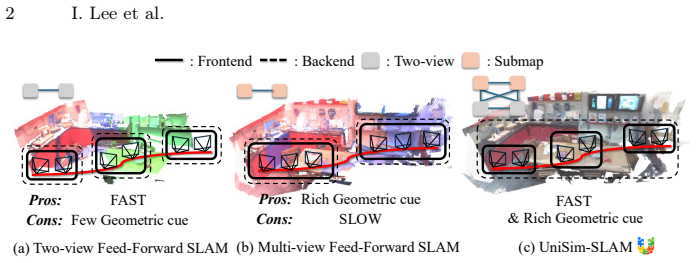
UniSim-SLAM claims that feed-forward SLAM can achieve both low-latency tracking and long-term consistency by jointly optimizing fast two-view odometry and periodic multi-view submaps in a single Sim(3) factor graph, delivering the best unca
Reviewed by Pith at T0; open to challenge. T0 means a machine referee read the full paper against a public rubric. the ladder, T0–T4 →
T0 review · deepseek-v4-flash
2026-08-04 22:29 UTC pith:HILJRV24
load-bearing objection A solid system paper with a genuinely useful idea—combining two-view tracking with multi-view submap refinement in one Sim(3) graph—but the formulation has two mechanical issues (initialization translation and conflicting scale residuals) and no code/data, so the mechanism needs to be fixed before the claimed gains are credible. the 3 major comments →
UniSim-SLAM: Feed-Forward SLAM with Unified Sim(3) Optimization
The pith
A machine-rendered reading of the paper's core claim, the machinery that carries it, and where it could break.
Core claim
The paper's central claim is that the geometry inconsistency and scale ambiguity of feed-forward predictions—caused by dependence on the input view set—can be resolved by treating each inference regime as a complementary constraint in a single optimization, rather than by aligning reconstructions afterwards. The method models global keyframe poses and submap poses jointly on Sim(3), with three edge types: temporal view-to-view edges that maintain connectivity and low latency; view-to-submap bridge edges that align submap-local predictions with the global trajectory and anchor scale using median depth ratios; and submap-to-submap tie and scale edges that keep overlapping submaps consistent. J
What carries the argument
Unified multi-level factor graph on Sim(3), the group of rotations, translations, and uniform scales. It contains global keyframe pose nodes and submap pose nodes, with three edge families: temporal view-to-view odometry edges; view-to-submap bridge edges plus depth-statistics scale anchors; and submap-to-submap tie and scale edges. This graph converts heterogeneous local predictions with inconsistent scales into a single similarity-consistent optimization, and the temporal edges let corrections propagate even between non-overlapping submaps.
Load-bearing premise
The gain depends on the backend's multi-view submap poses being accurate enough that bridge edges pull the global trajectory toward correct geometry; the paper's own ablation shows removing those bridge edges raises 7-Scenes error from 0.020 to 0.063 m.
What would settle it
Measure the submap-local poses against ground truth before global optimization: if they are no closer to ground truth than the chained two-view poses, then the bridge-edge correction cannot be the source of the improvement. A simpler version: add calibrated noise to backend submap predictions and show ATE degrades proportionally; the paper's scale-noise ablation already sketches this test.
If this is right
- Feed-forward SLAM systems can combine two-view and multi-view regimes in one pipeline, so accuracy no longer requires choosing between low latency and rich constraints.
- Scale drift on planar or texture-poor scenes, such as the TUM floor sequence, is substantially reduced through depth-statistics scale anchoring.
- The backend works with a different frontend model than the one that built submaps, so a low-latency tracker can be swapped in without losing most of the accuracy gain.
- Even without loop closure, the method remains competitive with prior full systems, indicating the graph structure itself supplies most of the global consistency.
- Dense reconstruction also improves on 7-Scenes in accuracy and Chamfer distance, not only trajectory error.
Where Pith is reading between the lines
- A testable consequence is that as multi-view foundation models improve, the same graph should transfer the gains almost directly to global trajectory accuracy, making submap prediction quality the key bottleneck.
- The depth-statistics scale anchor is a generic mechanism for fusing any two metric-less reconstructions; it could be applied to multi-agent SLAM or heterogeneous camera systems without modifying the graph.
- Because temporal edges preserve connectivity without submap overlap, the design should extend to long loop-free trajectories where overlap-based submap registration fails; this is an extension the paper only partially tests.
- Replacing the median depth-ratio scale with a learned scale head is a natural next step; the paper's noise experiments suggest scale errors feed directly into trajectory error, so such a head would need to beat the median baseline.
Editorial analysis
A structured set of objections, weighed in public.
Referee Report
Summary. UniSim-SLAM proposes a feed-forward SLAM system that combines a two-view keyframe tracking frontend with a multi-view submap refinement backend, and jointly optimizes both in a single Sim(3) factor graph. The graph contains temporal view-to-view edges, view-to-submap bridge and scale-anchoring edges, and submap-to-submap tie and scale edges. The paper reports state-of-the-art uncalibrated ATE on TUM RGB-D (0.032 m vs. 0.052 m for ViSTA-SLAM) and 7-Scenes (0.020 m vs. 0.037 m for VGGT-SLAM), with ablations and latency comparisons. The main claim is that this unified Sim(3) formulation resolves the efficiency-consistency trade-off of feed-forward SLAM.
Significance. If the reported numbers are correct, the paper demonstrates a practically meaningful improvement in uncalibrated feed-forward SLAM, especially on challenging sequences like TUM floor and 7-Scenes chess. The idea of jointly using two-view and multi-view predictions in a single optimization is timely, and the paper provides a fairly complete set of ablations, including a non-overlap regime and a heterogeneous frontend (Ours + STA). The supplementary adds Replica results and a weight sensitivity study. However, the central technical mechanism—the unified Sim(3) factor graph—contains algebraic inconsistencies in the residual definitions that need to be resolved before the claims are fully credible. The absence of code and data also limits verification. Overall, the empirical contribution is promising but the formulation, as written, is not yet sound.
major comments (3)
- [Section 3.4, Eqs. (10)-(11) and (12)-(13)] The scale constraints are mutually inconsistent. Since \hat{T}^{mv}_{mi} is stated to have scale component 1 (§3.3), the scale component of the bridge residual e_br in Eq. (10) is log(s_i/s_m); setting e_br=0 forces s_i=s_m. In contrast, Eq. (11) forces log s_i - log s_m = log s_rel, i.e. s_i = s_m·s_rel. For uncalibrated input, s_rel is generally not 1, so no configuration can satisfy both residuals. The same contradiction exists between the tie residual e_tie in Eq. (12), which forces s_m=s_n, and the submap scale residual e_sc in Eq. (13), which forces s_n=s_m·\hat{s}_mn. The optimization therefore amounts to a weighted compromise between incompatible constraints, with the weights (Supp. A: w_anch=w_sc=50, w_tie=0.2) deciding the outcome. This undermines the claim that the graph enforces 'consistent similarity relations'. Please either project scale out of the bridge/tie residuals, re
- [Section 3.3, Eq. (6)] The initialization of the submap pose does not satisfy the bridge relation (10). At the origin keyframe, \hat{T}^{mv}_{mi}=I, so Eq. (10) requires S_m ≈ T_i. Eq. (6) instead gives S_m^{(0)} = [(s_i/s_rel) R_i, t_i/s_rel], whereas T_i = [s_i R_i, t_i]. The translation and scale both differ from T_i. The text states that this initialization 'ensures that the submap origin aligns with the global pose of I_i', but the algebra shows that it does not. This discrepancy affects the interpretation of the optimization: the bridge residual starts at a nonzero value even at the origin keyframe, and the scale anchor then drives it further away. Please clarify the intended coordinate convention and correct the initialization or the residual definition so that they are mutually consistent.
- [Section 4.3, Tab. 4a] The text says that 'removing any individual constraint leads to a noticeable performance drop', but the reported ablations do not support this for the scale-anchoring residual e_anch. Under the default overlap φ=2, the 7-Scenes average ATE with e_anch removed is 0.020, identical to the full model (0.020). The same value appears in the extended ablation in Supp. Tab. A2. The only setting where e_anch changes the result is the non-overlap φ=0 row (0.083 vs. 0.032). Thus, the contribution of 'depth-statistics scale anchoring' in the default configuration is not demonstrated by the presented evidence. Please either reconcile the text with the table, or provide an additional analysis (e.g., a variant where e_anch is removed but e_br and other edges are kept) to substantiate the claimed role of this component.
minor comments (4)
- [General] No code, data, or project-page supplement with implementation details are provided beyond the PDF text. For a systems paper reporting SOTA numbers, this hampers reproducibility. Please release code/data or at least provide complete optimization details (covariances, robust loss parameters, convergence criteria) in the supplementary.
- [Tab. 4c] The reported frontend latency for Ours (197 ms) is described as 'low-latency', but it is much higher than ViSTA-SLAM (35 ms) and MASt3R-SLAM (90 ms). Consider clarifying that the latency advantage is relative to multi-view-only methods, and report the pose update rate or end-to-end latency including backend contributions.
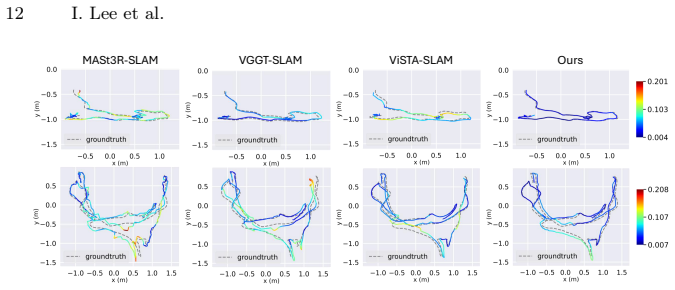
- [Section 4.2 / Fig. 4] The qualitative trajectory plots would benefit from a common axis scale and a clear legend. Currently it is difficult to visually compare the error magnitudes across methods.
- [Supp. Tab. A2] The notation 'w/o e_anch' and 'w/o e_sc' in the main ablation table is easily misread as 'with e_anch'. Please use an unambiguous notation (e.g., '− e_anch') in both the main text and supplementary.
Circularity Check
No significant circularity: the factor-graph constraints are built from external feed-forward measurements and the trajectory claims are benchmarked against outside baselines.
full rationale
The paper's central derivation is a factor graph whose residuals (Eqs. 9-13) are defined directly from feed-forward measurements (T^2v_ij, T^mv_mi, D^2v_i, D^mv_mi). There is no step that fits a parameter to the target ATE and then re-reports it as a prediction; the depth-statistics scale ratios in Eq. (11) and Eq. (13) are inputs to the estimator, not outputs claimed as discoveries. The ablations in Tab. 4a and Tab. A2 test removal of each edge against external benchmarks, so the contribution of each constraint is empirically falsifiable rather than tautological. No self-citation chain is load-bearing: the cited feed-forward models (VGGT, STA, MASt3R) are external systems used as black-box priors, and the factor-graph formulation is not justified by an author-imported uniqueness theorem. The evaluation uses Sim(3)-aligned ATE on TUM RGB-D and 7-Scenes, which is independent of the paper's chosen weights (w_anch=50, w_sc=50, w_tie=0.2). There is an algebraic tension between the scale component of the bridge residual (Eq. 10, which pushes s_i = s_m) and the anchor residual (Eq. 11, which pushes s_i = s_m * s_rel), and a related tension between the tie residual (Eq. 12) and the submap scale residual (Eq. 13); this makes the graph over-constrained and is a correctness/robustness concern, not a circular reduction of the output to the input. The depth-ratio scale anchors are ordinary measurements derived from the same model's depth predictions, and using them as constraints does not make the trajectory prediction equivalent to its inputs by construction. Overall, the paper is self-contained against external benchmarks and no circular step is exhibited.
Axiom & Free-Parameter Ledger
free parameters (2)
- factor graph residual weights (w2v, wbr, wanch, wsc, wtie) =
(1.0, 1.0, 50.0, 50.0, 0.2)
- submap size w, overlap phi, keyframe strides =
w=16, phi=2, stride 5 (7-Scenes) and 3 (TUM RGB-D)
axioms (4)
- domain assumption The feed-forward models (VGGT, STA) provide reliable two-view relative poses and depth maps (Eq. 1).
- domain assumption The multi-view model returns internally consistent submap-local poses used as anchor measurements in bridge residuals (Eq. 10).
- ad hoc to paper The median per-pixel depth ratio median(D_mv/D_2v) is an unbiased estimate of the relative scale between two-view and multi-view coordinate frames (Eqs. 6, 11).
- standard math Sim(3) manifold optimization with Levenberg-Marquardt converges to a useful local minimum for this factor graph.
Cite this review
Pith. "Pith review of UniSim-SLAM: Feed-Forward SLAM with Unified Sim(3) Optimization." pith.science (2026). https://pith.science/paper/HILJRV24
@misc{pith2026260801706,
  author       = {Pith},
  title        = {Pith review of: UniSim-SLAM: Feed-Forward SLAM with Unified Sim(3) Optimization},
  year         = {2026},
  howpublished = {\url{https://pith.science/paper/HILJRV24}},
  note         = {Machine review of arXiv:2608.01706}
}
read the original abstract
Recent geometric foundation models enable feed-forward inference for SLAM, but their predictions are strongly dependent on the input view set, which leads to geometric inconsistencies and trajectory drift when results are chained over long sequences. Online deployment further exposes a trade-off between the low latency of two-view tracking and the constraint richness of multi-view inference. We introduce UniSim-SLAM, an integrated system that runs lightweight two-view keyframe tracking in the frontend and performs periodic multi-view submap refinement in the backend. To combine predictions defined in heterogeneous local coordinates with inconsistent scales, we formulate a unified multi-level factor graph on $Sim(3)$ that jointly optimizes global keyframe poses and submap poses. The graph integrates temporal view-to-view odometry edges, view-to-submap bridge edges with depth-statistics scale anchoring, and submap-to-submap tie and scale constraints to enforce consistent similarity relations across submaps. Experiments on TUM RGB-D and 7-Scenes show that UniSim-SLAM achieves state-of-the-art accuracy in the uncalibrated setting, reducing trajectory error by $38.5\% $ on TUM RGB-D and $45.9\%$ on 7-Scenes compared to prior best results. Project page: https://vision3d-lab.github.io/unisim-slam/
Figures



Reference graph
Works this paper leans on
-
[1]
Communications of the ACM54(10), 105–112 (2011)
Agarwal, S., Furukawa, Y., Snavely, N., Simon, I., Curless, B., Seitz, S.M., Szeliski, R.: Building rome in a day. Communications of the ACM54(10), 105–112 (2011)
2011
-
[3]
Campos, C., Elvira, R., Rodríguez, J.J.G., M. Montiel, J.M., D. Tardós, J.: ORB- SLAM3: An accurate open-source library for visual, visual–inertial, and multimap slam. IEEE Trans. Robot.37(6), 1874–1890 (2021).https://doi.org/10.1109/ TRO.2021.3075644
-
[4]
Czarnowski, J., Laidlow, T., Clark, R., Davison, A.J.: Deepfactors: Real-time prob- abilistic dense monocular slam. IEEE Robot. Autom. Lett.5(2), 721–728 (2020). https://doi.org/10.1109/LRA.2020.2965415
-
[5]
arXiv preprint arXiv:2507.16443 (2025)
Deng, K., Ti, Z., Xu, J., Yang, J., Xie, J.: VGGT-Long: Chunk it, loop it, align it–pushing vggt’s limits on kilometer-scale long rgb sequences. arXiv preprint arXiv:2507.16443 (2025)
Pith/arXiv arXiv 2025
-
[8]
Engel, J., Koltun, V., Cremers, D.: Direct sparse odometry. IEEE Trans. Pattern Anal. Mach. Intell.40(3), 611–625 (2018).https://doi.org/10.1109/TPAMI. 2017.2658577
-
[9]
Engel, J., Schöps, T., Cremers, D.: LSD-SLAM: Large-scale direct monocular slam. In: Eur. Conf. Comput. Vis. pp. 834–849. Springer (2014)
work page 2014
- [10]
-
[11]
Izquierdo, S., Civera, J.: Optimal Transport Aggregation for Visual Place Recog- nition. In: Proceedings of the IEEE/CVF Conference on Computer Vision and Pattern Recognition (CVPR) (June 2024)
work page 2024
-
[12]
Karaev, N., Rocco, I., Graham, B., Neverova, N., Vedaldi, A., Rupprecht, C.: Cotracker: It is better to track together. In: Eur. Conf. Comput. Vis. pp. 18–35. Springer (2024)
work page 2024
-
[13]
Keetha, N., Müller, N., Schönberger, J., Porzi, L., Zhang, Y., Fischer, T., Knapitsch, A., Zauss, D., Weber, E., Antunes, N., et al.: Mapanything: Universal feed-forward metric 3d reconstruction; map-anything. github. io. In: 2026 Interna- tional Conference on 3D Vision (3DV). pp. 499–509. IEEE (2026)
work page 2026
-
[14]
ACM Transactions on Graphics42(4) (July 2023),https://repo-sam.inria.fr/fungraph/3d-gaussian-splatting/
Kerbl, B., Kopanas, G., Leimkühler, T., Drettakis, G.: 3d gaussian splatting for real-time radiance field rendering. ACM Transactions on Graphics42(4) (July 2023),https://repo-sam.inria.fr/fungraph/3d-gaussian-splatting/
2023
-
[15]
Kneip, L., Scaramuzza, D., Siegwart, R.: A novel parametrization of the perspective-three-point problem for a direct computation of absolute camera posi- tion and orientation. In: IEEE Conf. Comput. Vis. Pattern Recog. pp. 2969–2976 (2011).https://doi.org/10.1109/CVPR.2011.5995464
-
[16]
Lepetit, V., Moreno-Noguer, F., Fua, P.: Ep n p: An accurate o (n) solution to the p n p problem. Int. J. Comput. Vis.81(2), 155–166 (2009)
work page 2009
-
[17]
Leroy, V., Cabon, Y., Revaud, J.: Grounding image matching in 3d with mast3r. In: Eur. Conf. Comput. Vis. pp. 71–91. Springer (2024)
work page 2024
-
[18]
Lin, H., Chen, S., Liew, J.H., Chen, D.Y., Li, Z., Zhao, Y., Peng, S., Guo, H., Zhou, X., Shi, G., Feng, J., Kang, B.: Depth anything 3: Recovering the visual space from any views. In: Int. Conf. Learn. Represent. (2026),https://openreview. net/forum?id=yirunib8l8
work page 2026
-
[19]
Lipson, L., Teed, Z., Deng, J.: Deep patch visual slam. In: Eur. Conf. Comput. Vis. pp. 424–440. Springer (2024)
work page 2024
-
[20]
Liu, S., Gao, Y., Zhang, T., Pautrat, R., Schönberger, J.L., Larsson, V., Pollefeys, M.: Robust incremental structure-from-motion with hybrid features. In: Eur. Conf. Comput. Vis. pp. 249–269. Springer (2024)
work page 2024
-
[22]
Maggio, D., Lim, H., Carlone, L.: VGGT-SLAM: Dense rgb slam optimized on the sl (4) manifold. Adv. Neural Inform. Process. Syst.38(2025)
work page 2025
-
[24]
Mur-Artal, R., Montiel, J.M.M., Tardós, J.D.: Orb-slam: A versatile and accurate monocular slam system. IEEE Trans. Robot.31(5), 1147–1163 (2015).https: //doi.org/10.1109/TRO.2015.2463671
-
[25]
Mur-Artal,R.,Tardós,J.D.:ORB-SLAM2:Anopen-sourceslamsystemformonoc- ular, stereo, and rgb-d cameras. IEEE Trans. Robot.33(5), 1255–1262 (2017). https://doi.org/10.1109/TRO.2017.2705103
-
[27]
Oquab, M., Darcet, T., Moutakanni, T., Vo, H.V., Szafraniec, M., Khalidov, V., Fernandez, P., HAZIZA, D., Massa, F., El-Nouby, A., Assran, M., Ballas, N., UniSim-SLAM 17 Galuba, W., Howes, R., Huang, P.Y., Li, S.W., Misra, I., Rabbat, M., Sharma, V., Synnaeve, G., Xu, H., Jegou, H., Mairal, J., Labatut, P., Joulin, A., Bojanowski, P.: DINOv2: Learning rob...
work page 2024
-
[28]
Rosinol, A., Abate, M., Chang, Y., Carlone, L.: Kimera: an open-source library for real-time metric-semantic localization and mapping. In: IEEE Int. Conf. Robot. Autom. pp. 1689–1696 (2020).https://doi.org/10.1109/ICRA40945.2020. 9196885
arXiv 2020
-
[29]
Schönberger, J.L., Frahm, J.M.: Structure-from-motion revisited. In: IEEE Conf. Comput. Vis. Pattern Recog. pp. 4104–4113 (2016).https://doi.org/10.1109/ CVPR.2016.445
work page 2016
-
[30]
Shotton, J., Glocker, B., Zach, C., Izadi, S., Criminisi, A., Fitzgibbon, A.: Scene coordinate regression forests for camera relocalization in rgb-d images. In: IEEE Conf. Comput. Vis. Pattern Recog. pp. 2930–2937 (2013).https://doi.org/10. 1109/CVPR.2013.377
work page 2013
-
[31]
arXiv preprint arXiv:2408.13912 (2024)
Smart, B., Zheng, C., Laina, I., Prisacariu, V.A.: Splatt3r: Zero-shot gaussian splatting from uncalibrated image pairs. arXiv preprint arXiv:2408.13912 (2024)
Pith/arXiv arXiv 2024
-
[32]
arXiv preprint arXiv:1906.05797 (2019)
Straub, J., Whelan, T., Ma, L., Chen, Y., Wijmans, E., Green, S., Engel, J.J., Mur- Artal, R., Ren, C., Verma, S., Clarkson, A., Yan, M., Budge, B., Yan, Y., Pan, X., Yon, J., Zou, Y., Leon, K., Carter, N., Briales, J., Gillingham, T., Mueggler, E., Pesqueira, L., Savva, M., Batra, D., Strasdat, H.M., Nardi, R.D., Goesele, M., Lovegrove, S., Newcombe, R.:...
Pith/arXiv arXiv 1906
-
[33]
Sturm, J., Engelhard, N., Endres, F., Burgard, W., Cremers, D.: A benchmark for the evaluation of rgb-d slam systems. In: IEEE/RSJ Int. Conf. Intell. Robots Syst. pp. 573–580 (2012).https://doi.org/10.1109/IROS.2012.6385773
arXiv 2012
-
[34]
Sucar, E., Liu, S., Ortiz, J., Davison, A.J.: iMAP: Implicit mapping and positioning in real-time. In: Int. Conf. Comput. Vis. pp. 6209–6218 (2021).https://doi.org/ 10.1109/ICCV48922.2021.00617
arXiv 2021
-
[35]
Teed, Z., Deng, J.: Deepv2d: Video to depth with differentiable structure from motion (2020)
work page 2020
-
[36]
Teed, Z., Deng, J.: Droid-slam: Deep visual slam for monocular, stereo, and rgb-d cameras34, 16558–16569 (2021)
work page 2021
-
[37]
Vision Algorithms: Theory and Practice pp
Triggs, B., McLauchlan, P., Hartley, R., Fitzgibbon, A.: Bundle adjustment—a modern synthesis. Vision Algorithms: Theory and Practice pp. 153–177 (2000)
work page 2000
-
[38]
Wang, H., Agapito, L.: 3d reconstruction with spatial memory. In: Int. Conf. 3D Vis. pp. 78–89 (2025).https://doi.org/10.1109/3DV66043.2025.00013
arXiv 2025
-
[42]
Wang, Y., Zhou, J., Zhu, H., Chang, W., Zhou, Y., Li, Z., Chen, J., Pang, J., Shen, C., He, T.:π 3: Permutation-equivariant visual geometry learning. In: Int. Conf. Learn. Represent. (2026),https://openreview.net/forum?id=DTQIjngDta 18 I. Lee et al
work page 2026
-
[43]
Wen, B., Trepte, M., Aribido, J., Kautz, J., Gallo, O., Birchfield, S.: Foundation- stereo: Zero-shot stereo matching. In: IEEE Conf. Comput. Vis. Pattern Recog. pp. 5249–5260 (2025).https://doi.org/10.1109/CVPR52734.2025.00495
arXiv 2025
-
[44]
Yan, C., Qu, D., Xu, D., Zhao, B., Wang, Z., Wang, D., Li, X.: GS-SLAM: Dense visualslamwith3dgaussiansplatting.In:IEEEConf.Comput.Vis.PatternRecog. pp. 19595–19604 (2024).https://doi.org/10.1109/CVPR52733.2024.01853
arXiv 2024
-
[45]
Yang, L., Kang, B., Huang, Z., Xu, X., Feng, J., Zhao, H.: Depth anything: Un- leashing the power of large-scale unlabeled data. In: IEEE Conf. Comput. Vis. Pattern Recog. pp. 10371–10381 (2024).https://doi.org/10.1109/CVPR52733. 2024.00987
-
[46]
Yang, L., Kang, B., Huang, Z., Zhao, Z., Xu, X., Feng, J., Zhao, H.: Depth anything v2. Adv. Neural Inform. Process. Syst.37, 21875–21911 (2024)
work page 2024
-
[47]
Zhang, G., Qian, S., Wang, X., Cremers, D.: ViSTA-SLAM: Visual SLAM with symmetric two-view association. In: Int. Conf. 3D Vis. pp. 396–406 (2026).https: //doi.org/10.1109/3DV69130.2026.00044
arXiv 2026
-
[48]
arXiv preprint arXiv:2403.19549 (2024)
Zhang, G., Sandström, E., Zhang, Y., Patel, M., Van Gool, L., Oswald, M.R.: Glorie-slam: Globally optimized rgb-only implicit encoding point cloud slam. arXiv preprint arXiv:2403.19549 (2024)
Pith/arXiv arXiv 2024
-
[49]
Zhang, Y., Tosi, F., Mattoccia, S., Poggi, M.: GO-SLAM: Global Optimization for Consistent 3d Instant Reconstruction. In: Int. Conf. Comput. Vis. pp. 3704–3714 (2023).https://doi.org/10.1109/ICCV51070.2023.00345
arXiv 2023
-
[50]
Zhu, Z., Peng, S., Larsson, V., Cui, Z., Oswald, M.R., Geiger, A., Pollefeys, M.: NICER-SLAM: Neural implicit scene encoding for rgb slam. In: Int. Conf. 3D Vis. pp. 42–52 (2024).https://doi.org/10.1109/3DV62453.2024.00096 UniSim-SLAM 1 UniSim-SLAM: Feed-Forward SLAM with UnifiedSim(3)Optimization Supplementary Material Overview The supplementary material...
arXiv 2024
discussion (0)
Sign in with ORCID, Apple, or X to comment. Anyone can read and Pith papers without signing in.