Efficient calculation of two-neutrino double-beta-decay nuclear matrix elements
Pith reviewed 2026-06-29 02:01 UTC · model grok-4.3
The pith
Lanczos-based strength functions enable efficient computation of two-neutrino double-beta decay nuclear matrix elements without full diagonalization.
A machine-rendered reading of the paper's core claim, the machinery that carries it, and where it could break.
Core claim
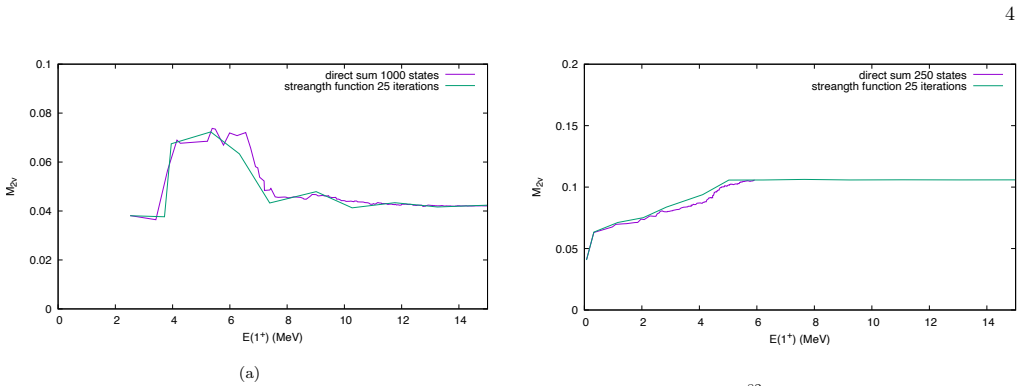
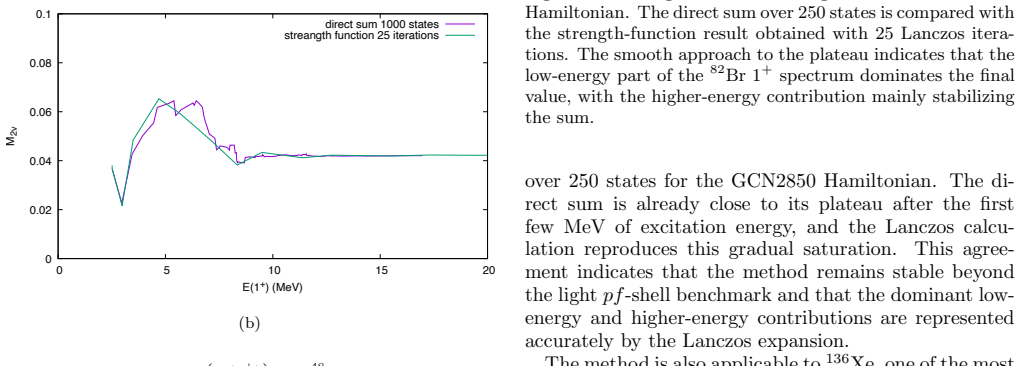
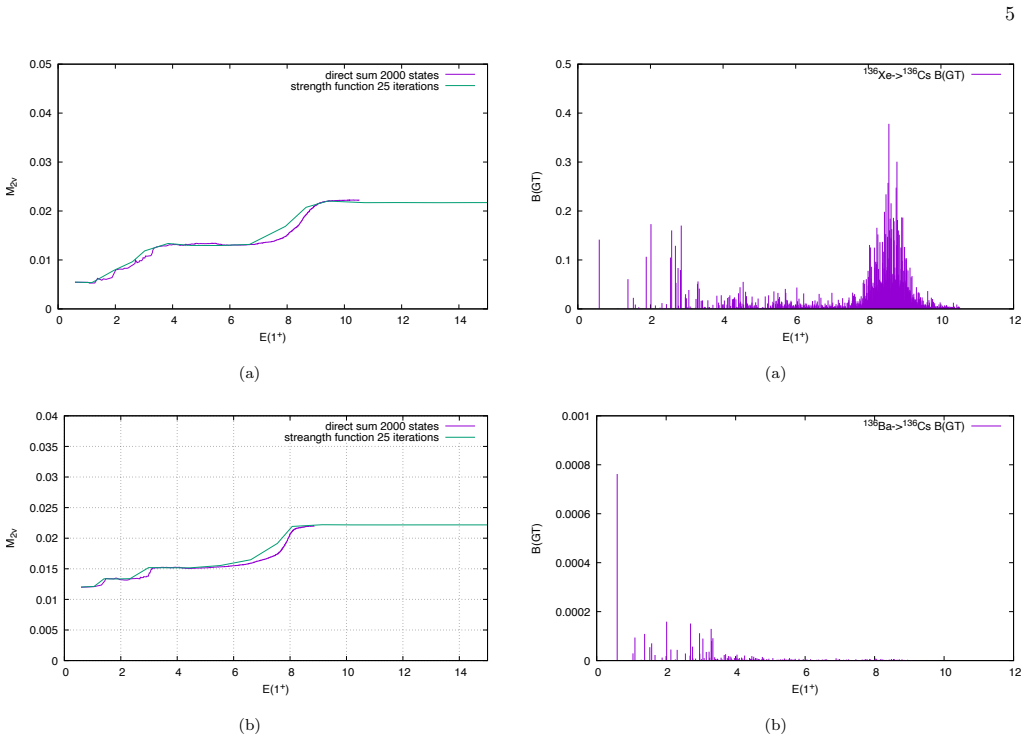
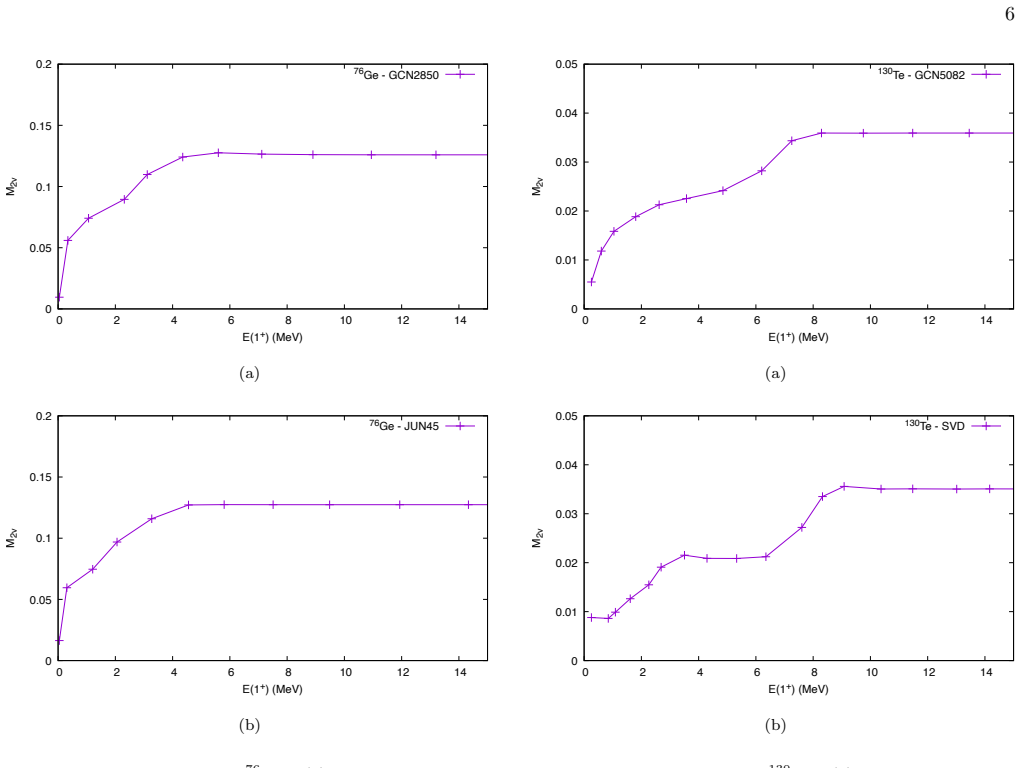
The central discovery is an improved strength-function method based on Lanczos iterations for two-neutrino double-beta-decay nuclear matrix elements. It avoids full diagonalization of the intermediate odd-odd nucleus while preserving the accuracy of explicit summation over 1+ states where benchmarks are possible. The method applies to several experimentally important emitters using different effective Hamiltonians and extends to higher-order NMEs for Taylor-expanded phase-space treatments.
What carries the argument
Lanczos iterations to generate the strength function approximating the sum over intermediate 1+ states in the odd-odd nucleus.
If this is right
- Calculations become feasible in larger model spaces for 2νββ NMEs.
- The same framework handles higher-order NMEs for 2νββ phase-space treatments.
- Results can inform assessments of 0νββ NMEs due to their indicated correlation with 2νββ values.
- The approach works across multiple experimentally important emitters and different effective Hamiltonians.
Where Pith is reading between the lines
- This could reduce computational barriers for exploring larger valence spaces in shell-model calculations of double-beta decay.
- The approach might generalize to other weak processes involving sums over intermediate states.
- If accurate, it supports using 2νββ data to constrain models for 0νββ predictions.
Load-bearing premise
The strength function obtained from Lanczos iterations converges to the exact sum over all 1+ intermediate states with only controllable truncation error.
What would settle it
Performing a full diagonalization in a small model space for a nucleus where the Lanczos method gives a different NME value would falsify the preservation of accuracy.
Figures
read the original abstract
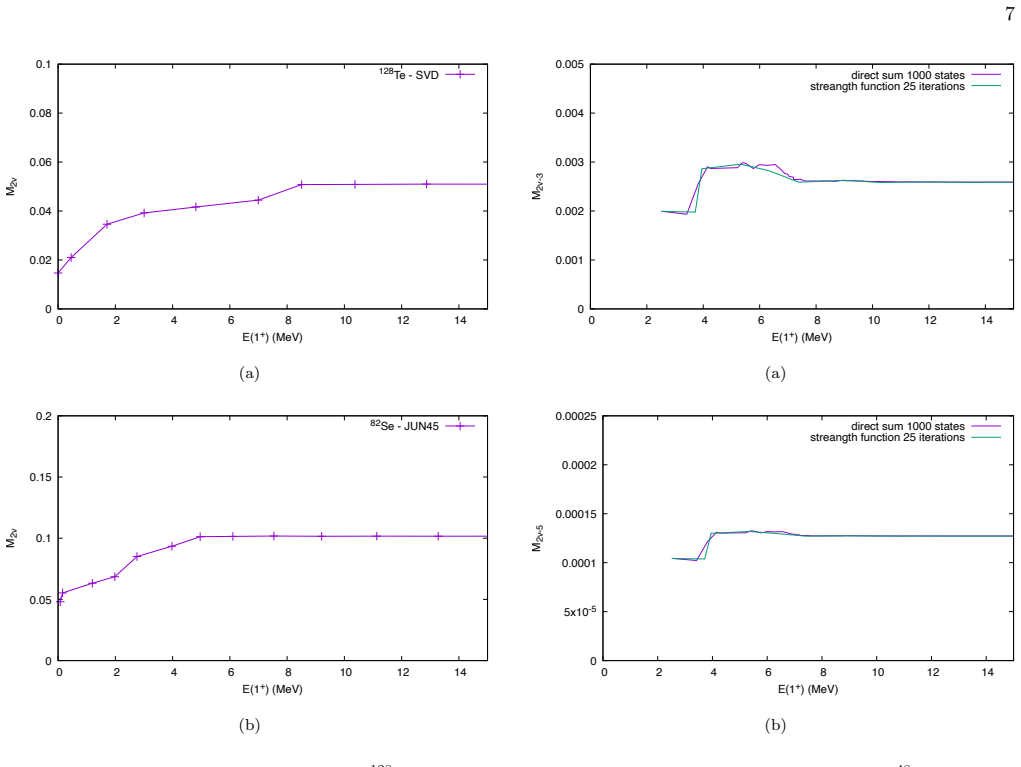
Reliable nuclear matrix elements (NMEs) are essential for interpreting double-beta-decay experiments and for connecting measured or constrained half-lives to the underlying weak-interaction physics. The two-neutrino mode ($2\nu\beta\beta$) is allowed by the Standard Model and has been observed in several nuclei, whereas the neutrinoless mode ($0\nu\beta\beta$) remains the key experimental signature of lepton-number violation and Majorana neutrino masses. Recent statistical shell-model studies indicate a strong correlation between the $2\nu\beta\beta$ and $0\nu\beta\beta$ NMEs, making accurate and efficient calculations of the former especially useful for assessing the latter. Direct evaluations of $2\nu\beta\beta$ NMEs usually require summing over many $1^+$ states in the intermediate odd-odd nucleus, a procedure that becomes expensive and may converge slowly in large model spaces. We present and test an improved strength-function method based on Lanczos iterations that avoids full diagonalization while preserving the accuracy of explicit summation where such benchmarks are possible. The method is applied to several experimentally important emitters and to different effective Hamiltonians. We also show that the same framework can be used for the higher-order NMEs entering Taylor-expanded phase-space treatments of $2\nu\beta\beta$ and related decay modes.
Editorial analysis
A structured set of objections, weighed in public.
Referee Report
Summary. The manuscript presents and tests an improved strength-function method based on Lanczos iterations for computing two-neutrino double-beta-decay (2νββ) nuclear matrix elements (NMEs). The approach avoids full diagonalization of the intermediate odd-odd nucleus Hamiltonian while claiming to preserve the accuracy of explicit summation over intermediate 1+ states wherever such benchmarks are computationally feasible. The method is applied to several experimentally relevant emitters using different effective Hamiltonians and is extended to higher-order NMEs relevant for Taylor-expanded phase-space treatments of 2νββ and related modes.
Significance. If the central claim of accuracy preservation holds with controllable truncation error, the work would provide a practically useful numerical tool for 2νββ NME calculations in large model spaces. This is relevant because recent statistical shell-model studies indicate correlations between 2νββ and 0νββ NMEs, and efficient 2νββ computations can help constrain interpretations of double-beta-decay experiments. The method builds on a standard, well-studied Lanczos technique for resolvent evaluation rather than introducing new ad-hoc parameters or entities, and the explicit limitation of the accuracy claim to benchmarkable cases is appropriately cautious.
minor comments (2)
- [Abstract] Abstract: the assertion that accuracy is preserved 'where such benchmarks are possible' would be strengthened by including at least one quantitative comparison (e.g., explicit-sum vs. Lanczos NME values and convergence metrics) already in the abstract or a dedicated early results paragraph.
- The manuscript should specify the Lanczos iteration count or Krylov-subspace dimension used for each nucleus/Hamiltonian and report the associated truncation error estimate relative to the explicit sum, even if only for the benchmark cases.
Simulated Author's Rebuttal
We thank the referee for the constructive and positive assessment of our manuscript. The recommendation for minor revision is noted, and we are happy to incorporate any specific suggestions. No major comments were listed in the report, so we have no points requiring detailed rebuttal at this stage.
Circularity Check
No significant circularity
full rationale
The paper describes a Lanczos-based strength-function method for 2νββ NMEs that is validated by direct comparison to explicit summation over 1+ states on the same nuclei and Hamiltonians where the latter is feasible. This is a standard numerical convergence test for resolvent techniques and does not reduce any reported result to a fitted parameter, self-definition, or self-citation chain. The abstract and skeptic analysis give no equations or claims that equate a prediction to its own input by construction, so the derivation chain remains independent of the target quantities.
Axiom & Free-Parameter Ledger
axioms (1)
- domain assumption The nuclear shell model with effective Hamiltonians provides a sufficiently accurate description of the low-lying states relevant to 2νββ decay in the nuclei considered.
Reference graph
Works this paper leans on
-
[1]
F. T. Avignone, III, S. R. Elliott, and J. Engel, Rev. Mod. Phys.80, 481 (2008)
2008
-
[2]
J. D. Vergados, H. Ejiri, and F. Simkovic, Rep. Prog. Phys.75, 106301 (2012)
2012
-
[3]
M. Doi, T. Kotani, H. Nishiura, and E. Takasugi, Progr. Theor. Exp. Phys.69, 602 (1983)
1983
-
[4]
M. Doi, T. Kotani, and E. Takasugi, Prog. Theor. Phys. Suppl.83, 1 (1985)
1985
-
[5]
Suhonen and O
J. Suhonen and O. Civitarese, Phys. Rep.300, 123 (1998)
1998
-
[6]
Kotila and F
J. Kotila and F. Iachello, Phys. Rev. C85, 034316 (2012)
2012
-
[7]
Stoica and M
S. Stoica and M. Mirea, Phys. Rev. C88, 037303 (2013)
2013
-
[8]
Engel and J
J. Engel and J. Men´ endez, Reports on Progress in Physics 80, 046301 (2017)
2017
-
[9]
C. Adams, K. Alfonso, C. Andreoiu, E. Angelico, I. J. Arnquist, J. A. A. Asaadi, F. T. Avignone, S. N. Axani, A. S. Barabash, P. S. Barbeau, L. Baudis, F. Bellini, M. Beretta, T. Bhatta, V. Biancacci, M. Biassoni, E. Bossio, P. A. Breur, J. P. Brodsky, C. Brofferio, E. Brown, R. Brugnera, T. Brunner, N. Burlac, E. Ca- den, S. Calgaro, G. F. Cao, L. Cao, C...
-
[10]
Rodejohann, J
W. Rodejohann, J. Phys. G39, 124008 (2012)
2012
-
[11]
F. F. Deppisch, M. Hirsch, and H. Pas, J. Phys. G39, 124007 (2012)
2012
-
[12]
Horoi and A
M. Horoi and A. Neacsu, Phys. Rev. C98, 035502 (2018)
2018
-
[13]
Caurier, A
E. Caurier, A. Poves, and A. P. Zuker, Phys. Lett. B252, 13 (1990)
1990
-
[14]
Caurier, G
E. Caurier, G. Martinez-Pinedo, F. Nowacki, A. Poves, and A. P. Zuker, Rev. Mod. Phys.77, 427 (2005)
2005
-
[15]
Horoi, S
M. Horoi, S. Stoica, and B. A. Brown, Phys. Rev. C75, 034303 (2007)
2007
-
[16]
Simkovic, G
F. Simkovic, G. Pantis, J. D. Vergados, and A. Faessler, Phys. Rev. C60, 055502 (1999)
1999
-
[17]
Barea and F
J. Barea and F. Iachello, Phys. Rev. C79, 044301 (2009)
2009
-
[18]
T. R. Rodriguez and G. Martinez-Pinedo, Phys. Rev. Lett.105, 252503 (2010)
2010
-
[19]
J. M. Yao, B. Bally, J. Engel, R. Wirth, T. R. Rodr´ ıguez, and H. Hergert, Phys. Rev. Lett.124, 232501 (2020)
2020
-
[20]
Novario, P
S. Novario, P. Gysbers, J. Engel, G. Hagen, G. R. Jansen, T. D. Morris, P. Navr´ atil, T. Papenbrock, and S. Quaglioni, Phys. Rev. Lett.126, 182502 (2021)
2021
-
[21]
Belley, C
A. Belley, C. G. Payne, S. R. Stroberg, T. Miyagi, and J. D. Holt, Phys. Rev. Lett.126, 042502 (2021)
2021
-
[22]
Patel, P
D. Patel, P. C. Srivastava, and J. Suhonen, Phys. Rev. C 110, 054323 (2024)
2024
-
[23]
Horoi, A
M. Horoi, A. Neacsu, and S. Stoica, Phys. Rev. C106, 054302 (2022)
2022
-
[24]
Engel, H
J. Engel, H. Haxton, , and P. Vogel, Phys. Rev. C46, 2153(R) (1992)
1992
-
[25]
Horoi, Physics4, 1135 (2022)
M. Horoi, Physics4, 1135 (2022)
2022
-
[26]
Nit ¸escu, S
O. Nit ¸escu, S. Ghinescu, V. A. Sevestrean, M. Horoi, F. ˇSimkovic, and S. Stoica, Journal of Physics G: Nuclear and Particle Physics51, 125103 (2024)
2024
-
[27]
Barabash, UNIVERSE6, 159 (2020)
A. Barabash, UNIVERSE6, 159 (2020)
2020
-
[28]
Tomoda, Rep
T. Tomoda, Rep. Prog. Phys.54, 53 (1991)
1991
-
[29]
NuShellX@MSU,https://people.nscl.msu.edu/ ~brown/resources/resources.html(2017)
2017
-
[30]
Neacsu and M
A. Neacsu and M. Horoi, Phys. Rev. C91, 024309 (2015)
2015
-
[31]
Horoi and A
M. Horoi and A. Neacsu, Phys. Rev. C93, 024308 (2016)
2016
-
[32]
R. A. Sen’kov, M. Horoi, and B. A. Brown, Phys. Rev. C89, 054304 (2014)
2014
-
[33]
R. A. Sen’kov and M. Horoi, Phys. Rev. C93, 044334 (2016)
2016
-
[34]
Honma, T
M. Honma, T. Otsuka, B. A. Brown, and T. Mizusaki, Phys. Rev. C69, 034335 (2004)
2004
-
[35]
Honma, T
M. Honma, T. Otsuka, B. A. Brown, and T. Mizusaki, 9 Eur. Phys. J. A25 Suppl. 1, 499 (2005)
2005
-
[36]
Poves, J
A. Poves, J. S´ anchez-Solano, E. Caurier, and F. Nowacki, Nuclear Physics A694, 157 (2001)
2001
-
[37]
Honma, T
M. Honma, T. Otsuka, T. Mizusaki, and M. Hjorth- Jensen, Phys. Rev. C80, 064323 (2009)
2009
-
[38]
Menendez, A
J. Menendez, A. Poves, E. Caurier, and F. Nowacki, Nucl. Phys. A818, 139 (2009)
2009
-
[39]
Caurier, F
E. Caurier, F. Nowacki, A. Poves, and K. Sieja, Phys. Rev. C82, 064304 (2010)
2010
-
[40]
Qi and Z
C. Qi and Z. X. Xu, Phys. Rev. C86, 044323 (2012)
2012
discussion (0)
Sign in with ORCID, Apple, or X to comment. Anyone can read and Pith papers without signing in.