REVIEW 4 major objections 6 minor 34 references
Evolutionary Gait Reconfiguration in Damaged Legged Robots
T0 review · 4 major / 6 minor · reviewed 2026-08-15 · deepseek-v4-flash
Pith's one-line read A hexapod robot that loses one or two legs can regain forward walking within an hour by switching to a statically stable gait and tuning 14 leg-trajectory parameters with differential evolution, entirely offline.
desk verdict Real hardware validation of a two-stage evolutionary gait recovery pipeline, but the printed gait sequence algorithm has a load-bearing bug that breaks the paper's own stability rationale. read the letter →
The pith
A machine-rendered reading of the paper's core claim, the machinery that carries it, and where it could break.
The reading
What carries the argument
The load-bearing machinery is the pair formed by the morphology vector $X$ and the faster-than-real-time simulator developed in [27], [28]: $X$ tells the planner which legs remain and therefore which canonical gait satisfies the three-support-leg stability condition, while the modular, closed-form dynamic model, written in a body-coordinate Lagrangian formulation, lets the differential-evolution optimizer evaluate each candidate entirely offline, eliminating trial-and-error on the damaged robot. The optimizer uses classic differential evolution [33] with a current-to-best mutation and binomial crossover, operating on the 14-dimensional trajectory parameter vector, with inverse kinematics from [35] converting tip trajectories into joint commands and a joint-space PID controller tracking them. The objective function in (5) is the scoring rule that couples all of these pieces.
What would settle it
Run the described algorithm on a 24-DoF hexapod with one leg removed; if the best offline-evaluated parameter set fails to keep the robot walking for a ten-second trial, or if the realized yaw exceeds the roughly 20-degree rotation observed in the paper's hardware tests, the transfer claim is contradicted.
Extended reading notes
Core claim
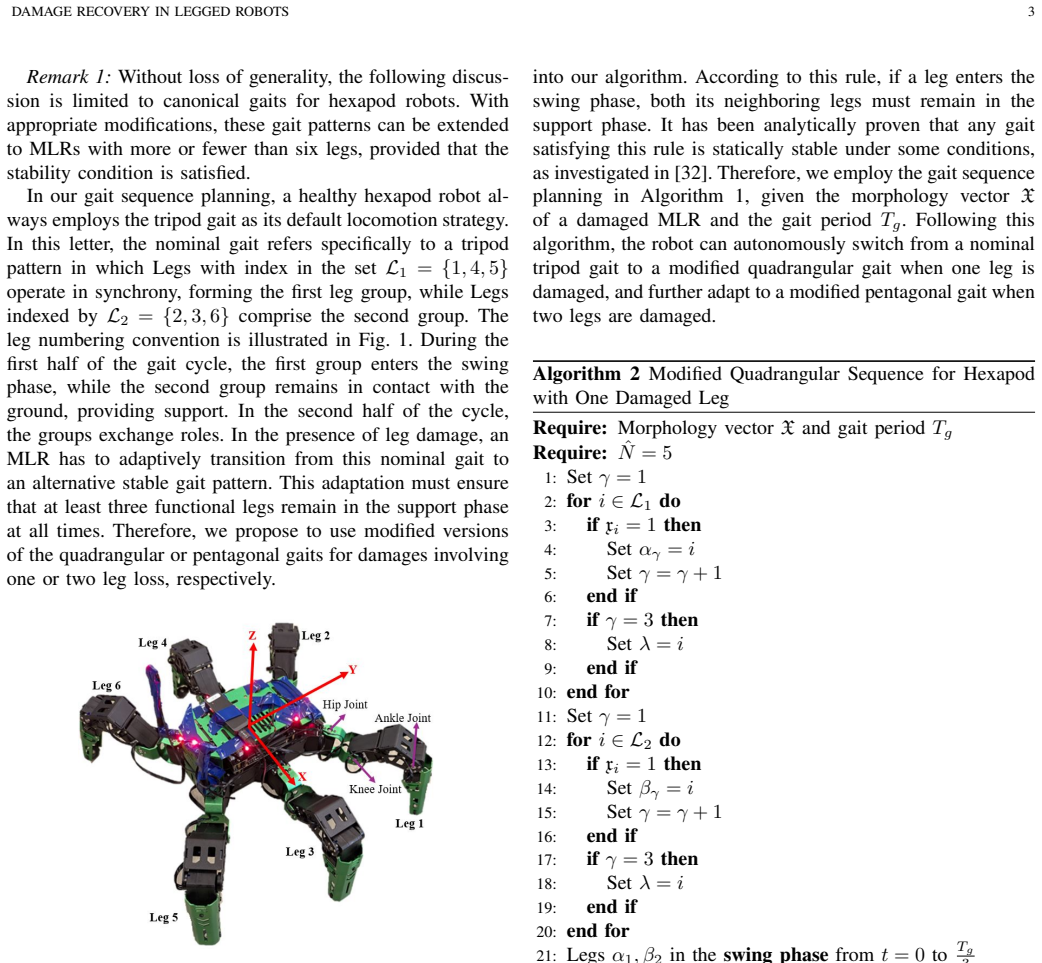
The paper's central claim is that leg damage in a multi-legged robot can be encoded as a binary morphology vector $X$, and that this vector alone is enough to select both a new gait sequence and a feasible search space for trajectory reconfiguration. For a hexapod, the healthy tripod gait is replaced by a modified quadrangular gait when one leg is lost and by a modified pentagonal gait when two are lost; the rule of neighborhood guarantees static stability. Differential evolution then optimizes the per-leg trajectory offsets $x_{0i}$, $y_{0i}$ together with global step length $L_{sl}$ and step height $L_{sh}$, scored by $$F = \frac{w_1 $y_f^{2}$}{1 + w_2 $x_f^{2}$ + w_3 \$psi_f^{2}$ + w_4 \$\Delta$\$phi^{2}$ + w_5 \$\Delta$\$theta^{2}$},$$ which rewards forward travel and punishes lateral drift, yaw, and roll/pitch oscillation. In all tested scenarios the objective converged within about 30 generations, and the best simulated parameter set restored straight walking on the physical robot with lateral drift and yaw kept within roughly 20 degrees.
Load-bearing premise
The entire recovery depends on the faster-than-real-time simulator being faithful enough that the best simulated gait transfers to the physical robot without trial-and-error; the paper's own hardware tests show real-world translation and yaw deviate from simulation, so that fidelity is only partly demonstrated.
Editorial extensions
If this is right
- A hexapod with five intact legs switches to a modified quadrangular gait; one with four intact legs switches to a modified pentagonal gait; both are statically stable under the rule of neighborhood.
- Convergence within roughly 30 generations with population size 30 implies the full recovery search fits inside one hour even on the robot's onboard class of computer.
- Because every candidate is evaluated in simulation, the approach avoids further wear or damage from testing unstable candidate gaits on the injured robot.
- The same objective function with the same weights serves all four damage scenarios, so no per-scenario tuning of the recovery objective is needed.
- Recovery requires at least two functional legs per side; with fewer, the planner returns an error rather than a gait.
Reading between the lines
- Editorial: the two-stage decomposition suggests a general template—rule-based gait selection for the discrete structure, continuous optimization for the trajectory parameters—that could transfer to quadrupeds or eight-legged robots, but the paper only demonstrates hexapods.
- Editorial: the reported simulation-to-reality gaps in translation and yaw, attributed to simplified friction and joint saturation, imply that a closed-loop correction step after transfer might close the gap; the paper leaves this to future work.
- Editorial: the binary morphology vector treats a damaged leg as fully detached; extending the same scheme to locked joints or partial limb loss would require enriching $X$ and revisiting the stability rule.
- Editorial: because only the best solution is transferred and differential evolution is stochastic, repeated runs yield slightly different gaits; a testable extension would compare the distribution of realized trajectories across repeated runs.
Signed reviews
Editorial analysis
A structured set of objections, weighed in public.
Referee Report
Summary. The paper proposes a training-free damage recovery pipeline for multi-legged robots. After a leg is lost, the method first selects a new gait sequence from a small set of canonical patterns (modified quadrangular for one missing leg, modified pentagonal for two missing legs), and then optimizes 14 leg-trajectory parameters with a differential evolution algorithm whose cost function is evaluated in a closed-form whole-body dynamics simulator developed in the authors' prior work. The approach is validated on a 24-DoF Hiwonder JetHexa hexapod in four damage scenarios involving one or two missing legs; the reported results show that the robot reacquires forward locomotion after optimization, and the abstract claims that recovery is achieved within one hour without pre-training or physical trial-and-error.
Significance. The real-hardware validation is a genuine strength, and the idea of decomposing damage recovery into rule-based gait sequence selection followed by trajectory optimization is practically appealing. If the method works exactly as described, the contribution is a simple, inexpensive alternative to learning-based or trial-and-error approaches, and the claimed ability to handle multiple leg losses goes beyond several prior single-failure methods. The paper also benefits from being grounded in the authors' previously published fast dynamic simulator, which gives the optimization loop a concrete computational basis. However, the as-printed gait sequence algorithm is internally inconsistent with the stated stability rationale and with the trajectory model used in the optimizer, and several headline quantitative claims are not backed by reported measurements. These issues prevent the paper from being accepted in its current form.
major comments (4)
- [Section III-A, Algorithm 2] As written, Algorithm 2 always sets lambda to beta_2, the second functional leg encountered while scanning L2, regardless of which leg is damaged. The condition 'if gamma = 3 then lambda = i' fires on the second functional leg of a group, and because the loop over L2 runs last, it unconditionally overwrites any value set in the L1 loop. For example, with leg 1 missing, the printed swing sets are {4,3}, {5,2}, {3}: leg 3 swings in both phase 1 and phase 3, and leg 6 never leaves the support phase. This contradicts (a) the claimed incorporation of the rule of neighborhood from [32], since leg 3 swings in the same phase as its neighbor leg 4; (b) the description of the modified quadrangular gait as alternating groups of two legs; and (c) the trajectory model in Eq. (3), in which each leg has exactly one swing phase per gait cycle. The hardware experiments in Section IV therefore either validated a gait different from the one that Algorithm 2 produces, or validated a gait that violates the paper's own stability design. This is a load-bearing reproducibility gap in the central claim.
- [Abstract and Section IV-B] The statement that locomotion is 'reliably restored in under one hour' is not supported by any timing measurement. The paper reports that the DE objective converges after about 30 generations, but it does not report the wall-clock time per simulator evaluation, the total optimization time, whether evaluations were parallelized, or the time required for gait sequence selection and deployment. With Ps=30, 30 generations imply about 900 simulator evaluations, but no runtime data are given. The one-hour claim should either be removed or backed by an actual end-to-end time measurement.
- [Section IV-C and Table II] The paper states that each damage scenario is run 10 times to demonstrate robustness, but Table II reports only average values with no standard deviations, confidence intervals, or individual run data. The convergence figures show only the best objective value per generation, without clarifying whether these are single runs, averaged curves, or all runs overlaid. Moreover, the table appears to average the 10 best simulated solutions rather than repeated physical experiments; it is unclear how many hardware trials were performed per scenario. Without variance information, the claimed robustness and convergence of the algorithm are not statistically substantiated.
- [Section IV-C, simulator-to-real transfer] The entire efficiency argument rests on selecting the best simulated candidate and deploying it on the robot with no trial-and-error, but the paper concedes that real-world translations and yaw deviate from simulation due to simplified friction, unmodeled dynamics, and joint saturation. The figures show simulated and real traces, yet the paper provides no quantitative sim-to-real error metrics, such as RMSE in position or yaw, and no evidence that the simulator ranks candidate gaits in the same order as the physical robot. Without this evidence, the reader cannot assess whether the optimized gait is near-optimal on hardware or merely a feasible one, which weakens the 'optimal gait reconfiguration' and 'avoids trial-and-error' contributions.
minor comments (6)
- [Figure 12 caption] The caption says 'Leg 3 is missing', while Table II and the text describe the fourth scenario as 'Leg 4 missing'. Please correct this inconsistency, and unify the 'missed'/'missing' wording throughout Table II and the text.
- [Section III-B, Eq. (3)] The support-phase expression for y appears to have a mismatched parenthesis, and the notation Ng/sigma should clarify whether integer division or floor is intended. The phase indices k = 1,...,Ng/sigma imply that Ng is divisible by sigma; if not, the gait timing is ambiguous.
- [Section IV-B, bound vectors] The printed Xmax and Xmin vectors have no index mapping to the variables in Eq. (4). Please state explicitly which entries correspond to y01,...,y06, x01,...,x06, Lsl, and Lsh, and specify exactly how the 20% relaxation for legs adjacent to a damaged leg is applied to these bounds.
- [References] References [22] and [29] are the same paper (Erden and Leblebicioğlu, 'Free gait generation with reinforcement learning for a six-legged robot', Robotics and Autonomous Systems, 2008). Please remove the duplicate.
- [Section III-B] There is a typo, 'optimizatoin', in the sentence introducing the optimization problem. Also, the objective weights w1,...,w5 are introduced without any sensitivity analysis or justification beyond a reference to [25]; a short paragraph on how the weights were chosen would improve reproducibility.
- [Section IV-C] The convergence criterion is not defined; the statement that the objective 'consistently converged within 30 generations' appears to be based on visual inspection of the figures. Reporting the specific termination rule (e.g., a tolerance on the objective change or a fixed generation count) would make the claim precise.
Circularity Check
No significant circularity: the DE-optimized gait is validated against physical hardware experiments, breaking the simulation-to-reality loop.
full rationale
The proposed method separates gait-sequence selection (Section III-A) from DE-based trajectory optimization (Section III-B), and the optimized solutions are evaluated by simulating the damaged robot in the authors' modular simulator [27], [28]. Although the simulator comes from the authors' prior work, the paper does not stop at simulation: Section IV-C reports implementing the best recovered gait on a real Hiwonder JetHexa robot and comparing the outcome with IMU and motion-tracker data. This external hardware benchmark means the central claim, that locomotion is restored within one hour, is not equivalent to the simulator's own output by construction. The objective function (5) uses manually chosen weights and design parameters rather than fitted values, so the reported forward motion, lateral drift, and yaw are not forced by the cost function's construction. The gait-sequence logic relies on standard canonical gaits and the externally cited rule-of-neighborhood stability analysis [32], neither of which smuggles the present paper's result into its inputs. The apparent Algorithm 2 scheduling inconsistency noted during review is a potential correctness and reproducibility concern, but it does not amount to circularity because the hardware experiments still provide independent evidence. Overall, the derivation chain is broken open by real-world validation, and no prediction is equivalent to its inputs by definition.
Assumptions & free parameters
free parameters (6)
- Objective weights w1-w5 =
w1=1, w2=1, w3=10, w4=100, w5=100
- Differential evolution parameters Ps, Gs, CR, Kf =
30, 60, 0.6, 0.5
- Bounds Xmax/Xmin for the 14 optimization variables =
Xmax=(0.05,0.05,0.03,0.03,0.01,0.01,0.13,...,0.05,0.05), Xmin=(-0.01,...,0.02)
- Neighbor bound relaxation (20%) =
20% relaxation for legs adjacent to a damaged leg
- Trajectory parameters z0i, Lsd, H0 =
not reported
- Simulation time and gait period Tg =
Simulation time = 10 s; Tg not reported
assumptions (6)
- domain assumption Access to the post-damage morphology vector X and the nominal gait designed for the healthy system (Assumption 1, Section II).
- domain assumption Nonfunctional legs are completely detached and contribute neither to locomotion nor stability; impaired legs can be repositioned to avoid obstruction (Assumption 2, Section II).
- domain assumption The rule-of-neighborhood stability result from [32] applies to the generated gait sequences.
- domain assumption The modular Lagrangian simulator of [27], [28] accurately predicts the damaged robot's dynamics in the DE evaluation loop.
- ad hoc to paper The cosine trajectory family in Eq. (3) is expressive enough to contain effective recovery gaits for the tested damage patterns.
- standard math The closed-form inverse kinematics from [35] is valid for the 3-DoF legs used in the experiments.
Cite this review
Pith. "Pith review of Evolutionary Gait Reconfiguration in Damaged Legged Robots." pith.science (2026). https://pith.science/paper/HJCQL7CR
@misc{pith2026250619968,
  author       = {Pith},
  title        = {Pith review of: Evolutionary Gait Reconfiguration in Damaged Legged Robots},
  year         = {2026},
  howpublished = {\url{https://pith.science/paper/HJCQL7CR}},
  note         = {Machine review of arXiv:2506.19968}
}
read the original abstract
Multi-legged robots deployed in complex missions are susceptible to physical damage in their legs, impairing task performance and potentially compromising mission success. This letter presents a rapid, training-free damage recovery algorithm for legged robots subject to partial or complete loss of functional legs. The proposed method first stabilizes locomotion by generating a new gait sequence and subsequently optimally reconfigures leg gaits via a developed differential evolution algorithm to maximize forward progression while minimizing body rotation and lateral drift. The algorithm successfully restores locomotion in a 24-degree-of-freedom hexapod within one hour, demonstrating both high efficiency and robustness to structural damage.
Figures


Figures from the paper (7 more)


Reference graph
Works this paper leans on
-
[32]
Analysis of wave gaits for energy efficiency,
M. Suphi Erden and K. Leblebicio ˘glu, “Analysis of wave gaits for energy efficiency,” Autonomous Robots, vol. 23, pp. 213–230, 2007
work page 2007
-
[27]
Fast and modular whole-body lagrangian dynamics of legged robots with changing morphology,
S. Farghdani, O. Abdelrahman, and R. Chhabra, “Fast and modular whole-body lagrangian dynamics of legged robots with changing morphology,” 2025. [Online]. Available: https://arxiv.org/abs/2504.16383
arXiv 2025
-
[28]
Singularity-free whole-body dynamical equations of legged robots for damage simulation,
S. Farghdani and R. Chhabra, “Singularity-free whole-body dynamical equations of legged robots for damage simulation,” in AIAA SCITECH 2024 Forum, 2024, p. 1017
2024
-
[1]
Fall prediction, control, and recovery of quadruped robots,
H. Sun, J. Yang, Y . Jia, C. Zhang, X. Yu, and C. Wang, “Fall prediction, control, and recovery of quadruped robots,” ISA transactions, 2024
work page 2024
-
[2]
Dynamic fall recovery control for legged robots via reinforcement learning,
S. Li, Y . Pang, P. Bai, S. Hu, L. Wang, and G. Wang, “Dynamic fall recovery control for legged robots via reinforcement learning,” Biomimetics, vol. 9, no. 4, p. 193, 2024
work page 2024
-
[3]
Learning an adaptive fall recovery controller for quadrupeds on complex terrains,
Y . Lu, Y . Dong, J. Ma, J. Zhang, and P. Lu, “Learning an adaptive fall recovery controller for quadrupeds on complex terrains,” arXiv preprint arXiv:2412.16924, 2024
arXiv 2024
-
[4]
Learning arm-assisted fall damage reduction and recovery for legged mobile manipulators,
Y . Ma, F. Farshidian, and M. Hutter, “Learning arm-assisted fall damage reduction and recovery for legged mobile manipulators,” in 2023 IEEE International Conference on Robotics and Automation (ICRA) . IEEE, 2023, pp. 12 149–12 155
2023
-
[5]
Gait planning and adjustment for a hexapod walking robot with one leg failure,
Y . Zhang, H. Zhang, W. Ma, P. Li, and D. Fang, “Gait planning and adjustment for a hexapod walking robot with one leg failure,” Australian Journal of Mechanical Engineering , pp. 1–14, 2024
work page 2024
Show all 34 references
-
[6]
A review on self-healing polymers for soft robotics,
S. Terryn, J. Langenbach, E. Roels, J. Brancart, C. Bakkali-Hassani, Q.- A. Poutrel, A. Georgopoulou, T. G. Thuruthel, A. Safaei, P. Ferrentino et al., “A review on self-healing polymers for soft robotics,” Materials Today, vol. 47, pp. 187–205, 2021
2021
-
[7]
A self-healing composite actuator for multifunctional soft robot via photo- welding,
M. Liu, S. Zhu, Y . Huang, Z. Lin, W. Liu, L. Yang, and D. Ge, “A self-healing composite actuator for multifunctional soft robot via photo- welding,” Composites Part B: Engineering , vol. 214, p. 108748, 2021
2021
-
[8]
Regenerating soft robots through neural cellular automata,
K. Horibe, K. Walker, and S. Risi, “Regenerating soft robots through neural cellular automata,” in Genetic Programming, T. Hu, N. Lourenc ¸o, and E. Medvet, Eds. Cham: Springer International Publishing, 2021, pp. 36–50
2021
-
[9]
Flailing, hailing, prevailing: perceptions of multi-robot failure recovery strate- gies,
S. Reig, E. J. Carter, T. Fong, J. Forlizzi, and A. Steinfeld, “Flailing, hailing, prevailing: perceptions of multi-robot failure recovery strate- gies,” in Proceedings of the 2021 ACM/IEEE International Conference on Human-Robot Interaction , 2021, pp. 158–167
2021
-
[10]
Self-reconfigurable multilegged robot swarms collectively accomplish challenging terradynamic tasks,
Y . Ozkan-Aydin and D. I. Goldman, “Self-reconfigurable multilegged robot swarms collectively accomplish challenging terradynamic tasks,” Science Robotics, vol. 6, no. 56, p. eabf1628, 2021
2021
-
[11]
Resilient machines through continuous self-modeling,
J. Bongard, V . Zykov, and H. Lipson, “Resilient machines through continuous self-modeling,” Science, vol. 314, no. 5802, pp. 1118–1121, 2006
2006
-
[12]
Robots that can adapt like animals,
A. Cully, J. Clune, D. Tarapore, and J.-B. Mouret, “Robots that can adapt like animals,” Nature, vol. 521, no. 7553, pp. 503–507, 2015
2015
-
[13]
Creative adaptation through learning,
A. Cully, “Creative adaptation through learning,” Ph.D. dissertation, Th`ese de doctorat dirig ´ee par Doncieux, St ´ephane et Mouret, Jean- Baptiste Informatique Paris 6, 2015
2015
-
[14]
Fast design space exploration of nonlinear systems: Part i,
S. Narain, E. Mak, D. Chee, B. Englot, K. Pochiraju, N. K. Jha, and K. Narayan, “Fast design space exploration of nonlinear systems: Part i,” IEEE Transactions on Computer-Aided Design of Integrated Circuits and Systems, 2021
2021
-
[15]
Fractional-order active fault-tolerant force-position controller design for the legged robots using saturated actuator with unknown bias and gain degradation,
Y . Farid, V . J. Majd, and A. Ehsani-Seresht, “Fractional-order active fault-tolerant force-position controller design for the legged robots using saturated actuator with unknown bias and gain degradation,” Mechanical Systems and Signal Processing , vol. 104, pp. 465–486, 2018
2018
-
[16]
Compensation for undefined be- haviors during robot task execution by switching controllers depending on embedded dynamics in rnn,
K. Suzuki, H. Mori, and T. Ogata, “Compensation for undefined be- haviors during robot task execution by switching controllers depending on embedded dynamics in rnn,” IEEE Robotics and Automation Letters , vol. 6, no. 2, pp. 3475–3482, 2021
2021
-
[17]
Gait adaptation after leg amputation of hexapod walking robot without sensory feedback,
J. Feber, R. Szadkowski, and J. Faigl, “Gait adaptation after leg amputation of hexapod walking robot without sensory feedback,” in International Conference on Artificial Neural Networks. Springer, 2022, pp. 656–667
2022
-
[18]
Fault-tolerant gaits of quadruped robots for locked joint failures,
J.-M. Yang, “Fault-tolerant gaits of quadruped robots for locked joint failures,” IEEE Transactions on Systems, Man, and Cybernetics, Part C (Applications and Reviews) , vol. 32, no. 4, pp. 507–516, 2002
2002
-
[19]
Disturbance detection, identification, and recovery by gait transition in legged robots,
A. Johnson, G. Haynes, and D. Koditschek, “Disturbance detection, identification, and recovery by gait transition in legged robots,” in 2010 IEEE/RSJ International Conference on Intelligent Robots and Systems . IEEE, 2010, pp. 5347–5353
2010
-
[20]
Fault-tolerant gait learning and morphology optimization of a polymorphic walking robot,
D. J. Christensen, J. C. Larsen, and K. Stoy, “Fault-tolerant gait learning and morphology optimization of a polymorphic walking robot,”Evolving Systems, vol. 5, pp. 21–32, 2014
2014
-
[21]
Optimal path and gait genera- tions simultaneously of a six-legged robot using a ga-fuzzy approach,
D. K. Pratihar, K. Deb, and A. Ghosh, “Optimal path and gait genera- tions simultaneously of a six-legged robot using a ga-fuzzy approach,” Robotics and Autonomous Systems , vol. 41, no. 1, pp. 1–20, 2002
2002
-
[23]
Reinforcement learning with evolutionary trajectory generator: A general approach for quadrupedal locomotion,
H. Shi, B. Zhou, H. Zeng, F. Wang, Y . Dong, J. Li, K. Wang, H. Tian, and M. Q.-H. Meng, “Reinforcement learning with evolutionary trajectory generator: A general approach for quadrupedal locomotion,” IEEE Robotics and Automation Letters , vol. 7, no. 2, pp. 3085–3092, 2022
2022
-
[24]
Straight gait research of a small electric hexapod robot,
F. Zhang, S. Zhang, Q. Wang, Y . Yang, and B. Jin, “Straight gait research of a small electric hexapod robot,” Applied Sciences, vol. 11, no. 8, p. 3714, 2021
2021
-
[25]
Gait generation for damaged hexapods using a genetic algorithm,
J. Kon and F. Sahin, “Gait generation for damaged hexapods using a genetic algorithm,” in 2020 IEEE 15th International Conference of System of Systems Engineering (SoSE) . IEEE, 2020, pp. 451–456
2020
-
[26]
Whole-body mpc and online gait sequence generation for wheeled-legged robots,
M. Bjelonic, R. Grandia, O. Harley, C. Galliard, S. Zimmermann, and M. Hutter, “Whole-body mpc and online gait sequence generation for wheeled-legged robots,” in 2021 IEEE/RSJ international conference on intelligent robots and systems (IROS) . IEEE, 2021, pp. 8388–8395
2021
-
[29]
Free gait generation with rein- forcement learning for a six-legged robot,
M. S. Erden and K. Leblebicio ˘glu, “Free gait generation with rein- forcement learning for a six-legged robot,” Robotics and Autonomous Systems, vol. 56, no. 3, pp. 199–212, 2008
2008
-
[30]
Reactive free-gait generation to follow arbitrary trajectories with a hexapod robot,
J. M. Porta and E. Celaya, “Reactive free-gait generation to follow arbitrary trajectories with a hexapod robot,” Robotics and Autonomous Systems, vol. 47, no. 4, pp. 187–201, 2004
2004
-
[31]
An analytical approach for gait study and its applications on wave gaits,
S.-M. Song and K. J. Waldron, “An analytical approach for gait study and its applications on wave gaits,” The International Journal of Robotics Research , vol. 6, no. 2, pp. 60–71, 1987. DAMAGE RECOVERY IN LEGGED ROBOTS 9
1987
-
[33]
Differential evolution–a simple and efficient heuristic for global optimization over continuous spaces,
R. Storn and K. Price, “Differential evolution–a simple and efficient heuristic for global optimization over continuous spaces,” Journal of global optimization, vol. 11, pp. 341–359, 1997
1997
-
[34]
Available online at: https://www.hiwonder.com/products/jethexa (Accessed March, 2024)
Hiwonder JetHexa ROS Hexapod Robot Kit Powered by Jetson Nano Boston Dynamics.; 2022. Available online at: https://www.hiwonder.com/products/jethexa (Accessed March, 2024)
2022
-
[35]
Hexapod robot kinematics modeling and tripod gait design based on the foot end trajectory,
J. Sun, J. Ren, Y . Jin, B. Wang, and D. Chen, “Hexapod robot kinematics modeling and tripod gait design based on the foot end trajectory,” in2017 IEEE International Conference on Robotics and Biomimetics (ROBIO) , 2017, pp. 2611–2616
2017
Reviewed August 15, 2026 · model on record in the stance chip above.
Discussion (0). Continue with ORCID to comment.