REVIEW 3 major objections 3 minor 41 references
Verifiably grounded machine interpretation of lunar geology
T0 review · 3 major / 3 minor · reviewed 2026-08-11 · deepseek-v4-flash
Pith's one-line read A lunar geology model produces verifiably grounded prose from maps, yet its numeric ages track the global mare prior until the published chronology is retrieved.
desk verdict Careful empirical paper dissociating numeric age retrieval from visual grounding; the central claim holds, but the prose-grounding evidence is slightly weaker than the authors' wording. read the letter →
The pith
A machine-rendered reading of the paper's core claim, the machinery that carries it, and where it could break.
The reading
What carries the argument
The load-bearing object is the supervision target: each training paragraph opens with four deterministic facts computed from the tile's own rasters at fixed quantization, followed on mare tiles by an age sentence gated on the mapped geology, under the design rule that a target must not be reproducible without reading the tile. Causal grounding is measured by the tile-swap flip rate, the fraction of next-token decisions that change when the tile's visual tokens are replaced by another tile's tokens; this distinguishes a model that reads the site from one that uses vision only as an on/off cue. The open-book condition adds a retriever over the published mare-basalt chronologies and map-unit descriptions, whose injected record can be perturbed to prove that the transferred age is causally driven by the retrieved text.
What would settle it
Train the same frozen vision tower and bridge with all age sentences removed from the training targets, then evaluate closed-book stated ages against polygon-accurate ground truth under a leave-one-region-out split; if the model still beats the constant-prior baseline, the claim that numeric ages cannot be extracted through the generation channel would be falsified.
Extended reading notes
Core claim
The paper shows that the supervision target, not the architecture, decides whether a vision-language system is verifiably grounded. With a frozen self-supervised vision tower and a standard bridge into a language model, prose that opens with deterministic raster-derived facts (albedo, elevation relief, roughness, and the Clementine 415/750 ratio) makes the generated text change when the input tile is swapped and makes the stated facts verifiable against the rasters. The same discipline demonstrates the precise negation: closed-book numeric ages cluster at the global mare prior, a leave-one-region-out control attributes apparent skill to memorized regional structure, and probe experiments localize the loss to language-side extraction rather than to representation. In the open-book regime, when a retrieved record supplies the published age, the same model transfers that value with a causal perturbation slope of 0.711. The claim is a division of labour: descriptive and stratigraphic interpretation can be grounded in vision, while numeric chronology must be retrieved and cited.
Load-bearing premise
The argument assumes the external chronologies used for supervision and evaluation—the published crater-count model ages, the geologic-map unit labels, and the lunar chronology calibration curve—are correct readings of lunar history; if those are systematically wrong, both the training targets and the open-book transfer measurements inherit that error.
Editorial extensions
If this is right
- A paragraph-producing geological interpretation system can be made verifiable without a new architecture by putting tile-specific numbers in the supervision targets and scoring with swap and removal ablations.
- The same system is ready to carry descriptive and stratigraphic content, because its stated facts check against the input rasters and its unit-naming and highland-silence behaviour follow the stratigraphic model.
- Numeric ages should not be generated from vision in this architecture; they should be supplied by a retrieval layer and cited, with deployed accuracy bounded by retrieval quality rather than by the model.
- The evaluation discipline transfers to any vision-language system over visually homogeneous scenes: validation loss on distilled targets is not a grounding signal, and checkpoint selection must trade target adherence against causal grounding.
Reading between the lines
- If the external chronologies used as ground truth are themselves systematically biased, both the supervision targets and the open-book retrieval inherit that bias; the paper's separation of visual evidence from numeric context would still hold, but the 'published age' being transferred could be wrong.
- The same target-design principle could be tested on other visually homogeneous planetary surfaces, where a similar prior-tracking failure for quantitative values is plausible unless retrieval is integrated.
- The probe evidence points toward a decoupled regression head on the frozen representation, aggregating over mapped units, as a design that might recover ages where the language channel fails; the paper identifies this direction but does not build it.
Editorial analysis
A structured set of objections, weighed in public.
Referee Report
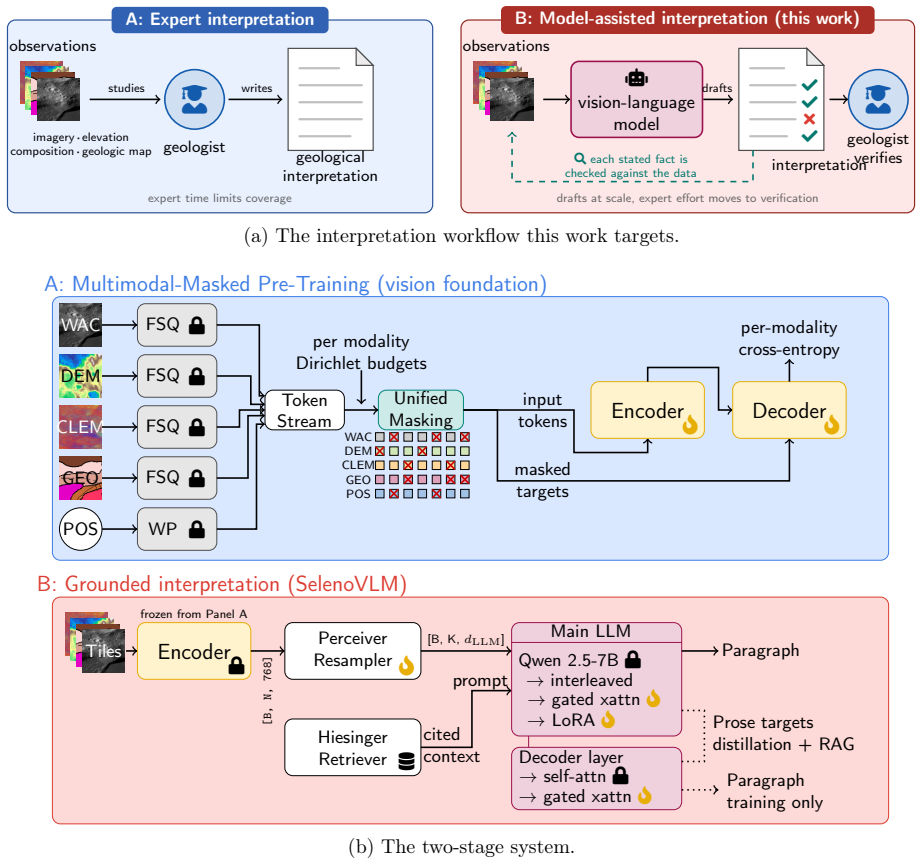
Summary. The paper presents SelenoVLM, a two-stage vision-language system for lunar mare stratigraphy. Stage A is a multimodal masked autoencoder pretrained on co-registered WAC imagery, GLD100 elevation, Clementine ratio composites, the USGS geologic map, and weak text captions. Stage B freezes that encoder and bridges it into a Qwen2.5-7B language model with a Perceiver resampler, gated cross-attention, and LoRA, supervised by distilled paragraph targets that open with deterministic raster-derived facts (albedo, relief, roughness, 415/750 ratio) and, on mare tiles, an age sentence. The paper reports held-out causal-grounding flip rates, stated-fact fidelity, stratigraphically gated age emission, and a closed-book negative result in which stated numeric ages track the global mare prior rather than local evidence, supported by probes that localize the dating signal up to the resampler bottleneck. In the open-book regime, the same generation channel transfers retrieved published ages faithfully and causally. The central claim is a division of labor: site evidence should enter through vision and be verifiable against the rasters, while quantitative chronology should be retrieved from the literature.
Significance. If the claims hold, the paper makes a valuable methodological contribution to grounded scientific generation. Its strengths include a spatially disjoint block split, cluster bootstrapping, constant-prior baselines for age recovery, leave-one-region-out controls, a probe battery with shuffle controls, explicit labeling of the open-book agreement as circular transfer fidelity, and a clear negative result on closed-book numeric age dating that is unusual and informative. The paper is also unusually explicit that perplexity and ROUGE on distilled targets are only fit diagnostics on circular supervision. The released code and weights, together with the detailed target-construction protocol, make the claims checkable. The main weakness is that the positive 'tile-grounded prose' claim rests on a teacher-forced flip-rate metric over all target positions rather than on a free-running generation-level tile-swap comparison; this is addressable and does not undermine the negative results.
major comments (3)
- [Sec. 1.1 and Sec. 3.8, Eq. (1)] The central causal-grounding statistic f_swap is computed teacher-forced over all target positions, including the deterministic opener-fact tokens that are almost guaranteed to flip under a tile swap. The manuscript does not report the flip rate restricted to the interpretive prose positions, and the only generation-level intervention is vision ablation (Jaccard distance 0.824), not a generation-level tile swap. As written, the evidence does not rule out a model that reads the tile only to emit the opener facts and then produces generic prose conditioned on that prefix. Since the Discussion's positive claim is specifically about 'tile-grounded geological prose,' please report a per-position breakdown of f_swap (opener-fact tokens versus the remaining target tokens) or, preferably, a free-running generation-level tile-swap metric, for example token-set Jaccard distance between generations conditioned on one tile's visual tokens and another tile's visual tokens with no teacher forcing. This is directly computable from the existing pipeline and would make the central claim directly measured rather than indirect.
- [Sec. 3.5, target construction] The design premise that supervision targets 'cannot be reproduced without reading the tile' is only partially realized: at the served granularity, only 44% of intra-mare targets are distinct, and ordinal wording alone leaves only 35% distinct. This means a substantial fraction of targets are shared across tiles, so high f_swap on those tiles cannot be attributed to tile-specific grounding; the model could be reproducing a memorized target. Please report the core grounding metrics separately for target-distinct versus target-duplicate tiles, or otherwise quantify how much of the observed f_swap comes from the 44% unique targets. This would also sharpen the interpretation of the coarsening ablation in Extended Data Table 3, where the distinctness fraction collapses to 13%.
- [Sec. 1.4, Extended Data Tables 5 and 6] The 'probe-generation gap' is used to localize the numeric-dating failure to the language pathway, but the generation slope (-0.054) is measured on the 93-tile polygon-accurate set while the probe slope (0.143) is measured on a separate 20,956-tile leave-unit-out set. These sets differ in tile composition and in ground-truth convention, so the gap could partly reflect set differences rather than the generation channel. The broader localization is supported by the in-loop age head result, but the specific quantitative comparison should be made on a common evaluation set, or the text should state explicitly why the cross-set comparison remains valid.
minor comments (3)
- [Sec. 3.4, checkpoint selection] The served checkpoint is described as selected at the 'knee' of the causal-grounding versus target-adherence trade-off, but no formal criterion is given. A reproducible rule, such as maximizing tile-swap flip subject to a minimum fact-fidelity threshold, would strengthen the claim that checkpoint selection is principled rather than discretionary.
- [Extended Data Fig. 1 and Supplementary Fig. S4] The qualitative chat examples are selected as best-of-N candidates and this is disclosed, but a randomly sampled or greedy decode would help calibrate typical free-running behavior and avoid the impression of cherry-picking.
- [Abstract and Sec. 1.5] The phrase 'accurate describe' in the abstract and 'deployed system states correct published ages' in Sec. 1.5 could be read as claiming geophysical correctness. Since the evaluation is against the published crater-count record, consider tightening the wording to 'agrees with the published chronology' to keep the claim coextensive with the measurement.
Circularity Check
No significant hidden circularity; the paper explicitly labels its two genuinely circular measurements as circular and excludes them from the central claims.
-
other
[Sec. 1.5 (open-book evaluation) and Sec. 3.8 (SelenoVLM metrics), Table 2 block A]
"The injected centroid record coincides with the centroid ground truth, so this agreement is circular and is reported strictly as transfer fidelity, not as age recovery."
In the open-book setting the prompt contains the same dated record that is used as the evaluation reference, so agreement between the stated age and the injected age measures copying from context rather than inference from vision. The reduction is by construction: the injected record and the centroid ground truth are the same quantity. The paper explicitly refuses to present this as age recovery and separately reports non-circular polygon-ground-truth accuracy, so the circularity is disclosed and is not load-bearing for the paper's central architectural claims.
-
other
[Sec. 3.8 (SelenoVLM metrics), final paragraph]
"We note that perplexity (ppl), token accuracy, and ROUGE against the distilled targets are fit diagnostics on circular supervision. They guide training but support no grounding claim, and no such claim in this paper rests on them."
The distilled targets are constructed from the same teacher model and from raster-derived facts used to build the task, so agreement with those targets only measures fit to the training signal, not correctness against an independent reference. This is circular by construction as a measurement of grounding. However, the paper explicitly disclaims any evidential weight for these diagnostics, and the central grounding claims instead rely on tile-swap and vision-removal interventions, raster verification, and constant-prior baselines.
full rationale
The paper is unusually explicit about where circularity could enter and neutralizes it. The open-book agreement with the injected centroid record is labeled circular and reported only as transfer fidelity; perplexity, token accuracy, and ROUGE are labeled fit diagnostics on circular supervision and excluded from all grounding claims. The central tile-grounding claim rests on causal interventions (tile-swap flip rate, vision-removal flip rate, generation-level Jaccard distance) and on external verification of stated facts against raster measurements, not on agreement with the training targets. The supervision targets are designed so that they cannot be reproduced without reading the tile, but the model's measured dependence on the tile is an empirical result, not a tautology: the baseline comparisons and the coarsening ablation show that the measured flip rate can go down and that content metrics can improve while grounding degrades. The only self-citation, the prior multimodal masked autoencoder of Sander et al. 2026, is used as a foundation whose relevant properties (cross-modal reconstruction quality, non-geolocatability, tile-specific wording) are re-measured in this paper rather than assumed. The age-recovery failure is scored against external references (polygon ground truth, leave-one-region-out control, constant prior), and the open-book success is bounded by a retrieval oracle, so the derivation is not forced by its own inputs. The two disclosed circular measurements are real but non-load-bearing, giving a low overall circularity score.
Assumptions & free parameters
free parameters (4)
- Retrieval gate radius =
8 degrees
- Age emission gate mare fraction =
0.5
- Target fact quantization =
albedo 2 decimals, relief 100 m, roughness 25 m, ratio 2 decimals
- Fact and age token upweighting =
6x
assumptions (4)
- domain assumption The Hiesinger crater-count model ages are correct reference ages for dated mare units.
- domain assumption The USGS Unified Geologic Map of the Moon unit labels are an accurate segmentation of surface units.
- domain assumption The Neukum lunar chronology function and the Robbins crater database are valid inputs.
- domain assumption The coarse spatial block split removes leakage relevant to the age-memorization analysis.
Cite this review
Pith. "Pith review of Verifiably grounded machine interpretation of lunar geology." pith.science (2026). https://pith.science/paper/HJOXW4ZL
@misc{pith2026260809276,
  author       = {Pith},
  title        = {Pith review of: Verifiably grounded machine interpretation of lunar geology},
  year         = {2026},
  howpublished = {\url{https://pith.science/paper/HJOXW4ZL}},
  note         = {Machine review of arXiv:2608.09276}
}
read the original abstract
Planetary geology relies on historical, interpretive reasoning to reconstruct past events from diverse observations. Here, we present a step toward an automated "machine intelligence geologist" by embedding this distinct methodology of geologic knowledge discovery and inference into a multimodal vision-language architecture. Focusing on the stratigraphy of lunar basaltic mare volcanism, we train a model to generate verifiably grounded geologic interpretations directly from co-registered topographic, spectral, and geologic maps. We demonstrate that while the system successfully balances established geological priors with local visual evidence to accurately describe stratigraphy and terrain, numeric age dating derived solely from vision defaults to memorized priors. Integrating an open-book retrieval mechanism resolves this, enabling the model to faithfully cite published chronologies. Our findings delineate the necessary architecture for automated geologic inference: site evidence must be visually interpreted from local data, while quantitative historical context must be retrieved from the scientific record.
Figures


Figures from the paper (1 more)

Reference graph
Works this paper leans on
-
[1]
and non-repetition (follow-ups). Named features quoted by the model (e.g. Oceanus Procellarum) are decorative and frequently wrong under the closed-book protocol, and they are not verified against the gazetteer. The answers are abridged at the marked ellipses. 30 0 0.2 0.4 0.6 0.8 1 1.2 1.4 1.6 1.8 ·104 0 0.2 0.4 0.6 0.8 1 selected checkpoint training ste...
work page 2013
-
[4]
doi:10.1098/rsta.2023.0254. Rishi Bommasani, Drew A. Hudson, Ehsan Adeli, et al. On the opportunities and risks of foundation models,
arXiv 2023
-
[6]
On faithfulness and factuality in abstractive summarization
Joshua Maynez, Shashi Narayan, Bernd Bohnet, and Ryan McDonald. On faithfulness and factuality in abstractive summarization. InProceedings of the 58th Annual Meeting of the Association for Computational Linguistics (ACL), pages 1906–1919,
work page 1906
-
[8]
URLhttps://arxiv.org/abs/2603.24696. M. S. Robinson, S. M. Brylow, M. Tschimmel, D. Humm, S. J. Lawrence, P. C. Thomas, B. W. Denevi, E. Bowman-Cisneros, J. Zerr, M. A. Ravine, M. A. Caplinger, F. T. Ghaemi, J. A. Schaffner, M. C. Malin, P. Mahanti, A. Bartels, J. Anderson, T. N. Tran, E. M. Eliason, A. S. McEwen, E. Turtle, B. L. Jolliff, and H. Hiesinge...
-
[15]
FabianMentzer, DavidMinnen, EirikurAgustsson, andMichaelTschannen
URLhttps://arxiv.org/abs/2103.13915. FabianMentzer, DavidMinnen, EirikurAgustsson, andMichaelTschannen. Finitescalarquantization: VQ-VAE made simple. InInternational Conference on Learning Representations (ICLR),
-
[16]
Max sequence length 1024 Epochs 5 Memory gradient checkpointing,bf16-mixed, 1 GPU Supplementary Table S2: Stage B (SelenoVLM) configuration. template constructed from the four caption fields serves as a fallback where no distilled target exists, and if no corpus is available, the retriever returns an empty context, allowing training to continue without re...
work page 2001
-
[17]
doi:10.1007/978-3-031-19836-6_20
ISBN 9783031198366. doi:10.1007/978-3-031-19836-6_20. URLhttp://dx.doi.org/10.1007/ 978-3-031-19836-6_20. Huiwen Chang, Han Zhang, Lu Jiang, Ce Liu, and William T Freeman. Maskgit: Masked generative image transformer. InProceedings of the IEEE/CVF conference on computer vision and pattern recognition, pages 11315–11325,
-
[18]
URL https://arxiv.org/abs/2412.15115. 23 Edward J Hu, Yelong Shen, Phillip Wallis, Zeyuan Allen-Zhu, Yuanzhi Li, Shean Wang, Liang Wang, Weizhu Chen, et al. Lora: Low-rank adaptation of large language models.Iclr, 1(2):3,
Show all 41 references
-
[20]
Rouge 2.0: Updated and improved measures for evaluation of summarization tasks
Kavita Ganesan. Rouge 2.0: Updated and improved measures for evaluation of summarization tasks. arXiv preprint arXiv:1803.01937,
-
[22]
Stella Frank, Emanuele Bugliarello, and Desmond Elliott
URLhttps://arxiv.org/abs/2110.14375. Stella Frank, Emanuele Bugliarello, and Desmond Elliott. Vision-and-language or vision-for-language? on cross-modal influence in multimodal transformers. In Marie-Francine Moens, Xuanjing Huang, Lucia Specia, and Scott Wen-tau Yih, editors,...
-
[23]
doi:10.18653/v1/2021.emnlp- main.775
Association for Computational Linguistics. doi:10.18653/v1/2021.emnlp- main.775. URLhttps://aclanthology.org/2021.emnlp-main.775/. Paul Jaccard. Étude comparative de la distribution florale dans une portion des Alpes et du Jura. Bull Soc Vaudoise Sci Nat, 37:547–579,
2021 doi
- [26]
-
[27]
URLhttps://arxiv.org/abs/2604.15804. Zhiyu Wu, Xiaokang Chen, Zizheng Pan, Xingchao Liu, Wen Liu, Damai Dai, Huazuo Gao, Yiyang Ma, Chengyue Wu, Bingxuan Wang, Zhenda Xie, Yu Wu, Kai Hu, Jiawei Wang, Yaofeng Sun, Yukun Li, Yishi Piao, Kang Guan, Aixin Liu, Xin Xie, Yuxiang You...
-
[28]
URL https: //arxiv.org/abs/2412.10302. OpenAI. Gpt-5.6 preview system card,
-
[29]
Accessed 2026-08-10
URL https://deploymentsafety.openai.com/ gpt-5-6-preview. Accessed 2026-08-10. EJ Speyerer, MS Robinson, BW Denevi, LROC Science Team, et al. Lunar reconnaissance orbiter camera global morphological map of the moon. In42nd annual lunar and planetary science conference, number ...
2026
-
[31]
Neural text generation with unlikelihood training.arXiv preprint arXiv:1908.04319,
Sean Welleck, Ilia Kulikov, Stephen Roller, Emily Dinan, Kyunghyun Cho, and Jason Weston. Neural text generation with unlikelihood training.arXiv preprint arXiv:1908.04319,
1908 arXiv
-
[32]
Glu variants improve transformer.arXiv preprint arXiv:2002.05202,
Noam Shazeer. Glu variants improve transformer.arXiv preprint arXiv:2002.05202,
2002 arXiv
-
[34]
Dicong Qiu, Brandon Rothrock, Tanvir Islam, Annie K Didier, Vivian Z Sun, Chris A Mattmann, and Masahiro Ono
URLhttps://arxiv.org/abs/2601.07795. Dicong Qiu, Brandon Rothrock, Tanvir Islam, Annie K Didier, Vivian Z Sun, Chris A Mattmann, and Masahiro Ono. Scoti: Science captioning of terrain images for data prioritization and local image search.Planetary and Space Science, 188:104943,
-
[35]
Aaron Van Den Oord, Oriol Vinyals, et al
URLhttps://arxiv.org/abs/2406.09406. Aaron Van Den Oord, Oriol Vinyals, et al. Neural discrete representation learning.Advances in neural information processing systems, 30,
-
[36]
Colorado J Reed, Ritwik Gupta, Shufan Li, Sarah Brockman, Christopher Funk, Brian Clipp, Kurt Keutzer, Salvatore Candido, Matt Uyttendaele, and Trevor Darrell
URLhttps://arxiv.org/abs/2207.08051. Colorado J Reed, Ritwik Gupta, Shufan Li, Sarah Brockman, Christopher Funk, Brian Clipp, Kurt Keutzer, Salvatore Candido, Matt Uyttendaele, and Trevor Darrell. Scale-MAE: A scale-aware masked autoencoder for multiscale geospatial representa...
-
[37]
URL https://arxiv.org/abs/2504.11171. Daniela Szwarcman, Sujit Roy, Paolo Fraccaro, Þorsteinn Elí Gíslason, Benedikt Blumenstiel, Rinki Ghosal, Pedro Henrique de Oliveira, Joao Lucas de Sousa Almeida, Rocco Sedona, Yanghui 26 Kang, Srija Chakraborty, Sizhe Wang, Carlos Gomes, ...
-
[38]
Philanthropic
URLhttps: //arxiv.org/abs/2412.02732. Philanthropic. Ai for earth. URLhttps://madewithclay.org/. Maria Tsimpoukelli, Jacob L Menick, Serkan Cabi, SM Eslami, Oriol Vinyals, and Felix Hill. Multimodal few-shot learning with frozen language models.Advances in Neural Information P...
-
[39]
attributes the remainder to memorized regional structure, hence we score it as not beating the prior. Model Facts↑Albedo↑415/750↑Unit naming↑Mare age cov.↑Highland FP↓Epoch acc.↑Beats const.? SelenoVLMage(served)0.494 0.567 0.433 0.8830.7340.0180.714 no † gemma4:26b 0.176 0.28...
-
[1971]
doi:10.1038/234034a0
ISSN 1476-4687. doi:10.1038/234034a0. URLhttp://dx.doi.org/10.1038/234034a0. Jiwei Li, Michel Galley, Chris Brockett, Jianfeng Gao, and Bill Dolan. A diversity-promoting objective function for neural conversation models. In Kevin Knight, Ani Nenkova, and Owen Rambow, editors,P...
-
[1999]
T. M. Hare, B. A. Archinal, T. L. Becker, E. M. Lee, L. R. Gaddis, B. L. Redding, and M. R. Rosiek. Clementine mosaics warped to ULCN 2005 network. In39th Lunar and Planetary Science Conference, Houston, TX,
2005
-
[2004]
Kishore Papineni, Salim Roukos, Todd Ward, and Wei-Jing Zhu
doi:10.1109/TIP.2003.819861. Kishore Papineni, Salim Roukos, Todd Ward, and Wei-Jing Zhu. Bleu: a method for automatic evaluation of machine translation. InProceedings of the 40th annual meeting of the Association for Computational Linguistics, pages 311–318,
2003
-
[2010]
doi:10.1007/s11214-010-9634-2
ISSN 1572-9672. doi:10.1007/s11214-010-9634-2. URLhttp://dx.doi.org/10.1007/s11214-010-9634-2. D. C. Humm, M. Tschimmel, S. M. Brylow, P. Mahanti, T. N. Tran, S. E. Braden, S. Wiseman, J. Danton, E. M. Eliason, and M. S. Robinson. Flight calibration of the lroc narrow angle ca...
-
[2011]
URL https://agupubs.onlinelibrary.wiley.com/doi/abs/10.1029/2011JE003797
doi:https://doi.org/10.1029/2011JE003797. URL https://agupubs.onlinelibrary.wiley.com/doi/abs/10.1029/2011JE003797. David R. Roberts, Volker Bahn, Simone Ciuti, Mark S. Boyce, Jane Elith, Gurutzeta Guillera- Arroita, Severin Hauenstein, José J. Lahoz-Monfort, Boris Schröder, W...
-
[2012]
Google’s neural machine translation sys- tem: Bridging the gap between human and machine translation.arXiv preprint arXiv:1609.08144,
Yonghui Wu, Mike Schuster, Zhifeng Chen, Quoc V Le, Mohammad Norouzi, Wolfgang Macherey, Maxim Krikun, Yuan Cao, Qin Gao, Klaus Macherey, et al. Google’s neural machine translation sys- tem: Bridging the gap between human and machine translation.arXiv preprint arXiv:1609.08144,
-
[2015]
doi:10.1007/s11214- 015-0201-8
ISSN 1572-9672. doi:10.1007/s11214- 015-0201-8. URLhttp://dx.doi.org/10.1007/s11214-015-0201-8. RV Wagner, EJ Speyerer, MS Robinson, LROC team, et al. New mosaicked data products from the lroc team. In46th annual lunar and planetary science conference, number 1832, page 1473,
-
[2016]
doi:10.18653/v1/N16-1014
Association for Computational Linguistics. doi:10.18653/v1/N16-1014. URLhttps://aclanthology.org/N16-1014/. Gemma Team. Gemma 4 technical report,
-
[2017]
URLhttps://nsojournals.onlinelibrary
doi:https://doi.org/10.1111/ecog.02881. URLhttps://nsojournals.onlinelibrary. wiley.com/doi/abs/10.1111/ecog.02881. Gemma Team, Aishwarya Kamath, et al. Gemma 3 technical report,
-
[2018]
Decoupled weight decay regularization.arXiv preprint arXiv:1711.05101,
Ilya Loshchilov and Frank Hutter. Decoupled weight decay regularization.arXiv preprint arXiv:1711.05101,
-
[2019]
Itai Gat, Idan Schwartz, and Alexander Schwing
URLhttps://arxiv.org/abs/ 1906.03731. Itai Gat, Idan Schwartz, and Alexander Schwing. Perceptual score: What data modalities does your model perceive?,
1906 arXiv
-
[2020]
Bge m3-embedding: Multi-lingual, multi-functionality, multi-granularity text embeddings through self-knowledge distillation.arXiv preprint arXiv:2402.03216, 4(5),
Jianlv Chen, Shitao Xiao, Peitian Zhang, Kun Luo, Defu Lian, and Zheng Liu. Bge m3-embedding: Multi-lingual, multi-functionality, multi-granularity text embeddings through self-knowledge distillation.arXiv preprint arXiv:2402.03216, 4(5),
-
[2021]
doi:10.1038/s41586- 021-03819-2. Trieu H. Trinh, Yuhuai Wu, Quoc V. Le, He He, and Thang Luong. Solving olympiad geometry without human demonstrations.Nature, 625(7995):476–482,
-
[2022]
URLhttp://dx.doi.org/10.1109/cvpr52688.2022.01553
doi:10.1109/cvpr52688.2022.01553. URLhttp://dx.doi.org/10.1109/cvpr52688.2022.01553. Jean-Baptiste Alayrac, Jeff Donahue, Pauline Luc, Antoine Miech, Iain Barr, Yana Hasson, Karel Lenc, Arthur Mensch, Katherine Millican, Malcolm Reynolds, et al. Flamingo: a visual language mod...
2022
-
[2023]
Daniel Martin Katz, Michael James Bommarito, Shang Gao, and Pablo Arredondo
doi:10.1038/s41586-023-06291-2. Daniel Martin Katz, Michael James Bommarito, Shang Gao, and Pablo Arredondo. GPT-4 passes the bar exam.Philosophical Transactions of the Royal Society A, 382(2270):20230254,
-
[2024]
Karan Singhal, Shekoofeh Azizi, Tao Tu, S
doi:10.1038/s41586-023-06747-5. Karan Singhal, Shekoofeh Azizi, Tao Tu, S. Sara Mahdavi, Jason Wei, Hyung Won Chung, Nathan Scales, Ajay Tanwani, Heather Cole-Lewis, Stephen Pfohl, et al. Large language models encode clinical knowledge.Nature, 620(7972):172–180,
-
[2025]
org/abs/2503.19786
URLhttps://arxiv. org/abs/2503.19786. Gilad Sharir, Asaf Noy, and Lihi Zelnik-Manor. An image is worth 16x16 words, what is a video worth?,
-
[2026]
Accessed 2026-08-10
URL https://www.anthropic.com/ claude-opus-5-system-card. Accessed 2026-08-10. Stuart J Robbins. A new global database of lunar impact craters> 1–2 km:
2026
Reviewed August 11, 2026 · model on record in the stance chip above.
Discussion (0). Continue with ORCID to comment.