REVIEW 5 major objections 4 minor 62 references
Multi-View Incremental Learning with Structured Hebbian Plasticity for Enhanced Fusion Efficiency
T0 review · 5 major / 4 minor · reviewed 2026-08-11 · deepseek-v4-flash
Pith's one-line read This paper proposes a multi-view incremental learning framework that fuses views one at a time with a Hebbian weight update and a synapse mask, and claims it outperforms state-of-the-art graph-based methods on six benchmarks.
desk verdict Timely problem, plausible mechanism, but the empirical evidence is too sloppy and internally inconsistent to support the paper's SOTA claims. read the letter →
The pith
A machine-rendered reading of the paper's core claim, the machinery that carries it, and where it could break.
The reading
What carries the argument
Structured Hebbian plasticity is the update rule $W_2^* = W_2 + \varepsilon(\hat{A}_v X_v W_1)^T H_{v-1}$, an outer-product term between the new view's graph-convolved features and the previous fused representation; it is the mechanism that expresses fine-grained correlation between old and new views. Synaptic partition learning is the elementwise mask $\mathrm{Reshape}(M)\cdot W_1$, where $M$ is a binary matrix with at most $\theta$ of its entries set to 1 and re-randomized each epoch; it disables part of the first-layer weight to suppress drastic changes. The streaming fusion equation $H_v = \hat{A}_v \sigma(\hat{A}_v X_v W_1^*)W_2 + \alpha H_{v-1}^*$ and the weight-drift regularizer $L_{RE}$ complete the machinery by blending the new stream with the retained representation and penalizing large weight changes.
What would settle it
Re-run the six benchmark comparisons under a protocol where all hyperparameters, including the mask fraction and the Hebbian learning rate, are chosen on a held-out validation set and all baselines receive the same training budget; if MVIL's advantage over the best baseline falls within the reported run-to-run variance, the superiority claim is unsupported.
Extended reading notes
Core claim
The central claim is that a streaming fusion rule, not a storage of old views, is enough to accumulate knowledge: when view $v$ arrives, the model computes $H_v = \hat{A}_v \sigma(\hat{A}_v X_v W_1^*)W_2 + \alpha H_{v-1}^*$, blending the new view's graph-filtered features with the retained representation from all previous views. The paper then adjusts weights in two complementary ways: $W_1$ is masked by a random binary matrix that turns off at most a $\theta$ fraction of its entries each epoch, and $W_2$ receives a Hebbian increment $\varepsilon(\hat{A}_v X_v W_1)^T H_{v-1}$ that reinforces connections whose pre- and post-synaptic activities co-occur. Together with a regularizer that penalizes deviation of $W_1$ and $W_2$ from their previous values, these updates are claimed to achieve fine-grained fusion of view representations while retaining old knowledge, yielding superior accuracy, precision, recall, and macro-F1 over the compared methods on all six datasets.
Load-bearing premise
The claim that MVIL beats state-of-the-art methods rests on the experimental comparison being fair, and the paper does not report the fraction of disabled synapses, the strength of the Hebbian update, or the validation procedure used to set per-dataset hyperparameters.
Editorial extensions
If this is right
- A system can incorporate a new view by updating shared weights instead of retraining on all views together, so previous raw data need not be stored.
- Performance on view-heavy datasets improves over static multi-view learners, which lose accuracy as view count grows.
- The Hebbian term adjusts the classifier weights before backpropagation, so correlation-based knowledge transfer is built into forward computation.
- Because the two weight matrices are shared across all views, model parameter count stays constant as views accumulate.
- Old knowledge is retained through a fused representation rather than through stored examples, which the paper argues supports privacy.
Reading between the lines
- If the Hebbian term is read as a correlation-based cross-view attention, the framework could be extended to weight views by reliability, a variant the paper does not test.
- A testable extension is to vary the mask fraction and the Hebbian learning rate on a validation set and observe when reinforcement should dominate suppression; the paper reports neither value.
- The adjustment strategy is written for a two-layer GCN but nothing in the equations depends on the GCN's specific message passing, suggesting the same update could be applied to deeper or attention-based graph encoders.
- The no-storage property points toward deployment in federated or on-device settings where views arrive from different sensors at different times.
Signed reviews
Editorial analysis
A structured set of objections, weighed in public.
Referee Report
Summary. The paper proposes MVIL, a continual multi-view learning framework for semi-supervised node classification in the setting where views arrive sequentially. A two-layer GCN with shared weights is trained incrementally; a structured Hebbian update is applied to the second-layer weights based on the correlation between new-view features and the previous fused representation, and a synaptic partition mask randomly disables a fraction of the first-layer weights each epoch. Training uses cross-entropy plus a regularization term that penalizes large weight changes. Experiments on six benchmark datasets compare MVIL with static multi-view learning and continual learning baselines, reporting accuracy, precision, recall, and macro-F1, and the paper claims superior performance over state-of-the-art graph-based algorithms.
Significance. If the empirical claims hold, MVIL would be a useful contribution: the incremental-view setting is real and under-studied, and the two mechanisms, Hebbian reinforcement and random synaptic masking, are simple enough to transfer to other graph architectures. The paper also includes an ablation study and a parameter sensitivity analysis, which are valuable. However, the contribution is primarily experimental, and the current evidence base has reproducibility and fairness gaps that block verification of the headline claim. The theoretical motivation is qualitative, and the reported experiments are not yet reported to the standard needed to support a state-of-the-art claim.
major comments (5)
- [Experimental Setting / Table 5] The two hyperparameters that control the proposed modules, ε in Eq. (5) and θ in Eq. (7), are never reported. The text only constrains θ with 'θ ≪ 1/V', and ε does not appear in Table 5 or in the parameter sensitivity analysis. Without these values, the core mechanisms of MVIL cannot be reproduced, and the results in Table 3 cannot be independently checked.
- [Experimental Setting] Table 5 gives per-dataset values for k, lr, hidden dimension d, and β, but the paper does not describe any validation split or model-selection procedure. Since only 10% of labels are used, choosing these hyperparameters on test accuracy would leak test information into model selection. The authors should state whether a held-out validation set was used and describe the tuning protocol.
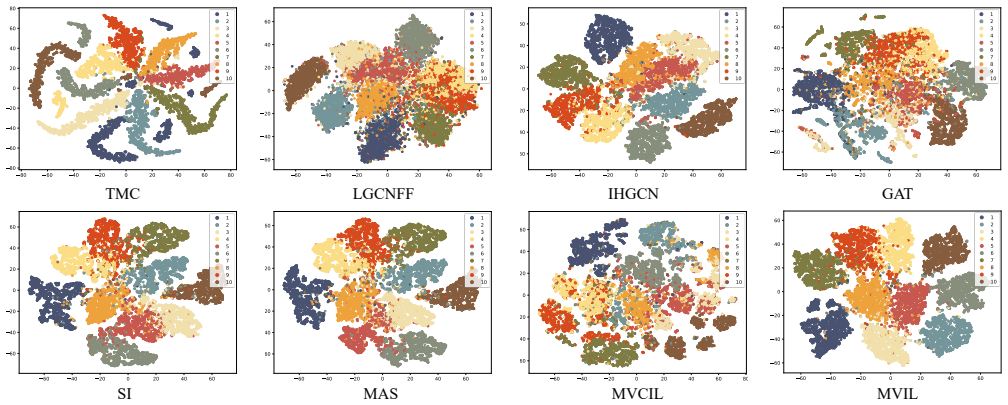
- [Comparison to SOTA (EQ1) / Table 3] The training budget is specified only for MVIL ('600 rounds per view'), and no comparable budget is given for TMC, LGCNFF, IHGCN, SI, MAS, or MVCIL. If baselines were trained with fewer epochs or less careful hyperparameter tuning, the comparison would be biased. The paper needs to report the training schedule and hyperparameter search for every baseline.
- [Table 3] All results are averages over three runs, and no significance tests or confidence intervals beyond standard deviations are reported. Several claimed improvements are small relative to the reported deviations, e.g., 100leaves ACC 91.50±0.47 versus IHGCN 91.03±0.70, and Animals ACC 84.42±0.10 versus IHGCN 83.13±0.04. A paired significance test (e.g., a paired t-test or Wilcoxon test over more runs) should be reported before claiming superiority.
- [Eqs. (5)–(6) and Table 4] There are inconsistencies between the method description and the reported ablation. First, Eq. (5) and Eq. (6) use (Â_v X_v W1) as the new-view feature, but Eq. (2) defines the hidden features as σ(Â_v X_v W*_1), i.e., with the mask and nonlinearity; this makes the Hebbian update ambiguous. Second, the full model 'C1+C2+C3' in Table 4 should equal the MVIL column in Table 3, but accuracies differ for 100leaves (91.36 vs. 91.50) and Flower17 (57.79 vs. 60.54). The authors should align the equations and resolve the discrepancy.
minor comments (4)
- [Abstract and Heading] There are typos in visible places: 'MVIL lies two fundamental modules' should be 'MVIL has two fundamental modules', and the section heading 'Preilminary' should be 'Preliminary'.
- [Eq. (7)] The mask M is defined as R^{nd×1}, but after reshaping it is used as R^{d_v×d}; since W1 is R^{d_v×d}, the mask should have d_v·d entries, not n·d. The notation is inconsistent.
- [Eq. (2)] The learnable parameter α is not described in the parameter table or in the optimization details; if it is learned, its initialization, update rule, and resulting values should be reported.
- [Figure 4] Figure 4 reports normalized time and space costs as percentages, but the hardware, implementation library, and measurement methodology are not specified, so the efficiency comparison is hard to interpret.
Circularity Check
No significant circularity: MVIL is an empirical method paper whose performance claims rest on benchmark experiments, not on a derivation that reduces to its own inputs.
full rationale
The paper proposes a heuristic incremental multi-view learning framework and supports it with experiments; it does not claim to derive a result from first principles or to predict a quantity from a fitted parameter. The structured Hebbian update (Eq. 5) and synaptic partition mask (Eq. 8) are stated construction rules, not fitted-then-predicted quantities. The Hebbian rule is justified by external neuroscience and continual-learning citations (e.g., Golkar et al. 2020; Triche et al. 2022; Zenke et al. 2017), and those citations are not used to forbid alternatives or to import a uniqueness theorem. The comparison claim depends on the reported benchmark numbers, which raises reproducibility concerns because the validation split is not described, the mask ratio theta and Hebbian learning rate epsilon are not reported, and baseline training budgets are unspecified; however, these issues concern experimental fairness and completeness, not circularity in the sense of a prediction being equivalent to its input by construction. The derivation chain is self-contained as an algorithm proposal, so under the stated hard rules the honest finding is no significant circularity.
Assumptions & free parameters
free parameters (7)
- kNN neighbor count k =
5, 10, 5, 30, 5, 5 per dataset (Table 5)
- learning rate lr =
0.01, 0.001, 0.0025, 0.0001, 0.007, 0.04 per dataset (Table 5)
- hidden dimension d =
64, 128, 512, 256, 512, 256 per dataset (Table 5)
- regularization weight beta =
1e-5, 1e-5, 0.02, 0.038, 0.3, 0.08 per dataset (Table 5)
- synaptic mask ratio theta =
not reported (stated theta << 1/V)
- Hebbian learning rate epsilon =
not reported
- balancing coefficient alpha =
learned during training, not reported
assumptions (4)
- domain assumption A k-nearest-neighbor graph built from each view's raw features captures that view's useful similarity structure for node classification.
- ad hoc to paper The cross-correlation between the new view's hidden features and the previous fused representation is the right signal for strengthening weights.
- ad hoc to paper Randomly masking a fraction theta of the first-layer weights with a fresh random pattern each epoch reduces forgetting without unacceptably hurting current-view learning.
- domain assumption Cross-entropy on 10% labeled nodes is a valid evaluation for semi-supervised node classification.
Cite this review
Pith. "Pith review of Multi-View Incremental Learning with Structured Hebbian Plasticity for Enhanced Fusion Efficiency." pith.science (2026). https://pith.science/paper/HKEOSG4Y
@misc{pith2026241212801,
  author       = {Pith},
  title        = {Pith review of: Multi-View Incremental Learning with Structured Hebbian Plasticity for Enhanced Fusion Efficiency},
  year         = {2026},
  howpublished = {\url{https://pith.science/paper/HKEOSG4Y}},
  note         = {Machine review of arXiv:2412.12801}
}
read the original abstract
The rapid evolution of multimedia technology has revolutionized human perception, paving the way for multi-view learning. However, traditional multi-view learning approaches are tailored for scenarios with fixed data views, falling short of emulating the intricate cognitive procedures of the human brain processing signals sequentially. Our cerebral architecture seamlessly integrates sequential data through intricate feed-forward and feedback mechanisms. In stark contrast, traditional methods struggle to generalize effectively when confronted with data spanning diverse domains, highlighting the need for innovative strategies that can mimic the brain's adaptability and dynamic integration capabilities. In this paper, we propose a bio-neurologically inspired multi-view incremental framework named MVIL aimed at emulating the brain's fine-grained fusion of sequentially arriving views. MVIL lies two fundamental modules: structured Hebbian plasticity and synaptic partition learning. The structured Hebbian plasticity reshapes the structure of weights to express the high correlation between view representations, facilitating a fine-grained fusion of view representations. Moreover, synaptic partition learning is efficient in alleviating drastic changes in weights and also retaining old knowledge by inhibiting partial synapses. These modules bionically play a central role in reinforcing crucial associations between newly acquired information and existing knowledge repositories, thereby enhancing the network's capacity for generalization. Experimental results on six benchmark datasets show MVIL's effectiveness over state-of-the-art methods.
Figures


Figures from the paper (4 more)


Reference graph
Works this paper leans on
-
[1]
, " * write output.state after.block = add.period write newline
ENTRY address archivePrefix author booktitle chapter edition editor eid eprint howpublished institution isbn journal key month note number organization pages publisher school series title type volume year label extra.label sort.label short.list INTEGERS output.state before.all mid.sentence after.sentence after.block FUNCTION init.state.consts #0 'before.a...
-
[2]
write newline
" write newline "" before.all 'output.state := FUNCTION n.dashify 't := "" t empty not t #1 #1 substring "-" = t #1 #2 substring "--" = not "--" * t #2 global.max substring 't := t #1 #1 substring "-" = "-" * t #2 global.max substring 't := while if t #1 #1 substring * t #2 global.max substring 't := if while FUNCTION word.in bbl.in capitalize " " * FUNCT...
-
[3]
Aljundi, R.; Babiloni, F.; Elhoseiny, M.; Rohrbach, M.; and Tuytelaars, T. 2018. Memory aware synapses: Learning what (not) to forget. In ECCV, 139--154
work page 2018
-
[4]
Cai, H.; Tan, Y.; Huang, S.; and Lv, J. 2023. Lifelong multi-view spectral clustering. In IJCAI, 3488--3496
work page 2023
-
[5]
Chen, Y.; Chen, F.; Wu, Z.; Chen, Z.; Cai, Z.; Tan, Y.; and Wang, S. 2024 a . Heterogeneous Graph Embedding with Dual Edge Differentiation. Neural Networks, 106965
work page 2024
-
[6]
Chen, Z.; Fu, L.; Yao, J.; Guo, W.; Plant, C.; and Wang, S. 2023 a . Learnable graph convolutional network and feature fusion for multi-view learning. Information Fusion, 95: 109--119
work page 2023
-
[7]
Chen, Z.; Wu, Z.; Lin, Z.; Wang, S.; Plant, C.; and Guo, W. 2023 b . AGNN: Alternating graph-regularized neural networks to alleviate over-smoothing. IEEE Transactions on Neural Networks and Learning Systems, 35(10): 13764--13776
work page 2023
-
[8]
Chen, Z.; Wu, Z.; Wang, S.; and Guo, W. 2023 c . Dual low-rank graph autoencoder for semantic and topological networks. In AAAI, volume 37, 4191--4198
work page 2023
Show all 62 references
-
[9]
Chen, Z.; Wu, Z.; Zhong, L.; Plant, C.; Wang, S.; and Guo, W. 2024 b . Attributed Multi-order Graph Convolutional Network for Heterogeneous Graphs. Neural Networks, 174: 106225
2024
-
[10]
J.; and Beer, R
Chiel, H. J.; and Beer, R. D. 1997. The brain has a body: adaptive behavior emerges from interactions of nervous system, body and environment. Trends in neurosciences, 20(12): 553--557
1997
-
[11]
Cui, Q.; Wu, S.; Liu, Q.; Zhong, W.; and Wang, L. 2018. MV-RNN: A multi-view recurrent neural network for sequential recommendation. IEEE Transactions on Knowledge and Data Engineering, 32(2): 317--331
2018
-
[12]
Duan, Y.; Jia, Z.; Li, Q.; Zhong, Y.; and Ma, K. 2023. Hebbian and gradient-based plasticity enables robust memory and rapid learning in rnns. In ICLR
2023
-
[13]
Golkar, S.; Lipshutz, D.; Bahroun, Y.; Sengupta, A.; and Chklovskii, D. 2020. A simple normative network approximates local non-Hebbian learning in the cortex. In NeurIPS, volume 33, 7283--7295
2020
-
[14]
Han, Z.; Zhang, C.; Fu, H.; and Zhou, J. T. 2020. Trusted multi-view classification. In ICLR
2020
-
[15]
Hou, H.; Zheng, Q.; Zhao, Y.; Pouget, A.; and Gu, Y. 2019. Neural correlates of optimal multisensory decision making under time-varying reliabilities with an invariant linear probabilistic population code. Neuron, 104(5): 1010--1021
2019
-
[16]
Huang, S.; Xiao, S.; Liu, W.; Lu, J.; Wu, Z.; Wang, S.; and Rajapakse, J. C. 2023. Multi-level Knowledge Integration with Graph Convolutional Network for Cancer Molecular Subtype Classification. In BIBM, 1983--1988
2023
-
[17]
R.; Laurent, P.; Schultz, D
Ito, T.; Yang, G. R.; Laurent, P.; Schultz, D. H.; and Cole, M. W. 2022. Constructing neural network models from brain data reveals representational transformations linked to adaptive behavior. Nature Communications, 13(1): 673
2022
-
[18]
Jiang, T.; Xu, Q.; Ran, X.; Shen, J.; Lv, P.; Zhang, Q.; and Pan, G. 2023. Adaptive deep spiking neural network with global-local learning via balanced excitatory and inhibitory mechanism. In ICLR
2023
-
[19]
R.; Liu, B.; Adly, A.; Faghihroohi, S.; and Navab, N
Kazi, A.; Markova, V.; Kondamadugula, P. R.; Liu, B.; Adly, A.; Faghihroohi, S.; and Navab, N. 2022. DG-GRU: dynamic graph based gated recurrent unit for age and gender prediction using brain imaging. In Medical Imaging 2022: Computer-Aided Diagnosis, volume 12033, 291--295
2022
-
[20]
Lan, C.; Yang, Y.; Li, X.; Luo, B.; and Huan, J. 2017. Learning social circles in ego-networks based on multi-view network structure. IEEE Transactions on Knowledge and Data Engineering, 29(8): 1681--1694
2017
-
[21]
Li, D.; Wang, T.; Chen, J.; Kawaguchi, K.; Lian, C.; and Zeng, Z. 2024. Multi-view class incremental learning. Information Fusion
2024
-
[22]
N.; and Huan, J
Li, X.; Chandrasekaran, S. N.; and Huan, J. 2017. Lifelong multi-task multi-view learning using latent spaces. In IEEE Big Data, 37--46
2017
-
[23]
Li, Z.; Tang, C.; Liu, X.; Zheng, X.; Zhang, W.; and Zhu, E. 2021. Consensus graph learning for multi-view clustering. IEEE Transactions on Multimedia, 24: 2461--2472
2021
-
[24]
Lu, J.; Wu, Z.; Chen, Z.; Cai, Z.; and Wang, S. 2024 a . Towards Multi-view Consistent Graph Diffusion. In ACM Multimedia, 186--195
2024
-
[25]
Lu, J.; Wu, Z.; Zhong, L.; Chen, Z.; Zhao, H.; and Wang, S. 2024 b . Generative Essential Graph Convolutional Network for Multi-View Semi-Supervised Classification. IEEE Transactions on Multimedia, 26: 7987--7999
2024
-
[26]
Luo, Y.; Song, G.; Li, P.; and Qi, Z. 2018. Multi-task medical concept normalization using multi-view convolutional neural network. In AAAI, volume 32
2018
-
[27]
Y.; and Ragin, A
Ma, G.; Lu, C.-T.; He, L.; Philip, S. Y.; and Ragin, A. B. 2017. Multi-view graph embedding with hub detection for brain network analysis. In ICDM, 967--972
2017
-
[28]
E.; and Boularias, A
Mitash, C.; Bekris, K. E.; and Boularias, A. 2017. A self-supervised learning system for object detection using physics simulation and multi-view pose estimation. In IROS, 545--551
2017
-
[29]
V.; Ernst, M
Pesnot Lerousseau, J.; Parise, C. V.; Ernst, M. O.; and van Wassenhove, V. 2022. Multisensory correlation computations in the human brain identified by a time-resolved encoding model. Nature Communications, 13(1): 2489
2022
-
[30]
Pi, Y.; Wu, Y.; Huang, Y.; Shi, Y.; and Wang, S. 2024. Inhomogeneous Diffusion-Induced Network for Multiview Semi-Supervised Classification. IEEE Transactions on Neural Networks and Learning Systems
2024
-
[31]
Shen, J.; Ni, W.; Xu, Q.; and Tang, H. 2024. Efficient spiking neural networks with sparse selective activation for continual learning. In AAAI, volume 38, 611--619
2024
-
[32]
T.; Yang, J.; and Wang, S
Song, N.; Du, S.; Wu, Z.; Zhong, L.; Yang, L. T.; Yang, J.; and Wang, S. 2024. GAF-Net: Graph attention fusion network for multi-view semi-supervised classification. Expert Systems with Applications, 238: 122151
2024
-
[33]
Sun, G.; Cong, Y.; Li, J.; and Fu, Y. 2018. Robust lifelong multi-task multi-view representation learning. In ICBK, 91--98
2018
-
[34]
Sun, G.; Cong, Y.; Zhang, Y.; Zhao, G.; and Fu, Y. 2020. Continual multiview task learning via deep matrix factorization. IEEE Transactions on Neural Networks and Learning Systems, 32(1): 139--150
2020
-
[35]
A.; Hippe, D
Thammasorn, P.; Chaovalitwongse, W. A.; Hippe, D. S.; Wootton, L. S.; Ford, E. C.; Spraker, M. B.; Combs, S. E.; Peeken, J. C.; and Nyflot, M. J. 2021. Nearest neighbor-based strategy to optimize multi-view triplet network for classification of small-sample medical imaging dat...
2021
-
[36]
S.; and Kumar, A
Triche, A.; Maida, A. S.; and Kumar, A. 2022. Exploration in neo-Hebbian reinforcement learning: Computational approaches to the exploration--exploitation balance with bio-inspired neural networks. Neural Networks, 151: 16--33
2022
-
[37]
M.; Tuytelaars, T.; and Tolias, A
Van de Ven, G. M.; Tuytelaars, T.; and Tolias, A. S. 2022. Three types of incremental learning. Nature Machine Intelligence, 4(12): 1185--1197
2022
-
[38]
Veli c kovi \'c , P.; Cucurull, G.; Casanova, A.; Romero, A.; Li \`o , P.; and Bengio, Y. 2018. Graph Attention Networks. In ICLR
2018
-
[39]
Wan, X.; Liu, J.; Liang, W.; Liu, X.; Wen, Y.; and Zhu, E. 2022. Continual multi-view clustering. In ACM Multimedia, 3676--3684
2022
-
[40]
Wan, X.; Liu, J.; Liu, X.; Wen, Y.; Yu, H.; Wang, S.; Yu, S.; Wan, T.; Wang, J.; and Zhu, E. 2024 a . Decouple then Classify: A Dynamic Multi-view Labeling Strategy with Shared and Specific Information. In ICML
2024
-
[41]
Wan, X.; Liu, X.; Liu, J.; Wang, S.; Wen, Y.; Liang, W.; Zhu, E.; Liu, Z.; and Zhou, L. 2023. Auto-weighted multi-view clustering for large-scale data. In AAAI, 10078--10086
2023
-
[42]
Wan, X.; Xiao, B.; Liu, X.; Liu, J.; Liang, W.; and Zhu, E. 2024 b . Fast continual multi-view clustering with incomplete views. IEEE Transactions on Image Processing
2024
-
[43]
Wang, M.; Lin, Y.; Lin, G.; Yang, K.; and Wu, X.-m. 2020. M2GRL: A multi-task multi-view graph representation learning framework for web-scale recommender systems. In SIGKDD, 2349--2358
2020
-
[44]
Wang, Q.; Sun, G.; Dong, J.; Wang, Q.; and Ding, Z. 2021. Continuous Multi-View Human Action Recognition. IEEE Transactions on Circuits and Systems for Video Technology, 32(6): 3603--3614
2021
-
[45]
Wang, R.; Nie, F.; Wang, Z.; Hu, H.; and Li, X. 2019. Parameter-free weighted multi-view projected clustering with structured graph learning. IEEE Transactions on Knowledge and Data Engineering, 32(10): 2014--2025
2019
-
[46]
Wang, W.; Arora, R.; Livescu, K.; and Bilmes, J. 2015. On deep multi-view representation learning. In ICML, 1083--1092
2015
-
[47]
Wen, Y.; Liu, S.; Wan, X.; Wang, S.; Liang, K.; Liu, X.; Yang, X.; and Zhang, P. 2023. Efficient Multi-View Graph Clustering with Local and Global Structure Preservation. In ACM Multimedia, 3021--3030
2023
-
[48]
Wu, Y.; Zhao, R.; Zhu, J.; Chen, F.; Xu, M.; Li, G.; Song, S.; Deng, L.; Wang, G.; Zheng, H.; et al. 2022. Brain-inspired global-local learning incorporated with neuromorphic computing. Nature Communications, 13(1): 65
2022
-
[49]
Wu, Z.; Chen, Z.; Du, S.; Huang, S.; and Wang, S. 2024. Graph Convolutional Network with elastic topology. Pattern Recognition, 151: 110364
2024
-
[50]
Wu, Z.; Lin, X.; Lin, Z.; Chen, Z.; Bai, Y.; and Wang, S. 2023. Interpretable graph convolutional network for multi-view semi-supervised learning. IEEE Transactions on Multimedia, 25: 8593--8606
2023
-
[51]
Wu, Z.; Zhang, Z.; and Fan, J. 2023. Graph Convolutional Kernel Machine versus Graph Convolutional Networks. In NeurIPS, volume 36, 19650--19672
2023
-
[52]
Xiao, M.; Meng, Q.; Zhang, Z.; He, D.; and Lin, Z. 2023. Hebbian Learning based Orthogonal Projection for Continual Learning of Spiking Neural Networks. In ICLR
2023
-
[53]
Yan, X.; Gan, Y.; Mao, Y.; Ye, Y.; and Yu, H. 2024. Live and Learn: Continual Action Clustering with Incremental Views. In AAAI, volume 38, 16264--16271
2024
-
[54]
Yang, D.; Zhou, Y.; Zhang, A.; Sun, X.; Wu, D.; Wang, W.; and Ye, Q. 2022. Multi-view correlation distillation for incremental object detection. Pattern Recognition, 131: 108863
2022
-
[55]
L.; and Fan, J
Yu, J.; Wu, Z.; Cai, J.; Jia, A. L.; and Fan, J. 2024. Kernel Readout for Graph Neural Networks. In IJCAI, 2505--2514
2024
-
[56]
Zenke, F.; Poole, B.; and Ganguli, S. 2017. Continual learning through synaptic intelligence. In ICML, 3987--3995
2017
-
[57]
Zhang, A.; Zhou, H.; Li, X.; and Zhu, W. 2019. Fast and robust learning in spiking feed-forward neural networks based on intrinsic plasticity mechanism. Neurocomputing, 365: 102--112
2019
-
[58]
Zhang, J.; Gu, Y.; Chen, A.; and Yu, Y. 2022. Unveiling Dynamic System Strategies for Multisensory Processing: From Neuronal Fixed-Criterion Integration to Population Bayesian Inference. Research
2022
-
[59]
I.; Huang, X.; Wan, M.; Borgheai, S
Zhu, S.; Hosni, S. I.; Huang, X.; Wan, M.; Borgheai, S. B.; McLinden, J.; Shahriari, Y.; and Ostadabbas, S. 2023. A dynamical graph-based feature extraction approach to enhance mental task classification in brain--computer interfaces. Computers in Biology and Medicine, 153: 106498
2023
-
[60]
Zhuang, S.; Huang, S.; Huang, W.; Chen, Y.; Wu, Z.; and Liu, X. 2024. Enhancing Multi-view Graph Neural Network with Cross-view Confluent Message Passing. In ACM Multimedia, 10065--10074
2024
-
[61]
Zou, D.; Wei, W.; Mao, X.-L.; Wang, Z.; Qiu, M.; Zhu, F.; and Cao, X. 2022. Multi-level cross-view contrastive learning for knowledge-aware recommender system. In SIGIR, 1358--1368
2022
-
[62]
Zou, Y.; Fang, Z.; Wu, Z.; Zheng, C.; and Wang, S. 2024. Revisiting multi-view learning: A perspective of implicitly heterogeneous Graph Convolutional Network. Neural Networks, 169: 496--505
2024
Reviewed August 11, 2026 · model on record in the stance chip above.
Discussion (0). Continue with ORCID to comment.