REVIEW 3 major objections 4 minor 70 references
Quantum Information Flow under String-Diagram Rewriting
T0 review · 3 major / 4 minor · reviewed 2026-08-11 · deepseek-v4-flash
Pith's one-line read The paper turns quantum information flow into an explicit string-diagram object: a through-path that survives every semantics-preserving rewrite until it is a bare-wire factor.
desk verdict There's a real idea here, but the central formal object — the apparent through-path — is never given a precise definition, and the gluing principle is false or unproven as stated. read the letter →
The pith
A machine-rendered reading of the paper's core claim, the machinery that carries it, and where it could break.
The reading
What carries the argument
The argument rests on four linked pieces. An apparent through-path is a continuous path in a diagram that crosses no visible tensor-product gap. Compatible inheritance is a relation $T_{\rho}$ between apparent through-paths in consecutive frames of a rewriting movie, inherited through a single rewrite. A boundary fibre $L_P(e)$ collects all local apparent through-paths in a local diagram $P$ meeting the same boundary-leg pair $e$, and the local inheritance relation induced by a rewrite rule $\rho$ is the disjoint union over $e$ of $L_{P_\rho}(e) \times L_{Q_\rho}(e)$. The local-to-global gluing principle says a global path decomposes into an external remnant and a local segment, so one-step inheritance is determined entirely by the successor boundary fibre; cardinality $0$, $1$, or $>1$ gives death, unique inheritance, or branching. The backward-generation algorithm then starts from the terminal bare wire and pulls examples back through the movie, yielding exactly the certifiable Coecke flow lines.
What would settle it
Search for a pair of semantics-preserving rewriting movies that connect the same initial and final diagrams but certify different apparent through-paths as Coecke flows, or a single movie where a path passes every local boundary-fibre check yet dies only when the full context is examined; either would show the definition depends on the chosen witness rather than on the underlying protocol.
Extended reading notes
Core claim
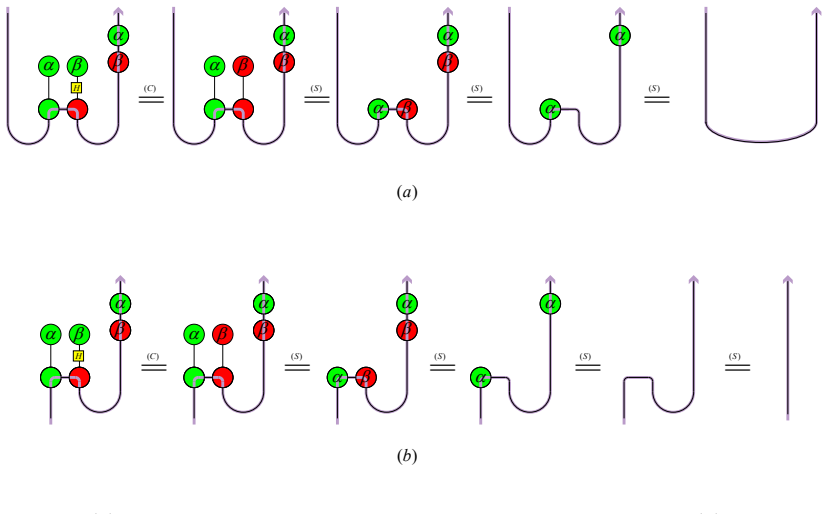
The central discovery is a formal definition: a Coecke flow line is an apparent through-path in the initial protocol diagram that, in every fixed branch of the protocol, admits a lineage of representatives inherited step by step through the rewriting movie and whose final representative is carried by a bare-wire factor tensor-decoupled from the rest of the diagram. The paper shows that this definition is testable because inheritance can be decided locally: for each elementary rewrite rule, one compares boundary fibres, the sets of local through-paths joining the same pair of boundary ports, and the cardinality of the successor fibre decides whether a path dies, survives uniquely, or branches. Applied to the ZX calculus, the paper computes these fibres for representative rules, including the Hopf rule, whose right-hand side has an empty fibre and therefore kills inheritance, and spider fusion, which can branch. Physically, a Coecke flow line is read as a constrained, quasi-local, line-like presentation, inside the original strategy diagram, of the target bare-wire morphism factor that the protocol shapes.
Load-bearing premise
The load-bearing premise is that a usable rewriting system has a reasonably small set of elementary rewrite rules, each supported on a small local diagram with fixed boundary ports; without that, the boundary-fibre inheritance relation and the gluing principle that decide a Coecke flow line simply do not apply.
Editorial extensions
If this is right
- Any protocol whose rewriting movie ends in a tensor-decoupled bare wire now has a certificate: a Coecke flow line exists exactly when the backward-generation algorithm reaches the initial diagram in every branch.
- Because inheritance is decided by boundary-fibre cardinalities, a flow line can be checked rule by rule without scanning the whole diagram.
- Multiple simultaneous bare-wire factors give multiple Coecke flows, which the paper connects to distilling several Bell pairs from one initial entangled state.
- The definition is not tied to the ZX calculus: it applies to any string-diagrammatic calculus with small local rewrite rules and terminal bare-wire factors, and in principle beyond dagger-compact structure.
- In holographic tensor-network states, the paper reports that Coecke flow lines obey the same constraints as bit threads, giving bit threads a candidate process-theoretic physical interpretation.
Reading between the lines
- A natural testable extension is to compile boundary-fibre tables for a complete axiomatization of the ZX calculus; if any elementary rule has a successor fibre of cardinality greater than one in a nontrivial way, the backward algorithm's branching structure becomes a quantitative measure of how many distinct flow-line witnesses exist.
- The definition may also give a handle on causality: in protocols where information flows against physical time, as in the original traversal rules, the compatible-inheritance relation makes the direction of a flow a property of the rewriting movie rather than of the underlying process, inviting comparison with causal structure in process theories.
- If the bit-thread correspondence is taken seriously, one could use Coecke flow lines to classify non-uniqueness of bit-thread configurations: different rewriting movies may certify different lineages, and their branching fibres might label the family of allowed thread geometries.
- The paper leaves the visual criterion "crosses no visible tensor-product gap" at the level of diagrams; a natural next step is to formalize it as a graph-theoretic condition on the embedded graph underlying a string diagram.
Editorial analysis
A structured set of objections, weighed in public.
Referee Report
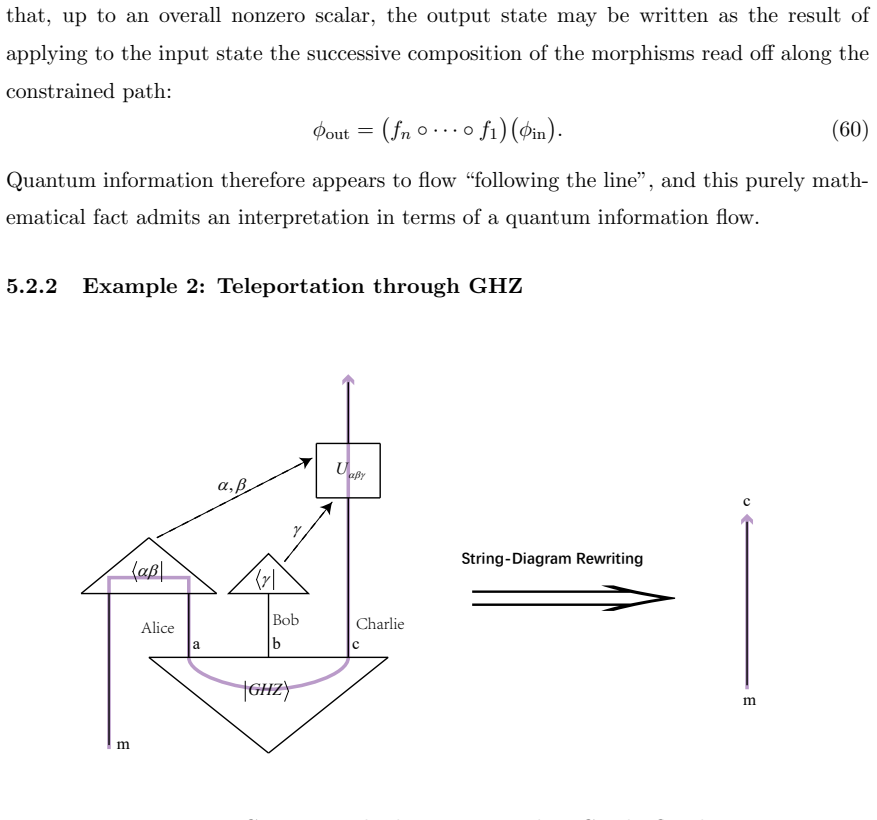
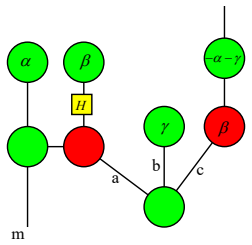
Summary. This paper proposes a formalization of Coecke's intuitive notion of "quantum information flow" in the language of string-diagram rewriting. Given a semantics-preserving rewriting movie, the authors distinguish apparent through-paths, which are defined for a single frame, from genuine through-paths, which admit compatible inheritance along every rewriting step and terminate in a tensor-decoupled bare-wire factor. A Coecke flow line is then defined as a branch-independent initial through-path that is genuinely through-going in every fixed classical branch. The paper develops a local boundary-fibre analysis of elementary rewrite rules, a local-to-global gluing principle, and a backward-generation algorithm, and illustrates these with the spider-fusion and Hopf rules of the ZX calculus. Applications discussed include quantum teleportation, GHZ-assisted teleportation, entanglement swapping, entanglement distillation, and a tentative connection to holographic bit threads via a companion paper.
Significance. If the main formalization is made precise, the paper would fill a genuine gap: it would turn Coecke's heuristic "quantum information flow" into an explicit, testable criterion involving compatible inheritance, rather than a purely visual notion. The paper is deliberately independent of the companion bit-thread paper for its formal core, uses standard ZX-calculus results, and presents worked examples in which the intended flow lines are exhibited frame by frame. The backward-generation algorithm is a useful and concrete contribution. However, the central primitive -- the apparent through-path and the set L(D) of all such paths -- is never given a formal graph-theoretic or categorical definition, and the local-to-global gluing principle as stated is not valid without additional restrictions. These are load-bearing issues for the paper's central claim, although they appear fixable within the manuscript's scope.
major comments (3)
- [Section 3.2.1, Definition (Apparent through-path)] The set L(D_k) of apparent through-paths is never formally defined. The phrase "a continuous path that crosses no visible tensor-product gap" is a visual predicate: the paper does not specify the underlying graph or spatial model of a string diagram, the allowed behaviour of a path at spiders, cups, and caps, or whether a path may enter and leave the same local region more than once. Since Eq. (20), the local inheritance relation (24), the gluing decomposition (34), and the backward-generation sets C_k in Eq. (47) all quantify over this undefined set, the central formalization is not yet testable. The definition should be replaced by a precise combinatorial characterization, for example paths in a prescribed embedded graph with explicit forbidden transitions at tensor-factor separations, together with stated conventions on repeated vertices and edges.
- [Section 4.1.3, Eqs. (34)-(39)] The local-to-global gluing principle is asserted without the uniqueness condition needed for Eq. (34). A global apparent through-path can meet the replaced region in several disjoint segments: take P to be a four-legged Z-spider with boundary legs a, b, c, d, and let the context connect b to c, with global endpoints a and d. A legal path enters P at a, leaves at b, follows the context bridge to c, re-enters P, and exits at d. Its intersection with P is two local segments, so it is not represented by any single term of the form (external remnant, local segment) in the disjoint union on the right-hand side of Eq. (34). Either Eq. (34) must be restricted to paths whose intersection with the replacement region is connected, or the gluing must be defined over sequences of boundary-leg pairs. Without one of these fixes, the global inheritance rule in Eqs. (37)-(39) is not well-defined.
- [Section 4.3, Table (52)] The boundary-fibre table for spider fusion leaves the same-side entries as "1?", and the accompanying text says that these ambiguities can be dispensed with by decomposing the generalized fusion rule into two elementary fusion rules. However, no boundary-fibre counts for those elementary rules are actually provided. Because the paper's central claim includes the statement that compatible inheritance can be decided locally, rewrite by rewrite, the reader cannot verify the central illustrative calculation. The same-side entries should be computed directly under the formal path definition adopted after fixing the issue raised above, or the elementary-fusion analysis should be carried out in full.
minor comments (4)
- [Section 4.1.2] There is a typo in the sentence "We now return to the elementary rewrite rule (17), s ince Pρ and Qρ have the same boundary...": "s ince" should be "since".
- [Section 3.1] The paragraph beginning "This raises a more general problem concerning string-diagrammatic calculation" is repeated almost verbatim; one of the two copies should be removed.
- [Section 4.2] In the sentence defining C_k, the phrase "can be certified by the remaining remaining suffix" contains a duplicated word "remaining".
- [Section 6.1] The bit-thread correspondence for the HaPPY example is stated to be shown in the companion paper [8] rather than in this manuscript; the text should state explicitly that this comparison is not established as a theorem in the present paper, so that readers do not mistake Fig. 12 for a self-contained derivation.
Circularity Check
No circularity: the Coecke-flow definition is a formal definition built from apparent through-paths and compatible inheritance, and the only self-citation (Ref. [8]) is explicitly non-load-bearing outlook.
full rationale
The paper's central claim is a definition-based formalization, not a derived prediction. A Coecke flow line is defined in Section 3.2.2 by starting from a branch-independent apparent through-path and requiring, for every fixed branch, a chain of compatible inheritances ending at a tensor-decoupled bare wire. The local inheritance relation (Eq. (24)) and the local-to-global gluing principle (Eq. (34)) are introduced as explicit constructions from boundary fibres, not fitted to data. No parameter is fitted and no semantic result is assumed in its input. The paper uses ZX rewriting rules and external completeness theorems (Backens; Jeandel–Perdrix–Vilmart) only as background calculi; the formal notion of flow is not derived from those theorems. The companion paper [8] is cited only in the outlook for a bit-thread analogy and is explicitly qualified as 'not an a priori logical proof'; it does not support any step of the formalization. The informal primitive 'crosses no visible tensor-product gap' is an under-specification risk rather than circularity, since the subsequent boundary-fibre machinery could in principle be made precise once L(D) is defined. Hence the derivation chain is self-contained and receives a score of 0.
Assumptions & free parameters
assumptions (5)
- standard math Axioms of monoidal, symmetric monoidal, and dagger compact closed categories, including snake equations and coherence theorems.
- domain assumption The rewriting system has a finite axiomatic set of elementary rewrite rules, each supported on a sufficiently small local diagram with fixed boundary type.
- domain assumption Semantics-preserving rewrites preserve the morphism denoted by the string diagram.
- domain assumption An apparent through-path may not traverse the same wire more than once.
- domain assumption The ZX calculus is complete for the relevant fragment (stabilizers, or Clifford+T, or general pure qubit processes).
invented entities (1)
-
Coecke flow line
Cite this review
Pith. "Pith review of Quantum Information Flow under String-Diagram Rewriting." pith.science (2026). https://pith.science/paper/HKU3ITVB
@misc{pith2026260809823,
  author       = {Pith},
  title        = {Pith review of: Quantum Information Flow under String-Diagram Rewriting},
  year         = {2026},
  howpublished = {\url{https://pith.science/paper/HKU3ITVB}},
  note         = {Machine review of arXiv:2608.09823}
}
read the original abstract
We revisit the notion of ``quantum information flow'' introduced in Bob Coecke's early work and seek to give it an explicit string-diagrammatic formalization. Given a semantics preserving string-diagram rewriting sequence, we first distinguish apparent through-paths, which depend on the current graphical presentation, from genuine through paths, which can be compatibly inherited through successive rewrites to a terminal decoupled bare wire factor. We then formally define a ``Coecke flow line'' in terms of this compatible inheritance relation. In particular, we use the ZX calculus, i.e., the ZX string diagram rewriting system, to illustrate the resulting formalism. In the physical setting of quantum protocols, a Coecke flow can be interpreted as a constrained, quasi-local, line-like presentation of a target bare wire morphism factor within the protocol string diagram.
Figures


Figures from the paper (19 more)





Reference graph
Works this paper leans on
-
[8]
Quantum Information Flow in String-Diagrams Meets Holography: Bit threads Gain Physical Meaning
Y. Y. Lin and S. Cheng, “ Quantum Information Flow in String-Diagrams Meets Holography: Bit threads Gain Physical Meaning.”
-
[1]
B. Coecke, “The logic of entanglement,” [arXiv:quant-ph/0402014 [quant-ph]]
-
[2]
Quantum information-flow, concretely, and axiomatically,
B. Coecke, “Quantum information-flow, concretely, and axiomatically,” [arXiv:quant- ph/0506132 [quant-ph]]
-
[3]
Teleporting an unknown quantum state via dual classical and Einstein-Podolsky- Rosen channels,
C. H. Bennett, G. Brassard, C. Crepeau, R. Jozsa, A. Peres and W. K. Wootters, “Teleporting an unknown quantum state via dual classical and Einstein-Podolsky- Rosen channels,” Phys. Rev. Lett.70, 1895-1899 (1993)
work page 1993
-
[4]
Quantum Computation and Quantum Information,
M. A. Nielsen and I. L. Chuang, “Quantum Computation and Quantum Information,” Cambridge University Press, 2012, ISBN 978-0-521-63503-5
work page 2012
-
[5]
A categorical semantics of quantum protocols,
S. Abramsky and B. Coecke, “A categorical semantics of quantum protocols,” [arXiv:quant-ph/0402130 [quant-ph]]
-
[6]
Categorical quantum mechanics,
S. Abramsky and B. Coecke, “Categorical quantum mechanics,” [arXiv:0808.1023 [quant-ph]]
-
[7]
Kindergarten Quantum Mechanics,
B. Coecke, “Kindergarten Quantum Mechanics,” [arXiv:quant-ph/0510032 [quant- ph]]. 68
Show all 70 references
-
[9]
Entanglement Renormalization and Holography,
B. Swingle, “Entanglement Renormalization and Holography,” Phys. Rev. D86, 065007 (2012) [arXiv:0905.1317 [cond-mat.str-el]]
2012 arXiv
-
[10]
Constructing holographic spacetimes using entanglement renormaliza- tion,
B. Swingle, “Constructing holographic spacetimes using entanglement renormaliza- tion,” [arXiv:1209.3304 [hep-th]]
-
[11]
Holographic quantum error- correcting codes: Toy models for the bulk/boundary correspondence,
F. Pastawski, B. Yoshida, D. Harlow and J. Preskill, “Holographic quantum error- correcting codes: Toy models for the bulk/boundary correspondence,” JHEP06, 149 (2015) [arXiv:1503.06237 [hep-th]]
2015 arXiv
-
[12]
Holographic duality from random tensor networks,
P. Hayden, S. Nezami, X. L. Qi, N. Thomas, M. Walter and Z. Yang, “Holographic duality from random tensor networks,” JHEP11, 009 (2016) [arXiv:1601.01694 [hep- th]]
2016 arXiv
-
[13]
Beyond Toy Models: Distilling Tensor Networks in Full AdS/CFT,
N. Bao, G. Penington, J. Sorce and A. C. Wall, “Beyond Toy Models: Distilling Tensor Networks in Full AdS/CFT,” JHEP11, 069 (2019) [arXiv:1812.01171 [hep-th]]
2019 arXiv
-
[14]
Bit threads and holographic entanglement,
M. Freedman and M. Headrick, “Bit threads and holographic entanglement,” Com- mun. Math. Phys.352, no.1, 407-438 (2017) [arXiv:1604.00354 [hep-th]]
2017 arXiv
-
[15]
Bit Threads and Holographic Monogamy,
S. X. Cui, P. Hayden, T. He, M. Headrick, B. Stoica and M. Walter, “Bit Threads and Holographic Monogamy,” Commun. Math. Phys.376, no.1, 609-648 (2019) [arXiv:1808.05234 [hep-th]]
2019 arXiv
-
[16]
Riemannian and Lorentzian flow-cut theorems,
M. Headrick and V. E. Hubeny, “Riemannian and Lorentzian flow-cut theorems,” Class. Quant. Grav.35, no.10, 10 (2018) [arXiv:1710.09516 [hep-th]]
2018 arXiv
-
[17]
Covariant bit threads,
M. Headrick and V. E. Hubeny, “Covariant bit threads,” JHEP07, 180 (2023) [arXiv:2208.10507 [hep-th]]
2023 arXiv
-
[18]
Holographic derivation of entanglement entropy from AdS/CFT,
S. Ryu and T. Takayanagi, “Holographic derivation of entanglement entropy from AdS/CFT,” Phys. Rev. Lett.96, 181602 (2006) [arXiv:hep-th/0603001 [hep-th]]
2006 arXiv
-
[19]
Aspects of Holographic Entanglement Entropy,
S. Ryu and T. Takayanagi, “Aspects of Holographic Entanglement Entropy,” JHEP 08, 045 (2006) [arXiv:hep-th/0605073 [hep-th]]
2006 arXiv
-
[20]
A Covariant holographic entan- glement entropy proposal,
V. E. Hubeny, M. Rangamani and T. Takayanagi, “A Covariant holographic entan- glement entropy proposal,” JHEP07, 062 (2007) [arXiv:0705.0016 [hep-th]]. 69
2007 arXiv
-
[21]
Interacting Quantum Observables,
B. Coecke and R. Duncan, “Interacting Quantum Observables,” Lect. Notes Comput. Sci.5126, 298-310 (2008)
2008
-
[22]
Interacting quantum observables: categorical algebra and diagrammatics,
R. Duncan and B. Coecke, “Interacting quantum observables: categorical algebra and diagrammatics,” New J. Phys.13, no.4, 043016 (2011) [arXiv:0906.4725 [quant-ph]]
2011 arXiv
-
[23]
ZX-calculus for the working quantum computer scientist,
J. van de Wetering, “ZX-calculus for the working quantum computer scientist,” [arXiv:2012.13966 [quant-ph]]
2012 arXiv
-
[24]
Picturing Quantum Processes,
B. Coecke and A. Kissinger, “Picturing Quantum Processes,” Cambridge University Press, 2017, ISBN 978-1-316-21931-7
2017
-
[25]
Quantum Picturalism: Learning Quantum Theory in High School,
S. D¨ undar-Coecke, L. Yeh, C. Puca, S. M. L. Pfaendler, M. H. Waseem, T. Cervoni, A. Kissinger, S. Gogioso and B. Coecke, “Quantum Picturalism: Learning Quantum Theory in High School,” [arXiv:2312.03653 [physics.ed-ph]]
-
[26]
Making the quantum world accessible to young learners through Quantum Picturalism: An experimental study,
S. D¨ undar-Coecke, C. Puca, L. Yeh, M. H. Waseem, E. M. Pothos, T. Cervoni, S. M. L. Pfaendler, V. Wang-Ma´ scianica, P. Sigrist and F. Tomassini,et al.“Making the quantum world accessible to young learners through Quantum Picturalism: An experimental study,” [arXiv:2504.0101...
-
[27]
Bases in diagrammatic quantum proto- cols,
B. Coecke, E. O. Paquette and S. Perdrix, “Bases in diagrammatic quantum proto- cols,” [arXiv:0808.1029 [quant-ph]]
-
[28]
Abstract Physical Traces,
S. Abramsky and B. Coecke, “Abstract Physical Traces,” [arXiv:0910.3144 [quant- ph]]
-
[29]
Reasoning about Meaning in Natural Language with Compact Closed Categories and Frobenius Algebras,
D. Kartsaklis, M. Sadrzadeh, S. Pulman and B. Coecke, “Reasoning about Meaning in Natural Language with Compact Closed Categories and Frobenius Algebras,” in Logic and Algebraic Structures in Quantum Computing, Cambridge University Press, pp. 199–222 (2016), [arXiv:1401.5980 [cs.CL]]
2016 arXiv
-
[30]
The Frobenius Anatomy of Word Meanings I: Subject and Object Relative Pronouns,
M. Sadrzadeh, S. Clark and B. Coecke, “The Frobenius Anatomy of Word Meanings I: Subject and Object Relative Pronouns,” J. Log. Comput.23, 1293–1317 (2013), [arXiv:1404.5278 [cs.CL]]
2013 arXiv
-
[31]
The Frobenius Anatomy of Word Meanings II: Possessive Relative Pronouns,
M. Sadrzadeh, S. Clark and B. Coecke, “The Frobenius Anatomy of Word Meanings II: Possessive Relative Pronouns,” J. Log. Comput.26, 785–815 (2016), [arXiv:1406.4690 [cs.CL]]. 70
2016 arXiv
-
[32]
Quantum teleportation using three-particle entan- glement,
A. Karlsson and M. Bourennane, “Quantum teleportation using three-particle entan- glement,” Phys. Rev. A58, no.6, 4394 (1998)
1998
-
[33]
Quantum secret sharing,
M. Hillery, V. Buzek and A. Berthiaume, “Quantum secret sharing,” Phys. Rev. A 59, 1829 (1999) [arXiv:quant-ph/9806063 [quant-ph]]
1999 arXiv
-
[34]
Quantum Protocols involving Multiparticle Entanglement and their Representations in the zx-calculus,
A. Hillebrand, “Quantum Protocols involving Multiparticle Entanglement and their Representations in the zx-calculus,” MSc thesis, University of Oxford (2011)
2011
-
[35]
Purification of noisy entanglement and faithful teleportation via noisy chan- nels,
C. H. Bennett, G. Brassard, S. Popescu, B. Schumacher, J. A. Smolin and W. K. Woot- ters, “Purification of noisy entanglement and faithful teleportation via noisy chan- nels,” Phys. Rev. Lett.76, 722-725 (1996) [arXiv:quant-ph/9511027 [quant-ph]]
1996 arXiv
-
[36]
Quantum entangle- ment,
R. Horodecki, P. Horodecki, M. Horodecki and K. Horodecki, “Quantum entangle- ment,” Rev. Mod. Phys.81, 865-942 (2009) [arXiv:quant-ph/0702225 [quant-ph]]
2009 arXiv
-
[37]
Concentrating partial entanglement by local operations,
C. H. Bennett, H. J. Bernstein, S. Popescu and B. Schumacher, “Concentrating partial entanglement by local operations,” Phys. Rev. A53, 2046-2052 (1996) [arXiv:quant- ph/9511030 [quant-ph]]
1996
-
[38]
Conditions for a Class of Entanglement Transformations,
M. A. Nielsen, “Conditions for a Class of Entanglement Transformations,” Phys. Rev. Lett.83, 436-439 (1999) [arXiv:quant-ph/9811053 [quant-ph]]
1999 arXiv
-
[39]
Entanglement in the stabilizer formalism,
D. Fattal, T. S. Cubitt, Y. Yamamoto, S. Bravyi and I. L. Chuang, “Entanglement in the stabilizer formalism,” [arXiv:quant-ph/0406168 [quant-ph]]
-
[40]
Entanglement on mixed stabilizer states: nor- mal forms and reduction procedures,
K. M. R. Audenaert and M. B. Plenio, “Entanglement on mixed stabilizer states: nor- mal forms and reduction procedures,” New J. Phys.7, no.1, 170 (2005) [arXiv:quant- ph/0505036 [quant-ph]]
2005
-
[41]
Renormalization algorithms for quantum-many body systems in two and higher dimensions,
F. Verstraete and J. I. Cirac, “Renormalization algorithms for quantum-many body systems in two and higher dimensions,” [arXiv:cond-mat/0407066 [cond-mat.str-el]]
-
[42]
Matrix product states, projected entan- gled pair states, and variational renormalization group methods for quantum spin systems,
F. Verstraete, V. Murg and J. I. Cirac, “Matrix product states, projected entan- gled pair states, and variational renormalization group methods for quantum spin systems,” Adv. Phys.57, no.2, 143-224 (2008) [arXiv:0907.2796 [quant-ph]]
2008 arXiv
-
[43]
Spin networks and quantum gravity,
C. Rovelli and L. Smolin, “Spin networks and quantum gravity,” Phys. Rev. D52, 5743-5759 (1995) [arXiv:gr-qc/9505006 [gr-qc]]. 71
1995 arXiv
-
[44]
Discreteness of area and volume in quantum gravity,
C. Rovelli and L. Smolin, “Discreteness of area and volume in quantum gravity,” Nucl. Phys. B442, 593-622 (1995) [erratum: Nucl. Phys. B456, 753-754 (1995)] [arXiv:gr-qc/9411005 [gr-qc]]
1995 arXiv
-
[45]
The Large N limit of superconformal field theories and supergrav- ity,
J. M. Maldacena, “The Large N limit of superconformal field theories and supergrav- ity,” Adv. Theor. Math. Phys.2, 231-252 (1998) [arXiv:hep-th/9711200 [hep-th]]
1998 arXiv
-
[46]
Gauge theory correlators from noncritical string theory,
S. S. Gubser, I. R. Klebanov and A. M. Polyakov, “Gauge theory correlators from noncritical string theory,” Phys. Lett. B428, 105-114 (1998) [arXiv:hep-th/9802109 [hep-th]]
1998 arXiv
-
[47]
Anti-de Sitter space and holography,
E. Witten, “Anti-de Sitter space and holography,” Adv. Theor. Math. Phys.2, 253- 291 (1998) [arXiv:hep-th/9802150 [hep-th]]
1998 arXiv
-
[48]
Absolutely Maximally Entangled Qudit Graph States,
W. Helwig, “Absolutely Maximally Entangled Qudit Graph States,” [arXiv:1306.2879 [quant-ph]]
-
[49]
Spin network states in gauge theory,
J. C. Baez, “Spin network states in gauge theory,” Adv. Math.117, 253-272 (1996) [arXiv:gr-qc/9411007 [gr-qc]]
1996 arXiv
-
[50]
String net condensation: A Physical mechanism for topological phases,
M. A. Levin and X. G. Wen, “String net condensation: A Physical mechanism for topological phases,” Phys. Rev. B71, 045110 (2005) [arXiv:cond-mat/0404617 [cond- mat]]
2005 arXiv
-
[51]
String-net model of Turaev-Viro invariants,
A. Kirillov, Jr, “String-net model of Turaev-Viro invariants,” [arXiv:1106.6033 [math.AT]]
-
[52]
The geometry of tensor calculus, I,
A. Joyal and R. Street, “The geometry of tensor calculus, I,” Adv. Math.88, no.1, 55-112 (1991)
1991
-
[53]
Applications of negative dimensional tensors,
R. Penrose, “Applications of negative dimensional tensors,” inCombinatorial Math- ematics and its Applications, ed. D. J. A. Welsh, Academic Press, New York (1971), pp. 221–244
1971
-
[54]
Mac Lane,Categories for the Working Mathematician, Graduate Texts in Mathe- matics, Vol
S. Mac Lane,Categories for the Working Mathematician, Graduate Texts in Mathe- matics, Vol. 5, 2nd ed., Springer (1998)
1998
-
[55]
Coherence for compact closed categories,
G. M. Kelly and M. L. Laplaza, “Coherence for compact closed categories,”J. Pure Appl. Algebra19(1980) 193–213, 72
1980
-
[56]
A survey of graphical languages for monoidal categories,
P. Selinger, “A survey of graphical languages for monoidal categories,” inNew Struc- tures for Physics, Lecture Notes in Physics813, Springer (2011), pp. 289–355, [arXiv:0908.3347]
2011 arXiv
-
[57]
Dagger Compact Closed Categories and Completely Positive Maps,
P. Selinger, “Dagger Compact Closed Categories and Completely Positive Maps,” Electron. Notes Theor. Comp. Sci.170, 139-163 (2007)
2007
-
[58]
Completely positive linear maps on complex matrices,
M. D. Choi, “Completely positive linear maps on complex matrices,” Linear Algebra Appl.10, no.3, 285-290 (1975)
1975
-
[59]
Linear transformations which preserve trace and positive semidef- initeness of operators,
A. Jamiolkowski, “Linear transformations which preserve trace and positive semidef- initeness of operators,” Rept. Math. Phys.3, 275-278 (1972)
1972
-
[60]
Categories of quantum and classical chan- nels,
B. Coecke, C. Heunen and A. Kissinger, “Categories of quantum and classical chan- nels,” Quant. Inf. Proc.15, no.12, 5179-5209 (2016) [arXiv:1305.3821 [quant-ph]]
2016 arXiv
-
[61]
Infinite-dimensional Categorical Quantum Mechanics,
S. Gogioso and F. Genovese, “Infinite-dimensional Categorical Quantum Mechanics,” EPTCS236, 51-69 (2017) [arXiv:1605.04305 [quant-ph]]
2017 arXiv
-
[62]
Towards Quantum Field Theory in Categorical Quan- tum Mechanics,
S. Gogioso and F. Genovese, “Towards Quantum Field Theory in Categorical Quan- tum Mechanics,” EPTCS266, 349-366 (2018) [arXiv:1703.09594 [quant-ph]]
2018 arXiv
-
[63]
The ZX-calculus is complete for stabilizer quantum mechanics,
M. Backens, “The ZX-calculus is complete for stabilizer quantum mechanics,” New J. Phys.16, no.9, 093021 (2014) [arXiv:1307.7025 [quant-ph]]
2014 arXiv
-
[64]
Making the stabilizer ZX-calculus complete for scalars,
M. Backens, “Making the stabilizer ZX-calculus complete for scalars,” EPTCS195, 17-32 (2015) [arXiv:1507.03854 [quant-ph]]
2015 arXiv
-
[65]
Tutorial: Graphical calculus for quantum circuits,
B. Coecke and R. Duncan, “Tutorial: Graphical calculus for quantum circuits,” in Reversible Computation, Lecture Notes in Computer Science7581, pp. 1–13,
-
[66]
Picturing Quantum Software: An Introduction to the ZX-Calculus and Quantum Compilation,
A. Kissinger and J. van de Wetering, “Picturing Quantum Software: An Introduction to the ZX-Calculus and Quantum Compilation,” Preprint (2024).https://github. com/zxcalc/book
2024
-
[67]
Towards a Minimal Stabilizer ZX-calculus,
M. Backens, S. Perdrix and Q. Wang, “Towards a Minimal Stabilizer ZX-calculus,” Log. Methods Comput. Sci.16, no.4, 7010 (2020) [arXiv:1709.08903 [quant-ph]]
2020 arXiv
-
[68]
A Complete Axiomatisation of the ZX- Calculus for Clifford+T Quantum Mechanics,
E. Jeandel, S. Perdrix and R. Vilmart, “A Complete Axiomatisation of the ZX- Calculus for Clifford+T Quantum Mechanics,” [arXiv:1705.11151 [quant-ph]]. 73
-
[69]
Completeness of the ZX-Calculus,
E. Jeandel, S. Perdrix and R. Vilmart, “Completeness of the ZX-Calculus,” Log. Methods Comput. Sci.16, no.2, 6532 (2020) [arXiv:1903.06035 [quant-ph]]
2020 arXiv
-
[70]
A Near-Optimal Axiomatisation of ZX-Calculus for Pure Qubit Quan- tum Mechanics,
R. Vilmart, “A Near-Optimal Axiomatisation of ZX-Calculus for Pure Qubit Quan- tum Mechanics,” [arXiv:1812.09114 [quant-ph]]. 74
Reviewed August 11, 2026 · model on record in the stance chip above.
Discussion (0). Continue with ORCID to comment.