REVIEW 2 major objections 74 references
Moiré density modulations can make fractional Chern insulator gaps arbitrarily large while rescaling their excitation spectra to match fractional quantum Hall states.
Reviewed by Pith at T0; open to challenge. T0 means a machine referee read the full paper against a public rubric. the ladder, T0–T4 →
T0 review · grok-4.3
2026-06-27 20:32 UTC pith:HKXAMIYX
load-bearing objection The paper claims small-q density components hurt FCI gaps while large-q ones help them enough for arbitrary enhancement and full spectrum rescaling to FQH states, but the independent tuning needed for this is not shown to preserve flatness and Chern number. the 2 major comments →
How Similar Can Fractional Chern Insulators Be to Fractional Quantum Hall States? Moir\'e-Enhanced Gaps and Excitation-Spectrum Correspondence
The pith
A machine-rendered reading of the paper's core claim, the machinery that carries it, and where it could break.
Core claim
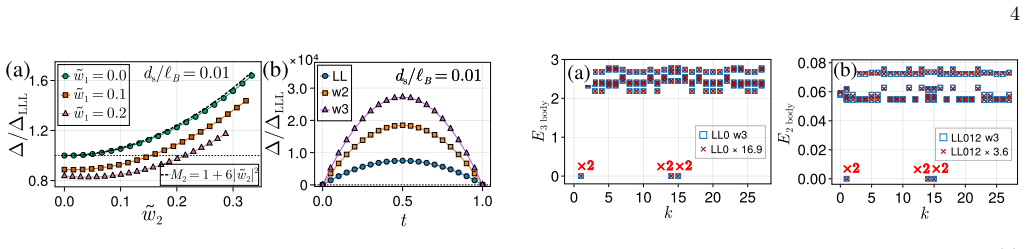
Different reciprocal-lattice Fourier components of the density modulation in flat Chern bands play sharply distinct roles: those at smaller wavevectors suppress the FCI gap whereas those at larger wavevectors enhance it. Suppressing the former and amplifying the latter makes the gap enhancement arbitrarily large in the projected flat-band theory, and the same enhancement factor rescales the full low-energy spectrum so that FCI excitations can be predicted from the corresponding Landau-level problem. This correspondence generalizes to non-Abelian states.
What carries the argument
Reciprocal-lattice Fourier components of the periodic electron-density modulations, classified by wavevector magnitude, which control gap size and rescale the excitation spectrum.
Load-bearing premise
The reciprocal-lattice Fourier components of the density modulation can be independently tuned or suppressed while keeping the band flat and preserving its Chern number.
What would settle it
A concrete lattice-model calculation in which suppressing small-wavevector density components and amplifying large-wavevector ones fails to increase the gap or rescale the spectrum by the predicted factor, or in which the tuning destroys band flatness or the Chern number.
If this is right
- FCI gaps can be increased without upper limit by appropriate engineering of density modulations.
- The full low-energy excitation spectrum of an FCI becomes a rescaled copy of the corresponding fractional quantum Hall spectrum.
- The same rescaling relation holds for non-Abelian fractional states.
- Reciprocal-lattice density components become practical diagnostics for selecting moiré Chern bands that host robust FCIs.
Where Pith is reading between the lines
- Moiré potentials could be designed to favor specific large-wavevector Fourier components, potentially producing experimentally accessible FCIs whose gaps rival those of fractional quantum Hall states.
- Numerical methods and trial wavefunctions developed for Landau levels could be imported to lattice models once the rescaling factor is known.
- The component-tuning principle may apply to other flat-band systems outside the moiré setting, offering a route to test the projected-theory limit.
Editorial analysis
A structured set of objections, weighed in public.
Referee Report
Summary. The paper claims that reciprocal-lattice Fourier components of density modulations in flat Chern bands play distinct roles: small-q components suppress the FCI gap while large-q components enhance it. By independently suppressing harmful small-q and amplifying beneficial large-q components, the gap enhancement can in principle be made arbitrarily large within the projected flat-band theory; the same factor rescales the entire low-energy spectrum, allowing FCI excitations to be predicted from the corresponding Landau-level problem. The correspondence is generalized to non-Abelian states and applied to moiré Chern bands as a diagnostic for robust FCIs.
Significance. If the central tuning principle holds, the work would supply both a practical diagnostic for gap robustness in moiré FCIs and a direct spectral correspondence to Landau-level problems, which would be a notable advance for the field. The manuscript does not, however, supply machine-checked proofs, reproducible code, or explicit parameter-free derivations that would strengthen the assessment.
major comments (2)
- [Abstract] Abstract and opening paragraphs: the claim that 'the gap enhancement can, in principle, be made arbitrarily large within the projected flat-band theory' rests on the assumption that small-q and large-q reciprocal-lattice Fourier components of the density modulation can be tuned independently while exactly preserving band flatness and Chern number. No explicit lattice potential, Hamiltonian, or projected-model construction is supplied that realizes the required component ratios without inducing dispersion or altering topology; this is load-bearing for the 'arbitrarily large' statement.
- [Abstract] The rescaling argument for the full low-energy spectrum (including the generalization to non-Abelian states) inherits the same tuning assumption. Without a concrete demonstration that the enhancement factor acts uniformly across the spectrum inside the projected theory, the predictive correspondence to Landau-level problems remains conditional on an unproven decoupling of Fourier components.
Simulated Author's Rebuttal
We thank the referee for the thoughtful review and for identifying areas where the assumptions in our claims require further clarification. We respond to the major comments point by point below. Our revisions will focus on making the scope of the projected flat-band theory explicit and adding supporting arguments for the rescaling.
read point-by-point responses
-
Referee: [Abstract] Abstract and opening paragraphs: the claim that 'the gap enhancement can, in principle, be made arbitrarily large within the projected flat-band theory' rests on the assumption that small-q and large-q reciprocal-lattice Fourier components of the density modulation can be tuned independently while exactly preserving band flatness and Chern number. No explicit lattice potential, Hamiltonian, or projected-model construction is supplied that realizes the required component ratios without inducing dispersion or altering topology; this is load-bearing for the 'arbitrarily large' statement.
Authors: We note that all claims are qualified as holding inside the projected flat-band theory, in which the band is constrained to be perfectly flat with a fixed Chern number. The Fourier components enter solely through the form factors in the projected interaction; within this effective theory these components are independent parameters. An explicit microscopic lattice model that achieves arbitrary ratios without dispersion would indeed be desirable but is not required for the validity of the principle we establish. We will revise the abstract and main text to emphasize this distinction and add a brief discussion of possible routes to realization in moiré systems. revision: partial
-
Referee: [Abstract] The rescaling argument for the full low-energy spectrum (including the generalization to non-Abelian states) inherits the same tuning assumption. Without a concrete demonstration that the enhancement factor acts uniformly across the spectrum inside the projected theory, the predictive correspondence to Landau-level problems remains conditional on an unproven decoupling of Fourier components.
Authors: The rescaling of the spectrum follows directly because the enhancement multiplies the strength of the entire projected interaction uniformly. Consequently, all energy scales in the low-energy manifold are multiplied by the same factor, including for non-Abelian states. We will insert a short derivation showing this uniform action on the spectrum in the revised manuscript. revision: yes
Circularity Check
No circularity detected; derivation self-contained
full rationale
The provided abstract and claims establish a physical principle distinguishing roles of small-q vs large-q Fourier components of density modulations within the projected flat-band model, leading to gap enhancement and spectrum rescaling. No equations, fitting procedures, self-citations, or ansatzes are visible that would reduce any prediction to an input by construction. The 'in principle' enhancement is framed as a consequence of the model's assumptions rather than a tautological redefinition or fitted output renamed as prediction. The central correspondence to Landau-level problems is presented as an external benchmark, not derived from self-referential steps. This is the expected honest non-finding for a theoretical proposal without visible self-referential structure.
Axiom & Free-Parameter Ledger
axioms (1)
- domain assumption Projected flat-band theory remains valid when density-modulation Fourier components are selectively suppressed or amplified.
read the original abstract
Fractional Chern insulators (FCIs) realize fractional quantum Hall topology in lattice bands, but their excitation spectra remain far less understood than their ground states. Here we establish a theoretical principle relating the periodic electron-density modulations of flat Chern bands to the many-body gap and excitation spectrum of FCIs. Contrary to the conventional view that such density modulations are detrimental to fractional topology, we show that different reciprocal-lattice Fourier components play sharply distinct roles: components at smaller reciprocal lattice vectors suppress the FCI gap, whereas components at larger reciprocal lattice vectors enhance it. By suppressing the harmful small-wave-vector components and amplifying the beneficial large-wave-vector components, the gap enhancement can, in principle, be made arbitrarily large within the projected flat-band theory. Moreover, the same enhancement factor rescales the full low-energy spectrum, making the FCI excitation spectrum predictable from the corresponding Landau-level problem. We further generalize this correspondence to non-Abelian states. Applying this principle to moir\'e Chern bands, we identify these reciprocal-lattice density components as practical diagnostics for robust FCIs.
Figures


Reference graph
Works this paper leans on
-
[1]
H. L. Stormer, D. C. Tsui, and A. C. Gossard, Reviews of Modern Physics71, S298 (1999)
1999
-
[2]
R. B. Laughlin, Reviews of Modern Physics71, 863 (1999). 6
1999
-
[3]
Tang, J.-W
E. Tang, J.-W. Mei, and X.-G. Wen, Phys. Rev. Lett. 106, 236802 (2011)
2011
-
[4]
K. Sun, Z. Gu, H. Katsura, and S. Das Sarma, Phys. Rev. Lett.106, 236803 (2011)
2011
-
[5]
Neupert, L
T. Neupert, L. Santos, C. Chamon, and C. Mudry, Phys. Rev. Lett.106, 236804 (2011)
2011
-
[6]
D. N. Sheng, Z.-C. Gu, K. Sun, and L. Sheng, Nat. Comm.2, 389 (2011)
2011
-
[7]
Regnault and B
N. Regnault and B. A. Bernevig, Phys. Rev. X1, 021014 (2011)
2011
-
[8]
D. Xiao, W. Zhu, Y. Ran, N. Nagaosa, and S. Okamoto, Nature Communications2(2011)
2011
-
[9]
B. A. Bernevig and N. Regnault, Physical Review B—Condensed Matter and Materials Physics85, 075128 (2012)
2012
-
[10]
Y.-H. Wu, J. K. Jain, and K. Sun, Phys. Rev. B86, 165129 (2012)
2012
-
[11]
S. A. Parameswaran, R. Roy, and S. L. Sondhi, Comptes Rendus Physique14, 816 (2013)
2013
-
[12]
Roy, Physical Review B90, 165139 (2014)
R. Roy, Physical Review B90, 165139 (2014)
2014
-
[13]
Repellin, T
C. Repellin, T. Neupert, Z. Papić, and N. Regnault, Physical Review B90, 045114 (2014)
2014
-
[14]
Y.-H. Wu, J. K. Jain, and K. Sun, Phys. Rev. B91, 041119 (2015)
2015
-
[15]
Repellin and T
C. Repellin and T. Senthil, Physical Review Research2, 023238 (2020)
2020
-
[16]
P. J. Ledwith, G. Tarnopolsky, E. Khalaf, and A. Vish- wanath, Physical Review Research2, 023237 (2020)
2020
-
[17]
S. H. Simon and M. S. Rudner, Physical Review B102, 165148 (2020)
2020
-
[18]
Z. Liu, A. Abouelkomsan, and E. J. Bergholtz, Physical Review Letters126, 026801 (2021)
2021
-
[19]
Mera and T
B. Mera and T. Ozawa, Physical Review B104, 115160 (2021)
2021
-
[20]
H. Li, U. Kumar, K. Sun, and S.-Z. Lin, Physical Review Research3, L032070 (2021)
2021
-
[21]
Devakul, V
T. Devakul, V. Crépel, Y. Zhang, and L. Fu, Nature Communications12, 6730 (2021)
2021
-
[22]
P. J. Ledwith, E. Khalaf, and A. Vishwanath, Annals of Physics435, 168646 (2021)
2021
-
[23]
J. Wang, J. Cano, A. J. Millis, Z. Liu, and B. Yang, Physical Review Letters127, 246403 (2021)
2021
-
[24]
Y. Xie, A. T. Pierce, J. M. Park, D. E. Parker, E. Khalaf, P. Ledwith, Y. Cao, S. H. Lee, S. Chen, P. R. Forrester, et al., Nature600, 439 (2021)
2021
-
[25]
J. Cai, E. Anderson, C. Wang, X. Zhang, X. Liu, W. Holtzmann, Y. Zhang, F. Fan, T. Taniguchi, K. Watanabe,et al., Nature622, 63 (2023)
2023
-
[26]
Y. Zeng, Z. Xia, K. Kang, J. Zhu, P. Knüppel, C. Vaswani, K. Watanabe, T. Taniguchi, K. F. Mak, and J. Shan, Nature622, 69 (2023)
2023
-
[27]
H. Park, J. Cai, E. Anderson, Y. Zhang, J. Zhu, X. Liu, C. Wang, W. Holtzmann, C. Hu, Z. Liu,et al., Nature 622, 74 (2023)
2023
-
[28]
F. Xu, Z. Sun, T. Jia, C. Liu, C. Xu, C. Li, Y. Gu, K. Watanabe, T. Taniguchi, B. Tong,et al., Physical Review X13, 031037 (2023)
2023
-
[29]
P. J. Ledwith, A. Vishwanath, and D. E. Parker, Phys- ical Review B108, 205144 (2023)
2023
-
[30]
A.-K. Wu, S. Sarkar, X. Wan, K. Sun, and S.-Z. Lin, Physical Review Research6, L032063 (2024)
2024
-
[31]
Z. Lu, T. Han, Y. Yao, A. P. Reddy, J. Yang, J. Seo, K. Watanabe, T. Taniguchi, L. Fu, and L. Ju, Nature 626, 759 (2024)
2024
-
[32]
J. Xie, Z. Huo, X. Lu, Z. Feng, Z. Zhang, W. Wang, Q. Yang, K. Watanabe, T. Taniguchi, K. Liu,et al., Na- ture Materials , 1 (2025)
2025
-
[33]
Y.-H. Wu, J. Jain, and K. Sun, Physical Review B—Condensed Matter and Materials Physics86, 165129 (2012)
2012
- [34]
-
[35]
M.-L. Schleith, T. Soejima, and E. Khalaf, arXiv preprint arXiv:2506.11211 (2025)
-
[36]
Z. Yan, Q. Li, T. Soejima, and E. Khalaf, arXiv preprint arXiv:2512.15863 (2025)
work page internal anchor Pith review arXiv 2025
-
[37]
K. Iyer, A. Feuerpfeil, V. Crépel, N. Regnault, and C. Mora, arXiv preprint arXiv:2604.24859 (2026)
work page internal anchor Pith review Pith/arXiv arXiv 2026
-
[38]
See supplementary materials, which includes Ref. []
-
[39]
B. M. Kousa, N. Morales-Durán, T. M. Wolf, E. Khalaf, and A. H. MacDonald, arXiv preprint arXiv:2502.17574 (2025)
work page internal anchor Pith review Pith/arXiv arXiv 2025
- [40]
-
[41]
H. Liu, K. Yang, A. Abouelkomsan, Z. Liu, and E. J. Bergholtz, Physical Review B111, L201105 (2025)
2025
-
[42]
S. Moitra and I. S. Villadiego, arXiv preprint arXiv:2509.18265 (2025)
work page internal anchor Pith review Pith/arXiv arXiv 2025
-
[43]
Aharonov and A
Y. Aharonov and A. Casher, Physical Review A19, 2461 (1979)
1979
-
[44]
Guerci, J
D. Guerci, J. Wang, and C. Mora, Physical Review B 112, L041108 (2025)
2025
-
[45]
(2) where a unit cell contains multiple flux quanta is also possible [60, 61], leading to multiple flat bands and unconventional frac- tional phases
Note that a generalization of Eq. (2) where a unit cell contains multiple flux quanta is also possible [60, 61], leading to multiple flat bands and unconventional frac- tional phases
-
[46]
F. D. M. Haldane, Physical Review Letters51, 605 (1983)
1983
-
[47]
S. A. Trugman and S. Kivelson, Physical Review B31, 5280 (1985)
1985
-
[48]
F. D. M. Haldane, inThe Quantum Hall Effect, edited by R. E. Prange and S. M. Girvin (Springer, New York, 1987)
1987
-
[49]
For pseudopotentials, the FCI ground state wavefunction is known to be the Laughlin wavefunction modulated byQNe i=1 h(ri)[16]
- [50]
-
[51]
E. H. Rezayi and F. D. M. Haldane, Physical Review Letters84, 4685 (2000)
2000
-
[52]
A. P. Reddy, N. Paul, A. Abouelkomsan, and L. Fu, Physical Review Letters133, 166503 (2024)
2024
-
[53]
In momentum space, the three-body pseudopotential is V(q 1,q 2)∝q 4 1q2
-
[54]
(7), one generates anisotropic terms and lower- order contributions such asq4 1,q 2 1q2 2,q 4 2,q 2 1, andq 2
Under shiftsq→q−Ganalogous to Eq. (7), one generates anisotropic terms and lower- order contributions such asq4 1,q 2 1q2 2,q 4 2,q 2 1, andq 2
-
[55]
Their matrix elements vanish identically in the LLL because fermionic three-particle wavefunctions necessarily contain the fac- tor(z 1 −z 2)(z2 −z 3)(z3 −z 1)
In real space these correspond to derivatives acting on the two delta functionsδ(r 1 −r 2)δ(r2 −r 3). Their matrix elements vanish identically in the LLL because fermionic three-particle wavefunctions necessarily contain the fac- tor(z 1 −z 2)(z2 −z 3)(z3 −z 1)
-
[56]
Wang, X.-W
C. Wang, X.-W. Zhang, X. Liu, Y. He, X. Xu, Y. Ran, T. Cao, and D. Xiao, Physical Review Letters132, 036501 (2024)
2024
-
[57]
J. Dong, J. Wang, P. J. Ledwith, A. Vishwanath, and D. E. Parker, Physical Review Letters131, 136502 (2023)
2023
-
[58]
Morales-Durán, J
N. Morales-Durán, J. Wang, G. R. Schleder, M. Angeli, 7 Z. Zhu, E. Kaxiras, C. Repellin, and J. Cano, Physical Review Research5, L032022 (2023)
2023
-
[59]
The approximation scheme is akin to [62], see SM [38] for details
-
[60]
Based on this, tMoTe2 ED spec- tra have been compared with ED spectra of Dirac par- ticles under inhomogeneous magnetic field [65]
Note that previously an adiabatic approximation to the continuum Hamiltonian of tMoTe2 was proposed [63, 64], which effectively maps the top valence band to Aharonov-Casher band. Based on this, tMoTe2 ED spec- tra have been compared with ED spectra of Dirac par- ticles under inhomogeneous magnetic field [65]. Here we are directly comparing with LLL under ...
-
[61]
In SM [38] we show that for this contin- uum model, the charge neutral gap atν= 1/3is smaller thanν= 2/3duetononzerobandwidthandparticle-hole asymmetry
In experiments on twisted MoTe 2, the FCI is most prominent nearν h = 2/3, while the FCI is weaker at νh = 1/3[66]. In SM [38] we show that for this contin- uum model, the charge neutral gap atν= 1/3is smaller thanν= 2/3duetononzerobandwidthandparticle-hole asymmetry
-
[62]
Sarkar, X
S. Sarkar, X. Wan, S.-Z. Lin, and K. Sun, Physical Re- view Letters135, 016501 (2025)
2025
-
[63]
Sarkar, X
S. Sarkar, X. Wan, A.-K. Wu, S.-Z. Lin, and K. Sun, Physical Review Letters135, 216501 (2025)
2025
-
[64]
Q. Gao, J. Dong, P. Ledwith, D. Parker, and E. Khalaf, Physical Review Letters131, 096401 (2023)
2023
-
[65]
N.Morales-Durán, N.Wei, J.Shi, andA.H.MacDonald, Physical Review Letters132, 096602 (2024)
2024
-
[66]
J. Shi, N. Morales-Durán, E. Khalaf, and A. H. Mac- Donald, Physical Review B110, 035130 (2024)
2024
-
[67]
B. Li, Y. Ouyang, and F. Wu, Physical Review B113, 195129 (2026)
2026
-
[68]
H. Pan, S. Yang, Y. Wang, X. Cai, W. Wang, Y. Zhao, K. Watanabe, T. Taniguchi, L. Zhang, Y. Liu,et al., Physical Review Letters136, 056601 (2026)
2026
-
[69]
X. Wan, S. Sarkar, S.-Z. Lin, and K. Sun, Physical Re- view Letters130, 216401 (2023)
2023
-
[70]
Haldane, Physical Review Letters55, 2095 (1985)
F. Haldane, Physical Review Letters55, 2095 (1985)
2095
-
[71]
F. Wu, T. Lovorn, E. Tutuc, I. Martin, and A. MacDon- ald, Physical Review Letters122, 086402 (2019)
2019
-
[72]
J. Yu, J. Herzog-Arbeitman, M. Wang, O. Vafek, B. A. Bernevig, and N. Regnault, Physical Review B109, 045147 (2024)
2024
-
[73]
Z. Liu, B. Mera, M. Fujimoto, T. Ozawa, and J. Wang, Physical Review X15, 031019 (2025)
2025
-
[74]
M(0) 2 2 d− M(0) 2 +M (1) 2 6 d3 + 2M(0) 2 + 4M(1) 2 +M (2) 2 15 d5 # +O(d 7),(S68) V LL0 1 =E C
A. M. Läuchli, Z. Liu, E. J. Bergholtz, and R. Moessner, Physical Review Letters111, 126802 (2013) Appendix A. Details of the (higher)-vortexable bands studied in main text Here we give a details of the conventions as well as the single particle bands we used for the ED results shown in the main text. Fig. A1(a) shows how the Fourier coefficientswG are or...
2013
discussion (0)
Sign in with ORCID, Apple, or X to comment. Anyone can read and Pith papers without signing in.