Coupled Spin-Orbital p-Wave Magnetism via Structural and Magnetic Chirality
Pith reviewed 2026-07-03 06:36 UTC · model grok-4.3
The pith
Spin-orbit coupling couples structural and magnetic chirality to create two distinct p-wave phases classified by relative chirality.
A machine-rendered reading of the paper's core claim, the machinery that carries it, and where it could break.
Core claim
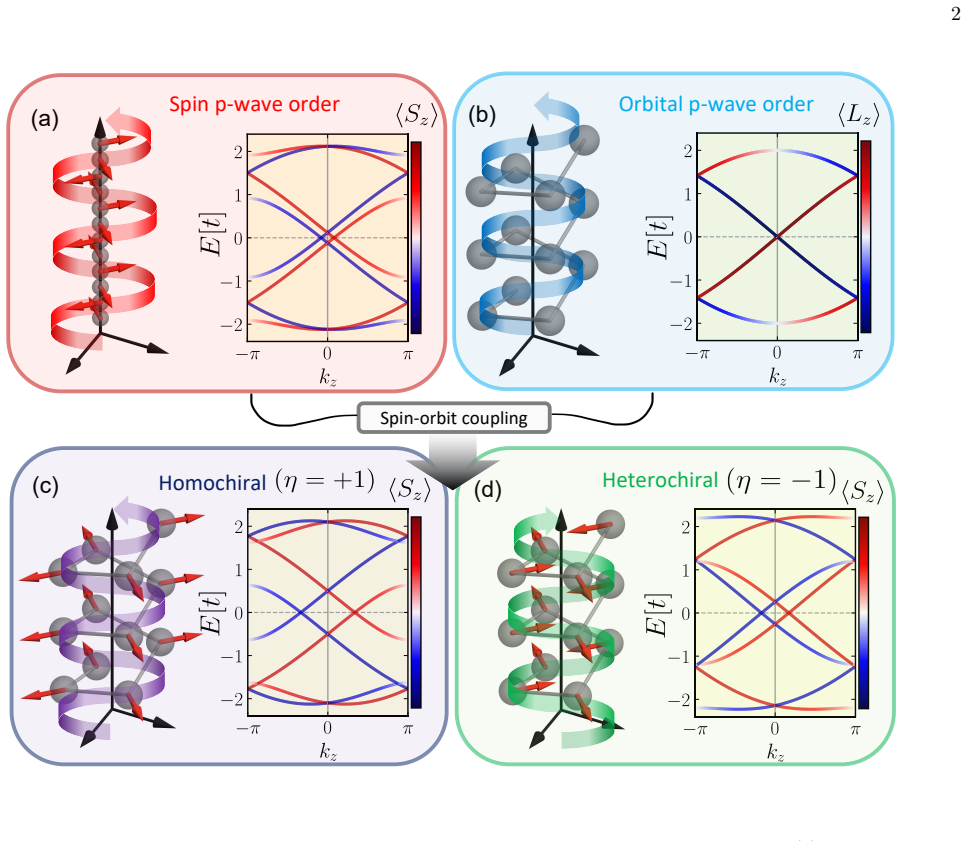
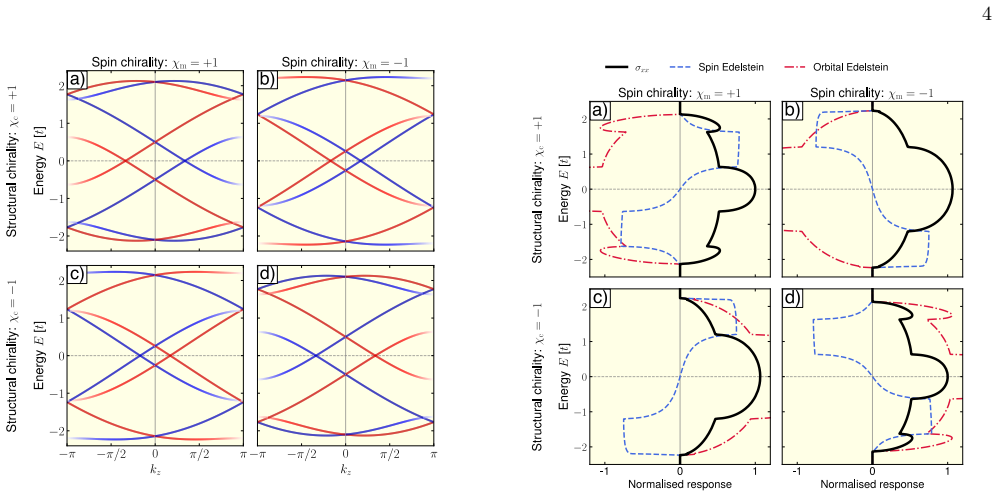
Spin-orbit coupling couples the orbital polarization of a chiral crystal to the spin polarization in a helical texture, adding to the p-wave spin splitting. The spin-orbital state is classified by the relative chirality η=χ_c χ_m. This gives two symmetry-distinct p-wave phases, homochiral and heterochiral, that are distinguishable by longitudinal conductivity measurements.
What carries the argument
Relative chirality η = χ_c χ_m that classifies homochiral versus heterochiral p-wave phases produced by spin-orbit coupling between structural and magnetic degrees of freedom.
Load-bearing premise
Structural orbital polarization and magnetic spin polarization act as independent chirality sources that are then linked by spin-orbit coupling, with their relative sign producing observable conductivity differences.
What would settle it
If experiments on a chiral magnet with switchable relative chirality find no difference in longitudinal conductivity between the two configurations, the distinction between the phases would be ruled out.
Figures
read the original abstract
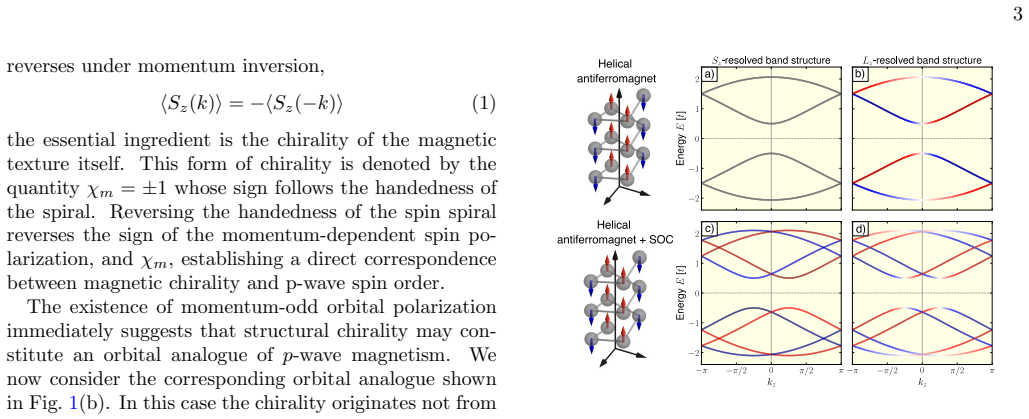
Helical spin textures represent the minimal realization of $p$-wave magnetism which is characterized by momentum-odd spin polarization. Independently, structurally chiral crystals exhibit momentum-odd orbital polarization arising from broken inversion symmetry. Here, we demonstrate that spin-orbit coupling couples these two independent microscopic chirality degrees of freedom, allowing the orbital polarization of a chiral crystal to generate an additional contribution to the $p$-wave spin splitting. The resulting spin-orbital state is naturally classified by the relative chirality $\eta=\chi_{\mathrm c}\chi_{\mathrm m}$, giving rise to two symmetry-distinct $p$-wave phases corresponding to homochiral and heterochiral configurations which can be directly probed by the longitudinal conductivity. These phases exhibit distinct transport signatures, establishing relative chirality as an experimentally accessible symmetry degree of freedom in chiral magnetic systems.
Editorial analysis
A structured set of objections, weighed in public.
Referee Report
Summary. The manuscript claims that spin-orbit coupling couples two independent microscopic chirality degrees of freedom—structural orbital polarization (χ_c) from broken inversion symmetry in chiral crystals and magnetic spin polarization (χ_m) from helical spin textures—producing an additional contribution to p-wave spin splitting. The resulting spin-orbital state is classified by the relative chirality η = χ_c χ_m, yielding two symmetry-distinct p-wave phases (homochiral and heterochiral). These phases are derived via point-group analysis of a model Hamiltonian whose symmetry-allowed terms produce distinct longitudinal conductivity tensors, providing an experimental probe of relative chirality.
Significance. If the result holds, the work is significant because it establishes relative chirality as an experimentally accessible symmetry degree of freedom in chiral magnetic systems, with direct transport signatures in longitudinal conductivity. Strengths include the use of a model Hamiltonian with symmetry-allowed terms enumerated by point-group analysis and the explicit demonstration that the conductivity tensors differ between homochiral and heterochiral cases exactly as required by the η label. The derivation is parameter-free in its symmetry classification and provides falsifiable predictions for transport measurements.
minor comments (1)
- The abstract and introduction would benefit from a brief statement of the specific point group(s) used in the analysis to allow readers to immediately connect the symmetry classification to known materials.
Simulated Author's Rebuttal
We thank the referee for their careful reading and positive assessment of our manuscript. The referee's summary accurately reflects the central claims regarding the coupling of structural and magnetic chirality via spin-orbit coupling and the resulting distinct p-wave phases distinguished by relative chirality η. We are pleased that the referee recognizes the significance of the transport signatures as an experimental probe and the parameter-free nature of the symmetry classification.
Circularity Check
No circularity; symmetry classification of coupled chiralities is independent of inputs
full rationale
The paper performs a standard point-group symmetry analysis on a model Hamiltonian to enumerate SOC-allowed terms that couple independent structural (χ_c) and magnetic (χ_m) chiralities. The relative chirality η = χ_c χ_m is introduced as a label for the resulting homochiral vs. heterochiral phases, with distinct longitudinal conductivity tensors following directly from the symmetry-allowed terms. No parameter is fitted to data and then relabeled as a prediction, no self-citation supplies a load-bearing uniqueness theorem, and the classification does not reduce any claimed result to its own definitional inputs. The derivation chain is self-contained against external symmetry benchmarks.
Axiom & Free-Parameter Ledger
axioms (1)
- domain assumption The orbital polarization from structural chirality and the spin polarization from magnetic chirality are independent microscopic degrees of freedom prior to spin-orbit coupling.
Reference graph
Works this paper leans on
-
[1]
Efficient Electrical Spin Splitter Based on Nonrelativistic Collinear Antiferromagnetism,
Rafael Gonz´ alez-Hern´ andez, Libor ˇSmejkal, Karel V´ yborn´ y, Yuta Yahagi, Jairo Sinova, Tom´ aˇ s Jungwirth, and Jakub ˇZelezn´ y, “Efficient Electrical Spin Splitter Based on Nonrelativistic Collinear Antiferromagnetism,” Phys. Rev. Lett.126, 127701 (2021), arXiv:2002.07073
-
[2]
Be- yond Conventional Ferromagnetism and Antiferromag- netism: A Phase with Nonrelativistic Spin and Crystal Rotation Symmetry,
Libor ˇSmejkal, Jairo Sinova, and Tomas Jungwirth, “Be- yond Conventional Ferromagnetism and Antiferromag- netism: A Phase with Nonrelativistic Spin and Crystal Rotation Symmetry,” Phys. Rev. X12, 031042 (2022)
2022
-
[3]
Libor ˇSmejkal, Jairo Sinova, and Tomas Jungwirth, “Emerging Research Landscape of Altermagnetism,” Phys. Rev. X12, 040501 (2022), arXiv:2204.10844
-
[4]
Altermagnetism Then and Now,
I I Mazin, “Altermagnetism Then and Now,” Phys. Rev. X (2024)
2024
-
[5]
Nanoscale imaging and control of alter- magnetism in MnTe,
O. J. Amin, A. Dal Din, E. Golias, Y. Niu, A. Za- kharov, S. C. Fromage, C. J. B. Fields, S. L. Heywood, R. B. Cousins, F. Maccherozzi, J. Krempask´ y, J. H. Dil, D. Kriegner, B. Kiraly, R. P. Campion, A. W. Rushforth, K. W. Edmonds, S. S. Dhesi, L. ˇSmejkal, T. Jungwirth, and P. Wadley, “Nanoscale imaging and control of alter- magnetism in MnTe,” Nature6...
2024
-
[6]
Observation of time-reversal symmetry breaking in the band structure of altermagnetic RuO2,
Olena Fedchenko, Jan Min´ ar, Akashdeep Akashdeep, Sunil Wilfred D’Souza, Dmitry Vasilyev, Olena Tkach, Lukas Odenbreit, Quynh Nguyen, Dmytro Kutnyakhov, Nils Wind, Lukas Wenthaus, Markus Scholz, Kai Ross- nagel, Moritz Hoesch, Martin Aeschlimann, Benjamin Stadtm¨ uller, Mathias Kl¨ aui, Gerd Sch¨ onhense, Tomas Jungwirth, Anna Birk Hellenes, Gerhard Jako...
-
[7]
All-electrically controlled spintronics in altermagnetic heterostructures,
Pei Hao Fu, Qianqian Lv, Yong Xu, Jorge Cayao, Jun Feng Liu, and Xiang Long Yu, “All-electrically controlled spintronics in altermagnetic heterostructures,” npj Quantum Mater. 2025 10110, 111– (2025), arXiv:2506.05504
-
[8]
Chiral-Angle-Controlled Altermagnetic Spin Splitting in Nanotubes
Ersoy S S ¸a¸ sıo˘ glu, Tom G Saunderson, B¨ orge G¨ obel, Ingrid Mertig, and Samir Lounis, “Chiral-Angle- Controlled Altermagnetic Spin Splitting in Nanotubes,” (2026), arXiv:2606.08757
work page internal anchor Pith review Pith/arXiv arXiv 2026
-
[9]
Anna Birk Hellenes, Tom´ aˇ s Jungwirth, Rodrigo Jaeschke-Ubiergo, Atasi Chakraborty, Jairo Sinova, and Libor ˇSmejkal, “P-wave magnets,” arXiv2309.01607 (2023), arXiv:2309.01607 [cond-mat.mtrl-sci]
work page internal anchor Pith review Pith/arXiv arXiv 2023
-
[10]
Minimal Mod- els and Transport Properties of Unconventionalp-Wave Magnets,
Bjørnulf Brekke, Pavlo Sukhachov, Hans Hans Gl¨ ockner Giil, Arne Brataas, and Jacob Linder, “Minimal Mod- els and Transport Properties of Unconventionalp-Wave Magnets,” Phys. Rev. Lett.133, 236703 (2024)
2024
-
[11]
Emergence ofp-wave collinear magnetism in antiferromagnets with reflection- asymmetric magnetic motifs,
Reynel C´ ardenas, Valeria Quintana, Lin-Ding Yuan, and Carlos Mera Acosta, “Emergence ofp-wave collinear magnetism in antiferromagnets with reflection- asymmetric magnetic motifs,” Phys. Rev. B113, 94431 (2026)
2026
-
[12]
Electrical switching of a p-wave magnet,
Qian Song, Srdjan Stavri´ c, Riccardo Comin, and Others, “Electrical switching of a p-wave magnet,” Nature642, 349–355 (2025)
2025
-
[13]
Highly efficient non- relativistic Edelstein effect in nodal p-wave magnets,
Atasi Chakraborty, Anna Birk Hellenes, Libor ˇSmejkal, Jairo Sinova, and Others, “Highly efficient non- relativistic Edelstein effect in nodal p-wave magnets,” Nat. Commun.16(2025), 10.1038/s41467-025-62516-0
-
[14]
P-wave magnetism in a metal,
Daniel McNally, “P-wave magnetism in a metal,” Nat. Mater.25, 16 (2026)
2026
-
[15]
Floquet Odd-Parity Collinear Mag- nets,
Tongshuai Zhu, Di Zhou, Huaiqiang Wang, Su Huai Wei, and Jiawei Ruan, “Floquet Odd-Parity Collinear Mag- nets,” Phys. Rev. Lett.136, 126704 (2026)
2026
-
[16]
Rolling Two-Dimensional Collinear Magnets into Chiral Nanotubes with $p$-Wave Magnetism
Zhejunyu Jin, Robin R. Neumann, Rodrigo Jaeschke- Ubiergo, Jairo Sinova, and Alexander Mook, “Rolling Two-Dimensional Collinear Magnets into Chiral Nanotubes withp-Wave Magnetism,” (2026), arXiv:2606.30214
work page internal anchor Pith review Pith/arXiv arXiv 2026
-
[17]
Chirality-dependentp-wave anti-altermagnetism and edelstein effect in analytically solvable spin-spiral model,
B¨ orge G¨ obel, Tom G. Saunderson, Lennart Schimpf, Freia Opfermann, Ersoy S ¸a¸ sıo˘ glu, and Samir Lou- nis, “Chirality-dependentp-wave anti-altermagnetism and edelstein effect in analytically solvable spin-spiral model,” (2026), manuscript in preparation
2026
-
[18]
Orbital Topology of Chiral Crystals for Orbitronics,
Kenta Hagiwara, Ying Jiun Chen, Dongwook Go, Xin Liang Tan, Sergii Grytsiuk, Kui Hon Ou Yang, Guo Jiun Shu, Jing Chien, Yi Hsin Shen, Xiang Lin Huang, Iulia Cojocariu, Vitaliy Feyer, Minn Tsong Lin, Stefan Bl¨ ugel, Claus Michael Schneider, Yuriy Mokrousov, and Christian Tusche, “Orbital Topology of Chiral Crystals for Orbitronics,” Adv. Mater.37, 2418040...
-
[19]
Intrinsic Spin and Orbital Hall Effects from Orbital Texture
Dongwook Go, Daegeun Jo, Changyoung Kim, and Hyun Woo Lee, “Intrinsic Spin and Orbital Hall Ef- fects from Orbital Texture,” Phys. Rev. Lett.121, 86602 (2018), arXiv:1804.02118
work page internal anchor Pith review Pith/arXiv arXiv 2018
-
[20]
Orbitronics: Orbital currents in solids,
Dongwook Go, Daegeun Jo, Hyun Woo Lee, Mathias Kl¨ aui, and Yuriy Mokrousov, “Orbitronics: Orbital currents in solids,” Europhys. Lett.135, 37001 (2021), arXiv:2107.08478
-
[21]
Chirality-induced Orbital Edelstein Effect in an Analyt- ically Solvable Model,
B¨ orge G¨ obel, Lennart Schimpf, and Ingrid Mertig, “Chirality-induced Orbital Edelstein Effect in an Analyt- ically Solvable Model,” Phys. Rev. Res.7, 33180 (2025)
2025
-
[22]
Orbital magnetization in crystalline solids: Multi-band insulators, Chern insulators, and met- als,
Davide Ceresoli, T Thonhauser, David Vanderbilt, and Raffaele Resta, “Orbital magnetization in crystalline solids: Multi-band insulators, Chern insulators, and met- als,” Phys. Rev. B74, 24408 (2006)
2006
-
[23]
Berry Phase Effects on Electronic Properties
Di Xiao, Ming Che Chang, and Qian Niu, “Berry phase effects on electronic properties,” Rev. Mod. Phys.82, 1959–2007 (2010), arXiv:0907.2021. 6
work page internal anchor Pith review Pith/arXiv arXiv 1959
-
[24]
Quantum Theory of Orbital Magnetization and its Generalization to Interacting Systems
Junren Shi, G. Vignale, Di Xiao, and Qian Niu, “Quan- tum Theory of Orbital Magnetization and Its Generaliza- tion to Interacting Systems,” Phys. Rev. Lett.99, 197202 (2007), arXiv:0704.3824
work page internal anchor Pith review Pith/arXiv arXiv 2007
-
[25]
Current-induced Orbital and Spin Magnetizations in Crystals with Helical Structure,
Taiki Yoda, Takehito Yokoyama, and Shuichi Murakami, “Current-induced Orbital and Spin Magnetizations in Crystals with Helical Structure,” Sci. Rep.5, 12024– (2015)
2015
-
[26]
Chirality-induced selectivity of angular momentum by orbital Edelstein effect in carbon nanotubes,
B¨ orge G¨ obel, Ingrid Mertig, and Samir Lounis, “Chirality-induced selectivity of angular momentum by orbital Edelstein effect in carbon nanotubes,” Commun. Phys.8, 395– (2025), arXiv:2504.07665
-
[27]
See Supplemental Material
-
[28]
Controlling the helicity of magnetic skyrmions in aβ-Mn-type high-temperature chiral mag- net,
K Karube, K Shibata, J S White, T Koretsune, X Z Yu, Y Tokunaga, H M Rønnow, R Arita, T Arima, Y Tokura, and Y Taguchi, “Controlling the helicity of magnetic skyrmions in aβ-Mn-type high-temperature chiral mag- net,” Phys. Rev. B98, 155120 (2018)
2018
-
[29]
A new class of chiral materials hosting magnetic skyrmions beyond room temperature,
Y Tokunaga, X Z Yu, J S White, H M Rønnow, D Morikawa, Y Taguchi, and Y Tokura, “A new class of chiral materials hosting magnetic skyrmions beyond room temperature,” Nat. Commun.6, 7638 (2015)
2015
-
[30]
Chiral Properties of Structure and Magnetism in Mn 1−xFexGe Compounds: When the Left and the Right are Fighting, Who Wins?
S V Grigoriev, N M Potapova, S.-A. Siegfried, V A Dyad- kin, E V Moskvin, V Dmitriev, D Menzel, C D De- whurst, D Chernyshov, R A Sadykov, L N Fomicheva, and A V Tsvyashchenko, “Chiral Properties of Structure and Magnetism in Mn 1−xFexGe Compounds: When the Left and the Right are Fighting, Who Wins?” Phys. Rev. Lett.110, 207201 (2013)
2013
-
[31]
Control of Dzyaloshinskii-Moriya Interaction in Mn1−xFexGe: A First-Principles Study,
Takashi Koretsune, Naoto Nagaosa, and Ryotaro Arita, “Control of Dzyaloshinskii-Moriya Interaction in Mn1−xFexGe: A First-Principles Study,” Sci. Rep.5, 13302 (2015)
2015
-
[32]
Towards control of the size and helicity of skyrmions in helimagnetic alloys by spin–orbit coupling,
K. Shibata, X. Z. Yu, T. Hara, D. Morikawa, N. Kanazawa, K. Kimoto, S. Ishiwata, Y. Matsui, and Y. Tokura, “Towards control of the size and helicity of skyrmions in helimagnetic alloys by spin–orbit coupling,” Nat. Nanotechnol.8, 723–728 (2013)
2013
discussion (0)
Sign in with ORCID, Apple, or X to comment. Anyone can read and Pith papers without signing in.