Rolling Two-Dimensional Collinear Magnets into Chiral Nanotubes with p-Wave Magnetism
Pith reviewed 2026-06-30 04:47 UTC · model grok-4.3
The pith
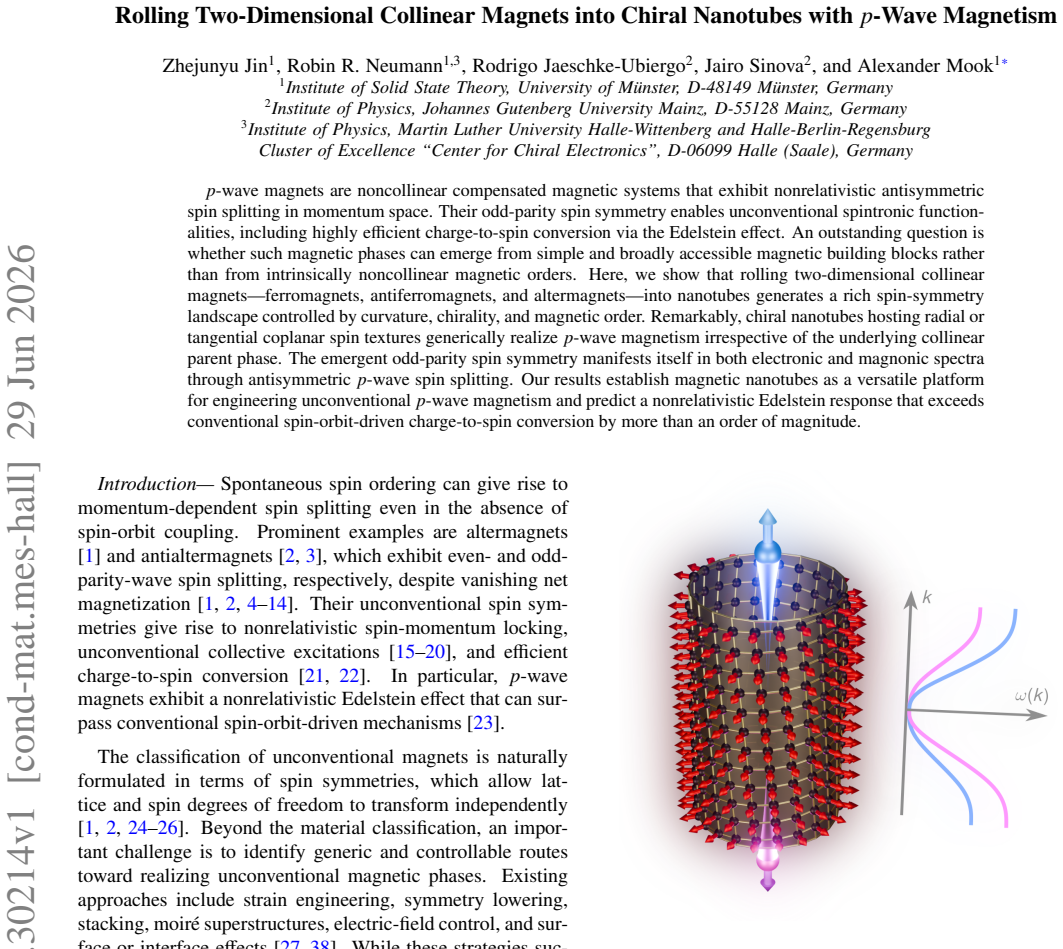
Rolling collinear magnets into chiral nanotubes with radial or tangential spin textures produces p-wave magnetism with antisymmetric spin splitting.
A machine-rendered reading of the paper's core claim, the machinery that carries it, and where it could break.
Core claim
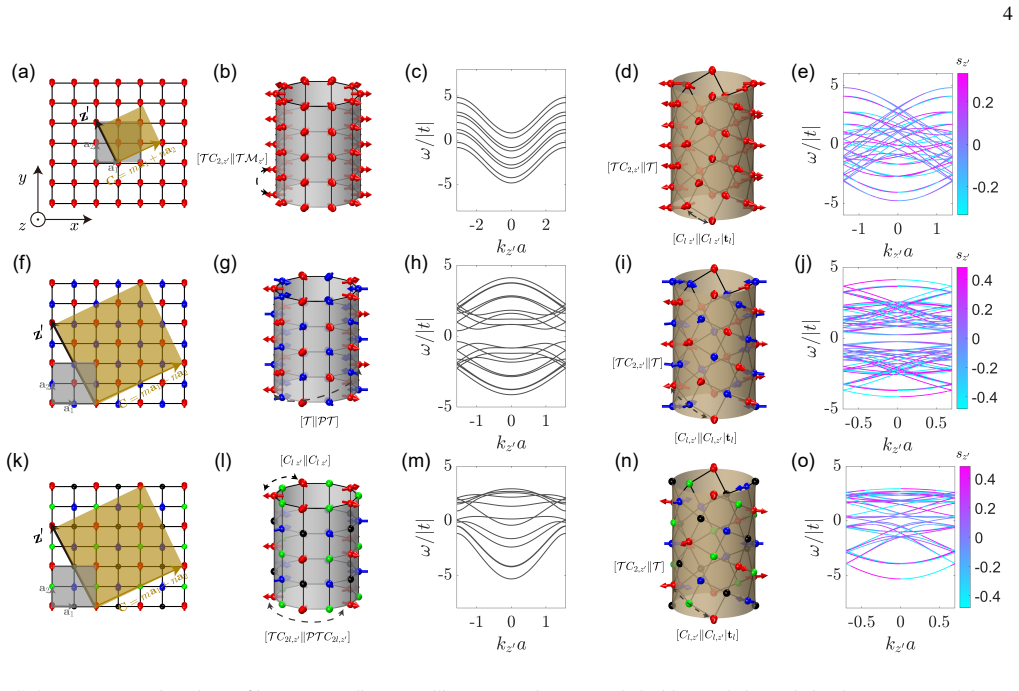
Rolling two-dimensional collinear magnets into chiral nanotubes generates p-wave magnetism when the nanotubes host radial or tangential coplanar spin textures. This occurs irrespective of the underlying collinear parent phase. The emergent odd-parity spin symmetry appears in both electronic and magnonic spectra as antisymmetric p-wave spin splitting.
What carries the argument
The chiral nanotube geometry that enforces radial or tangential coplanar spin textures on the rolled collinear magnetic layers.
If this is right
- The p-wave magnetism enables highly efficient charge-to-spin conversion via the Edelstein effect.
- Nonrelativistic Edelstein response exceeds conventional spin-orbit-driven conversion by more than an order of magnitude.
- The effect applies across ferromagnets, antiferromagnets, and altermagnets.
- Spin splitting occurs in both electronic bands and magnon spectra.
Where Pith is reading between the lines
- Nanotubes could serve as a platform to induce p-wave magnetism in a wide range of collinear materials without needing intrinsic noncollinear orders.
- Curvature and chirality provide a tunable way to control spin symmetry in low-dimensional magnets.
- This approach might extend to other curved geometries like nanoribbons for similar symmetry engineering.
Load-bearing premise
The rolling process induces or maintains radial or tangential coplanar spin textures purely through curvature and chirality, without introducing additional symmetry-breaking interactions.
What would settle it
Measuring the electronic band structure or magnon dispersion in a fabricated chiral magnetic nanotube and checking for the presence of antisymmetric p-wave spin splitting that is odd in momentum.
Figures
read the original abstract
$p$-wave magnets are noncollinear compensated magnetic systems that exhibit nonrelativistic antisymmetric spin splitting in momentum space. Their odd-parity spin symmetry enables unconventional spintronic functionalities, including highly efficient charge-to-spin conversion via the Edelstein effect. An outstanding question is whether such magnetic phases can emerge from simple and broadly accessible magnetic building blocks rather than from intrinsically noncollinear magnetic orders. Here, we show that rolling two-dimensional collinear magnets -- ferromagnets, antiferromagnets, and altermagnets -- into nanotubes generates a rich spin-symmetry landscape controlled by curvature, chirality, and magnetic order. Remarkably, chiral nanotubes hosting radial or tangential coplanar spin textures generically realize $p$-wave magnetism irrespective of the underlying collinear parent phase. The emergent odd-parity spin symmetry manifests itself in both electronic and magnonic spectra through antisymmetric $p$-wave spin splitting. Our results establish magnetic nanotubes as a versatile platform for engineering unconventional $p$-wave magnetism and predict a nonrelativistic Edelstein response that exceeds conventional spin-orbit-driven charge-to-spin conversion by more than an order of magnitude.
Editorial analysis
A structured set of objections, weighed in public.
Referee Report
Summary. The paper claims that rolling 2D collinear magnets (ferromagnets, antiferromagnets, altermagnets) into chiral nanotubes generates p-wave magnetism via curvature- and chirality-controlled radial or tangential coplanar spin textures, independent of the parent phase. This produces antisymmetric p-wave spin splitting in both electronic and magnonic spectra and a nonrelativistic Edelstein response exceeding conventional spin-orbit mechanisms by more than an order of magnitude.
Significance. If the symmetry mapping and model calculations hold, the work establishes magnetic nanotubes as a geometry-driven platform for realizing p-wave magnetism from widely available collinear orders, enabling unconventional spintronic responses without requiring intrinsically noncollinear magnetism or strong spin-orbit coupling. The explicit prediction of an enhanced Edelstein effect provides a concrete, testable signature.
major comments (2)
- [§3.2] §3.2, Hamiltonian (3): the assumption that rolling preserves purely radial/tangential coplanar textures without introducing additional out-of-plane or symmetry-breaking terms from curvature-induced strain or inter-layer coupling is load-bearing for the 'irrespective of parent phase' claim; an explicit check against possible extra terms in the nanotube Hamiltonian is needed to confirm the textures remain controlled solely by curvature and chirality.
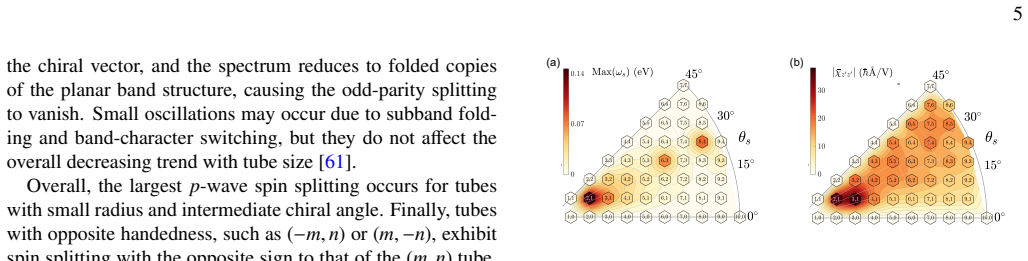
- [§5] §5, Fig. 5 and associated text: the reported Edelstein conductivity exceeding the spin-orbit benchmark by >10× relies on the p-wave splitting magnitude extracted from the nanotube band structure; the scaling with nanotube radius and chirality index should be shown explicitly to establish that the enhancement is generic rather than parameter-specific.
minor comments (3)
- The notation for the spin texture components (radial vs. tangential) is introduced in the abstract but defined only later; a brief inline definition or reference to Eq. (2) in the introduction would improve readability.
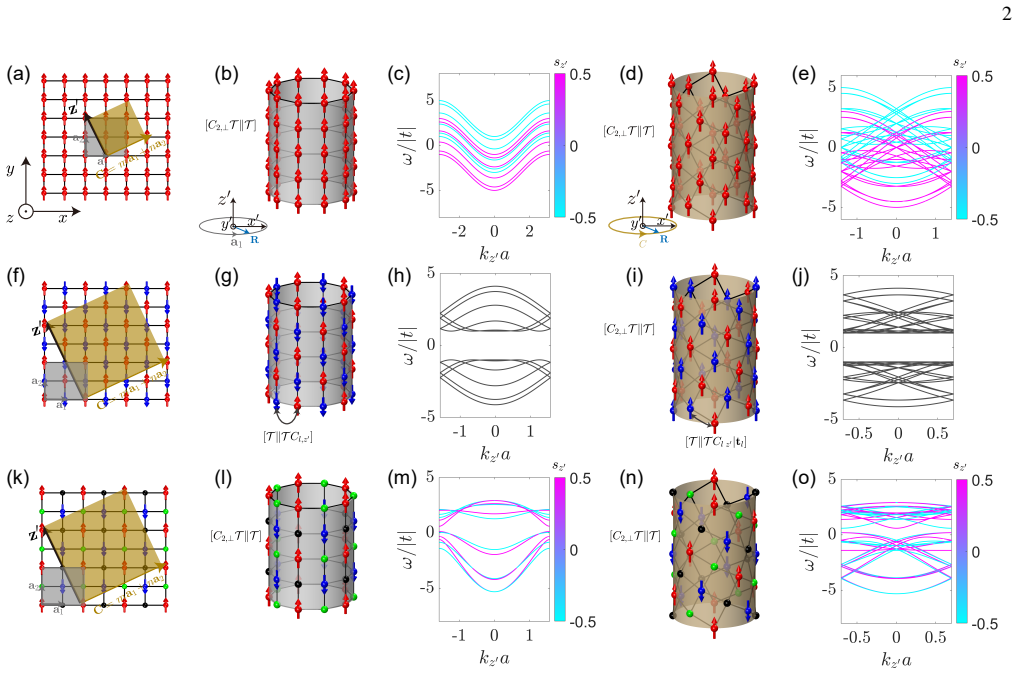
- Figure 2 caption: the color bar for the magnon dispersion splitting lacks units or a reference scale; adding this would clarify the magnitude of the p-wave effect.
- Reference list: several key works on altermagnetism and nanotube magnetism are cited, but the connection to prior curvature-induced magnetism papers could be strengthened with one additional sentence in the introduction.
Simulated Author's Rebuttal
We thank the referee for the positive assessment and constructive comments. We respond to each major comment below.
read point-by-point responses
-
Referee: [§3.2] §3.2, Hamiltonian (3): the assumption that rolling preserves purely radial/tangential coplanar textures without introducing additional out-of-plane or symmetry-breaking terms from curvature-induced strain or inter-layer coupling is load-bearing for the 'irrespective of parent phase' claim; an explicit check against possible extra terms in the nanotube Hamiltonian is needed to confirm the textures remain controlled solely by curvature and chirality.
Authors: We agree an explicit check strengthens the claim. In the revised manuscript we add a supplementary analysis of curvature-induced strain and inter-layer coupling for representative radii (>5 nm). These contributions appear as higher-order perturbations that preserve the coplanar radial/tangential character and the resulting p-wave symmetry; the leading Hamiltonian (3) is unchanged at the level relevant to the 'irrespective of parent phase' statement. revision: yes
-
Referee: [§5] §5, Fig. 5 and associated text: the reported Edelstein conductivity exceeding the spin-orbit benchmark by >10× relies on the p-wave splitting magnitude extracted from the nanotube band structure; the scaling with nanotube radius and chirality index should be shown explicitly to establish that the enhancement is generic rather than parameter-specific.
Authors: We thank the referee for this suggestion. The revised manuscript includes a new supplementary figure that plots the Edelstein conductivity versus nanotube radius R (5–20 nm) and chirality indices (n,m). The p-wave splitting scales as 1/R and the >10× enhancement relative to the spin-orbit benchmark persists across the displayed range, confirming the result is generic. revision: yes
Circularity Check
No significant circularity; derivation is symmetry-based and self-contained
full rationale
The paper derives p-wave magnetism in chiral nanotubes from rolling 2D collinear magnets by applying geometric curvature and chirality to generate radial/tangential coplanar spin textures, which then produce antisymmetric spin splitting in electronic and magnonic spectra. This mapping is presented as a generic consequence of symmetry considerations applied to any collinear parent phase (ferromagnets, antiferromagnets, altermagnets), without fitted parameters, self-definitional loops, or load-bearing self-citations. No equations or steps in the provided text reduce the central claim to its inputs by construction; the result follows from independent model calculations grounded in the nanotube geometry.
Axiom & Free-Parameter Ledger
axioms (1)
- domain assumption Rolling 2D collinear magnets induces radial or tangential coplanar spin textures controlled by curvature and chirality
Reference graph
Works this paper leans on
-
[1]
and antialtermagnets [2, 3], which exhibit even- and odd- parity-wave spin splitting, respectively, despite vanishing net magnetization [1, 2, 4–14]. Their unconventional spin sym- metries give rise to nonrelativistic spin-momentum locking, unconventional collective excitations [15–20], and efficient charge-to-spin conversion [21, 22]. In particular,p-wav...
work page internal anchor Pith review Pith/arXiv arXiv 2026
-
[2]
ˇSmejkal, J
L. ˇSmejkal, J. Sinova, and T. Jungwirth, Beyond Conventional Ferromagnetism and Antiferromagnetism: A Phase with Non- relativistic Spin and Crystal Rotation Symmetry, Phys. Rev. X 12, 031042 (2022)
2022
-
[3]
A. Hellenes, T. Jungwirth, R. Jaeschke-Ubiergo, A. Chakraborty, J. Sinova, L. ˘Smejkal, P-wave magnets, arXiv:2309.01607 (2023)
work page internal anchor Pith review Pith/arXiv arXiv 2023
-
[4]
Jungwirth, R
T. Jungwirth, R. M. Fernandes, E. Fradkin, A. H. MacDonald, J. Sinova, L. ˇSmejkal , Altermagnetism: An unconventional spin- ordered phase of matter, Newton1, 100162 (2025)
2025
-
[5]
ˇSmejkal, J
L. ˇSmejkal, J. Sinova, and T. Jungwirth, Emerging Research Landscape of Altermagnetism, Phys. Rev. X12, 040501 (2022)
2022
-
[6]
Hayami, Y
S. Hayami, Y . Yanagi, and H. Kusunose, Bottom-up design of spin-split and reshaped electronic band structures in antiferro- magnets without spin-orbit coupling: Procedure on the basis of augmented multipoles, Phys. Rev. B102, 144441 (2020)
2020
-
[7]
H. Ma, M. Hu, N. Li, J. Liu, W. Yao, J. Jia, and J. Liu, Multifunctional antiferromagnetic materials with giant piezo- magnetism and noncollinear spin current, Nat. Commun.391, 040501 (2022)
2022
-
[8]
P. A. McClarty and J. G. Rau, Landau Theory of Altermag- netism, Phys. Rev. Lett.132, 176702 (2024)
2024
-
[9]
Gomonay, V
O. Gomonay, V . P. Kravchuk, R. Jaeschke-Ubiergo, K. V . Yer- shov, T. Jungwirth, L. ˇSmejkal, J. van den Brink, and J. Sinova, Structure, control, and dynamics of altermagnetic textures, npj Spintronics2, 35 (2024)
2024
-
[10]
H. Ma, M. Hu, N. Li, J. Liu, W. Yao, J. Jia, and J. Liu, Mul- tifunctional antiferromagnetic materials with giant piezomag- netism and noncollinear spin current, Nat. Commun.12, 2846 (2021)
2021
-
[11]
X. Duan, J. Zhang, Z. Zhu, Y . Liu, Z. Zhang, Igor ˘Zuti´c, and T. Zhou, Antiferroelectric Altermagnets: Antiferroelectricity Al- ters Magnets, Phys. Rev. Lett.134, 106801 (2025)
2025
-
[12]
Osumi, S
T. Osumi, S. Souma, T. Aoyama, K. Yamauchi, A. Honma, K. Nakayama, T. Takahashi, K. Ohgushi, and T. Sato, Observation of a giant band splitting in altermagnetic MnTe, Phys. Rev. B 109, 115102 (2024)
2024
-
[13]
Jiang, M
B. Jiang, M. Hu, J. Bai, Z. Song, C. Mu, G. Qu, W. Li, W. Zhu, H. Pi, Z. Wei, Y . Sun, Y . Huang, X. Zheng, Y . Peng, L. He, S. Li, J. Luo, Z. Li, G. Chen, H. Li, H. Weng, and T. Qian, A metallic room-temperatured−wave altermagnet, Nat. Phys.21, 754 (2025)
2025
-
[14]
Brekke, P
B. Brekke, P. Sukhachov, H. Giil, A. Brataas, and J. Linder, Minimal Models and Transport Properties of Unconventional p−Wave Magnets, Phys. Rev. Lett.13, 236703 (2024)
2024
-
[15]
Q. Song, S. Stavri ´c, P. Barone, A. Droghetti, D. S. Antonenko, J. W. F. Venderbos, C. A. Occhialini, B. Ilyas, E. Ergec ¸en, N. Gedik, S. Cheong, R. M. Fernandes, S. Picozzi, R. Comin, and B. Hillebrands, Electrical switching of a p-wave magnet , Na- ture642, 64 (2025)
2025
-
[16]
ˇSmejkal, A
L. ˇSmejkal, A. Marmodoro, K. Ahn, R. Gonzalez-Hernandez, I. Turek, S. Mankovsky, H. Ebert, S. W. D’Souza, O. ˇSipr, J. Sinova, and T. Jungwirth, Chiral Magnons in Altermagnetic RuO2, Phys. Rev. Lett.131, 256703 (2023)
2023
-
[17]
Q. Cui, B. Zeng, P. Cui, T. Yu, and H. Yang, Efficient spin See- beck and spin Nernst effects of magnons in altermagnets, Phys. Rev. B108, L180401 (2023)
2023
-
[18]
Z. Jin, T. Gong, J. Liu, H. Yang, Z. Zeng, Y . Cao, and P. Yan, Strong Coupling of Chiral Magnons in Altermagnets, Phys. Rev. Lett.135, 126702 (2026)
2026
-
[19]
P. M. Gunnink, J. Sinova, and A. Mook, Surface Acoustic Wave Driven Acoustic Spin Splitter in ¨ı¿œd−Wave Altermag- netic Thin Films, Phys. Rev. Lett.136, 116706 (2026)
2026
-
[20]
Y . Yang, D. Wang, B. Yang, P. Wang, Y . Mu, Y . Tian, B. Zheng, W. Qin, K. Wang, B. Huang, B. Wang, X. Wan, and D. Wu, Altermagnet-Driven Magnon Spin Splitting Nernst Effect, Phys. Rev. Lett.136, 026701 (2026)
2026
-
[21]
R. Neumann, R. Jaeschke-Ubiergo, R. Zarzuela, L. ˇSmejkal, J. Sinova, and A. Mook, Odd-Parity-Wave Magnons and Nonrel- ativistic Thermal Edelstein Effect, arXiv:2603.05415 (2026)
-
[22]
Gonz ´alez-Hern´andez, L
R. Gonz ´alez-Hern´andez, L. ˇSmejkal, K. V ´yborn´y, Y . Yahagi, J. Sinova, T. Jungwirth, and J. ˇZelezn´y, Efficient Electrical Spin Splitter Based on Nonrelativistic Collinear Antiferromag- netism, Phys. Rev. Lett.126, 127701 (2021)
2021
-
[23]
H. Bai, Y . C. Zhang, Y . J. Zhou, P. Chen, C. H. Wan, L. Han, W. X. Zhu, S. X. Liang, Y . C. Su, X. F. Han, F. Pan, and C. Song, Efficient Spin-to-Charge Conversion via Altermagnetic Spin Splitting Effect in AntiferromagnetRuO2, Phys. Rev. Lett. 130, 216701 (2023)
2023
-
[24]
Chakraborty, A
A. Chakraborty, A. Hellenes, R. Jaeschke-Ubiergo, T. Jung- wirth, L. ˇSmejkal, and J. Sinova, Highly efficient non- relativistic Edelstein effect in nodalp−wave magnets, Nat. Commun.16, 7270 (2025)
2025
-
[25]
W. F. Brinkman and R. J. Elliott, Theory of Spin-Space Groups, Proc. R. Soc. A294, 343 (1996)
1996
-
[26]
D. B. Litvin and W. Opechowski, Spin Groups, Physica76, 538 (1974)
1974
-
[27]
D. B. Litvin, Spin Point Groups, Acta Crystallogr. Sect. A33, 279 (1977)
1977
-
[28]
Chakraborty, R
A. Chakraborty, R. Hern ´andez, L. ˘Smejkal, and J. Sinova, Strain-induced phase transition from antiferromagnet to alter- magnet, Phys. Rev. B109, 144421 (2024)
2024
-
[29]
P. Zhou, X. N. Peng, Y . Z. Hu, B. R. Pan, S. M. Liu, P. B. Lyu, and L. Z. Sun, Transition from antiferromagnets to alter- magnets: Symmetry-breaking theory, Phys. Rev. B112, 144419 (2025)
2025
-
[30]
Karetta, X
B. Karetta, X. H. Verbeek, R. Jaeschke-Ubiergo, L. ˇSmejkal, and J. Sinova, Strain-controlledg−tod−wave transition in al- termagnetic CrSb, Phys. Rev. B112, 094454 (2025)
2025
-
[31]
K. D. Belashchenko, Giant Strain-Induced Spin Splitting Effect in MnTe, ag−wave Altermagnetic Semiconductor, Phys. Rev. Lett.134, 086701 (2025)
2025
-
[32]
M. Khodas, Sai Mu, I. I. Mazin, K. D. Belashchenko, Tuning of altermagnetism by strain, arXiv:2506.06257 (2025)
- [33]
-
[34]
Y . Liu, J. Yu, and C. Liu, Twisted Magnetic Van der Waals Bi- layers: An Ideal Platform for Altermagnetism, Phys. Rev. Lett. 133, 206702 (2025)
2025
-
[35]
D. Wang, H. Wang, L. Liu, J. Zhang, and H. Zhang, Electric-Field-Induced Switchable Two-Dimensional Alter- magnets, Nano Lett.25, 498 (2025)
2025
-
[36]
Zeng and Y
S. Zeng and Y . Zhao, Bilayer stackingA−type altermagnet: A general approach to generating two-dimensional altermag- 7 netism, Phys. Rev. B110, 174410 (2024)
2024
-
[37]
C. Lange, R. Jaeschke-Ubiergo, A. Chakraborty, X. H. Verbeek, L. ˇSmejkal, J. Sinova, A. Mook, Emergent altermagnetism at surfaces of antiferromagnets: full symmetry classification and material identification, arXiv:2602.08773 (2026)
work page internal anchor Pith review Pith/arXiv arXiv 2026
-
[38]
$d$-wave Surface Altermagnetism in Centrosymmetric Collinear Antiferromagnets
E. Sasioglu, I. Mertig, S. Lounis,d−Wave Surface Alter- magnetism in Centrosymmetric Collinear Antiferromagnets, arXiv:2602.08790 (2026)
work page internal anchor Pith review Pith/arXiv arXiv 2026
- [39]
-
[40]
B. Li, D. Shao, and A. A. Kovalev, Floquet Spin Splitting and Spin Generation in Antiferromagnets, Phys. Rev. Lett.136, 166701 (2026)
2026
-
[41]
Huang, Z
S. Huang, Z. Qin, F. Zhan, D. Xu, D. Ma, and R. Wang, Light- Induced Odd-Parity Magnetism in Conventional Antiferromag- netism, Phys. Rev. Lett.136, 126703 (2026)
2026
- [42]
-
[43]
D. Liu, Z. Zhuang, D. Zhu, Z. Wu, and Z. Yan, Light-induced odd-parity altermagnets on dimerized lattices, Phys. Rev. B 113, L060409 (2026)
2026
- [44]
-
[45]
Kravchuk, D
V . Kravchuk, D. D. Sheka, A. K´akay, O. M. V olkov, U. R¨oßler, J. Brink, D. Makarov, and Y . Gaididei, Multiplet of Skyrmion States on a Curvilinear Defect: Reconfigurable Skyrmion Lat- tices, Phys. Rev. Lett.120, 067201 (2018)
2018
-
[46]
Yershov, O
K. Yershov, O. Gomonay, J. Sinova, J. Brink, and V . Kravchuk, Curvature-Induced Magnetization of Altermagnetic Films, Phys. Rev. Lett.134, 116701 (2025)
2025
-
[47]
Bittencourt, S
G. Bittencourt, S. Castillo-Sep ´ulveda, O. Chubykalo-Fesenko, R. Moreno, D. Altbir, and V . L. Carvalho-Santos, Domain wall damped harmonic oscillations induced by curvature gradients in elliptical magnetic nanowires, Phys. Rev. B106, 174424 (2022)
2022
-
[48]
Yershov, A
K. Yershov, A. K´akay, and V olodymyr P. Kravchuk, Curvature- induced drift and deformation of magnetic skyrmions: Com- parison of the ferromagnetic and antiferromagnetic cases, Phys. Rev. B105, 054425 (2022)
2022
-
[49]
J. Yang, H. Park, G. Park, C. Abert, D. Suess, and S. Kim, Robust formation of skyrmion and skyrmionium in magnetic hemispherical shells and their dynamic switching, Phys. Rev. B 104, 134427 (2022)
2022
-
[50]
Kravchuk, U
V . Kravchuk, U. R¨oßler, O. M. V olkov, D. Sheka, J. Brink, D. Makarov, H. Fuchs, H. Fangohr, and Y . Gaididei, Phys. Rev. B 94, 144402 (2016)
2016
- [51]
-
[52]
G ¨obel, I
B. G ¨obel, I. Mertig, and S. Lounis , Chirality-induced selectiv- ity of angular momentum by orbital Edelstein effect in carbon nanotubes, Commun. Phys.8, 395 (2025)
2025
-
[53]
Landeros, O
P. Landeros, O. J. Suarez, A. Cuchillo, and P. Vargas, Equilib- rium states and vortex domain wall nucleation in ferromagnetic nanotubes, Phys. Rev. B79, 024404 (2009)
2009
-
[54]
M. Yan, C. Andreas, A. K ´akay, F. Garc´ıa-S´anchez, R. Hertel, Chiral symmetry breaking and pair-creation mediated Walker breakdown in magnetic nanotubes, Appl. Phys. Lett.100, 252401 (2012)
2012
-
[55]
J. A. Ot ´alora, M. Yan, H. Schultheiss, R. Hertel, A. K ´akay, Asymmetric spin-wave dispersion in ferromagnetic nanotubes induced by surface curvature, Phys. Rev. B95, 184415 (2017)
2017
-
[56]
K ¨orber, I
L. K ¨orber, I. K´ezsm´arki, and A. K ´akay, Mode splitting of spin waves in magnetic nanotubes with discrete symmetries, Phys. Rev. B105, 184435 (2022)
2022
-
[57]
R. A. Gallardo, P. Alvarado-Seguel, and P. Landeros, High spin-wave asymmetry and emergence of radial standing modes in thick ferromagnetic nanotubes, Phys. Rev. B105, 104435 (2022)
2022
-
[58]
K ¨orber, R
L. K ¨orber, R. Verba, Jorge A. Ot´alora, V . Kravchuk, J. Lindner, J. Fassbender, and A. K ´akay, Curvilinear spin-wave dynamics beyond the thin-shell approximation: Magnetic nanotubes as a case study, Phys. Rev. B106, 014405 (2022)
2022
-
[59]
Ajayan and T
P. Ajayan and T. Ebbesen, Nanometre-size tubes of carbon, Rep. Prog. Phys.60, 1025 (1997)
1997
-
[60]
Laird, F
E. Laird, F. Kuemmeth, G. Steele, K. Grove-Rasmussen, J. Nygård, K. Flensberg, and L. Kouwenhoven, Quantum trans- port in carbon nanotubes, Rev. Mod. Phys.87, 703 (2015)
2015
-
[61]
Zhang, L
S. Zhang, L. Kang, X Wang, L. Tong, L. Yang, Z. Wang, K. Qi, S. Deng, Q. Li,, X. Bai, F. Ding, and J. Zhang, Arrays of horizontal carbon nanotubes of controlled chirality grown using designed catalysts, Nature543, 234 (2017)
2017
-
[62]
I), spin-degenerate bands in altermagnetic achiral nanotubes (Sec
See Supplemental Material at http://link.aps.org/supplemental/ for suppressed transverse spin polarization in magnetic nan- otubes (Sec. I), spin-degenerate bands in altermagnetic achiral nanotubes (Sec. II), opposite spin splitting from reversed chiral- ity in chiral nanotubes (Sec. III), geometry-dependentp−wave band structures (Sec. IV), effects of spi...
-
[63]
Ezawa, Out-of-plane Edelstein effects: Electric field in- duced magnetization inp−wave magnets, Phys
M. Ezawa, Out-of-plane Edelstein effects: Electric field in- duced magnetization inp−wave magnets, Phys. Rev. B111, L161301 (2025)
2025
-
[64]
Z. Liu, M. Ozeki, S. Asai, S. Itoh, and T. Masuda, Chiral Split Magnon in Altermagnetic MnTe, Phys. Rev. Lett.133, 156702 (2024)
2024
-
[65]
Okuma, Magnon Spin-Momentum Locking: Various Spin V ortices and Dirac magnons in Noncollinear Antiferromagnets, Phys
N. Okuma, Magnon Spin-Momentum Locking: Various Spin V ortices and Dirac magnons in Noncollinear Antiferromagnets, Phys. Rev. Lett.119, 107205 (2017)
2017
-
[66]
Neumann, A
R. Neumann, A. Mook, J. Henk, and I. Mertig, Orbital Mag- netic Moment of Magnons, Phys. Rev. Lett.125, 117209 (2020)
2020
-
[67]
B. Li, A. Mook, A. Raeliarijaona, and A. Kovalev, Magnonic analog of the Edelstein effect in antiferromagnetic insulators, Phys. Rev. B101, 024427 (2020)
2020
-
[68]
Holstein and H
T. Holstein and H. Primakoff, Field dependence of the intrinsic domain magnetization of a ferromagnet, Phys. Rev.58, 1098 (1940)
1940
-
[69]
Edstr ¨om, D
A. Edstr ¨om, D. Amoroso, S. Picozzi, P. Barone, and M. Sten- gel, Curved Magnetism in CrI 3, Phys. Rev. Lett.128, 177202 (2022)
2022
- [70]
-
[71]
D. I. Badrtdinov, G. V . Pushkarev, M. I. Katsnelson, and A. N. Rudenko, Electron transport and scattering mechanisms in ferromagnetic monolayer Fe3GeTe2, npj 2D Mater. Appl.7, 53 (2023)
2023
-
[72]
Gonz ´alez-Hern´andez, P
R. Gonz ´alez-Hern´andez, P. Ritzinger, K. V ´yborn´y, J. ˘Zelezn´y, and A. Manchon, Non-relativistic torque and Edelstein effect in non-collinear magnets, Nat. Commun.15, 7663 (2024)
2024
-
[73]
V . P. Kravchuk, K. V . Yershov, B. Pradenas, R. R. Neumann, R. Jaeschke-Ubiergo, R. Zarzuela, J. Sinova, J. Brink, and A. Mook, Nonlinear Magnon Magnetic Moment Transport in Triangular-Lattice f-Wave Antialtermagnets, arXiv:2605.22614 8 (2026)
work page internal anchor Pith review Pith/arXiv arXiv 2026
-
[74]
Ersoy Sasioglu, Tom. G. Saunderson, B¨orge G¨obel, Ingrid Mer- tig, Samir Lounis, Chiral-Angle-Controlled Altermagnetic Spin Splitting in Nanotubes, arXiv:2606.08757 (2026). END MA TTER Appendix A:Tight-binding model—To verify our symmetry analysis, we employ a tight-binding model with isotropics-d exchange interaction, He =− X i,j,σ ti,j c† i,σc j,σ −µ X...
work page internal anchor Pith review Pith/arXiv arXiv 2026
discussion (0)
Sign in with ORCID, Apple, or X to comment. Anyone can read and Pith papers without signing in.