Impact of Anomalous Microwave Emission (AME) on Radio Spectral Energy Distributions: SKA Observations of Galaxies Near and Far
Pith reviewed 2026-06-25 20:11 UTC · model grok-4.3
The pith
Thermal free-free emission dominates the radio continuum of distant galaxies at about 10 GHz, with negligible AME contribution.
A machine-rendered reading of the paper's core claim, the machinery that carries it, and where it could break.
Core claim
Thermal free-free emission dominates the radio continuum emission for distant galaxies at approximately 10 GHz frequency with negligible contribution from AME. The significance of AME is determined by the size of the AME region relative to the observing beam and ISM hydrogen column density. High-angular resolution observation of nearby galaxies resolving individual star forming regions may need multi-frequency observations to avoid potential bias from AME in star formation rate measurements from single frequency observation.
What carries the argument
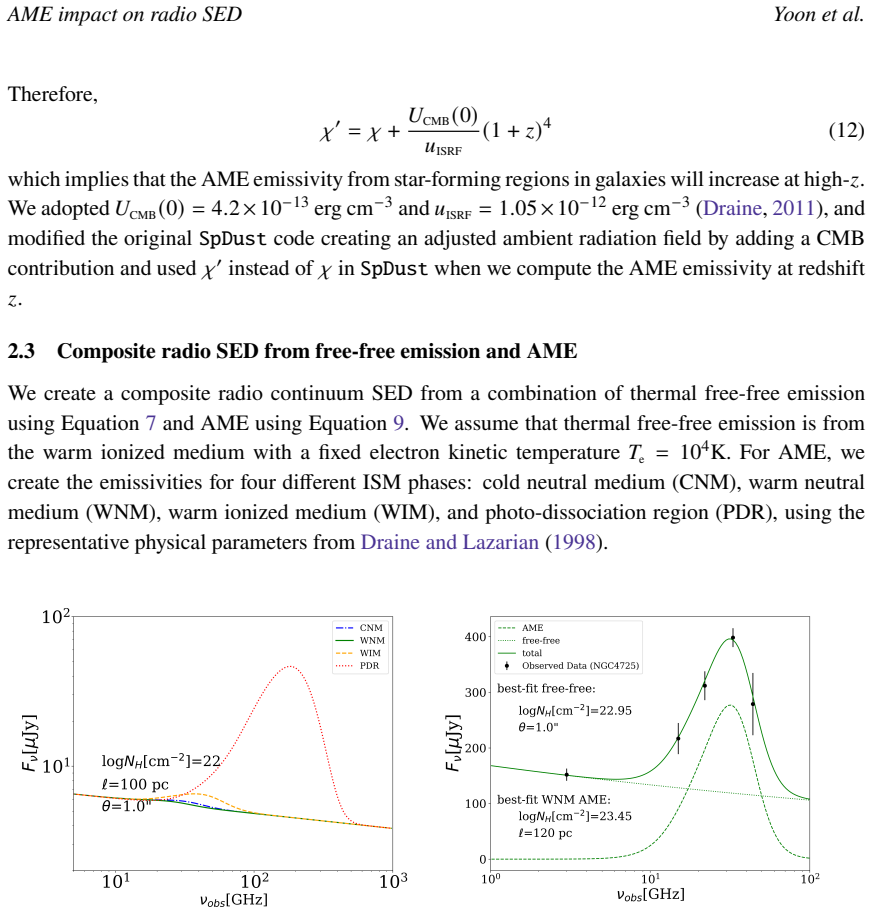
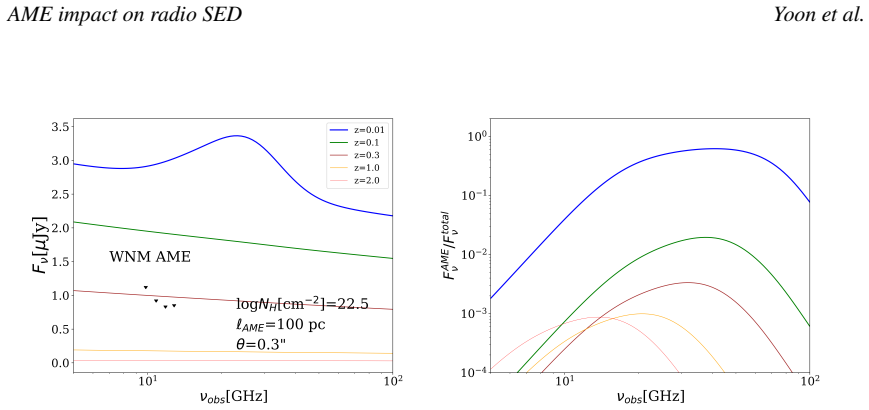
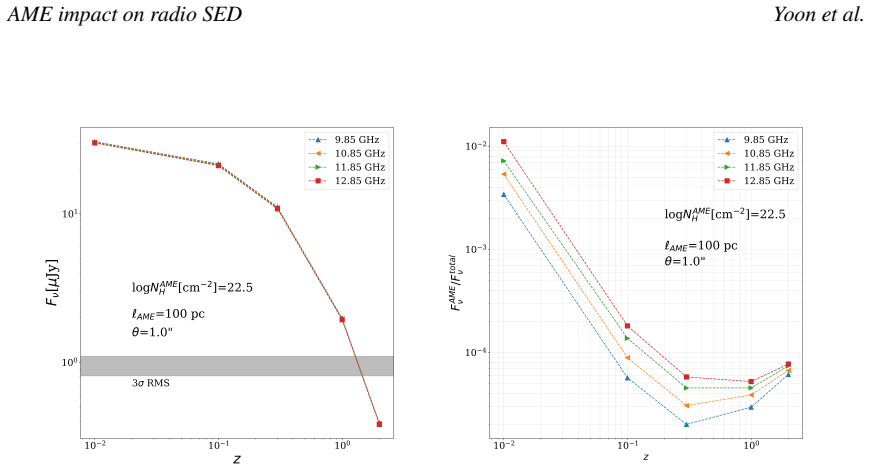
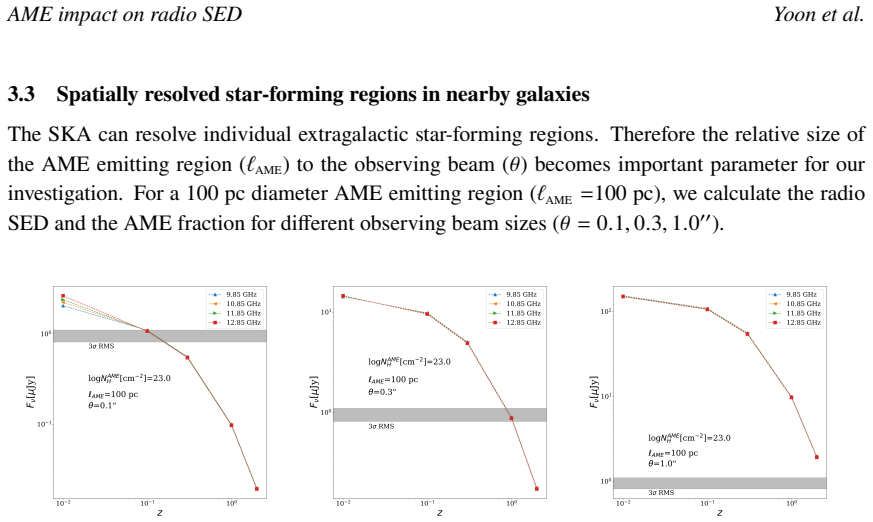
Calculations of observable flux density for free-free emission versus AME, incorporating beam size, redshift, and ISM column density to model the radio spectral energy distribution.
If this is right
- Single-frequency SKA observations at approximately 10 GHz can measure star formation rates in distant galaxies without significant AME contamination.
- AME can bias star formation rate estimates from single-frequency data when high-angular-resolution observations resolve individual regions in nearby galaxies.
- AME contribution grows with higher ISM hydrogen column densities and when the AME-emitting area occupies a larger fraction of the observing beam.
- Redshift shifts the observed frequency of any AME feature, further reducing its impact on 10 GHz measurements of high-redshift sources.
Where Pith is reading between the lines
- Models could be extended to predict at which lower observed frequencies AME might become detectable in high-redshift samples after accounting for redshift.
- The conclusion supports continued use of existing radio SFR calibrations for SKA-era surveys provided the observing frequency is chosen near 10 GHz in the rest frame.
- Direct comparison of resolved AME maps in local galaxies with integrated high-redshift measurements could test whether beam dilution fully explains the negligible contribution.
Load-bearing premise
The significance of AME is determined by the size of the AME region relative to the observing beam and the ISM hydrogen column density.
What would settle it
Detection of an AME-like spectral excess or bump in the radio SED of a high-redshift galaxy observed near 10 GHz that cannot be explained by free-free emission alone.
Figures
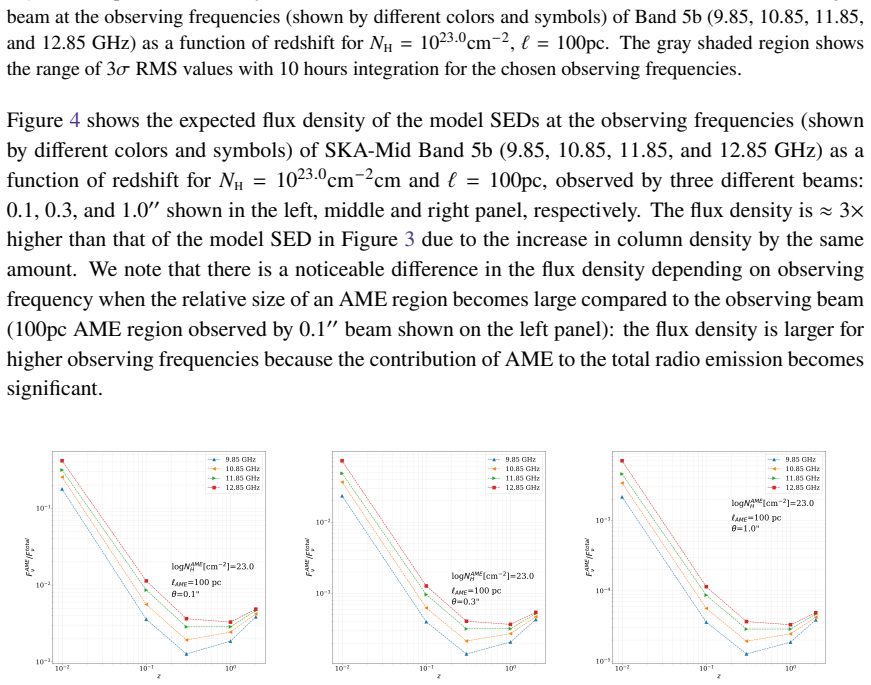
read the original abstract
Radio continuum emission powered by the thermal bremsstrahlung process is a clean, dust-free tracer of star formation in galaxies. However, the existence of anomalous microwave emission (AME) that is also prominent in a similar frequency range may challenge the use of thermal radio continuum emission to measure the star formation rates of galaxies. So while the nature of AME and the ISM conditions that lead to strong observable AME are still not well understood, the impact of AME on the radio emission from galaxies needs to be investigated for the SKA, which will be sensitive to large numbers of faint, high-redshift galaxies. In this chapter, we compute the observable flux density of free-free emission and AME and investigate the impact of AME on the galaxy radio spectral energy distribution for given observing frequencies and redshifts. Our conclusion is that (1) significance of AME is determined by the size of the AME region relative to the observing beam and ISM hydrogen column density, (2) thermal free-free emission dominates the radio continuum emission for distant galaxies at $\approx 10$ GHz frequency with negligible contribution from AME, (3) high-angular resolution observation of nearby galaxies resolving individual star forming region may need multi-frequency observations to avoid a potential bias from AME in the measure of star formation rate from single frequency observation.
Editorial analysis
A structured set of objections, weighed in public.
Referee Report
Summary. The manuscript computes the observable flux densities of thermal free-free emission and anomalous microwave emission (AME) as functions of frequency, redshift, beam size, and ISM hydrogen column density to assess AME contamination in radio spectral energy distributions. It concludes that (1) AME significance is set by the ratio of the AME-emitting region size to the observing beam and the hydrogen column density, (2) free-free emission dominates the radio continuum at observed frequencies of approximately 10 GHz for distant galaxies with negligible AME contribution, and (3) high-angular-resolution observations of individual star-forming regions in nearby galaxies may require multi-frequency data to avoid bias in single-frequency star-formation-rate estimates.
Significance. If the underlying computations and scaling relations hold, the work provides a practical criterion for when AME can be neglected in SKA radio observations of high-redshift galaxies, strengthening the use of free-free emission as a dust-free star-formation tracer. The explicit dependence on beam size and column density yields falsifiable predictions for both nearby resolved and distant unresolved sources.
major comments (1)
- [Abstract] Abstract: the central claims rest on explicit computations of free-free and AME flux densities, yet the abstract (and the provided manuscript text) contains no equations, model parameters, emissivity prescriptions, or validation against observed AME spectra or free-free measurements; without these the dominance of free-free at ~10 GHz for distant galaxies cannot be independently verified.
minor comments (1)
- [Abstract] The abstract refers to 'this chapter,' suggesting the work is excerpted from a larger document; the manuscript should clarify its standalone scope and include the relevant model equations in the main text.
Simulated Author's Rebuttal
We thank the referee for their constructive review and for highlighting the need for greater transparency in the abstract. We address the single major comment below.
read point-by-point responses
-
Referee: [Abstract] Abstract: the central claims rest on explicit computations of free-free and AME flux densities, yet the abstract (and the provided manuscript text) contains no equations, model parameters, emissivity prescriptions, or validation against observed AME spectra or free-free measurements; without these the dominance of free-free at ~10 GHz for distant galaxies cannot be independently verified.
Authors: We agree that the abstract, as currently written, is a high-level summary and does not contain the explicit equations, emissivity prescriptions, or parameter values. The full manuscript derives the free-free flux density from the standard thermal bremsstrahlung emissivity (e.g., the Gaunt factor approximation and electron temperature dependence) and the AME flux from a spinning-dust model normalized to observed AME spectra in the Milky Way and nearby galaxies, with explicit dependence on hydrogen column density and beam filling factor. These details appear in Sections 2 and 3. To make the central claims more verifiable from the abstract alone, we will revise it to include a concise statement of the adopted emissivity prescriptions and the key scaling parameters (column density, beam size, redshift). revision: yes
Circularity Check
No significant circularity identified
full rationale
The paper computes observable flux densities of free-free emission and AME from external models as explicit functions of frequency, redshift, beam size, and ISM column density. Conclusions (1)–(3) follow directly from these scalings without any self-definitional equations, fitted parameters renamed as predictions, or load-bearing self-citations. The central claim that free-free dominates at observed ~10 GHz for distant galaxies is an independent computation against external benchmarks and does not reduce to its inputs by construction.
Axiom & Free-Parameter Ledger
Reference graph
Works this paper leans on
-
[1]
doi: 10.1111/j.1365-2966.2009.14599.x. E. S. Battistelli et al.Astrophys. J. Lett., 877(2):L31, June
-
[2]
doi: 10.3847/2041-8213/ab21de. R. J. Beswick et al.PoS, AASKA14:070,
-
[3]
doi: 10.22323/1.215.0070. S. Bianchi et al.Astron. Astrophys., 658:L8, Feb
-
[4]
doi: 10.1051/0004-6361/202142684. R.Braunetal. Anticipatedperformanceofthesquarekilometrearray–phase1(ska1),2019. URL https://arxiv.org/abs/1912.12699. S. Casassus et al.Mon. Not. R. Astron. Soc., 391(3):1075–1090, Dec
-
[6]
L.P.CrosthwaiteandJ.L.Turner.Astron
doi: 10.1051/0004-6361/202557211. L.P.CrosthwaiteandJ.L.Turner.Astron. J.,134(5):1827–1842,Nov.2007. doi: 10.1086/521645. C. Dickinson et al. InAdvancing Astrophysics with the Square Kilometre Array (AASKA14), page 124, Apr
-
[7]
doi: 10.22323/1.215.0124. C. Dickinson et al.New Astronomy Reviews, 80:1–28,
-
[8]
, archivePrefix = "arXiv", eprint =
ISSN 1387-6473. doi: https: //doi.org/10.1016/j.newar.2018.02.001. URLhttps://www.sciencedirect.com/science/ article/pii/S1387647317300842. B. T. Draine.Physics of the Interstellar and Intergalactic Medium. Princeton University Press,
-
[9]
doi: 10.1086/306387. M. Fernández-Torreiro et al.Mon. Not. R. Astron. Soc., 527(4):11945–11961, Feb
-
[10]
12 AME impact on radio SED Yoon et al
doi: 10.1093/mnras/stad3145. 12 AME impact on radio SED Yoon et al. B. S. Hensley, B. T. Draine, and A. M. Meisner.Astrophys. J., 827(1):45, Aug
-
[11]
doi: 10.3847/0004-637X/827/1/45. T. Hoang and L. N. Tram.Astrophys. J., 877(1):36, May
-
[12]
doi: 10.3847/1538-4357/ab1845. M. Jarvis et al.PoS, AASKA14:068,
-
[13]
doi: 10.22323/1.215.0068. R. C. Kennicutt, Jr.Astrophys. J., 498(2):541–552, May
-
[14]
doi: 10.1086/305588. A. Kogut et al.Astrophys. J., 460:1, Mar
work page internal anchor Pith review doi:10.1086/305588
-
[15]
E.M.Leitch,A.C.S.Readhead,T.J.Pearson,andS.T.Myers.Astrophys
doi: 10.1086/176947. E.M.Leitch,A.C.S.Readhead,T.J.Pearson,andS.T.Myers.Astrophys. J. Lett.,486(1):L23–L26, Sept
-
[16]
doi: 10.1086/310823. S.T.Lindenetal.Astrophys. J. Suppl. Ser.,248(2):25,June2020. doi: 10.3847/1538-4365/ab8a4d. E. Murphy et al.PoS, AASKA14:085,
-
[17]
doi: 10.22323/1.215.0085. E. J. Murphy et al.Astrophys. J. Lett., 709(2):L108–L113, Feb
-
[18]
doi: 10.1088/2041-8205/ 709/2/L108. E. J. Murphy et al.Astrophys. J., 737(2):67, Aug
-
[19]
doi: 10.1088/0004-637X/737/2/67. E. J. Murphy et al.Astrophys. J., 761(2):97, Dec
-
[20]
doi: 10.1088/0004-637X/761/2/97. E. J. Murphy et al.Astrophys. J., 862(1):20, July
-
[21]
doi: 10.3847/1538-4357/aac5f5. M. Nashimoto, M. Hattori, R. Génova-Santos, and F. Poidevin.Publ. Astron. Soc. Jpn, 72(1):6, Feb
-
[22]
Planck Collaboration et al.Astron
doi: 10.1093/pasj/psz124. Planck Collaboration et al.Astron. Astrophys., 536:A20, Dec
-
[23]
doi: 10.1051/0004-6361/ 201116470. Planck Collaboration et al.Astron. Astrophys., 571:A11, Nov. 2014a. doi: 10.1051/0004-6361/ 201323195. Planck Collaboration et al.Astron. Astrophys., 565:A103, May 2014b. doi: 10.1051/0004-6361/ 201322612. P. Poojon et al.Astrophys. J., 963(2):88, Mar
-
[24]
doi: 10.3847/1538-4357/ad1bc8. I. Prandoni and N. Seymour.PoS, AASKA14:067,
-
[25]
A.Rahmati,J.Schaye,A.H.Pawlik,andM.Raičević.Mon
doi: 10.22323/1.215.0067. A.Rahmati,J.Schaye,A.H.Pawlik,andM.Raičević.Mon. Not. R. Astron. Soc.,431(3):2261–2277, May
-
[26]
doi: 10.1093/mnras/stt324. A. M. M. Scaife et al.Mon. Not. R. Astron. Soc., 406(1):L45–L49, July
-
[27]
Available: https://onlinelibrary.wiley.com/doi/10.1111/j
doi: 10.1111/j. 1745-3933.2010.00878.x. C. T. Tibbs, R. Paladini, and C. Dickinson.Advances in Astronomy, 2012:124931, Jan
work page doi:10.1111/j 2010
-
[28]
doi: 10.1155/2012/124931. R. A. Watson et al.Astrophys. J. Lett., 624(2):L89–L92, May
-
[29]
doi: 10.1086/430519. I. Yoon.Astrophys. J., 936(2):179, Sept
-
[30]
doi: 10.3847/1538-4357/ac83b6. N. Ysard, M.-A. Miville-Deschênes, L. Verstraete, and A. P. Jones.Astron. Astrophys., 663:A65, July
-
[31]
doi: 10.1051/0004-6361/202142825. 13
discussion (0)
Sign in with ORCID, Apple, or X to comment. Anyone can read and Pith papers without signing in.