REVIEW 5 major objections 4 minor 16 references
A Computationally Aware Multi Objective Framework for Camera LiDAR Calibration
T0 review · 5 major / 4 minor · reviewed 2026-08-06 · deepseek-v4-flash
Pith's one-line read An NSGA-II multi-objective search returns an accuracy-versus-compute Pareto front for camera-LiDAR calibration.
desk verdict A reasonable multi-objective framing for camera-LiDAR calibration, but the paper's central accuracy claim is untested: no ground-truth extrinsic error, no baseline comparison, and inconsistent rotation bounds. read the letter →
The pith
A machine-rendered reading of the paper's core claim, the machinery that carries it, and where it could break.
The reading
What carries the argument
The load-bearing machinery is the pair of objectives tied together by the seventh design variable, the LiDAR sampling count $n$. Chamfer distance, $E_{\text{chamfer}}(X) = \frac{1}{n}\sum_{p \in P_{GT}}\min_{q \in P_{\text{est}}(X)}\|p-q\|^2$, penalizes how far projected LiDAR points land from image edges, while $E_{\text{comp}}(X)$ normalizes and sums runtime and memory. Because raising $n$ improves the Chamfer estimate but raises resource cost, the same variable couples the two objectives so that NSGA-II can search the full accuracy-versus-efficiency envelope in one run. The algorithm supplies a non-dominated front whose knee region is proposed as the deployment choice under embedded constraints.
What would settle it
Run the framework on a KITTI sequence with known ground-truth extrinsics, take the knee-region solution, and compute the rotation and translation error against the ground-truth extrinsic matrix; if a low-Chamfer solution still deviates by more than about one degree or ten centimeters, the edge-alignment surrogate has local minima or ambiguities and the calibration claim fails.
Extended reading notes
Core claim
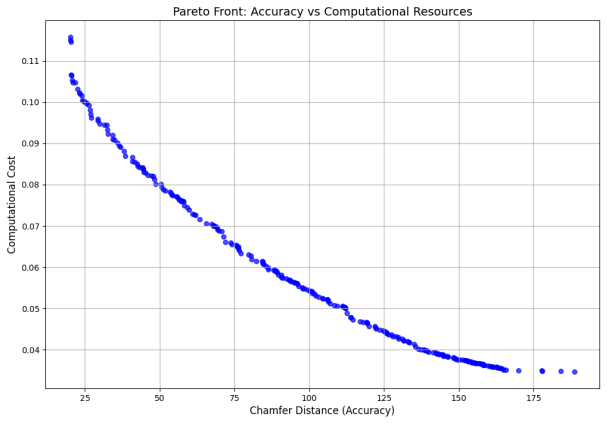
The paper's central discovery is that calibration error and computational cost form a genuine trade-off curve that can be mapped explicitly rather than collapsed into a single weighted score. It defines the design vector as $X = [x, y, z, \theta_{\text{yaw}}, \theta_{\text{pitch}}, \theta_{\text{roll}}, n]$, where $n$ is the number of LiDAR points used per evaluation, and minimizes $E_{\text{chamfer}}(X)$, the Chamfer distance between projected LiDAR points and the image edge map, alongside $E_{\text{comp}}(X) = t_{\text{norm}}(X) + m_{\text{norm}}(X)$. The resulting Pareto-optimal set shows a smooth spread of solutions in which higher accuracy costs more compute, and a preference-based rule picks a knee-region trade-off. The authors further report that an 80/20 weighting of edge versus intensity cues minimizes the combined error, and that an innovization analysis finds no dominant interaction among the six extrinsic parameters.
Load-bearing premise
The framework assumes that lowering the Chamfer distance between projected LiDAR points and the image edge map is a faithful surrogate for true extrinsic calibration, so that the global minimum of that cost coincides with the ground-truth extrinsic parameters, yet the paper never validates the recovered extrinsics against those ground-truth parameters numerically.
Editorial extensions
If this is right
- A vehicle could re-run this search periodically and select a knee-region calibration that matches its current CPU budget, enabling OTA-triggered self-recalibration without a service visit.
- Treating the LiDAR sampling rate as a decision variable turns compute capacity into a first-class requirement, so calibration accuracy can be dialled to the processor rather than assuming a fixed point budget.
- The explicit Pareto front gives system engineers a quantitative accuracy-versus-runtime curve, turning calibration selection into a requirements-driven choice instead of an arbitrary weighting.
- The reported optimum at an 80/20 edge-to-intensity weighting implies that fusing geometric and photometric cues is preferable to relying on either cue alone, which is a concrete recipe for future loss design.
Reading between the lines
- If the Chamfer-to-edge surrogate is validated against ground-truth extrinsics on more sequences, the same Pareto framing could be used for online drift monitoring, where slow changes in the selected solution's parameters warn of mechanical shift before perception degrades.
- Because the paper reports no numerical extrinsic error against ground truth, the recovered Pareto-optimal solutions may be visually plausible yet biased; a direct comparison of recovered and true extrinsic matrices would settle whether the surrogate has hidden local minima.
- The innovization finding that no parameter dominates suggests the objective landscape is comparatively flat near the front, implying many distinct extrinsics score similarly; that degeneracy would matter for run-to-run reproducibility and should be probed explicitly.
Editorial analysis
A structured set of objections, weighed in public.
Referee Report
Summary. The paper proposes a multi-objective optimization framework, based on NSGA-II, for camera-LiDAR extrinsic calibration. The two objectives are a Chamfer distance between projected LiDAR points and image edge maps and a computational-cost metric; the decision variables are the six extrinsic parameters plus the LiDAR point sampling rate. The authors apply the framework to KITTI data, present a Pareto front, a claimed epsilon-constraint verification, a robustness study over edge/intensity weights, and qualitative projection images, and conclude that the method outperforms traditional and learning-based calibration methods while remaining suitable for embedded systems.
Significance. If the central claim were substantiated, the paper would offer a useful practical contribution: a tunable, resource-aware calibration method for deployed autonomous vehicles. The use of a standard, open-source optimizer (NSGA-II via pymoo), a public dataset (KITTI), and explicit attention to computational cost are strengths. However, the manuscript's central assertions are not currently supported by the evidence presented. The paper never quantifies the error of the recovered extrinsics against KITTI ground truth, never compares against any baseline calibration method, and relies on a circular verification procedure. The reported results therefore do not establish that the Pareto-optimal solutions correspond to accurate calibrations or that the method outperforms existing approaches. These are load-bearing gaps rather than presentation issues.
major comments (5)
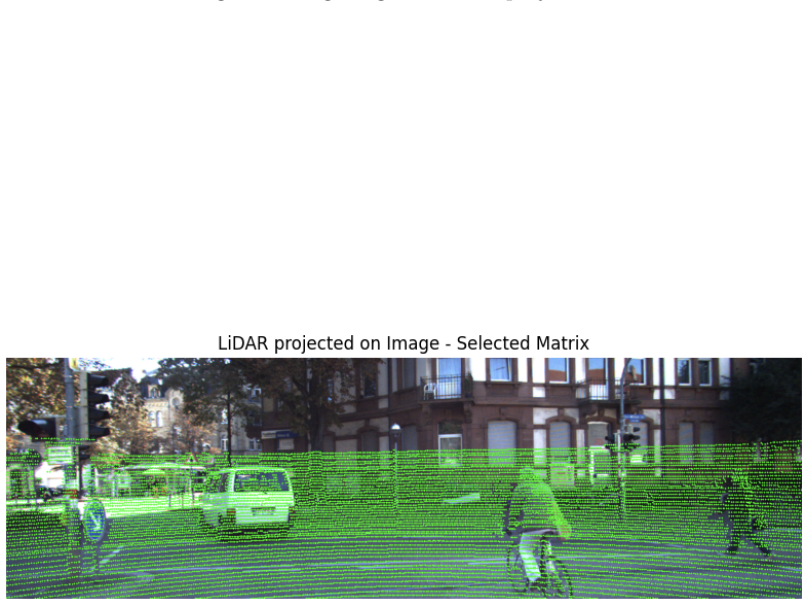
- [§4 and §6] The central claim that the framework is validated and outperforms traditional and learning-based calibration methods is not supported by any quantitative extrinsic-error evaluation. The paper reports only optimized Chamfer values and subjective qualitative projections (Figures 8-9). No rotation or translation error relative to KITTI ground truth is given, and no comparison with any baseline method is reported. The authors should report per-axis rotation and translation errors (or rotation/translation MAE) for the selected Pareto solution and compare against at least one traditional and one learning-based calibration method.
- [§2.2, §3.3, §4.1] The rotation bounds are internally inconsistent. Section 2.2 and Eq. (3.3) state a ±25° range for roll, pitch, and yaw, while Section 4.1 states a rotation range of ±0.1 radians (~5.7°). The claimed robustness to 'significant initial misalignments' is only meaningful under the larger bound. Please clarify which bounds were actually used, and if ±25° is intended, re-run the experiments with those bounds and report the resulting Pareto front and ground-truth errors.
- [Eq. (3.1)] The Chamfer distance in Eq. (3.1) is an asymmetric, one-sided distance normalized by the number of ground-truth edge points only. The manuscript does not justify that the global minimum of this surrogate coincides with the true extrinsic parameters. Edge maps can be ambiguous or repetitive, so low Chamfer values do not guarantee correct calibration. The paper should validate the recovered extrinsics against KITTI ground truth and, ideally, also report results with a symmetric Chamfer term or a reverse-direction term to reduce this risk.
- [§4.3 and Figure 6] The epsilon-constraint 'verification' is circular. The baseline re-optimizes the same Chamfer objective under constraints on the same computational-cost metric, so agreement between the two fronts merely shows that NSGA-II and a single-objective run find similar solutions on the same objective landscape. This does not independently validate the Pareto front as a set of accurate calibrations. Independent validation requires comparison with alternate calibration methods or with ground-truth extrinsics.
- [§4.6 and Figure 10] The robustness study reports a single U-shaped trend in the weighted objective but provides no error bars or multiple-run statistics. Since NSGA-II is stochastic, the reported objective values (e.g., 13.997, 13.893, 16.03) may not be reproducible. Moreover, these are objective-function values, not calibration-accuracy metrics. The authors should report distributions across repeated runs and, more importantly, the corresponding ground-truth extrinsic errors for the selected solutions.
minor comments (4)
- [Abstract and §4.1] The abstract states that KITTI ground-truth extrinsic parameters are used for validation, but no ground-truth-based validation result appears in the paper; the text should either present such results or remove the claim.
- [Throughout] There are several typographical issues: 'Michagan' in the affiliation, 'Y aw' and 'V ariable bounds' and 'T ermination criteria' in Section 4.1, and duplicated sentences in the Introduction ('Sensor fusion using LiDAR and camera is foundational...' appears twice).
- [§3.2] The computational-cost objective E_comp(X) = t_norm(X) + m_norm(X) is not fully defined. The normalization procedure for t_norm and m_norm, and how they are measured (e.g., over what hardware), should be specified.
- [References] Reference [14] is misattributed; 'Robotics, Vision and Control' is by Peter Corke, not Schultz and Lynch. Please verify and correct all references.
Circularity Check
Validation circularity: the epsilon-constraint baseline re-solves the same bi-objective problem, and the 'ground-truth match' claim is supported only by the minimized Chamfer objective.
-
other
[Section 4.3 'Verification by Single-objective Optimization Methods', Figure 6]
"The red crosses in the Figure 6 represent the feasible solutions obtained by applying epsilon constraints on computational cost. We are constraining the computational resources at various points and minimizing the chamfer error at those points. The figure illustrates the points closely follow the Pareto front that was found through NSGA-II."
The epsilon-constraint baseline minimizes exactly the same Chamfer error subject to the same computational-cost constraint that defines the second NSGA-II objective. This is the standard scalarization of the same bi-objective optimization problem, so a converged solver is mathematically expected to reproduce the same Pareto front. The agreement is a self-consistency check of the optimizer, not independent evidence that the Pareto front corresponds to accurate calibration or that the method outperforms traditional and learning-based calibration approaches.
-
self definitional
[Section 4.4 'Preference-based Decision-making' (with Section 3.1 objective definition)]
"Our goal is to ensure that the selected solution maintains a low Chamfer error, providing a calibration result that closely matches the ground truth."
The paper's calibration-accuracy objective is itself the one-sided Chamfer distance Echamfer(X) minimized during optimization. The sentence equates a low optimized Chamfer error with 'closely matches the ground truth,' but no comparison of the recovered 6-DoF extrinsic parameters to KITTI ground-truth extrinsic parameters is reported anywhere in the manuscript. The only evidence supplied for ground-truth agreement is therefore the very objective that was minimized, making the accuracy/ground-truth validation claim true by construction rather than by external measurement.
full rationale
The generation of the Pareto front itself is not circular: NSGA-II optimizes the stated Chamfer-distance and computational-cost objectives, and the front is a direct output of that optimization. The paper's equations do not define the objectives in terms of the claimed results, and the one self-citation ([11]) is background material rather than load-bearing. However, two validation steps are circular. First, the epsilon-constraint 'baseline' in Section 4.3 solves the same bi-objective problem by scalarization, so its agreement with the NSGA-II front is guaranteed by construction and cannot independently verify the calibration or the claim of outperforming prior methods. Second, Section 4.4 asserts that a low Chamfer error 'provides a calibration result that closely matches the ground truth,' but the Chamfer error is exactly the objective being minimized, and the manuscript never reports extrinsic rotation/translation errors against the KITTI ground-truth calibration. Hence the ground-truth-match claim is supported only by the optimized objective itself. Other weaknesses—missing quantitative baselines, no ground-truth extrinsic error comparison, and inconsistent rotation bounds between Section 3.3 (±25°) and Section 4.1 (±0.1 radians)—are correctness and evidence concerns rather than circularity, and are not scored here. Overall, the circularity is partial: the central optimization is self-contained, but the advertised validation and accuracy claims reduce to the problem's own objectives.
Assumptions & free parameters
free parameters (3)
- Edge weight w1 in combined Chamfer loss =
0.8
- Computational complexity factor =
3 iterations per evaluation
- Normalization constants for t_norm and m_norm =
not reported
assumptions (5)
- standard math The pinhole camera model with known intrinsics K correctly maps LiDAR points to image pixels.
- standard math A single rigid-body 6-DoF transform (R,T) fully captures the LiDAR-camera extrinsics.
- domain assumption Image edges extracted from the camera image are a valid 'ground-truth' target for calibration, so minimizing Chamfer distance between projected LiDAR points and these edges recovers the true extrinsics.
- domain assumption The Chamfer distance averaged over ground-truth points (with denominator n) is a meaningful error measure.
- domain assumption Computational cost can be represented as a sum of normalized time and memory, both scaling with the number of LiDAR points n.
Cite this review
Pith. "Pith review of A Computationally Aware Multi Objective Framework for Camera LiDAR Calibration." pith.science (2026). https://pith.science/paper/HNSTKVN3
@misc{pith2026250620636,
  author       = {Pith},
  title        = {Pith review of: A Computationally Aware Multi Objective Framework for Camera LiDAR Calibration},
  year         = {2026},
  howpublished = {\url{https://pith.science/paper/HNSTKVN3}},
  note         = {Machine review of arXiv:2506.20636}
}
read the original abstract
Accurate extrinsic calibration between LiDAR and camera sensors is important for reliable perception in autonomous systems. In this paper, we present a novel multi-objective optimization framework that jointly minimizes the geometric alignment error and computational cost associated with camera-LiDAR calibration. We optimize two objectives: (1) error between projected LiDAR points and ground-truth image edges, and (2) a composite metric for computational cost reflecting runtime and resource usage. Using the NSGA-II \cite{deb2002nsga2} evolutionary algorithm, we explore the parameter space defined by 6-DoF transformations and point sampling rates, yielding a well-characterized Pareto frontier that exposes trade-offs between calibration fidelity and resource efficiency. Evaluations are conducted on the KITTI dataset using its ground-truth extrinsic parameters for validation, with results verified through both multi-objective and constrained single-objective baselines. Compared to existing gradient-based and learned calibration methods, our approach demonstrates interpretable, tunable performance with lower deployment overhead. Pareto-optimal configurations are further analyzed for parameter sensitivity and innovation insights. A preference-based decision-making strategy selects solutions from the Pareto knee region to suit the constraints of the embedded system. The robustness of calibration is tested across variable edge-intensity weighting schemes, highlighting optimal balance points. Although real-time deployment on embedded platforms is deferred to future work, this framework establishes a scalable and transparent method for calibration under realistic misalignment and resource-limited conditions, critical for long-term autonomy, particularly in SAE L3+ vehicles receiving OTA updates.
Figures


Figures from the paper (7 more)



Reference graph
Works this paper leans on
-
[1]
Wu, T., Pan, L., Zhang, J., Wang, T., Liu, Z., and Lin, D. (2021). Density-aware Cham- fer Distance as a Comprehensive Metric for Point Cloud Completion. arXiv preprint 15 arXiv:2111.12702
arXiv 2021
-
[2]
Geiger, A., Lenz, P., Stiller, C., and Urtasun, R. (2013). Vision meets Robotics: The KITTI Dataset. International Journal of Robotics Research (IJRR)
work page 2013
-
[3]
Sun, Y., Li, J., Wang, Y., Xu, X., Yang, X., and Sun, Z. (2023). ATOP: An Attention- to-Optimization Approach for Automatic LiDAR-Camera Calibration via Cross-Modal Object Matching. IEEE Transactions on Intelligent Vehicles, 8(1), 696-708
work page 2023
-
[4]
Shi, J., Zhu, Z., Zhang, J., Liu, R., Wang, Z., Chen, S., and Liu, H. (2020). CalibRCNN: Calibrating Camera and LiDAR by Recurrent Convolutional Neural Network and Geo- metric Constraints. In 2020 IEEE/RSJ International Conference on Intelligent Robots and Systems (IROS)(pp. 10197-10202)
work page 2020
-
[5]
Lv, X., Wang, B., Ye, D., and Wang, S. (2021). LCCNet: LiDAR and Camera Self- Calibration using Cost Volume Network. arXiv preprint arXiv:2012.13901
work page Pith review arXiv 2021
-
[6]
Zhang, Z. and Pless, R. (2004). Extrinsic calibration of a camera and laser range finder (checkerboard method). In Intelligent Robots and Systems, 2004.(IROS 2004). Proceed- ings. 2004 IEEE/RSJ International Conference on, Vol. 3 (pp. 2301-2306). IEEE
work page 2004
-
[7]
Besl, P. J. and McKay, N. D. (1992). A method for registration of 3-D shapes. IEEE Transactions on Pattern Analysis and Machine Intelligence, 14(2), 239-256
work page 1992
-
[8]
Zhou, Q.-Y., Park, J., and Koltun, V. (2018). Open3D: A modern library for 3D data processing. arXiv preprint arXiv:1801.09847
arXiv 2018
Show all 16 references
-
[9]
Deb, K., Pratap, A., Agarwal, S., and Meyarivan, T. (2002). A fast and elitist multiobjec- tive genetic algorithm: NSGA-II. IEEE Transactions on Evolutionary Computation, 6(2), 182-197
2002
-
[10]
and Deb, K
Blank, J. and Deb, K. (2020). pymoo: Multi-Objective Optimization in Python. IEEE Access, 8, 89497-89509
2020
-
[11]
and Mitchell, L
Karramreddy, V. and Mitchell, L. (2024). Validation & Exploration of Multimodal Deep- Learning Camera-Lidar Calibration Models. arXiv preprint arXiv:2409.13402
2024 arXiv
-
[12]
Fan, R., Ge, S., Lin, L., Liu, M., et al. (2023). Calib-anything: Generalizable LiDAR- Camera extrinsic calibration. arXiv preprint arXiv:2303.07636
2023 arXiv
-
[13]
Huang, J., Fan, R., et al. (2022). Self-supervised multi-modal calibration via 2D geometry alignment. IEEE Robotics and Automation Letters. IEEE
2022
-
[14]
and Lynch, K
Schultz, J. and Lynch, K. (2020). Robotics, vision and control: Fundamental algorithms in MATLAB. IEEE Control Systems Magazine, 40(1), 52-54
2020
-
[15]
An, P., Ma, T., Yu, K., Fang, B., Zhang, J., Fu, W., and Ma, J. (2020). Geometric calibration for LiDAR-camera system fusing 3D-2D and 3D-3D point correspondences. Optics Express, 28(2), 2122-2141
2020
-
[16]
and Zisserman, A
Hartley, R. and Zisserman, A. (2003). Multiple View Geometry in Computer Vision. Cam- bridge University Press, Cambridge, U.K. 16
2003
Reviewed August 6, 2026 · model on record in the stance chip above.
Discussion (0). Sign in to comment.