Quantum Information of Photon Pairs at Lepton Colliders
Pith reviewed 2026-07-01 01:54 UTC · model grok-4.3
The pith
A factorization framework and two-qubit model extract quantum information from photon pairs at lepton colliders.
A machine-rendered reading of the paper's core claim, the machinery that carries it, and where it could break.
Core claim
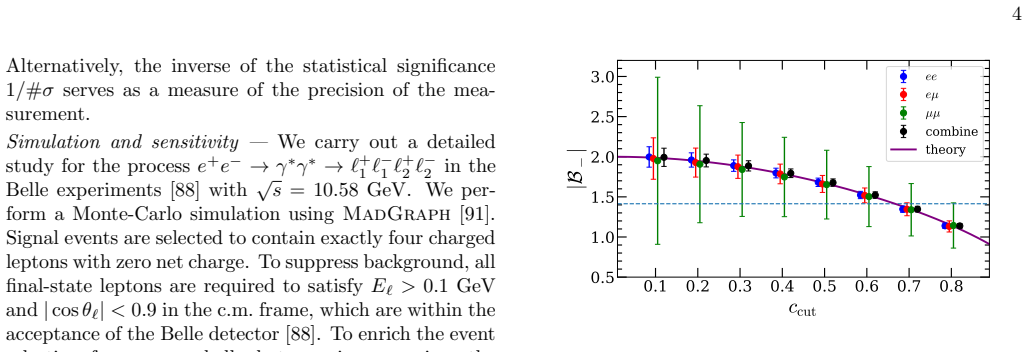
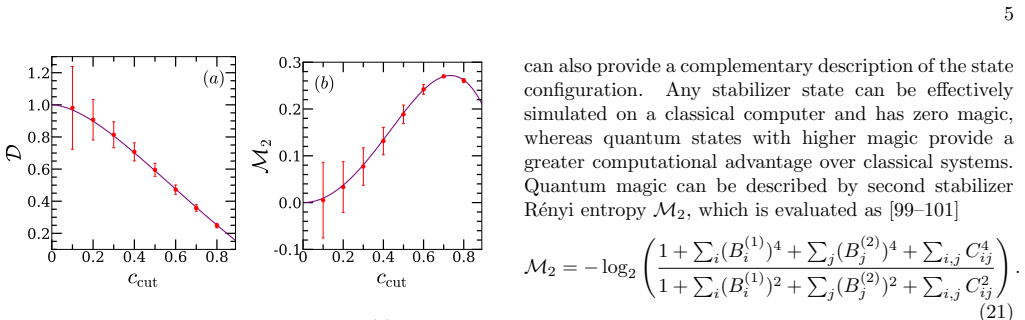
Exploiting the photon conversion process for nearly on-shell photons, we formulate a factorization framework and an effective two-qubit description, which enable access to quantum information encoded in photon pairs. Using the existing Belle data set, we estimate that a 7.4σ violation of the Bell inequality could be achieved. The same framework can also probe quantum discord and nonstabilizerness, which could be measured with precisions of 5.6% and 1.6%, respectively. All the reconstructed results from photon conversion in the two-qubit framework are found to be consistent with the kinematic approach of real photons, and the formalism can apply to other spin-1 systems in an appropriate two-q
What carries the argument
The factorization framework and effective two-qubit description for photon pairs via the photon conversion process.
If this is right
- A 7.4 sigma violation of the Bell inequality is achievable with the Belle data set.
- Quantum discord can be measured with a precision of 5.6%.
- Nonstabilizerness can be measured with a precision of 1.6%.
- Reconstructed results remain consistent with the kinematic approach for real photons.
- The formalism extends to other spin-1 systems in the two-qubit limit.
Where Pith is reading between the lines
- The same framework could be applied to data from future lepton colliders to achieve higher precision on quantum measures.
- This description may allow quantum information observables to be studied in other high-energy vector boson production processes.
- It provides a route to test whether quantum discord or nonstabilizerness exhibit energy-dependent behavior in collider environments.
Load-bearing premise
The effective two-qubit description and factorization framework accurately capture the quantum state and information content of photon pairs produced at lepton colliders when using the photon conversion process for nearly on-shell photons.
What would settle it
An analysis of the Belle data set that yields a Bell inequality violation below 5 sigma significance or shows inconsistency between the two-qubit reconstruction and the kinematic approach would challenge the central claim.
Figures
read the original abstract
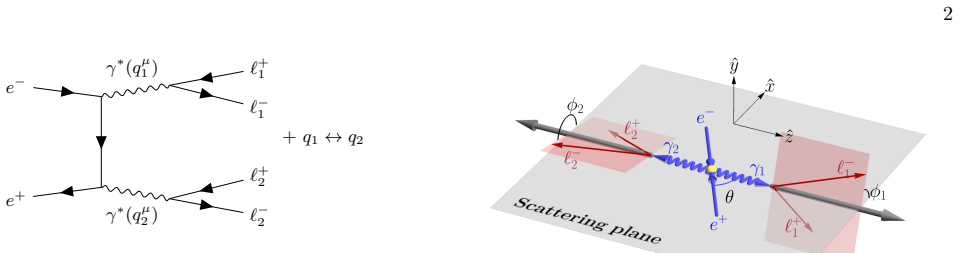
Photon pairs have provided an ideal laboratory for exploring entanglement and Bell inequality violation in low-energy experiments. Extending such studies to high-energy colliders is of great interest but has yet to be explored. Exploiting the photon conversion process for nearly on-shell photons, we formulate a factorization framework and an effective two-qubit description, which enable access to quantum information encoded in photon pairs. Using the existing Belle data set, we estimate that a $7.4\sigma$ violation of the Bell inequality could be achieved. The same framework can also probe quantum discord and nonstabilizerness, which could be measured with precisions of 5.6\% and 1.6\%, respectively. All the reconstructed results from photon conversion in the two-qubit framework are found to be consistent with the kinematic approach of real photons, and the formalism can apply to other spin-1 systems in an appropriate two-qubit limit.
Editorial analysis
A structured set of objections, weighed in public.
Referee Report
Summary. The manuscript formulates a factorization framework and effective two-qubit description for photon pairs at lepton colliders by exploiting the photon conversion process for nearly on-shell photons. It applies this to the existing Belle data set to estimate a 7.4σ violation of the Bell inequality, along with projected precisions of 5.6% for quantum discord and 1.6% for nonstabilizerness. The reconstructed results are stated to be consistent with a kinematic approach for real photons, and the formalism is claimed to extend to other spin-1 systems.
Significance. If the two-qubit reduction and factorization are shown to faithfully preserve the relevant coherences, the work would enable collider-based studies of quantum information measures in photon pairs using existing data, extending low-energy entanglement experiments to high energies. The explicit cross-check against the independent kinematic method for real photons is a positive feature that strengthens the internal consistency claim.
major comments (2)
- [section formulating the effective two-qubit description and factorization framework] The central 7.4σ Bell violation estimate and the discord/nonstabilizerness precision projections rest on the factorization framework plus two-qubit reduction accurately reconstructing the photon-pair density matrix from conversion events. The manuscript must supply an explicit derivation (in the section defining the effective two-qubit description) showing how the conversion amplitude maps the full QED helicity amplitudes onto the two-qubit basis while preserving off-diagonal coherences at Belle kinematics; the abstract's statement of consistency with the kinematic approach does not substitute for this step.
- [application to Belle data set and numerical estimates] No derivation steps, error analysis, or validation details are supplied for the numerical 7.4σ figure or the quoted precisions; without these, it is not possible to assess whether the projections follow from the stated framework or incorporate realistic experimental uncertainties in the Belle data set.
Simulated Author's Rebuttal
We thank the referee for the detailed and constructive report. We agree that the two major comments identify areas where the manuscript requires additional explicit content to support its central claims. We will revise the paper to address both points fully.
read point-by-point responses
-
Referee: [section formulating the effective two-qubit description and factorization framework] The central 7.4σ Bell violation estimate and the discord/nonstabilizerness precision projections rest on the factorization framework plus two-qubit reduction accurately reconstructing the photon-pair density matrix from conversion events. The manuscript must supply an explicit derivation (in the section defining the effective two-qubit description) showing how the conversion amplitude maps the full QED helicity amplitudes onto the two-qubit basis while preserving off-diagonal coherences at Belle kinematics; the abstract's statement of consistency with the kinematic approach does not substitute for this step.
Authors: We agree that an explicit derivation is required. In the revised manuscript we will add a dedicated subsection deriving the mapping from the full QED helicity amplitudes through the conversion amplitude to the two-qubit density matrix. The derivation will explicitly track the off-diagonal coherences and demonstrate their preservation at Belle kinematics, using the same photon-conversion process already employed in the paper. This will replace reliance on the abstract-level consistency statement. revision: yes
-
Referee: [application to Belle data set and numerical estimates] No derivation steps, error analysis, or validation details are supplied for the numerical 7.4σ figure or the quoted precisions; without these, it is not possible to assess whether the projections follow from the stated framework or incorporate realistic experimental uncertainties in the Belle data set.
Authors: We acknowledge the absence of these details. The revised version will include the full step-by-step calculation of the 7.4σ Bell violation from the Belle data set, together with the error propagation that incorporates the reported experimental uncertainties. The same level of detail will be provided for the 5.6% and 1.6% precision projections on quantum discord and nonstabilizerness, including how the two-qubit framework propagates statistical and systematic errors. revision: yes
Circularity Check
No significant circularity detected
full rationale
The paper formulates a factorization framework and effective two-qubit description as a new construction, then reports that reconstructed results are consistent with an independent kinematic approach for real photons. No load-bearing step reduces by definition or self-citation to its own inputs; the Bell-violation estimate and quantum-information projections are presented as outputs of the formulated framework rather than tautological re-expressions of fitted parameters or prior self-referential results. The derivation chain is therefore self-contained against external benchmarks.
Axiom & Free-Parameter Ledger
axioms (1)
- domain assumption Photon conversion for nearly on-shell photons permits an accurate effective two-qubit description of the pair state.
Reference graph
Works this paper leans on
-
[1]
The same event selection as in the Belle analysis is adopted, except for a tighter requirementm ee <0.2 GeV to further suppress backgrounds
at √s= 3.773 GeV using theeechannel, since the two-qubit approximation breaks down for the muon final state. The same event selection as in the Belle analysis is adopted, except for a tighter requirementm ee <0.2 GeV to further suppress backgrounds. Using the currently ac- 5 0 0.2 0.4 0.6 0.8 ccut 0.2 0.4 0.6 0.8 1.0 1.2 D (a) 0 0.2 0.4 0.6 0.8 ccut -0.1 ...
-
[2]
C. S. Wu and I. Shaknov, Phys. Rev.77, 136 (1950)
1950
-
[3]
S. J. Freedman and J. F. Clauser, Phys. Rev. Lett.28, 938 (1972)
1972
-
[4]
L. R. Kasday, J. D. Ullman, and C.-S. Wu, Il Nuovo Cimento B (1971-1996)25, 633 (1975)
1971
-
[5]
Aspect, J
A. Aspect, J. Dalibard, and G. Roger, Phys. Rev. Lett. 49, 1804 (1982)
1982
-
[6]
Weihs, T
G. Weihs, T. Jennewein, C. Simon, H. Weinfurter, and A. Zeilinger, Physical Review Letters81, 5039–5043 (1998)
1998
-
[7]
Y. Afik and J. R. M. n. de Nova, Eur. Phys. J. Plus 136, 907 (2021), arXiv:2003.02280 [quant-ph]
-
[8]
M. Fabbrichesi, R. Floreanini, and G. Panizzo, Phys. Rev. Lett.127, 161801 (2021), arXiv:2102.11883 [hep- ph]
- [9]
-
[10]
Quantum informa- tion with top quarks in QCD,
Y. Afik and J. R. M. n. de Nova, Quantum6, 820 (2022), arXiv:2203.05582 [quant-ph]
-
[11]
Quantum Discord and Steering in Top Quarks at the LHC,
Y. Afik and J. R. M. de Nova, Phys. Rev. Lett.130, 221801 (2023), arXiv:2209.03969 [quant-ph]
- [12]
- [13]
- [14]
- [15]
- [16]
- [17]
-
[18]
Y. Afik, R. Demina, A. Herrera, O. Heinz Hin- drichs, J. R. M. de Nova, and B. Ravina, (2026), arXiv:2602.15115 [quant-ph]
work page internal anchor Pith review Pith/arXiv arXiv 2026
- [19]
-
[20]
K. Ehat¨ aht, M. Fabbrichesi, L. Marzola, and C. Veelken, Phys. Rev. D109, 032005 (2024), arXiv:2311.17555 [hep-ph]
- [21]
-
[22]
M. Fabbrichesi and L. Marzola, Phys. Rev. D110, 076004 (2024), arXiv:2405.09201 [hep-ph]
- [23]
- [24]
-
[25]
Y. Zhang, B.-H. Zhou, Q.-B. Liu, S. Li, S.-C. Hsu, T. Han, M. Low, and T. A. Wu, (2025), arXiv:2504.01496 [hep-ph]
work page internal anchor Pith review Pith/arXiv arXiv 2025
- [26]
- [27]
- [28]
-
[29]
R. Ashby-Pickering, A. J. Barr, and A. Wierzchucka, JHEP05, 020 (2023), arXiv:2209.13990 [quant-ph]
- [30]
-
[31]
M. Fabbrichesi, R. Floreanini, E. Gabrielli, and L. Mar- zola, Eur. Phys. J. C83, 823 (2023), arXiv:2302.00683 [hep-ph]
- [32]
- [33]
- [34]
- [35]
- [36]
-
[37]
D. Gon¸ calves, A. Kaladharan, F. Krauss, and A. Navarro, (2025), arXiv:2505.12125 [hep-ph]
-
[38]
D. Gon¸ calves, A. Kaladharan, and A. Navarro, (2025), arXiv:2506.19951 [hep-ph]
- [39]
- [40]
- [41]
-
[42]
Aadet al.(ATLAS), (2026), arXiv:2603.26463 [hep- ex]
G. Aadet al.(ATLAS), (2026), arXiv:2603.26463 [hep- ex]
- [43]
- [44]
-
[45]
S. Chen, Y. Nakaguchi, and S. Komamiya, PTEP2013, 063A01 (2013), arXiv:1302.6438 [hep-ph]
work page internal anchor Pith review Pith/arXiv arXiv 2013
- [46]
- [47]
-
[48]
M. Fucilla and Y. Hatta, Phys. Rev. D113, L031504 (2026), arXiv:2509.05267 [hep-ph]
-
[49]
K. Cheng and B. Yan, Phys. Rev. Lett.135, 011902 (2025), arXiv:2501.03321 [hep-ph]
- [50]
- [51]
- [52]
-
[53]
Y.-J. Fang, A. Bhoonah, K. Cheng, T. Han, Y. Liu, and 7 H. Zhang, (2026), arXiv:2604.11887 [hep-ph]
work page internal anchor Pith review Pith/arXiv arXiv 2026
- [54]
- [55]
-
[56]
Y. Hatta and J. Schoenleber, Phys. Rev. D113, 094016 (2026), arXiv:2511.04537 [hep-ph]
- [57]
- [58]
- [59]
-
[60]
M. Fucilla, Y. Hatta, and B.-W. Xiao, (2026), arXiv:2604.11697 [hep-ph]
work page internal anchor Pith review Pith/arXiv arXiv 2026
-
[61]
Manipulating Bell nonlocality and entanglement in polarized electron-positron annihilation
H.-W. Zhang, X. Cao, and T.-F. Feng, (2026), arXiv:2602.10389 [hep-ph]
work page internal anchor Pith review Pith/arXiv arXiv 2026
-
[62]
Y.-X. Liu, W. Qi, L.-T. He, and B.-W. Xiao, (2026), arXiv:2604.17756 [hep-ph]
work page internal anchor Pith review Pith/arXiv arXiv 2026
-
[63]
D. Wang, X. Hao, L. Liu, L. Wu, and T. Li, (2026), arXiv:2605.13250 [hep-ph]
work page internal anchor Pith review Pith/arXiv arXiv 2026
-
[64]
Quantum Tomography and Entanglement in Semi-Leptonic $h\to VV^*$ Decays at Higher Orders
D. Gon¸ calves, A. Kaladharan, and A. Navarro, (2026), arXiv:2604.16218 [hep-ph]
work page internal anchor Pith review Pith/arXiv arXiv 2026
-
[65]
Spin-flavor entanglement in $\Lambda_b \to \Lambda D$ and weak phase extraction
Y. Du, C.-Q. Geng, X.-G. He, C.-W. Liu, S.-L. Liu, and X.-Y. Liu, (2026), arXiv:2605.09682 [hep-ph]
work page internal anchor Pith review Pith/arXiv arXiv 2026
- [66]
-
[67]
C. Li, X. Cao, A.-Q. Guo, C.-X. Yu, H.-W. Zhang, and Z. Zhang, (2026), arXiv:2602.10398 [hep-ph]
work page internal anchor Pith review Pith/arXiv arXiv 2026
- [68]
- [69]
-
[70]
G. Aadet al.(ATLAS), Nature633, 542 (2024), arXiv:2311.07288 [hep-ex]
-
[71]
A. Hayrapetyanet al.(CMS), Rept. Prog. Phys.87, 117801 (2024), arXiv:2406.03976 [hep-ex]
-
[72]
J. S. Bell, Physics Physique Fizika1, 195 (1964)
1964
-
[73]
S. A. Abel, M. Dittmar, and H. K. Dreiner, Phys. Lett. B280, 304 (1992)
1992
- [74]
-
[75]
P. Bechtle, C. Breuning, H. K. Dreiner, and C. Duhr, (2025), arXiv:2507.15947 [hep-ph]
- [76]
- [77]
-
[78]
J. A. Aguilar-Saavedra, J. A. Casas, and J. M. Moreno, (2026), arXiv:2603.19389 [hep-ph]
work page internal anchor Pith review Pith/arXiv arXiv 2026
-
[79]
Y. Afiket al., Eur. Phys. J. Plus140, 855 (2025), arXiv:2504.00086 [hep-ph]
- [80]
discussion (0)
Sign in with ORCID, Apple, or X to comment. Anyone can read and Pith papers without signing in.