REVIEW 4 major objections 4 minor 1 cited by
Coop-WD: Cooperative Perception with Weighting and Denoising for Robust V2V Communication
T0 review · 4 major / 4 minor · reviewed 2026-08-15 · deepseek-v4-flash
Pith's one-line read A two-stage receiver fix—weighting then denoising—keeps cooperative 3D detection accurate on impaired V2V channels.
desk verdict A useful engineering combo of self-supervised weighting and diffusion denoising for V2V-robust cooperative perception, but the paper's central claim of consistent superiority is contradicted by its own Table I. read the letter →
The pith
A machine-rendered reading of the paper's core claim, the machinery that carries it, and where it could break.
The reading
What carries the argument
The carrying mechanism is a conditional diffusion probabilistic model operating on shared feature maps. At diffusion step $t$, the corrupted feature $x_t$ is drawn from $q_{\text{cond}}(x_t|x_0,y)=\mathcal{N}(x_t;(1-m_t)\sqrt{\bar\alpha_t}x_0+m_t\sqrt{\bar\alpha_t}y,\delta_t I)$, a Gaussian blend of the clean transmitted feature $x_0$ and the received distorted feature $y$, with mixing ratio $m_t$ growing from 0 to about 1. The reverse process, a U-Net that predicts the mixed noise $\epsilon_\theta(x_t,y,t)$, iteratively removes that blend to recover the denoised feature map. Above it sits a self-supervised contrastive weighting module that multiplies each received feature by a scalar $W_k\in[0,1]$; its output feeds the diffusion model. The weighting handles severe whole-vehicle corruption, the diffusion handles residual pixel-level distortion, and the two modules share residual blocks and skip connections so they can be trained and run together.
What would settle it
Record real V2V feature corruption that includes packet bursts and correlated interference, feed those traces through the same trained pipeline, and compare Coop-WD against Coop-W; the central claim predicts the diffusion stage still lifts AP, so observing Coop-WD at or below Coop-W under such non-Gaussian corruption would falsify it.
Extended reading notes
Core claim
The paper argues that combining a CAV-level weighting module with a pixel-level conditional diffusion denoiser yields a cooperative-perception system that outperforms both components alone and the conventional CNN-autoencoder baseline across every channel condition tested: simulated Rician fading, realistic WINNER II, and a non-stationary V2V model, at SNRs from 0 to 20 dB. The ablation results show Coop-WD consistently beats Coop-W and Coop-D at IoU 0.5 and 0.7; in the non-stationary V2V channel at 0 dB, for example, it reaches AP 0.487 at IoU 0.5 while Coop-W reaches 0.483 and Coop-D reaches 0.151. The same hierarchy transfers to an attentive fusion backend, and the eco variant cuts runtime by more than half under severe distortion with near-equal AP, while saving roughly 10% runtime at higher SNR.
Load-bearing premise
The whole denoising gain rests on treating the damage a V2V channel does to a feature map as Gaussian noise blended with the clean signal; if real corruption is bursty, correlated, or state-dependent in a way the training distribution never covers, the reverse process may not reconstruct the clean features and the advantage over weighting alone could disappear.
Editorial extensions
If this is right
- Coop-WD consistently beats Coop-W, Coop-D, and the CNN-autoencoder baseline at every tested SNR on Rician, WINNER II, and non-stationary V2V channels.
- Ablation shows neither module alone is sufficient: weighting rescues severe distortion while denoising handles mild distortion, and their combination dominates both.
- The framework transfers to an attentive fusion backend, not only V2VNet, so the benefit generalizes across fusion designs within the tested settings.
- Training on a non-stationary V2V channel and testing on unseen Rician and WINNER II channels still yields the same ordering, indicating cross-channel generalization.
- Coop-WD-eco cuts runtime by more than half under severe distortion with minimal AP loss and saves about 10% at higher SNR, making the added compute controllable.
Reading between the lines
- The corruption model in Eq. (7) is Gaussian by construction, so the marginal value of the diffusion stage should shrink under non-Gaussian impairments such as packet bursts or correlated interference; measuring that gap would isolate where the assumption binds.
- The fixed 0.6 threshold in Coop-WD-eco could be replaced by a learned controller that trades AP for runtime continuously, since the weighting output already encodes distortion severity.
- The same hierarchical principle could be applied to other shared representations, such as bird's-eye-view semantic maps or raw point-cloud features, where the distortion statistics differ and the weighting/denoising split would need rebalancing.
Signed reviews
Editorial analysis
A structured set of objections, weighed in public.
Referee Report
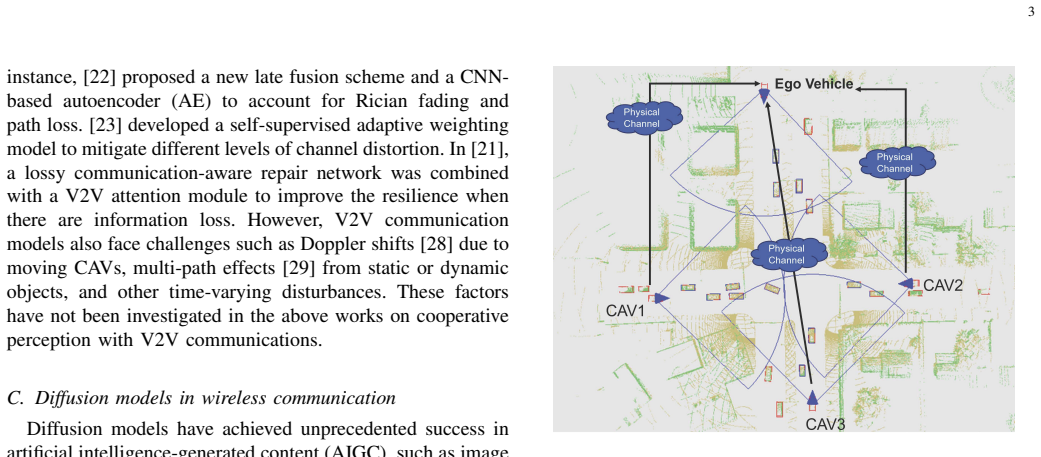
Summary. The paper proposes Coop-WD, a hierarchical feature-enhancement method for cooperative perception under V2V channel impairments. A self-supervised CAV-level weighting module is combined with a conditional diffusion-based pixel-level denoiser before feature fusion. The method is evaluated on the V2V4Real dataset with PointPillars and V2VNet under Rician fading, WINNER II, and a non-stationary V2V channel, including imperfect CSI, path-loss variation, and time-varying distortions. An efficient variant, Coop-WD-eco, selectively bypasses the denoiser under severe distortion to reduce runtime. The paper claims that Coop-WD consistently outperforms both weighting-only and denoising-only baselines across all SNR levels and channel types, and that Coop-WD-eco cuts computational cost by up to 50% with comparable accuracy.
Significance. If the results hold, the proposed integration of vehicle-level weighting and pixel-level diffusion denoising is a plausible and useful contribution for robust cooperative perception, and the breadth of channel conditions tested (including generalization to unseen channel models) is a clear strength. The use of a real-world cooperative-perception dataset and the inclusion of imperfect CSI, path loss, and time-varying distortions make the evaluation more realistic than many prior works. However, the central quantitative claim is overstated relative to the paper's own Table I, and the absence of statistical uncertainty reporting leaves even the non-contradicted cells difficult to assess. The efficient variant is an interesting practical addition, but its reported runtime savings are not consistent across all rows of Table V.
major comments (4)
- [Section V-B, Table I] The claim, repeated in the abstract and in Section V-B, that "Coop-WD consistently outperforms both Coop-W and Coop-D across all SNR levels" is directly contradicted by the reported numbers. At IoU=0.7 and 0 dB Rician fading, Coop-W achieves 0.280 while Coop-WD achieves 0.264; at IoU=0.7 and 0 dB non-stationary V2V, Coop-W scores 0.273 versus Coop-WD's 0.260; and at IoU=0.7 and 20 dB Rician fading, Coop-D scores 0.292 versus Coop-WD's 0.286. The paper needs to either modify the claim to a per-cell, non-universal statement or provide a corrected table, and the abstract and conclusion must be revised accordingly.
- [Section V (all results)] No error bars, number of seeds, or significance tests are reported for any of the AP values in Tables I-V or Figure 5. Several differences that are used to support the superiority of Coop-WD are very small, for example 0.483 vs. 0.481 at IoU=0.5 and 0 dB Rician fading, and 0.487 vs. 0.483 at IoU=0.5 and 0 dB non-stationary V2V. Without multiple seeds or paired evaluation across scenes, these differences could be run-to-run noise. The authors should report means and standard deviations over at least three seeds, or provide a paired significance test, for the main tables.
- [Section IV-A, Eq. (7)] The conditional diffusion forward process assumes that the corrupted feature at each step is a Gaussian linear interpolation between the clean transmitted feature x0 and the received distorted feature y, with an isotropic variance delta_t I. However, the actual feature distortion after zero-forcing detection, Rician or non-stationary fading, imperfect CSI, and time-varying noise is unlikely to be exactly Gaussian or state-independent. Because the reverse process is trained to invert this assumed corruption model, a mismatch could explain why denoising helps in some operating points and hurts in others. The authors should provide evidence that the modeled corruption matches the empirical feature-level distortion, for example by comparing the learned denoiser against a simple non-generative baseline under the same channel conditions, or by analyzing the distribution of feature residuals.
- [Section V-B, Table I and Section IV-B] The synergy narrative in Section IV-B states that weighting handles severe distortion while denoising handles moderate distortion, yet Table I shows Coop-WD losing to Coop-W alone at several low-SNR operating points (e.g., IoU=0.7, 0 dB Rician and 0 dB non-stationary V2V). This suggests the joint approach does not always combine the strengths of the two modules in the regime where weighting is claimed to dominate. The interpretation of the ablation needs to account for these cases explicitly rather than asserting consistent synergy.
minor comments (4)
- [Section V-D, second bullet] The text says "Coop-D falsely identifies some areas" in a comparison between Coop-W and Coop-WD; this should read "Coop-W" to match the comparison being made.
- [Section V-E, Table V] For the WINNER II channel at 20 dB, Coop-WD-eco has runtime 68.9 ms versus 69.0 ms for Coop-WD, so the claim of "approximately 10% improvement in computational efficiency" at higher SNR is not supported by this row.
- [Section V-A4 and Section V-E] The threshold of 0.6 used to activate the denoising module in Coop-WD-eco is introduced without any sensitivity analysis or justification; a brief study or discussion of how this threshold affects the accuracy-runtime trade-off would improve reproducibility.
- [General] The paper does not state the number of evaluation frames or the number of training/evaluation runs used to produce the reported AP values; this information should be included for reproducibility.
Circularity Check
No significant circularity: Coop-WD's claimed gains are empirical, externally benchmarked, and not equivalent to its inputs by construction.
full rationale
I find no circular step in the paper's derivation chain. The proposed Coop-WD is a joint architecture whose weighting module is explicitly credited to the authors' prior work [23] and whose conditional diffusion formulation follows the external speech-enhancement framework [32]; neither citation is used to forbid alternatives or to define the claimed outcome. The central claims are empirical: the model is trained on a non-stationary V2V channel at SNR 15-20 dB and tested on Rician fading, WINNER II, and the same channel at different SNR levels, with AP measured against external baselines. No fitted parameter is renamed as a prediction, and the eco variant's threshold is an engineering control rule rather than a target result. The internal contradiction between the abstract's 'consistently outperforms' claim and several Table I cells (e.g., Coop-W beats Coop-WD at IoU=0.7, 0 dB Rician, 0.280 vs 0.264) is a correctness and reproducibility concern, not a circularity concern. The derivation is therefore self-contained, and the self-citation to [23] is a normal component citation rather than a load-bearing circular step.
Assumptions & free parameters
free parameters (6)
- loss weight beta_coop =
0.1
- loss weight beta_diffusion =
1
- training SNR range =
15 to 20 dB
- diffusion noise schedule beta_t =
1e-4 to 0.035, 50 steps
- inference denoising schedule =
[0.0001, 0.001, 0.01, 0.05, 0.2, 0.35]
- Coop-WD-eco gating threshold =
0.6
assumptions (4)
- domain assumption V2V channel corruption on intermediate features can be modeled by the conditional diffusion Gaussian form in Eq. (7).
- domain assumption The non-stationary V2V model [42] plus WINNER II and Rician fading are representative test channels for generalization.
- domain assumption The self-supervised weighting module [23] provides a scalar trust score that faithfully ranks distortion and can gate denoising.
- standard math The conditional diffusion ELBO and reverse-process formulas in Eqs. (11) to (22) are correct as stated.
Cite this review
Pith. "Pith review of Coop-WD: Cooperative Perception with Weighting and Denoising for Robust V2V Communication." pith.science (2026). https://pith.science/paper/HOOHV2JJ
@misc{pith2026250503528,
  author       = {Pith},
  title        = {Pith review of: Coop-WD: Cooperative Perception with Weighting and Denoising for Robust V2V Communication},
  year         = {2026},
  howpublished = {\url{https://pith.science/paper/HOOHV2JJ}},
  note         = {Machine review of arXiv:2505.03528}
}
read the original abstract
Cooperative perception, leveraging shared information from multiple vehicles via vehicle-to-vehicle (V2V) communication, plays a vital role in autonomous driving to alleviate the limitation of single-vehicle perception. Existing works have explored the effects of V2V communication impairments on perception precision, but they lack generalization to different levels of impairments. In this work, we propose a joint weighting and denoising framework, Coop-WD, to enhance cooperative perception subject to V2V channel impairments. In this framework, the self-supervised contrastive model and the conditional diffusion probabilistic model are adopted hierarchically for vehicle-level and pixel-level feature enhancement. An efficient variant model, Coop-WD-eco, is proposed to selectively deactivate denoising to reduce processing overhead. Rician fading, non-stationarity, and time-varying distortion are considered. Simulation results demonstrate that the proposed Coop-WD outperforms conventional benchmarks in all types of channels. Qualitative analysis with visual examples further proves the superiority of our proposed method. The proposed Coop-WD-eco achieves up to 50% reduction in computational cost under severe distortion while maintaining comparable accuracy as channel conditions improve.
Figures


Figures from the paper (4 more)


Forward citations
Cited by 1 Pith paper
-
SimBEV2X: A Large-Scale Dataset and Data Generation Tool for Multi-Task Vehicle-to-Everything Cooperative Perception
SimBEV2X delivers a large-scale synthetic V2X dataset and generator with multi-task annotations, plus an attention fusion model that improves fused/lidar performance.
Reference graph
Works this paper leans on
-
[23]
Self-supervised adaptive weighting for cooperative perception in v2v communications,
C. Liu, J. Chen, Y . Chen, R. Payton, M. Riley, and S.-H. Yang, “Self-supervised adaptive weighting for cooperative perception in v2v communications,” IEEE Transactions on Intelligent V ehicles , vol. 9, no. 2, pp. 3569–3580, 2024
work page 2024
-
[1]
Pointpillars: Fast encoders for object detection from point clouds,
A. H. Lang, S. V ora, H. Caesar, L. Zhou, J. Yang, and O. Beijbom, “Pointpillars: Fast encoders for object detection from point clouds,” in Proceedings of the IEEE/CVF conference on computer vision and pattern recognition, 2019, pp. 12 697–12 705
2019
-
[2]
Pv-rcnn: Point-voxel feature set abstraction for 3d object detection,
S. Shi, C. Guo, L. Jiang, Z. Wang, J. Shi, X. Wang, and H. Li, “Pv-rcnn: Point-voxel feature set abstraction for 3d object detection,” in Proceedings of the IEEE/CVF conference on computer vision and pattern recognition, 2020, pp. 10 529–10 538
2020
-
[3]
F-cooper: Feature based cooperative perception for autonomous vehicle edge computing system using 3d point clouds,
Q. Chen, X. Ma, S. Tang, J. Guo, Q. Yang, and S. Fu, “F-cooper: Feature based cooperative perception for autonomous vehicle edge computing system using 3d point clouds,” in Proceedings of the 4th ACM/IEEE Symposium on Edge Computing , 2019, pp. 88–100
2019
-
[4]
Opv2v: An open benchmark dataset and fusion pipeline for perception with vehicle-to- vehicle communication,
R. Xu, H. Xiang, X. Xia, X. Han, J. Li, and J. Ma, “Opv2v: An open benchmark dataset and fusion pipeline for perception with vehicle-to- vehicle communication,” in 2022 International Conference on Robotics and Automation (ICRA) . IEEE, 2022, pp. 2583–2589
2022
-
[5]
V2vnet: Vehicle-to-vehicle communication for joint perception and pre- diction,
T. Wang, S. Manivasagam, M. Liang, B. Yang, W. Zeng, and R. Urtasun, “V2vnet: Vehicle-to-vehicle communication for joint perception and pre- diction,” in Computer Vision–ECCV 2020: 16th European Conference, Glasgow, UK, August 23–28, 2020, Proceedings, Part II 16 . Springer, 2020, pp. 605–621
work page 2020
-
[6]
V2x-vit: Vehicle-to-everything cooperative perception with vision transformer,
R. Xu, H. Xiang, Z. Tu, X. Xia, M.-H. Yang, and J. Ma, “V2x-vit: Vehicle-to-everything cooperative perception with vision transformer,” in European conference on computer vision . Springer, 2022, pp. 107– 124
2022
-
[7]
Cobevt: Cooper- ative bird’s eye view semantic segmentation with sparse transformers,
R. Xu, Z. Tu, H. Xiang, W. Shao, B. Zhou, and J. Ma, “Cobevt: Cooper- ative bird’s eye view semantic segmentation with sparse transformers,” in Conference on Robot Learning . PMLR, 2023, pp. 989–1000
work page 2023
Show all 46 references
-
[8]
When2com: Multi-agent perception via communication graph grouping,
Y .-C. Liu, J. Tian, N. Glaser, and Z. Kira, “When2com: Multi-agent perception via communication graph grouping,” in Proceedings of the IEEE/CVF Conference on computer vision and pattern recognition , 2020, pp. 4106–4115
2020
-
[9]
Where2comm: Communication-efficient collaborative perception via spatial confidence maps,
Y . Hu, S. Fang, Z. Lei, Y . Zhong, and S. Chen, “Where2comm: Communication-efficient collaborative perception via spatial confidence maps,” Advances in neural information processing systems , vol. 35, pp. 4874–4886, 2022. 11
2022
-
[10]
Who2com: Collaborative perception via learnable handshake communication,
Y . Liu, J. Tian, C.-Y . Ma, N. Glaser, C.-W. Kuo, and Z. Kira, “Who2com: Collaborative perception via learnable handshake communication,” in 2020 IEEE International Conference on Robotics and Automation (ICRA). IEEE, 2020, pp. 6876–6883
2020
-
[11]
On the road to 6g: Visions, requirements, key technologies, and testbeds,
C.-X. Wang, X. You, X. Gao, X. Zhu, Z. Li, C. Zhang, H. Wang, Y . Huang, Y . Chen, H. Haas, J. S. Thompson, E. G. Larsson, M. D. Renzo, W. Tong, P. Zhu, X. Shen, H. V . Poor, and L. Hanzo, “On the road to 6g: Visions, requirements, key technologies, and testbeds,” IEEE Communi...
2023
-
[12]
A vision of 6g wireless systems: Applications, trends, technologies, and open research problems,
W. Saad, M. Bennis, and M. Chen, “A vision of 6g wireless systems: Applications, trends, technologies, and open research problems,” IEEE Network, vol. 34, no. 3, pp. 134–142, 2020
2020
-
[13]
An introduction to deep learning for the physical layer,
T. O’Shea and J. Hoydis, “An introduction to deep learning for the physical layer,” IEEE Transactions on Cognitive Communications and Networking, vol. 3, no. 4, pp. 563–575, 2017
2017
-
[14]
Deep learning based detection for communications systems with radar interference,
C. Liu, Y . Chen, and S.-H. Yang, “Deep learning based detection for communications systems with radar interference,” IEEE Transactions on V ehicular Technology, vol. 71, no. 6, pp. 6245–6254, 2022
2022
-
[15]
Deep learning enabled semantic communication systems,
H. Xie, Z. Qin, G. Y . Li, and B.-H. Juang, “Deep learning enabled semantic communication systems,” IEEE Transactions on Signal Pro- cessing, vol. 69, pp. 2663–2675, 2021
2021
-
[16]
Knowledge distillation- based semantic communications for multiple users,
C. Liu, Y . Zhou, Y . Chen, and S.-H. Yang, “Knowledge distillation- based semantic communications for multiple users,” IEEE Transactions on Wireless Communications , vol. 23, no. 7, pp. 7000–7012, 2024
2024
-
[17]
Cooperative perception for 3d object detection in driving scenarios using infrastruc- ture sensors,
E. Arnold, M. Dianati, R. de Temple, and S. Fallah, “Cooperative perception for 3d object detection in driving scenarios using infrastruc- ture sensors,” IEEE Transactions on Intelligent Transportation Systems , vol. 23, no. 3, pp. 1852–1864, 2020
2020
-
[18]
Object classification using cnn-based fusion of vision and lidar in autonomous vehicle environment,
H. Gao, B. Cheng, J. Wang, K. Li, J. Zhao, and D. Li, “Object classification using cnn-based fusion of vision and lidar in autonomous vehicle environment,” IEEE Transactions on Industrial Informatics , vol. 14, no. 9, pp. 4224–4231, 2018
2018
-
[19]
Object-level perception sharing among connected vehicles,
M. Ambrosin, I. J. Alvarez, C. Buerkle, L. L. Yang, F. Oboril, M. R. Sas- try, and K. Sivanesan, “Object-level perception sharing among connected vehicles,” in 2019 IEEE Intelligent Transportation Systems Conference (ITSC). IEEE, 2019, pp. 1566–1573
2019
-
[20]
Distributed dynamic map fusion via federated learning for intelligent networked vehicles,
Z. Zhang, S. Wang, Y . Hong, L. Zhou, and Q. Hao, “Distributed dynamic map fusion via federated learning for intelligent networked vehicles,” in 2021 IEEE International conference on Robotics and Automation (ICRA). IEEE, 2021, pp. 953–959
2021
-
[21]
Learning for vehicle-to-vehicle cooperative perception under lossy communication,
J. Li, R. Xu, X. Liu, J. Ma, Z. Chi, J. Ma, and H. Yu, “Learning for vehicle-to-vehicle cooperative perception under lossy communication,” IEEE Transactions on Intelligent V ehicles, vol. 8, no. 4, pp. 2650–2660, 2023
2023
-
[22]
Co- operative perception with learning-based v2v communications,
C. Liu, Y . Chen, J. Chen, R. Payton, M. Riley, and S.-H. Yang, “Co- operative perception with learning-based v2v communications,” IEEE Wireless Communications Letters, vol. 12, no. 11, pp. 1831–1835, 2023
2023
-
[24]
Cooper: Cooperative perception for connected autonomous vehicles based on 3d point clouds,
Q. Chen, S. Tang, Q. Yang, and S. Fu, “Cooper: Cooperative perception for connected autonomous vehicles based on 3d point clouds,” in 2019 IEEE 39th International Conference on Distributed Computing Systems (ICDCS). IEEE, 2019, pp. 514–524
2019
-
[25]
Latency-aware collaborative perception,
Z. Lei, S. Ren, Y . Hu, W. Zhang, and S. Chen, “Latency-aware collaborative perception,” in European Conference on Computer Vision . Springer, 2022, pp. 316–332
2022
-
[26]
Keypoints-based deep feature fusion for cooperative vehicle detection of autonomous driving,
Y . Yuan, H. Cheng, and M. Sester, “Keypoints-based deep feature fusion for cooperative vehicle detection of autonomous driving,” IEEE Robotics and Automation Letters , vol. 7, no. 2, pp. 3054–3061, 2022
2022
-
[27]
Among us: Adversarially robust collaborative perception by consensus,
Y . Li, Q. Fang, J. Bai, S. Chen, F. Juefei-Xu, and C. Feng, “Among us: Adversarially robust collaborative perception by consensus,” in Proceedings of the IEEE/CVF International Conference on Computer Vision, 2023, pp. 186–195
2023
-
[28]
Intercarrier interference self-cancellation scheme for ofdm mobile communication systems,
Y . Zhao and S.-G. Haggman, “Intercarrier interference self-cancellation scheme for ofdm mobile communication systems,” IEEE transactions on Communications , vol. 49, no. 7, pp. 1185–1191, 2001
2001
-
[29]
A non- stationary mobile-to-mobile channel model allowing for velocity and trajectory variations of the mobile stations,
W. Dahech, M. P ¨atzold, C. A. Guti ´errez, and N. Youssef, “A non- stationary mobile-to-mobile channel model allowing for velocity and trajectory variations of the mobile stations,” IEEE Transactions on Wireless Communications, vol. 16, no. 3, pp. 1987–2000, 2017
1987
-
[30]
Image super-resolution via iterative refinement,
C. Saharia, J. Ho, W. Chan, T. Salimans, D. J. Fleet, and M. Norouzi, “Image super-resolution via iterative refinement,” IEEE transactions on pattern analysis and machine intelligence , vol. 45, no. 4, pp. 4713–4726, 2022
2022
-
[31]
Diffir: Efficient diffusion model for image restoration,
B. Xia, Y . Zhang, S. Wang, Y . Wang, X. Wu, Y . Tian, W. Yang, and L. Van Gool, “Diffir: Efficient diffusion model for image restoration,” in Proceedings of the IEEE/CVF International Conference on Computer Vision, 2023, pp. 13 095–13 105
2023
-
[32]
Conditional diffusion probabilistic model for speech enhancement,
Y .-J. Lu, Z.-Q. Wang, S. Watanabe, A. Richard, C. Yu, and Y . Tsao, “Conditional diffusion probabilistic model for speech enhancement,” in ICASSP 2022-2022 IEEE International Conference on Acoustics, Speech and Signal Processing (ICASSP) . IEEE, 2022, pp. 7402–7406
2022
-
[33]
Cddm: Channel denoising diffusion models for wireless semantic communica- tions,
T. Wu, Z. Chen, D. He, L. Qian, Y . Xu, M. Tao, and W. Zhang, “Cddm: Channel denoising diffusion models for wireless semantic communica- tions,” IEEE Transactions on Wireless Communications , 2024
2024
-
[34]
Conditional denoising diffusion probabilistic models for data reconstruction enhancement in wireless communications,
M. Letafati, S. Ali, and M. Latva-Aho, “Conditional denoising diffusion probabilistic models for data reconstruction enhancement in wireless communications,” IEEE Transactions on Machine Learning in Commu- nications and Networking , vol. 3, pp. 133–146, 2025
2025
-
[35]
Diffusion model-aided data reconstruction in cell-free massive mimo downlink: A computation-aware approach,
——, “Diffusion model-aided data reconstruction in cell-free massive mimo downlink: A computation-aware approach,” IEEE Wireless Com- munications Letters , vol. 13, no. 11, pp. 3162–3166, 2024
2024
-
[36]
Generative semantic communication: Diffusion models beyond bit recovery,
E. Grassucci, S. Barbarossa, and D. Comminiello, “Generative semantic communication: Diffusion models beyond bit recovery,” arXiv preprint arXiv:2306.04321, 2023
2023 arXiv
-
[37]
Commin: Semantic image communications as an inverse problem with inn-guided diffusion models,
J. Chen, D. You, D. G ¨und¨uz, and P. L. Dragotti, “Commin: Semantic image communications as an inverse problem with inn-guided diffusion models,” in ICASSP 2024-2024 IEEE International Conference on Acoustics, Speech and Signal Processing (ICASSP) . IEEE, 2024, pp. 6675–6679
2024
-
[38]
Ssd: Single shot multibox detector,
W. Liu, D. Anguelov, D. Erhan, C. Szegedy, S. Reed, C.-Y . Fu, and A. C. Berg, “Ssd: Single shot multibox detector,” in Computer Vision– ECCV 2016: 14th European Conference, Amsterdam, The Netherlands, October 11–14, 2016, Proceedings, Part I 14 . Springer, 2016, pp. 21–37
2016
-
[39]
Pointnet: Deep learning on point sets for 3D classification and segmentation,
R. Q. Charles, H. Su, M. Kaichun, and L. J. Guibas, “Pointnet: Deep learning on point sets for 3D classification and segmentation,” in Proc. IEEE Conf. Comput. Vision Pattern Recognit. (CVPR) , 2017, pp. 77–85
2017
-
[40]
Focal loss for dense object detection,
T.-Y . Lin, P. Goyal, R. Girshick, K. He, and P. Doll ´ar, “Focal loss for dense object detection,” in 2017 IEEE International Conference on Computer Vision (ICCV) , 2017, pp. 2999–3007
2017
-
[41]
Winner ii channel models,
P. Kyosti, “Winner ii channel models,” IST, Tech. Rep. IST- 4-027756 WINNER II D1.1.2 V1.2 , 2007. [Online]. Available: https://cir.nii.ac.jp/crid/1571698600936523008
2007
-
[42]
A practical non-stationary channel model for vehicle-to-vehicle mimo commu- nications,
W. Li, Q. Zhu, C.-X. Wang, F. Bai, X. Chen, and D. Xu, “A practical non-stationary channel model for vehicle-to-vehicle mimo commu- nications,” in 2020 IEEE Wireless Communications and Networking Conference (WCNC). IEEE, 2020, pp. 1–6
2020
-
[43]
A novel 3d non-stationary wireless mimo channel simulator and hardware emulator,
Q. Zhu, H. Li, Y . Fu, C.-X. Wang, Y . Tan, X. Chen, and Q. Wu, “A novel 3d non-stationary wireless mimo channel simulator and hardware emulator,” IEEE Transactions on Communications , vol. 66, no. 9, pp. 3865–3878, 2018
2018
-
[44]
A novel 3d non-stationary vehicle-to-vehicle channel model and its spatial- temporal correlation properties,
Q. Zhu, Y . Yang, X. Chen, Y . Tan, Y . Fu, C.-X. Wang, and W. Li, “A novel 3d non-stationary vehicle-to-vehicle channel model and its spatial- temporal correlation properties,” IEEE access, vol. 6, pp. 43 633–43 643, 2018
2018
-
[45]
Denoising diffusion probabilistic models,
J. Ho, A. Jain, and P. Abbeel, “Denoising diffusion probabilistic models,” Advances in neural information processing systems , vol. 33, pp. 6840– 6851, 2020
2020
-
[46]
V2v4real: A real-world large-scale dataset for vehicle-to-vehicle cooperative perception,
R. Xu, X. Xia, J. Li, H. Li, S. Zhang, Z. Tu, Z. Meng, H. Xiang, X. Dong, R. Song et al. , “V2v4real: A real-world large-scale dataset for vehicle-to-vehicle cooperative perception,” in Proceedings of the IEEE/CVF Conference on Computer Vision and Pattern Recognition , 2023, p...
2023
Reviewed August 15, 2026 · model on record in the stance chip above.
Discussion (0). Continue with ORCID to comment.