REVIEW 3 major objections 4 minor 121 references
Do You Really Need Public Data? Surrogate Public Data for Differential Privacy on Tabular Data
T0 review · 3 major / 4 minor · reviewed 2026-08-16 · deepseek-v4-flash
Pith's one-line read LLM-generated surrogate public data—synthesized from schema metadata alone—can effectively replace traditional public data when pretraining differentially private tabular classifiers, with the strongest gains on small datasets.
desk verdict A broad and genuinely useful empirical study of LLM-generated surrogate public data for DP tabular ML; the main pretraining result holds on small datasets, but the independence-from-private-data assumption needs stronger support. read the letter →
The pith
A machine-rendered reading of the paper's core claim, the machinery that carries it, and where it could break.
The reading
What carries the argument
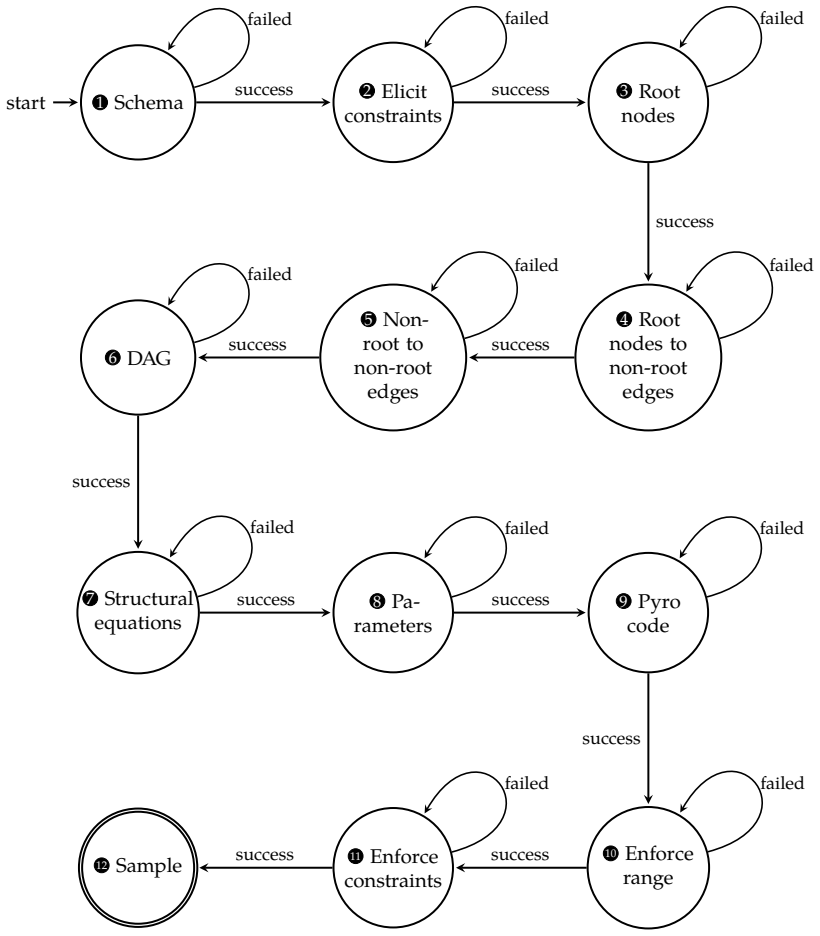
The central object is surrogate public data plus a schema-to-data generation pipeline. The Agent method is the load-bearing piece: an automated state machine that prompts an LLM to declare variables, propose consistency constraints, choose root nodes, add parent-child edges while checking acyclicity, assign structural equations and parameters, emit sampling code, and enforce value ranges, re-querying on any validation failure. This encodes plausible dependencies among variables using only schema metadata, making the sampled records statistically coherent while consuming zero privacy budget. Direct CSV generation is the simpler alternative, and the uniform, univariate, and arbitrary Bayesian-network baselines isolate which data properties actually matter.
What would settle it
Take a private split that was published before the generation models' training cutoffs and run the paper's own header-generation and row-completion memorization tests on the LLMs used to build surrogates; if the LLMs reproduce exact or near-exact private records, the reported pretraining gains cannot be attributed to schema-based priors.
Extended reading notes
Core claim
On its own terms, the paper claims that LLMs can stand in for the panel of domain experts that would manually encode a plausible data-generating process, turning public schema or codebook metadata into usable public data. It proposes two automated routes: direct CSV record generation, and a state-machine Agent that elicits a structural causal model (a DAG with structural equations) from the LLM and then samples from it. Across three datasets, the paper finds that LLM-generated surrogates match traditional public data when pretraining a DP FTTransformer under DP-SGD fine-tuning at $\varepsilon=1$ on small datasets, with the strongest aggregate results for direct CSV generation from Claude on EDAD and for the Claude Agent on the Workplace Equity survey. On the large ACS dataset, no pretraining method helps, and a subsampling analysis shows the advantage reappears at 5% and 10% sizes, which the paper attributes to the inverse relationship between noise and dataset size.
Load-bearing premise
The load-bearing premise is that the large language models used to generate the surrogate data never memorized the private evaluation records, so the measured gains reflect the schema-based prior rather than data leakage.
Editorial extensions
If this is right
- Practitioners with a small private tabular dataset and no public split can pretrain a DP classifier on LLM-generated surrogate data and keep most of the pretraining benefit that a real public sample would provide.
- The input that matters is schema metadata, so a codebook or README—rather than an actual public sample—can be sufficient to build a zero-privacy-cost prior for private learning.
- Surrogate pretraining is a low-data-regime tool: as the private dataset grows, the advantage disappears, so large-scale deployments should not expect gains from this technique.
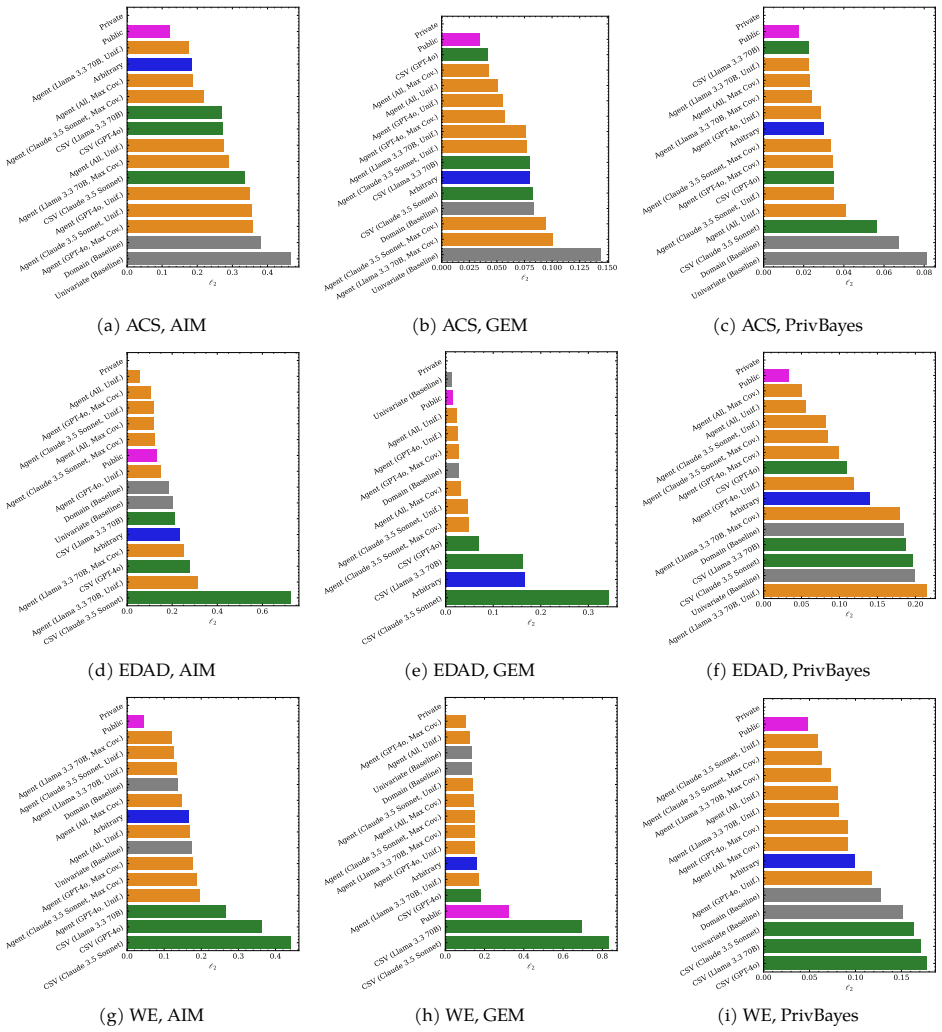
- For tuning DP synthesizers, encoding any plausible dependency structure can be enough to choose useful hyperparameters, which explains why an arbitrary Bayesian network lands on the Pareto frontier alongside the LLM-generated surrogates.
- Estimating the privacy-utility trade-off is the hardest of the three tasks; surrogate data tracks the private curve only loosely, and traditional public data remains the best estimator in most settings.
Reading between the lines
- Editorial inference: If schema priors are what carry the gains, then the binding constraint becomes metadata quality, and augmenting sparse codebooks with retrieval from domain literature or expert review of the elicited SCM should push surrogates closer to parity with real public splits.
- Editorial inference: The large-dataset failure implies a measurable size threshold—somewhere between the 1,400-record WE split and the 23,006-record ACS split at $\varepsilon=1$—where surrogate pretraining stops beating no pretraining; locating that threshold across datasets would give practitioners a rule of thumb.
- Editorial inference: The absence of a link between TVD and 3-way marginal similarity and usefulness suggests the right similarity measure for surrogate selection is task-relative, such as fidelity of the conditional distribution of the target given features, and such a metric could select among generated surrogates without spending privacy budget.
- Editorial inference: Because CSV and Agent surrogates succeed in different spots (CSV on EDAD pretraining, Agent on WE pretraining and tuning), a portfolio that generates both and picks by task may beat either alone; the paper does not test this.
Signed reviews
Editorial analysis
A structured set of objections, weighed in public.
Referee Report
Summary. The paper introduces the notion of "surrogate public data" for differentially private (DP) tabular analytics: datasets generated from schema-level metadata only, without access to sensitive records and without consuming privacy budget. Two LLM-based generation methods are proposed: direct CSV generation and an agent-based state machine that elicits a structural causal model (SCM) from an LLM. These are compared against simpler baselines (uniform, univariate, arbitrary Bayesian network) and against traditional public data on three datasets (ACS, EDAD, WE), three DP synthesizers (PrivBayes, GEM, AIM), and an FTTransformer classifier. The main empirical finding is that surrogate public data can substantially improve DP classifier pretraining in the low-data regime, with EDAD and WE showing large AUC advantages at small epsilon, while ACS at full size shows no pretraining benefit. The paper also reports more limited usefulness for hyperparameter tuning of DP synthesizers and a mixed story for privacy-utility tradeoff estimation.
Significance. If the central claim holds, the paper makes a practically valuable contribution: it relaxes the common assumption that DP tabular pipelines require access to traditional public data, and it offers a concrete, automatable way to generate domain-informed priors from public schema information. The experimental design is broad and reproducible, with public code, multiple LLMs, multiple synthesizers, multiple epsilon values, and repeated runs. The authors also take the memorization issue seriously by choosing post-cutoff private splits and applying the Bordt et al. row-level memorization tests. However, the validity of the central claim depends on a load-bearing independence assumption: the LLM-generated surrogate data must not encode information from the private splits. The paper's evidence for this assumption is incomplete, and the headline quantitative comparisons lack uncertainty quantification. These issues do not overturn the empirical phenomenon but do affect how strongly the central claim can be stated.
major comments (3)
- [8.1, Appendix B.1.4] The paper's non-leakage evidence is insufficient for the load-bearing independence requirement. The Bordt et al. (2024) tests used in Appendix B.1.4 target verbatim record-level memorization (header tests and row completion tests); they do not test whether an LLM has internalized published aggregate statistics of the private EDAD 2023 and WE 2023 releases, such as marginal distributions, correlation tables, or descriptive summaries in codebooks and press releases. This matters because EDAD 2023 and WE 2023 were released in April 2024, overlapping with the stated cutoff of Claude 3.5 Sonnet (April 2024) and postdating the surveys themselves, so exposure to public summaries of these very releases is plausible. The paper explicitly acknowledges this risk in Section 8.1 but then treats the row-level memorization test as sufficient. It is not sufficient for distributional leakage. To support the central claim that the observed gains come from schema-based priors rather than private-informative prior contamination, the authors should add tests that compare generated surrogate data against publicly available aggregate summaries, or otherwise demonstrate that the LLM's output is insensitive to the private distribution's published summary statistics.
- [6.1, Table 3] The headline pretraining results are presented as point estimates without standard errors, confidence intervals, or significance tests, although 10 runs per configuration are reported. For example, on EDAD at epsilon=1 the AUC advantage is 0.19 for traditional public data, 0.17 for CSV (Claude), and 0.17 for CSV (Llama); the differences among these methods are small relative to the expected variance of DP training. Similarly, the WE results at epsilon=1 show Agent (Claude, Unif.) at 0.21 versus Public at 0.11, but no measure of variability is given. The claim that surrogate methods are "on par with" traditional public data, and the ranking of methods in Figures 3-9, would be substantially strengthened by reporting standard errors or confidence intervals and, where appropriate, paired significance tests across the shared fine-tuning hyperparameter configurations.
- [6.1, Figure 9] The explanation that the ACS failure is due to dataset size rests on subsampling a single dataset (ACS) at four rates. This is suggestive but not conclusive: the observed difference between full-size ACS and the small EDAD/WE datasets could also be explained by domain, schema complexity, or the strength of the LLM's prior for the specific variables. Since the low-data regime is the core of the paper's central claim, the evidence base of two small datasets is thin. The authors should either add at least one additional large dataset (or an additional small one from a different domain) to test the size hypothesis, or explicitly scope the claim to the two demonstrated datasets and temper the abstract accordingly.
minor comments (4)
- [Section 3 heading] The section title "statical distance metrics" contains a typo and should read "statistical distance metrics."
- [4.1.2, footnote 2] The Univariate baseline is explicitly disclosed as not a valid public data surrogate, but this disclosure appears only in a footnote. Because the method appears as a Pareto efficient method in Task 3 results (e.g., Table 14), the main text should clearly mark it as a reference condition and not as a candidate surrogate.
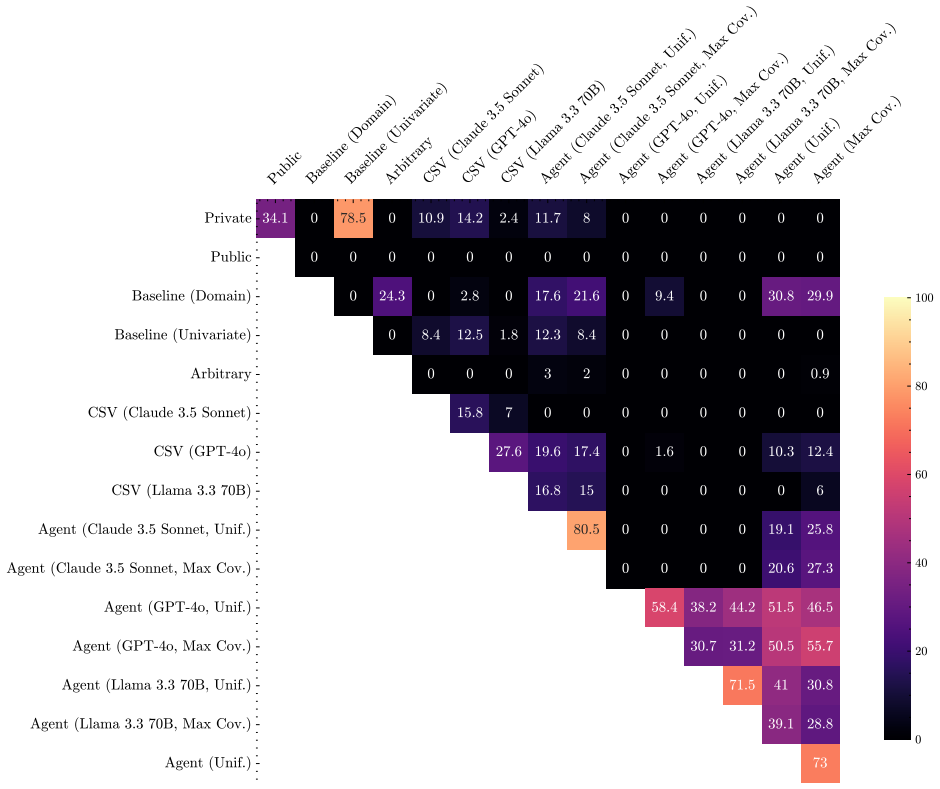
- [Table 16, Appendix D] In Table 16, zero values are omitted for readability, but this makes it difficult to distinguish true zero similarity from missing entries, particularly for EDAD and WE where many LLM-based rows contain only blanks. A placeholder such as "<0.05" or explicit zeros would improve interpretability.
- [Appendix C.1, Table 22a] The table contains a typo: "Agent (Allm Unif.)" should be "Agent (All, Unif.)."
Circularity Check
No significant circularity: the central claim is an empirical benchmark, and the surrogate generation methods do not access sensitive records.
full rationale
The paper's central claim — that LLM-generated surrogate public data can effectively replace traditional public data in DP auxiliary tasks — is supported by a controlled empirical evaluation, not by a derivation that reduces to its own inputs. Surrogate generation (CSV and Agent) consumes only schema-level metadata, and the evaluation includes both a no-pretraining control and a traditional public split as external points of comparison. Reported AUC advantages are measured on a held-out private test split after fine-tuning, so they are not fitted quantities renamed as predictions. The only baseline that samples directly from private data (Univariate) is explicitly disclosed as not a valid surrogate in Section 4.1.2, so it cannot serve as a hidden fitted input. Self-citations, such as Hod & Canetti (2025) for motivation and Rosenblatt et al. (2024b) for FTTransformer adaptation, are not load-bearing for the central empirical claim. The acknowledged memorization risk in Section 8.1 is a validity threat about whether the Bordt et al. row-level tests rule out distributional leakage, but it is not a circularity: no equation or fitted quantity in the paper makes the conclusion equivalent to its inputs. The paper is self-contained against external benchmarks and control conditions, so the circularity score is 0.
Assumptions & free parameters
assumptions (5)
- standard math Differential privacy definitions and composition (Dwork et al., 2016).
- standard math Public data close to the private distribution improves private learning (Bassily et al., 2019).
- domain assumption LLM pretrained knowledge encodes plausible relationships among tabular variables from schema descriptions.
- domain assumption Private splits of EDAD (2023) and WE (2023) postdate LLM knowledge cutoffs and are not memorized.
- domain assumption Schema-level metadata alone (names, types, ranges) is publicly available for tabular datasets.
Cite this review
Pith. "Pith review of Do You Really Need Public Data? Surrogate Public Data for Differential Privacy on Tabular Data." pith.science (2026). https://pith.science/paper/HP4WIQ5Y
@misc{pith2026250414368,
  author       = {Pith},
  title        = {Pith review of: Do You Really Need Public Data? Surrogate Public Data for Differential Privacy on Tabular Data},
  year         = {2026},
  howpublished = {\url{https://pith.science/paper/HP4WIQ5Y}},
  note         = {Machine review of arXiv:2504.14368}
}
read the original abstract
Differentially private (DP) machine learning often relies on the availability of public data for tasks like privacy-utility trade-off estimation, hyperparameter tuning, and pretraining. While public data assumptions may be reasonable in text and image domains, they are less likely to hold for tabular data due to tabular data heterogeneity across domains. We propose leveraging powerful priors to address this limitation; specifically, we synthesize realistic tabular data directly from schema-level specifications - such as variable names, types, and permissible ranges - without ever accessing sensitive records. To that end, this work introduces the notion of "surrogate" public data - datasets generated independently of sensitive data, which consume no privacy loss budget and are constructed solely from publicly available schema or metadata. Surrogate public data are intended to encode plausible statistical assumptions (informed by publicly available information) into a dataset with many downstream uses in private mechanisms. We automate the process of generating surrogate public data with large language models (LLMs); in particular, we propose two methods: direct record generation as CSV files, and automated structural causal model (SCM) construction for sampling records. Through extensive experiments, we demonstrate that surrogate public tabular data can effectively replace traditional public data when pretraining differentially private tabular classifiers. To a lesser extent, surrogate public data are also useful for hyperparameter tuning of DP synthetic data generators, and for estimating the privacy-utility tradeoff.
Figures


Figures from the paper (18 more)






Reference graph
Works this paper leans on
-
[1]
write newline
" write newline "" before.all 'output.state := FUNCTION n.dashify 't := "" t empty not t #1 #1 substring "-" = t #1 #2 substring "--" = not "--" * t #2 global.max substring 't := t #1 #1 substring "-" = "-" * t #2 global.max substring 't := while if t #1 #1 substring * t #2 global.max substring 't := if while FUNCTION format.date year duplicate empty "emp...
-
[2]
J., McMahan, H
Abadi, M., Chu, A., Goodfellow, I. J., McMahan, H. B., Mironov, I., Talwar, K., and Zhang, L. Deep learning with differential privacy. In Proceedings of the 2016 ACM SIGSAC Conference on Computer and Communications Security, Vienna, Austria, October 24-28, 2016 , pp.\ 308--318. ACM , 2016
2016
-
[3]
M., He, T., Ijishakin, A., Drobnjak, I., Castro, D
Abdulaal, A., Hadjivasiliou, A., Brown, N. M., He, T., Ijishakin, A., Drobnjak, I., Castro, D. C., and Alexander, D. C. Causal modelling agents: Causal graph discovery through synergising metadata- and data-driven reasoning. In The Twelfth International Conference on Learning Representations, ICLR 2024, Vienna, Austria, May 7-11, 2024 . OpenReview.net, 2024
2024
-
[4]
M., Ashmead, R., Cumings - Menon, R., Garfinkel, S
Abowd, J. M., Ashmead, R., Cumings - Menon, R., Garfinkel, S. L., Heineck, M., Heiss, C., Johns, R., Kifer, D., Leclerc, P., Machanavajjhala, A., Moran, B., Sexton, W., Spence, M., and Zhuravlev, P. The 2020 census disclosure avoidance system topdown algorithm. CoRR, abs/2204.08986, 2022
arXiv 2020
-
[5]
M., Adams, T., Ashmead, R., Darais, D., Dey, S., Garfinkel, S
Abowd, J. M., Adams, T., Ashmead, R., Darais, D., Dey, S., Garfinkel, S. L., Goldschlag, N., Kifer, D., Leclerc, P., Lew, E., Moore, S., Rodr'iguez, R. A., Tadros, R. N., and Vilhuber, L. The 2010 Census confidentiality protections failed, here's how and why. Technical report, National Bureau of Economic Research, 2023
2010
-
[6]
Almeida, D. R. Synthetic data generation (part 1). https://cookbook.openai.com/examples/sdg1, 2024. OpenAI Cookbook
2024
-
[7]
M., Thakkar, O., and Thakurta, A
Amid, E., Ganesh, A., Mathews, R., Ramaswamy, S., Song, S., Steinke, T., Suriyakumar, V. M., Thakkar, O., and Thakurta, A. Public data-assisted mirror descent for private model training. In International Conference on Machine Learning, ICML 2022, 17-23 July 2022, Baltimore, Maryland, USA , volume 162 of Proceedings of Machine Learning Research, pp.\ 517--...
2022
-
[8]
Private prediction for large-scale synthetic text generation
Amin, K., Bie, A., Kong, W., Kurakin, A., Ponomareva, N., Syed, U., Terzis, A., and Vassilvitskii, S. Private prediction for large-scale synthetic text generation. In Findings of the Association for Computational Linguistics: EMNLP 2024, Miami, Florida, USA, November 12-16, 2024 , pp.\ 7244--7262. Association for Computational Linguistics, 2024
2024
Show all 121 references
-
[9]
Claude API Documentation
Anthropic . Claude API Documentation . https://docs.anthropic.com/claude/reference/, 2025
2025
-
[10]
Ayd \" o re, S., Brown, W., Kearns, M., Kenthapadi, K., Melis, L., Roth, A., and Siva, A. A. Differentially private query release through adaptive projection. In Meila, M. and Zhang, T. (eds.), Proceedings of the 38th International Conference on Machine Learning, ICML 2021, 18...
2021
-
[11]
Limits of private learning with access to public data
Bassily, R., Moran, S., and Alon, N. Limits of private learning with access to public data. In Advances in Neural Information Processing Systems 32: Annual Conference on Neural Information Processing Systems 2019, NeurIPS 2019, December 8-14, 2019, Vancouver, BC, Canada, pp.\ ...
2019
-
[12]
R., and Wu, Z
Bassily, R., Cheu, A., Moran, S., Nikolov, A., Ullman, J. R., and Wu, Z. S. Private query release assisted by public data. In Proceedings of the 37th International Conference on Machine Learning, ICML 2020, 13-18 July 2020, Virtual Event , volume 119 of Proceedings of Machine ...
2020
-
[13]
Learning from mixtures of private and public populations
Bassily, R., Moran, S., and Nandi, A. Learning from mixtures of private and public populations. In Advances in Neural Information Processing Systems 33: Annual Conference on Neural Information Processing Systems 2020, NeurIPS 2020, December 6-12, 2020, virtual, 2020 b
2020
-
[14]
L., Kamath, G., and Singhal, V
Ben - David, S., Bie, A., Canonne, C. L., Kamath, G., and Singhal, V. Private distribution learning with public data: The view from sample compression. In Advances in Neural Information Processing Systems 36: Annual Conference on Neural Information Processing Systems 2023, Neu...
2023
-
[15]
Private estimation with public data
Bie, A., Kamath, G., and Singhal, V. Private estimation with public data. 2022
2022
-
[16]
P., Jankowiak, M., Obermeyer, F., Pradhan, N., Karaletsos, T., Singh, R., Szerlip, P
Bingham, E., Chen, J. P., Jankowiak, M., Obermeyer, F., Pradhan, N., Karaletsos, T., Singh, R., Szerlip, P. A., Horsfall, P., and Goodman, N. D. Pyro: Deep universal probabilistic programming. J. Mach. Learn. Res., 20: 0 28:1--28:6, 2019
2019
-
[17]
Oracle-efficient differentially private learning with public data
Block, A., Bun, M., Desai, R., Shetty, A., and Wu, S. Oracle-efficient differentially private learning with public data. CoRR, abs/2402.09483, 2024
2024 arXiv
-
[18]
Elephants never forget: Memorization and learning of tabular data in large language models
Bordt, S., Nori, H., Rodrigues, V., Nushi, B., and Caruana, R. Elephants never forget: Memorization and learning of tabular data in large language models. In Conference on Languge Modeling ( COLM ) , 2024
2024
-
[19]
Language models are realistic tabular data generators
Borisov, V., Se ler, K., Leemann, T., Pawelczyk, M., and Kasneci, G. Language models are realistic tabular data generators. In The Eleventh International Conference on Learning Representations, ICLR 2023, Kigali, Rwanda, May 1-5, 2023 . OpenReview.net, 2023
2023
-
[20]
Differentially private bias-term fine-tuning of foundation models
Bu, Z., Wang, Y., Zha, S., and Karypis, G. Differentially private bias-term fine-tuning of foundation models. In Forty-first International Conference on Machine Learning, ICML 2024, Vienna, Austria, July 21-27, 2024 . OpenReview.net, 2024
2024
-
[21]
E., Engler, A., Khitatrakun, S., Nunns, J
Burman, L. E., Engler, A., Khitatrakun, S., Nunns, J. R., Armstrong, S., Iselin, J., MacDonald, G., and Stallworth, P. Safely expanding research access to administrative tax data: creating a synthetic public use file and a validation server. Technical report US, Internal Reven...
2019
-
[22]
Bynum, L. E. J. and Cho, K. Language models as causal effect generators. CoRR, abs/2411.08019, 2024
2024
-
[23]
Data synthesis via differentially private markov random field
Cai, K., Lei, X., Wei, J., and Xiao, X. Data synthesis via differentially private markov random field. Proc. VLDB Endow. , 14 0 (11): 0 2190--2202, 2021
2021
-
[24]
B., Song, D., Erlingsson, \' U ., Oprea, A., and Raffel, C
Carlini, N., Tram \` e r, F., Wallace, E., Jagielski, M., Herbert - Voss, A., Lee, K., Roberts, A., Brown, T. B., Song, D., Erlingsson, \' U ., Oprea, A., and Raffel, C. Extracting training data from large language models. In 30th USENIX Security Symposium, USENIX Security 202...
2021
-
[25]
Quantifying memorization across neural language models
Carlini, N., Ippolito, D., Jagielski, M., Lee, K., Tram \` e r, F., and Zhang, C. Quantifying memorization across neural language models. In The Eleventh International Conference on Learning Representations, ICLR 2023, Kigali, Rwanda, May 1-5, 2023 , 2023
2023
-
[26]
A., Papernot, N., and Thakurta, A
Cattan, Y., Choquette - Choo, C. A., Papernot, N., and Thakurta, A. Fine-tuning with differential privacy necessitates an additional hyperparameter search. CoRR, abs/2210.02156, 2022
2022 arXiv
-
[27]
Causal evaluation of language models
Chen, S., Peng, B., Chen, M., Wang, R., Xu, M., Zeng, X., Zhao, R., Zhao, S., Qiao, Y., and Lu, C. Causal evaluation of language models. CoRR, abs/2405.00622, 2024
2024 arXiv
-
[28]
and Guestrin, C
Chen, T. and Guestrin, C. Xgboost: A scalable tree boosting system. In Proceedings of the 22nd ACM SIGKDD International Conference on Knowledge Discovery and Data Mining, San Francisco, CA, USA, August 13-17, 2016 , pp.\ 785--794. ACM , 2016
2016
-
[29]
J., Khashabi, D., and Durme, B
Cheng, J., Marone, M., Weller, O., Lawrie, D. J., Khashabi, D., and Durme, B. V. Dated data: Tracing knowledge cutoffs in large language models. In Conference on Languge Modeling ( COLM ) , 2024
2024
-
[30]
and Sarathy, J
Cummings, R. and Sarathy, J. Centering policy and practice: Research gaps around usable differential privacy. In 5th IEEE International Conference on Trust, Privacy and Security in Intelligent Systems and Applications, TPS-ISA 2023, Atlanta, GA, USA, November 1-4, 2023 , pp.\ ...
2023
-
[31]
Advancing Differential Privacy : Where We Are Now and Future Directions for Real - World Deployment
Cummings, R., Desfontaines, D., Evans, D., Geambasu, R., Huang, Y., Jagielski, M., Kairouz, P., Kamath, G., Oh, S., Ohrimenko, O., Papernot, N., Rogers, R., Shen, M., Song, S., Su, W., Terzis, A., Thakurta, A., Vassilvitskii, S., Wang, Y.-X., Xiong, L., Yekhanin, S., Yu, D., Z...
2024
-
[32]
ATTAXONOMY: unpacking differential privacy guarantees against practical adversaries
Cummings, R., Hod, S., Sarathy, J., and Swanberg, M. ATTAXONOMY: unpacking differential privacy guarantees against practical adversaries. CoRR, abs/2405.01716, 2024 b
2024 arXiv
-
[33]
Large language models are effective priors for causal graph discovery
Darvariu, V., Hailes, S., and Musolesi, M. Large language models are effective priors for causal graph discovery. CoRR, abs/2405.13551, 2024
2024 arXiv
-
[34]
DeepSeek - AI, Guo, D., Yang, D., Zhang, H., Song, J., Zhang, R., Xu, R., Zhu, Q., Ma, S., Wang, P., Bi, X., Zhang, X., Yu, X., Wu, Y., Wu, Z. F., Gou, Z., Shao, Z., Li, Z., Gao, Z., Liu, A., Xue, B., Wang, B., Wu, B., Feng, B., Lu, C., Zhao, C., Deng, C., Zhang, C., Ruan, C.,...
2025 arXiv
-
[35]
A list of real-world uses of differential privacy - T ed is writing things --- desfontain.es
Desfontaines, D. A list of real-world uses of differential privacy - T ed is writing things --- desfontain.es. https://desfontain.es/privacy/real-world-differential-privacy.html, 2021
2021
-
[36]
BERT: pre-training of deep bidirectional transformers for language understanding
Devlin, J., Chang, M., Lee, K., and Toutanova, K. BERT: pre-training of deep bidirectional transformers for language understanding. pp.\ 4171--4186, 2019
2019
-
[37]
Generalization or memorization: Data contamination and trustworthy evaluation for large language models
Dong, Y., Jiang, X., Liu, H., Jin, Z., Gu, B., Yang, M., and Li, G. Generalization or memorization: Data contamination and trustworthy evaluation for large language models. In Findings of the Association for Computational Linguistics, ACL 2024, Bangkok, Thailand and virtual me...
2024
-
[38]
N., and Vadhan, S
Dwork, C., Naor, M., Reingold, O., Rothblum, G. N., and Vadhan, S. P. On the complexity of differentially private data release: efficient algorithms and hardness results. In Mitzenmacher, M. (ed.), Proceedings of the 41st Annual ACM Symposium on Theory of Computing, STOC 2009,...
2009
-
[39]
Dwork, C., McSherry, F., Nissim, K., and Smith, A. D. Calibrating noise to sensitivity in private data analysis. volume 7, pp.\ 17--51, 2016
2016
-
[40]
Multicriteria optimization, volume 491
Ehrgott, M. Multicriteria optimization, volume 491. Springer Science & Business Media, 2005
2005
-
[41]
and DeSalvo, K
Fitzpatrick, J. and DeSalvo, K. Helping public health officials combat covid-19. https://blog.google/technology/health/covid-19-community-mobility-reports/, 2020
2020
-
[42]
O., Rossi, R
Gallegos, I. O., Rossi, R. A., Barrow, J., Tanjim, M. M., Kim, S., Dernoncourt, F., Yu, T., Zhang, R., and Ahmed, N. K. Bias and fairness in large language models: A survey. Computational Linguistics, 50 0 (3): 0 1097--1179, 2024
2024
-
[43]
G., and Wang, L
Ganesh, A., Haghifam, M., Nasr, M., Oh, S., Steinke, T., Thakkar, O., Thakurta, A. G., and Wang, L. Why is public pretraining necessary for private model training? In Krause, A., Brunskill, E., Cho, K., Engelhardt, B., Sabato, S., and Scarlett, J. (eds.), International Confere...
2023
-
[44]
Submix: Practical private prediction for large-scale language models
Ginart, A., van der Maaten, L., Zou, J., and Guo, C. Submix: Practical private prediction for large-scale language models. CoRR, abs/2201.00971, 2022
2022 arXiv
-
[45]
Mixed differential privacy in computer vision
Golatkar, A., Achille, A., Wang, Y., Roth, A., Kearns, M., and Soatto, S. Mixed differential privacy in computer vision. In IEEE/CVF Conference on Computer Vision and Pattern Recognition, CVPR 2022, New Orleans, LA, USA, June 18-24, 2022 , pp.\ 8366--8376. IEEE , 2022
2022
-
[46]
and Surdeanu, M
Golchin, S. and Surdeanu, M. Time travel in llms: Tracing data contamination in large language models. In The Twelfth International Conference on Learning Representations, ICLR 2024, Vienna, Austria, May 7-11, 2024 , 2024
2024
-
[47]
Revisiting deep learning models for tabular data
Gorishniy, Y., Rubachev, I., Khrulkov, V., and Babenko, A. Revisiting deep learning models for tabular data. In Advances in Neural Information Processing Systems 34: Annual Conference on Neural Information Processing Systems 2021, NeurIPS 2021, December 6-14, 2021, virtual, pp...
2021
-
[48]
On embeddings for numerical features in tabular deep learning
Gorishniy, Y., Rubachev, I., and Babenko, A. On embeddings for numerical features in tabular deep learning. 2022
2022
-
[49]
Gu, X., Kamath, G., and Wu, Z. S. Choosing public datasets for private machine learning via gradient subspace distance. CoRR, abs/2303.01256, 2023
2023 arXiv
-
[50]
and Roysdon, P
Gulati, M. and Roysdon, P. F. Tabmt: Generating tabular data with masked transformers. In Advances in Neural Information Processing Systems 36: Annual Conference on Neural Information Processing Systems 2023, NeurIPS 2023, New Orleans, LA, USA, December 10 - 16, 2023, 2023
2023
-
[51]
J., and Schult, D
Hagberg, A., Swart, P. J., and Schult, D. A. Exploring network structure, dynamics, and function using networkx. Technical report, Los Alamos National Laboratory (LANL), Los Alamos, NM (United States), 2008
2008
-
[52]
A simple and practical algorithm for differentially private data release
Hardt, M., Ligett, K., and McSherry, F. A simple and practical algorithm for differentially private data release. In Advances in Neural Information Processing Systems 25: 26th Annual Conference on Neural Information Processing Systems 2012. Proceedings of a meeting held Decemb...
2012
-
[53]
Hasani, W. S. R., Musa, K. I., Chen, X. W., and Cheng, K. Y. Constructing causal pathways for premature cardiovascular disease mortality using directed acyclic graphs with integrating evidence synthesis and expert knowledge. Scientific Reports, 14 0 (1): 0 28849, 2024
2024
-
[54]
T., Backurs, A., Yu, N., and Bian, J
He, J., Li, X., Yu, D., Zhang, H., Kulkarni, J., Lee, Y. T., Backurs, A., Yu, N., and Bian, J. Exploring the limits of differentially private deep learning with group-wise clipping. In The Eleventh International Conference on Learning Representations, ICLR 2023, Kigali, Rwanda...
2023
-
[55]
Hegselmann, S., Buendia, A., Lang, H., Agrawal, M., Jiang, X., and Sontag, D. A. Tabllm: Few-shot classification of tabular data with large language models. In Ruiz, F. J. R., Dy, J. G., and van de Meent, J. (eds.), International Conference on Artificial Intelligence and Stati...
2023
-
[56]
and Canetti, R
Hod, S. and Canetti, R. Differentially private release of I srael's national registry of live births. In 46th IEEE Symposium on Security and Privacy, SP 2025, San Francisco, CA, USA, May 12-15, 2025 . IEEE , 2025
2025
-
[57]
Disabilities survey - results - microdata
Instituto Nacional de Estadística . Disabilities survey - results - microdata. https://www.ine.es/dyngs/INEbase/en/operacion.htm?c=Estadistica_C&cid=1254736176782&menu=resultados&idp=1254735573175#_tabs-1254736195313, 2024
2024
-
[58]
P., Song, D., Thakkar, O., Thakurta, A., and Wang, L
Iyengar, R., Near, J. P., Song, D., Thakkar, O., Thakurta, A., and Wang, L. Towards practical differentially private convex optimization. In 2019 IEEE Symposium on Security and Privacy, SP 2019, San Francisco, CA, USA, May 19-23, 2019 , pp.\ 299--316. IEEE , 2019
2019
-
[59]
Jaech, A., Kalai, A., Lerer, A., Richardson, A., El - Kishky, A., Low, A., Helyar, A., Madry, A., Beutel, A., Carney, A., Iftimie, A., Karpenko, A., Passos, A. T., Neitz, A., Prokofiev, A., Wei, A., Tam, A., Bennett, A., Kumar, A., Saraiva, A., Vallone, A., Duberstein, A., Kon...
2024 arXiv
-
[60]
Jaynes, E. T. Information theory and statistical mechanics. Physical review, 106 0 (4): 0 620, 1957
1957
-
[61]
R., Rush, K., and Thakurta, A
Kairouz, P., Diaz, M. R., Rush, K., and Thakurta, A. (nearly) dimension independent private ERM with adagrad ratesvia publicly estimated subspaces. In Belkin, M. and Kpotufe, S. (eds.), Conference on Learning Theory, COLT 2021, 15-19 August 2021, Boulder, Colorado, USA , volum...
2021
-
[62]
Deduplicating training data mitigates privacy risks in language models
Kandpal, N., Wallace, E., and Raffel, C. Deduplicating training data mitigates privacy risks in language models. In International Conference on Machine Learning, ICML 2022, 17-23 July 2022, Baltimore, Maryland, USA , 2022
2022
-
[63]
On the convergence of differentially-private fine-tuning: To linearly probe or to fully fine-tune? CoRR, abs/2402.18905, 2024
Ke, S., Hou, C., Fanti, G., and Oh, S. On the convergence of differentially-private fine-tuning: To linearly probe or to fully fine-tune? CoRR, abs/2402.18905, 2024
2024
-
[64]
H., Naseer, M., Hayat, M., Zamir, S
Khan, S. H., Naseer, M., Hayat, M., Zamir, S. W., Khan, F. S., and Shah, M. Transformers in vision: A survey. ACM Comput. Surv. , 54 0 (10s): 0 200:1--200:41, 2022
2022
-
[65]
Causal reasoning and large language models: Opening a new frontier for causality
Kiciman, E., Ness, R., Sharma, A., and Tan, C. Causal reasoning and large language models: Opening a new frontier for causality. CoRR, abs/2305.00050, 2023
2023 arXiv
-
[66]
Group-wise prompting for synthetic tabular data generation using large language models
Kim, J., Kim, T., and Choo, J. Group-wise prompting for synthetic tabular data generation using large language models. CoRR, abs/2404.12404, 2024
2024 arXiv
-
[67]
Harnessing large-language models to generate private synthetic text
Kurakin, A., Ponomareva, N., Syed, U., MacDermed, L., and Terzis, A. Harnessing large-language models to generate private synthetic text. CoRR, abs/2306.01684, 2023
2023 arXiv
-
[68]
D., Xia, X., and Chen, Z
Le, H. D., Xia, X., and Chen, Z. Multi-agent causal discovery using large language models. CoRR, abs/2407.15073, 2024
2024 arXiv
-
[69]
Workplace equity survey 2023, 2024
Lemieux, C., Taylor, S., Stone, A., Wooden, P., and Chauhan, C. Workplace equity survey 2023, 2024. https://doi.org/10.3886/E202701V1
2023 doi
-
[70]
u ttler, H., Lewis, M., Yih, W., Rockt \
Lewis, P. S. H., Perez, E., Piktus, A., Petroni, F., Karpukhin, V., Goyal, N., K \" u ttler, H., Lewis, M., Yih, W., Rockt \" a schel, T., Riedel, S., and Kiela, D. Retrieval-augmented generation for knowledge-intensive NLP tasks. In Advances in Neural Information Processing S...
2020
-
[71]
R., and Wu, Z
Liu, T., Vietri, G., Steinke, T., Ullman, J. R., and Wu, Z. S. Leveraging public data for practical private query release. In Proceedings of the 38th International Conference on Machine Learning, ICML 2021, 18-24 July 2021, Virtual Event , volume 139 of Proceedings of Machine ...
2021
-
[72]
Iterative methods for private synthetic data: Unifying framework and new methods
Liu, T., Vietri, G., and Wu, S. Iterative methods for private synthetic data: Unifying framework and new methods. In Advances in Neural Information Processing Systems 34: Annual Conference on Neural Information Processing Systems 2021, NeurIPS 2021, December 6-14, 2021, virtua...
2021
-
[73]
Liu, T., Vietri, G., and Wu, S. Z. Iterative methods for private synthetic data: Unifying framework and new methods. Advances in Neural Information Processing Systems, 34: 0 690--702, 2021 c
2021
-
[74]
Causal discovery with language models as imperfect experts
Long, S., Pich \' e , A., Zantedeschi, V., Schuster, T., and Drouin, A. Causal discovery with language models as imperfect experts. CoRR, abs/2307.02390, 2023 a
2023 arXiv
-
[75]
Can large language models build causal graphs? CoRR, abs/2303.05279, 2023 b
Long, S., Schuster, T., and Pich \' e , A. Can large language models build causal graphs? CoRR, abs/2303.05279, 2023 b
2023 arXiv
-
[76]
Optimal differentially private model training with public data
Lowy, A., Li, Z., Huang, T., and Razaviyayn, M. Optimal differentially private model training with public data. In Forty-first International Conference on Machine Learning, ICML 2024, Vienna, Austria, July 21-27, 2024 . OpenReview.net, 2024
2024
-
[77]
Ma, J., Dankar, A., Stein, G., Yu, G., and Caterini, A. L. Tabpfgen - tabular data generation with tabpfn. CoRR, abs/2406.05216, 2024
2024 arXiv
-
[78]
and Schwartz, R
Magar, I. and Schwartz, R. Data contamination: From memorization to exploitation. In Proceedings of the 60th Annual Meeting of the Association for Computational Linguistics (Volume 2: Short Papers), ACL 2022, Dublin, Ireland, May 22-27, 2022 , 2022
2022
-
[79]
Winning the NIST contest: A scalable and general approach to differentially private synthetic data
McKenna, R., Miklau, G., and Sheldon, D. Winning the NIST contest: A scalable and general approach to differentially private synthetic data. J. Priv. Confidentiality, 11 0 (3), 2021
2021
-
[80]
AIM: an adaptive and iterative mechanism for differentially private synthetic data
McKenna, R., Mullins, B., Sheldon, D., and Miklau, G. AIM: an adaptive and iterative mechanism for differentially private synthetic data. Proc. VLDB Endow. , 15 0 (11): 0 2599--2612, 2022
2022
-
[81]
Optimizing error of high-dimensional statistical queries under differential privacy
McKenna, R., Miklau, G., Hay, M., and Machanavajjhala, A. Optimizing error of high-dimensional statistical queries under differential privacy. J. Priv. Confidentiality, 13 0 (1), 2023
2023
-
[82]
and Talwar, K
McSherry, F. and Talwar, K. Mechanism design via differential privacy. In 48th Annual IEEE Symposium on Foundations of Computer Science (FOCS 2007), October 20-23, 2007, Providence, RI, USA, Proceedings , pp.\ 94--103. IEEE Computer Society, 2007
2007
-
[83]
Negotiating Privacy/Utility Trade-Offs under differential privacy
Miklau, G. Negotiating Privacy/Utility Trade-Offs under differential privacy. In USENIX Conference on Privacy Engineering Practice and Respect, PEPR , 2022
2022
-
[84]
Transformers can do bayesian inference
M \" u ller, S., Hollmann, N., Pineda - Arango, S., Grabocka, J., and Hutter, F. Transformers can do bayesian inference. 2022
2022
-
[85]
Effectively using public data in privacy preserving machine learning
Nasr, M., Mahloujifar, S., Tang, X., Mittal, P., and Houmansadr, A. Effectively using public data in privacy preserving machine learning. In Krause, A., Brunskill, E., Cho, K., Engelhardt, B., Sabato, S., and Scarlett, J. (eds.), International Conference on Machine Learning, I...
2023
-
[86]
E., Funke, T., and Khosla, M
Olatunji, I. E., Funke, T., and Khosla, M. Releasing graph neural networks with differential privacy guarantees. Trans. Mach. Learn. Res., 2023, 2023
2023
-
[87]
OpenAI API Documentation
OpenAI . OpenAI API Documentation . https://platform.openai.com/docs, 2025
2025
-
[88]
Y., Zhao, H., Yu, M., Gangal, V., Zou, C., Wang, Z., Wang, J
Phan, L., Gatti, A., Han, Z., Li, N., Hu, J., Zhang, H., Shi, S., Choi, M., Agrawal, A., Chopra, A., Khoja, A., Kim, R., Hausenloy, J., Zhang, O., Mazeika, M., Anderson, D., Nguyen, T., Mahmood, M., Feng, F., Feng, S. Y., Zhao, H., Yu, M., Gangal, V., Zou, C., Wang, Z., Wang, ...
2025 arXiv
-
[89]
B., Vassilvitskii, S., Chien, S., and Thakurta, A
Ponomareva, N., Hazimeh, H., Kurakin, A., Xu, Z., Denison, C., McMahan, H. B., Vassilvitskii, S., Chien, S., and Thakurta, A. G. How to dp-fy ML: A practical guide to machine learning with differential privacy. J. Artif. Intell. Res., 77: 0 1113--1201, 2023
2023
-
[90]
To the cutoff
Roberts, M., Thakur, H., Herlihy, C., White, C., and Dooley, S. To the cutoff... and beyond? A longitudinal perspective on LLM data contamination. In The Twelfth International Conference on Learning Representations, ICLR 2024, Vienna, Austria, May 7-11, 2024 . OpenReview.net, 2024
2024
-
[91]
Differentially private synthetic data: Applied evaluations and enhancements
Rosenblatt, L., Liu, X., Pouyanfar, S., de Leon, E., Desai, A., and Allen, J. Differentially private synthetic data: Applied evaluations and enhancements. CoRR, abs/2011.05537, 2020
2011 arXiv
-
[92]
R., McKinnie, E., Rumezhak, T., Stadnik, A., Howe, B., and Stoyanovich, J
Rosenblatt, L., Herman, B., Holovenko, A., Lee, W., Loftus, J. R., McKinnie, E., Rumezhak, T., Stadnik, A., Howe, B., and Stoyanovich, J. Epistemic parity: Reproducibility as an evaluation metric for differential privacy. Proc. VLDB Endow. , 16 0 (11): 0 3178--3191, 2023
2023
-
[93]
Are data experts buying into differentially private synthetic data? gathering community perspectives
Rosenblatt, L., Howe, B., and Stoyanovich, J. Are data experts buying into differentially private synthetic data? gathering community perspectives. CoRR, abs/2412.13030, 2024 a
2024 arXiv
-
[94]
Differential privacy under class imbalance: Methods and empirical insights
Rosenblatt, L., Lut, Y., Turok, E., Avella - Medina, M., and Cummings, R. Differential privacy under class imbalance: Methods and empirical insights. CoRR, abs/2411.05733, 2024 b
2024 arXiv
-
[95]
Curated LLM: synergy of llms and data curation for tabular augmentation in low-data regimes
Seedat, N., Huynh, N., van Breugel, B., and van der Schaar, M. Curated LLM: synergy of llms and data curation for tabular augmentation in low-data regimes. In Forty-first International Conference on Machine Learning, ICML 2024, Vienna, Austria, July 21-27, 2024 . OpenReview.net, 2024
2024
-
[96]
Solatorio, A. V. and Dupriez, O. Realtabformer: Generating realistic relational and tabular data using transformers. CoRR, abs/2302.02041, 2023
2023 arXiv
-
[97]
Workplace equity survey, 2020
Spilka, S., Taylor, S., and Wachter, J. Workplace equity survey, 2020. https://doi.org/10.3886/E116922V2
2020 doi
-
[98]
A survey of reasoning with foundation models
Sun, J., Zheng, C., Xie, E., Liu, Z., Chu, R., Qiu, J., Xu, J., Ding, M., Li, H., Geng, M., Wu, Y., Wang, W., Chen, J., Yin, Z., Ren, X., Fu, J., He, J., Yuan, W., Liu, Q., Liu, X., Li, Y., Dong, H., Cheng, Y., Zhang, M., Heng, P., Dai, J., Luo, P., Wang, J., Wen, J., Qiu, X.,...
2023 arXiv
-
[99]
Is API access to llms useful for generating private synthetic tabular data? CoRR, abs/2502.06555, 2025
Swanberg, M., McKenna, R., Roth, E., Cheu, A., and Kairouz, P. Is API access to llms useful for generating private synthetic tabular data? CoRR, abs/2502.06555, 2025
2025 arXiv
-
[100]
Benchmarking differentially private synthetic data generation algorithms
Tao, Y., McKenna, R., Hay, M., Machanavajjhala, A., and Miklau, G. Benchmarking differentially private synthetic data generation algorithms. CoRR, abs/2112.09238, 2021
2021 arXiv
-
[101]
The NIST data excerpt benchmarks
Task, C., Bhagat, K., Sen, A., Streat, D., Simpson, A., and Howarth, G. The NIST data excerpt benchmarks. https://github.com/usnistgov/SDNist/blob/main/BenchmarkData/README.md , 2023. NIST CRC
2023
-
[102]
Z., and Smith, V
Thaker, P., Setlur, A., Wu, S. Z., and Smith, V. On the benefits of public representations for private transfer learning under distribution shift. In Advances in Neural Information Processing Systems 38: Annual Conference on Neural Information Processing Systems 2024, NeurIPS ...
2024
-
[103]
Together AI LLaMA API Documentation
Together AI . Together AI LLaMA API Documentation . https://docs.together.ai/reference/chat-completions-1, 2025
2025
-
[104]
and Boneh, D
Tram \` e r, F. and Boneh, D. Differentially private learning needs better features (or much more data). In 9th International Conference on Learning Representations, ICLR 2021, Virtual Event, Austria, May 3-7, 2021 . OpenReview.net, 2021
2021
-
[105]
Position: Considerations for differentially private learning with large-scale public pretraining
Tram \` e r, F., Kamath, G., and Carlini, N. Position: Considerations for differentially private learning with large-scale public pretraining. In Forty-first International Conference on Machine Learning, ICML 2024, Vienna, Austria, July 21-27, 2024 . OpenReview.net, 2024
2024
-
[106]
G., Kumar, A., Bachu, S., Balasubramanian, V
Vashishtha, A., Reddy, A. G., Kumar, A., Bachu, S., Balasubramanian, V. N., and Sharma, A. Causal inference using llm-guided discovery. CoRR, abs/2310.15117, 2023
2023 arXiv
-
[107]
Vietri, G., Tian, G., Bun, M., Steinke, T., and Wu, Z. S. New oracle-efficient algorithms for private synthetic data release. In Proceedings of the 37th International Conference on Machine Learning, ICML 2020, 13-18 July 2020, Virtual Event , volume 119 of Proceedings of Machi...
2020
-
[108]
Generalized linear models in non-interactive local differential privacy with public data
Wang, D., Hu, L., Zhang, H., Gaboardi, M., and Xu, J. Generalized linear models in non-interactive local differential privacy with public data. J. Mach. Learn. Res., 24: 0 132:1--132:57, 2023 a
2023
-
[109]
and Zhou, Z
Wang, J. and Zhou, Z. Differentially private learning with small public data. In The Thirty-Fourth AAAI Conference on Artificial Intelligence, AAAI 2020, The Thirty-Second Innovative Applications of Artificial Intelligence Conference, IAAI 2020, The Tenth AAAI Symposium on Edu...
2020
-
[110]
V., Chi, E
Wang, X., Wei, J., Schuurmans, D., Le, Q. V., Chi, E. H., Narang, S., Chowdhery, A., and Zhou, D. Self-consistency improves chain of thought reasoning in language models. In The Eleventh International Conference on Learning Representations, ICLR 2023, Kigali, Rwanda, May 1-5, ...
2023
-
[111]
J., Zhang, C
Wilson, R. J., Zhang, C. Y., Lam, W., Desfontaines, D., Simmons - Marengo, D., and Gipson, B. Differentially private SQL with bounded user contribution. Proc. Priv. Enhancing Technol., 2020 0 (2): 0 230--250, 2020
2020
-
[112]
Transformers: State-of-the-art natural language processing
Wolf, T., Debut, L., Sanh, V., Chaumond, J., Delangue, C., Moi, A., Cistac, P., Rault, T., Louf, R., Funtowicz, M., et al. Transformers: State-of-the-art natural language processing. In Proceedings of the 2020 conference on empirical methods in natural language processing: sys...
2020
-
[113]
Prompt public large language models to synthesize data for private on-device applications
Wu, S., Xu, Z., Zhang, Y., Zhang, Y., and Ramage, D. Prompt public large language models to synthesize data for private on-device applications. CoRR, abs/2404.04360, 2024
2024 arXiv
-
[114]
Xu, C., Guan, S., Greene, D., and Kechadi, M. T. Benchmark data contamination of large language models: A survey. CoRR, abs/2406.04244, 2024
2024 arXiv
-
[115]
Modeling tabular data using conditional GAN
Xu, L., Skoularidou, M., Cuesta - Infante, A., and Veeramachaneni, K. Modeling tabular data using conditional GAN . pp.\ 7333--7343, 2019
2019
-
[116]
A., Kamath, G., Kulkarni, J., Lee, Y
Yu, D., Naik, S., Backurs, A., Gopi, S., Inan, H. A., Kamath, G., Kulkarni, J., Lee, Y. T., Manoel, A., Wutschitz, L., Yekhanin, S., and Zhang, H. Differentially private fine-tuning of language models. In The Tenth International Conference on Learning Representations, ICLR 202...
2022
-
[117]
Training private and efficient language models with synthetic data from llms
Yu, D., Backurs, A., Gopi, S., Inan, H., Kulkarni, J., Lin, Z., Xie, C., Zhang, H., and Zhang, W. Training private and efficient language models with synthetic data from llms. In Socially Responsible Language Modelling Research, 2023
2023
-
[118]
M., Srivastava, D., and Xiao, X
Zhang, J., Cormode, G., Procopiuc, C. M., Srivastava, D., and Xiao, X. Privbayes: private data release via bayesian networks. In Dyreson, C. E., Li, F., and \" O zsu, M. T. (eds.), International Conference on Management of Data, SIGMOD 2014, Snowbird, UT, USA, June 22-27, 2014...
2014
-
[119]
Causal graph discovery with retrieval-augmented generation based large language models
Zhang, Y., Zhang, Y., Gan, Y., Yao, L., and Wang, C. Causal graph discovery with retrieval-augmented generation based large language models. CoRR, abs/2402.15301, 2024
2024 arXiv
-
[120]
Zhao, Z., Birke, R., and Chen, L. Y. Tabula: Harnessing language models for tabular data synthesis. CoRR, abs/2310.12746, 2023
2023 arXiv
-
[121]
Bypassing the ambient dimension: Private SGD with gradient subspace identification
Zhou, Y., Wu, S., and Banerjee, A. Bypassing the ambient dimension: Private SGD with gradient subspace identification. In 9th International Conference on Learning Representations, ICLR 2021, Virtual Event, Austria, May 3-7, 2021 . OpenReview.net, 2021
2021
Reviewed August 16, 2026 · model on record in the stance chip above.
Discussion (0). Continue with ORCID to comment.