REVIEW 3 major objections 5 minor 31 references
Controlling the transport of active matter in disorderd lattices of asymmetrical obstacles
T0 review · 3 major / 5 minor · reviewed 2026-08-14 · deepseek-v4-flash
Pith's one-line read This paper claims that randomly removing a fraction of touching half-circle obstacles from a square lattice makes active particles drift opposite the easy-flow direction at low disorder, with no external field.
desk verdict Plausible new simulation result — disorder-induced current inversion in a touching half-circle lattice — but the absence of error bars and finite-size checks means the central effect is not yet secure. read the letter →
The pith
A machine-rendered reading of the paper's core claim, the machinery that carries it, and where it could break.
The reading
What carries the argument
The load-bearing object is the trap-imbalance formula for the x-current, $J_x = v'(L/D)^2(1-f)f[(\pi D+d)/(2d)(f^2-1)\langle c_+\rangle + (D/d)\langle c_-\rangle]$, where $\langle c_+\rangle$ and $\langle c_-\rangle$ are the mean numbers of particle layers around the curved and flat sides of an obstacle. The traps are the two capture regions: for a particle moving in the +x direction, a trap is the space between two touching obstacles, reached by sliding along the curved side; for a particle moving in the -x direction, a trap is the flat side of an obstacle. The counting uses the probability that a remaining obstacle is isolated, which the simulations find scales as $f^2$, to estimate how many curved-side traps survive removal, while every remaining obstacle keeps its flat-side trap. The argument then assumes positive and negative travelers have equal mean speeds, so the sign of $J_x$ is decided purely by whether more particles are held in curved-side traps ($\langle c_+\rangle > \langle c_-\rangle$) than in flat-side traps, which is the condition for the inversion.
What would settle it
Repeat the simulations with the same obstacle diameter D=10 and periodic boundary conditions in larger boxes, say L=200 and L=400, at a mid-range area fraction such as φ=0.5 and fractions f=0.15, 0.25, 0.35; if the negative minimum of Jx shrinks toward zero, changes sign, or scales with 1/L, the inversion is a finite-size effect rather than a spontaneous reversal.
Extended reading notes
Core claim
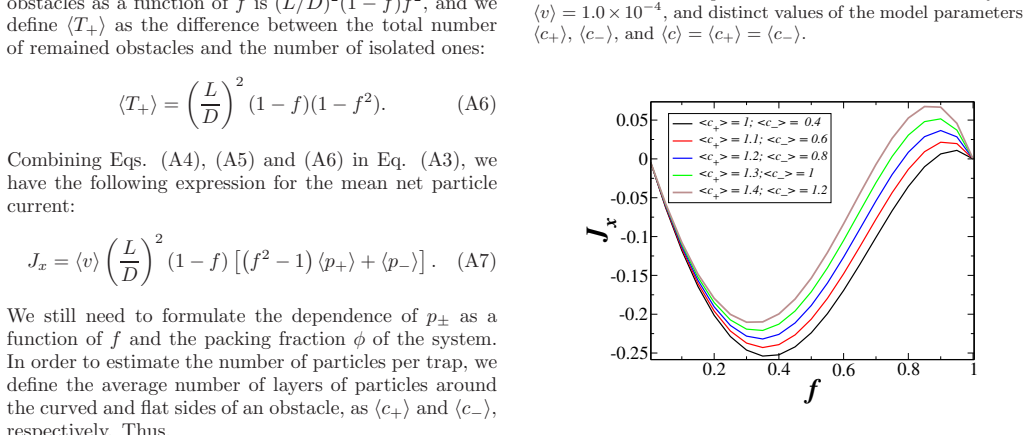
On the paper's own terms, the central discovery is a spontaneous current inversion in a disordered lattice of asymmetric obstacles. For half-circles of diameter D equal to the unit-cell length of a square lattice, arranged so the easy-flow direction is +x, randomly removing a fraction f of the obstacles produces Jx < 0 for low and intermediate f, with the negative minimum deepening as the area fraction φ decreases; for sufficiently large f the current becomes positive and follows the easy-flow direction, with a crossover f*(φ) that decreases as φ increases. The inversion disappears when the obstacle diameter is smaller than the cell (D=9), and circular obstacles produce no current at all, while wedge-shaped obstacles produce a weaker inversion. The mechanism asserted is an imbalance in trapping: particles moving in +x are trapped between the curved sides of touching neighbors, whereas particles moving in -x are trapped at flat sides, and because more particles are held in the curved-side traps the free particles preferentially drift in the -x direction. The paper derives $J_x = v'(L/D)^2(1-f)f[(\pi D+d)/(2d)(f^2-1)\langle c_+\rangle + (D/d)\langle c_-\rangle]$ from this trap-counting argument and shows it reproduces the simulated curves above the negative current minimum when $\langle c_+\rangle > \langle c_-\rangle$.
Load-bearing premise
The central claim rests on the negative current at low and intermediate disorder being a real property of the disordered lattice rather than a finite-size artifact: the simulations use one box side L=100 (a 10-by-10 array of obstacles), and finite-size checks are reported only for the isolated-obstacle probability, not for the current Jx itself.
Editorial extensions
If this is right
- At fixed area fraction, tuning the removal fraction f from low to high values sweeps the net current from negative through zero to positive, so a single quenched disorder parameter controls transport direction.
- The crossover fraction f*(φ) moves to smaller f as area fraction increases, meaning denser suspensions reach the easy-flow regime with less disorder.
- The sign and magnitude of the inverted current depend on obstacle shape: touching half-circles give the strongest negative minimum, wedges give a weaker one, circles give none, and half-circles that do not touch (D=9) give no inversion at all.
- Because the negative current only appears when neighboring obstacles touch, the effect is tied to the existence of curved-side traps, allowing shape and spacing to serve as design parameters.
- The derived expression for Jx, when its assumptions hold, predicts the current from obstacle geometry, the layer numbers $\langle c_\pm\rangle$, and the self-propulsion speed, so it can be used to estimate transport in microfluidic obstacle arrays.
Reading between the lines
- A testable extension the paper does not run: sweeping the obstacle diameter continuously between D=9 and D=10 should reveal a threshold diameter at which the negative current first appears, pinning the trap-size condition quantitatively.
- The empirical $f^2$ scaling for isolated-obstacle probability could be derived from site-percolation statistics on the square lattice; if exact, it would turn Eq. (4) into a parameter-free prediction for the f-dependence of Jx.
- Particles with different angular noise η should be trapped at different rates, so a binary mixture in the same disordered lattice is likely to develop opposite or unequal net currents for the two species, giving a noise-based sorting mechanism—the paper notes this possibility but does not test it.
- If the negative-current regime is tied to percolating paths of touching obstacles, then the onset near f≈0.10 (one removed column) may be connected to a directed-percolation threshold; checking whether f*(φ) follows a percolation scaling would sharpen the mechanism.
Signed reviews
Editorial analysis
A structured set of objections, weighed in public.
Referee Report
Summary. The manuscript studies transport of self-propelled disks in a square lattice of touching half-circle obstacles, with disorder introduced by randomly deleting a fraction f of obstacles. Using Brownian dynamics simulations at one box size (L=100, D=10, so a 10×10 array of obstacles), the authors find that for packing fractions φ=0.1–0.9 the x-component of the mean current is negative for low/intermediate f and positive for larger f, i.e., an inversion relative to the usual easy-flow direction; no inversion occurs for D=9. They propose a trap-imbalance mechanism—positive-moving particles are captured in the spaces between touching obstacles, while negative-moving particles are impeded at the flat sides—and derive Eq. (4) from a mean-field counting of traps and particle layers. The calculation is compared with two simulation curves above the negative minimum using per-curve fitted values of v′, c+, and c−. Additional simulations with circular obstacles and wedges are used as controls.
Significance. The claimed inversion is potentially significant: if confirmed, it shows that quenched disorder in an asymmetric obstacle lattice can reverse, rather than merely reduce, the rectified current of active particles, with implications for microfluidic sorting and active-matter control. The D=9 control and the wedge comparison are well-designed falsifiable checks that support the proposed mechanism. The manuscript is also honest about the model's limitations, explicitly stating that Eq. (4) fails below Jmin. However, the central numerical result currently rests on a single array size with no statistical or finite-size characterization, which is the main barrier to accepting the claim.
major comments (3)
- [Sec. II and Fig. 2] The central observation Jx<0 at low/intermediate f is reported for a single system size, L=100 with D=10 (a 10×10 array of obstacles), and no realization count, standard deviation, or finite-size analysis of Jx is provided. Since the low-f region corresponds to removing only 5–20 of 100 obstacles and the persistence length v0/η=1000 is ten times the box size, the negative minimum could in principle be a finite-size or periodic-image artifact; the finite-size check in Fig. 5 concerns the isolated-obstacle probability, not the current. Please report error bars and the evolution of Jx(f) for at least L=150, 200, and 300, showing that the negative minimum persists and converges.
- [Eq. (4) and Fig. 2] The analytical result is not an independent validation of the inversion because c+, c−, and v′ are fitted per curve to the very simulation data with which they are compared, and the text acknowledges that Eq. (4) fails below Jmin, which is precisely the low-f region containing the inversion. Please state the number of fitted parameters explicitly, restrict the claimed agreement to f above f(Jmin), and test the underlying assumptions (statistical independence of n± and v±, equality of the mean positive and negative velocities) by measuring these quantities separately in the simulations.
- [Appendix, Eq. (A6)] The derivation of ⟨T+⟩ relies on the ad hoc counting rule that 'each removed obstacle corresponds to one removed trap,' which is not derived from the cluster statistics of the random lattice, and it is combined with an isolated-obstacle probability fitted in Fig. 5 without error bars or residuals. This makes the quantitative agreement above Jmin less compelling than stated; presenting the fit parameters and their uncertainties, or deriving ⟨T+⟩ from the actual cluster-size distribution, would place the model on firmer ground.
minor comments (5)
- [Appendix, before Eq. (A2)] The line 'Jx = ⟨J+⟩⟨J−⟩' appears to be a typo for 'Jx = ⟨J+⟩ − ⟨J−⟩'; please correct it and check the surrounding notation.
- [Sec. II] The number of particles N used for each φ and the number of realizations included in the average in Eq. (2) are not stated; please provide these values together with the length of the time averaging window.
- [Eqs. (4) and (A9)] The notation is inconsistent between v′ and ⟨v⟩; please clarify that v′ is the f-independent prefactor used in the linear ansatz ⟨v⟩=v′f, and define the exact relation used to produce the curves in Fig. 2.
- [Fig. 5] The fitting functions 1.0014f^2.002 and 1.04f^2.02 are plausible, but the text should report the fit range, the number of data points, and a goodness-of-fit measure for each curve.
- [General] Minor typographical issues include 'disorderd' in the arXiv title and 'The arrange of the disks' in Sec. II; the color-coded dashed lines in Fig. 2 should also be distinguishable by line style or labels for accessibility.
Circularity Check
The analytic 'calculation' is a fit to the very Jx curves it is said to reproduce, so the trap-imbalance explanation is partly circular; the main inversion observation itself comes from direct simulation.
-
fitted input called prediction
[Sec. III, text and Fig. 2 caption after Eq. (4); Appendix Eq. (A9)]
"In Fig. 2, we also plot two examples obtained from Eq. 4 that qualitatively reproduce the results above Jmin of the φ = 0.90 (red dashed) and φ = 0.50 (black dashed) curves. The parameters we use to plot the theoretical results are, for the red curve, ⟨v⟩ = 1.50 × 10⁻⁴, ⟨c+⟩ = 2.00, and ⟨c−⟩ = 1.77. For the black curve, we have ⟨v⟩ = 3.00 × 10⁻⁴, ⟨c+⟩ = 1.35, ⟨c−⟩ = 1.00. Notice that, in both cases ⟨c+⟩ > ⟨c−⟩, which means that more particles are trapped in the spaces between the obstacles as compared to those stuck on the flat sides, which is consistent with our original argument."
Equation (4) contains three undetermined constants (v′, ⟨c+⟩, ⟨c−⟩) with no independent determination. The paper chooses their values so that the expression matches the simulated Jx curves, and then interprets the chosen inequality ⟨c+⟩>⟨c−⟩ as evidence for the trap-imbalance mechanism. Because the sign and shape of the theoretical curve are controlled by these fitted parameters, the statement that Eq. (4) 'reproduces' the data is a fit, not a prediction: the conclusion that trap imbalance causes inversion is inserted via parameter choice. The appendix adds another simulation-fitted ingredient, the isolated-obstacle probability used for ⟨T+⟩ in Eq. (A6), and the paper itself states Eq. (4) fails below Jmin, so the analytic model cannot independently certify the central inversion.
full rationale
The paper's central observation—spontaneous inversion of Jx at low disorder—is obtained directly from Langevin simulations and is not itself a fit or a self-referential construction, so this is not a case of the main result being circular. However, the analytical derivation presented as supporting the trap-imbalance explanation is partly circular: Eq. (A9)/Eq. (4) has free parameters (v′, ⟨c+⟩, ⟨c−⟩) that are tuned to reproduce the simulation curves, and the fitted inequality ⟨c+⟩>⟨c−⟩ is then quoted as confirmation of the explanation. The appendix also uses an isolated-obstacle probability fitted from simulations (Fig. 5) inside the theoretical expression. The paper explicitly admits that the model does not reproduce Jx below Jmin, so the analytic curve is not an independent validation of the negative-current regime. The citation to prior work [14] by overlapping authors is used to justify the rectification direction of isolated obstacles; it is an external published result and does not, by itself, create a circular chain. Finite-size and error-bar concerns about relying on a single L=100 array are correctness risks, not circularity. Overall, the circularity is confined to the explanatory model, while the principal numerical observation retains independent content.
Assumptions & free parameters
free parameters (4)
- c+ (mean layers on curved side) =
2.00 (phi=0.9); 1.35 (phi=0.5)
- c- (mean layers on flat side) =
1.77 (phi=0.9); 1.00 (phi=0.5)
- v (mean particle velocity) =
1.50e-4 (phi=0.9); 3.00e-4 (phi=0.5)
- isolated-obstacle probability fit =
1.04 f^2.02 and 1.0014 f^2.002
assumptions (6)
- domain assumption The system is athermal and described by active Langevin equations with xi=0; only angular noise eta remains.
- ad hoc to paper n+ and v+ are statistically independent, and likewise n- and v-, so Jx = <n+><v+> - <n-><v->.
- ad hoc to paper The mean positive and negative velocities are equal (<v+> = <v->).
- domain assumption On average half the particles travel in each direction, so <n+> = N/2 - <T+><p+> and <n-> = N/2 - <T-><p->.
- ad hoc to paper Each removed obstacle removes exactly one positive-direction trap.
- ad hoc to paper The mean velocity depends linearly on the removed fraction, <v> = v' f.
Cite this review
Pith. "Pith review of Controlling the transport of active matter in disorderd lattices of asymmetrical obstacles." pith.science (2026). https://pith.science/paper/HQGXNYEV
@misc{pith2026190805942,
  author       = {Pith},
  title        = {Pith review of: Controlling the transport of active matter in disorderd lattices of asymmetrical obstacles},
  year         = {2026},
  howpublished = {\url{https://pith.science/paper/HQGXNYEV}},
  note         = {Machine review of arXiv:1908.05942}
}
read the original abstract
We investigate the transport of active matter system in the presence of a disordered square lattice of half-circles, which is built by removing a fraction of them from the initial full lattice. We consider no external field. We observe a spontaneous inversion of the net current, compared to the usual sense of such a current reported in previous papers, if the obstacle has the same diameter as the unit cell of the square lattice. If this diameter is smaller, there is no inversion. We show a calculation that reproduces our numerical results qualitatively, based on the argument that such effects are the results of the imbalance of particles traveling in the positive and the negative directions due to traps formed by the obstacles: for positive travelers the traps are the spaces between neighboring obstacles, while for negative travelers, they are the flat side of the obstacles.
Figures


Figures from the paper (4 more)


Reference graph
Works this paper leans on
- [1]
-
[2]
00, and ⟨c−⟩ = 1 . 77. For the black curve, we have ⟨v⟩ = 3 . 00 × 10−4, ⟨c+⟩ = 1 . 35, ⟨c−⟩ = 1 . 00. Notice that, in both cases ⟨c+⟩ > ⟨c−⟩, which means that more particles are trapped in the spaces between the obstacles as compared to those stuck on the flat sides, which is consistent with our original argument. Also, we had to use a smaller mean veloci...
-
[3]
Vicsek and A
T. Vicsek and A. Zafeiris, Phys. Rep. 517, 71 (2012)
2012
- [4]
-
[5]
C. Bechinger, R. Di Leonardo, H. Loewen, C. Reichhardt, G. Volpe and G. Volpe, Rev. Mod. Phys. 88, 045006 (2016)
work page 2016
-
[6]
M. C. Marchetti, J. F. Joanny, S. Ramaswamy, T. B. Liverpool, J. Prost, M. Rao and R. Aditi Simha, Rev. Mod. Phys. 85, 1143 (2013)
work page 2013
-
[7]
J. A. Drocco, C. J. Olson-Reichhardt, and C. Reich- hardt,Phys. Rev. E 85, 056102 (2012)
work page 2012
-
[8]
Vicsek, A
T. Vicsek, A. Czir´ ok, E. Ben-Jacob, I. Cohen, and O. Shochet, Phys. Rev. Lett. 75, 1226 (1995)
1995
Show all 31 references
-
[9]
M. B. Wan, C. J. Olson Reichhardt, Z. Nussinov, and C. Reichhardt,Phys. Rev. Lett. 101, 018102 (2008)
2008
-
[10]
Fily, and M
Y. Fily, and M. C. Marchetti, Phys. Rev. Lett. 108, 235702 (2012)
2012
-
[11]
Galajda, J
P. Galajda, J. Keymer, P. Chaikin and R. Austin, J. Bacter. 189, 8704 (2007)
2007
-
[12]
Tailleur and M
J. Tailleur and M. E. Cates, Europhys. Lett. 86, 60002 (2009)
2009
-
[13]
Reichhardt, and C
C. Reichhardt, and C. J. O. Reichhardt, Phys. Rev. E 88, 062310 (2013)
2013
-
[14]
In fact, particles sliding on the curved side of the obstacle have their motion rectified along the +x-direction
that isolated obstacles do not trap any particle on the curved side. In fact, particles sliding on the curved side of the obstacle have their motion rectified along the +x-direction. Based on our simulation results, we obtained the prob- ability of occurrence of isolated obstac...
-
[15]
P. K. Ghosh, V. R. Misko, F. Marchesoni, and F. Nori, Phys. Rev. Lett. 110, 268301 (2013)
2013
-
[16]
F. Q. Potiguar, G. A. Farias and W. P. Ferreira, Phys. Rev. E 90, 012307 (2014)
2014
-
[17]
Chepizkho, E
O. Chepizkho, E. G. Altmann and F. Peruani, Phys. Rev. Lett. 110, 238101 (2013)
2013
-
[18]
P. Dolai,A. Simha, and S. Mishra, Soft matter 14, 29 (2018)
2018
-
[19]
Chepizkho and F
O. Chepizkho and F. Peruani, Phys. Rev. Lett. 111, 160604 (2013)
2013
-
[20]
Reichhardt and C
C. Reichhardt and C. J. O. Reichhardt, Phys. Rev. E 90, 012701 (2014)
2014
-
[21]
Morin, N
A. Morin, N. Desreumaux, J.-B. Caussin and D. Bartolo, Nat. Phys. 13, 63 (2017)
2017
-
[22]
J. Wang, D. Zhang, B. Xia and W. Yu, Soft Matter 13, 758 (2017)
2017
-
[23]
Yllanes, M
D. Yllanes, M. Leoni, and M. C. Marchetti, New Journal of Physics. 19, 10 (2017)
2017
-
[24]
McDermott, C
D. McDermott, C. Reichhardt and C. J. O. Reichhardt, Soft Matter 12, 8606 (2016)
2016
-
[25]
R. L. Honeycutt, Phys. Rev. A 45, 600 (1992)
1992
-
[26]
R. Ni, M. A. Cohen Stuart, and P. G. Bolhuis, Phys. Rev. Lett. 114, 018302 (2015)
2015
-
[27]
L. R. Leite, D. Lucena, F. Q. Potiguar and W. P. Ferreira, Phys. Rev. E 94, 062602 (2016)
2016
-
[28]
Volpe, I
G. Volpe, I. Buttinoni, D. Vogt, H.-J. Kummerer, and C. Bechinger, Soft Matter 7, 8810 (2011)
2011
-
[29]
Kaiser, H
A. Kaiser, H. H. Wensink and H. Loewen, Phys. Rev. Lett. 108, 268307 (2012)
2012
-
[30]
S. C. Takatori, W. Yan and J. F. Brady, Phys. Rev. Lett. 113, 028103 (2014)
2014
-
[31]
Kumar, R
N. Kumar, R. K. Gupta, H. Soni, S. Ramaswamy and A. K. Sood, Phys. Rev. E 99, 032605 (2019)
2019
Reviewed August 14, 2026 · model on record in the stance chip above.
Discussion (0). Continue with ORCID to comment.