REVIEW 4 major objections 5 minor 14 references
Grokking Explained: A Statistical Phenomenon
T0 review · 4 major / 5 minor · reviewed 2026-08-09 · deepseek-v4-flash
Pith's one-line read The paper claims that grokking—delayed generalization—is fundamentally a statistical consequence of distribution shift between training and test data, not of data sparsity or regularization, and that it can be systematically induced by…
desk verdict Useful synthetic benchmarks and a plausible hypothesis, but the causal claim about distribution shift is confounded by partial subclass coverage and the paper's own weight-decay explanation. read the letter →
The pith
A machine-rendered reading of the paper's core claim, the machinery that carries it, and where it could break.
The reading
What carries the argument
The central machinery is a pair of synthetic datasets built from multivariate normal subclasses organized into classes. In the equidistant dataset, all subclass centroids are equally far apart; in the equivariant dataset, subclasses within a class are closer to each other than to subclasses of other classes. A sampling fraction $f \in [0,1]$ controls how many examples are kept from selected subclasses, creating a controlled distribution shift. These datasets let the authors isolate whether grokking tracks sample size, regularization, or the shift itself; the class–subclass geometry also lets them test whether relational proximity among subclasses can substitute for missing samples. A formal Definition 3.1 of grokking, based on the transition interval between memorization and generalization, provides the measurement used throughout.
What would settle it
Train the same architecture on the equidistant dataset with $f=0$ (subclass absent) while sweeping weight decay and initialization scale: if grokking appears under some hyperparameters, the effect is not due to the shift alone. Alternatively, compare $f=0.01$ imbalanced sampling with a balanced sample of the same size; if balanced sampling also groks, the distribution shift is not the determining factor.
Extended reading notes
Core claim
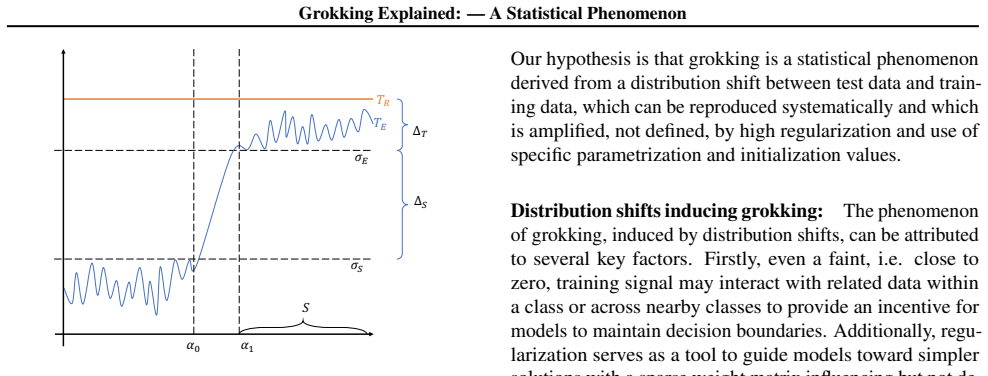
The paper's central claim is that grokking is a statistical phenomenon: it occurs when the training distribution is shifted away from the test distribution, specifically when some subclasses of a class hierarchy are under-represented. The authors formalize grokking with a definition based on inflection points $\alpha_0$ and $\alpha_1$ and the gap $\Delta S$ between low- and high-performing test regions. Using synthetic data where classes are unions of equidistant or equivariant subclasses, they show that a faint training signal from a down-sampled subclass—even 1% of its samples—can trigger late generalization, while removing the subclass entirely ($f=0$) blocks it in the equidistant setting. In the equivariant setting, where subclasses of a class are close to each other, grokking occurs even when a subclass is completely absent, because nearby subclasses leak information. They conclude that small sample sizes are only a convenient route to the necessary distribution shift, not the cause, and that grokking can be induced with dense data and minimal tuning.
Load-bearing premise
The load-bearing premise is that under-sampling a subclass counts as a distribution shift and that the delayed generalization is caused by that shift, rather than by simply having a few examples of each subclass; the paper's own result that $f=0$ blocks grokking while $f=0.01$ triggers it makes this distinction the crux, and the fixed weight decay and initialization scale are not ablated.
Editorial extensions
If this is right
- Grokking can be induced systematically in class-hierarchical data by under-sampling subclasses, without extreme sparsity or heavy regularization.
- A very small number of examples from an under-represented subclass ($f=0.01$) is enough to produce late generalization, while zero examples blocks it in equidistant structure.
- When subclasses are close within a class, grokking can occur even with a subclass completely absent, showing that relational structure in the data carries part of the training signal.
- The phenomenon is architecture-independent: similar late-generalization curves appear for MLPs and transformers.
- MNIST experiments with clustered latent representations show induced distribution shifts can reproduce grokking outside synthetic data, supporting new stopping criteria based on the likelihood of late generalization.
Reading between the lines
- If shift magnitude rather than mere presence of samples were the driver, grokking probability should vary monotonically with $f$; the $f=0$ versus $f=0.01$ discontinuity suggests a threshold experiment worth running: sweep $f$ finely and check whether grokking appears abruptly or gradually.
- The equivariant result implies that datasets with hierarchical or geometric label structure may be prone to grokking under mild imbalance; an untested extension is that curriculum or active-learning methods that deliberately expose a few examples from each subclass could trigger or suppress grokking on demand.
- A practical consequence the paper leaves implicit: train–test distribution divergence measured during training (e.g., by two-sample tests on hidden representations) could serve as an early-warning signal for imminent grokking, enabling adaptive stopping rather than waiting for the late jump.
- The definition of grokking via $\Delta S$ and the support interval $S$ could be turned into an automated detector, though the paper does not propose thresholds for these quantities.
Signed reviews
Editorial analysis
A structured set of objections, weighed in public.
Referee Report
Summary. The paper argues that grokking (delayed generalization) is a statistical phenomenon caused by a distribution shift between training and test data, with data sparsity and regularization acting only as amplifiers rather than causes. The authors define grokking informally, introduce two synthetic datasets with class-subclass hierarchies, and induce distribution shifts by downsampling subclasses by a fraction f. Experiments with MLPs and a two-layer transformer show grokking across several settings, including dense datasets, and the authors claim that grokking can be reproduced systematically with minimal hyperparameter tuning. The paper also announces MNIST experiments validating the findings beyond synthetic data, and provides code and datasets for replication.
Significance. If the central hypothesis were convincingly established, the paper would offer a unifying statistical explanation of grokking and provide useful controlled benchmarks for studying delayed generalization. The synthetic dataset construction and the systematic f-sweep are valuable contributions, and the release of code and data is a strength. However, the causal claim is currently under-supported: the operationalization of 'distribution shift' is confounded with partial subclass coverage, the shift itself is never quantified, and the fixed grokking-promoting hyperparameters are not ablated. The reported MNIST validation is missing from the manuscript. These issues currently prevent the paper from supporting its main claim, though the underlying hypothesis remains plausible and testable.
major comments (4)
- [§5.2, Figure 3b] The non-monotonic relationship between f and grokking undercuts the causal attribution to distribution shift magnitude. Removing a subclass entirely (f = 0) prevents grokking, while retaining only 1-20% of that subclass (f = 0.01-0.2) induces it. If a larger distribution shift caused more grokking, f = 0 should grok the most; instead, the pattern is equally or better explained by whether any correctly labeled examples of each subclass remain (partial coverage / weak training signal). The manuscript should quantify the induced shift (e.g., KL divergence or total variation between training and test subclass proportions) and test monotonicity, or reframe the claim as requiring partial subclass coverage rather than shift magnitude.
- [§5.2, Figure 3a] Balanced downsampling of the equidistant dataset, with no subclass forced to be sampled less than another, still produces grokking at small sample sizes. If the test set is the full balanced 10,000-sample set, the small training set has the same expected subclass proportions but a different finite-sample realization; whether this constitutes 'distribution shift' is not established. Without a direct measure of the shift, small sample size itself remains a viable candidate cause, which conflicts with the paper's claim that sparsity is merely a mechanism for achieving distribution shift.
- [§5.1 and §5.2] The experiments fix weight decay at 1e-4 and initialization scale at 8, both known grokking-promoting choices from Liu et al. (2022), yet no ablation is reported. Moreover, §5.2 states that 'weight decay led the network to a more sparse internal representation,' which attributes the late improvement to regularization. This is difficult to reconcile with the claim that regularization merely amplifies and does not cause grokking. The authors should either ablate these hyperparameters or clarify the precise role of regularization in their account.
- [Introduction and Abstract] The abstract and introduction claim that MNIST experiments validate the findings beyond synthetic data, but no MNIST results appear in the main text or in Appendix A. This claim is currently unsupported and must either be substantiated with results or removed from the paper.
minor comments (5)
- [Figure 3a caption and §5.2] The caption says 'It occurs in every case,' while the text says grokking 'only existing in considerably small sample sizes.' These statements are contradictory and should be reconciled.
- [Appendix A.2] The inequality |C(Ci,j) - C(Ci,l)| > |C(Ci,j) - C(Ck,l)| for i≠k appears to contradict the prose that subclasses of the same class are closer than subclasses of different classes; if the intended property is the opposite, the inequality should use '<'.
- [§5, experimental setup] The text states results are aggregated from 10 independent runs, but the figures show only average curves without error bars or confidence bands; given that grokking detection is sensitive to training dynamics, variance information should be included.
- [§3, Definition 3.1] Definition 3.1 relies on informal thresholds and symbols such as α0, α1, and 'S ≫ (α1 - α0)' without operational criteria; please specify how these quantities are estimated from training curves in practice.
- [§2 and References] There are minor typographical issues, including 'liner models' instead of 'linear models,' and the reference to Quiñonero-Candela et al. (2022) should cite the original 2008 work on dataset shift.
Circularity Check
No circularity found: the distribution-shift account is an empirical interpretation of controlled sampling experiments, not a definitional reduction or a fitted prediction.
full rationale
The paper's central claim (Section 3) is a hypothesis, not a derivation: grokking is defined operationally in Definition 3.1 purely in terms of training and test curve geometry, with no reference to distribution shift. The experiments then manipulate subclass sampling fraction f (Section 4, Eq. 1) and report measured test curves; the presence of grokking is read off the curves, while the shift is an intervention, never a fitted parameter used to produce those curves. No equation or definition makes the occurrence of grokking equivalent to the value of f, and no parameter is fit to a subset of curves and then 'predicted' on a closely related quantity. The self-citation (d'Avila Garcez et al., 2009) appears only as a contextual pointer to neuro-symbolic approaches and is not load-bearing; the grokking-promoting hyperparameters (weight decay 1e-4, initialization scale 8) are adopted from external work by Liu et al. (2022), not from a self-citation chain. The Limitations section concedes that the paper cannot predict when late generalization will occur, which further shows the claim is not a closed tautology. Concerns that the causal attribution is confounded (e.g., Figure 3b's non-monotonic f=0 result and the absence of a direct shift measurement) are underdetermination or validity objections, not circular reductions; they do not raise the circularity score.
Assumptions & free parameters
free parameters (5)
- downsampling fraction f =
grid: 0, 0.01, 0.05, 0.2
- weight decay =
1e-4
- initialization scale factor =
8
- learning rate =
1e-3
- number of binary positions p and dimension r =
p=9, r=13
assumptions (5)
- ad hoc to paper Definition 3.1 captures grokking
- domain assumption Train/test distribution shift is the active causal variable
- domain assumption Subclass proximity in the equivariant dataset provides information leakage
- domain assumption Weight decay leads to sparse representations that enable late generalization
- domain assumption Linearly separable Gaussian subclasses are representative of real data structure
Cite this review
Pith. "Pith review of Grokking Explained: A Statistical Phenomenon." pith.science (2026). https://pith.science/paper/HQJE2HMG
@misc{pith2026250201774,
  author       = {Pith},
  title        = {Pith review of: Grokking Explained: A Statistical Phenomenon},
  year         = {2026},
  howpublished = {\url{https://pith.science/paper/HQJE2HMG}},
  note         = {Machine review of arXiv:2502.01774}
}
read the original abstract
Grokking, or delayed generalization, is an intriguing learning phenomenon where test set loss decreases sharply only after a model's training set loss has converged. This challenges conventional understanding of the training dynamics in deep learning networks. In this paper, we formalize and investigate grokking, highlighting that a key factor in its emergence is a distribution shift between training and test data. We introduce two synthetic datasets specifically designed to analyze grokking. One dataset examines the impact of limited sampling, and the other investigates transfer learning's role in grokking. By inducing distribution shifts through controlled imbalanced sampling of sub-categories, we systematically reproduce the phenomenon, demonstrating that while small-sampling is strongly associated with grokking, it is not its cause. Instead, small-sampling serves as a convenient mechanism for achieving the necessary distribution shift. We also show that when classes form an equivariant map, grokking can be explained by the model's ability to learn from similar classes or sub-categories. Unlike earlier work suggesting that grokking primarily arises from high regularization and sparse data, we demonstrate that it can also occur with dense data and minimal hyper-parameter tuning. Our findings deepen the understanding of grokking and pave the way for developing better stopping criteria in future training processes.
Figures


Figures from the paper (1 more)

Reference graph
Works this paper leans on
-
[1]
write newline
" write newline "" before.all 'output.state := FUNCTION n.dashify 't := "" t empty not t #1 #1 substring "-" = t #1 #2 substring "--" = not "--" * t #2 global.max substring 't := t #1 #1 substring "-" = "-" * t #2 global.max substring 't := while if t #1 #1 substring * t #2 global.max substring 't := if while FUNCTION format.date year duplicate empty "emp...
-
[2]
M., Bruna, J., Cohen, T., and Velickovic, P
Bronstein, M. M., Bruna, J., Cohen, T., and Velickovic, P. Geometric deep learning: Grids, groups, graphs, geodesics, and gauges. CoRR, abs/2104.13478, 2021. URL https://arxiv.org/abs/2104.13478
arXiv 2021
-
[3]
d'Avila Garcez, A. S., Lamb, L. C., and Gabbay, D. M. Neural-Symbolic Cognitive Reasoning. Cognitive Technologies. Springer, 2009. ISBN 978-3-540-73245-7. URL http://dblp.uni-trier.de/db/series/cogtech/index.html#GarcezLG2009
work page 2009
-
[4]
Kumar, T., Bordelon, B., Gershman, S. J., and Pehlevan, C. Grokking as the transition from lazy to rich training dynamics. In The Twelfth International Conference on Learning Representations, 2024. URL https://openreview.net/forum?id=vt5mnLVIVo
work page 2024
-
[5]
Grokking in linear estimators - A solvable model that groks without understanding
Levi, N., Beck, A., and Bar - Sinai, Y. Grokking in linear estimators - A solvable model that groks without understanding. CoRR, abs/2310.16441, 2023. doi:10.48550/ARXIV.2310.16441. URL https://doi.org/10.48550/arXiv.2310.16441
-
[6]
Lin, T.-Y., Maire, M., Belongie, S., Hays, J., Perona, P., Ramanan, D., Doll \'a r, P., and Zitnick, C. L. Microsoft coco: Common objects in context. In Computer Vision--ECCV 2014: 13th European Conference, Zurich, Switzerland, September 6-12, 2014, Proceedings, Part V 13, pp.\ 740--755. Springer, 2014
2014
-
[7]
S., Michaud, E., Tegmark, M., and Williams, M
Liu, Z., Kitouni, O., Nolte, N. S., Michaud, E., Tegmark, M., and Williams, M. Towards understanding grokking: An effective theory of representation learning. Advances in Neural Information Processing Systems, 35: 0 34651--34663, 2022
2022
-
[8]
Progress measures for grokking via mechanistic interpretability
Nanda, N., Chan, L., Lieberum, T., Smith, J., and Steinhardt, J. Progress measures for grokking via mechanistic interpretability. In The Eleventh International Conference on Learning Representations, ICLR 2023, Kigali, Rwanda, May 1-5, 2023 . OpenReview.net, 2023. URL https://openreview.net/pdf?id=9XFSbDPmdW
work page 2023
Show all 14 references
-
[9]
Grokking: Generalization beyond overfitting on small algorithmic datasets
Power, A., Burda, Y., Edwards, H., Babuschkin, I., and Misra, V. Grokking: Generalization beyond overfitting on small algorithmic datasets. CoRR, abs/2201.02177, 2022. URL https://arxiv.org/abs/2201.02177
2022 arXiv
-
[10]
Qui \ n onero-Candela, J., Sugiyama, M., Schwaighofer, A., and Lawrence, N. D. Dataset shift in machine learning. MIT Press, 2022
2022
-
[11]
Failing loudly: An empirical study of methods for detecting dataset shift
Rabanser, S., G\" u nnemann, S., and Lipton, Z. Failing loudly: An empirical study of methods for detecting dataset shift. In Wallach, H., Larochelle, H., Beygelzimer, A., d Alch\' e -Buc, F., Fox, E., and Garnett, R. (eds.), Advances in Neural Information Processing Systems, ...
2019
-
[12]
Are emergent abilities of large language models a mirage? In Oh, A., Naumann, T., Globerson, A., Saenko, K., Hardt, M., and Levine, S
Schaeffer, R., Miranda, B., and Koyejo, S. Are emergent abilities of large language models a mirage? In Oh, A., Naumann, T., Globerson, A., Saenko, K., Hardt, M., and Levine, S. (eds.), Advances in Neural Information Processing Systems, volume 36, pp.\ 55565--55581. Curran Ass...
2023
-
[13]
S., and Kersting, K
Seng, J., Ze c evi \'c , M., Dhami, D. S., and Kersting, K. Learning large DAG s is harder than you think: Many losses are minimal for the wrong DAG . In The Twelfth International Conference on Learning Representations, 2024. URL https://openreview.net/forum?id=gwbQ2YwLhD
2024
-
[14]
and Ilievski, E
Z unkovi c , B. and Ilievski, E. Grokking phase transitions in learning local rules with gradient descent. arXiv preprint arXiv:2210.15435, 2022
2022 arXiv
Reviewed August 9, 2026 · model on record in the stance chip above.
Discussion (0). Continue with ORCID to comment.