REVIEW 3 major objections 5 minor 2 cited by
A generator of forward neutrons for ultra-peripheral collisions: $\textbf{n$\mathbf{_O^O}$n}$
T0 review · 3 major / 5 minor · reviewed 2026-08-14 · deepseek-v4-flash
Pith's one-line read The nOOn Monte Carlo program generates, event by event, the forward neutrons produced by electromagnetic dissociation in ultra-peripheral heavy-ion collisions.
desk verdict A useful UPC neutron generator that fills a real gap, but with an unvalidated high-energy extrapolation and no end-to-end benchmark against measured EMD data; worth peer review after that gap is addressed. read the letter →
The pith
A machine-rendered reading of the paper's core claim, the machinery that carries it, and where it could break.
The reading
What carries the argument
The central object is the nOOn program itself, a C++ Monte Carlo generator for events with forward neutrons. Its load-bearing mechanism is the combination of three impact-parameter-dependent probabilities: the hard photoproduction probability $P_P(b)$, the nuclear break-up probability $P_{ij}(b)$, factorised as $P_i(b) P_j(b)$ and constructed from Poisson-distributed, independent Coulomb excitations, and the no-hadronic-interaction factor $\exp(-P_H(b))$; these are weighted by the semi-classical photon flux to assign neutron multiplicities for a given photon energy. The energy behaviour is carried by a branching-ratio map obtained by extrapolating the measured mean and dispersion of neutron multiplicity logarithmically up to photon energies of $10^9$ MeV, supplemented by a Gaussian approximation for the multiplicity shape and evaluated nuclear data tables for neutron energies.
What would settle it
Compare the generator's predicted fractions of events with 0, 1, or many forward neutrons against measured forward-neutron multiplicities in Pb-Pb ultra-peripheral collisions at LHC energies; a disagreement that grows with photon energy would falsify the logarithmic extrapolation from 140 MeV to $10^9$ MeV.
Extended reading notes
Core claim
nOOn claims to supply complete per-event simulation of the forward neutrons from Coulomb break-up in ultra-peripheral heavy-ion collisions. It starts from measured total and partial photonuclear cross sections for 208Pb, builds impact-parameter-dependent probabilities for each nucleus to emit any number of neutrons, treats multiple photon exchanges as independent Poisson excitations, and factorises the two sides. The photon-energy dependence is handled by a branching-ratio map built from a logarithmic extrapolation of the measured mean and dispersion of neutron multiplicity, with a Gaussian shape for the multiplicity distribution; neutron energies are sampled from evaluated nuclear data and then boosted to the laboratory frame. The output is a standard list of particles per event, ready for detector simulation.
Load-bearing premise
The generator assumes that the average and spread of neutron multiplicity, measured only up to photon energies of 140 MeV, continue to grow logarithmically all the way to about $10^9$ MeV; if that extrapolation is wrong, the produced neutron multiplicities at LHC energies will be biased.
Editorial extensions
If this is right
- Simulated ultra-peripheral collision events can now include realistic forward-neutron signals, allowing trigger and acceptance studies for neutron-based selectors.
- Vector-meson measurements can be separated into 0n0n, 0nXn, and XnXn neutron-tag classes, which helps pin down the photon energy when rapidity alone is ambiguous.
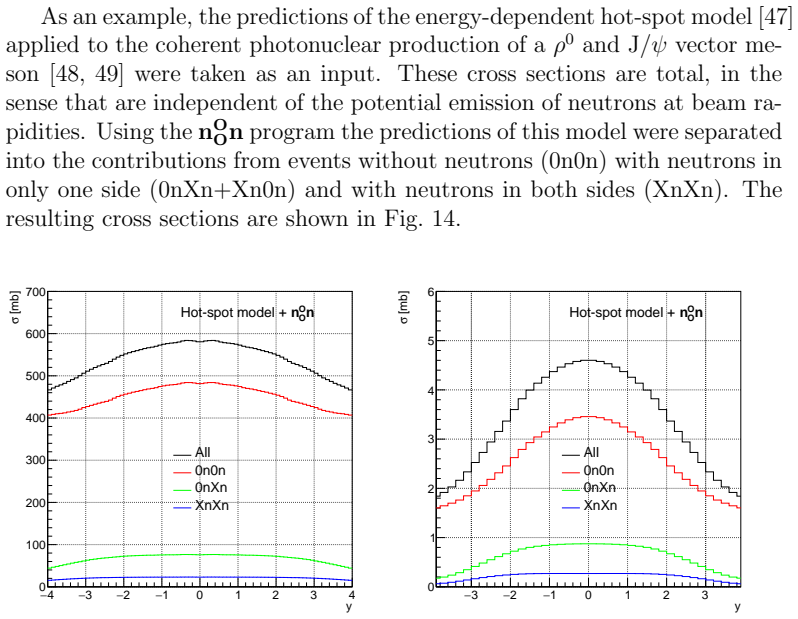
- Theoretical photonuclear cross sections can be expanded into rapidity-dependent, neutron-tagged cross-section predictions, as the paper demonstrates for rho0 and J/psi.
- The same program structure applies to other photon-induced processes in ultra-peripheral collisions, such as jet production and light-by-light scattering.
Reading between the lines
- Because the neutron tag effectively selects the photon energy, this generator could also be used to correct the acceptance of forward J/psi measurements, not just to build triggers; the paper does not develop that use.
- The Poisson and independence assumptions could be tested directly against measured forward-neutron multiplicity distributions from LHC Pb-Pb runs, a comparison the paper does not include.
- The Gaussian shape used above 140 MeV is an interpolation; data at intermediate photon energies would either validate it or force a more detailed shape model.
Signed reviews
Editorial analysis
A structured set of objections, weighed in public.
Referee Report
Summary. The manuscript presents nOOn, a ROOT-based Monte Carlo generator that produces forward neutrons from electromagnetic dissociation (EMD) in ultra-peripheral collisions (UPC) of heavy ions. The generator computes nuclear break-up probabilities using measured photoneutron cross sections, a logarithmic extrapolation of the mean and dispersion of neutron multiplicity from 140 MeV to 1e9 MeV, a Gaussian approximation for the multiplicity shape, and a Poisson-based convolution of multiple excitations with truncation and renormalisation. It can be used either as an afterburner for the STARlight generator or with theoretical photonuclear cross sections as input, and it outputs final-state neutrons in a TTree format. The paper includes examples for coherent rho0 and J/psi production and discusses the implementation details and program flow.
Significance. If the generator is validated, it fills a practical gap: STARlight, the most commonly used UPC Monte Carlo, does not produce final-state neutrons, while nOOn does, and it is designed for straightforward integration with the simulation frameworks of RHIC and LHC experiments. The paper's strengths are that it builds on established measured data for the GDR region, uses evaluated nuclear data from ENDF, and provides an open-source, GPL-licensed program with reproducible event-by-event output. The central physics risk is the large extrapolation of neutron-multiplicity parameters from 140 MeV to LHC energies and the absence of a direct end-to-end comparison of the generator output to measured Pb-Pb EMD data, which leaves the quantitative reliability of the generated neutron multiplicities at LHC conditions conditional.
major comments (3)
- [Section 3.1, Fig. 7] The mean and dispersion of the neutron multiplicity are fitted to data only up to 140 MeV and then extrapolated logarithmically to 1e9 MeV, while at LHC energies a non-negligible fraction of the EMD cross section comes from photons above the fitted region. The only validation shown is the comparison to the RELDIS model in Fig. 7, not a comparison of nOOn output to a measured Pb-Pb observable. The paper should add a quantitative validation against the ALICE EMD cross-section measurement (Ref. [23]) or, at minimum, provide an estimate of the systematic uncertainty propagated from the extrapolation to the generated multiplicities.
- [Section 2.3, Eqs. (12) and (20), Fig. 5] The Poisson assumption for the number of Coulomb excitations (Eq. (12)) is introduced without justification, and the renormalisation procedure shown in Fig. 5 indicates that about 20% of the break-up probability is lost at small impact parameters before renormalisation. The claim that increasing the number of excitations to six would not significantly change predictions is not demonstrated quantitatively. Since the renormalisation reshapes the multiplicity distribution and could affect the impact-parameter dependence used in Eq. (10), the paper should justify the Poisson ansatz and quantify the effect of the truncation and renormalisation on, for example, the 0n0n and XnXn fractions.
- [Section 3.1, Fig. 8] The Gaussian shape of the neutron multiplicity distribution is inferred from deconvoluted data at only two photon energies, 199 and 390 MeV, as shown in Fig. 8. This Gaussian shape is then applied over the entire extrapolated range up to 1e9 MeV in constructing the branching-ratio map of Fig. 9. The paper should discuss whether the Gaussian approximation remains reasonable at higher photon energies where additional reaction channels open, and ideally compare the branching-ratio map with the predictions of a model such as RELDIS over a wider energy range.
minor comments (5)
- [Section 3.1] The fit function for the logarithmic extrapolation of the mean and dispersion is described only verbally; the explicit functional form and the fit parameters should be stated in the text or in an appendix for reproducibility.
- [Program Summary and Abstract] The program is currently restricted to Pb only, yet the abstract and introduction refer to RHIC as a target application. The restriction should be stated more prominently in the abstract, or an indication of planned support for other nuclei (e.g., Au) should be given.
- [Section 4, 'Particle generation'] For photon energies above 140 MeV, the last bin of the ENDF emission spectrum is reused; the potential effect of this approximation on the generated neutron energies and on the response of zero-degree calorimeters should be commented on.
- [Fig. 13] The numerical labels in the heatmap of Fig. 13 are difficult to read at the published size; increasing the font size or using a different colour scale would improve readability.
- [Section 2, Eq. (6)] The photon flux expression contains a term proportional to 1/gamma^2 K0^2; the text says K1 is a Bessel function but does not state the order of K0, which is clear from context but should be specified for completeness.
Circularity Check
No circularity: the generator's inputs are external measured/evaluated data and its outputs are simulated events; no fitted parameter is renamed as a prediction.
full rationale
The derivation chain is self-contained in the honest sense: the paper builds a Monte Carlo from external empirical inputs and does not tune those inputs to the tool's own output. The central equations (Eq. 7, Eq. 10, Eq. 14) combine the semi-classical photon flux with break-up probabilities obtained from measured photoneutron cross sections and evaluated nuclear data, which are all independent of the generated events. The neutron-multiplicity model is explicitly an extrapolation, not a hidden fit to the target: the text states that 'the average and dispersion, as a function of photon energy, was fitted to a logarithm and extrapolated to higher energies' (Sec. 3.1), and the result is checked against RELDIS and against measured multiplicity shapes at 199 and 390 MeV. The Program Summary openly says the code 'computes the probability of neutron emission based on existing measurements and some mild modelling; it then generates neutrons in a per-event basis.' There is no quantity labeled a prediction that is, by construction, equal to an input. The absence of an end-to-end comparison of nOOn output to ALICE EMD data is a validation gap and a correctness risk concerning the high-energy extrapolation, but it is not circular reasoning: the extrapolated model is not fitted to the ALICE result, and the generator's central claim is conditional rather than tautological.
Assumptions & free parameters
free parameters (3)
- Mean neutron multiplicity log-extrapolation parameters =
Not reported in paper
- Dispersion of neutron multiplicity log-extrapolation parameters =
Not reported in paper
- Truncation limits: 50 neutrons and 5 excitations =
50 neutrons, 5 excitations
assumptions (8)
- standard math Poisson statistics for multiple independent Coulomb excitations, Eq. (12)-(13)
- standard math Equivalent photon approximation with semi-classical photon flux, Eq. (6)
- domain assumption Independence of hard photoproduction and electromagnetic dissociation
- domain assumption Woods-Saxon nuclear density profile for 208Pb
- domain assumption Regge parametrisation of total photonuclear cross section above 16.4 GeV
- ad hoc to paper Logarithmic extrapolation of mean and dispersion of neutron multiplicity above 140 MeV
- ad hoc to paper Gaussian approximation for neutron multiplicity distribution at fixed photon energy
- ad hoc to paper Truncation of sums at 50 neutrons and 5 excitations with renormalisation to P_Xn
Cite this review
Pith. "Pith review of A generator of forward neutrons for ultra-peripheral collisions: $\textbf{n$\mathbf{_O^O}$n}$." pith.science (2026). https://pith.science/paper/HRA3N2YT
@misc{pith2026190808263,
  author       = {Pith},
  title        = {Pith review of: A generator of forward neutrons for ultra-peripheral collisions: $\textbfn$\mathbf_O^O$n$},
  year         = {2026},
  howpublished = {\url{https://pith.science/paper/HRA3N2YT}},
  note         = {Machine review of arXiv:1908.08263}
}
abstract
The study of photon-induced reactions in collisions of heavy nuclei at RHIC and the LHC has become an important direction of the research program of these facilities in recent years. In particular, the production of vector mesons in ultra-peripheral collisions (UPC) has been intensively studied. Owing to the intense photon fluxes, the two nuclei participating in such processes undergo electromagnetic dissociation producing neutrons at beam rapidities. Here, we introduce the $\textbf{n$\mathbf{_O^O}$n}$ (pronounced noon) Monte Carlo program, which generates events containing such neutrons. $\textbf{n$\mathbf{_O^O}$n}$ is a ROOT based program that can be interfaced with existing generators of vector meson production in UPC or with theoretical calculations of such photonuclear processes. $\textbf{n$\mathbf{_O^O}$n}$ can also be easily integrated with the simulation programs of the experiments at RHIC and the LHC.
Figures


Figures from the paper (12 more)


Forward citations
Cited by 2 Pith papers
-
Modelling Coincident Particle Production in Ultraperipheral Heavy Ion Collisions
A new SuperChic Monte Carlo implementation reproduces the ATLAS-observed rate and kinematic dependence of coincident rho meson and dimuon production in ultraperipheral PbPb collisions.
-
Inclusive photoproduction of vector quarkonium in ultra-peripheral collisions at the LHC
Inclusive photoproduction of J/psi mesons in proton-lead collisions at the LHC can likely be separated from hadronic background using centrality, rapidity-gap, and forward-neutron veto selections, extending the measur...
Reference graph
Works this paper leans on
-
[23]
B. Abelev, et al., Measurement of the Cross Section for Electromagnetic Dissociation with Neutron Emission in Pb-Pb Collisions at √sNN = 2.76 TeV, Phys. Rev. Lett. 109 (2012) 252302. arXiv:1203.2436, doi: 10.1103/PhysRevLett.109.252302
arXiv 2012
-
[1]
Fermi, On the Theory of the impact between atoms and electri- cally charged particles, Z.Phys
E. Fermi, On the Theory of the impact between atoms and electri- cally charged particles, Z.Phys. 29 (1924) 315–327. doi:10.1007/ BF03184853
work page 1924
-
[2]
Fermi, On the theory of collisions between atoms and electrically charged particles, Nuovo Cim
E. Fermi, On the theory of collisions between atoms and electrically charged particles, Nuovo Cim. 2 (1925) 143–158. arXiv:hep-th/ 0205086, doi:10.1007/BF02961914
-
[3]
F. Krauss, M. Greiner, G. Soff, Photon and gluon induced processes in relativistic heavy ion collisions, Prog. Part. Nucl. Phys. 39 (1997) 503–564. doi:10.1016/S0146-6410(97)00049-5
-
[4]
G. Baur, K. Hencken, D. Trautmann, S. Sadovsky, Y. Kharlov, Coherent gamma gamma and gamma-A interactions in very peripheral collisions at relativistic ion colliders, Phys.Rept. 364 (2002) 359–450. arXiv: hep-ph/0112211, doi:10.1016/S0370-1573(01)00101-6
arXiv 2002
-
[5]
C. A. Bertulani, S. R. Klein, J. Nystrand, Physics of ultra-peripheral nuclear collisions, Ann. Rev. Nucl. Part. Sci. 55 (2005) 271–310. arXiv: nucl-ex/0502005, doi:10.1146/annurev.nucl.55.090704.151526
arXiv 2005
-
[6]
A. J. Baltz, The Physics of Ultraperipheral Collisions at the LHC, Phys. Rept. 458 (2008) 1–171. arXiv:0706.3356, doi:10.1016/j.physrep. 2007.12.001. 20
arXiv 2008
-
[7]
J. G. Contreras, J. D. Tapia Takaki, Ultra-peripheral heavy-ion collisions at the LHC, Int. J. Mod. Phys. A30 (2015) 1542012. doi:10.1142/ S0217751X15420129
work page 2015
Show all 55 references
-
[8]
M. G. Ryskin, Diffractive J / psi electroproduction in LLA QCD, Z. Phys. C57 (1993) 89–92. doi:10.1007/BF01555742
1993 doi
-
[9]
Agakishiev, et al., ρ0 Photoproduction in AuAu Collisions at√sNN =62.4 GeV with STAR, Phys
G. Agakishiev, et al., ρ0 Photoproduction in AuAu Collisions at√sNN =62.4 GeV with STAR, Phys. Rev. C85 (2012) 014910. arXiv: 1107.4630, doi:10.1103/PhysRevC.85.014910
2012 arXiv
-
[10]
Adler, et al., Coherent rho0 production in ultraperipheral heavy ion collisions, Phys
C. Adler, et al., Coherent rho0 production in ultraperipheral heavy ion collisions, Phys. Rev. Lett. 89 (2002) 272302. arXiv:nucl-ex/0206004, doi:10.1103/PhysRevLett.89.272302
2002 arXiv
-
[11]
B. I. Abelev, et al., ρ0 photoproduction in ultraperipheral relativistic heavy ion collisions at√sNN = 200 GeV, Phys. Rev. C77 (2008) 034910. arXiv:0712.3320, doi:10.1103/PhysRevC.77.034910
2008 arXiv
-
[12]
Adamczyk, et al., Coherent diffractive photoproduction of ?0 mesons on gold nuclei at 200 GeV/nucleon-pair at the Relativistic Heavy Ion Collider, Phys
L. Adamczyk, et al., Coherent diffractive photoproduction of ?0 mesons on gold nuclei at 200 GeV/nucleon-pair at the Relativistic Heavy Ion Collider, Phys. Rev. C96 (5) (2017) 054904. arXiv:1702.07705, doi: 10.1103/PhysRevC.96.054904
2017
-
[13]
Afanasiev, et al., Photoproduction of J/psi and of high mass e+e- in ultra-peripheral Au+Au collisions at s**(1/2) = 200-GeV, Phys
S. Afanasiev, et al., Photoproduction of J/psi and of high mass e+e- in ultra-peripheral Au+Au collisions at s**(1/2) = 200-GeV, Phys. Lett. B679 (2009) 321–329. arXiv:0903.2041, doi:10.1016/j.physletb. 2009.07.061
2009 arXiv
-
[14]
Adam, et al., Coherent ρ0 photoproduction in ultra-peripheral Pb- Pb collisions at √sNN = 2.76 TeV, JHEP 09 (2015) 095
J. Adam, et al., Coherent ρ0 photoproduction in ultra-peripheral Pb- Pb collisions at √sNN = 2.76 TeV, JHEP 09 (2015) 095. arXiv:1503. 09177, doi:10.1007/JHEP09(2015)095
2015 doi
-
[15]
A. M. Sirunyan, et al., Measurement of exclusive ρ(770)0 photopro- duction in ultraperipheral pPb collisions at √sNN = 5.02 TeV arXiv: 1902.01339
1902 arXiv
-
[16]
Abelev, et al., Coherent J/ψ photoproduction in ultra-peripheral Pb- Pb collisions at√sNN = 2.76 TeV, Phys
B. Abelev, et al., Coherent J/ψ photoproduction in ultra-peripheral Pb- Pb collisions at√sNN = 2.76 TeV, Phys. Lett. B718 (2013) 1273–1283. arXiv:1209.3715, doi:10.1016/j.physletb.2012.11.059. 21
2013 arXiv
-
[17]
Abbas, et al., Charmonium and e+e− pair photoproduction at mid- rapidity in ultra-peripheral Pb-Pb collisions at √sNN=2.76 TeV, Eur
E. Abbas, et al., Charmonium and e+e− pair photoproduction at mid- rapidity in ultra-peripheral Pb-Pb collisions at √sNN=2.76 TeV, Eur. Phys. J. C73 (11) (2013) 2617. arXiv:1305.1467, doi:10.1140/epjc/ s10052-013-2617-1
2013 arXiv
-
[18]
Khachatryan, et al., Coherent J/ψ photoproduction in ultra- peripheral PbPb collisions at √sNN = 2.76 TeV with the CMS ex- periment, Phys
V. Khachatryan, et al., Coherent J/ψ photoproduction in ultra- peripheral PbPb collisions at √sNN = 2.76 TeV with the CMS ex- periment, Phys. Lett. B772 (2017) 489–511. arXiv:1605.06966, doi: 10.1016/j.physletb.2017.07.001
2017 arXiv
-
[19]
Acharya, et al., Energy dependence of exclusive J/ψ photoproduction off protons in ultra-peripheral pPb collisions at √sNN = 5.02 TeV, Eur
S. Acharya, et al., Energy dependence of exclusive J/ψ photoproduction off protons in ultra-peripheral pPb collisions at √sNN = 5.02 TeV, Eur. Phys. J. C79 (5) (2019) 402. arXiv:1809.03235, doi:10.1140/epjc/ s10052-019-6816-2
2019 arXiv
-
[20]
Acharya, et al., Coherent J/ ψ photoproduction at forward rapidity in ultra-peripheral Pb-Pb collisions at √sNN = 5.02 TeVarXiv:1904
S. Acharya, et al., Coherent J/ ψ photoproduction at forward rapidity in ultra-peripheral Pb-Pb collisions at √sNN = 5.02 TeVarXiv:1904. 06272
1904
-
[21]
Adam, et al., Coherent ψ(2S) photo-production in ultra-peripheral Pb Pb collisions at√sNN = 2.76 TeV, Phys
J. Adam, et al., Coherent ψ(2S) photo-production in ultra-peripheral Pb Pb collisions at√sNN = 2.76 TeV, Phys. Lett. B751 (2015) 358–370. arXiv:1508.05076, doi:10.1016/j.physletb.2015.10.040
2015 arXiv
-
[22]
A. M. Sirunyan, et al., Measurement of exclusive Υ photoproduc- tion from protons in pPb collisions at √sNN = 5.02 TeV, Eur. Phys. J. C79 (3) (2019) 277. arXiv:1809.11080, doi:10.1140/epjc/ s10052-019-6774-8
2019 arXiv
-
[24]
I. A. Pshenichnov, J. P. Bondorf, I. N. Mishustin, A. Ventura, S. Masetti, Mutual heavy ion dissociation in peripheral collisions at ultrarelativistic energies, Phys. Rev. C64 (2001) 024903. arXiv:nucl-th/0101035, doi: 10.1103/PhysRevC.64.024903
2001 arXiv
-
[25]
I. A. Pshenichnov, Electromagnetic excitation and fragmentation of ultrarelativistic nuclei, Phys. Part. Nucl. 42 (2011) 215–250. doi: 10.1134/S1063779611020067. 22
2011 doi
-
[26]
A. J. Baltz, S. R. Klein, J. Nystrand, Coherent vector meson pho- toproduction with nuclear breakup in relativistic heavy ion collisions, Phys. Rev. Lett. 89 (2002) 012301. arXiv:nucl-th/0205031, doi: 10.1103/PhysRevLett.89.012301
2002 arXiv
-
[27]
Guzey, M
V. Guzey, M. Strikman, M. Zhalov, Disentangling coherent and incoher- ent quasielastic J/ψ photoproduction on nuclei by neutron tagging in ultraperipheral ion collisions at the LHC, Eur. Phys. J. C74 (7) (2014)
2014
-
[28]
Guzey, E
V. Guzey, E. Kryshen, M. Zhalov, Coherent photoproduction of vec- tor mesons in ultraperipheral heavy ion collisions: Update for run 2 at the CERN Large Hadron Collider, Phys. Rev. C93 (5) (2016) 055206. arXiv:1602.01456, doi:10.1103/PhysRevC.93.055206
2016 arXiv
-
[29]
S. R. Klein, J. Nystrand, J. Seger, Y. Gorbunov, J. Butterworth, STARlight: A Monte Carlo simulation program for ultra-peripheral col- lisions of relativistic ions, Comput. Phys. Commun. 212 (2017) 258–268. arXiv:1607.03838, doi:10.1016/j.cpc.2016.10.016
2017 arXiv
-
[30]
Veyssiere, H
A. Veyssiere, H. Beil, R. Bergere, P. Carlos, A. Lepretre, Photoneutron cross sections of 208 Pb and 197 Au, Nucl. Phys. A159 (1970) 561–576. doi:10.1016/0375-9474(70)90727-X
1970 doi
-
[31]
Lepretre, H
A. Lepretre, H. Beil, R. Bergere, P. Carlos, J. Fagot, A. De Miniac, A. Veyssiere, Measurements of the Total Photonuclear Cross-sections From 30-MeV to 140-MeV for SN, Ce, Ta, Pb and U Nuclei, Nucl. Phys. A367 (1981) 237–268. doi:10.1016/0375-9474(81)90516-9
1981 doi
-
[32]
Carlos, H
P. Carlos, H. Beil, R. Bergere, J. Fagot, A. Lepretre, A. de Miniac, A. Veyssiere, TOTAL PHOTONUCLEAR ABSORPTION CROSS- SECTION FOR PB AND FOR HEAVY NUCLEI IN THE DELTA RESONANCE REGION, Nucl. Phys. A431 (1984) 573–592. doi: 10.1016/0375-9474(84)90269-0
1984 doi
-
[33]
T. A. Armstrong, et al., Total hadronic cross-section of gamma rays in hydrogen in the energy range 0.265-GeV to 4.215-GeV, Phys. Rev. D5 (1972) 1640–1652. doi:10.1103/PhysRevD.5.1640. 23
1972 doi
-
[34]
T. A. Armstrong, et al., The total photon deuteron hadronic cross- section in the energy range 0.265-4.215 gev, Nucl. Phys. B41 (1972) 445–473. doi:10.1016/0550-3213(72)90403-8
1972 doi
-
[35]
Michalowski, D
S. Michalowski, D. Andrews, J. Eickmeyer, T. Gentile, N. B. Mis- try, R. Talman, K. Ueno, Experimental Study of Nuclear Shadow- ing in Photoproduction, Phys. Rev. Lett. 39 (1977) 737–740. doi: 10.1103/PhysRevLett.39.737
1977 doi
-
[36]
D. O. Caldwell, V. B. Elings, W. P. Hesse, R. J. Morrison, F. V. Mur- phy, D. E. Yount, Total Hadronic Photoabsorption Cross-Sections on Hydrogen and Complex Nuclei from 4-GeV to 18-GeV, Phys. Rev. D7 (1973) 1362. doi:10.1103/PhysRevD.7.1362
1973 doi
-
[37]
D. O. Caldwell, et al., Measurement of Shadowing in Photon - Nu- cleus Total Cross-sections From 20-GeV to 185-GeV, Phys. Rev. Lett. 42 (1979) 553. doi:10.1103/PhysRevLett.42.553
1979 doi
-
[38]
B. L. Berman, R. E. Pywell, S. S. Dietrich, M. N. Thompson, K. G. Mc- Neill, J. W. Jury, Absolute photoneutron cross sections for Zr, I, Pr, Au, and Pb, Phys. Rev. C36 (1987) 1286–1292.doi:10.1103/PhysRevC.36. 1286
1987 doi
-
[39]
A. J. Baltz, M. J. Rhoades-Brown, J. Weneser, Heavy ion partial beam lifetimes due to Coulomb induced processes, Phys. Rev. E54 (1996) 4233–4239. doi:10.1103/PhysRevE.54.4233
1996 doi
-
[40]
A. J. Baltz, C. Chasman, S. N. White, Correlated forward - backward dissociation and neutron spectra as luminosity monitor in heavy ion col- liders, Nucl. Instrum. Meth. A417 (1998) 1–8.arXiv:nucl-ex/9801002, doi:10.1016/S0168-9002(98)00575-0
1998 arXiv
-
[41]
Lepretre, H
A. Lepretre, H. Beil, R. Bergere, P. Carlos, J. Fagot, A. Veyssiere, I. Halpern, ANALYSIS OF NEUTRON MULTIPLICITIES IN PHO- TONUCLEAR REACTIONS FROM 30-MEV TO 140-MEV IN HEAVY ELEMENTS, Nucl. Phys. A390 (1982) 221–239.doi:10.1016/ 0375-9474(82)90159-2
1982
-
[42]
J. D. T. Arruda-Neto, S. Simionatto, V. P. Likhachev, F. Garcia, J. Mesa, A. Deppman, O. Rodriguez, F. Guzman, Photoneutron multi- 24 plicities of preactinide nuclei at energies above the pion threshold, Nucl. Phys. A638 (1998) 701–713. doi:10.1016/S0375-9474(98)00215-2
1998 doi
-
[43]
M. B. Chadwick, et al., ENDF/B-VII.1 Nuclear Data for Science and Technology: Cross Sections, Covariances, Fission Product Yields and Decay Data, Nucl. Data Sheets 112 (12) (2011) 2887–2996. doi:10. 1016/j.nds.2011.11.002
2011
-
[44]
Herman, M
M. Herman, M. of the Cross Sections Evaluation Working Group, Endf- 6 formats manual data formats and procedures for the evaluated nuclear data file endf/b-vi and endf/b-vii doi:10.2172/981813
-
[45]
Sjostrand, S
T. Sjostrand, S. Mrenna, P. Z. Skands, A Brief Introduction to PYTHIA 8.1, Comput. Phys. Commun. 178 (2008) 852–867. arXiv:0710.3820, doi:10.1016/j.cpc.2008.01.036
2008 arXiv
-
[46]
L. A. Harland-Lang, V. A. Khoze, M. G. Ryskin, Exclusive LHC physics with heavy ions: SuperChic 3, Eur. Phys. J. C79 (1) (2019) 39. arXiv: 1810.06567, doi:10.1140/epjc/s10052-018-6530-5
2019 arXiv
-
[47]
Cepila, J
J. Cepila, J. G. Contreras, J. D. Tapia Takaki, Energy dependence of dissociative J/ψ photoproduction as a signature of gluon saturation at the LHC, Phys. Lett. B766 (2017) 186–191. arXiv:1608.07559, doi: 10.1016/j.physletb.2016.12.063
2017 arXiv
-
[48]
Cepila, J
J. Cepila, J. G. Contreras, M. Krelina, J. D. Tapia Takaki, Mass depen- dence of vector meson photoproduction off protons and nuclei within the energy-dependent hot-spot model, Nucl. Phys. B934 (2018) 330–
2018
-
[49]
Cepila, J
J. Cepila, J. G. Contreras, M. Krelina, Coherent and incoherent J/ψ photonuclear production in an energy-dependent hot-spot model, Phys. Rev. C97 (2) (2018) 024901. arXiv:1711.01855, doi:10.1103/ PhysRevC.97.024901
2018 arXiv
-
[50]
T. A. collaboration, Photo-nuclear dijet production in ultra-peripheral Pb+Pb collisions
-
[51]
Aaboud, et al., Evidence for light-by-light scattering in heavy-ion collisions with the ATLAS detector at the LHC, Nature Phys
M. Aaboud, et al., Evidence for light-by-light scattering in heavy-ion collisions with the ATLAS detector at the LHC, Nature Phys. 13 (9) (2017) 852–858. arXiv:1702.01625, doi:10.1038/nphys4208. 25
2017 arXiv
-
[52]
Aad, et al., Observation of light-by-light scattering in ultraperipheral Pb+Pb collisions with the ATLAS detector, Phys
G. Aad, et al., Observation of light-by-light scattering in ultraperipheral Pb+Pb collisions with the ATLAS detector, Phys. Rev. Lett. 123 (5) (2019) 052001. arXiv:1904.03536, doi:10.1103/PhysRevLett.123. 052001
2019 arXiv
-
[53]
A. M. Sirunyan, et al., Evidence for light-by-light scattering and searches for axion-like particles in ultraperipheral PbPb collisions at√sNN = 5.02 TeVarXiv:1810.04602, doi:10.1016/j.physletb.2019.134826. 26
2019 arXiv
-
[340]
arXiv:1804.05508, doi:10.1016/j.nuclphysb.2018.07.010
2018 arXiv
-
[2942]
arXiv:1312.6486, doi:10.1140/epjc/s10052-014-2942-z
Reviewed August 14, 2026 · model on record in the stance chip above.
Discussion (0). Continue with ORCID to comment.