REVIEW 3 major objections 5 minor 69 references
Valence-bonds, spin liquids and unconventional criticality in a 1D Kondo insulator
T0 review · 3 major / 5 minor · reviewed 2026-08-07 · deepseek-v4-flash
Pith's one-line read By tuning kinetic energy in a one-dimensional multi-orbital Kondo lattice, this paper establishes valence-bond, spin-liquid, and unconventional critical phases that separate two featureless insulators.
desk verdict Genuinely new phase diagram for a 1D Kondo lattice, strong numerics, but the non-CFT criticality claim is suggestive, not proven; deserves a serious referee. read the letter →
The pith
A machine-rendered reading of the paper's core claim, the machinery that carries it, and where it could break.
The reading
What carries the argument
The load-bearing construction is the strong-coupling limit $t_1=0$, where the c-electrons are taken to be localized in bonding orbitals on the $t_2$ bonds and act as spins sitting midway between the f-moments. The Kondo lattice then reduces to the sawtooth spin chain, a frustrated spin-1/2 ladder in which the basal f-moments exchange couple with strength $J_H$ and the apical c-spins couple to the f-moments with strength $J_K/2$; the factor 1/2 arises because an f-moment touches an apical site with probability 1/2. This chain is solvable at the Majumdar-Ghosh point $J_H=J_K/2$, where the ground state is a valence-bond solid, and its phase diagram contains an SU(2)$_1$ gapless phase at small $J_H$ and an incommensurate spiral spin liquid at large $J_H$. The reflection symmetry of the chain carries a Lieb-Schultz-Mattis obstruction against a featureless gapped ground state, which is why the spiral spin liquid can act as a critical point between two featureless Kondo insulators with different reflection quantum numbers.
What would settle it
A direct infinite-bond-dimension DMRG calculation of the Kondo lattice at $t_1=0$, $t_2=1$, $J_K=0.6$, $J_H=1.2$ should show a charge gap extrapolating to zero and a c-electron spin structure factor peaked at $k=\pi/2$; if the extrapolated gap stays positive or the peak locks to a commensurate wavevector, the identification with the sawtooth-chain spiral spin liquid critical point would be falsified.
Extended reading notes
Core claim
The central claim is that the Hamiltonian in Eq. (1) hosts a valence-bond solid, an extended SU(2)$_1$ spin liquid region, and two distinct fragile Kondo insulators, with the two fragile Kondo insulators separated by a critical line corresponding to the gapless spiral spin liquid of the sawtooth spin chain. The two insulators are featureless: they preserve all symmetries and are topologically trivial in the usual sense, yet they carry different quantum numbers under spatial reflection. Because band insulators must have trivial point-group quantum numbers, the state adiabatically connected to $|\psi_-\rangle$ is a non-trivial fragile Kondo insulator. The transition between the two is continuous and symmetry-preserving, placing it outside the Landau paradigm, and the paper argues that the critical theory is not a conformal field theory: an entanglement-entropy fit gives an unreasonably large central charge, the finite-size gap does not obey a single power-law in system size, and the c-electron correlations have distinct even/odd exponents.
Load-bearing premise
The central phase diagram rests on the assumption that at $t_1=0$ every conduction electron is perfectly localized in a bonding orbital on a $t_2$ bond, so each f-moment couples to the two neighboring conduction spins with exchange $J_K/2$; if charge fluctuations are not fully frozen, the Kondo lattice's critical point need not coincide with the spiral spin liquid of the sawtooth chain.
Editorial extensions
If this is right
- Kinetic-energy tuning, rather than geometric frustration, can stabilize valence-bond and spin-liquid states in a Kondo insulator, broadening the class of materials in which such spin physics might appear.
- The two featureless Kondo insulators are adiabatically connected to the product states $|\psi_+\rangle$ and $|\psi_-\rangle$, and the one connected to $|\psi_-\rangle$ is a non-trivial fragile Kondo insulator because band insulators must have trivial reflection quantum numbers.
- The continuous transition between the two insulators is symmetric and topologically trivial on both sides, so it falls outside the usual Landau paradigm and joins a short list of such transitions.
- Adding a small on-site Hubbard repulsion for the c-electrons is expected to turn the critical line into a narrow two-dimensional region of spiral spin liquid, making the transition found here a multicritical point.
- The charge gap closes only exactly at $t_1=0$, where the system becomes compressible, while the electron correlation length remains short for all nonzero $t_1$, consistent with a critical point rather than a region.
Reading between the lines
- If the $J_K/2$ mapping is exact, similar kinetic-energy-driven transitions should appear in other Kondo lattices with a polarized itinerant band, including two-dimensional moiré-like variants; this is an extension beyond the paper.
- The weakest link is the factor $J_K/2$: a controlled Schrieffer-Wolff expansion at $t_1=0$ would show whether charge fluctuations renormalize the apex exchange, and if they do, the phase boundaries and the location of the critical point would shift relative to the sawtooth-chain values.
- The paper's suggested picture of a single doped electron or hole nucleating a localized dispersionless spinon could be tested by computing the single-particle spectral function at $t_1=0$; the paper does not compute this spectral function.
- The claimed non-CFT character might be probed by studying the entanglement spectrum across the critical line; a CFT would produce a universal level spacing pattern, whereas the paper's evidence points toward a more exotic critical theory.
Editorial analysis
A structured set of objections, weighed in public.
Referee Report
Summary. The manuscript studies the one-dimensional multi-orbital Kondo lattice model in Eq. (1) at quarter filling, with itinerant c-electrons on a two-site unit cell and local f-moments. Using VUMPS with bond dimensions up to 5600, fidelity density, quasi-particle dispersions, and exact diagonalization, the authors map out the t1-JH phase diagram at fixed JK=0.6 and t2=1. They report a featureless Kondo insulator at large t1, a valence-bond solid, an extended gapless SU(2)1 spin-liquid region, and two reflection-distinct fragile Kondo insulators at large JH that are separated by a critical line at t1=0. They identify this critical line with the gapless spiral spin liquid of the sawtooth spin chain and argue, based on poor fits to CFT entanglement and finite-size gap scaling, that the critical theory is not a conformal field theory.
Significance. If correct, the paper would demonstrate kinetic-energy-driven spin-liquid and valence-bond physics in a Kondo insulator and a continuous transition between two trivial featureless phases distinguished only by reflection quantum numbers, with a possibly non-CFT critical point. The numerical work is extensive and mostly well controlled: bond dimensions up to 5600, explicit extrapolation of correlation lengths, fidelity-density checks against first-order transitions, quasi-particle gap calculations, and ED on 34 spins. The use of external sawtooth-chain results is appropriate, and the identification of a VBS region and an SU(2)1 region is well supported. However, the two most novel claims—the exact reduction at t1=0 and the non-CFT nature of the critical line—are not established at the same level of rigor as the phase-diagram evidence.
major comments (3)
- [Sec. II.B, paragraph after Fig. 1(c)] The strong-coupling mapping to the sawtooth chain at t1=0 assigns an exchange coupling JK/2 between the f-moments and the bonding-orbital c-moments using a probability argument rather than a controlled Schrieffer-Wolff or degenerate-perturbation expansion. This is load-bearing because the identification of the t1=0 critical line with the spiral spin liquid of the sawtooth chain, and hence the claimed transition between the two fragile Kondo insulators, rests on this mapping. Please provide a controlled derivation (for example, in the limit of small JK/t2 with explicit corrections) or direct numerical verification that the t1=0 Kondo lattice reproduces the correlation exponents, structure factor, and finite-size spectra of the sawtooth chain.
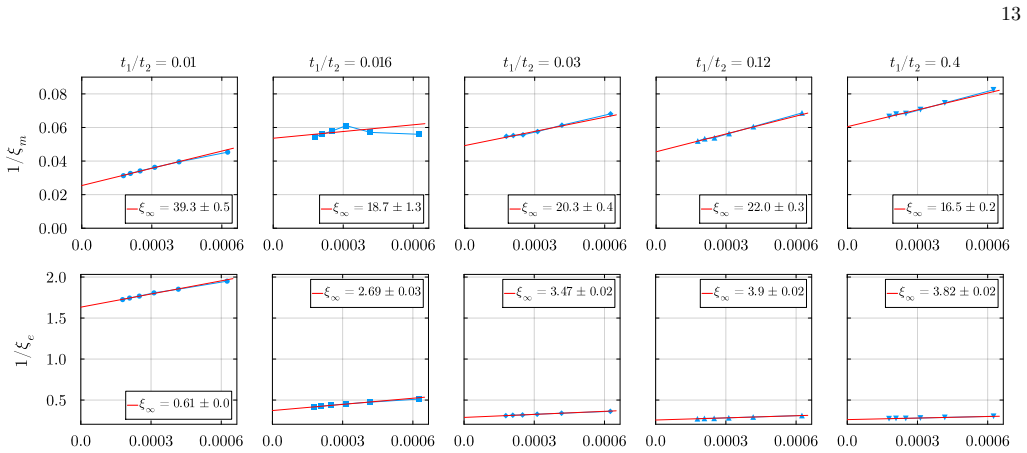
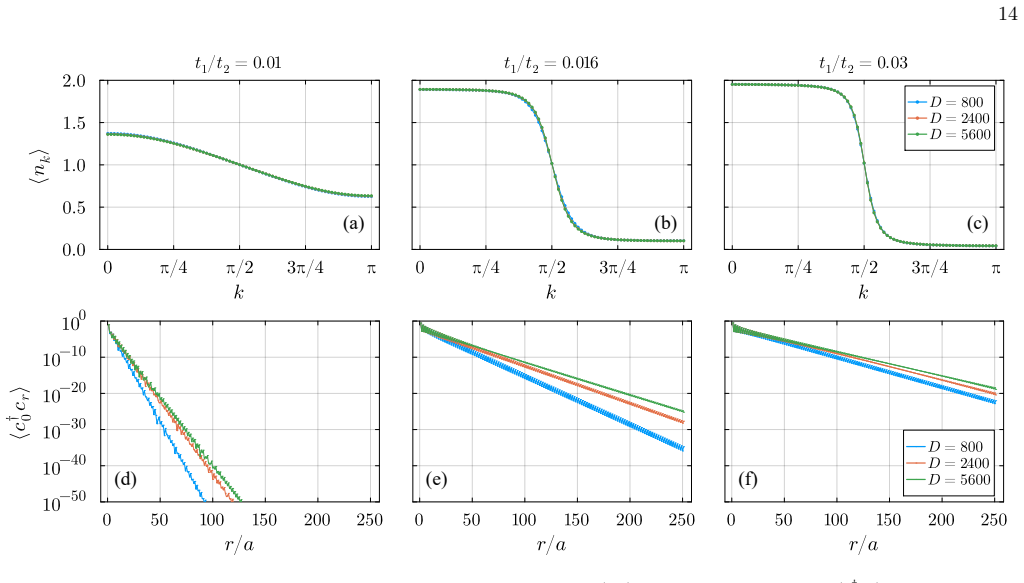
- [Sec. IV and Appendix D] The claim that the spiral spin liquid is not a CFT rests solely on negative evidence: the entanglement entropy does not fit S=(c/6) log xi_m with a reasonable central charge (best fit c~4.4), and the finite-size gap does not collapse as L^{-z} for any fixed z, with the fitted z varying by system size and boundary conditions. These failures are exactly what one would expect if a gapless CFT description is contaminated by the incommensurate wavevector k0=pi/2, finite-size oscillations, and limited correlation length xi_m~132 at D=5600. Moreover, Fig. 6(b) shows that the odd-distance exponent alpha_c,o is not converged at D=5600. To support the 'unconventional criticality' claim, please provide a positive identification of the critical theory, such as a scaling collapse that explicitly includes oscillatory corrections, an alternative entanglement-scaling form, or a reliable extraction of a dynamical exponent. Without such a positive test, the non-CFT conclusion is not established.
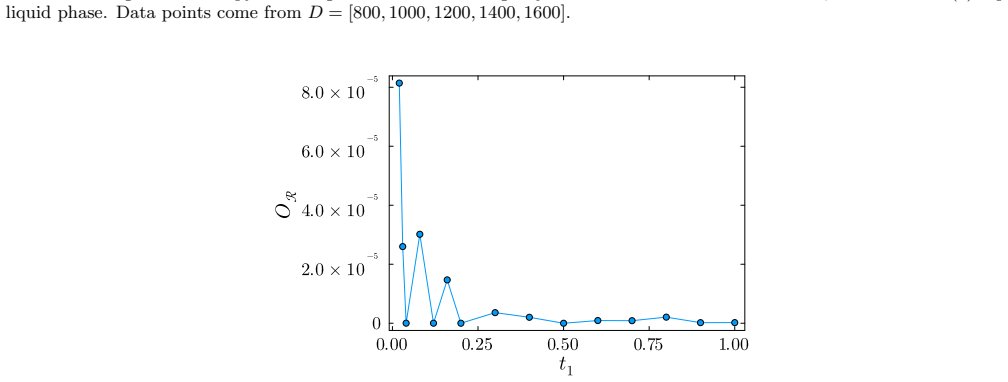
- [Sec. III.B, Fig. 2 and Fig. 4] The conclusion that the system becomes compressible exactly at t1=0 is based on the extrapolation of the quasi-particle gap Delta_qp to zero, while Delta_qp remains positive at every finite t1 and the electron correlation length remains small. This is a reasonable interpretation, but the numerical evidence does not exclude a very small but finite gap at t1=0. Please state the associated uncertainty or provide an independent estimate (for example, a finite-size scaling of the charge gap in the Kondo lattice) so that the reader can assess how sharply the incompressible-to-compressible distinction at t1=0 is established.
minor comments (5)
- [Sec. II.B] The text refers to a 'gapless SU(1)1 spin liquid' in the sawtooth-chain discussion; this should be SU(2)1.
- [Table I] The first column lists t1 values with an apparent typo: '0.012' should likely be '0.12'.
- [Appendix A] The classical analysis uses J_AB and J_AA without explicitly mapping them to JK and JH of Eq. (1); stating the correspondence would make the appendix easier to follow.
- [Fig. 3 and Sec. III.B] The sentence 'there are two physical unit cells in each unit cell in our simulation' is confusing; please clarify that the numerical unit cell is doubled and that the dispersions were unfolded.
- [Sec. IV, Fig. 6(b)] The statement that alpha_c,e and alpha_c,o 'are really distinct' is stronger than the data justify, since alpha_c,o is explicitly not converged at the largest bond dimension; please soften the claim or provide extrapolated values with error bars.
Circularity Check
No significant circularity: the central Kondo-lattice phase diagram is computed directly by VUMPS, and the only author self-citation is background non-load-bearing material.
full rationale
The paper's central derivation is self-contained rather than circular. The Kondo lattice phase diagram in Eq. (1) is obtained by direct variational uniform matrix product state (VUMPS) calculations, and the main claims (VBS phase, SU(2)_1 spin liquid region, two fragile Kondo insulators, charge-gap closure at t1=0, reflection quantum numbers, continuity of the transition) are numerical outputs, not recycled fit parameters. The step from the Kondo lattice at t1=0 to the sawtooth spin chain is an explicit strong-coupling mapping presented in Sec. II.B; whether that mapping is quantitatively controlled is a correctness question, not a circularity, and the paper additionally provides its own numerical evidence for spiral correlations and gaplessness near t1=0. The sawtooth-chain phase diagram is imported from external works by Rausch-Karrasch and others, which are independent numerical results rather than self-citations. The only author self-citation is Ref. [9] (N. C. Hu et al.), used in the introduction as background for moiré Kondo systems; it is not load-bearing for any derivation. The non-CFT conclusion about the spiral spin liquid is explicitly hedged in Appendix D ('we suspect a non-CFT critical point', 'we cannot reliably extract the dynamical exponent'); this is an honest limitation based on negative numerical evidence, not a definitional or self-referential reduction. No equation in the paper reduces to its own input, and no fitted parameter is renamed as a prediction. Accordingly, the paper shows no substantive circularity; the score reflects only the presence of one minor, non-load-bearing self-citation.
Assumptions & free parameters
free parameters (2)
- JK (Kondo coupling) =
0.6 (in units of t2=1)
- t2 (intercell hopping) =
1 (energy scale)
assumptions (5)
- domain assumption At t1=0, c-electrons are localized in bonding states on t2 bonds, giving a sawtooth spin chain with exchange JH between f-moments and JK/2 between f and c moments.
- domain assumption The LSM obstruction forbids a gapped, symmetric, featureless ground state in the sawtooth chain with odd spin per unit cell.
- domain assumption The phase diagram of the sawtooth spin chain from Refs [27-29] is correct: SU(2)1 for JH/JK<0.24, VBS near 0.5, spiral for JH/JK>0.75.
- domain assumption Extrapolation ansatz 1/xi = m/D + 1/xi_inf describes the bond-dimension dependence of correlation lengths.
- domain assumption The dynamic spin structure factor of the spiral spin liquid has flat zero-energy spectral weight near k=pi/2, as computed in Ref [27].
Cite this review
Pith. "Pith review of Valence-bonds, spin liquids and unconventional criticality in a 1D Kondo insulator." pith.science (2026). https://pith.science/paper/HRRFAQKF
@misc{pith2026250521619,
  author       = {Pith},
  title        = {Pith review of: Valence-bonds, spin liquids and unconventional criticality in a 1D Kondo insulator},
  year         = {2026},
  howpublished = {\url{https://pith.science/paper/HRRFAQKF}},
  note         = {Machine review of arXiv:2505.21619}
}
read the original abstract
We consider a one-dimensional multi-orbital Kondo lattice model and show that by tuning the kinetic energy of the itinerant electrons it is possible to stabilize Kondo insulators with non-trivial spin physics. In particular, depending on the size of the exchange coupling between the local moments, we find kinetic-energy-driven transitions between a featureless Kondo insulator and a valence-bond solid or a gapless spin liquid. We also provide evidence for an unconventional continuous phase transition between two featureless Kondo insulators distinguished by their quantum numbers under reflection symmetry.
Figures


Figures from the paper (14 more)





Reference graph
Works this paper leans on
-
[1]
2(a) we show electron correlation lengthξ e as a function oft 1/t2, for different bond dimensionsD
Charge gap In Fig. 2(a) we show electron correlation lengthξ e as a function oft 1/t2, for different bond dimensionsD. We see thatξ e remains small (ξ e ≲4) along the entire path, which confirms the insulating nature of the ground state at non-zerot 1/t2. As expected,ξ e drops to zero att 1 = 0, where charge correlations are restricted to pairs of neigh- ...
-
[2]
Spin correlations Next, we consider the spin correlations. In Fig. 2(b) we see that the spin correlation lengthξ m, interpolated to infinite bond dimension, evolves non-monotonically and displays a pronounced dip neart 1/t2 ∼0.02. To rule out the possibility that this dip inξ m is a kink induced by a first order phase transition we compute the ground stat...
work page 2000
-
[3]
G. R. Stewart, Heavy-fermion systems, Rev. Mod. Phys. 56, 755 (1984)
1984
-
[4]
P. Gegenwart, Q. Si, and F. Steglich, Quantum criticality in heavy-fermion metals, nature physics4, 186 (2008)
work page 2008
-
[5]
S. Paschen and Q. Si, Quantum phases driven by strong correlations, Nature Reviews Physics , 1 (2020)
work page 2020
-
[6]
Coleman, C
P. Coleman, C. P´ epin, Q. Si, and R. Ramazashvili, How do fermi liquids get heavy and die?, Journal of Physics: Condensed Matter13, R723 (2001)
2001
-
[7]
T. Senthil, M. Vojta, and S. Sachdev, Weak magnetism and non-fermi liquids near heavy-fermion critical points, Phys. Rev. B69, 035111 (2004)
work page 2004
-
[8]
W. Zhao, B. Shen, Z. Tao, Z. Han, K. Kang, K. Watan- abe, T. Taniguchi, K. F. Mak, and J. Shan, Gate-tunable heavy fermions in a moir´ e kondo lattice, Nature616, 61 (2023)
work page 2023
Show all 69 references
-
[9]
W. Zhao, B. Shen, Z. Tao, S. Kim, P. Kn¨ uppel, Z. Han, Y. Zhang, K. Watanabe, T. Taniguchi, D. Chowdhury, J. Shan, and K. F. Mak, Emergence of ferromagnetism at the onset of moir´ e kondo breakdown, Nature Physics 20, 1772 (2024)
2024
-
[10]
Dalal and J
A. Dalal and J. Ruhman, Orbitally selective mott phase in electron-doped twisted transition metal- dichalcogenides: A possible realization of the kondo lat- tice model, Phys. Rev. Res.3, 043173 (2021)
2021
-
[11]
Kumar, N
A. Kumar, N. C. Hu, A. H. MacDonald, and A. C. Pot- ter, Gate-tunable heavy fermion quantum criticality in a moir´ e kondo lattice, Phys. Rev. B106, L041116 (2022)
2022
-
[12]
Song and B
Z.-D. Song and B. A. Bernevig, Magic-angle twisted bi- layer graphene as a topological heavy fermion problem, Phys. Rev. Lett.129, 047601 (2022)
2022
-
[13]
Calugaru, M
D. Calugaru, M. Borovkov, L. L. H. Lau, P. Coleman, Z.- D. Song, and B. A. Bernevig, Twisted bilayer graphene as topological heavy fermion: Ii. analytical approximations of the model parameters, Low Temperature Physics49, 640 (2023)
2023
-
[14]
Guerci, J
D. Guerci, J. Wang, J. Zang, J. Cano, J. H. Pixley, and A. Millis, Chiral kondo lattice in doped mote2/wse2 bi- layers, Science Advances9, eade7701 (2023)
2023
-
[15]
Guerci, K
D. Guerci, K. P. Lucht, V. Cr´ epel, J. Cano, J. H. Pixley, and A. Millis, Topological kondo semimetal and insula- tor in ab-stacked heterobilayer transition metal dichalco- genides, Phys. Rev. B110, 165128 (2024)
2024
-
[16]
F. Xie, L. Chen, and Q. Si, Kondo effect and its destruc- tion in heterobilayer transition metal dichalcogenides, Phys. Rev. Res.6, 013219 (2024)
2024
-
[17]
Herzog-Arbeitman, J
J. Herzog-Arbeitman, J. Yu, D. C˘ alug˘ aru, H. Hu, N. Reg- nault, C. Liu, O. Vafek, P. Coleman, A. Tsvelik, Z.-d. Song, and B. A. Bernevig, Topological Heavy Fermion Principle For Flat (Narrow) Bands With Concentrated Quantum Geometry, arXiv e-prints , arXiv:2404.07253 (2024)...
2024 arXiv
-
[18]
Singh, A
K. Singh, A. Chew, J. Herzog-Arbeitman, B. A. Bernevig, and O. Vafek, Topological heavy fermions in magnetic field, Nature Communications15, 5257 (2024)
2024
-
[19]
F. D. M. Haldane, Nonlinear field theory of large-spin heisenberg antiferromagnets: Semiclassically quantized solitons of the one-dimensional easy-axis n´ eel state, Phys. Rev. Lett.50, 1153 (1983)
1983
-
[20]
S. P. Strong and A. J. Millis, Competition between singlet formation and magnetic ordering in one-dimensional spin systems, Phys. Rev. B50, 9911 (1994)
1994
-
[21]
Yao and S
H. Yao and S. A. Kivelson, Fragile mott insulators, Phys. Rev. Lett.105, 166402 (2010)
2010
-
[22]
Nakamura and K
T. Nakamura and K. Kubo, Elementary excitations in the ∆ chain, Phys. Rev. B53, 6393 (1996). 9
1996
-
[23]
D. Sen, B. S. Shastry, R. E. Walstedt, and R. Cava, Quantum solitons in the sawtooth lattice, Phys. Rev. B 53, 6401 (1996)
1996
-
[24]
Derzhko, J
O. Derzhko, J. Schnack, D. V. Dmitriev, V. Y. Krivnov, and J. Richter, Flat-band physics in the spin-1/2 saw- tooth chain, The European Physical Journal B93, 161 (2020)
2020
-
[25]
Schulenburg, A
J. Schulenburg, A. Honecker, J. Schnack, J. Richter, and H.-J. Schmidt, Macroscopic magnetization jumps due to independent magnons in frustrated quantum spin lat- tices, Phys. Rev. Lett.88, 167207 (2002)
2002
-
[26]
S. A. Blundell and M. D. N´ u˜ nez-Regueiro, Quantum topological excitations: from the sawtooth lattice to the heisenberg chain, The European Physical Journal B - Condensed Matter and Complex Systems31, 453 (2003)
2003
-
[27]
Richter, J
J. Richter, J. Schulenburg, A. Honecker, J. Schnack, and H.-J. Schmidt, Exact eigenstates and macroscopic magnetization jumps in strongly frustrated spin lattices, Journal of Physics: Condensed Matter16, S779 (2004)
2004
-
[28]
Richter, Localized-magnon states in strongly frus- trated quantum spin lattices, Low Temperature Physics 31, 695 (2005)
J. Richter, Localized-magnon states in strongly frus- trated quantum spin lattices, Low Temperature Physics 31, 695 (2005)
2005
-
[29]
Rausch and C
R. Rausch and C. Karrasch, Noncollinear phase of the antiferromagnetic sawtooth chain, Phys. Rev. B111, 045154 (2025)
2025
-
[30]
Jiang, Y.-J
J.-J. Jiang, Y.-J. Liu, F. Tang, C.-H. Yang, and Y.- B. Sheng, Analytical and numerical studies of the one- dimensional sawtooth chain, Physica B: Condensed Mat- ter463, 30 (2015)
2015
-
[31]
Hutak, T
T. Hutak, T. Krokhmalskii, O. Derzhko, and J. Richter, Spin-half heisenberg antiferromagnet on a symmetric sawtooth chain: rotation-invariant green’s functions and high-temperature series, The European Physical Journal B96, 50 (2023)
2023
-
[32]
C. K. Majumdar and D. K. Ghosh, On next-nearest- neighbor interaction in linear chain. i, Journal of Mathe- matical Physics10, 1388 (1969)
1969
-
[33]
Zauner-Stauber, L
V. Zauner-Stauber, L. Vanderstraeten, M. T. Fishman, F. Verstraete, and J. Haegeman, Variational optimization algorithms for uniform matrix product states, Phys. Rev. B97, 045145 (2018)
2018
-
[34]
Van Damme, L
M. Van Damme, L. Devos, and J. Haegeman, Mpskit (2024)
2024
-
[35]
Haegeman, L
J. Haegeman, L. Devos, M. Hauru, H. Nakano, M. Damme, G. Roose, S. Carlstr¨ om, and X. Dong, Jutho/tensorkit. jl: v0. 12.2 (2024)
2024
-
[36]
Hauru, M
M. Hauru, M. V. Damme, and J. Haegeman, Riemannian optimization of isometric tensor networks, SciPost Phys. 10, 040 (2021)
2021
-
[37]
Pollmann, A
F. Pollmann, A. M. Turner, E. Berg, and M. Oshikawa, Entanglement spectrum of a topological phase in one di- mension, Phys. Rev. B81, 064439 (2010)
2010
-
[38]
Haegeman, B
J. Haegeman, B. Pirvu, D. J. Weir, J. I. Cirac, T. J. Os- borne, H. Verschelde, and F. Verstraete, Variational ma- trix product ansatz for dispersion relations, Phys. Rev. B85, 100408 (2012)
2012
-
[39]
Haegeman, T
J. Haegeman, T. J. Osborne, and F. Verstraete, Post- matrix product state methods: To tangent space and beyond, Phys. Rev. B88, 075133 (2013)
2013
-
[40]
The quasi-particle dispersions are obtained by unfolding bands in the folded Brillouin zone
As mentioned earlier, there are two physical unit cells in each unit cell in our simulation. The quasi-particle dispersions are obtained by unfolding bands in the folded Brillouin zone. We observe weak translation symmetry breaking of order 10 −3 fort 1 = 0.04. See also Fig. 1...
-
[41]
den Nijs, The domain wall theory of twodimensional commensurate-incommensurate phase transitions, Phase transitions and critical phenomena12(1988), edited by C
M. den Nijs, The domain wall theory of twodimensional commensurate-incommensurate phase transitions, Phase transitions and critical phenomena12(1988), edited by C. Domb and J.L. Lebowitz
1988
-
[42]
Schollwock, T
U. Schollwock, T. Jolicoeur, and T. Garel, Onset of in- commensurability at the valence-bond-solid point in the s=1 quantum spin chain, Phys. Rev. B53, 3304 (1996)
1996
-
[43]
Herviou, A
L. Herviou, A. Rey, and F. Mila, Singularity with and without disorder at AKLT points, arXiv e-prints , arXiv:2411.17848 (2024)
2024 arXiv
-
[44]
S. R. White and I. Affleck, Dimerization and incommen- surate spiral spin correlations in the zigzag spin chain: Analogies to the kondo lattice, Phys. Rev. B54, 9862 (1996)
1996
-
[45]
In our simulations we use a unit cell which consists of two physical unit cells, so a spontaneous doubling of the unit cell would be detectable. Larger periodicities have not been explicitly investigated, but from the fact that the MPS remains injective we can safely rule out ...
-
[46]
Tsukano and K
M. Tsukano and K. Nomura, Spin-1 XXZ chains in a staggered magnetic field, Phys. Rev. B57, R8087 (1998)
1998
-
[47]
Y. Fuji, F. Pollmann, and M. Oshikawa, Distinct trivial phases protected by a point-group symmetry in quantum spin chains, Phys. Rev. Lett.114, 177204 (2015)
2015
-
[48]
Bak, Commensurate phases, incommensurate phases and the devil’s staircase, Reports on Progress in Physics 45, 587 (1982)
P. Bak, Commensurate phases, incommensurate phases and the devil’s staircase, Reports on Progress in Physics 45, 587 (1982)
1982
-
[49]
Chepiga and F
N. Chepiga and F. Mila, Lifshitz point at commensurate melting of chains of rydberg atoms, Phys. Rev. Res.3, 023049 (2021)
2021
-
[50]
Zhang, S
J. Zhang, S. H. Cant´ u, F. Liu, A. Bylinskii, B. Braver- man, F. Huber, J. Amato-Grill, A. Lukin, N. Gemelke, A. Keesling, S.-T. Wang, Y. Meurice, and S. W. Tsai, Probing quantum floating phases in rydberg atom arrays (2024), arXiv:2401.08087 [quant-ph]
2024 arXiv
-
[51]
Chepiga, I
N. Chepiga, I. Affleck, and F. Mila, From su(2)5 to su(2)3 wess-zumino-witten transitions in a frustrated spin- 5 2 chain, Phys. Rev. B105, 174402 (2022)
2022
-
[52]
Chepiga and N
N. Chepiga and N. Laflorencie, Topological and quan- tum critical properties of the interacting Majorana chain model, SciPost Phys.14, 152 (2023)
2023
-
[53]
B. E. L¨ uscher, F. Mila, and N. Chepiga, Critical proper- ties of the quantum ashkin-teller chain with chiral per- turbations, Phys. Rev. B108, 184425 (2023)
2023
-
[54]
Glittum, A
C. Glittum, A. ˇStrkalj, D. Prabhakaran, P. A. Goddard, C. D. Batista, and C. Castelnovo, Spin-charge separa- tion and resonant valence bond spin liquid in a frustrated doped Mott insulator, arXiv e-prints , arXiv:2408.03372 (2024), arXiv:2408.03372
2024
-
[55]
X. Cai, Z. Han, Z.-X. Li, S. A. Kivelson, and H. Yao, Quantum spin liquid from electron-phonon coupling, arXiv e-prints , arXiv:2408.04002 (2024), arXiv:2408.04002
2024
-
[56]
Fujimoto and N
S. Fujimoto and N. Kawakami, Bosonization approach to the one-dimensional kondo lattice model, Journal of the Physical Society of Japan63, 4322 (1994)
1994
-
[57]
Moukouri and L
S. Moukouri and L. G. Caron, Fermi surface of the one- dimensional kondo-lattice model, Phys. Rev. B54, 12212 (1996)
1996
-
[58]
A. E. Sikkema, I. Affleck, and S. R. White, Spin gap in 10 a doped kondo chain, Phys. Rev. Lett.79, 929 (1997)
1997
-
[59]
J. C. Xavier and E. Dagotto, Robustd-wave pairing cor- relations in the heisenberg kondo lattice model, Phys. Rev. Lett.100, 146403 (2008)
2008
-
[60]
E. Berg, E. Fradkin, and S. A. Kivelson, Pair-density- wave correlations in the kondo-heisenberg model, Phys. Rev. Lett.105, 146403 (2010)
2010
-
[61]
Eidelstein, S
E. Eidelstein, S. Moukouri, and A. Schiller, Quantum phase transitions, frustration, and the fermi surface in the kondo lattice model, Phys. Rev. B84, 014413 (2011)
2011
-
[62]
L. Yang, E. Dagotto, and A. E. Feiguin, Emergent Pair Density Wave Order Across a Lifshitz Transition, arXiv e-prints , arXiv:2503.19761 (2025), arXiv:2503.19761
2025 arXiv
-
[63]
J. M. Luttinger and L. Tisza, Theory of dipole interaction in crystals, Phys. Rev.70, 954 (1946)
1946
-
[64]
D. H. Lyons and T. A. Kaplan, Method for determining ground-state spin configurations, Phys. Rev.120, 1580 (1960)
1960
-
[65]
Capello, F
M. Capello, F. Becca, M. Fabrizio, S. Sorella, and E. Tosatti, Variational description of mott insulators, Phys. Rev. Lett.94, 026406 (2005)
2005
-
[66]
Kawamura, K
M. Kawamura, K. Yoshimi, T. Misawa, Y. Yamaji, S. Todo, and N. Kawashima, Quantum lattice model solver hϕ, Computer Physics Communications217, 180 (2017)
2017
-
[67]
K. Ido, M. Kawamura, Y. Motoyama, K. Yoshimi, Y. Ya- maji, S. Todo, N. Kawashima, and T. Misawa, Update of hϕ: Newly added functions and methods in versions 2 and 3, Computer Physics Communications298, 109093 (2024). 11 Appendix A: Classical considerations for the sawtooth spi...
2024
-
[68]
12, we also show that the charge structure factors obtained in simulations with and without SU(2) symmetry enforced are similar
Simulations with and without SU(2) symmetry In Fig. 12, we also show that the charge structure factors obtained in simulations with and without SU(2) symmetry enforced are similar. In Fig. 13 we show a few other characteristics that non-SU(2)-symmetric and SU(2)-symmetric 15 (...
-
[69]
T ranslation symmetry breaking Due to the doubling of the unit cell in our MPS simulations, we need to unfold the quasi-particle dispersion relations to represent the original Brillouin zone physics. Reflection symmetry implies thatE n(k) =E n(−k), and single unit-cell transla...
2000
Reviewed August 7, 2026 · model on record in the stance chip above.
Discussion (0). Sign in to comment.