REVIEW 3 major objections 5 minor 49 references
D=11 cosmologies with teleparallel structure
T0 review · 3 major / 5 minor · reviewed 2026-08-14 · deepseek-v4-flash
Pith's one-line read In eleven-dimensional f(T) gravity, only a seven-sphere internal space allows vacuum inflation.
desk verdict Solid, careful derivation of D=11 f(T) cosmologies; the S7 vacuum-inflation result is new and checks out, though its frame-dependence deserves a closer look. read the letter →
The pith
A machine-rendered reading of the paper's core claim, the machinery that carries it, and where it could break.
The reading
What carries the argument
The load-bearing object is the explicit global basis of one-forms on the internal manifold, in particular the octonionic parallelization of $S^7$ in Eq. (39); because $f(T)$ field equations fix the full vielbein rather than just the metric, the torsion scalar $T$ and all equations depend on this frame. For the $S^7$ compactification the frame yields $T=-6(H_0^2+7H_0H_1+7H_1^2-7a_1^{-2})$, and with $H_1=0$ the vacuum system collapses to the two algebraic relations $f+12f'H_0^2=0$ and $f+6f'(3H_0^2-2a_1^{-2})=0$, which together determine the inflation rate and the internal size. The associated first-order autonomous system in $(H_0,H_1)$, written out in Appendix D, is then compactified on the Poincaré sphere to give the global phase portrait and the critical points. This machinery converts a higher-dimensional field-theory question into a finite-dimensional dynamical-system statement whose fixed points can be classified.
What would settle it
Recompute the vacuum $S^7$ field equations with a different global parallelization of the seven-sphere, for example one related to Eq. (39) by a remnant Lorentz transformation of the kind discussed in Appendix B, and check whether the relations $a_1^{-2}=H_0^2/2$ and $f+12f'H_0^2=0$ remain consistent; a sign flip in the internal contribution to the torsion scalar would falsify the claim that $S^7$ alone can drive vacuum inflation.
Extended reading notes
Core claim
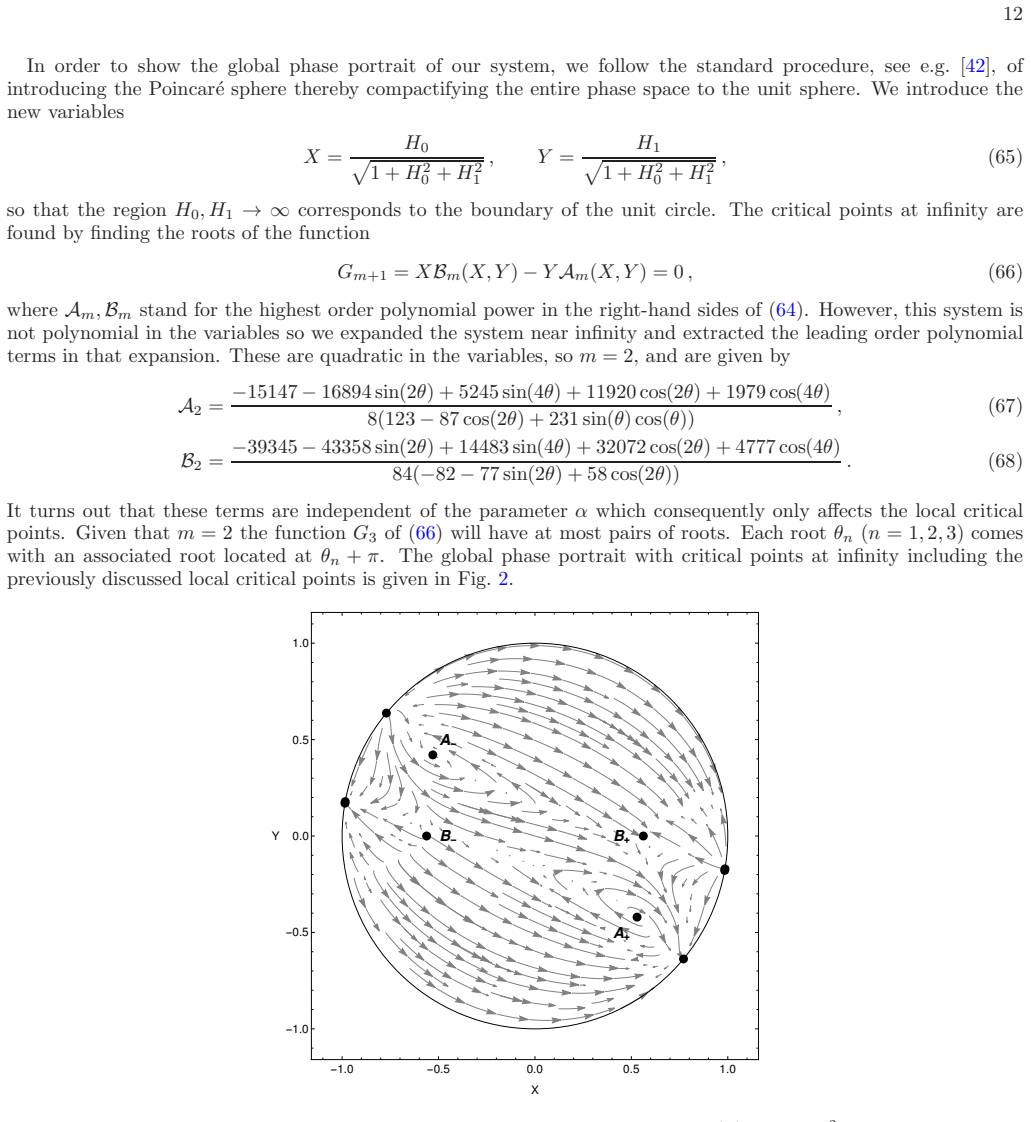
The paper's central claim is that in D=11 vacuum $f(T)$ cosmology, the seven-sphere is singled out among the parallelizable-sphere compactifications as the only internal space able to source a de Sitter inflationary epoch without matter. Assuming the internal scale factors are constant, the field equations for $T^7$, $T^4\times S^3$, and $S^1\times S^3\times S^3$ reduce to incompatible pairs such as $f+12f'H_0^2=0$ and $f+18f'H_0^2=0$, whereas the $S^7$ equations reduce consistently to $f+12f'H_0^2=0$ together with $f+6f'(3H_0^2-2a_1^{-2})=0$. Combining these gives $a_1^{-2}=H_0^2/2$, valid for any $f$ other than general relativity, and for $f(T)=T+\alpha T^2$ fixes $\alpha=-3/(65H_0^2)$. For $\alpha=-0.1$, the two-Hubble dynamical system $(H_0,H_1)$ has four finite critical points; the expanding solution with static internal space, $B_+$ at $H_0=\sqrt{6/13}$, $H_1=0$, is a stable node, so trajectories are attracted to an accelerated phase with $q=-1$. The paper therefore concludes that extra dimensions can naturally drive inflation and that among the four topologies considered, $S^7$ is physically favored.
Load-bearing premise
The argument assumes that the explicit octonionic frame chosen for $S^7$ is representative, in the sense that any other admissible global frame would give the same conclusions; because $f(T)$ gravity is sensitive to the frame's local orientation, a different parallelization could change the sign of the effective cosmological constant and destroy the inflationary solution.
Editorial extensions
If this is right
- In the quadratic model, inflation and the extra-dimensional size are locked together: $H_0=\sqrt{2}/a_1$ and $\alpha=-3a_1^2/130$, so smaller internal dimensions produce faster inflation.
- The three non-$S^7$ compactifications cannot support vacuum de Sitter phases with static extra dimensions; within this class, geometric inflation from extra dimensions selects the $S^7$ topology.
- The stable node $B_+$ means that once the $S^7$ internal space stops evolving, an accelerating four-dimensional expansion with $q=-1$ is an attractor of the vacuum dynamics.
- Because all critical points at infinity lie in quadrants where one Hubble parameter expands while the other contracts, generic trajectories end with the four-dimensional space expanding and the seven extra dimensions contracting.
Reading between the lines
- The frame-dependence of $f(T)$ gravity is not settled in the paper: if another admissible parallelization of $S^7$, or a remnant Lorentz transformation of the chosen one, changes the sign of the effective cosmological constant, the $S^7$ inflation result would not be a property of the topology alone.
- The pattern in which $S^7$ powers inflation in D=11 and $S^3$ did so in D=7 suggests that the maximal parallelizable sphere in each odd dimension may play the same selective role; repeating the construction in higher dimensions would test whether the pattern persists.
- The relation $\alpha<0$ with $H_0\sim 1/\sqrt{-\alpha}$ gives a concrete target: computing inflationary observables such as the tensor-to-scalar ratio for this model would let existing cosmological bounds on the deformation scale rule the scenario in or out.
- The same explicit-frame method could be applied to the remaining eleven product topologies of spheres in D=11, which the paper leaves for future work, to determine whether $S^7$ remains unique beyond the four parallelizable-product cases studied here.
Signed reviews
Editorial analysis
A structured set of objections, weighed in public.
Referee Report
Summary. This paper studies D=11 f(T) gravity cosmologies built as a four-dimensional flat FLRW spacetime times seven extra dimensions compactified on products of parallelizable spheres: T^7, T^4×S^3, S^1×S^3×S^3, and S^7. For each topology, the authors provide explicit global vielbeins and derive the corresponding cosmological field equations. In the vacuum and with static internal dimensions, they find that only the S^7 case admits a de Sitter solution, with a1^{-2}=H0^2/2 and, for f(T)=T+αT^2, the relation α=-3/(65H0^2). They then perform a dynamical system analysis for f(T)=T-0.1T^2, identifying four finite critical points and several critical points at infinity, including a stable node B+ with H0=sqrt(6/13) and H1=0.
Significance. If the conclusions hold, the paper proposes a concrete mechanism by which extra dimensions can source a vacuum inflationary or accelerating phase in a modified teleparallel theory, and it usefully catalogues explicit global parallelizations of S^3 and S^7. The analytic derivations are explicit and checkable, and the GR limit around Eq. (50) together with the parameter-free relation a1^{-2}=H0^2/2 are strengths. However, the physical interpretation is currently clouded by the frame-dependence of f(T) gravity and by an apparent confusion between early-time and late-time attractors, so the significance of the central claim is not yet fully established.
major comments (3)
- [Section III.E and Appendix B] The S7 vacuum-inflation result is derived for the specific octonionic parallelization of Eq. (39), but f(T) gravity is not locally Lorentz invariant, as the paper itself emphasizes in Section II. The field equations depend on the local orientation of the vielbein, so a different global parallelization of S7 (not connected to Eq. (39) by a remnant transformation) could in principle change the torsion scalar T and alter the vacuum equations (59)-(60). The remnant group analysis in Appendix B is partial and does not characterize the full remnant group for the S7 frame, nor does it test any non-remnant parallelization. The claim that S7 is uniquely favored among the four topologies is therefore demonstrated only for the chosen frame. The authors should either restrict the claim accordingly or show invariance of the de Sitter solution under all admissible S7 parallelizations.
- [Section IV.B, Table I] The stability assignment undermines the early-inflation interpretation. Table I lists B+ as a stable node with eigenvalues (-3.309, -1.157), meaning it is a future (late-time) attractor, yet the text states that 'the critical point B+ corresponds to an early time inflationary state' and that 'trajectories are attracted to this state.' A stable node is a late-time attractor, so the static-internal de Sitter solution is a late-time phase for this system, not an early-time one. The early-time (past) attractors are the unstable points A+ and B-, for which the internal dimensions are not static. The abstract's claim of an 'early inflationary epoch' therefore requires either a different identification of the relevant attractor or a revised statement of the time direction.
- [Appendix D, Eq. (D3)] The function b^2 in Eq. (D3) is obtained by solving the vacuum constraint (43) for a1^{-2}; because the constraint is quadratic in a1^{-2}, there are two branches, and the paper does not state why the displayed branch is chosen or whether the critical-point structure and the stability of B+ are independent of that choice. Since the functions A and B in Eqs. (D1)-(D2), and hence the entire dynamical-system analysis, are built from this b, the branch ambiguity is a load-bearing gap for the phase-portrait conclusions.
minor comments (5)
- [Throughout] The spelling 'Weitzenbock' should be 'Weitzenböck' in several places, for example after Eq. (46) and in Section II.
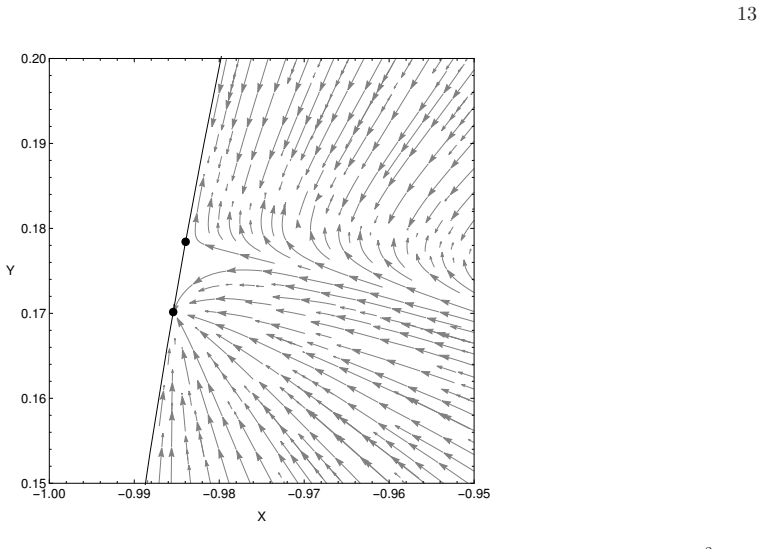
- [Section IV.B, Fig. 2 and surrounding text] The text says 'there are only two pairs of critical points at infinity' but immediately lists three angular values θ1=2.450, θ2=2.962, θ3=2.971, each with an associated θ+π pair; this discrepancy should be clarified.
- [Eq. (60)] The derivation of α=-3/(65H0^2) from Eq. (59) is elegant and holds for any negative α; consider stating explicitly that this relation is independent of the choice of α and only the magnitude of H0 adjusts, since this is a useful check for the reader.
- [Eqs. (61)-(63)] The inconsistency of the T7, T4×S3, and S1×S3×S3 vacuum equations is stated, but it would be helpful to add one sentence explaining that subtracting the first two equations forces f'=0 for H0≠0, making the inconsistency generic rather than a special property of the quadratic model.
- [Section V] The final paragraph correctly notes that the remaining eleven of the fifteen product topologies have not been analyzed; this caveat should also be reflected in the wording of the abstract and Section IV.A, where 'S7 is clearly favored' could be misread as a proof of uniqueness among all parallelizable-sphere products.
Circularity Check
No significant circularity: the D=11 field equations and the S7 vacuum-de Sitter condition are derived from the action and explicit parallelizations, with no fitted input renamed as a prediction.
full rationale
The derivation chain is self-contained. The Weitzenbock invariant for each topology is computed from explicit parallel one-forms (Eqs. (16), (23), (33), (42)), and the field equations (43)-(45) follow by varying the stated f(T) action, not from an assumed answer. The vacuum de Sitter condition for S7 is obtained algebraically from Eqs. (59): combining f + 12 f' H0^2 = 0 with f + 6 f'(3 H0^2 - 2 a1^{-2}) = 0 gives a1^{-2} = H0^2/2 for any f with f' != 0. Substituting f = T + alpha T^2 and T = 15 H0^2 gives alpha = -3/(65 H0^2), which is a derived constraint, not an input. The later use of alpha = -0.1 is an illustrative choice, and the resulting H0 = sqrt(6/13) at B+ reproduces Eq. (60); this is a consistency check, not a fitted prediction. The exclusion of T7, T4 x S3, and S1 x S3 x S3 follows from the same explicit equations, which force f + 12 f' H0^2 = 0 and f + 18 f' H0^2 = 0 simultaneously (Eqs. (61)-(63)); hence the comparison among the four topologies is not circular. Self-citations to the authors' earlier paper [29] are programmatic ('we started the program') or anticipatory; they do not supply the D=11 equations or the S7 conclusion. Section V explicitly acknowledges that proving S7 is the sole topology would require checking the remaining eleven product topologies, which is a scope limitation rather than circularity. The frame-dependence of f(T) gravity noted in Appendix B is a correctness and falsifiability concern about representative parallelizations, not a step in which the conclusion is defined into the premises.
Assumptions & free parameters
free parameters (1)
- alpha (α) =
-0.1 (chosen for dynamical systems analysis)
assumptions (6)
- domain assumption The seven extra dimensions are compact and their topological product is built from parallelizable spheres S1, S3, S7 (Eqs. (9)-(10)).
- ad hoc to paper The vielbein fields for the internal spaces are the explicit global 1-forms in (15), (20), (28)-(29), and (39), which inherit the product structure of Min.
- domain assumption The matter content is a perfect fluid with diagonal energy-momentum tensor (13)-(14).
- domain assumption The internal scale factors are constant (H_i=0) when deriving the reduced 4D equations and the inflation condition.
- standard math The f(T) action (4) and field equations (5) define the theory.
- standard math Only S1, S3, S7 are parallelizable spheres (Kervaire-Milnor theorem).
Cite this review
Pith. "Pith review of D=11 cosmologies with teleparallel structure." pith.science (2026). https://pith.science/paper/HRUX3FMG
@misc{pith2026190803680,
  author       = {Pith},
  title        = {Pith review of: D=11 cosmologies with teleparallel structure},
  year         = {2026},
  howpublished = {\url{https://pith.science/paper/HRUX3FMG}},
  note         = {Machine review of arXiv:1908.03680}
}
read the original abstract
The presence of additional compact dimensions in cosmological models is studied in the context of modified teleparallel theories of gravity. We focus the analysis on eleven dimensional spacetimes, where the seven dimensional extra dimensions are compactified. In particular, and due to the importance that global vector fields play within the conceptual body of teleparallel modified gravity models, we consider the additional dimensions to be products of parallelizable spheres. The global vector fields characterizing the different topologies are obtained, as well as the equations of motion associated to them. Using global dynamical system techniques, we discuss some physical consequences arising because of the existence of the extra dimensions. In particular, the possibility of having an early inflationary epoch driven by the presence of extra dimensions without other matter sources is discussed.
Figures

Reference graph
Works this paper leans on
-
[29]
W-D Guo, Q-M Fu, Y-P Zhang and Y-X Liu, Phys. Rev. D93, (2016) 044002
work page 2016
-
[1]
T. Kaluza, Sitzungsber. Preuss. Akad. Wiss. Berlin (Math. Phys.) , (1921) 996. O. Klein, Z. F. Physik 37, (1926) 895
work page 1921
-
[2]
N. Arkani-Hamed, S. Dimopoulos and G. R. Dvali, Phys. Lett. B 429 (1998) 263
work page 1998
-
[3]
− ds2 in , (12) where ds2 in is the line element corresponding to the internal dimensions given by a ny of the four possible forms ( 10). In order to apply these models to a cosmological setting, we will assu me a perfect fluid with energy density ρ(t) and pressure p(t) as the only matter source in the field equations. This means we have T µν = (ρ + p)V µV ...
-
[4]
which in the present case give the Hubble constraint equation f − 2 T f′ = 16πGρ . (17) Next, we have the three (identical) spatial equations coming from t he standard FLR W part 2f ′ ( (2H0 + 7∑ n=1 Hn)2 + H0(2H0 + 7∑ n=1 Hn) + 2 ˙H0 + 7∑ n=1 ˙Hn ) + 2f ′′ ˙T (2H0 + 7∑ n=1 Hn) + f = −16πGp0 . (18) Finally there are seven additional equations which are 2f...
-
[5]
define the spacetime structure by means of a parallelization by D non-null and smooth vector fields eµ a(x). It is natural, then, that the vielbein grid so determined is sensitive to local boosts and rotations Λ ab(x) acting on it according to eµ a → eµ b = Λ ba eµ a. These local Lorentz transformations Λ ab(x) have the effect of breaking the global structur...
- [6]
-
[7]
is by no means simply a choice. Even though many other proper tetrads exist for the description of MFLR W, related to ( 7) through transformations of the remnant group, the autoparallel curves of flat Euclidean space are given by straight line s which can be generated by the coordinate basis ∂xn , whose dual co-basis is dxn. The Euclidean grid so obtained ...
Show all 49 references
-
[8]
Zanelli, Class
J. Zanelli, Class. Quant. Grav. 29 (2012) 133001
2012
-
[9]
Randall and R
L. Randall and R. Sundrum, Phys. Rev. Lett. 83, (1999) 4690
1999
-
[10]
G. R. Dvali, G. Gabadadze and M. Porrati, Phys. Lett. B 485 (2000) 208; G. R. Dvali and G. Gabadadze, Phys. Rev. D63 (2001) 065007; G. R. Dvali, G. Gabadadze and M. Shifman, Phys. Rev. D67 (2003) 044020
2000
-
[11]
M. B. Green and J. H. Schwarz, Phys. Lett. B 149 (1984) 117
1984
-
[12]
Zheng and Q
R. Zheng and Q. G. Huang, JCAP 1103, 002 (2011)
2011
-
[13]
Lovelock, J
D. Lovelock, J. Math. Phys. 12 (1971) 498
1971
-
[14]
Golovnev and T
A. Golovnev and T. Koivisto, JCAP 1811, no. 11, 012 (2018)
2018
-
[15]
See, e.g. D. G. Boulware and S. Deser, Phys. Rev. Lett. 55 (1985) 2656, and references therein contained
1985
-
[16]
Ferraro, F
R. Ferraro, F. Fiorini, Phys. Rev. D75, (2007) 084031; Phys. Rev. D78, (2008) 124019
2007
-
[17]
Note that ( 19) contains seven different equations which correspond to the seven different pressures pj appearing in T µ ν
coming from the temporal coordinate is the constraint, which play s the role of a modified Friedmann equation. Note that ( 19) contains seven different equations which correspond to the seven different pressures pj appearing in T µ ν . There is no a priori reason to assume these ...
-
[18]
G. R. Bengochea and R. Ferraro, Phys. Rev. D79, (2009) 124019
2009
-
[19]
Zhang, H
Y. Zhang, H. Li, Y. Gong and Z. H. Zhu, JCAP 1107, 015 (2011)
2011
-
[20]
Bamba, S
K. Bamba, S. Nojiri and S. D. Odintsov, Phys. Lett. B725 (2013) 368
2013
-
[21]
Paliathnasis, JCAP 1708, no
A. Paliathnasis, JCAP 1708, no. 08, 027 (2017)
2017
-
[22]
Mirza and F
B. Mirza and F. Obudiat, JCAP 1711, no. 11, 011 (2017)
2017
-
[23]
03, 040 (2017)
R-H-Lin, X-H Zhai, X-Z Li, JCAP 1703, no. 03, 040 (2017)
2017
-
[24]
A. Awad, W. El Hanafy, G. G. L. Nashed and S. D. Odintsov JCAP 1807, no. 07, 026 (2018)
2018
-
[25]
Capozziello, P
S. Capozziello, P. A. Gonzalez, E. N. Saridakis and Y. Va squez, JHEP 1302, 039 (2013)
2013
-
[26]
Krssak, R
M. Krssak, R. J. Van Den Hoogen, J. G. Pereira, C. G. B¨ ohm er and A. A. Coley, [arXiv:1810.12932 [gr-qc]]
-
[27]
Yang, W-D Guo, Z-C Ling and Y-X Liu, Phys
K. Yang, W-D Guo, Z-C Ling and Y-X Liu, Phys. Lett. B782 (2018) 170
2018
-
[28]
Wang, W-D Guo, Z-C Ling and Y-X Liu, Phys
J. Wang, W-D Guo, Z-C Ling and Y-X Liu, Phys. Rev. D98, (2018) 084046
2018
-
[30]
P. A. Gonzalez and Y. Vasquez, Phys. Rev. D92, no. 12, 124023 (2015)
2015
-
[31]
P. A. Gonz´ alez, S. Reyes and Y. V´ asquez,JCAP 2019, no. 07, 040 (2019)
2019
-
[32]
F. W. Hehl, J. D. McCrea, E. W. Mielke and Y. Ne’eman, Phys. Rep. 258 (1995) 1
1995
-
[33]
J. W. Maluf, Annalen Phys. 525, 339 (2013)
2013
-
[34]
Aldrovandi and J
R. Aldrovandi and J. G. Pereira, Teleparallel Gravity – An Introduction , Springer (2013)
2013
-
[35]
Fiorini, P
F. Fiorini, P. A. Gonzalez and Y. Vasquez, Phys. Rev. D89 (2014) 024028
2014
-
[36]
Ferraro and F
R. Ferraro and F. Fiorini, Phys. Lett. B702 (2011) 75; Phys. Rev. D84 (2011) 083518
2011
-
[37]
Ferraro and M
R. Ferraro and M. J. Guzm´ an, Phys. Rev. D97 (2018) 104028
2018
-
[38]
Parton, Rend
M. Parton, Rend. Istit. Mat. Univ. Trieste 35 (2003), no. 1-2, (2004) 61
2003
-
[39]
Bejarano, R
C. Bejarano, R. Ferraro, F. Fiorini and M. J. Guzm´ an, Universe 5 (2019), 158. 18
2019
-
[40]
Ferraro and M
R. Ferraro and M. J. Guzm´ an, Phys. Rev. D98 (2018) 124037
2018
-
[41]
Ferraro and F
R. Ferraro and F. Fiorini, Phys. Rev. D91 (2015), 064019
2015
-
[42]
Kervaire
M. Kervaire. Courbure int´ egrale g´ en´ eralis´ ee et homotopie. Math. Ann., 131 (1956) 219
1956
-
[43]
Bruni, Rend
M. Bruni, Rend. di Mat. , Serie VII 12 (1992) 405
1992
-
[45]
M. A. Kervaire and J. W. Milnor, Annals of Math. 77 (1963) 504
1963
-
[46]
Stiefel, Comm
E. Stiefel, Comm. Math. Helv. 8 (1936) 305
1936
-
[47]
non trivial
and ( 48) coalesce to the single equation f + 12f ′H 2 0 = 0, in vacuum and for constant H0. Then, the T 7 topology leads to the inconsistent (for a non null H0) system f + 12f ′H 2 0 = 0 , f + 18f ′H 2 0 = 0 . (61) Similarly the T 4 × S3 case shows the same inconsistency by m...
1979
-
[48]
Godoy Molina and I
M. Godoy Molina and I. Markina, Rev. Mat. Iberoamericana 27, 3 (2011) 997
2011
-
[49]
Bahamonde, C
S. Bahamonde, C. G. B¨ ohmer, S. Carloni, E. J. Copeland, W. Fang and N. Tamanini, Phys. Rept. 775-777, 1 (2018)
2018
-
[50]
Brickel and R
F. Brickel and R. S. Clark, Differential Manifolds, an introduction, Van Nostrand Reinh old Company, London, 1970
1970
Reviewed August 14, 2026 · model on record in the stance chip above.
Discussion (0). Continue with ORCID to comment.