REVIEW 4 major objections 4 minor 28 references
Benchmarking the Benchmarks: Evaluating Benchmarks for Conversational Agents
T0 review · 4 major / 4 minor · reviewed 2026-08-07 · deepseek-v4-flash
Pith's one-line read The paper claims that a reference-free LLM-judge framework can rank conversational-agent benchmarks by consistency, complexity, and policy coverage, and can diagnose their specific weaknesses.
desk verdict A useful reference-free benchmark-auditing framework that is well designed but validated on an unproven proxy; deserves referee time with revisions. read the letter →
The pith
A machine-rendered reading of the paper's core claim, the machinery that carries it, and where it could break.
The reading
What carries the argument
The load-bearing object is the policy item—a rule or constraint marked as an annotated span inside the domain policy document. The central mechanism is an LLM judge that, given a task's description and initial database state plus the annotated policy, returns the subset of policy items the task violates. Averaging the sizes of those sets gives the complexity score; counting how many items are hit by at least K tasks gives the coverage score. Two further LLM judges score pairwise alignment (description-to-expected-behavior and expected-behavior-to-policy). The prompts structure the judging by forbidding invented facts, invented actions, and missing required steps, so the model returns a 1–10 score with a bulleted rationale, which also serves as the diagnostic output.
What would settle it
Run the expected-behavior-swap perturbation on a new domain with a new judge model: if the Description–Expected Behavior Alignment score fails to decrease monotonically as 0%, 20%, 40%, 60%, and 80% of tasks are corrupted, the consistency metric is not sensitive to the degradation it purports to measure. Alternatively, if independent human raters judge a weaker generator's benchmark to be better than a stronger generator's while the four metrics rank the stronger one higher, the generator-capability proxy used for validation fails.
Extended reading notes
Core claim
The central discovery is a multidimensional, reference-free benchmark audit. Four metrics are defined: Description–Expected Behavior Alignment, which checks that the expected behavior matches what the user asked for; Policy–Expected Behavior Alignment, which checks that the expected behavior contains no invented actions and omits no policy-required steps; Policy Violations Count, the average number of policy items a task violates, used as a complexity measure; and Policy Violations Coverage, the fraction of policy items violated by at least K tasks, used as a coverage measure. The paper's evidence is that across two domains and three judge models these metrics achieve near-perfect ordering over five synthetic benchmarks generated by LLMs of different capabilities, that they fall monotonically under controlled perturbations, and that their task-level scores correlate with human judgments (rank correlations from 0.32 to 0.67). On a manually curated airline benchmark, the metrics transfer with minimal prompt adaptation.
Load-bearing premise
The paper's validation rests on treating generator model capability as a proxy for benchmark quality, so the observed ordering assumes stronger models make better tasks; it also assumes the extracted list of policy rules is complete, since coverage scores are computed against it. If either fails, the metrics could rank benchmarks without truly ranking quality.
Editorial extensions
If this is right
- Benchmark builders can filter low-scoring tasks automatically, flagging inconsistent descriptions, invented workflow steps, and missing required information collection.
- Coverage scores reveal which policy rules no task challenges, allowing targeted generation of adversarial tasks for untested rules.
- Developers of manually curated benchmarks can audit them the same way; the paper shows the metrics transfer with only small prompt changes.
- Because the scores are reference-free, they work where no existing high-quality benchmark is available for comparison.
- The qualitative failure categories (hallucinated stages, missing info collection, missing confirmation, incorrect compensation, forbidden actions) can feed back into generation prompts to fix systematic weaknesses.
Reading between the lines
- The same audit logic could extend beyond conversational agents: replace 'policy' with API contracts, permission rules, or safety specifications, and the consistency and coverage metrics would apply to tool-use or code-generation benchmarks.
- Coverage measured as violations by at least K tasks is a conservative proxy for 'tested by the benchmark'; a policy item could also be exercised by compliant scenarios, so coverage scores may understate how well a benchmark explores its policy space.
- The generator-capability ordering could be checked directly on task difficulty: if tasks from stronger generators are not actually harder for agents (measured by agent success rates), the quality ordering would need reinterpretation.
Editorial analysis
A structured set of objections, weighed in public.
Referee Report
Summary. The paper proposes a reference-free framework for evaluating conversational-agent benchmarks using LLM judges. It defines four metrics: Description–Expected Behavior Alignment, Policy–Expected Behavior Alignment, Policy Violations Count (a complexity measure), and Policy Violations Coverage. The metrics are validated in three ways: benchmarks generated by LLMs of varying capabilities are expected to be ordered by quality; controlled perturbations (swapping expected behaviors and cross-domain policies) are expected to degrade scores; and task-level LLM-judge scores are compared with a human annotator. The framework is also applied to the manually curated τ3-bench. The paper concludes that the metrics consistently and reliably capture quality differences among synthetic benchmarks and provide actionable diagnostics.
Significance. If the central claim holds, the framework would be a valuable contribution: it offers a reference-free, policy-grounded way to audit conversational-agent benchmarks, with actionable diagnostics rather than a single quality score. The perturbation experiments are a genuine strength: they manipulate precisely the alignments the metrics are designed to detect and therefore provide a non-circular sensitivity check. The task-level human correlation study, despite its limitations, gives some evidence that the LLM judges track human judgments on the three constructs. The application to a manually curated benchmark is also useful. However, the benchmark-level validity claim rests on an unproven monotonicity assumption, and the human validation is neither independent nor benchmark-level, so the current evidence does not establish that the metrics 'reliably capture quality differences' across whole benchmarks.
major comments (4)
- [§5.2, Table 2; §4.1] The core validation that the metrics 'reliably capture quality differences among synthetic benchmarks' rests on the Benchmark Ordering Score, which checks whether metric scores respect a tier ordering of generator LLMs (GPT-5.4 and Claude-4.5 above Llama-70B and Llama-8B above Llama-1B). This assumes, without independent evidence, that generator capability is a proxy for benchmark quality. Because GPT-4o is retained for all final construction stages, the varied models affect only selected stages, so the mapping from generator tier to task quality is unmeasured. The human study in Appendix E validates task-level ratings by LLM judges, not the benchmark-level ordering, complexity, or coverage aggregates. The perturbation experiments in §5.3 manipulate exactly the alignments the metrics are designed to detect, so they establish sensitivity, not benchmark-level validity. The conclusion in §5.2 is therefore conditional on an unproven monotonicity assumption; please either provide a direct validation of benchmark-level quality (for example, human whole-benchmark quality rankings or a known-quality benchmark set beyond the generator-tier proxy) or reframe the claim accordingly.
- [§5.4, Appendix E] The human evaluation is not independent as claimed in the abstract: a single annotator, one of the paper's authors, rated 50 tasks along the same three constructs used by the LLM judges. There is no inter-annotator reliability measure, and the author's familiarity with the framework and hypotheses may bias the ratings. Moreover, only task-level constructs are validated; the benchmark-level Policy Violations Coverage and the aggregation steps in Eqs. (7)–(8) receive no human validation. The reported correlations (τb = 0.32–0.67) support the use of LLM judges as task-level raters, but they do not support the benchmark-level claim in §5.2.
- [§3.2, Appendix B] The complexity and coverage metrics are computed relative to a list of policy items extracted semi-automatically with TOOLGUARD and reviewed by one author. There is no evaluation of the precision or recall of this extraction, and the entire policy-violation pipeline in Eqs. (5)–(8) inherits any errors in LP. If the item list is incomplete or mis-segmented, both Policy Violations Count and Policy Violations Coverage will be biased even when the LLM judge is perfectly accurate. Please report an assessment of extraction quality or a sensitivity analysis over alternative policy-item segmentations.
- [§6, Table 1] The comparison of τ3-bench with INTELLAGENT benchmarks is confounded by expected-behavior granularity. As the authors state, τ3-bench expected behaviors typically specify only the final outcome, whereas INTELLAGENT benchmarks describe the full policy-compliant workflow, and Policy–Expected Behavior Alignment penalizes missing policy-required steps. Consequently, the low alignment scores for τ3-bench may reflect annotation detail rather than actual quality. The acknowledgement in the text is useful, but the current presentation still invites the reader to interpret the τ3-bench scores as quality deficiencies; a more careful interpretation or an additional analysis that controls for granularity would strengthen this section.
minor comments (4)
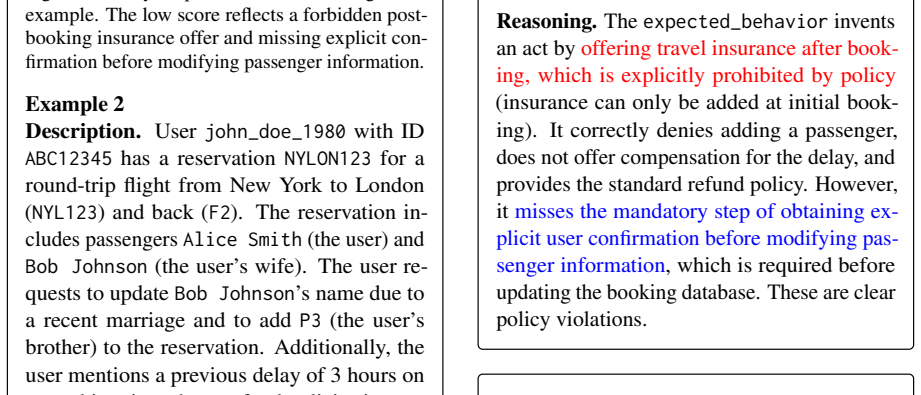
- [Figure 4 caption] The caption says the figure reports Description–Expected Behavior Alignment, Policy–Expected Behavior Alignment, and Policy Violations, but the grid appears to show four metrics including Policy Violations Coverage; please align the caption with the panels.
- [Eq. (8)] The coverage threshold K=3 is chosen without sensitivity analysis; since Policy Violations Coverage is a discontinuous function of K, reporting results for neighboring values of K would clarify how robust the ordering conclusions are.
- [Abstract] The phrase 'independent human annotations' should be revised, since the human evaluation in Appendix E uses a single author annotator and is therefore not independent in the usual sense.
- [§5.1] The definition of the partial-order constraints for the Benchmark Ordering Score is clear for between-tier comparisons, but the paper does not specify how within-tier ties are handled or whether they are excluded from the constraint set; this should be stated explicitly.
Circularity Check
No substantive circularity: the metrics are defined independently of the benchmarks, and validation uses external generator tiers, perturbations, and human ratings; only a minor non-load-bearing self-citation lowers the score.
full rationale
The derivation chain is self-contained. The four metrics are defined directly from task components dt, et, it and policy P (Eqs. 2-8): Mdesc uses Jdesc(dt, et), Mpol uses Jpol(dt, et, P), Sv_count averages |V(t)| where V(t)=Jviolate(P, LP, t), and Sv_cov counts policy items violated by at least K tasks. None of these definitions references generator identity, benchmark tier, or any target quality score; the metrics could in principle fail to order the synthetic benchmarks. The validation in Section 5.2 uses an external operationalization (generator capability tiers as a proxy for quality) rather than the metric itself; the perturbation experiments in Section 5.3 are manipulation checks of the defined constructs; and the human study in Section 5.4 compares LLM judges to an independent annotation modality. The proxy assumption in Section 4.1 is an untested empirical premise and therefore a correctness risk, not a circular reduction: the ordering scores are not fitted from the metric equations, and no parameter is renamed as a prediction. The paper's only self-citation (Yehudai et al., 2026, co-authored by Roy Bar-Haim) is used to motivate the importance of LLM-agent evaluation and does not carry the argument for metric validity. Hence no significant circularity; the low score reflects only this minor, non-load-bearing self-citation.
Assumptions & free parameters
free parameters (1)
- Coverage threshold K =
3
assumptions (4)
- domain assumption LLM generator capability is a proxy for benchmark quality.
- domain assumption The semi-automatically extracted policy item list is complete and accurate.
- domain assumption LLM judges produce valid alignment and violation assessments.
- domain assumption The benchmark structure (policy plus tasks of the form description, expected behavior, initial state) is the right target.
Cite this review
Pith. "Pith review of Benchmarking the Benchmarks: Evaluating Benchmarks for Conversational Agents." pith.science (2026). https://pith.science/paper/HSF6KFQP
@misc{pith2026260806329,
  author       = {Pith},
  title        = {Pith review of: Benchmarking the Benchmarks: Evaluating Benchmarks for Conversational Agents},
  year         = {2026},
  howpublished = {\url{https://pith.science/paper/HSF6KFQP}},
  note         = {Machine review of arXiv:2608.06329}
}
read the original abstract
Task-oriented conversational agents are evaluated using curated or automatically generated benchmarks, yet benchmark quality is rarely assessed. Poor benchmarks may contain inconsistent tasks, simplistic scenarios, or limited policy coverage, leading to unreliable evaluations. We introduce a reference-free framework that uses LLM judges to assess benchmark consistency, complexity, and policy coverage, while providing actionable diagnostics of weaknesses. We validate the framework by demonstrating agreement with independent human annotations and by evaluating benchmarks generated by LLMs of varying capabilities, as well as benchmarks subjected to controlled quality-degrading perturbations. Across domains and judge models, the proposed metrics consistently distinguish between benchmark quality levels. We further demonstrate the framework's applicability to manually curated benchmarks. Our framework offers a practical approach for evaluating synthetic and manually curated conversational-agent benchmarks.
Figures


Figures from the paper (6 more)


Reference graph
Works this paper leans on
-
[1]
2024 , eprint=
-bench: A Benchmark for Tool-Agent-User Interaction in Real-World Domains , author=. 2024 , eprint=
2024
-
[2]
Proceedings of the 2024 Conference on Empirical Methods in Natural Language Processing , pages=
Quality matters: Evaluating synthetic data for tool-using llms , author=. Proceedings of the 2024 Conference on Empirical Methods in Natural Language Processing , pages=
work page 2024
-
[3]
The Treatment of Ties in Ranking Problems , author =. Biometrika , volume =. 1945 , doi =
work page 1945
-
[4]
2025 , eprint=
^2 -Bench: Evaluating Conversational Agents in a Dual-Control Environment , author=. 2025 , eprint=
2025
-
[5]
IntellAgent: A Multi-Agent Framework for Evaluating Conversational AI Systems , author=. 2025 , eprint=
work page 2025
-
[6]
Qian, Qi and Huang, Chengsong and Xu, Jingwen and Lv, Changze and Wu, Muling and Liu, Wenhao and Wang, Xiaohua and others , journal =
- [7]
-
[8]
M ulti WOZ - A Large-Scale Multi-Domain W izard-of- O z Dataset for Task-Oriented Dialogue Modelling
Budzianowski, Pawe and Wen, Tsung-Hsien and Tseng, Bo-Hsiang and Casanueva, I \ n igo and Ultes, Stefan and Ramadan, Osman and Ga s i \'c , Milica. M ulti WOZ - A Large-Scale Multi-Domain W izard-of- O z Dataset for Task-Oriented Dialogue Modelling. Proceedings of the 2018 Conference on Empirical Methods in Natural Language Processing. 2018. doi:10.18653/...
Show all 28 references
-
[9]
Towards Enforcing Company Policy Adherence in Agentic Workflows
Zwerdling, Naama and Boaz, David and Rabinovich, Ella and Uziel, Guy and Amid, David and Anaby Tavor, Ateret. Towards Enforcing Company Policy Adherence in Agentic Workflows. Proceedings of the 2025 Conference on Empirical Methods in Natural Language Processing: Industry Track...
2025 doi
-
[10]
2025 , isbn =
Mohammadi, Mahmoud and Li, Yipeng and Lo, Jane and Yip, Wendy , title =. 2025 , isbn =. doi:10.1145/3711896.3736570 , booktitle =
2025
-
[11]
2026 , eprint=
Survey on Evaluation of LLM-based Agents , author=. 2026 , eprint=
2026
-
[12]
2024 , howpublished=
Berkeley Function Calling Leaderboard , author=. 2024 , howpublished=
2024
-
[13]
Advances in Neural Information Processing Systems , volume=
Planbench: An extensible benchmark for evaluating large language models on planning and reasoning about change , author=. Advances in Neural Information Processing Systems , volume=
-
[14]
Advances in Neural Information Processing Systems , volume=
Webshop: Towards scalable real-world web interaction with grounded language agents , author=. Advances in Neural Information Processing Systems , volume=
-
[15]
ArXiv , year=
SWE-bench: Can Language Models Resolve Real-World GitHub Issues? , author=. ArXiv , year=
-
[16]
arXiv preprint arXiv:2307.13854 , year=
Webarena: A realistic web environment for building autonomous agents , author=. arXiv preprint arXiv:2307.13854 , year=
-
[17]
A pp W orld: A Controllable World of Apps and People for Benchmarking Interactive Coding Agents
Trivedi, Harsh and Khot, Tushar and Hartmann, Mareike and Manku, Ruskin and Dong, Vinty and Li, Edward and Gupta, Shashank and Sabharwal, Ashish and Balasubramanian, Niranjan. A pp W orld: A Controllable World of Apps and People for Benchmarking Interactive Coding Agents. Proc...
2024 doi
-
[18]
arXiv preprint arXiv:2502.12115 , year=
SWE-Lancer: Can Frontier LLMs Earn \ 1 Million from Real-World Freelance Software Engineering? , author=. arXiv preprint arXiv:2502.12115 , year=
-
[19]
2024 , eprint=
TheAgentCompany: Benchmarking LLM Agents on Consequential Real World Tasks , author=. 2024 , eprint=
2024
-
[20]
and Zhang, Hao and Gonzalez, Joseph E
Zheng, Lianmin and Chiang, Wei-Lin and Sheng, Ying and Zhuang, Siyuan and Wu, Zhanghao and Zhuang, Yonghao and Lin, Zi and Li, Zhuohan and Li, Dacheng and Xing, Eric P. and Zhang, Hao and Gonzalez, Joseph E. and Stoica, Ion , title =. Proceedings of the 37th International Conf...
2023
-
[21]
Bean, Andrew M. and Kearns, Ryan Othniel and Romanou, Angelika and Hafner, Franziska Sofia and Mayne, Harry and Batzner, Jan and Foroutan Eghlidi, Negar and Schmitz, Chris and Korgul, Karolina and Batra, Hunar and Deb, Oishi and Beharry, Emma and Emde, Cornelius and Foster, Th...
-
[22]
2025 , eprint=
SABER: Small Actions, Big Errors -- Safeguarding Mutating Steps in LLM Agents , author=. 2025 , eprint=
2025
-
[23]
Proceedings of the 2023 conference on empirical methods in natural language processing , pages=
Api-bank: A comprehensive benchmark for tool-augmented llms , author=. Proceedings of the 2023 conference on empirical methods in natural language processing , pages=
2023
-
[24]
Yujia Qin and Shihao Liang and Yining Ye and Kunlun Zhu and Lan Yan and Yaxi Lu and Yankai Lin and Xin Cong and Xiangru Tang and Bill Qian and Sihan Zhao and Lauren Hong and Runchu Tian and Ruobing Xie and Jie Zhou and Mark Gerstein and dahai li and Zhiyuan Liu and Maosong Sun...
2024
-
[25]
arXiv preprint arXiv:2407.21783 , year=
The llama 3 herd of models , author=. arXiv preprint arXiv:2407.21783 , year=
-
[26]
Proceedings of the 41st International Conference on Machine Learning , articleno =
Cui, Ganqu and Yuan, Lifan and Ding, Ning and Yao, Guanming and He, Bingxiang and Zhu, Wei and Ni, Yuan and Xie, Guotong and Xie, Ruobing and Lin, Yankai and Liu, Zhiyuan and Sun, Maosong , title =. Proceedings of the 41st International Conference on Machine Learning , article...
2024
-
[27]
2023 , eprint=
Sparks of Artificial General Intelligence: Early experiments with GPT-4 , author=. 2023 , eprint=
2023
-
[28]
Aligning Large Language Models through Synthetic Feedback
Kim, Sungdong and Bae, Sanghwan and Shin, Jamin and Kang, Soyoung and Kwak, Donghyun and Yoo, Kang and Seo, Minjoon. Aligning Large Language Models through Synthetic Feedback. Proceedings of the 2023 Conference on Empirical Methods in Natural Language Processing. 2023. doi:10....
2023 doi
Reviewed August 7, 2026 · model on record in the stance chip above.
Discussion (0). Continue with ORCID to comment.