REVIEW 3 major objections 6 minor 1 cited by
Joint inference for gravitational wave signals and glitches using a data-informed glitch model
T0 review · 3 major / 6 minor · reviewed 2026-08-16 · deepseek-v4-flash
Pith's one-line read A normalising flow trained on real Blip glitches, embedded in a standard Bayesian inference code, allows gravitational-wave signal and glitch parameters to be fitted jointly; the paper reports that this removes the glitch and reduces…
desk verdict A solid, honest proof-of-concept for a data-informed glitch prior in Bilby; the core idea is new and works, but the authors should verify the glitch model is not absorbing signal power in clean data and should give readers a baseline comparison. read the letter →
The pith
A machine-rendered reading of the paper's core claim, the machinery that carries it, and where it could break.
The reading
What carries the argument
The load-bearing mechanism is the pairing of a low-dimensional SVD subspace of observed glitches with a normalising-flow prior over the subspace coordinates. A normalising flow is a machine-learning density estimator built from invertible transformations, which can both evaluate the probability of a set of glitch amplitudes and generate new glitch realisations by sampling a latent Gaussian. The training pipeline bandpasses 20–400 Hz, whitens, cuts to 1/8 s, applies a Hann window, and keeps enough singular vectors to retain 97% of the power, yielding 12 amplitude parameters per glitch. The flow learns the distribution of these 12 parameters; at inference time the amplitudes are drawn from the flow, multiplied by the fixed basis, shifted in time under a 10-ms Gaussian prior, and scaled by an amplitude factor, and the subtracted glitch leaves a residual whose Gaussian likelihood scores the signal parameters. This construction is what lets the analysis move from an agnostic wavelet description of transients to one informed by the actual population of glitches.
What would settle it
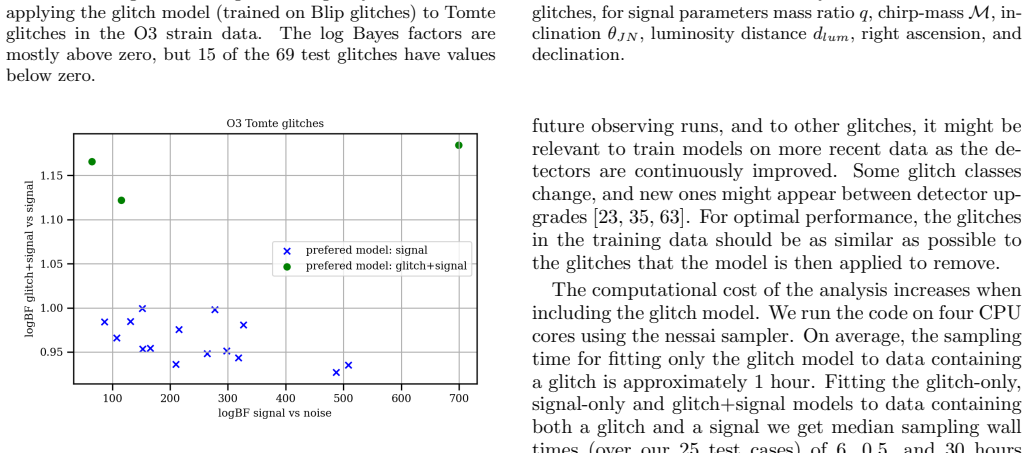
Take a sample of Blip glitches from a later observing run not used in training, inject a signal with known parameters into each, and measure the standard accuracy of the recovered parameters with and without the joint glitch model: if the model does not bring the bias down to about 1, or if the signal-plus-glitch model is not preferred in most cases, the central claim fails. The paper's Tomte experiment already provides a partial version of this test, with a 22% false-alarm rate and joint-model preference in only 15% of cases when the prior does not match the glitch class.
Extended reading notes
Core claim
The central claim is that a parameterised glitch model with a data-learned prior can be jointly inferred with a gravitational-wave signal, and that doing so removes the glitch and reduces bias in the recovered source parameters. The paper states this directly: modelling Blip glitches using normalising flows can successfully remove glitches from the data, thus reducing bias in the signal parameter estimation. The demonstration uses real O1 and O3 glitches: a flow trained on O1 Blip glitches is applied to unseen glitches, separates glitch from Gaussian background in log Bayes factor, and when a known binary signal is injected over a glitch, the signal-plus-glitch model is preferred over the signal-only model for the majority of test cases. Quantitatively, the mean standard accuracy of recovered parameters moves toward about 1 when the glitch model is included, whereas the glitch-contaminated analysis shows biases several times larger for the most affected parameters.
Load-bearing premise
The load-bearing assumption is that the Blip glitches in the data being analysed look like the O1 Blip glitches used for training—same morphology, same 20–400 Hz band, same short duration—so the learned SVD subspace and flow prior cover the target glitch, and the paper's Tomte results show what happens when they do not.
Editorial extensions
If this is right
- Existing compact-binary analyses could adopt the method without changing their inference software: the glitch prior plugs into the same likelihood and sampler used for standard parameter estimation.
- For Blip-class contamination, glitch-removed posteriors should have standard accuracy near 1 across mass, distance, and sky-location parameters, rather than the multi-sigma biases seen when the glitch is ignored.
- Training a new model is cheap, so the procedure can be re-run for each observing run or detector configuration to keep the prior matched to current glitch populations.
- The technique is not restricted to Blip glitches; a quick retraining on Koi Fish and Power Line glitches also yields a model that removes those glitches.
- Using a glitch model trained on a morphologically similar but different class still reduces parameter bias, but model selection becomes unreliable, so the paper recommends training one model per glitch class.
Reading between the lines
- If the SVD-plus-flow representation generalises as cleanly as the Blip results suggest, the same glitch-prior plugin could be used as a transient model for unmodelled astrophysical bursts, where no waveform template is available for joint inference.
- The strong separation in log Bayes factors between glitch and no-glitch data indicates the glitch evidence itself could serve as a data-quality flag, not just a parameter-estimation fix, with thresholds set from the background distribution.
- A mixture-of-flows prior spanning several glitch classes would be a natural extension; it would let the sampler choose which class is present rather than committing to one trained morphology, and would likely address the Tomte failure mode.
- The per-run retraining requirement suggests a monitoring use: periodic retraining on fresh glitch classifications would keep the prior aligned as detector noise evolves, turning the method into a continuous glitch-calibration tool.
Signed reviews
Editorial analysis
A structured set of objections, weighed in public.
Referee Report
Summary. The paper develops a data-informed parametric glitch model for LIGO data. Blip glitches from the Gravity Spy O1 training set are decomposed with SVD into a 12-dimensional basis, and a normalizing flow is trained on the coefficients to form a prior. This prior is implemented in Bilby, together with an amplitude scale and a time-shift parameter, so that signal and glitch parameters are inferred jointly. The authors validate the model on real O1 and O3 glitches with injected signals, reporting Bayes-factor separation between glitch and noise data, model-selection tests for signal-only, glitch-only, and glitch+signal models, and standard-accuracy bias metrics before and after glitch removal. They find that the joint model is preferred for most Blip test cases and that the recovered signal parameters are less biased after glitch removal.
Significance. If the clean-data signal-absorption issue is resolved, this is a valuable contribution. The method sits between agnostic wavelet models such as BayesWave and fully physical glitch models, and it is integrated into the standard Bilby workflow, which lowers barriers to adoption. The public code and trained model, the use of real glitches from three observing runs, and the explicit transfer test to Tomte glitches are strengths, and the validation is more extensive than in many similar proof-of-concept papers. The paper is clearly written and the conclusions are appropriately cautious about the need to retrain for other glitch classes. However, the absence of a signal-parameter check on glitch-free data leaves a gap in the central claim that glitch removal, rather than partial signal absorption, is responsible for the reported bias reduction.
major comments (3)
- [Section IV B, Fig. 7] The signal-only validation reports only log Bayes factors, not the signal posterior recovered by the glitch+signal model on glitch-free data. Because the glitch model contains 12 SVD coefficients plus a scale parameter A with prior 1e-3 to 1e3 and a 10-ms time shift, it can partially absorb a compact-binary merger waveform, which is concentrated in the same 1/8-s window. If this occurs, the bias reduction in Section IV D could be partly caused by removing signal power rather than glitch power. Please add a glitch-free injection test that compares the posterior moments, or the standard accuracy, of the reported parameters between the signal-only and glitch+signal analyses, and report both the model evidence and the recovered posteriors.
- [Sections III B and IV] The results depend on several ad hoc preprocessing choices: the 20-400 Hz bandpass, the 97% SVD power cutoff, the 1/8-s window, the 10-ms time-shift prior, and the A prior range, but no sensitivity analysis is given. Since the paper's central claim is that the method effectively removes glitches and reduces bias, the reader cannot tell whether the reported Bayes-factor separation and standard-accuracy improvement are robust to reasonable variations of these choices or are tuned to the specific settings. Please add a sensitivity test varying at least the SVD cutoff, the window length, and the bandpass edges, and report the effect on the foreground/background separation and on the standard accuracy for a subset of O3 glitches.
- [Section IV E and Section V] The Tomte analysis concludes that even an incorrect glitch model improves signal analysis, but the same section reports that the glitch+signal model is preferred in only 15% of the 20 injections and that the foreground false-alarm rate is 22%. These two observations need to be reconciled explicitly, for example by showing that the standard-accuracy improvement is not driven by a few events and by reporting per-event standard accuracy or a model-averaged posterior. Without this, the claim that an incorrect model still reduces bias is not fully supported, and the conclusion is more fragile than the Blip-only claims.
minor comments (6)
- [Equation (4)] The quantity xmaxL is described as the 'maximum likelihood posterior value'; this wording is ambiguous. Please state whether it is the maximum-likelihood sample, the maximum-a-posteriori value, or the maximum of the marginal posterior.
- [Section IV A 1] The O1 foreground results in Fig. 5 use glitches that are in the training set, while the O3 results use held-out glitches. Please state this explicitly in the text, or separate the in-sample and out-of-sample O1 results, so the reader can gauge the potential optimism from training on the same glitches.
- [Section IV C, Fig. 10] The y-axis is described as the 'ratio of log Bayes factors', but the text and the threshold at one indicate that the plotted quantity is the log Bayes factor between the glitch+signal and signal-only models. Please clarify the exact quantity plotted.
- [Section IV D, Figs. 12, 13, 16] The mean standard accuracy is reported without uncertainties or per-event scatter. Adding error bars or showing the distribution would make the comparisons more interpretable given the small sample sizes of 20-25 glitches.
- [Section V] A direct comparison, or at least an explicit discussion, with BayesWave and gwsubtract on the same test glitches would help the reader judge the practical added value of the new model, since these are the standard methods in LVK analyses.
- [Section III D] Please specify whether the 10-ms Gaussian time-shift prior is centered on the Omicron trigger time and whether that trigger time is the one reported in the Gravity Spy catalogue.
Circularity Check
No significant circularity: the normalising-flow glitch prior is an input, and the headline Bayes factors and bias metrics are evaluated on injected signals and held-out glitches.
full rationale
The paper's derivation chain is not circular. The normalising flow is trained only on glitch amplitudes T from an SVD decomposition of O1 Gravity Spy Blip glitches (Section III A-C); this trained prior is then inserted into Bilby's likelihood as an input model. The headline results - glitch-versus-noise Bayes factors, signal-plus-glitch model selection, and standard-accuracy bias metrics - are all computed on data that are not used to fit the NF: injected signals have known true parameters, glitch tests include unseen O2/O3a/O3b glitches, and the bias reduction is measured by comparing posteriors with and without the glitch model. No equation in the paper defines the target result in terms of the fitted prior; the Bayes factor is an evidence ratio (Eq. 3) over the full likelihood, and the standard accuracy (Eq. 4) is evaluated against injected values. The O1 in-sample component is disclosed ('This was done both for glitches present in the training data (O1) and for unseen glitches from the O2, O3a, and O3b runs') and is not the sole evidence, since O3 results are reported throughout. The Tomte experiments (Section IV E) explicitly show that the model can fail, with a 22% false alarm rate and the joint model preferred in only 15% of signal-injection cases, confirming that the tests are not tautological. The paper also states in Section V that 'the model is only knowledgeable about these types of glitches as they appeared during O1,' an honest limitation rather than a circular move. Self-citations (nessai sampler [60], glasflow [59], and Veitch and Vecchio [62]) are software/tool citations or a peripheral model-selection remark; none carry the central argument. The skeptic concern that the glitch model could absorb signal power is a robustness limitation of the Section IV B test, not a circularity: the glitch model is flexible, but the paper's own model-selection results on glitch-free data show the signal-only model is preferred, and no fitted parameter is renamed as a prediction.
Assumptions & free parameters
free parameters (7)
- Number of SVD components =
12 (97% power cutoff)
- Bandpass filter =
20-400 Hz
- Time window =
1/8 s
- Time shift prior width =
10 ms (Gaussian std)
- Amplitude scaling prior =
1/A on [1e-3, 1e3]
- Whitening ASD =
O1 representative ASD per detector
- NF hyperparameters =
not stated in text
assumptions (6)
- domain assumption Gaussian noise likelihood after glitch subtraction
- domain assumption Gravity Spy classifications are correct
- domain assumption Blip glitches in O2/O3/O4 are similar to O1 training set
- standard math Signal and glitch add linearly in strain data
- ad hoc to paper SVD basis captures all relevant glitch features at 97% power cutoff
- standard math Nested sampling (nessai) converges for the 12-14 parameter joint model
Cite this review
Pith. "Pith review of Joint inference for gravitational wave signals and glitches using a data-informed glitch model." pith.science (2026). https://pith.science/paper/HTAN7J7B
@misc{pith2026250500657,
  author       = {Pith},
  title        = {Pith review of: Joint inference for gravitational wave signals and glitches using a data-informed glitch model},
  year         = {2026},
  howpublished = {\url{https://pith.science/paper/HTAN7J7B}},
  note         = {Machine review of arXiv:2505.00657}
}
read the original abstract
Gravitational wave data are often contaminated by non-Gaussian noise transients, glitches, which can bias the inference of astrophysical signal parameters. Traditional approaches either subtract glitches in a pre-processing step, or a glitch model can be included from an agnostic wavelet basis (e.g. BayesWave). In this work, we introduce a machine-learning-based approach to build a parameterised model of glitches. We train a normalising flow on known glitches from the Gravity Spy catalogue, constructing an informative prior on the glitch model. By incorporating this model into the Bayesian inference analysis with Bilby, we estimate glitch and signal parameters simultaneously. We demonstrate the performance of our method through bias reduction, glitch identification and Bayesian model selection on real glitches. Our results show that this approach effectively removes glitches from the data, significantly improving source parameter estimation and reducing bias.
Figures


Figures from the paper (10 more)


Forward citations
Cited by 1 Pith paper
-
Improving gravitational wave search sensitivity with TIER: Trigger Inference using Extended strain Representation
A machine learning classifier trained on the extended noise environment around gravitational wave candidates improves search sensitivity for heavy, unequal-mass black hole mergers by up to roughly 20 percent.
Reference graph
Works this paper leans on
- [64]
-
[1]
With known glitches To test the glitch model for real glitches, we select several known glitch times randomly from the Gravity Spy dataset and run the analysis on the strain data from the relevant LIGO detector around these times. This was done both for glitches present in the training data (O1) and for unseen glitches from the O2, O3a, and O3b runs. 7 FI...
-
[2]
not worth more than a bare mention
On Gaussian noise To check that the glitch model is disfavoured when ap- plied to data not containing a glitch, we apply it to Gaus- sian noise generated according to a known power spectral density (PSD), as well as to LIGO strain data at times when no glitch (or signal) is present (according to Gravity Spy, using a Omicron SNR threshold of 7.5 [23]). The...
-
[3]
J. Aasi, B. Abbott, R. Abbott, T. Abbott, M. Aber- nathy, K. Ackley, C. Adams, T. Adams, P. Addesso, R. Adhikari, et al. , Advanced ligo, Classical and quan- tum gravity 32, 074001 (2015)
2015
-
[4]
F. a. Acernese, M. Agathos, K. Agatsuma, D. Aisa, N. Allemandou, A. Allocca, J. Amarni, P. Astone, G. Balestri, G. Ballardin, et al. , Advanced virgo: a 15 second-generation interferometric gravitational wave de- tector, Classical and Quantum Gravity 32, 024001 (2014)
work page 2014
-
[5]
Y. Aso, Y. Michimura, K. Somiya, M. Ando, O. Miyakawa, T. Sekiguchi, D. Tatsumi, H. Yamamoto, K. Collaboration, et al. , Interferometer design of the ka- gra gravitational wave detector, Physical Review D 88, 043007 (2013)
work page 2013
-
[6]
On Blip glitches The two corner plots in Fig. 11 show the signal pos- teriors as inferred from data with or without the glitch being removed, respectively. The corner plots in Fig. 11 demonstrate how the inference of the signal posterior im- proves significantly if the glitch is removed from the data prior to analysis. The mean of the standard accuracy of...
-
[7]
B. P. Abbott, R. Abbott, T. D. Abbott, M. R. Aber- nathy, F. Acernese, K. Ackley, C. Adams, T. Adams, P. Addesso, R. X. Adhikari, V. B. Adya, C. Affeldt, M. Agathos, K. Agatsuma, N. Aggarwal, and O. D. e. a. Aguiar (LIGO Scientific Collaboration and Virgo Col- laboration), Observation of gravitational waves from a binary black hole merger, Phys. Rev. Lett...
work page 2016
Show all 70 references
-
[8]
Abbott et al
R. Abbott et al. (KAGRA, VIRGO, LIGO Scientific), Gwtc-3: Compact binary coalescences observed by ligo and virgo during the second part of the third observing run, Phys. Rev. X 13, 041039 (2023), arXiv:2111.03606 [gr-qc]
2023 arXiv
-
[9]
Robinet, Omicron: an algorithm to detect and char- acterize transient events in gravitational-wave detectors , Tech
F. Robinet, Omicron: an algorithm to detect and char- acterize transient events in gravitational-wave detectors , Tech. Rep. (2016)
2016
-
[10]
Robinet, N
F. Robinet, N. Arnaud, N. Leroy, A. Lundgren, D. Macleod, and J. McIver, Omicron: a tool to char- acterize transient noise in gravitational-wave detectors, SoftwareX 12, 100620 (2020), arXiv:2007.11374 [astro- ph.IM]
2020 arXiv
-
[11]
Zevin, S
M. Zevin, S. Coughlin, S. Bahaadini, E. Besler, N. Ro- hani, S. Allen, M. Cabero, K. Crowston, A. K. Katsagge- los, S. L. Larson, T. K. Lee, C. Lintott, T. B. Littenberg, A. Lundgren, C. Østerlund, J. R. Smith, L. Trouille, and V. Kalogera, Gravity spy: integrating advanced li...
2017
-
[12]
B. P. Abbott, R. Abbott, T. D. Abbott, S. Abraham, F. Acernese, K. Ackley, C. Adams, V. B. Adya, C. Af- feldt, M. Agathos, K. Agatsuma, N. Aggarwal, O. D. Aguiar, L. Aiello, A. Ain, and P. A. et al (LIGO Sci- entific Collaboration and Virgo Collaboration), A guide to ligo–virg...
2020
-
[13]
Davis and M
D. Davis and M. Walker, Detector characterization and mitigation of noise in ground-based gravitational-wave interferometers, Galaxies 10, 12 (2022)
2022
-
[14]
Plunkett et al
discusses this further, and highlights the importance and need for different glitch mitigation methods suitable for the wide range of possible glitch and signal scenarios. Plunkett et al. [25] simultaneously estimate compact bi- nary and noise parameters using the BayesLine al...
-
[15]
Abbott, T
R. Abbott, T. Abbott, F. Acernese, K. Ackley, C. Adams, N. Adhikari, R. Adhikari, V. Adya, C. Affeldt, D. Agar- wal, et al. (LIGO Scientific Collaboration, Virgo Collab- oration, and KAGRA Collaboration), Gwtc-3: Compact binary coalescences observed by ligo and virgo during th...
2023
-
[16]
Abbott et al
R. Abbott et al. (LIGO Scientific, Virgo), Gwtc-2: Com- pact binary coalescences observed by ligo and virgo dur- ing the first half of the third observing run, Phys. Rev. X 11, 021053 (2021), arXiv:2010.14527 [gr-qc]
2021 arXiv
-
[17]
Abbott et al
R. Abbott et al. (LIGO Scientific, VIRGO), Gwtc-2.1: Deep extended catalog of compact binary coalescences observed by ligo and virgo during the first half of the third observing run, Phys. Rev. D 109, 022001 (2024), arXiv:2108.01045 [gr-qc]
2024 arXiv
-
[18]
Zevin, C
M. Zevin, C. B. Jackson, Z. Doctor, Y. Wu, C. Østerlund, L. C. Johnson, C. P. Berry, K. Crowston, S. B. Cough- lin, V. Kalogera, et al. , Gravity Spy: lessons learned and a path forward, Eur. Phys. J. Plus 139, 100 (2024), arXiv:2308.15530 [gr-qc]
2024 arXiv
-
[19]
Razzano, F
M. Razzano, F. Di Renzo, F. Fidecaro, G. Hemming, and S. Katsanevas, Gwitchhunters: Machine learning and citizen science to improve the performance of gravita- tional wave detector, Nuclear Instruments and Methods in Physics Research Section A: Accelerators, Spectrome- ters, D...
2023
-
[20]
Davis, T
D. Davis, T. B. Littenberg, I. M. Romero-Shaw, M. Mill- house, J. McIver, F. Di Renzo, and G. Ashton, Subtract- ing glitches from gravitational-wave detector data during the third ligo-virgo observing run, Class. Quant. Grav. 39, 245013 (2022), arXiv:2207.03429 [astro-ph.IM]
2022 arXiv
-
[21]
Ghonge, J
S. Ghonge, J. Brandt, J. M. Sullivan, M. Millhouse, K. Chatziioannou, J. A. Clark, T. Littenberg, N. Cornish, S. Hourihane, and L. Cadonati, Assessing and mitigating the impact of glitches on gravitational-wave parameter estimation: A model agnostic approach, Phys. Rev. D 110,...
2024 arXiv
-
[22]
Macas, A
R. Macas, A. Lundgren, and G. Ashton, Revisiting the evidence for precession in gw200129 with machine learn- ing noise mitigation, Phys. Rev. D 109, 062006 (2024), arXiv:2311.09921 [gr-qc]
2024 arXiv
-
[23]
Glanzer, S
J. Glanzer, S. Banagiri, S. Coughlin, S. Soni, M. Zevin, C. P. L. Berry, O. Patane, S. Bahaadini, N. Rohani, K. Crowston, et al. , Data quality up to the third observing run of advanced LIGO: Gravity Spy glitch classifications, Class. Quant. Grav. 40, 065004 (2023), arXiv:2208...
2023 arXiv
-
[24]
B. P. Abbott, R. Abbott, T. Abbott, F. Acernese, K. Ackley, C. Adams, T. Adams, P. Addesso, R. Ad- hikari, V. B. Adya, et al. , Gw170817: observation of gravitational waves from a binary neutron star inspiral, Physical review letters 119, 161101 (2017)
2017
-
[25]
B. P. Abbott et al. (LIGO Scientific, Virgo), Properties of the binary neutron star merger gw170817, Phys. Rev. X 9, 011001 (2019), arXiv:1805.11579 [gr-qc]
2019 arXiv
-
[26]
Udall, S
R. Udall, S. Hourihane, S. Miller, D. Davis, K. Chatzi- ioannou, M. Isi, and H. Deshong, Antialigned spin of gw191109: Glitch mitigation and its implications, Phys. Rev. D 111, 024046 (2025), arXiv:2409.03912 [gr-qc]
2025 arXiv
-
[27]
Payne, S
E. Payne, S. Hourihane, J. Golomb, R. Udall, R. Udall, D. Davis, and K. Chatziioannou, Curious case of gw200129: Interplay between spin-precession inference and data-quality issues, Phys. Rev. D 106, 104017 (2022), arXiv:2206.11932 [gr-qc]
2022 arXiv
-
[28]
Hourihane, K
S. Hourihane, K. Chatziioannou, M. Wijngaarden, D. Davis, T. Littenberg, and N. Cornish, Accurate mod- eling and mitigation of overlapping signals and glitches in gravitational-wave data, Phys. Rev. D 106, 042006 (2022), arXiv:2205.13580 [gr-qc]
2022 arXiv
-
[29]
Davis, T
D. Davis, T. Massinger, A. Lundgren, J. C. Driggers, A. L. Urban, and L. Nuttall, Improving the sensitivity of advanced ligo using noise subtraction, Classical and Quantum Gravity 36, 055011 (2019)
2019
-
[30]
N. J. Cornish and T. B. Littenberg, Bayeswave: Bayesian inference for gravitational wave bursts and instrument glitches, Classical and Quantum Gravity 32, 135012 (2015)
2015
-
[31]
Plunkett, S
C. Plunkett, S. Hourihane, and K. Chatziioannou, Con- current estimation of noise and compact-binary signal pa- rameters in gravitational-wave data, Phys. Rev. D 106, 104021 (2022), arXiv:2208.02291 [gr-qc]
2022 arXiv
-
[32]
T. B. Littenberg and N. J. Cornish, Bayesian inference for spectral estimation of gravitational wave detector noise, Phys. Rev. D 91, 084034 (2015), arXiv:1410.3852 [gr-qc]
2015 arXiv
-
[33]
Chatziioannou, N
K. Chatziioannou, N. Cornish, M. Wijngaarden, and T. B. Littenberg, Modeling compact binary signals and instrumental glitches in gravitational wave data, Phys. Rev. D 103, 044013 (2021), arXiv:2101.01200 [gr-qc]
2021 arXiv
-
[34]
Bahaadini, V
S. Bahaadini, V. Noroozi, N. Rohani, S. Coughlin, M. Zevin, J. R. Smith, V. Kalogera, and A. Katsaggelos, Machine learning for Gravity Spy: Glitch classification and dataset, Info. Sci. 444, 172 (2018)
2018
-
[35]
Soni et al
S. Soni et al. , Discovering features in gravitational-wave data through detector characterization, citizen science and machine learning, Class. Quant. Grav. 38, 195016 (2021), arXiv:2103.12104 [gr-qc]
2021 arXiv
-
[36]
Ashton, Gaussian processes for glitch-robust gravitational-wave astronomy, Mon
G. Ashton, Gaussian processes for glitch-robust gravitational-wave astronomy, Mon. Not. Roy. Astron. Soc. 520, 2983 (2023), arXiv:2209.15547 [gr-qc]
2023 arXiv
-
[37]
Merritt, B
J. Merritt, B. Farr, R. Hur, B. Edelman, and Z. Doctor, 16 Transient glitch mitigation in advanced ligo data, Phys. Rev. D 104, 102004 (2021), arXiv:2108.12044 [gr-qc]
2021 arXiv
-
[38]
S. D. Mohanty and M. A. T. Chowdhury, Glitch sub- traction from gravitational wave data using adaptive spline fitting, Class. Quant. Grav. 40, 125001 (2023), arXiv:2301.02398 [gr-qc]
2023 arXiv
-
[39]
Udall and D
R. Udall and D. Davis, Bayesian modeling of scattered light in the LIGO interferometers, Appl. Phys. Lett.122, 094103 (2023), arXiv:2211.15867 [astro-ph.IM]
2023 arXiv
-
[40]
Lopez, V
M. Lopez, V. Boudart, K. Buijsman, A. Reza, and S. Caudill, Simulating transient noise bursts in LIGO with generative adversarial networks, Phys. Rev. D 106, 023027 (2022), arXiv:2203.06494 [astro-ph.IM]
2022 arXiv
-
[41]
Dooney, R
T. Dooney, R. L. Curier, D. S. Tan, M. Lopez, C. Van Den Broeck, and S. Bromuri, One flexible model for multiclass gravitational wave signal and glitch genera- tion, Phys. Rev. D 110, 022004 (2024), arXiv:2401.16356 [physics.ins-det]
2024
- [42]
-
[43]
Chatterji, L
S. Chatterji, L. Blackburn, G. Martin, and E. Kat- savounidis, Multiresolution techniques for the detection of gravitational-wave bursts, Classical and Quantum Gravity 21, S1809 (2004)
2004
-
[44]
In Xiong et al
use a normalising flow for likelihood-free inference of GW source parameters, based on training data that include Blip and Scattered Light glitches. In Xiong et al. [45], the authors then extend the work to not rely on glitch modelling by training on signals in Gaussian noise....
-
[45]
Vajente, Y
G. Vajente, Y. Huang, M. Isi, J. C. Driggers, J. S. Kissel, M. J. Szczepanczyk, and S. Vitale, Machine-learning nonstationary noise out of gravitational-wave detectors, Phys. Rev. D 101, 042003 (2020), arXiv:1911.09083 [gr- qc]
2020 arXiv
-
[46]
H. Wang, Y. Zhou, Z. Cao, Z. Guo, and Z. Ren, Waveformer: transformer-based denoising method for gravitational-wave data, Mach. Learn. Sci. Tech. 5, 015046 (2024), arXiv:2212.14283 [gr-qc]
2024 arXiv
-
[47]
I. M. Romero-Shaw, C. Talbot, S. Biscoveanu, V. D’emilio, G. Ashton, C. Berry, S. Coughlin, S. Galaudage, C. Hoy, M. H¨ ubner, et al. , Bayesian inference for compact binary coalescences with bilby: validation and application to the first LIGO–Virgo gravitational-wave transien...
2020 arXiv
- [48]
-
[49]
Bondarescu, A
R. Bondarescu, A. Lundgren, and R. Macas, Quasiphysi- cal model for removing short glitches from ligo and virgo data, Phys. Rev. D108, 122004 (2023), arXiv:2309.06594 [gr-qc]
2023 arXiv
-
[50]
Sun, C.-Y
T.-Y. Sun, C.-Y. Xiong, S.-J. Jin, Y.-X. Wang, J.- F. Zhang, and X. Zhang, Efficient parameter inference for gravitational wave signals in the presence of tran- sient noises using temporal and time-spectral fusion normalizing flow*, Chin. Phys. C 48, 045108 (2024), arXiv:2312....
2024 arXiv
-
[51]
Xiong, T.-Y
C.-Y. Xiong, T.-Y. Sun, J.-F. Zhang, and X. Zhang, Ro- bust inference of gravitational wave source parameters in the presence of noise transients using normalizing flows, Phys. Rev. D 111, 024019 (2025), arXiv:2405.09475 [gr- qc]
2025 arXiv
-
[52]
Ashton, M
G. Ashton, M. H¨ ubner, P. D. Lasky, C. Talbot, K. Ack- ley, S. Biscoveanu, Q. Chu, A. Divakarla, P. J. Easter, B. Goncharov, F. H. Vivanco, J. Harms, M. E. Lower, G. D. Meadors, D. Melchor, E. Payne, M. D. Pitkin, J. Powell, N. Sarin, R. J. E. Smith, and E. Thrane, Bilby: A u...
2019
-
[53]
Coughlin, Gravity spy training set, 10.5281/zen- odo.1486046 (2018)
S. Coughlin, Gravity spy training set, 10.5281/zen- odo.1486046 (2018)
2018 doi
-
[54]
Legin, M
R. Legin, M. Isi, K. W. K. Wong, Y. Hezaveh, and L. Perreault-Levasseur, Gravitational-wave parameter es- timation in non-gaussian noise using score-based likeli- hood characterization, (2024), arXiv:2410.19956 [astro- ph.IM]
2024 arXiv
-
[55]
Kobyzev, S
I. Kobyzev, S. J. Prince, and M. A. Brubaker, Normaliz- ing flows: An introduction and review of current meth- ods, IEEE transactions on pattern analysis and machine intelligence 43, 3964 (2020)
2020
-
[56]
Jimenez Rezende and S
D. Jimenez Rezende and S. Mohamed, Variational in- ference with normalizing flows, arXiv e-prints , arXiv (2015)
2015
-
[57]
Papamakarios, E
G. Papamakarios, E. T. Nalisnick, D. J. Rezende, S. Mo- hamed, and B. Lakshminarayanan, Normalizing flows for probabilistic modeling and inference., J. Mach. Learn. Res. 22, 1 (2021)
2021
-
[58]
Thrane and C
E. Thrane and C. Talbot, An introduction to bayesian inference in gravitational-wave astronomy: parame- ter estimation, model selection, and hierarchical mod- els—corrigendum, Publications of the Astronomical So- ciety of Australia 37, e036 (2020)
2020
-
[59]
M. J. Williams, jmcginn, federicostak, and J. Veitch, uof- 17 gravity/glasflow: v0.2.0 (2023), software
2023
-
[60]
Cabero, A
M. Cabero, A. Lundgren, A. H. Nitz, T. Dent, D. Barker, E. Goetz, J. S. Kissel, L. K. Nuttall, P. Schale, R. Schofield, et al. , Blip glitches in advanced ligo data, Classical and Quantum Gravity 36, 155010 (2019)
2019
-
[61]
Abbott, T
R. Abbott, T. D. Abbott, M. R. Abernathy, F. Acernese, K. Ackley, C. L. S. C. Adams, and V. Collaboration), Open data from the first and second observing runs of advanced ligo and advanced virgo, SoftwareX13, 100658 (2021)
2021
-
[62]
D. M. Macleod, J. S. Areeda, S. B. Coughlin, T. J. Massinger, and A. L. Urban, Gwpy: A python pack- age for gravitational-wave astrophysics, SoftwareX 13, 100657 (2021)
2021
-
[63]
Glanzer, S
J. Glanzer, S. Banagari, S. Coughlin, M. Zevin, S. Ba- haadini, N. Rohani, S. Allen, C. Berry, K. Crowston, M. Harandi, C. Jackson, V. Kalogera, A. Katsaggelos, V. Noroozi, C. Osterlund, O. Patane, J. Smith, S. Soni, and L. Trouille, Gravity spy machine learning classifica- ti...
2021 doi
-
[66]
M. J. Williams, J. Veitch, and C. Messenger, Nested sam- pling with normalizing flows for gravitational-wave infer- ence, Phys. Rev. D103, 103006 (2021), arXiv:2102.11056 [gr-qc]
2021 arXiv
-
[67]
R. E. Kass and A. E. Raftery, Bayes factors, Journal of the American Statistical Association 90, 773 (1995)
1995
-
[68]
Veitch and A
J. Veitch and A. Vecchio, Assigning confidence to inspiral gravitational wave candidates with Bayesian model selection, Class. Quant. Grav. 25, 184010 (2008), arXiv:0807.4483 [gr-qc]
2008 arXiv
-
[69]
S. Soni, B. K. Berger, D. Davis, F. Di Renzo, A. Ef- fler, T. Ferreira, J. Glanzer, E. Goetz, G. Gonza- lez, A. Helmling-Cornell, et al. (LIGO), LIGO Detec- tor Characterization in the first half of the fourth Ob- serving run, arXiv preprint arXiv:2409.02831 (2024), arXiv:2409...
2024
-
[70]
Malz and J
A.-K. Malz and J. Veitch, Code for paper: Joint inference for gravitational wave signals and glitches using a data- informed glitch model (2025)
2025
-
[786]
glitch for O3 where the log Bayes factor is less than zero (−0.22), thus indicating that a Gaussian noise model is slightly preferred over the glitch model for this glitch. Investigating this further, we note that the outlier glitch appears louder and broader in the time-frequ...
Reviewed August 16, 2026 · model on record in the stance chip above.
Discussion (0). Continue with ORCID to comment.