Prospects for Observing Gravity-gradient Noise and Earthquake Gravity Signals with CHRONOS
Pith reviewed 2026-06-26 18:44 UTC · model grok-4.3
The pith
CHRONOS torsion-bar detector can register prompt gravitational signals from earthquakes up to 90 km away before seismic P-waves arrive.
A machine-rendered reading of the paper's core claim, the machinery that carries it, and where it could break.
Core claim
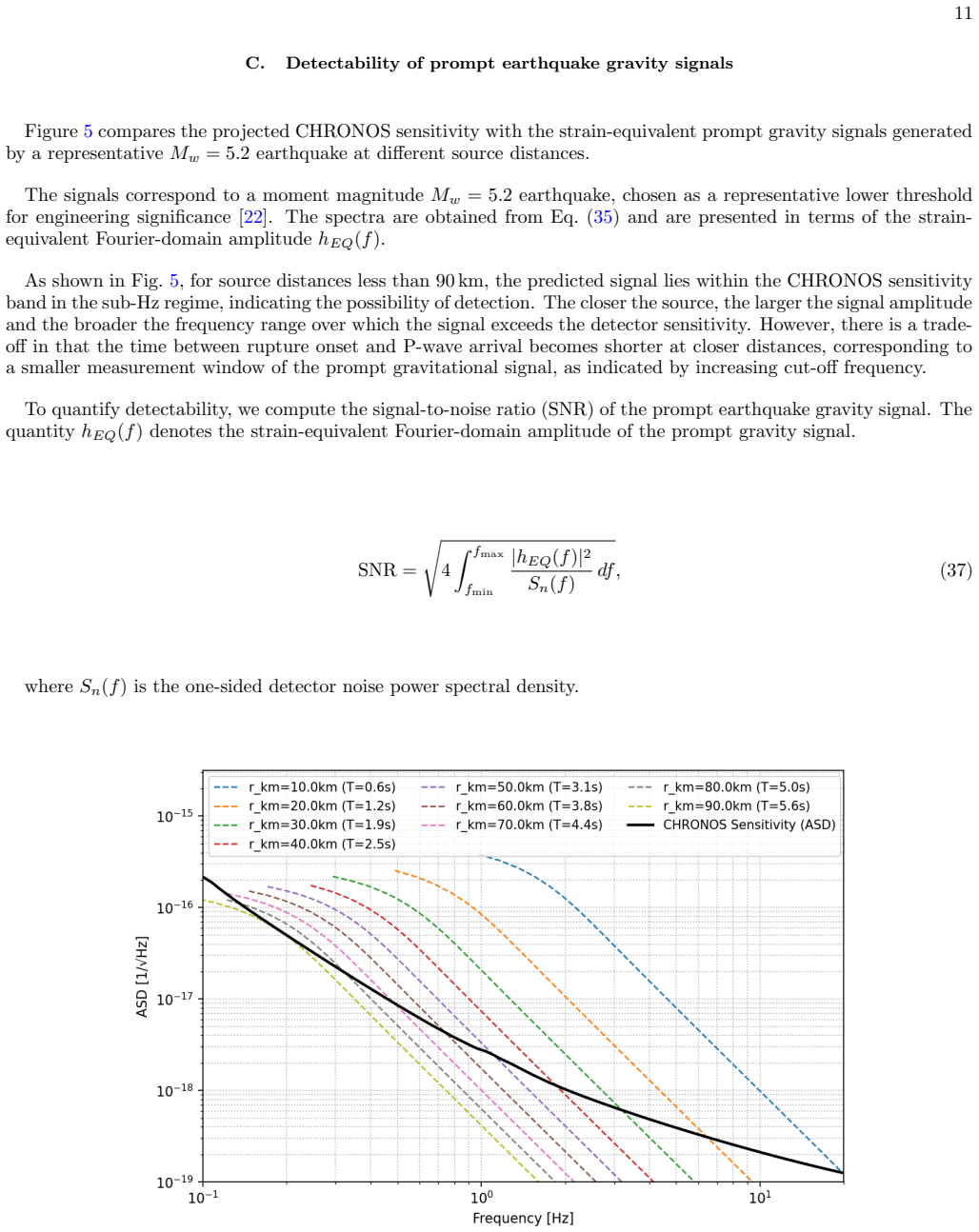
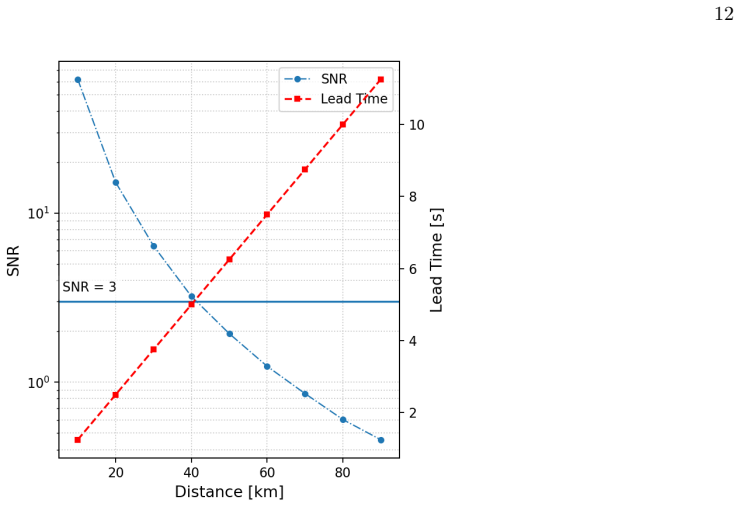
CHRONOS reaches a peak strain sensitivity of order 10^{-18} Hz^{-1/2} near 2 Hz. When gravity-gradient contributions from Rayleigh-wave seismic fields, atmospheric infrasound fluctuations, and earthquake mass redistribution are projected onto its torsion-bar response, Rayleigh-wave Newtonian noise dominates below approximately 0.5 Hz. For a representative Mw=5.2 event, sources within roughly 90 km produce detectable signals; at 40 km the integrated sub-Hz signal-to-noise ratio is approximately 3.62, and the corresponding strain amplitude reaches the sensitivity curve in the 0.2-0.6 Hz interval. The gravitational signal arrives several seconds before the seismic P-wave, depending on propagati
What carries the argument
Projection of modeled gravity-gradient fluctuations from Rayleigh waves, atmosphere, and earthquake mass redistribution onto the CHRONOS torsion-bar response function.
Load-bearing premise
The models of transient mass redistribution during earthquakes and the functional form used to project Rayleigh-wave gravity gradients onto the torsion-bar response accurately represent real processes.
What would settle it
An actual sub-Hz strain measurement from a confirmed Mw=5.2 earthquake at 40 km distance that either reaches or falls short of an integrated SNR of 3.62 while intersecting the sensitivity curve between 0.2 and 0.6 Hz.
Figures
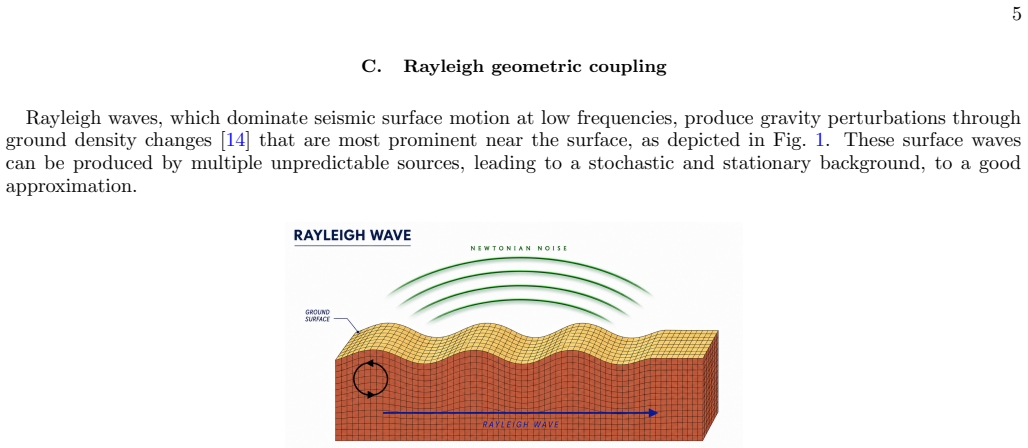
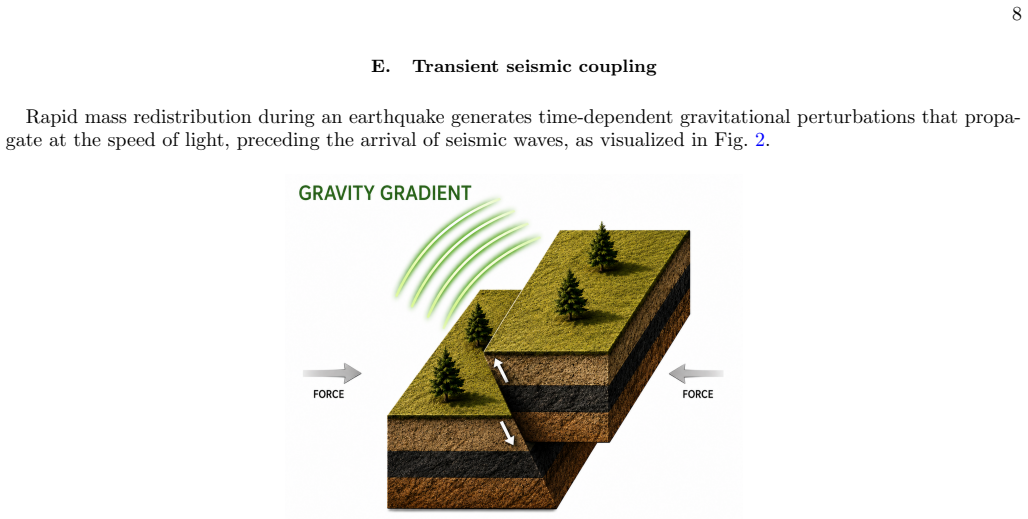
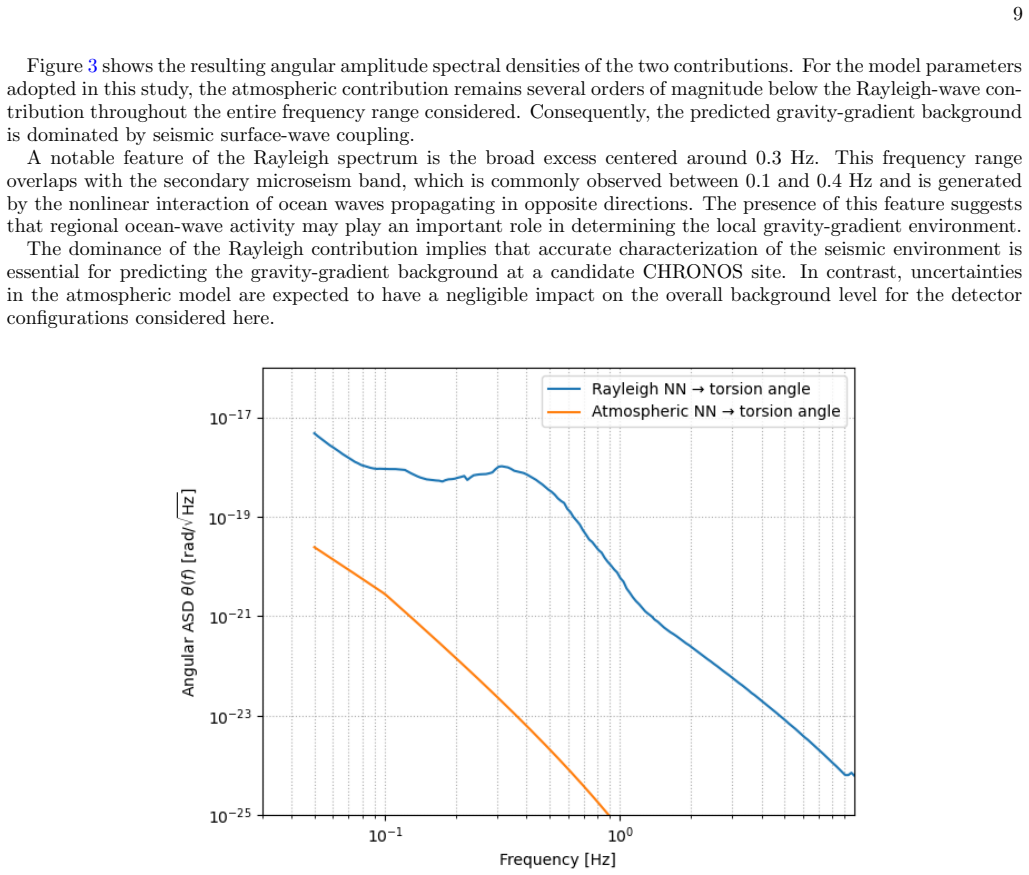
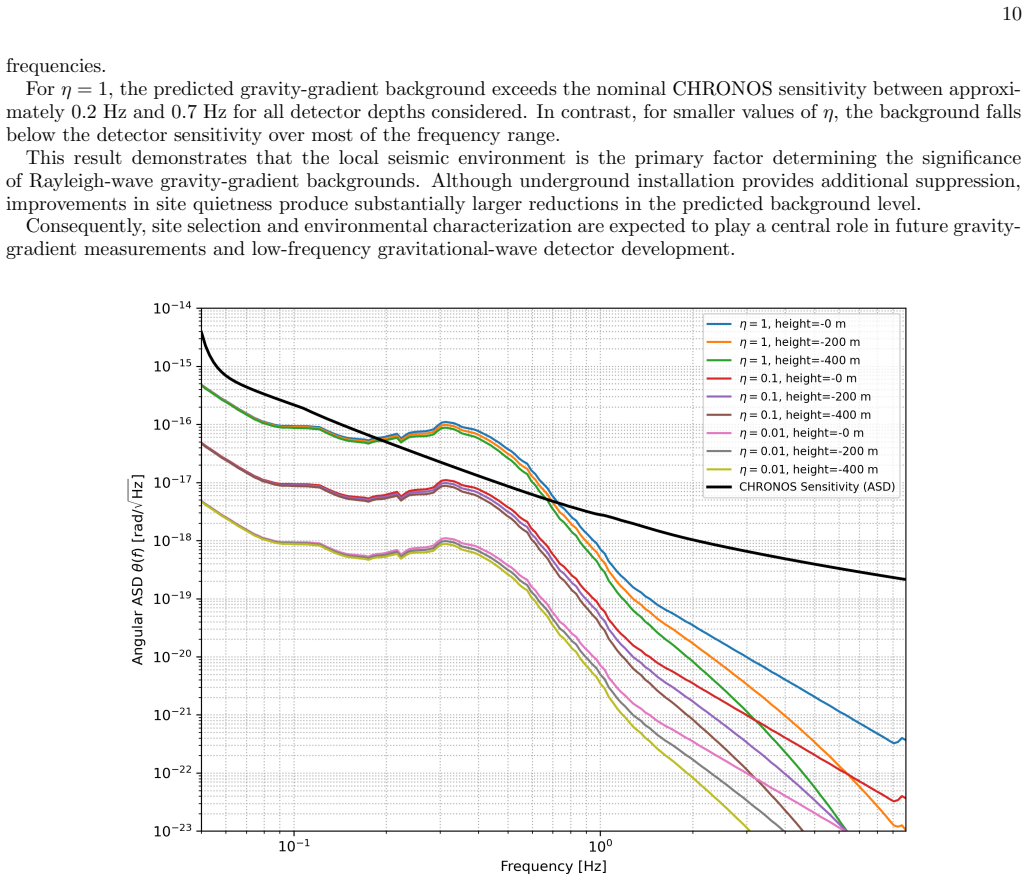
read the original abstract
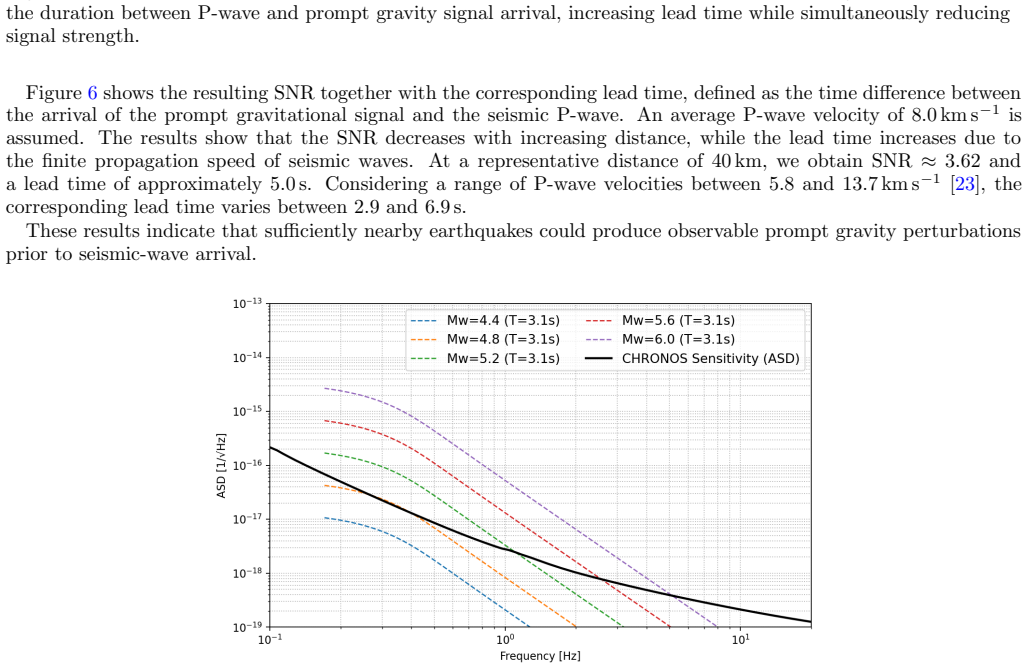
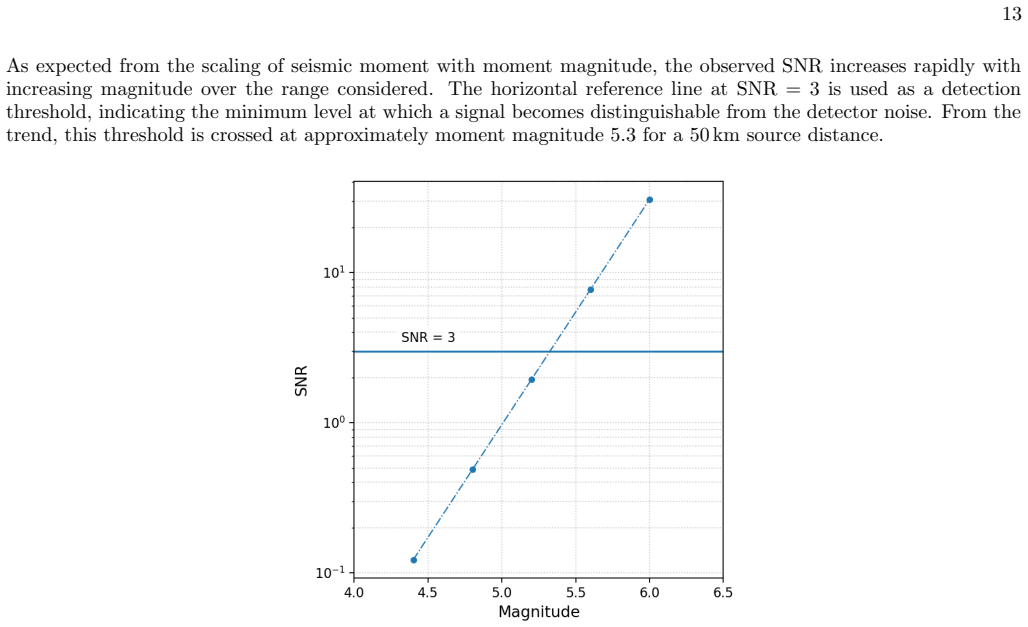
Ground-based gravitational-wave detectors operating in the sub-Hertz regime are expected to be strongly limited by environmental gravity-gradient fluctuations, commonly referred to as Newtonian Noise (NN). At the same time, this frequency band provides unique opportunities to probe terrestrial gravitational perturbations associated with seismic and atmospheric processes. In this work, we investigate the feasibility of using the proposed Cryogenic sub-Hz cROss torsion-bar detector with quantum NOn-demolition speed meter (CHRONOS) as a platform for studying gravity-gradient noise and detecting prompt gravitational signals from earthquakes. We model gravity-gradient contributions from Rayleigh-wave-induced seismic fields, atmospheric infrasound fluctuations, and transient mass redistribution during earthquakes, and project these onto the CHRONOS torsion-bar response. CHRONOS achieves a peak strain sensitivity of order ~1e-18 Hz^(-1/2) near ~2 Hz. Rayleigh-wave NN is found to be the dominant environmental contribution below approximately 0.5 Hz, while atmospheric NN remains several orders of magnitude smaller throughout the frequency range considered. We further assess the detectability of prompt gravitational signals from earthquakes. For a representative Mw = 5.2 event, sources within approximately 90 km may produce detectable signals. At 40 km distance, we obtain a signal-to-noise ratio (SNR) of approximately 3.62 integrated over the sub-Hz band, with a corresponding strain amplitude reaching the CHRONOS sensitivity curve around 0.2 to 0.6 Hz. The gravitational signal is expected to precede seismic P-wave arrival by several seconds, depending on the assumed propagation velocity. These results demonstrate the potential of CHRONOS to probe both gravity-gradient noise and transient geophysical gravity signals in the sub-Hertz regime.
Editorial analysis
A structured set of objections, weighed in public.
Referee Report
Summary. The manuscript models gravity-gradient noise contributions from Rayleigh-wave seismic fields, atmospheric infrasound, and transient mass redistribution during earthquakes, projecting them onto the response of the proposed CHRONOS torsion-bar detector. It concludes that Rayleigh NN dominates below ~0.5 Hz while atmospheric NN is negligible, and that for a representative Mw=5.2 earthquake, signals are detectable within ~90 km (with SNR~3.62 at 40 km in the sub-Hz band), preceding seismic P-wave arrival.
Significance. If the underlying models are accurate, the work identifies a dual-use opportunity for CHRONOS in both characterizing Newtonian noise and observing prompt geophysical gravity signals, which could inform sub-Hz detector design and early geophysical monitoring. The absence of explicit modeling details, however, limits the strength of this assessment.
major comments (2)
- [Abstract] Abstract and modeling description: the central SNR~3.62 claim at 40 km (and the 0.2–0.6 Hz crossing of the sensitivity curve) for Mw=5.2 rests on the modeled gravitational strain from transient mass redistribution and its projection onto the CHRONOS torsion-bar response. No explicit functional form, source density perturbation profile, time-scale assumptions, or validation against independent calculations (e.g., gravimeter records or moment-tensor methods) is supplied, rendering the detectability conclusion uninspectable.
- [Modeling description] Modeling of Rayleigh-wave NN and atmospheric contributions: the statement that Rayleigh NN is dominant below ~0.5 Hz while atmospheric NN is orders of magnitude smaller requires the specific transfer functions or response projections used to map these fields onto the torsion-bar strain; without these equations the dominance claim cannot be reproduced or stress-tested.
minor comments (1)
- [Abstract] Abstract: the detector acronym expansion contains inconsistent capitalization ('cROss', 'NOn-demolition') that should be standardized for clarity.
Simulated Author's Rebuttal
We thank the referee for the detailed report and the recognition of the potential dual-use value of CHRONOS. We agree that the current manuscript lacks sufficient explicit modeling details to allow independent reproduction or validation of the SNR and dominance claims. We will therefore expand the modeling sections with the requested functional forms, profiles, transfer functions, and validation steps.
read point-by-point responses
-
Referee: [Abstract] Abstract and modeling description: the central SNR~3.62 claim at 40 km (and the 0.2–0.6 Hz crossing of the sensitivity curve) for Mw=5.2 rests on the modeled gravitational strain from transient mass redistribution and its projection onto the CHRONOS torsion-bar response. No explicit functional form, source density perturbation profile, time-scale assumptions, or validation against independent calculations (e.g., gravimeter records or moment-tensor methods) is supplied, rendering the detectability conclusion uninspectable.
Authors: We agree that the absence of these explicit elements renders the detectability claim difficult to inspect. In the revised manuscript we will add a dedicated subsection deriving the gravitational strain from the transient mass redistribution, including the explicit functional form for the density perturbation profile (based on a moment-tensor source with finite rupture duration), the assumed time-scale (rise time ~1–2 s for Mw 5.2), the projection onto the torsion-bar differential strain, and direct numerical comparisons against published gravimeter records for similar events and against standard moment-tensor gravity calculations. revision: yes
-
Referee: [Modeling description] Modeling of Rayleigh-wave NN and atmospheric contributions: the statement that Rayleigh NN is dominant below ~0.5 Hz while atmospheric NN is orders of magnitude smaller requires the specific transfer functions or response projections used to map these fields onto the torsion-bar strain; without these equations the dominance claim cannot be reproduced or stress-tested.
Authors: We concur that the transfer functions mapping the seismic and atmospheric fields onto the CHRONOS torsion-bar response must be shown explicitly. The revised version will include the full set of response functions: the Rayleigh-wave NN transfer function (incorporating the vertical and horizontal displacement gradients projected onto the bar torsion), the atmospheric infrasound NN transfer function (pressure-to-strain coupling via the bar geometry), and the resulting strain spectra that demonstrate Rayleigh NN dominance below ~0.5 Hz by more than two orders of magnitude. These will be derived from the standard Saulson-type formalism adapted to the torsion-bar geometry. revision: yes
Circularity Check
No significant circularity; projections rely on external models
full rationale
The paper describes modeling of gravity-gradient noise from Rayleigh waves, atmospheric infrasound, and transient earthquake mass redistribution, then projects these onto the CHRONOS torsion-bar response to obtain SNR values such as 3.62 at 40 km for Mw=5.2. No equations or steps in the provided text reduce these outputs by construction to fitted parameters from the same data, self-citations, or ansatzes. The derivation chain uses external geophysical inputs and remains independent of the reported detectability claims.
Axiom & Free-Parameter Ledger
free parameters (3)
- earthquake magnitude =
5.2
- source distance
- propagation velocity
axioms (2)
- domain assumption Rayleigh-wave seismic fields produce the dominant gravity-gradient fluctuations below 0.5 Hz
- domain assumption Transient mass redistribution during an earthquake generates a prompt gravitational signal that can be projected onto the torsion-bar response
Reference graph
Works this paper leans on
-
[1]
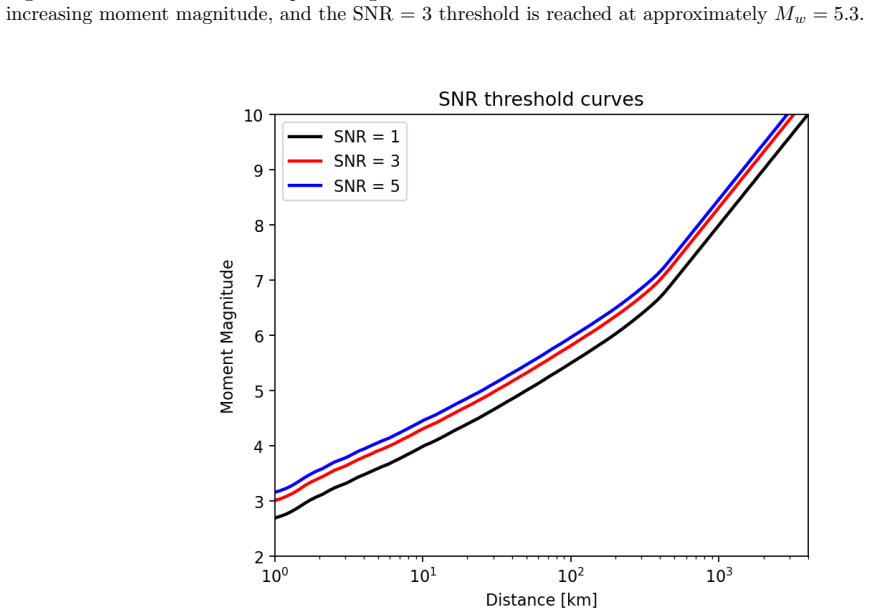
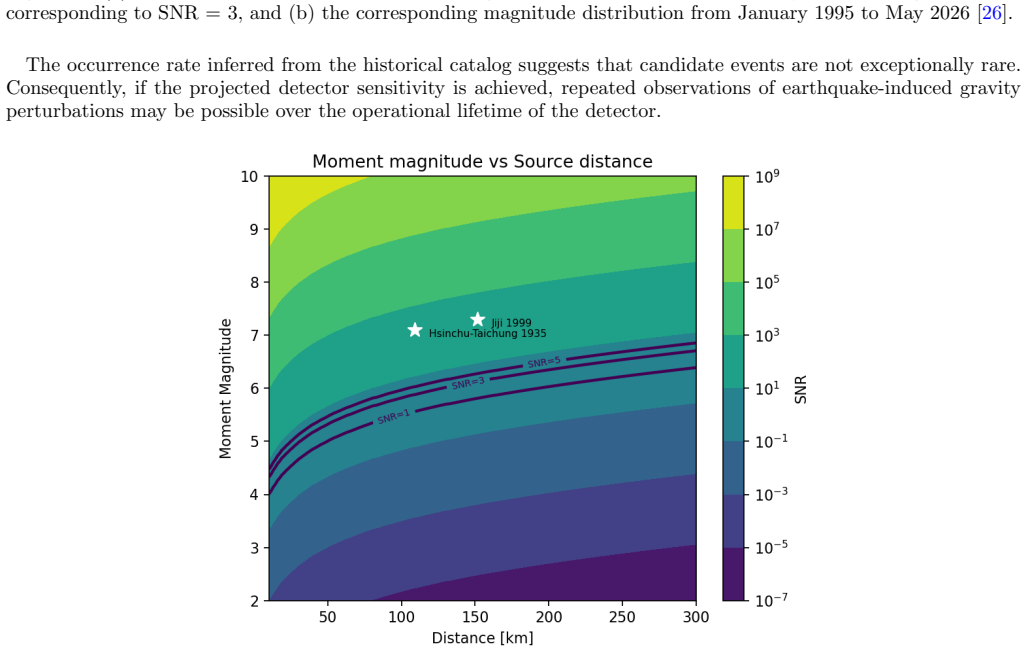
Figure 9 provides a convenient summary of the accessible distance–magnitude parameter space for the prototype CHRONOS detector
Regions above and to the left of each curve correspond to detectable events. Figure 9 provides a convenient summary of the accessible distance–magnitude parameter space for the prototype CHRONOS detector. Figure 9 illustrates the minimum detectable moment magnitude as a function of source–site 14 distance for three SNR thresholds (SNR = 1, 3, and 5) obtai...
1995
-
[2]
B. P. Abbott, R. Abbott, T. D. Abbott,et al., Phys. Rev. Lett.116, 061102 (2016)
2016
-
[3]
Buikema, C
A. Buikema, C. Cahillane, G. Mansell,et al., Phys. Rev. D102, 062003 (2020)
2020
-
[4]
Capote, W
E. Capote, W. Jia, N. Aritomi,et al., Phys. Rev. D111, 062002 (2025)
2025
-
[5]
Cosmic Explorer: The U.S. Contribution to Gravitational-Wave Astronomy beyond LIGO
D. Reitze, R. X. Adhikari, S. Ballmer,et al., Cosmic explorer: the us contribution to gravitational-wave astronomy beyond ligo (2019), arXiv:1907.04833
work page internal anchor Pith review Pith/arXiv arXiv 2019
-
[6]
Punturo, M
M. Punturo, M. Abernathy, F. Acernese,et al., Class. Quantum Grav.27, 194002 (2010)
2010
-
[7]
M. Ando, K. Ishidoshiro, K. Yamamoto,et al., Phys. Rev. Lett.105, 161101 (2010)
2010
-
[8]
D. J. McManus, P. Forsyth, M. J. Yap,et al., Class. Quantum Grav.34, 135002 (2017)
2017
- [9]
- [10]
-
[11]
Tanabe, Y
D. Tanabe, Y. Inoue, V. Kumar, M. Ma’arif, and T.-C. Yu, Classical and Quantum Gravity (2026), accepted by CQG(2026)
2026
-
[12]
M. J. S. Onglao, H.-Y. Huang, Y. Inoue, V. Kumar, and D. Tanabe, inProceedings of the 44 th Samahang Pisika ng Pilipinas Physics Conference(Philippines, 2026) pp. SPP–2026–3A–02
2026
-
[13]
Tanabe, H.-Y
D. Tanabe, H.-Y. Huang, Y. Inoue, M. J. S. Onglao, and T.-C. Yu, inProceedings of the 44 th Samahang Pisika ng Pilipinas Physics Conference(Philippines, 2026) pp. SPP–2026–3A–03
2026
-
[14]
Inoue, H.-Y
Y. Inoue, H.-Y. Huang, V. Kumar, M. Onglao, D. Tanabe, and T.-C. Yu, inProceedings of the 44 th Samahang Pisika ng Pilipinas Physics Conference(Philippines, 2026) pp. SPP–2026–3A–06
2026
-
[15]
Harms, B
J. Harms, B. J. Slagmolen, R. X. Adhikari,et al., Phys. Rev. D88, 122003 (2013)
2013
-
[16]
Coughlin, N
M. Coughlin, N. Mukund, J. Harms, J. Driggers, R. Adhikari, and S. Mitra, Classical and Quantum Gravity33, 244001 (2016)
2016
-
[17]
Harms and H
J. Harms and H. J. Paik, Physical Review D92, 022001 (2015)
2015
- [18]
-
[19]
Fiorucci, J
D. Fiorucci, J. Harms, M. Barsuglia, I. Fiori, and F. Paoletti, Physical Review D97, 062003 (2018)
2018
-
[20]
De Carlo, F
M. De Carlo, F. Ardhuin, and A. Le Pichon, Geophysical Journal International221, 569 (2020), https://academic.oup.com/gji/article-pdf/221/1/569/32511019/ggaa015.pdf
2020
-
[21]
M. L. Waite, Journal of Fluid Mechanics888, F1 (2020)
2020
-
[22]
Harms, J.-P
J. Harms, J.-P. Ampuero, M. Barsuglia,et al., Geophys. J. Int.201, 1416 (2015). 18
2015
-
[23]
Thenhaus, S
P. Thenhaus, S. Hanson, S. Algermissen,et al., inNatural Disaster Mitigation in the Philippines (Proceedings)(1994) pp. 71–98
1994
-
[24]
Bormann, B
P. Bormann, B. Engdahl, and R. Kind, inNew manual of seismological observatory practice 2 (NMSOP2)(Deutsches GeoForschungsZentrum GFZ, 2012) pp. 1–105
2012
-
[25]
Tanimoto and A
T. Tanimoto and A. Anderson, Progress in Earth and Planetary Science10, 56 (2023)
2023
-
[26]
M. S. Longuet-Higgins, Philosophical Transactions of the Royal Society of London. Series A, Mathematical and Physical Sciences243, 1 (1950)
1950
-
[27]
Central Weather Administration, Earthquake reports (2026), accessed: 2026-05-16
2026
discussion (0)
Sign in with ORCID, Apple, or X to comment. Anyone can read and Pith papers without signing in.