REVIEW 4 major objections 5 minor 1 cited by
Low-Barrier Dataset Collection with Real Human Body for Interactive Per-Garment Virtual Try-On
T0 review · 4 major / 5 minor · reviewed 2026-08-07 · deepseek-v4-flash
Pith's one-line read A real-human capture session of about two minutes, combined with a hybrid person representation, is enough to train a per-garment virtual try-on network that aligns synthesized garments to the body and runs at about 8 frames per second.
desk verdict A useful incremental per-garment VTO system with a real-human capture pipeline, but the quantitative evaluation is self-referential and the key generalization claim is untested. read the letter →
The pith
A machine-rendered reading of the paper's core claim, the machinery that carries it, and where it could break.
The reading
What carries the argument
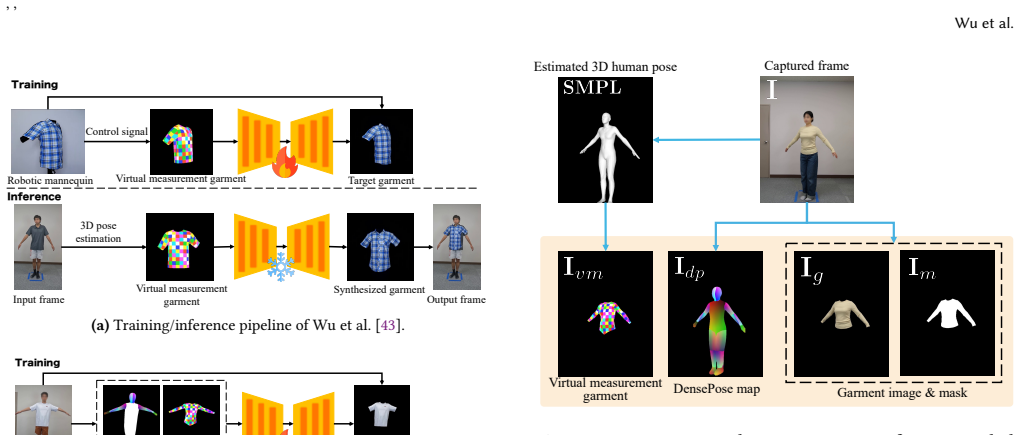
The central object is the hybrid person representation $I_{\mathrm{hybrid}} = I_{\mathrm{vm}} \oplus I_{\mathrm{sdp}}$ defined by Eq. (1), where $\oplus$ is channel-wise concatenation. $I_{\mathrm{vm}}$ is the virtual measurement garment image: a rendered SMPL mesh, with head, hands, and lower body removed and the remaining body textured with a grid pattern, which supplies 3D pose and orientation information. $I_{\mathrm{sdp}}$ is the simplified DensePose map, obtained by painting the torso and lower body of an estimated DensePose map white; it supplies 2D image-space body-surface correspondence and rough garment deformation. Together the six channels let the per-garment synthesis network $G_S$, trained with pix2pixHD-style GAN, feature-matching, and VGG losses, know both where the body is and how the worn garment should sit on it, which is what makes alignment, multi-view interaction, and the removal of the measurement garment possible.
What would settle it
Take one garment captured on subject A, run the trained network on subject B with a clearly different body shape wearing the same garment, and measure garment-mask intersection-over-union and collar alignment against ground-truth frames; if the alignment error grows sharply with body-shape difference, the cross-user generalization premise fails.
Extended reading notes
Core claim
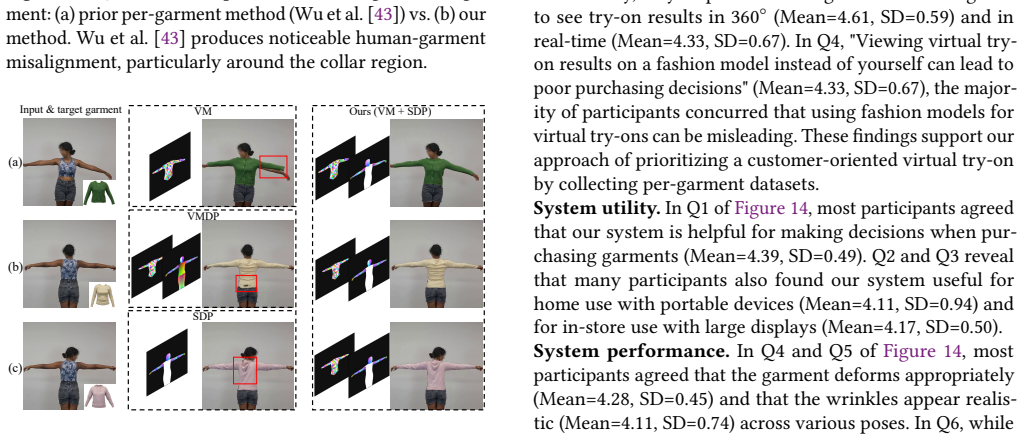
On its own terms, the paper claims that per-garment garment synthesis should be driven by a hybrid person representation $I_{\mathrm{hybrid}} = I_{\mathrm{vm}} \oplus I_{\mathrm{sdp}}$: the virtual measurement garment image $I_{\mathrm{vm}}$, an SMPL body mesh with head, hands, and lower body removed and textured with a grid, plus the simplified DensePose map $I_{\mathrm{sdp}}$, obtained by painting the torso and lower body of a DensePose estimate white. Feeding this six-channel representation to a pix2pixHD-based garment synthesis network produces a target garment image and mask that align with the body without post-processing, support user interaction with the garment by pulling or deforming it, and render at 7.93 fps. The paper reports that this configuration outperforms the OOTDiffusion and ViViD baselines on SSIM, LPIPS, VFID, and frame rate, and that its ablation study shows each component of the hybrid representation is necessary: removing the simplified DensePose map causes misalignment, keeping the unsimplified map introduces artifacts, and removing the virtual measurement garment breaks orientation consistency.
Load-bearing premise
The method assumes that the simplified body-surface map (DensePose) taken from a person wearing a garment tells the network reliably where the body is and how the garment hangs on it, so a network trained on one real human body will place the garment correctly on other users and poses; the paper concedes this fails for extremely loose garments and does not quantitatively test the cross-user part.
Editorial extensions
If this is right
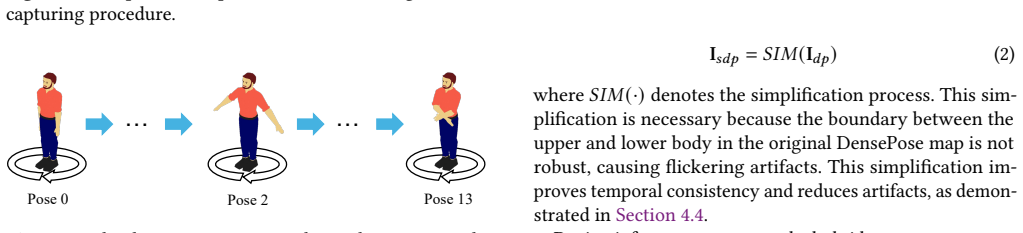
- A per-garment dataset for a new clothing item can be collected in about two minutes by an untrained person using only a camera and a monitor, rather than about two hours with a robotic mannequin.
- The simplified DensePose channel removes the need for a customized measurement garment, so users can interact with the virtual garment by pulling or deforming the clothes they are already wearing.
- At 7.93 fps on a moderate PC, the method supports interactive try-on at interactive rates, unlike the diffusion-based baselines it is compared with.
- The full hybrid representation is necessary: the ablation studies show that removing the simplified DensePose map causes misalignment, using the unsimplified map causes flicker and artifacts, and dropping the virtual measurement garment breaks orientation consistency.
- The reported quantitative results (SSIM 0.920, LPIPS 0.036, lower VFID) indicate that per-garment training on real-human video yields higher image quality and temporal consistency than the compared image and video try-on models.
Reading between the lines
- A direct test the paper leaves open is cross-subject generalization: capturing a garment on one body and running inference on substantially different body shapes would show whether the alignment claim survives outside the capture subject.
- The method's reliance on DensePose suggests a concrete roadmap: if DensePose estimation becomes robust for loose garments, the same hybrid representation could extend to coats and dresses, which the paper currently excludes.
- Because the network is trained per garment for about 15 hours, the practical overhead is best amortized in a retail setting where many users try the same garment; the paper's retailer framing implies this but does not quantify the amortization.
- One could combine the predicted garment mask with a skin-inpainting module to remove the original garment rather than overlay it, moving from try-on overlay to true garment replacement; the paper names this as future work.
Editorial analysis
A structured set of objections, weighed in public.
Referee Report
Summary. The paper proposes a low-barrier per-garment virtual try-on system. Instead of using an expensive robotic mannequin, the authors collect per-garment datasets by recording a real human wearing the target garment while following a small set of predefined poses. The per-garment synthesis network is trained on a hybrid person representation that concatenates a virtual measurement garment image (I_vm) with a simplified DensePose map (I_sdp), as defined in Eq. (1). At inference, the network outputs a synthesized garment image and mask, which are composited onto the input frame. The paper reports image-quality, video-quality, and frame-rate comparisons against OOTDiffusion and ViViD, ablation studies of the hybrid representation, and a user study on dataset-collection usability and system utility. The central claims are that the method eliminates the need for a customized robotic mannequin and wearable measurement garment, supports real-time interactive try-on at about 8 fps, and achieves accurate human-garment alignment.
Significance. If the central claims hold, this work would make per-garment virtual try-on substantially more accessible: dataset collection would require only a camera, a monitor, and a human model, and the reported 8 fps inference would enable interactive try-on without specialized hardware. The hybrid representation and the simplification of DensePose are plausible and well-motivated mechanisms for improving alignment and temporal consistency. The paper is also strong in presenting a complete pipeline, including data capture, training, inference, ablation studies, and a user study. However, the quantitative evaluation does not currently support the load-bearing claim that the system works for ordinary users, because the evaluation is self-referential: it uses the ground-truth wearing video as input, does not remove the original garment, and tests only the same person and garment used for training. The user study does not close this gap because participants were only used as capture models, not evaluated as end users. The core idea is promising, but the evidence for cross-identity generalization is missing.
major comments (4)
- [§4.3, Figure 9, §6] The quantitative evaluation is self-referential and therefore does not support the central claim of superiority in Table 1(a). The free-style video used as ground truth is also used as the input image (Figure 9 caption), and Section 6 (Figure 15c) states that the original garment is not removed from the input. The pipeline is thus reconstructing a held-out video of the same person wearing the same target garment, with the garment already present in the input. Under this protocol, SSIM=0.920 and LPIPS=0.036 largely measure how faithfully the network copies the visible target garment, and the comparison with OOTDiffusion/ViViD is confounded because those methods are evaluated on a task (garment transfer/removal) that the current protocol does not actually test. A valid evaluation should use an input person wearing a different garment (or at least remove the target garment region) and should include identities and garments not seen during per-garment training.
- [§2.2, §5] The paper's practical claim that an ordinary user can use a per-garment model trained on another person's capture is asserted in Section 2.2 but never tested. Table 1(a) is computed on the same person and garment used for dataset collection, and the user study in Section 5 only asks participants to act as capture models; it does not report try-on results for those participants' own bodies. The authors should report quantitative and qualitative results for held-out identities (and ideally held-out source garments and poses), for example by training on participant A and testing on participant B, to substantiate the 'ordinary users' claim.
- [§3.4, §6] The interaction and alignment mechanisms rely on DensePose capturing rough garment deformation, but the paper itself acknowledges in Section 6 that DensePose estimation fails for extremely loose garments and in Section 3.4 that DensePose is not fully garment-invariant. Because the simplified DensePose map is a core component of the hybrid representation (Eq. 1), the boundary of applicability should be characterized concretely: for which garment types, looseness levels, and poses does the simplification in Eq. (2) preserve enough alignment information? At minimum, the authors should report failure cases quantitatively and restrict the claims accordingly.
- [§4.4, Table 1(b)] The ablation study shows only a single aggregate comparison and does not report variance or a per-garment breakdown; moreover, it inherits the self-referential evaluation protocol of §4.3. The improvements in Table 1(b) (e.g., VM 0.902 vs. VM+SDP 0.920 SSIM) are presented as supporting the hybrid representation, but without statistical significance testing or a description of how many of the 25 garments were used, it is unclear whether the gap is robust. Please report per-garment results and confidence intervals, and evaluate the ablations under a held-out-identity protocol as well.
minor comments (5)
- [§4.3] Please report how OOTDiffusion and ViViD were configured, including which target garment image was used and whether the input person image was identical to the one used for the proposed method, so that the comparison is reproducible.
- [§3.2, Eq. (9)] The definition of the VGG loss is unclear: VGG(·) typically expects an image, but the argument is a masked synthesized garment image. Please clarify the preprocessing applied before the VGG network.
- [§6] The footnote attributing the fashion model image to a short URL is not a stable citation; please provide a formal reference or replace the image with one from a public dataset with a clear license.
- [§1] The term 'low-barrier' is used in the title and abstract but is never formally defined. Please state explicitly what is meant by low barrier in terms of cost, equipment, time, and required expertise.
- [§4.1] The paper states that each per-garment dataset contains approximately 3,000 images and that the free-style evaluation video has about 600 frames, but it does not specify how the quantitative metrics in Table 1 were aggregated over the 25 garments. Please clarify whether the reported numbers are averaged over all garments or computed on a subset.
Circularity Check
Quantitative 'prediction' is a same-person/same-garment reconstruction: ground-truth frames are used as input and the original garment is never removed, so the reported superiority is partly forced by construction.
-
self definitional
[Section 4.3 (Quantitative evaluation) and Figure 9 caption]
"we leverage the recorded video with free-style try-on movements as both input and ground truth. Note that we use the ground-truth image (captured from free-style movements and not included in the training data) shown in the first row as input to demonstrate our method can faithfully recover the real-world wearing result."
The test image itself is the ground truth. The network output is composited onto that same input image by Eq. (14), I_o = I⊙(1−˜I_m)+˜I_g⊙˜I_m, so every non-garment pixel and the original garment itself are retained in the output by construction. The SSIM/LPIPS numbers therefore measure self-reconstruction of a frame whose target garment is already present in the input, not prediction of a try-on on a different body or over a different source garment. The claim that 'our method generates try-on results that outperform all other methods across all metrics' (Table 1) is an artifact of this evaluation design.
-
fitted input called prediction
[Section 4.1 (Per-garment dataset), Section 4.3, and Section 6 (Presence of original garment in the input images)]
"we recorded a video of the same person wearing the same garment while performing free-style try-on movements ... These recordings are intended for both qualitative and quantitative evaluation purposes. Our method overlays the synthesized garment directly onto the input frame without removing the original garment, as shown in Figure 15(c)."
The per-garment GS network is trained on captures of one person wearing the target garment, and the quantitative evaluation uses frames of that same person wearing that same target garment. Because the composed output keeps the original input frame (Eq. 14) and the original garment is not removed, the high scores only show that the network can reproduce a frame from the training distribution. They do not test the load-bearing practical claim that a garment network trained on one human body transfers to other users' bodies or to a source garment that is not the target garment. The reported 'prediction' is thus a fitted reconstruction of the same identity/garment pair rather than a cross-identity try-on.
full rationale
The core technical derivation is not circular: the hybrid person representation is constructively defined from SMPL pose and a simplified DensePose map (Eqs. 1-2), the training objective is a standard pix2pixHD combination of GAN, feature-matching, and VGG losses, and no load-bearing mathematical claim is imported from the authors' prior work. The circularity is confined to the empirical evaluation. The paper explicitly uses the ground-truth free-style video as both input and target, evaluates only on the same person wearing the same garment used to train the per-garment network, and admits that the original garment is never removed from the input before compositing. Consequently, the quantitative comparison in Table 1 reduces to a within-distribution reconstruction test in which the target garment is physically present in the input. This makes the reported superiority over OOTDiffusion and ViViD partly forced by construction and leaves the ordinary-user, cross-identity try-on claim untested. The qualitative and user-study results are suggestive but do not close that gap. Score 6 reflects partial circularity in the central empirical claim, not in the technical pipeline itself.
Assumptions & free parameters
free parameters (3)
- Loss weights lambda0, lambda1 =
1, 1
- ROI size s =
512
- Predefined pose set =
14 symmetrical poses
assumptions (5)
- domain assumption DensePose maps estimated from monocular RGB video give reliable body-surface correspondence and rough garment deformation for arbitrary users, poses, and garment types.
- domain assumption BEV monocular 3D pose estimation recovers an SMPL mesh accurate enough to render a virtual measurement garment.
- domain assumption Graphonomy human parsing provides correct target garment image and mask for training labels.
- domain assumption A per-garment model trained on one human body generalizes to other users' bodies and identities.
- ad hoc to paper Painting the torso and lower body white in the DensePose map removes non-robust boundaries and improves temporal consistency.
invented entities (2)
-
Hybrid person representation I_hybrid = I_vm plus I_sdp
-
Simplified DensePose map I_sdp
Cite this review
Pith. "Pith review of Low-Barrier Dataset Collection with Real Human Body for Interactive Per-Garment Virtual Try-On." pith.science (2026). https://pith.science/paper/HTVEHRP3
@misc{pith2026250610468,
  author       = {Pith},
  title        = {Pith review of: Low-Barrier Dataset Collection with Real Human Body for Interactive Per-Garment Virtual Try-On},
  year         = {2026},
  howpublished = {\url{https://pith.science/paper/HTVEHRP3}},
  note         = {Machine review of arXiv:2506.10468}
}
read the original abstract
Existing image-based virtual try-on methods are often limited to the front view and lack real-time performance. While per-garment virtual try-on methods have tackled these issues by capturing per-garment datasets and training per-garment neural networks, they still encounter practical limitations: (1) the robotic mannequin used to capture per-garment datasets is prohibitively expensive for widespread adoption and fails to accurately replicate natural human body deformation; (2) the synthesized garments often misalign with the human body. To address these challenges, we propose a low-barrier approach for collecting per-garment datasets using real human bodies, eliminating the necessity for a customized robotic mannequin. We also introduce a hybrid person representation that enhances the existing intermediate representation with a simplified DensePose map. This ensures accurate alignment of synthesized garment images with the human body and enables human-garment interaction without the need for customized wearable devices. We performed qualitative and quantitative evaluations against other state-of-the-art image-based virtual try-on methods and conducted ablation studies to demonstrate the superiority of our method regarding image quality and temporal consistency. Finally, our user study results indicated that most participants found our virtual try-on system helpful for making garment purchasing decisions.
Figures


Figures from the paper (12 more)






Forward citations
Cited by 1 Pith paper
-
Real-Time Per-Garment Virtual Try-On with Temporal Consistency for Loose-Fitting Garments
A per-garment virtual try-on method for loose-fitting garments uses a garment-invariant pose representation and a recurrent ConvLSTM synthesis network to achieve temporally smoother try-on video at about 10 fps.
Reference graph
Works this paper leans on
-
[43]
Zaiqiang Wu, Jingyuan Liu, Long Hin Toby Chong, I-Chao Shen, and Takeo Igarashi. 2024. Virtual Measurement Garment for Per-Garment Virtual Try-On. In Graphics Interface 2024
2024
-
[1]
Michelle Carney, Barron Webster, Irene Alvarado, Kyle Phillips, Noura Howell, Jordan Griffith, Jonas Jongejan, Amit Pitaru, and Alexander Chen. 2020. Teachable machine: Approachable Web-based tool for exploring machine learning classification. In Extended abstracts of the 2020 CHI conference on human factors in computing systems . 1–8
work page 2020
-
[2]
Joao Carreira and Andrew Zisserman. 2017. Quo vadis, action recogni- tion? a new model and the kinetics dataset. In proceedings of the IEEE Conference on Computer Vision and Pattern Recognition . 6299–6308
2017
-
[3]
Andrés Casado-Elvira, Marc Comino Trinidad, and Dan Casas. 2022. Pergamo: Personalized 3d garments from monocular video. In Com- puter Graphics Forum, Vol. 41. Wiley Online Library, 293–304
2022
-
[4]
Chieh-Yun Chen, Ling Lo, Pin-Jui Huang, Hong-Han Shuai, and Wen- Huang Cheng. 2021. Fashionmirror: Co-attention feature-remapping virtual try-on with sequential template poses. In Proceedings of the IEEE/CVF International Conference on Computer Vision . 13809–13818
2021
-
[5]
Seunghwan Choi, Sunghyun Park, Minsoo Lee, and Jaegul Choo. 2021. Viton-hd: High-resolution virtual try-on via misalignment-aware nor- malization. In Proceedings of the IEEE/CVF conference on computer vision and pattern recognition. 14131–14140
2021
-
[6]
Toby Chong, I-Chao Shen, Nobuyuki Umetani, and Takeo Igarashi
-
[7]
Gabriel Cirio, Jorge Lopez-Moreno, David Miraut, and Miguel A Otaduy. 2014. Yarn-level simulation of woven cloth. ACM Trans- actions on Graphics (TOG) 33, 6 (2014), 1–11
2014
Show all 50 references
-
[8]
Haoye Dong, Xiaodan Liang, Xiaohui Shen, Bowen Wu, Bing-Cheng Chen, and Jian Yin. 2019. Fw-gan: Flow-navigated warping gan for video virtual try-on. In Proceedings of the IEEE/CVF international con- ference on computer vision . 1161–1170
2019
-
[9]
Zixun Fang, Wei Zhai, Aimin Su, Hongliang Song, Kai Zhu, Mao Wang, Yu Chen, Zhiheng Liu, Yang Cao, and Zheng-Jun Zha. 2024. ViViD: Video Virtual Try-on using Diffusion Models. arXiv preprint arXiv:2405.11794 (2024)
2024 arXiv
-
[10]
Ke Gong, Yiming Gao, Xiaodan Liang, Xiaohui Shen, Meng Wang, and Liang Lin. 2019. Graphonomy: Universal human parsing via graph transfer learning. In Proceedings of the IEEE/CVF Conference on Computer Vision and Pattern Recognition . 7450–7459
2019
-
[11]
Ian Goodfellow, Jean Pouget-Abadie, Mehdi Mirza, Bing Xu, David Warde-Farley, Sherjil Ozair, Aaron Courville, and Yoshua Bengio. 2014. Generative adversarial nets. Advances in neural information processing systems 27 (2014)
2014
-
[12]
Artur Grigorev, Michael J Black, and Otmar Hilliges. 2023. Hood: Hierarchical graphs for generalized modelling of clothing dynamics. In Proceedings of the IEEE/CVF Conference on Computer Vision and Pattern Recognition. 16965–16974
2023
-
[13]
Peng Guan, Loretta Reiss, David A Hirshberg, Alexander Weiss, and Michael J Black. 2012. Drape: Dressing any person. ACM Transactions on Graphics (ToG) 31, 4 (2012), 1–10
2012
-
[14]
Rıza Alp Güler, Natalia Neverova, and Iasonas Kokkinos. 2018. Dense- pose: Dense human pose estimation in the wild. In Proceedings of the IEEE conference on computer vision and pattern recognition . 7297–7306
2018
-
[15]
Oshri Halimi, Egor Larionov, Zohar Barzelay, Philipp Herholz, and Tuur Stuyck. 2023. Physgraph: Physics-based integration using graph neural networks. arXiv preprint arXiv:2301.11841 (2023)
2023 arXiv
-
[16]
Kensho Hara, Hirokatsu Kataoka, and Yutaka Satoh. 2018. Can spa- tiotemporal 3d cnns retrace the history of 2d cnns and imagenet?. In Proceedings of the IEEE conference on Computer Vision and Pattern Recognition. 6546–6555
2018
-
[17]
Nikolay Jetchev and Urs Bergmann. 2017. The conditional analogy gan: Swapping fashion articles on people images. In Proceedings of the IEEE international conference on computer vision workshops . 2287–2292
2017
-
[18]
Jianbin Jiang, Tan Wang, He Yan, and Junhui Liu. 2022. Cloth- former: Taming video virtual try-on in all module. In Proceedings of the IEEE/CVF Conference on Computer Vision and Pattern Recognition . 10799–10808. Low-Barrier Dataset Collection with Real Human Body for Interact...
2022
-
[19]
Jonathan M Kaldor, Doug L James, and Steve Marschner. 2008. Simu- lating knitted cloth at the yarn level. In ACM SIGGRAPH 2008 papers. 1–9
2008
-
[20]
Johanna Karras, Yingwei Li, Nan Liu, Luyang Zhu, Innfarn Yoo, An- dreas Lugmayr, Chris Lee, and Ira Kemelmacher-Shlizerman. 2024. Fashion-VDM: Video Diffusion Model for Virtual Try-On. arXiv preprint arXiv:2411.00225 (2024)
2024 arXiv
-
[21]
Tero Karras, Samuli Laine, and Timo Aila. 2019. A style-based gener- ator architecture for generative adversarial networks. In Proceedings of the IEEE/CVF conference on computer vision and pattern recognition . 4401–4410
2019
-
[22]
Tero Karras, Samuli Laine, Miika Aittala, Janne Hellsten, Jaakko Lehti- nen, and Timo Aila. 2020. Analyzing and improving the image quality of stylegan. In Proceedings of the IEEE/CVF conference on computer vision and pattern recognition . 8110–8119
2020
-
[23]
Jeongho Kim, Guojung Gu, Minho Park, Sunghyun Park, and Jaegul Choo. 2024. Stableviton: Learning semantic correspondence with latent diffusion model for virtual try-on. InProceedings of the IEEE/CVF Conference on Computer Vision and Pattern Recognition . 8176–8185
2024
-
[24]
Zorah Lahner, Daniel Cremers, and Tony Tung. 2018. Deepwrinkles: Accurate and realistic clothing modeling. InProceedings of the European conference on computer vision (ECCV) . 667–684
2018
-
[25]
Christian Ledig, Lucas Theis, Ferenc Huszár, Jose Caballero, Andrew Cunningham, Alejandro Acosta, Andrew Aitken, Alykhan Tejani, Jo- hannes Totz, Zehan Wang, et al. 2017. Photo-realistic single image super-resolution using a generative adversarial network. In Proceed- ings of ...
2017
-
[26]
Sangyun Lee, Gyojung Gu, Sunghyun Park, Seunghwan Choi, and Jaegul Choo. 2022. High-resolution virtual try-on with misalignment and occlusion-handled conditions. InEuropean Conference on Computer Vision. Springer, 204–219
2022
-
[27]
Matthew Loper, Naureen Mahmood, Javier Romero, Gerard Pons-Moll, and Michael J Black. 2015. SMPL: A Skinned Multi-Person Linear Model. Acm Transactions on Graphics 34, Article 248 (2015)
2015
-
[28]
Rahul Narain, Armin Samii, and James F O’brien. 2012. Adaptive anisotropic remeshing for cloth simulation. ACM transactions on graphics (TOG) 31, 6 (2012), 1–10
2012
-
[29]
Xiaoyu Pan, Jiaming Mai, Xinwei Jiang, Dongxue Tang, Jingxiang Li, Tianjia Shao, Kun Zhou, Xiaogang Jin, and Dinesh Manocha. 2022. Pre- dicting loose-fitting garment deformations using bone-driven motion networks. In ACM SIGGRAPH 2022 Conference Proceedings . 1–10
2022
-
[30]
Chaitanya Patel, Zhouyingcheng Liao, and Gerard Pons-Moll. 2020. Tailornet: Predicting clothing in 3d as a function of human pose, shape and garment style. In Proceedings of the IEEE/CVF conference on com- puter vision and pattern recognition . 7365–7375
2020
-
[31]
Gonzalo Ramos, Christopher Meek, Patrice Simard, Jina Suh, and Soroush Ghorashi. 2020. Interactive machine teaching: a human- centered approach to building machine-learned models. Human– Computer Interaction 35, 5-6 (2020), 413–451
2020
-
[32]
Igor Santesteban, Miguel A Otaduy, and Dan Casas. 2019. Learning- based animation of clothing for virtual try-on. In Computer Graphics Forum, Vol. 38. Wiley Online Library, 355–366
2019
-
[33]
Igor Santesteban, Miguel A Otaduy, and Dan Casas. 2022. Snug: Self- supervised neural dynamic garments. In Proceedings of the IEEE/CVF Conference on Computer Vision and Pattern Recognition . 8140–8150
2022
-
[34]
Igor Santesteban, Nils Thuerey, Miguel A Otaduy, and Dan Casas
-
[35]
Masahiro Sekine, Kaoru Sugita, Frank Perbet, Björn Stenger, and Masashi Nishiyama. 2014. Virtual fitting by single-shot body shape estimation. In Int. Conf. on 3D Body Scanning Technologies , Vol. 406. Citeseer, 413
2014
-
[36]
In Proceedings of the IEEE/CVF Conference on Computer Vision and Pattern Recognition
Self-supervised collision handling via generative 3d garment models for virtual try-on. In Proceedings of the IEEE/CVF Conference on Computer Vision and Pattern Recognition . 11763–11773
-
[37]
Patrice Y Simard, Saleema Amershi, David M Chickering, Alicia Edel- man Pelton, Soroush Ghorashi, Christopher Meek, Gonzalo Ramos, Jina Suh, Johan Verwey, Mo Wang, et al. 2017. Machine teaching: A new paradigm for building machine learning systems. arXiv preprint arXiv:1707.06...
2017 arXiv
-
[38]
Andrew Selle, Jonathan Su, Geoffrey Irving, and Ronald Fedkiw. 2008. Robust high-resolution cloth using parallelism, history-based colli- sions, and accurate friction. IEEE transactions on visualization and computer graphics 15, 2 (2008), 339–350
2008
-
[39]
Yu Sun, Wu Liu, Qian Bao, Yili Fu, Tao Mei, and Michael J Black. 2022. Putting people in their place: Monocular regression of 3d people in depth. In Proceedings of the IEEE/CVF Conference on Computer Vision and Pattern Recognition. 13243–13252
2022
-
[40]
Dan Song, Xuanpu Zhang, Juan Zhou, Weizhi Nie, Ruofeng Tong, and An-An Liu. 2023. Image-Based Virtual Try-On: A Survey. arXiv preprint arXiv:2311.04811 (2023)
2023 arXiv
-
[41]
Ting-Chun Wang, Ming-Yu Liu, Jun-Yan Zhu, Andrew Tao, Jan Kautz, and Bryan Catanzaro. 2018. High-resolution image synthesis and semantic manipulation with conditional gans. In Proceedings of the IEEE conference on computer vision and pattern recognition . 8798–8807
2018
-
[42]
Haoyu Wang, Zhilu Zhang, Donglin Di, Shiliang Zhang, and Wang- meng Zuo. 2024. MV-VTON: Multi-View Virtual Try-On with Diffusion Models. arXiv preprint arXiv:2404.17364 (2024)
2024 arXiv
-
[44]
Xingjiao Wu, Luwei Xiao, Yixuan Sun, Junhang Zhang, Tianlong Ma, and Liang He. 2022. A survey of human-in-the-loop for machine learning. Future Generation Computer Systems 135 (2022), 364–381
2022
-
[45]
Yuhao Xu, Tao Gu, Weifeng Chen, and Chengcai Chen. 2024. Ootdif- fusion: Outfitting fusion based latent diffusion for controllable virtual try-on. arXiv preprint arXiv:2403.01779 (2024)
2024 arXiv
-
[46]
Donglai Xiang, Fabian Prada, Timur Bagautdinov, Weipeng Xu, Yuan Dong, He Wen, Jessica Hodgins, and Chenglei Wu. 2021. Modeling clothing as a separate layer for an animatable human avatar. ACM Transactions on Graphics (TOG) 40, 6 (2021), 1–15
2021
-
[47]
Zhongyi Zhou and Koji Yatani. 2022. Gesture-aware interactive ma- chine teaching with in-situ object annotations. In Proceedings of the 35th Annual ACM Symposium on User Interface Software and Technology. 1–14
2022
-
[48]
Zhengze Xu, Mengting Chen, Zhao Wang, Linyu Xing, Zhonghua Zhai, Nong Sang, Jinsong Lan, Shuai Xiao, and Changxin Gao. 2024. Tunnel Try-on: Excavating Spatial-temporal Tunnels for High-quality Virtual Try-on in Videos. arXiv preprint arXiv:2404.17571 (2024)
2024 arXiv
-
[50]
Jun-Yan Zhu, Taesung Park, Phillip Isola, and Alexei A Efros. 2017. Unpaired image-to-image translation using cycle-consistent adver- sarial networks. In Proceedings of the IEEE international conference on computer vision. 2223–2232
2017
-
[2021]
In The 34th Annual ACM Symposium on User Interface Software and Technology
Per garment capture and synthesis for real-time virtual try-on. In The 34th Annual ACM Symposium on User Interface Software and Technology. 457–469
Reviewed August 7, 2026 · model on record in the stance chip above.
Discussion (0). Sign in to comment.