REVIEW 4 major objections 8 minor 84 references
SPORT: Structure-Aware Prototype Disentanglement for Incomplete Multi-View Clustering
T0 review · 4 major / 8 minor · reviewed 2026-07-14 · grok-4.5
Pith's one-line read SPORT improves incomplete multi-view clustering by splitting prototypes into shared and view-specific parts and recovering missing views from both prototypes and neighbors.
desk verdict Solid incremental IMVC recipe with real empirical breadth; the superiority claim is useful but not yet variance-robust, and the orthogonal prototype split is plausible rather than proven causal. read the letter →
The pith
A machine-rendered reading of the paper's core claim, the machinery that carries it, and where it could break.
The reading
What carries the argument
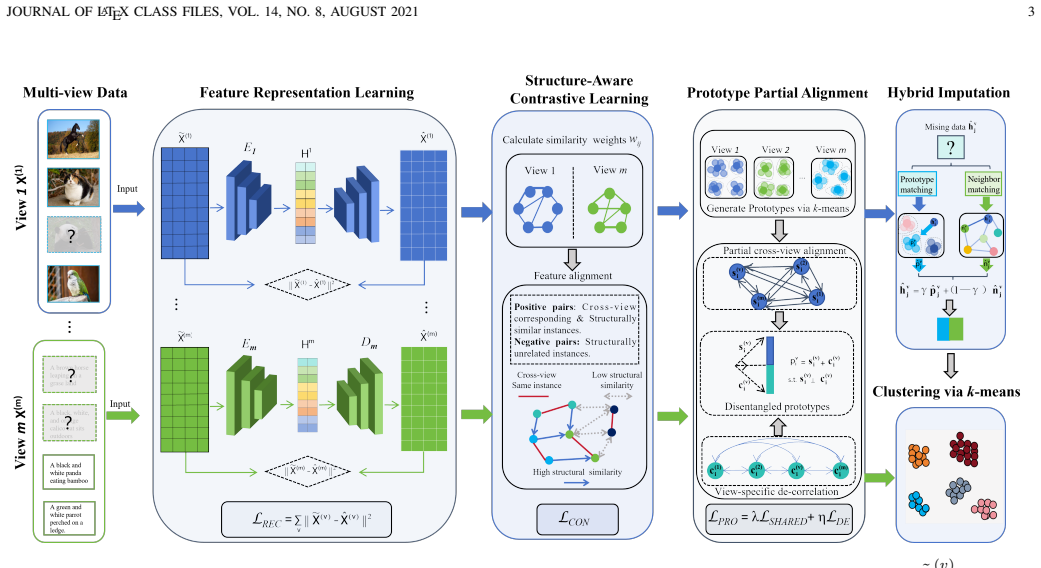
Prototype partial alignment: each k-means prototype is split by a learnable orthogonal projector U (reparameterized via the Cayley transform) into shared and view-specific parts; only the shared parts are contrastively aligned across views while view-specific parts are decorrelated, and missing features are then filled by a weighted sum of the best-matched prototype and best-matched neighbor.
What would settle it
On a controlled multi-view dataset where true shared and view-specific prototype components are known by construction, measure whether the learned shared components recover the planted consensus and whether removing the orthogonal split or the hybrid imputation measurably collapses clustering accuracy relative to the full model.
Extended reading notes
Core claim
The paper claims that incomplete multi-view clustering improves when prototypes are explicitly disentangled into orthogonal shared and view-specific components (aligning only the shared ones and decorrelating the view-specific ones), when contrastive alignment is made structure-aware via similarity-weighted positives rather than hard instance pairs, and when missing views are recovered by a hybrid of global prototype matching and local neighborhood matching. Together these choices yield superior accuracy, ARI, and F-score on six benchmarks under missing rates from 0.1 to 0.7 compared with fourteen state-of-the-art baselines.
Load-bearing premise
The method assumes that a single learnable orthogonal split of independently computed prototypes cleanly separates consensus from complementary information; if that split is wrong, both the alignment loss and the prototype half of imputation lose their meaning.
Editorial analysis
A structured set of objections, weighed in public.
Referee Report
Summary. The paper proposes SPORT, a deep incomplete multi-view clustering framework that addresses three claimed limitations of prototype-based IMVC: (i) over-alignment of full prototypes across views (termed POP), (ii) hard instance-level contrastive learning that ignores cluster-level structure, and (iii) prototype-only missing-view imputation. SPORT maps observed views with autoencoders, applies a structure-aware relational contrastive loss with similarity weights w_ij (Eqs. 5–10), decomposes k-means prototypes into orthogonal shared and view-specific parts via a Cayley-reparameterized projector U (Eqs. 11–16), aligns only shared components while decorrelating view-specific ones (Eqs. 17–20), and imputes missing features by a hybrid of matched prototypes and neighbors (Eqs. 22–24). Training uses reconstruction pretraining then joint fine-tuning (Alg. 1; Eq. 21). Empirically, SPORT is compared to 14 recent baselines on six benchmarks under missing rates 0.1–0.7 (Tables II–III), with ablations (Table IV), hyperparameter sweeps (Figs. 6–7), hybrid-γ analysis (Fig. 8), convergence curves (Fig. 9), and t-SNE stage visualizations (Fig. 10). The central claim is superior clustering performance under incompleteness.
Significance. If the empirical ranking holds under a fixed, multi-seed protocol, SPORT is a useful contribution to deep IMVC: it cleanly articulates the POP issue, combines consensus/complementarity at the prototype level with structure-aware contrastive learning, and shows a simple hybrid imputation rule that is more robust than pure prototype matching under high missingness. Strengths include broad evaluation (six datasets, four missing rates, many recent baselines), systematic ablations and sensitivity analyses, public code, and staged representation visualizations that make the training pipeline inspectable. The work is incremental relative to prior prototype-based IMVC (ProImp, matching networks, etc.) but the orthogonal shared/view-specific split plus hybrid imputation is a coherent design package of practical interest to the multi-view clustering community.
major comments (4)
- Tables II–III report only single-run point estimates, while Experimental Configurations state that a subset of hyperparameters is selectively fine-tuned per dataset. Combined with free parameters (α, β, λ, η, τ, τw, t, γ, d, dc) and several strong baselines marked O/M on ALOI_100 and VGGFace2_50, the load-bearing claim of consistent superiority is not yet statistically established. Please report mean±std over multiple random seeds (and missing-pattern draws) under a fixed hyperparameter protocol, or at least a shared search budget, and clarify which baselines were re-run vs. taken from prior reports.
- §III-D / Alg. 1 / Eqs. (17)–(18): prototypes are obtained by independent k-means per view, yet L_SHARED treats index g as corresponding across views (pulling s^v_g toward s^u_g). Independent k-means yields arbitrary label permutations; re-running k-means inside the fine-tuning loop would reshuffle indices. The manuscript does not specify Hungarian/optimal matching, Sinkhorn alignment, or any other index-alignment step before partial alignment. Without this, the shared-alignment objective is ill-defined. Please state how cross-view prototype correspondence is established and maintained, and add an ablation with vs. without explicit matching.
- Table IV (0.5 missing rate): on Digit4k and several other settings, variants without full L_PRO / L_SHARED remain close to the full model, so the orthogonal U-decomposition (Eqs. 11–16) is not clearly the causal driver of the reported gains on all datasets. To support the POP narrative and contribution (1), isolate (a) full prototype alignment vs. partial shared-only alignment, (b) with vs. without L_DE, and (c) hybrid imputation (γ) with fixed representation learning—ideally with multi-seed stats—so that each claimed module’s necessity is quantified rather than only joint removal.
- §III-F, Eqs. (22)–(24): hybrid imputation matches a single global prototype and a single neighbor by average cosine similarity over co-observed views, then mixes them with fixed γ. Under high missing rates |V_j| is small, so both argmax matches can be noisy; the paper does not analyze failure cases or confidence weighting. Given that robustness to missing rate is a main selling point (Fig. 5; text after Table III), please justify the single-match design (vs. top-k / soft assignment) and report sensitivity when the matched prototype is wrong (e.g., forced mismatch ablation).
minor comments (8)
- Title/acronym inconsistency: abstract uses “incompleTe” in SPORT while the title uses “Incomplete”; pick one expansion and keep it consistent.
- Eq. (5): the weight formula mixes exp(S/τ_w)/exp(1/τ_w) with averaging over co-observed views; a short derivation or geometric interpretation would help readers see why this is a calibrated soft positive weight rather than an ad-hoc score.
- Eq. (18): the series form ∑_r (1−Q)^r / r is nonstandard for prototype contrastive losses; cite a source or briefly motivate t and this expansion vs. standard InfoNCE/CE on Q.
- Notation: c^{(v′)}_g appears in Eq. (19) while surrounding text uses u; VGGFace2_50 / ALOI_100 naming and “Leaves_100” vs “100Leaves” in Fig. 9 captions should be unified.
- Related work is thorough but dense; a short table mapping generator / predictor / neighborhood / prototype methods to the three claimed gaps would improve readability.
- Fig. 1 and Fig. 4 are helpful; ensure vector fonts and that POP vs. hybrid imputation panels remain legible in print grayscale.
- Typos/grammar: “incompleTe”, “de-correlating” vs “decorrelating”, “foR incompleTe”, occasional missing spaces after periods in the introduction; a careful copy-edit pass is needed.
- Code link is appreciated; please pin commit/hash and list exact baseline re-implementation sources for reproducibility of Tables II–III.
Circularity Check
No significant circularity: empirical method paper whose losses are optimization objectives and whose superiority claim is measured against external public benchmarks and published baselines.
full rationale
SPORT is a standard deep incomplete multi-view clustering method paper. It defines reconstruction, structure-aware contrastive, and prototype partial-alignment losses (Eqs. 4, 8, 18–21), a Cayley-reparameterized orthogonal decomposition of k-means prototypes (Eqs. 11–16), and a hybrid imputation rule (Eqs. 22–24), then trains and evaluates ACC/ARI/F-score on six public datasets against 14 published baselines under controlled missing rates (Tables II–III). None of these steps reduces a claimed prediction or first-principles result to its own inputs by construction: the losses are ordinary training objectives, the decomposition is an inductive bias whose utility is tested by ablation (Table IV), and the ranking is an empirical comparison, not a fitted quantity renamed as a prediction. Naming the Prototype Over-alignment Problem (POP) and designing modules to address it is ordinary framing, not a self-definitional loop. There is no load-bearing uniqueness theorem, no self-citation that forces the central claim, and no ansatz smuggled in via prior author work that collapses the derivation. The paper is therefore self-contained against external benchmarks; circularity score is zero.
Assumptions & free parameters
free parameters (8)
- α (weight on L_CON) =
1.6e-5 (default)
- β (weight on L_PRO) =
5 (default)
- λ, η (shared vs de-correlation weights) =
λ=10, η=5
- τ, τw (temperatures) =
[0.75, 0.5]
- t (shared-alignment exponent) =
3
- γ (hybrid imputation mix) =
0.3
- latent dims d, dc and AE widths =
d=256, dc=128, 512-512-1024
- per-dataset selective hyperparameter fine-tuning =
dataset-dependent (repo)
assumptions (5)
- domain assumption Multi-view observations of a sample share consensus semantics while also carrying complementary view-specific information.
- domain assumption k-means prototypes on latent features are adequate global semantic anchors for missing-view imputation.
- ad hoc to paper A single orthogonal projector U can separate each prototype into shared and view-specific components that should be aligned vs decorrelated respectively.
- ad hoc to paper Pairwise cosine similarities over co-observed views are a valid soft proxy for cluster-level relational structure in contrastive learning.
- standard math Cayley transform of a skew-symmetric matrix yields a valid orthogonal matrix usable as a learnable projection during training.
invented entities (3)
-
Prototype Over-alignment Problem (POP)
-
SPORT hybrid prototype-neighbor imputation rule
-
Structure-aware relational contrastive weights w_ij
Cite this review
Pith. "Pith review of SPORT: Structure-Aware Prototype Disentanglement for Incomplete Multi-View Clustering." pith.science (2026). https://pith.science/paper/HUD2LZB6
@misc{pith2026260710413,
  author       = {Pith},
  title        = {Pith review of: SPORT: Structure-Aware Prototype Disentanglement for Incomplete Multi-View Clustering},
  year         = {2026},
  howpublished = {\url{https://pith.science/paper/HUD2LZB6}},
  note         = {Machine review of arXiv:2607.10413}
}
read the original abstract
Prototype-based Incomplete Multi-view Clustering has recently attracted increasing attention by exploiting prototypes as semantic anchors for missing-view imputation. However, existing approaches are still limited in three aspects. First, they typically focus on enforcing cross-view prototype consistency, while ignoring view-specific information embedded in prototypes, thus limiting multi-view expressiveness. Second, most methods rely on instance-level contrastive learning that only aligns paired samples across views, failing to preserve cluster-level relational structures. Third, missing-view imputation is usually performed using global prototypes alone, without considering local geometric neighborhood structures, leading to inaccurate recovery of missing representations. To address these limitations, we propose a novel framework termed Structure-aware PrOtotype disentanglement foR incomplete multi-view clusTering (SPORT), which explicitly disentangles shared and view-specific components of prototypes while preserving cluster-level relational structures. Specifically, we decouple prototypes into orthogonal shared and view-specific components, aligning only shared components to capture consensus semantics while de-correlating view-specific components to preserve complementary information. Meanwhile, a structure-aware contrastive learning mechanism is incorporated to explicitly model cluster-level relationships during cross-view representation learning. Furthermore, a hybrid imputation strategy integrates global prototype matching with local neighborhood matching, enabling joint exploitation of semantic prototypes and manifold structures for missing-view recovery. Extensive experiments on six benchmark datasets show that SPORT achieves superior performance over state-of-the-art methods under various missing rates.
Figures


Figures from the paper (6 more)


Reference graph
Works this paper leans on
-
[1]
Multi-level feature learning for contrastive multi-view clustering,
J. Xu, H. Tang, Y . Ren, L. Peng, X. Zhu, and L. He, “Multi-level feature learning for contrastive multi-view clustering,” inProceedings of the IEEE/CVF conference on computer vision and pattern recognition, 2022, pp. 16 051–16 060
2022
-
[2]
Convex multi-view subspace learning,
M. White, X. Zhang, D. Schuurmans, and Y .-l. Yu, “Convex multi-view subspace learning,”Advances in neural information processing systems, vol. 25, pp. 1– 14, 2012
2012
-
[3]
Multi-view intact space learning,
C. Xu, D. Tao, and C. Xu, “Multi-view intact space learning,”IEEE transactions on pattern analysis and machine intelligence, vol. 37, no. 12, pp. 2531–2544, 2015
2015
-
[4]
Deep partial multi-view learning,
C. Zhang, Y . Cui, Z. Han, J. T. Zhou, H. Fu, and Q. Hu, “Deep partial multi-view learning,”IEEE transactions on pattern analysis and machine intelligence, vol. 44, no. 5, pp. 2402–2415, 2020
2020
-
[5]
Multi-view clustering via bilaterally constrained anchor graph,
Q. Qiang, B. Zhang, Y . Hua, and F. Nie, “Multi-view clustering via bilaterally constrained anchor graph,”IEEE Transactions on Pattern Analysis and Machine Intelli- gence, pp. 1–14, 2026
2026
-
[6]
Deep information-balanced multimodal learning,
Y . Qin, Y . Feng, Y . Sun, D. Peng, X. Peng, and P. Hu, “Deep information-balanced multimodal learning,”IEEE Transactions on Pattern Analysis and Machine Intelli- gence, pp. 1–13, 2026
2026
-
[7]
Discriminatively embedded k-means for multi-view clustering,
J. Xu, J. Han, and F. Nie, “Discriminatively embedded k-means for multi-view clustering,” inProceedings of the IEEE conference on computer vision and pattern recognition, 2016, pp. 5356–5364
2016
-
[8]
A novel approach for effective multi-view clus- tering with information-theoretic perspective,
C. Cui, Y . Ren, J. Pu, J. Li, X. Pu, T. Wu, Y . Shi, and L. He, “A novel approach for effective multi-view clus- tering with information-theoretic perspective,”Advances in neural information processing systems, vol. 36, pp. 44 847–44 859, 2023
2023
Show all 84 references
-
[9]
Llm-damvc: A large language model assisted dynamic agent for multi-view clustering,
Q. Wang, “Llm-damvc: A large language model assisted dynamic agent for multi-view clustering,”Advances in Neural Information Processing Systems, vol. 38, pp. 119 515–119 534, 2026
2026
-
[10]
Multilevel reliable guidance for unpaired multiview clustering,
L. Xin, W. Yang, L. Wang, and M. Yang, “Multilevel reliable guidance for unpaired multiview clustering,”IEEE Transactions on Neural Networks and Learning Systems, vol. 36, no. 10, pp. 18 968–18 982, 2025
2025
-
[11]
Hypergraph-enhanced contrastive learning for multi-view clustering with hyper-laplacian regularization,
Z. Gu and W. Wang, “Hypergraph-enhanced contrastive learning for multi-view clustering with hyper-laplacian regularization,”Advances in Neural Information Process- ing Systems, vol. 38, pp. 54 600–54 620, 2026
2026
-
[12]
Twin tensor learning for consistency and inconsistency: A unified affinity learning framework for multi-view clustering,
Z. Gu and S. Feng, “Twin tensor learning for consistency and inconsistency: A unified affinity learning framework for multi-view clustering,”IEEE Transactions on Multi- media, vol. 28, pp. 4233–4244, 2026
2026
-
[13]
On the effects of self-supervision and contrastive alignment in deep multi-view clustering,
D. J. Trosten, S. Løkse, R. Jenssen, and M. C. Kampffmeyer, “On the effects of self-supervision and contrastive alignment in deep multi-view clustering,” in Proceedings of the IEEE/CVF conference on computer vision and pattern recognition, 2023, pp. 23 976–23 985
2023
-
[14]
Multi-task multi-view clustering,
X. Zhang, X. Zhang, H. Liu, and X. Liu, “Multi-task multi-view clustering,”IEEE Transactions on Knowledge and Data Engineering, vol. 28, no. 12, pp. 3324–3338, 2016
2016
-
[15]
Two decades of multi-view clustering: Taxonomy, appli- cation, and challenge,
X. Liu, K. Liang, J. Wang, S. Liu, X. Wang, and H. Wang, “Two decades of multi-view clustering: Taxonomy, appli- cation, and challenge,”IEEE Transactions on Pattern Analysis and Machine Intelligence, vol. 48, no. 3, pp. 3744–3764, 2026
2026
-
[16]
Incomplete multi-view clustering via hierarchical semantic alignment and cooperative completion,
X. Ding, L. Zhao, X. Li, and X. Zhu, “Incomplete multi-view clustering via hierarchical semantic alignment and cooperative completion,” inAdvances in Neural Information Processing Systems, vol. 39, 2025
2025
-
[17]
Prototype matching learning for incomplete multi-view clustering,
H. Yuan, Y . Sun, F. Zhou, J. Wen, S. Yuan, X. You, and Z. Ren, “Prototype matching learning for incomplete multi-view clustering,”IEEE Transactions on Image Processing, vol. 34, pp. 828–841, 2025
2025
-
[18]
Reliable representation learning for incomplete multi- view missing multi-label classification,
C. Liu, J. Wen, Y . Xu, B. Zhang, L. Nie, and M. Zhang, “Reliable representation learning for incomplete multi- view missing multi-label classification,”IEEE Trans- actions on Pattern Analysis and Machine Intelligence, vol. 47, no. 6, pp. 4940–4956, 2025
2025
-
[19]
Adversarial fair incomplete multi-view clustering,
Q. Wang, H. Xu, W. Feng, and Q. Gao, “Adversarial fair incomplete multi-view clustering,” inProceedings of the AAAI Conference on Artificial Intelligence, vol. 40, no. 12, 2026, pp. 10 011–10 019
2026
-
[20]
Dynamic deep graph learning for incomplete multi-view clustering with masked graph reconstruction loss,
Z. Zhang, J. Xie, X. Chen, T. Yu, H. Yi, K. Xu, Y . Wang, T. Zong, X. Wang, J. Chenet al., “Dynamic deep graph learning for incomplete multi-view clustering with masked graph reconstruction loss,” inProceedings of the AAAI Conference on Artificial Intelligence, vol. 40, no. 34...
2026
-
[21]
Gaussian regression-driven tensorized incomplete multi-view clus- tering with dual manifold regularization,
Z. Zhong, Z. Gu, P. Yang, R. Guoet al., “Gaussian regression-driven tensorized incomplete multi-view clus- tering with dual manifold regularization,”Advances in JOURNAL OF LATEX CLASS FILES, VOL. 14, NO. 8, AUGUST 2021 14 Neural Information Processing Systems, vol. 38, pp. 72 ...
2021
-
[22]
Koala: Kernel coupling and element imputation induced multi- view clustering,
T. Wu, Z. Li, Z. Gu, J. Yuan, and S. Feng, “Koala: Kernel coupling and element imputation induced multi- view clustering,” inProceedings of the AAAI Conference on Artificial Intelligence, vol. 39, no. 20, 2025, pp. 21 581– 21 589
2025
-
[23]
Cpm- nets: Cross partial multi-view networks,
C. Zhang, Z. Han, H. Fu, J. T. Zhou, Q. Huet al., “Cpm- nets: Cross partial multi-view networks,”Advances in Neural Information Processing Systems, vol. 32, 2019
2019
-
[24]
Clustering-induced adaptive structure enhancing network for incomplete multi-view data
Z. Xue, J. Du, C. Zheng, J. Song, W. Ren, and M. Liang, “Clustering-induced adaptive structure enhancing network for incomplete multi-view data.” inIjcai, 2021, pp. 3235– 3241
2021
-
[25]
Multi-view clustering via deep matrix factorization,
H. Zhao, Z. Ding, and Y . Fu, “Multi-view clustering via deep matrix factorization,” inProceedings of the AAAI Conference on Artificial Intelligence, vol. 31, no. 1, 2017
2017
-
[26]
Doubly aligned incomplete multi- view clustering,
M. Hu and S. Chen, “Doubly aligned incomplete multi- view clustering,” inInternational Joint Conference on Artificial Intelligence, 2018, pp. 2262–2268
2018
-
[27]
Graph regularized and feature aware matrix factorization for robust incomplete multi-view clustering,
J. Wen, G. Xu, Z. Tang, W. Wang, L. Fei, and Y . Xu, “Graph regularized and feature aware matrix factorization for robust incomplete multi-view clustering,”IEEE Trans- actions on Circuits and Systems for Video Technology, vol. 34, no. 5, pp. 3728–3741, 2024
2024
-
[28]
Consensus graph learning for incomplete multi-view clustering,
W. Zhou, H. Wang, and Y . Yang, “Consensus graph learning for incomplete multi-view clustering,” inLecture Notes in Computer Science, 2019, pp. 529–540
2019
-
[29]
Incomplete multiview spectral clustering with adaptive graph learning,
J. Wen, Y . Xu, and H. Liu, “Incomplete multiview spectral clustering with adaptive graph learning,”IEEE Transactions on Cybernetics, vol. 50, no. 4, pp. 1418– 1429, 2020
2020
-
[30]
Projective incomplete multi-view clustering,
S. Deng, J. Wen, C. Liu, K. Yan, G. Xu, and Y . Xu, “Projective incomplete multi-view clustering,”IEEE Trans- actions on Neural Networks and Learning Systems, vol. 35, no. 8, pp. 10 539–10 551, 2024
2024
-
[31]
Partial multi-view subspace clustering,
N. Xu, Y . Guo, X. Zheng, Q. Wang, and X. Luo, “Partial multi-view subspace clustering,” inProceedings of the 26th ACM International Conference on Multimedia, 2018, pp. 1794–1801
2018
-
[32]
Consensus kernel k-means clustering for incomplete multiview data,
Y . Ye, X. Liu, Q. Liu, and J. Yin, “Consensus kernel k-means clustering for incomplete multiview data,”Com- putational Intelligence and Neuroscience, vol. 2017, pp. 1–11, 2017
2017
-
[33]
Multiple kernel k-means with incomplete kernels,
X. Liu, X. Zhu, M. Li, L. Wang, E. Zhu, T. Liu, M. Kloft, D. Shen, J. Yin, and W. Gao, “Multiple kernel k-means with incomplete kernels,”IEEE Transactions on Pattern Analysis and Machine Intelligence, vol. 42, no. 5, pp. 1191–1204, 2019
2019
-
[34]
Anchors bring ease: An embarrassingly simple approach to partial multi-view clustering,
J. Guo and J. Ye, “Anchors bring ease: An embarrassingly simple approach to partial multi-view clustering,” inPro- ceedings of the AAAI Conference on Artificial Intelligence, vol. 33, no. 01, 2019, pp. 118–125
2019
-
[35]
Incomplete contrastive multi-view clustering with high-confidence guiding,
G. Chao, Y . Jiang, and D. Chu, “Incomplete contrastive multi-view clustering with high-confidence guiding,” in Proceedings of the AAAI conference on artificial intelli- gence, vol. 38, no. 10, 2024, pp. 11 221–11 229
2024
-
[36]
A survey on multiview clustering,
G. Chao, S. Sun, and J. Bi, “A survey on multiview clustering,”IEEE Transactions on Artificial Intelligence, vol. 2, no. 2, pp. 146–168, 2021
2021
-
[37]
Structural deep incomplete multi-view clustering network,
J. Wen, Z. Wu, Z. Zhang, L. Fei, B. Zhang, and Y . Xu, “Structural deep incomplete multi-view clustering network,” inProceedings of the 30th ACM international conference on information & knowledge management, 2021, pp. 3538– 3542
2021
-
[38]
Easemvc: Efficient dual selection mechanism for deep multi-view clustering,
B. Xiao, Z. Dong, K. Liang, S. Liu, S. Wang, T. Liu, X. Hu, E. Zhu, and X. Liu, “Easemvc: Efficient dual selection mechanism for deep multi-view clustering,” inProceedings of the Computer Vision and Pattern Recognition Conference, 2025, pp. 20 716–20 726
2025
-
[39]
Dimc-net: Deep incomplete multi-view clustering network,
J. Wen, Z. Zhang, Z. Zhang, Z. Wu, L. Fei, Y . Xu, and B. Zhang, “Dimc-net: Deep incomplete multi-view clustering network,” inProceedings of the 28th ACM international conference on multimedia, 2020, pp. 3753– 3761
2020
-
[40]
Ccr- net: Consistent contrastive representation network for multi-view clustering,
R. Lin, Y . Lin, Z. Lin, S. Du, and S. Wang, “Ccr- net: Consistent contrastive representation network for multi-view clustering,”Information Sciences, vol. 637, p. 118937, 2023
2023
-
[41]
Adaptive feature projection with distribution alignment for deep incomplete multi-view clustering,
J. Xu, C. Li, L. Peng, Y . Ren, X. Shi, H. T. Shen, and X. Zhu, “Adaptive feature projection with distribution alignment for deep incomplete multi-view clustering,” IEEE Transactions on Image Processing, vol. 32, pp. 1354–1366, 2023
2023
-
[42]
Incomplete multi- view clustering via self-attention networks and feature reconstruction: Y . zhang et al
Y . Zhang, L. Jiang, D. Liu, and W. Liu, “Incomplete multi- view clustering via self-attention networks and feature reconstruction: Y . zhang et al.”Applied Intelligence, vol. 54, no. 4, pp. 2998–3016, 2024
2024
-
[43]
Untie: Clustering analysis with disentanglement in multi-view information fusion,
J. Xu, Y . Ren, X. Shi, H. T. Shen, and X. Zhu, “Untie: Clustering analysis with disentanglement in multi-view information fusion,”Information Fusion, vol. 100, p. 101937, 2023
2023
-
[44]
Com- pleter: Incomplete multi-view clustering via contrastive prediction,
Y . Lin, Y . Gou, Z. Liu, B. Li, J. Lv, and X. Peng, “Com- pleter: Incomplete multi-view clustering via contrastive prediction,” inProceedings of the IEEE/CVF conference on computer vision and pattern recognition, 2021, pp. 11 174–11 183
2021
-
[45]
Deep safe incomplete multi-view clustering: Theorem and algorithm,
H. Tang and Y . Liu, “Deep safe incomplete multi-view clustering: Theorem and algorithm,” inInternational conference on machine learning, 2022, pp. 21 090–21 110
2022
-
[46]
Vigan: Missing view imputation with generative adver- sarial networks,
C. Shang, A. Palmer, J. Sun, K.-S. Chen, J. Lu, and J. Bi, “Vigan: Missing view imputation with generative adver- sarial networks,” in2017 IEEE International conference on big data (Big Data), 2017, pp. 766–775
2017
-
[47]
Diffusion-based missing-view generation with the application on incomplete multi-view clustering,
J. Wen, S. Deng, W. Wong, G. Chao, C. Huang, L. Fei, and Y . Xu, “Diffusion-based missing-view generation with the application on incomplete multi-view clustering,” in Forty-first international conference on machine learning, vol. 235, 2024, pp. 52 762–52 778
2024
-
[48]
Deep incomplete multi-view clustering with cross-view partial sample and prototype alignment,
J. Jin, S. Wang, Z. Dong, X. Liu, and E. Zhu, “Deep incomplete multi-view clustering with cross-view partial sample and prototype alignment,” inProceedings of the IEEE/CVF conference on computer vision and pattern recognition, 2023, pp. 11 600–11 609
2023
-
[49]
Learning from disjoint views: A contrastive pro- JOURNAL OF LATEX CLASS FILES, VOL. 14, NO. 8, AUGUST 2021 15 totype matching network for fully incomplete multi-view clustering,
Y . Wang, Q. Li, D. Chang, J. Wen, H. Dai, F. Xiao, and Y . Zhao, “Learning from disjoint views: A contrastive pro- JOURNAL OF LATEX CLASS FILES, VOL. 14, NO. 8, AUGUST 2021 15 totype matching network for fully incomplete multi-view clustering,”Advances in Neural Information P...
2021
-
[50]
Incomplete multi-view clustering via prototype-based imputation,
H. Li, Y . Li, M. Yang, P. Hu, D. Peng, and X. Peng, “Incomplete multi-view clustering via prototype-based imputation,”arXiv preprint arXiv:2301.11045, 2023
2023 arXiv
-
[51]
Attention- based deep incomplete multi-view clustering via bi- alignment guidance,
A. Li, S. Mei, F. Gu, D. Miao, and T. Gao, “Attention- based deep incomplete multi-view clustering via bi- alignment guidance,”Complex & Intelligent Systems, vol. 11, no. 8, p. 349, 2025
2025
-
[52]
Pgformer: A prototype-graph transformer for incomplete multiview clustering,
Y . Du, Y . Wang, Z. Wang, R. Ning, and L. Li, “Pgformer: A prototype-graph transformer for incomplete multiview clustering,”IEEE Transactions on Neural Networks and Learning Systems, vol. 37, no. 3, pp. 1163–1175, 2026
2026
-
[53]
Prototype and sample level semantic alignment for incomplete multi-view clustering,
Z. Zhu, P. Zhou, L. Bai, J. Nie, L. Cheng, S. Min, and J. Zhu, “Prototype and sample level semantic alignment for incomplete multi-view clustering,” inProceedings of the IEEE/CVF Conference on Computer Vision and Pattern Recognition, 2026, pp. 5818–5827
2026
-
[54]
Imputation- free incomplete multi-view clustering via knowledge distillation,
B. Wu, W. Du, J. Wang, and G. Yu, “Imputation- free incomplete multi-view clustering via knowledge distillation,” inProceedings of the Computer Vision and Pattern Recognition Conference, 2025, pp. 5071–5081
2025
-
[55]
Adaptive feature imputation with latent graph for deep incomplete multi-view clustering,
J. Pu, C. Cui, X. Chen, Y . Ren, X. Pu, Z. Hao, P. S. Yu, and L. He, “Adaptive feature imputation with latent graph for deep incomplete multi-view clustering,” inProceedings of the AAAI conference on artificial intelligence, vol. 38, no. 13, 2024, pp. 14 633–14 641
2024
-
[56]
Graph-guided imputation-free incomplete multi-view clustering,
S. Bai, Q. Zheng, X. Ren, and J. Zhu, “Graph-guided imputation-free incomplete multi-view clustering,”Expert Systems with Applications, vol. 258, p. 125165, 2024
2024
-
[57]
Consistent graph embedding network with optimal transport for incomplete multi-view clustering,
R. Lin, S. Du, S. Wang, and W. Guo, “Consistent graph embedding network with optimal transport for incomplete multi-view clustering,”Information Sciences, vol. 647, p. 119418, 2023
2023
-
[58]
Deep varia- tional incomplete multi-view clustering with information- theoretic guidance,
W. Chen, L. Gao, C. Liang, and F. Guo, “Deep varia- tional incomplete multi-view clustering with information- theoretic guidance,” inProceedings of the 33rd ACM International Conference on Multimedia, 2025, pp. 2457– 2466
2025
-
[59]
Selective cross-view topology for deep incomplete multi- view clustering,
Z. Dong, D. Hu, J. Jin, S. Wang, X. Liu, and E. Zhu, “Selective cross-view topology for deep incomplete multi- view clustering,”IEEE Transactions on Image Processing, 2025
2025
-
[60]
Partial multi-view clustering via self-supervised network,
W. Feng, G. Sheng, Q. Wang, Q. Gao, Z. Tao, and B. Dong, “Partial multi-view clustering via self-supervised network,” inProceedings of the AAAI conference on artificial intelligence, vol. 38, no. 11, 2024, pp. 11 988– 11 995
2024
-
[61]
Self- supervised image clustering from multiple incomplete views via constrastive complementary generation,
J. Wang, Z. Xu, X. Yang, D. Guo, and L. Liu, “Self- supervised image clustering from multiple incomplete views via constrastive complementary generation,”IET Computer Vision, vol. 17, no. 2, pp. 189–202, 2023
2023
-
[62]
Adversarial incomplete multi-view clustering
C. Xu, Z. Guan, W. Zhao, H. Wu, Y . Niu, and B. Ling, “Adversarial incomplete multi-view clustering.” inIjcai, vol. 7, 2019, pp. 3933–3939
2019
-
[63]
Partial multi-view clustering via consistent gan,
Q. Wang, Z. Ding, Z. Tao, Q. Gao, and Y . Fu, “Partial multi-view clustering via consistent gan,” in2018 IEEE International Conference on Data Mining (ICDM), 2018, pp. 1290–1295
2018
-
[64]
Incomplete multi-view clustering via diffusion completion,
S. Fang, Z. Yang, and J. Chen, “Incomplete multi-view clustering via diffusion completion,”Multimedia Tools and Applications, vol. 83, no. 18, pp. 55 889–55 902, 2024
2024
-
[65]
Incomplete multi-view clustering via diffusion contrastive generation,
Y . Zhang, Y . Lin, W. Yan, L. Yao, X. Wan, G. Li, C. Zhang, G. Ke, and J. Xu, “Incomplete multi-view clustering via diffusion contrastive generation,” inPro- ceedings of the AAAI Conference on Artificial Intelligence, vol. 39, no. 21, 2025, pp. 22 650–22 658
2025
-
[66]
Generative adversarial networks,
I. Goodfellow, J. Pouget-Abadie, M. Mirza, B. Xu, D. Warde-Farley, S. Ozair, A. Courville, and Y . Bengio, “Generative adversarial networks,”Communications of the ACM, vol. 63, no. 11, pp. 139–144, 2020
2020
-
[67]
Generative partial multi-view clustering with adaptive fusion and cy- cle consistency,
Q. Wang, Z. Ding, Z. Tao, Q. Gao, and Y . Fu, “Generative partial multi-view clustering with adaptive fusion and cy- cle consistency,”IEEE Transactions on Image Processing, vol. 30, pp. 1771–1783, 2021
2021
-
[68]
Denoising diffusion probabilistic models,
J. Ho, A. Jain, and P. Abbeel, “Denoising diffusion probabilistic models,”Advances in neural information processing systems, vol. 33, pp. 6840–6851, 2020
2020
-
[69]
Dual contrastive prediction for incomplete multi-view representation learning,
Y . Lin, Y . Gou, X. Liu, J. Bai, J. Lv, and X. Peng, “Dual contrastive prediction for incomplete multi-view representation learning,”IEEE Transactions on Pattern Analysis and Machine Intelligence, vol. 45, no. 4, pp. 4447–4461, 2022
2022
-
[70]
De- coupled contrastive multi-view clustering with high-order random walks,
Y . Lu, Y . Lin, M. Yang, D. Peng, P. Hu, and X. Peng, “De- coupled contrastive multi-view clustering with high-order random walks,” inProceedings of the AAAI conference on artificial intelligence, vol. 38, no. 13, 2024, pp. 14 193– 14 201
2024
-
[71]
Incomplete multi- view clustering via multi-level contrastive learning,
J. Yin, P. Wang, S. Sun, and Z. Zheng, “Incomplete multi- view clustering via multi-level contrastive learning,”IEEE Transactions on Knowledge and Data Engineering, 2025
2025
-
[72]
Robust multi-view clustering with incomplete information,
M. Yang, Y . Li, P. Hu, J. Bai, J. Lv, and X. Peng, “Robust multi-view clustering with incomplete information,”IEEE Transactions on Pattern Analysis and Machine Intelli- gence, vol. 45, no. 1, pp. 1055–1069, 2022
2022
-
[73]
Urrl-imvc: Unified and robust representation learn- ing for incomplete multi-view clustering,
G. Teng, T. Mao, C. Shen, X. Tian, X. Liu, Y . Chen, and J. Ye, “Urrl-imvc: Unified and robust representation learn- ing for incomplete multi-view clustering,” inProceedings of the 30th ACM SIGKDD Conference on Knowledge Discovery and Data Mining, 2024, pp. 2888–2899
2024
-
[74]
Neighbor-based completion for addressing incomplete multiview clustering,
W. Yan, J. Zhu, Y . Zhou, J. Chen, H. Cheng, K. Yue, and Q. Zheng, “Neighbor-based completion for addressing incomplete multiview clustering,”IEEE Transactions on Neural Networks and Learning Systems, 2025
2025
-
[75]
K-nearest neighbor,
L. E. Peterson, “K-nearest neighbor,”Scholarpedia, vol. 4, no. 2, p. 1883, 2009
2009
-
[76]
Graph neural networks,
G. Corso, H. Stark, S. Jegelka, T. Jaakkola, and R. Barzi- lay, “Graph neural networks,”Nature Reviews Methods Primers, vol. 4, no. 1, p. 17, 2024
2024
-
[77]
A comprehensive survey on design and application of autoencoder in deep learning,
P. Li, Y . Pei, and J. Li, “A comprehensive survey on design and application of autoencoder in deep learning,” Applied Soft Computing, vol. 138, p. 110176, 2023
2023
-
[78]
Random orthogonal matrices and the cayley transform,
M. JAUCH, P. D. HOFF, and D. B. DUNSON, “Random orthogonal matrices and the cayley transform,”Bernoulli, JOURNAL OF LATEX CLASS FILES, VOL. 14, NO. 8, AUGUST 2021 16 vol. 26, no. 2, pp. 1560–1586, 2020
2021
-
[79]
Incom- plete multi-view clustering via inference and evaluation,
B. Huang, Z. Huang, S. Lan, Q. Zheng, and Y . Yu, “Incom- plete multi-view clustering via inference and evaluation,” inICASSP 2024-2024 IEEE International Conference on Acoustics, Speech and Signal Processing (ICASSP), 2024, pp. 8180–8184
2024
-
[80]
Robust prototype completion for incomplete multi-view clustering,
H. Yuan, S. Lai, X. Li, J. Dai, Y . Sun, and Z. Ren, “Robust prototype completion for incomplete multi-view clustering,” inProceedings of the 32nd ACM international conference on multimedia, 2024, pp. 10 402–10 411
2024
-
[81]
Deep incomplete multi-view clustering with distribution dual-consistency recovery guidance,
J. Jin, S. Wang, Z. Dong, X. Yang, X. Liu, E. Zhu, and K. He, “Deep incomplete multi-view clustering with distribution dual-consistency recovery guidance,” in Proceedings of the IEEE/CVF International Conference on Computer Vision, 2025, pp. 1016–1026
2025
-
[82]
A unified framework to bridge complete and incomplete deep multi-view clustering under non- iid missing patterns,
X. Jiang, B. He, P. Y . Zhou, X. Chen, J. Guo, J. Xu, and Y . Liao, “A unified framework to bridge complete and incomplete deep multi-view clustering under non- iid missing patterns,” inProceedings of the IEEE/CVF International Conference on Computer Vision, 2025, pp. 594–603
2025
-
[83]
Incomplete and unpaired multi-view graph clustering with cross-view feature fusion,
L. Zhao, Z. Wang, X. Wang, Z. Chen, and B. Xu, “Incomplete and unpaired multi-view graph clustering with cross-view feature fusion,” inProceedings of the AAAI Conference on Artificial Intelligence, vol. 39, no. 21, 2025, pp. 22 786–22 794
2025
-
[84]
Learning disentangled representations for generalized multi-view clustering,
X. Zou, R. Liu, C. Tang, Z. Li, X. Liu, K. He, and W. Li, “Learning disentangled representations for generalized multi-view clustering,”IEEE Transactions on Pattern Analysis and Machine Intelligence, pp. 1–16, 2026
2026
Reviewed July 14, 2026 · model on record in the stance chip above.
Discussion (0). Continue with ORCID to comment.