REVIEW 3 major objections 5 minor 56 references
A driven-nucleation rate law claims to unify when capabilities emerge, are lost, and can be restored in language models.
Reviewed by Pith at T0; open to challenge. T0 means a machine referee read the full paper against a public rubric. the ladder, T0–T4 →
T0 review · deepseek-v4-flash
2026-08-01 10:28 UTC pith:HUSN2Q3U
load-bearing objection A serious, unusually honest attempt to make capability formation quantitative — worth refereeing, but the load-bearing mixing assumption makes the real-model rate law a conjecture, and the claimed artifacts aren't in the manuscript. the 3 major comments →
The Kinetics of Training: A Driven-Nucleation Rate Law for Emergence, Plasticity Loss, and Circuit Control in Language Models
The pith
A machine-rendered reading of the paper's core claim, the machinery that carries it, and where it could break.
Core claim
The paper's central claim is that the rate of capability formation J is governed by J = N × ν × σ(c) × e^{-βK} − D, where K is the number of jointly necessary circuit parts, e^{-βK} is the combinatorial barrier, σ(c) is the data concentration (supersaturation), N is the number of available sites, and D is destruction. It argues this form is forced once no strict subset of parts carries signal, and it reports that the same equation, read forward, gives a concentration floor below which no amount of tokens can ignite a capability and a clock C(K)=e^{β(K−1)} whose frozen constants date unseen models' ignition; read backward, it gives an aging tax, a finite horizon past which a withheld capabili
What carries the argument
The central object is the driven-nucleation rate equation J = N × ν × σ(c) × e^{−βK} − D. It is a rare-event escape rate: N is the count of available circuit sites, ν the attempt frequency, σ(c) the supersaturation from capability-relevant data concentration, βK the additive barrier (β per part), and D destruction. The load-bearing mechanism inside it is the no-partial-credit joint-alignment step — a conjunction of K parts with zero drift on any strict subset — which makes the barrier exponential in K and turns every reading of the equation into a statement about that single rate-limiting step.
Load-bearing premise
The physical reading rests entirely on Assumption 1(b): that SGD dynamics inside the pre-formation basin mix fast enough for small-noise rare-event escape theory to apply — the paper states this is not proved for transformer SGD and is the single unproved premise on which the propositions are conditional.
What would settle it
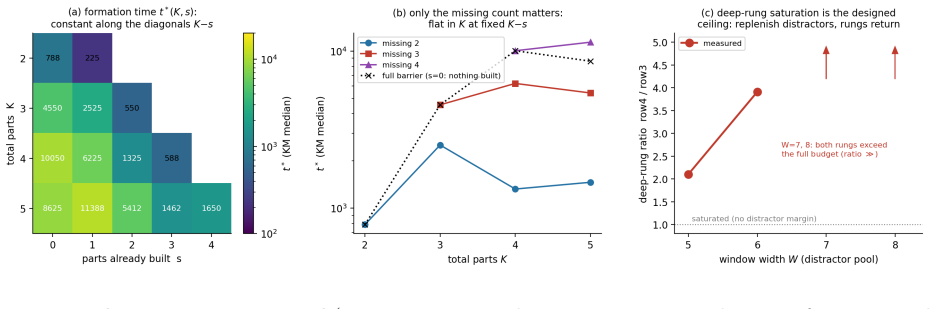
Run a genuinely subset-signal-free parity-style task at K = 5, 6, 7 and measure median formation time: the additive-barrier claim requires log median t* to grow linearly in K and requires rows of fixed missing-part count to stay flat in total K; if the ladder saturates or the rows climb with total size, the additive barrier is wrong. A second check: measure waiting-time shape in a deep-barrier cell — if the shape parameter stays far from memoryless (κ >> 1) where the theory requires κ → 1, the mixing premise fails.
If this is right
- Capability arrival can be dated before the capability is observable: a single attention-pattern precursor and the frozen constant C(K) predicted held-out models to a median 5% error, including across a different model family.
- Ignition can be scheduled: switching the data mixture above an intensive concentration floor triggered emergence in 10/10 runs, while no batch size ignited below the floor.
- Plasticity loss is not gradual degradation but a site-term death: aging past a critical step makes a capability permanently uninducible at fixed drive, even while validation loss falls smoothly.
- The same all-or-nothing structure is the repair guide: re-initializing only the query–key (score) slices of attention restored learnability in 6/6 cases, and value-slice resets were indistinguishable from doing nothing.
- If the rate law holds, standard validation-loss monitoring is structurally blind to the approach of the plasticity deadline; the measurable early-warning is attention commitment, not loss.
Where Pith is reading between the lines
- Editorial inference: If emergence is a barrier crossing rather than a scale effect, capability-timing laws should be written in terms of K and data concentration, not parameter count alone; scale would matter through its effect on β and site depletion.
- Editorial inference: The QK-reset result suggests a cheap continual-learning intervention — refreshing attention score subspaces of aged models instead of full resets or replay — though the paper demonstrates the mechanism only up to 1.4B parameters in two model families.
- Editorial inference: The intensive floor implies a practical reporting standard for data-mixing studies: report the target's share of gradient against a persistent competitor, not raw token fraction, or floors and throttles may be artifacts of the diluent's learnability.
Editorial analysis
A structured set of objections, weighed in public.
Referee Report
Summary. The paper argues that capability formation in transformers to 1.4B is rate-limited by a no-partial-credit joint-alignment step, governed by a driven-nucleation rate law J = N·ν·σ(c)·e^{-βK} − D (Eq. 1). It derives the exponential-in-K barrier from rare-event additivity plus SQ/leap theorems, measures each factor in controlled toy experiments and public Pythia/OLMo checkpoints, and reads the equation three ways: forward as emergence (a concentration floor, a throttle, and a precursor clock), backward as loss of plasticity (a waiting tax, a deadline, a located attention-commitment mechanism, and a QK-slice reset repair), and completed as temperature-based process control (annealing, selective melting, pinning). The paper is explicit that Assumption 1(b) — mixing within the pre-formation basin on the formation timescale — is unproved for transformer SGD, and that this assumption is the single unproved premise on which the nucleation-form propositions are conditional. It also reports withdrawn contaminated cells, a failed frozen prediction, and a deliberately retained negative result.
Significance. If the central claim holds, the paper would supply a quantitative, testable rate law that unifies emergence, plasticity loss, and circuit-level control in language models — a significant step beyond the existing equilibrium/phase-diagram picture. The paper's strengths are its experimental discipline: preregistered protocols, censoring-aware statistics, a public failure log, withdrawal of contaminated cells, explicit grading of proved/conditional/measured claims, and reproducible per-experiment JSON/scripts. The prospective clock validation with frozen constants, the intensive-floor experiments, and the QK/OV reset dissociation are genuinely informative regardless of the theoretical framing. The central limitation is that the rate-law reading rests on an unverified stochastic-analysis premise (Assumption 1(b)), and the direct empirical discrimination of the exponential form is narrow.
major comments (3)
- [§4.1, §6.1, §12] Assumption 1(b) (mixing) is load-bearing for the rate-law reading. The paper states it is not proved for transformer SGD (§4.1) and repeats in §12. The memorylessness test EK-1 is run only in the controlled toy, not on real checkpoints. The §6.1 clock validation compares mean/median ratios on 6/6 held-out models; a non-exponential deterministic process with the same ratio would also pass this test. Without mixing, Prop. 2's exponential waiting-time law and the nucleation interpretation lose their foundation, and Eq. (1) becomes an empirical interpolation. Please either (a) supply direct waiting-time distribution evidence on real checkpoints (e.g., repeated formation times from identical checkpoints, or a shape-parameter estimate), or (b) reframe the abstract and introduction so that the rate-law status is stated as conditional on an explicitly unverified premise, and not as an establishe
- [§4.3 Remark 5, §4.4] Direct-K measurements span K=2..4, over which the paper reports R²=0.980/0.978/0.989 for exponential/power/linear fits — locally indistinguishable. The exponential-in-K form is supported by SQ and leap theorems for the tested task class, but the empirical claim that the barrier grows exponentially with missing parts on real models is not directly discriminated over a wide K range. The wide-range evidence cited from Barak et al. is for sparse parity in a different setting, not for these transformers. Please extend the K ladder in a shortcut-free design (as the paper itself identifies as the highest-value experiment) or explicitly mark the exponential form on real models as theory-driven extrapolation rather than a direct measurement.
- [§6.1] The 'frozen constants' claim is weaker than stated. The clock constant C=1.241 is fit on five Pythia models, then tested on six held-out models, but five of those six are deduped-data variants of the same Pythia family; the cross-family test is a single OLMo-1B point. Given that β is family-dependent (Remark 4/5), the 'cross-family' language overstates the degree of out-of-family validation. Please report the exact composition of the held-out set and temper the wording, or add more out-of-family points.
minor comments (5)
- [Eq. (1) vs Prop. 7] The notation σ(c) for supersaturation conflicts with σ_i for link thresholds in Prop. 7. Consider renaming one of them.
- [App. A, Theorem 1] In the bound E[t_dead] ≲ (H−K+1)/(ρ_min p0), the quantity p0 is not defined before its first use in the proof chain. Please define it explicitly.
- [Fig. 2b / §4.4] The text reports β=1.75 but also withdraws the summed-design K≥3 cells as contaminated; Figure 2b's caption should make clear that this number is not a clean per-part increment.
- [§7.1] The phrase 'whose consequences need no mixing assumption' is correct but should not be read as 'needs no assumptions at all': Theorem 1 depends on the gated model's Assumption 4 (G1–G8), including oracle gating. The appendix is transparent, but the main text should remind the reader.
- [§8.2] The melt-threshold ratios '5.3–6.4×' and '2.5–6×' should specify whether these are ratios of injected-noise magnitudes at the same metric or ratios of some other quantity; clarify to avoid ambiguity.
Circularity Check
No significant circularity: Eq. (1)'s form is derived from external rare-event/SQ theorems, constants are frozen and tested on held-out models, and premises are explicitly flagged.
full rationale
The central rate law is not circular. The exponential-in-K form of Eq. (1) is derived in Proposition 1 from Assumptions 1–3, with the computational leg resting on external statistical-query and leap-complexity theorems (refs 18–23) rather than on the paper's own fitted values. The per-part constant β is explicitly treated as a measured material constant ('to be measured per system exactly as an activation energy is measured, not derived'), then frozen and used predictively; fitting a physical constant and testing it on never-run combinations is not the same as fitting the prediction itself. The clock constant C=1.241 was fit on five Pythia models, frozen, and evaluated on six held-out models plus cross-family OLMo; the paper states 'No circularity, twice over' and explains that the precursor head came from prior literature. Similarly, K is measured independently by single-checkpoint ablation without access to formation times, and the paper explicitly argues 'Nor is the count circular: K is measured by ablation at a single checkpoint, with no access to formation times.' The K=2/K=4 unification under one β is candidly labeled a separate, post-hoc consistency check, not counted as prospective. Assumption 1(b) (mixing for transformer SGD) is unproved and is flagged wherever used; an unproved premise is a scope condition, not a circular step, and the paper states that proving it would upgrade the conditional theorems. Self-citations to [25] appear as supplementary 'consistent prior evidence' or auxiliary measured constants, but the primary EK suite, the floor sweep, the QK-reset arms, and the from-scratch reproductions are direct measurements in this paper, including negative and withdrawn results that demonstrate falsifiability. No step reduces to its own inputs by construction.
Axiom & Free-Parameter Ledger
free parameters (6)
- beta (per-part barrier) =
0.23 (Pythia off-wall); 1.75 summed toy (withdrawn); >=2.40 parity toy
- C (clock constant) =
1.241 (Pythia)
- c0 (concentration floor) =
0.26 (70M), 0.20 (160M), ~0.17 (410M)
- gamma (drive exponent) =
0.62 +/- 0.01
- batch exponent =
-0.33
- epsilon0 (intrinsic noise scale) =
5e-4
axioms (6)
- domain assumption Assumption 1(b): mixing on the formation timescale (Freidlin–Wentzell quasi-stationary escape applies)
- domain assumption Assumption 2: simultaneous joint alignment (no partial credit)
- domain assumption Assumption 3: approximate part independence (mean-field prefactor factorization)
- ad hoc to paper Oracle gating (G6) in the gated-attention model
- standard math SQ/CSQ lower bounds and leap-complexity theorems for SGD on parities/conjunctions
- standard math Freidlin–Wentzell / Kramers large-deviation escape theory
read the original abstract
A capability appears in a language model when the last parts of its circuit align in one stochastic attempt, and getting all but one right is worth nothing. We show this no-partial-credit joint alignment is the rate-limiting step of capability formation. Two fingerprints: in a shortcut-free apparatus a five-part circuit missing three waits as long as a three-part circuit missing three (1.19-1.37), so the wait counts missing parts, not size; and on Pythia across seven capabilities and three scales, ablating one part leaves a median 17% of the capability in 32 of 32 discriminating cells, where partial credit predicts 50-83% (p = 2e-10), while a random non-part head leaves 100%. One rare event whose barrier grows with missing parts yields a rate equation -- sites x attempts x drive x exp(-beta*K), minus destruction -- read three ways, each preregistered with frozen constants. Forward: a capability flat at baseline ignites at a step of our choosing once the mix passes a concentration floor (10/10 above, 0/12 below), and while still flat its arrival is datable from its precursor to 5% median error on six held-out models. Backward: the delay to learn a withheld capability grows with waiting until, past a critical step, it never ignites -- yet validation loss falls smoothly throughout, so standard monitors are blind to it. We locate the damage (heads commit to the base data) and isolate the cure: re-initializing only the query-key slices restores learnability (6/6) while the value slices do nothing (0/6). We prove the mechanism in a controlled gated-attention model: occupation forces a deadline whose consequences need no mixing assumption. Completed: SGD's noise fails the fluctuation-dissipation test, so we install one and anneal, melt and pin circuits on schedule. Scope: conjunction circuits in transformers to 1.4B.
Figures


Reference graph
Works this paper leans on
-
[1]
Cambridge University Press, 2009
Sumio Watanabe.Algebraic Geometry and Statistical Learning Theory. Cambridge University Press, 2009
2009
-
[2]
The developmental landscape of in-context learning.arXiv preprint arXiv:2402.02364, 2024
Jesse Hoogland, George Wang, Matthew Farrugia-Roberts, Liam Carroll, Susan Wei, and Daniel Murfet. The developmental landscape of in-context learning.arXiv preprint arXiv:2402.02364, 2024. 36
Pith/arXiv arXiv 2024
-
[3]
Zhongtian Chen, Edmund Lau, Jake Mendel, Susan Wei, and Daniel Murfet. Dynamical versus bayesian phase transitions in a toy model of superposition.arXiv preprint arXiv:2310.06301, 2023
Pith/arXiv arXiv 2023
-
[4]
Xinran Gu, Kaifeng Lyu, Jiazheng Li, and Jingzhao Zhang. Data mixing can induce phase transitions in knowledge acquisition.arXiv preprint arXiv:2505.18091, 2026
Pith/arXiv arXiv 2026
-
[5]
Grokking as a first order phase transition in two layer networks
Noa Rubin, Inbar Seroussi, and Zohar Ringel. Grokking as a first order phase transition in two layer networks. InInternational Conference on Learning Representations, 2024
2024
-
[6]
Ibrahim Talha Ersoy and Karoline Wiesner. Noise-driven escape from metastable phases explains grokking in deep neural networks.arXiv preprint arXiv:2606.17120, 2026
Pith/arXiv arXiv 2026
-
[7]
Fernando Hernandez-Garcia, Qingfeng Lan, Parash Rahman, A
Shibhansh Dohare, J. Fernando Hernandez-Garcia, Qingfeng Lan, Parash Rahman, A. Rupam Mahmood, and Richard S. Sutton. Loss of plasticity in deep continual learning.Nature, 632: 768–774, 2024
2024
-
[8]
Ash and Ryan P
Jordan T. Ash and Ryan P. Adams. On warm-starting neural network training. InAdvances in Neural Information Processing Systems, 2020
2020
-
[9]
Disentangling the causes of plasticity loss in neural networks
Clare Lyle, Zeyu Zheng, Evgenii Nikishin, Bernardo Avila Pires, Razvan Pascanu, and Will Dabney. Disentangling the causes of plasticity loss in neural networks. InInternational Conference on Machine Learning, 2024
2024
-
[10]
Doremi: Optimizing data mixtures speeds up language model pretraining
Sang Michael Xie, Hieu Pham, Xuanyi Dong, et al. Doremi: Optimizing data mixtures speeds up language model pretraining. InAdvances in Neural Information Processing Systems, 2023
2023
-
[11]
Qian Liu, Xiaosen Zheng, Niklas Muennighoff, et al. Regmix: Data mixture as regression for language model pre-training.arXiv preprint arXiv:2407.01492, 2024
Pith/arXiv arXiv 2024
-
[12]
Jiasheng Ye, Peiju Liu, Tianxiang Sun, Yunhua Zhou, Jun Zhan, and Xipeng Qiu. Data mixing laws: Optimizing data mixtures by predicting language modeling performance.arXiv preprint arXiv:2403.16952, 2024
Pith/arXiv arXiv 2024
-
[13]
Predictability and surprise in large generative models
Deep Ganguli, Danny Hernandez, Liane Lovitt, et al. Predictability and surprise in large generative models. InACM Conference on Fairness, Accountability, and Transparency, 2022
2022
-
[14]
Pythia: A suite for analyzing large language models across training and scaling
Stella Biderman, Hailey Schoelkopf, Quentin Anthony, et al. Pythia: A suite for analyzing large language models across training and scaling. InInternational Conference on Machine Learning, 2023
2023
-
[15]
Olmo: Accelerating the science of language models.arXiv preprint arXiv:2402.00838, 2024
Dirk Groeneveld, Iz Beltagy, Pete Walsh, et al. Olmo: Accelerating the science of language models.arXiv preprint arXiv:2402.00838, 2024
Pith/arXiv arXiv 2024
-
[16]
Stochastic modified equations and adaptive stochastic gradient algorithms
Qianxiao Li, Cheng Tai, and Weinan E. Stochastic modified equations and adaptive stochastic gradient algorithms. InInternational Conference on Machine Learning, 2017
2017
-
[17]
Hoffman, and David M
Stephan Mandt, Matthew D. Hoffman, and David M. Blei. Stochastic gradient descent as approximate bayesian inference.Journal of Machine Learning Research, 18(134):1–35, 2017
2017
-
[18]
Efficient noise-tolerant learning from statistical queries.Journal of the ACM, 45(6):983–1006, 1998
Michael Kearns. Efficient noise-tolerant learning from statistical queries.Journal of the ACM, 45(6):983–1006, 1998. 37
1998
-
[19]
Weakly learning dnf and characterizing statistical query learning using fourier analysis
Avrim Blum, Merrick Furst, Jeffrey Jackson, Michael Kearns, Yishay Mansour, and Steven Rudich. Weakly learning dnf and characterizing statistical query learning using fourier analysis. InProceedings of the 26th Annual ACM Symposium on Theory of Computing (STOC), pages 253–262, 1994
1994
-
[20]
Edelman, Surbhi Goel, Sham Kakade, Eran Malach, and Cyril Zhang
Boaz Barak, Benjamin L. Edelman, Surbhi Goel, Sham Kakade, Eran Malach, and Cyril Zhang. Hidden progress in deep learning: Sgd learns parities near the computational limit. InAdvances in Neural Information Processing Systems, 2022
2022
-
[21]
The merged-staircase property: a necessary and nearly sufficient condition for sgd learning of sparse functions on two-layer neural networks
Emmanuel Abbe, Enric Boix-Adserà, and Theodor Misiakiewicz. The merged-staircase property: a necessary and nearly sufficient condition for sgd learning of sparse functions on two-layer neural networks. InConference on Learning Theory (COLT), 2022
2022
-
[22]
Sgd learning on neural networks: leap complexity and saddle-to-saddle dynamics
Emmanuel Abbe, Enric Boix-Adserà, and Theodor Misiakiewicz. Sgd learning on neural networks: leap complexity and saddle-to-saddle dynamics. InConference on Learning Theory (COLT), 2023
2023
-
[23]
Sgd finds then tunes features in two-layer neural networks with near-optimal sample complexity: A case study in the xor problem
Margalit Glasgow. Sgd finds then tunes features in two-layer neural networks with near-optimal sample complexity: A case study in the xor problem. InInternational Conference on Learning Representations (ICLR), 2024
2024
-
[24]
The benefit of reusing batches for gradient descent in two-layer networks: Breaking the curse of information and leap exponents
Yatin Dandi, Emanuele Troiani, Luca Arnaboldi, Luca Pesce, Lenka Zdeborová, and Florent Krzakala. The benefit of reusing batches for gradient descent in two-layer networks: Breaking the curse of information and leap exponents. InInternational Conference on Machine Learning (ICML), 2024
2024
-
[25]
Lei Dong. Circuits crystallize: A nucleation theory of whether, when, and how conjunction circuits form, compete, and regenerate. Zenodo, doi:10.5281/zenodo.21253471, 2026
-
[26]
Freidlin and Alexander D
Mark I. Freidlin and Alexander D. Wentzell.Random Perturbations of Dynamical Systems. Springer, 3rd edition, 2012
2012
-
[27]
Springer, 2nd edition, 1998
Amir Dembo and Ofer Zeitouni.Large Deviations Techniques and Applications. Springer, 2nd edition, 1998
1998
-
[28]
Hendrik A. Kramers. Brownian motion in a field of force and the diffusion model of chemical reactions.Physica, 7(4):284–304, 1940
1940
-
[29]
Online stochastic gradient descent on non-convex losses from high-dimensional inference.Journal of Machine Learning Research, 22(106):1–51, 2021
Gérard Ben Arous, Reza Gheissari, and Aukosh Jagannath. Online stochastic gradient descent on non-convex losses from high-dimensional inference.Journal of Machine Learning Research, 22(106):1–51, 2021
2021
-
[30]
Stochastic gradient descent performs variational in- ference, converges to limit cycles for deep networks.International Conference on Learning Representations, 2018
Pratik Chaudhari and Stefano Soatto. Stochastic gradient descent performs variational in- ference, converges to limit cycles for deep networks.International Conference on Learning Representations, 2018
2018
-
[31]
Thermodynamic irreversibility of training algorithms.arXiv preprint arXiv:2605.21933, 2026
Liu Ziyin, Yizhou Ren, Herbert Levine, and Isaac Chuang. Thermodynamic irreversibility of training algorithms.arXiv preprint arXiv:2605.21933, 2026
Pith/arXiv arXiv 2026
-
[32]
In-context learning and induction heads.Transformer Circuits Thread, 2022
Catherine Olsson, Nelson Elhage, Neel Nanda, Nicholas Joseph, et al. In-context learning and induction heads.Transformer Circuits Thread, 2022. 38
2022
-
[33]
Martin V. Day. On the exponential exit law in the small parameter exit problem.Stochastics, 8(4):297–323, 1983
1983
-
[34]
Springer, 2015
Anton Bovier and Frank den Hollander.Metastability: A Potential-Theoretic Approach. Springer, 2015
2015
-
[35]
The fluctuation-dissipation theorem.Reports on Progress in Physics, 29(1):255–284, 1966
Rep Kubo. The fluctuation-dissipation theorem.Reports on Progress in Physics, 29(1):255–284, 1966
1966
-
[36]
Itamar Lavie, Kirsten Fischer, Stefan Lekov, Ward Van Maele, Zohar Ringel, and Moritz Helias. Phase transitions in attention: A bayesian theory of copy head emergence.arXiv preprint arXiv:2606.12058, 2026
Pith/arXiv arXiv 2026
-
[37]
Vedang Baherwani, Yifei Chen, Shikai Qiu, Andrew Gordon Wilson, and Pavel Izmailov. Emergent capabilities arise randomly from learning sparse attention patterns.arXiv preprint arXiv:2606.25010, 2026
Pith/arXiv arXiv 2026
-
[38]
Hitting-time and occupation-time bounds implied by drift analysis with applica- tions.Advances in Applied Probability, 14(3):502–525, 1982
Bruce Hajek. Hitting-time and occupation-time bounds implied by drift analysis with applica- tions.Advances in Applied Probability, 14(3):502–525, 1982
1982
-
[39]
The dormant neuron phenomenon in deep reinforcement learning
Ghada Sokar, Rishabh Agarwal, Pablo Samuel Castro, and Utku Evci. The dormant neuron phenomenon in deep reinforcement learning. InInternational Conference on Machine Learning, 2023
2023
-
[40]
Clare Lyle, Ghada Sokar, Razvan Pascanu, and András György. What can grokking teach us about learning under nonstationarity?arXiv preprint arXiv:2507.20057, 2026
Pith/arXiv arXiv 2026
-
[41]
Grokfast: Accelerated grokking by amplifying slow gradients
Jaerin Lee, Bong Gyun Kang, Kihoon Kim, and Kyoung Mu Lee. Grokfast: Accelerated grokking by amplifying slow gradients. InarXiv preprint arXiv:2405.20233, 2024
Pith/arXiv arXiv 2024
-
[42]
Kinetics of phase change
Melvin Avrami. Kinetics of phase change. i: General theory.Journal of Chemical Physics, 7 (12):1103–1112, 1939
1939
-
[43]
Driven alloys.Solid State Physics, 50:189–331, 1996
Georges Martin and Pascal Bellon. Driven alloys.Solid State Physics, 50:189–331, 1996
1996
-
[44]
Laidler.Chemical Kinetics
Keith J. Laidler.Chemical Kinetics. Harper & Row, 3rd edition, 1987
1987
-
[45]
Porter and Kenneth E
David A. Porter and Kenneth E. Easterling.Phase Transformations in Metals and Alloys. Chapman & Hall, 2nd edition, 1992
1992
-
[46]
Fine-tuning aligned language models compromises safety, even when users do not intend to!International Conference on Learning Representations, 2024
Xiangyu Qi, Yi Zeng, Tinghao Xie, et al. Fine-tuning aligned language models compromises safety, even when users do not intend to!International Conference on Learning Representations, 2024
2024
-
[47]
Tatsuya Aoyama, Ethan Wilcox, and Nathan Schneider. Predicting the emergence of induction heads in language model pretraining.arXiv preprint arXiv:2511.16893, 2025
Pith/arXiv arXiv 2025
-
[48]
Emergent abilities of large language models
Jason Wei, Yi Tay, Rishi Bommasani, et al. Emergent abilities of large language models. Transactions on Machine Learning Research, 2022
2022
-
[49]
Are emergent abilities of large language models a mirage? InAdvances in Neural Information Processing Systems, 2023
Rylan Schaeffer, Brando Miranda, and Sanmi Koyejo. Are emergent abilities of large language models a mirage? InAdvances in Neural Information Processing Systems, 2023. 39
2023
-
[50]
A mathematical framework for transformer circuits.Transformer Circuits Thread, 2021
Nelson Elhage, Neel Nanda, Catherine Olsson, et al. A mathematical framework for transformer circuits.Transformer Circuits Thread, 2021
2021
-
[51]
The mechanistic basis of data dependence and abrupt learning in an in-context classification task.International Conference on Learning Representations, 2024
Gautam Reddy. The mechanistic basis of data dependence and abrupt learning in an in-context classification task.International Conference on Learning Representations, 2024
2024
-
[52]
Singh, Stephanie C
Aaditya K. Singh, Stephanie C. Y. Chan, Ted Moskovitz, Erin Grant, Andrew M. Saxe, and Felix Hill. The transient nature of emergent in-context learning in transformers.Advances in Neural Information Processing Systems, 2023
2023
-
[53]
Fluctuation-dissipation relations for stochastic gradient descent
Sho Yaida. Fluctuation-dissipation relations for stochastic gradient descent. InInternational Conference on Learning Representations, 2019
2019
-
[54]
Le, Ilya Sutskever, Lukasz Kaiser, Karol Kurach, and James Martens
Arvind Neelakantan, Luke Vilnis, Quoc V. Le, Ilya Sutskever, Lukasz Kaiser, Karol Kurach, and James Martens. Adding gradient noise improves learning for very deep networks.arXiv preprint arXiv:1511.06807, 2015
Pith/arXiv arXiv 2015
-
[55]
Singh, Ted Moskovitz, Felix Hill, Stephanie C
Aaditya K. Singh, Ted Moskovitz, Felix Hill, Stephanie C. Y. Chan, and Andrew M. Saxe. What needs to go right for an induction head? a mechanistic study of in-context learning circuits and their formation.International Conference on Machine Learning, 2024
2024
-
[56]
Have you tried thinking about it as crystals? LessWrong, December 2025, 2025
Jonas Hallgren. Have you tried thinking about it as crystals? LessWrong, December 2025, 2025. 40
2025
discussion (0)
Sign in with ORCID, Apple, or X to comment. Anyone can read and Pith papers without signing in.