REVIEW 4 major objections 5 minor 42 references
Integrable model of a $p$-wave bosonic superfluid
T0 review · 4 major / 5 minor · reviewed 2026-08-14 · deepseek-v4-flash
Pith's one-line read An exactly solvable two-species p-wave bosonic pairing model has a third-order quantum phase transition from a fragmented singlet-pair condensate to a gapped pair Bose superfluid, with a Bose Moore-Read pair condensate at the critical…
desk verdict New exactly solvable p-wave bosonic pairing model with a third-order transition and a Bose Moore-Read critical state; the finite-size solution is solid, but the thermodynamic-limit reduction needs real work. read the letter →
The pith
A machine-rendered reading of the paper's core claim, the machinery that carries it, and where it could break.
The reading
What carries the argument
The engine is the hyperbolic su(1,1) Richardson-Gaudin integrability structure built from singlet-pair operators $K^+_k = b^\dagger_k a^\dagger_{-k} - a^\dagger_k b^\dagger_{-k}$, which create pairs with opposite momenta and opposite pseudo-spin. The commuting integrals of motion in Eq. (2) combine linearly into the Hamiltonian of Eq. (7), so every eigenstate is a Richardson state (4) labelled by spectral parameters $e_\alpha$ (the pairons) that solve Richardson equations (3). In the thermodynamic limit these equations reduce to the boson gap and number equations (13)-(14), and it is this reduction that yields the critical coupling, the Volovik line, and the third-order discontinuity of the energy density.
What would settle it
Solve the full Richardson equations (3) for increasing $M$ and $L$ at fixed density $\rho$ and large $gL$, and compare the resulting ground-state energy density with the thermodynamic formula (15) using the $\mu \approx -\gamma_1 g$, $\Delta \approx \gamma_2 g$ branch. If no solution with $4\gamma_2^2 < \gamma_1^2$ exists for some $g$, or if the exact energy density departs from the third-order behavior of Eq. (16), the predicted pair superfluid phase and transition order would be ruled out.
Extended reading notes
Core claim
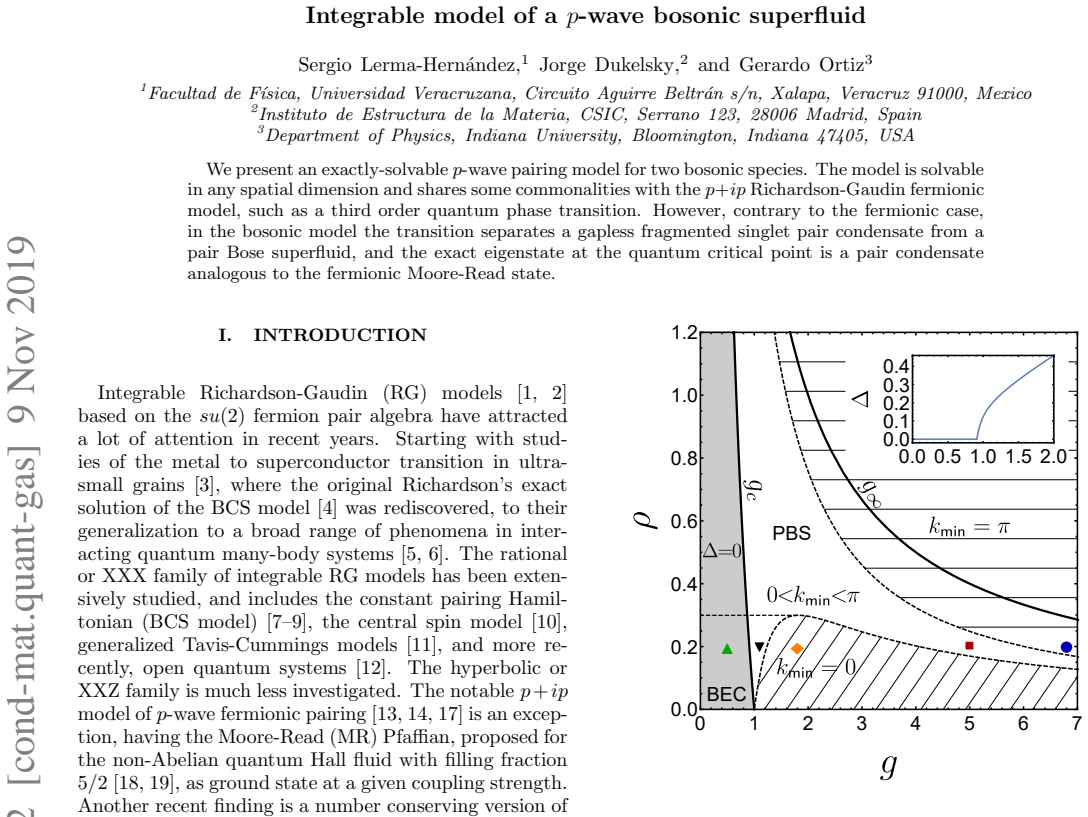
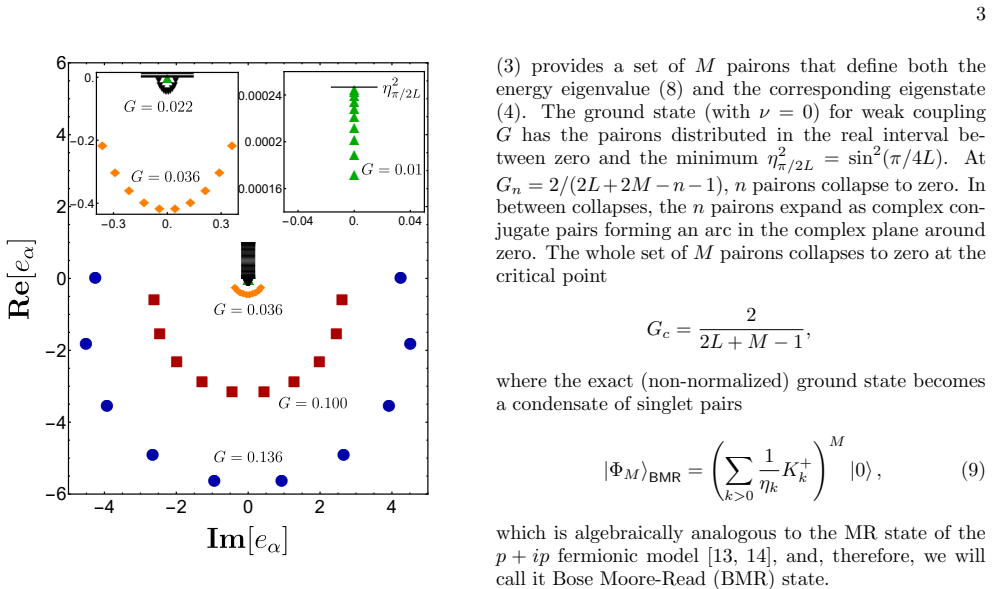
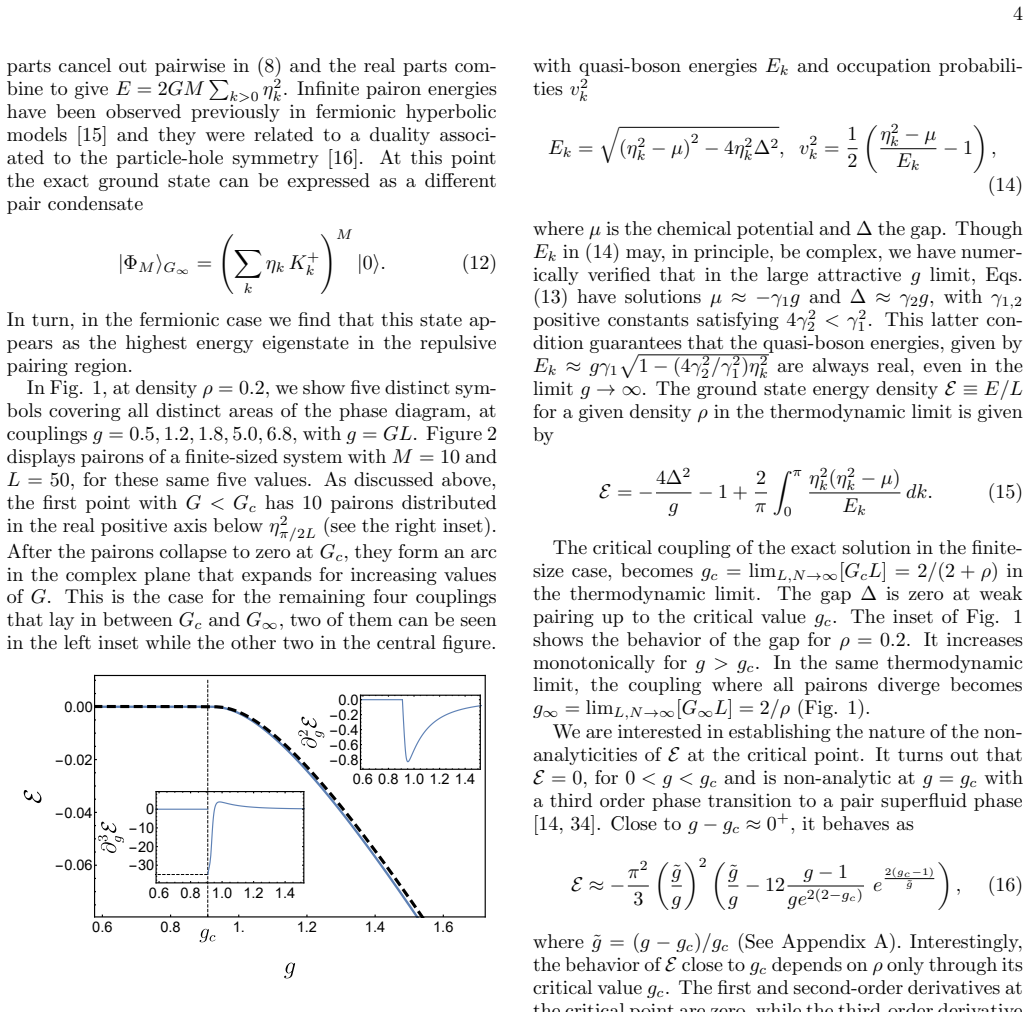
The central claim is that the Hamiltonian of Eq. (6), with single-particle dispersion $\sin^2(k/2)$ and two-body p-wave attraction $G$, is exactly integrable and its ground state changes character at a critical coupling. In the balanced, zero-momentum sector the weak-coupling phase, $0 \le g < g_c$, is a gapless fragmented singlet-pair condensate whose occupation sits at the lowest finite momentum $\pm k_{\min}$; at $g_c = 2/(2+\rho)$ in the thermodynamic limit ($G_c = 2/(2L+M-1)$ in finite size) all pairons collapse to zero energy and the exact ground state is the Bose Moore-Read pair condensate of Eq. (9). Above $g_c$ the ground state is a gapped pair Bose superfluid, and the ground-state energy density is non-analytic at $g_c$ with vanishing first and second derivatives and a discontinuous third derivative. The superfluid quasiboson dispersion has three regimes, with the minimum at $k=0$, at $0<k<\pi$, or at $k=\pi$, separated by the Volovik line and the line $\mu + 2\Delta^2 = 1$.
Load-bearing premise
The load-bearing premise is that the exact Richardson equations reduce to the boson gap and number equations (13) as $N$ and $L$ go to infinity at fixed density, and that for large attractive coupling those equations have the real branch $\mu \approx -\gamma_1 g$, $\Delta \approx \gamma_2 g$ with $4\gamma_2^2 < \gamma_1^2$; the paper reports numerical verification but no proof of this branch.
Editorial extensions
If this is right
- Below the critical coupling $g_c$, the ground state is gapless and macroscopically occupied at the lowest nonzero momentum pair states, not at zero momentum.
- At $g_c$ the full set of pairons collapses to zero energy and the exact ground state is the Bose Moore-Read pair condensate, an algebraic bosonic counterpart of the fermionic Moore-Read state.
- Above $g_c$ the system is a gapped pair Bose superfluid, and the energy density is non-analytic at $g_c$: the first two derivatives are continuous and the third derivative jumps.
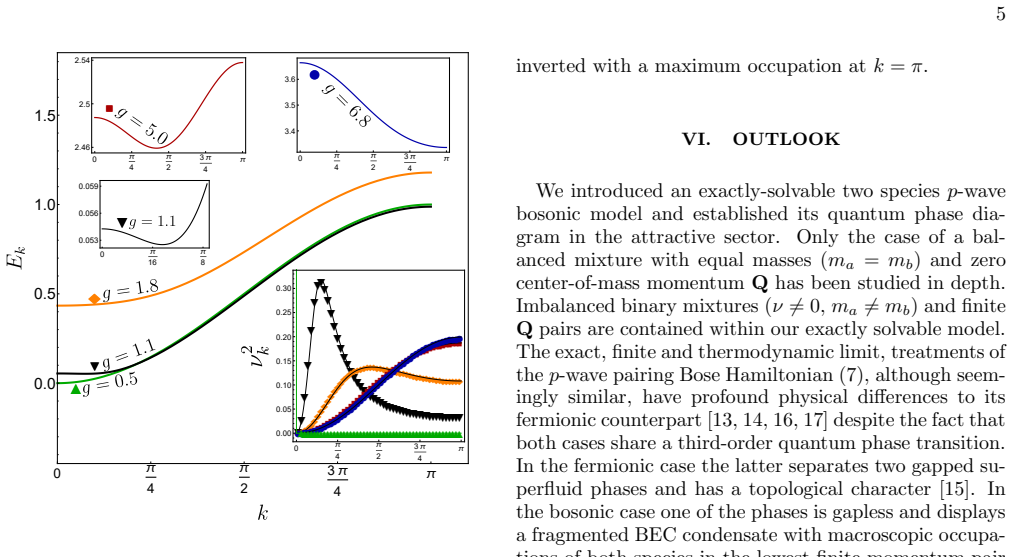
- The quasiboson dispersion in the superfluid phase has three shapes, with its minimum at $k=0$ for weak densities, at intermediate $k$ in a broad region, and at $k=\pi$ for strong coupling; the boundary of the first region is the Volovik line.
- Because the construction is integrable in any dimension and includes imbalanced mixtures and finite center-of-mass momentum pairs, the phase diagram is not restricted to the one-dimensional balanced case studied in detail.
Reading between the lines
- The same hyperbolic su(1,1) machinery with $Q \neq 0$ likely yields exactly solvable finite-momentum-pair (Larkin-Ovchinnikov-type) bosonic phases; the paper notes the algebra is available but does not map that regime.
- The Bose Moore-Read critical state could serve as a fixed-point ansatz for perturbative studies of p-wave bosonic droplets; the paper says the pair superfluid phase is a candidate quantum liquid but does not establish self-binding.
- In the fermionic $p+ip$ case the analogous $k=0$ occupation jump is tied to a topological transition, so an open question this paper leaves implicit is whether the bosonic jump at $g_c$ also carries topological or geometric meaning.
- A direct experimental test would be Bragg spectroscopy of the quasiboson minimum: crossing the Volovik line should shift $k_{\min}$ discontinuously, a signature that does not depend on the fine details of the trap.
Signed reviews
Editorial analysis
A structured set of objections, weighed in public.
Referee Report
Summary. The paper constructs an exactly solvable two-species bosonic p-wave pairing Hamiltonian by taking a linear combination of known hyperbolic su(1,1) Richardson-Gaudin integrals of motion. The finite-size exact solution is obtained from the Richardson equations, and the ground state is tracked as a function of coupling. The authors claim that for 0≤G<Gc the system is a gapless fragmented singlet-pair condensate, that at the critical coupling Gc=2/(2L+M−1) the exact ground state is a Bose analog of the Moore-Read state, and that for G>Gc the system is a gapped pair Bose superfluid. In the thermodynamic limit, the Richardson equations are asserted to reduce to boson gap and number equations (13), from which the phase diagram, the Volovik line, and a third-order quantum phase transition are derived. The paper also claims that the construction extends to any spatial dimension.
Significance. If the claims hold, this is a valuable addition to the small family of exactly solvable bosonic pairing models. The finite-size solution is an honest Richardson-Gaudin solution: the Hamiltonian is built from commuting su(1,1) invariants, the eigenstates are explicitly constructed, and the energy formula (8) follows directly from the Richardson equations. The identification of the ground state at Gc as a bosonic Moore-Read-type pair condensate, and the contrast with the fermionic p+ip model, are conceptually interesting and falsifiable. The main novelty—the phase diagram with a gapless fragmented phase and a gapped pair superfluid separated by a third-order transition—rests on the thermodynamic-limit reduction in Section IV, which is asserted rather than derived. The paper also gives credit where due by comparing with known fermionic results and by providing a finite-size check in Fig. 3. However, the absence of a derivation or verification of the thermodynamic-limit reduction and of the large-coupling asymptotic branch leaves the central quantitative claims under-supported.
major comments (4)
- [Section IV, Eq. (13)] The reduction of the Richardson equations (3) to the boson gap and number equations (13) is stated without derivation or supporting data. The reduction is not uniform in the gapless phase: for g<gc with Δ=0 and μ=0, Eq. (13) gives v_k^2=0 for all k and hence ρ=0, whereas the phase diagram in Fig. 1 assigns a finite density ρ to this region. The macroscopic occupation of the kmin state in the fragmented condensate must contribute a singular term to the number equation that is not present in Eq. (13). The paper needs to specify how this singular contribution emerges from the Richardson pairon distribution and to justify the claimed limit.
- [Section IV, paragraph after Eq. (14)] The large-coupling branch μ≈−γ1g, Δ≈γ2g with 4γ2^2<γ1^2 is described as 'numerically verified,' but no numerical data, convergence criterion, or analytic argument is shown. This branch is load-bearing because it guarantees real quasi-boson energies for all k, determines the Volovik line μ+2Δ^2=0, the g∞ divergence, and the overall shape of the phase diagram. The authors should provide either a derivation of the asymptotic behavior from Eqs. (13) or a reproducible numerical verification with residuals.
- [Appendix A and Eq. (16)] The third-order nonanalyticity of E(g) is derived from the thermodynamic-limit equations (A1)-(A9), so it inherits the gap identified in the previous two comments. In addition, the expansion (A7)-(A8) assumes a specific ordering of μ, Δ, and a=μ+2Δ^2 as δ→0+; the paper should show that this ordering is the unique physical branch selected by the original finite-size equations as L→∞. Without this, the claimed universal third derivative −2π^2/gc^6 is not established.
- [Abstract and Section II] The claim that the model is solvable in any spatial dimension is asserted in the abstract and in Section II ('It is straightforward to extend our model to higher dimensions') but no higher-dimensional Hamiltonian, single-particle dispersion, or su(1,1) construction is provided. Since the entire analysis uses η_k=sin(k/2) on a one-dimensional chain, the dimensional generalization should either be demonstrated explicitly or the claim should be softened to a conjecture. This is part of the paper's advertised scope and needs support.
minor comments (5)
- [Section IV, after Eq. (13)] In the sentence 'This latter condition guarantees that the quasi-boson energies ... are always real, even in the limit g→∞,' the text should state whether the condition 4γ2^2<γ1^2 is verified for all ρ or only for the numerically checked cases.
- [Section III, Eq. (12)] The pair condensate at G∞ is written as (∑_k η_k K_k^+)^M|0⟩, but the earlier sums are restricted to k>0; the notation in Eq. (12) should be made consistent with the earlier k>0 convention.
- [Section IV, Eq. (16) and Appendix A] The exponential factors in Eq. (16) and Eq. (A9) are typeset ambiguously; a reader cannot tell whether the last factor is e^{2(gc−1)}/g̃ or e^{2(gc−1)/g̃}. The formula should be rewritten with clear parentheses.
- [Supplemental material, Ref. [31]] The Supplemental Material reference contains a publisher URL placeholder; the authors should provide an accessible link or archive identifier.
- [Section V, Fig. 4] The caption mentions 'g = 1.1' in the inset but the list of five couplings in the main text is g = 0.5, 1.2, 1.8, 5.0, 6.8; the caption should be aligned with the displayed data.
Circularity Check
No significant circularity: the model is integrable by construction, and the phase diagram, critical coupling, and third-order transition follow from the Richardson equations rather than from fitted inputs or circular self-citations.
full rationale
The paper's central solvability claim is a construction, not a prediction: the Hamiltonian in Eq. (7) is explicitly written as a linear combination of the su(1,1) integrals of motion (2), so exact solvability by Richardson-Gaudin methods is guaranteed by design. This is a valid way to build an integrable model, not a circular derivation. The substantive results, including the critical coupling Gc = 2/(2L+M-1), the Bose Moore-Read condensate at criticality, the gapless fragmented phase for g < gc, and the gapped pair Bose superfluid for g > gc, are obtained by solving the Richardson equations (3) and their thermodynamic-limit counterparts (13)-(15), rather than by fitting parameters to the quantities being predicted. The finite-size pairon trajectories in Fig. 2 and the asymptotic analysis in Appendix A provide independent checks of the thermodynamic-limit claims. Some references, such as [2], [6], [8], [14], and [34], include the present authors, but the load-bearing arguments do not reduce to those citations: the integrable structure is a standard algebraic result, and the third-order nonanalyticity is re-derived directly through Eq. (A9) rather than merely imported. The main weak point is that the reduction of the Richardson equations to the boson gap and number equations (13) in the thermodynamic limit is asserted rather than derived in detail, and the large-g solution mu ≈ -gamma1 g, Delta ≈ gamma2 g with 4 gamma2^2 < gamma1^2 is described as numerically verified without displayed verification. That is a technical gap or a robustness concern, not a circular step, because the finite-size exact solution and the explicit asymptotic calculation are independent of the conclusions they support. No step was found in which a fitted input is renamed a prediction, a uniqueness theorem from prior work forces the model choice, or a known result is merely relabeled as a new finding.
Assumptions & free parameters
assumptions (5)
- standard math The hyperbolic su(1,1) integrals of motion R_k in Eq. (2) are integrable and have the eigenvalues r_k stated in the text.
- domain assumption The su(1,1) algebra realization with kx>0 restriction and antiperiodic boundary conditions avoids double counting and spans the Brillouin zone.
- domain assumption In the thermodynamic limit the Richardson equations reduce to the boson gap and number equations (13).
- ad hoc to paper For large attractive g, Eqs. (13) have solutions mu approx -gamma1 g and Delta approx gamma2 g with 4 gamma2^2 < gamma1^2.
- ad hoc to paper The model is solvable in any spatial dimension by a straightforward extension of the 1D construction.
Cite this review
Pith. "Pith review of Integrable model of a $p$-wave bosonic superfluid." pith.science (2026). https://pith.science/paper/HUY2DI4A
@misc{pith2026190802821,
  author       = {Pith},
  title        = {Pith review of: Integrable model of a $p$-wave bosonic superfluid},
  year         = {2026},
  howpublished = {\url{https://pith.science/paper/HUY2DI4A}},
  note         = {Machine review of arXiv:1908.02821}
}
abstract
We present an exactly-solvable $p$-wave pairing model for two bosonic species. The model is solvable in any spatial dimension and shares some commonalities with the $p + ip$ Richardson-Gaudin fermionic model, such as a third order quantum phase transition. However, contrary to the fermionic case, in the bosonic model the transition separates a gapless fragmented singlet pair condensate from a pair Bose superfluid, and the exact eigenstate at the quantum critical point is a pair condensate analogous to the fermionic Moore-Read state.
Figures
Figures from the paper (1 more)
Reference graph
Works this paper leans on
-
[1]
This latter con- dition guarantees that the quasi-boson energies, given by Ek≈ gγ1 √ 1− (4γ2 2/γ2 1)η2 k are always real, even in the limit g→∞ . The ground state energy density E≡ E/L for a given densityρ in the thermodynamic limit is given by E =−4∆2 g − 1 + 2 π ∫ π 0 η2 k(η2 k−µ) Ek dk. (15) The critical coupling of the exact solution in the finite- siz...
-
[2]
Dukelsky, C
J. Dukelsky, C. Esebbag, and P. Schuck, Phys. Rev. Lett. 87, 066403 (2001)
2001
-
[3]
For µ + 2∆2 ≥ 1 (area with horizontal lines in Fig
The previous condition is fulfilled for any density, and gives the form of the quasi-boson dispersion immediately after the quantum phase transition. For µ + 2∆2 ≥ 1 (area with horizontal lines in Fig. 1), the quasi-boson dispersion is a monotonous decreasing function with min- imum at kmin =π (g = 6.8). The occupation probabilities in momentum space are d...
- [4]
-
[5]
Dukelsky, S
J. Dukelsky, S. Pittel, and G. Sierra, Rev. Mod. Phys. 76, 643 (2004)
2004
- [6]
-
[7]
R. W. Richardson, Phys. Lett. 3, 277 (1963)
work page 1963
- [8]
Show all 42 references
-
[9]
for fermionic systems. In terms of the su(1,1) generators (1), the hyperbolic integrals of motion for Q = 0 are [2, 6] Rk = Kz k− 2λ ∑ k′(⁄=k)>0 [ ηkηk′ η2 k−η2 k′ ( K + kK− k′ +K− kK + k′ ) −η2 k +η2 k′ η2 k−η2 k′ Kz kKz k′ ] , (2) where ηk are arbitrary odd functions of k. T...
-
[10]
Ortiz, R
G. Ortiz, R. Somma, J. Dukelsky, and S. M. A. Rom- bouts, Nucl. Phys. B 707, 421 (2005)
2005
-
[11]
R. W. Richardson, Phys. Rev. 141, 949 (1966)
1966
-
[12]
Dukelsky, G
J. Dukelsky, G. Ortiz, S. M. A. Rombouts, and K. Van Houcke, Phys. Rev. Lett. 96, 180404 (2006)
2006
-
[13]
Bortz, S
M. Bortz, S. Eggert, and J. Stolze, Phys. Rev. B 81, 035315 (2010)
2010
-
[14]
Dukelsky, G
J. Dukelsky, G. G. Dussel, C. Esebbag, and S. Pittel, Phys. Rev. Lett. 93, 050403 (2004)
2004
-
[15]
D. A. Rowlands, and A. Lamacraft, Phys. Rev. Lett.120, 090401 (2018). 7
2018
-
[16]
M. I. Iba˜ nez, J. Links, G. Sierra, and S. Y. Zhao, Phys. Rev. B 79, 180501(R) (2009)
2009
-
[17]
S. M. A. Rombouts, J. Dukelsky, and G. Ortiz, Phys. Rev. B 82, 224510 (2010)
2010
-
[18]
Ortiz, J
G. Ortiz, J. Dukelsky, E. Cobanera, C. Esebbag, and C. Beenakker, Phys. Rev. Lett. 113, 267002 (2014)
2014
-
[19]
Links, I
J. Links, I. Marquette, and A. Moghaddam, J. Phys. A: Math. Theor. 48 (2015) 374001
2015
-
[20]
Van Raemdonck, S
M. Van Raemdonck, S. De Baerdemacker, and D. Van Neck, Phys. Rev. B 89, 155136 (2014)
2014
-
[21]
Moore and N
G. Moore and N. Read, Nucl. Phys. B 360, 362 (1991)
1991
-
[22]
Read and D
N. Read and D. Green, Phys. Rev. B 61, 10267 (2000)
2000
-
[23]
Ortiz, Z
G. Ortiz, Z. Nussinov, J. Dukelsky, and A. Seidel, Phys. Rev. B 88, 165303 (2013)
2013
-
[24]
R. W. Richardson, J. Math. Phys. 9, 1327 (1967)
1967
-
[25]
Dukelsky and P
J. Dukelsky and P. Schuck, Phys. Rev. Lett. 86, 4207 (2001)
2001
-
[26]
Pan and J
F. Pan and J. P. Draayer, Nucl. Phys. A 636, 156 (1998)
1998
-
[27]
Dukelsky and S
J. Dukelsky and S. Pittel, Phys. Rev. Lett. 86, 4791 (2001)
2001
-
[28]
Pan and J
F. Pan and J. P. Draayer, Phys. Lett. B 451, 1 (1999)
1999
-
[29]
S. Lerma H. and J. Dukelsky, Nucl. Phys. B 870, 421 (2013)
2013
-
[30]
S. Papp, J. Pino, and C. Wieman, Phys. Rev. Lett. 101, 040402 (2008)
2008
-
[31]
S. Dong, Y. Cui, C. Shen, Y. Wu, M. K. Tey, L. You, and B. Gao, Phys. Rev. A 94, 062702 (2016)
2016
-
[32]
Radzihovsky and S
L. Radzihovsky and S. Choi, Phys. Rev. Lett. 103, 095302 (2009)
2009
- [33]
-
[34]
See Supplemental Material at [URL will be inserted by publisher] for an animation of the pairons evolution as a function of coupling strength
-
[35]
A. B. Kuklov and B.V. Svistunov, Phys. Rev. Lett. 89, 170403 (2002)
2002
-
[36]
Ashhab and A
S. Ashhab and A. J. Leggett, Phys. Rev. A 68, 063612 (2003)
2003
-
[37]
Lerma H., S
S. Lerma H., S. M. A. Rombouts, J. Dukelsky, and G. Ortiz, Phys. Rev. B 84, 100503(R) (2011)
2011
-
[38]
Stouten, P
E. Stouten, P. W. Claeys, J.-S. Caux, and V. Gritsev, Phys. Rev. B 99, 075111 (2019)
2019
-
[39]
D. S. Petrov, Phys. Rev. Lett. 115, 155302 (2015)
2015
-
[40]
Kadau et
H. Kadau et. al., Nature 530, 194 (2016)
2016
-
[41]
Semeghini et
G. Semeghini et. al. , Phys. Rev. Lett. 120, 235301 (2018)
2018
-
[42]
C. R. Cabrera et. al., Science 359, 301 (2018)
2018
Reviewed August 14, 2026 · model on record in the stance chip above.
Discussion (0). Continue with ORCID to comment.