REVIEW 3 major objections 4 minor 1 cited by
G1: Teaching LLMs to Reason on Graphs with Reinforcement Learning
T0 review · 3 major / 4 minor · reviewed 2026-08-07 · deepseek-v4-flash
Pith's one-line read Reinforcement learning on synthetic graph problems can turn a 3B LLM into a stronger graph reasoner than a 72B model, and the skill transfers zero-shot to larger graphs and real-world tasks.
desk verdict G1 is a well-executed first application of RLVR/GRPO to LLM graph reasoning with open-sourced code and a large synthetic benchmark, but the headline Erdős numbers rest on a train/test decontamination check that the paper never reports. read the letter →
The pith
A machine-rendered reading of the paper's core claim, the machinery that carries it, and where it could break.
The reading
What carries the argument
The load-bearing object is the Erdős dataset combined with a rule-based reward model. Erdős contains 50 NetworkX graph-theoretic tasks with 2,000 training questions each, generated as random-walk-with-restart subgraphs of real-world graphs with 5 to 35 nodes, with answers produced by library solvers and by algorithmic verifiers. The reward is not a learned judge: it is strict value matching for unique answers, Jaccard index for set answers, and algorithmic verification for answers with multiple valid solutions. GRPO uses these rewards to compute group-relative advantages, which is what turns correct and incorrect rollouts into a training signal without human annotations.
What would settle it
Re-run the benchmark with train subgraphs and test subgraphs drawn from disjoint source graphs, or at least node-disjoint subgraphs, and recompute hard-task labels with independently verified exact solvers; if the accuracy gap over base models collapses or the labels differ, the claimed scaling is partly in-distribution alignment rather than learned graph reasoning.
Extended reading notes
Core claim
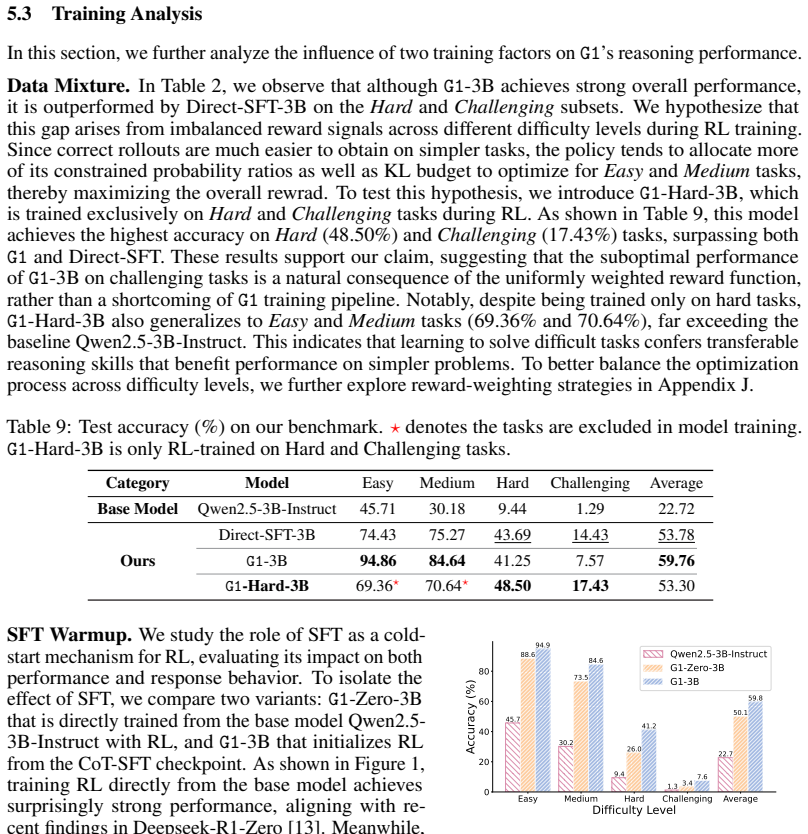
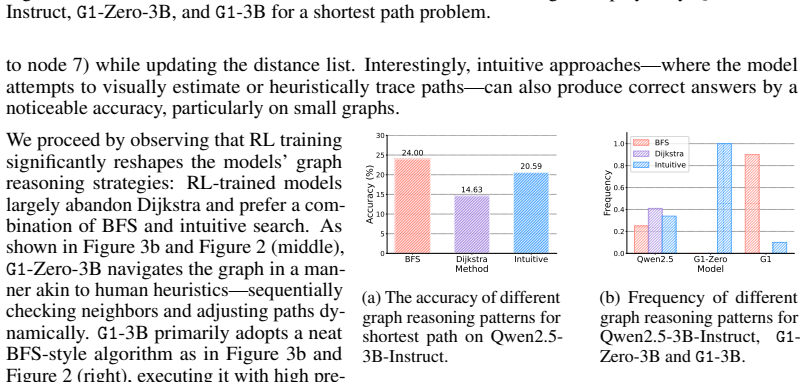
Reinforcement learning from verifiable rewards on synthetic graph-theoretic problems can elicit substantial graph reasoning ability from pretrained LLMs as small as 3B parameters, and the elicited ability transfers beyond the training distribution. The paper's central evidence is that RL-trained G1-7B reaches 66.16% average accuracy on the 50-task Erdős benchmark, close to o3-mini's 64.90%, while G1-3B reaches 59.76% and beats Qwen2.5-72B-Instruct (47.16%) with roughly 24x fewer parameters. RL also shifts solution strategy: on shortest path the models move from brittle Dijkstra-style bookkeeping toward BFS and heuristic tracing, and the authors show that CoT-SFT warm-up mainly helps the hardest tasks. The authors interpret these results as showing that LLMs already contain graph understanding from pretraining, and that RL is what activates it.
Load-bearing premise
The accuracy numbers assume the 100,000 training questions and the 5,000 test questions are independent, but both are downsampled from the same real-world source graphs by random walk with restart and the paper does not describe a disjoint split; they also assume the library's default solvers give correct labels for NP-hard tasks.
Editorial extensions
If this is right
- A 3B model trained this way surpasses a 72B instruction model on graph reasoning, so model scale is not the binding constraint for graph tasks if suitable RL data is available.
- Graph reasoning learned on 5-35 node subgraphs transfers zero-shot to 36-100 node graphs, suggesting the trained skill is structural rather than tied to a particular graph size.
- Training on one edge-list encoding transfers to other encodings and to real-world node classification and link prediction, so the method does not overfit a single prompt format.
- RL training on graph tasks did not degrade general math and language reasoning; on GSM8K, MATH, and MMLU-Pro, G1-7B slightly exceeds its base model.
- Training only on Hard and Challenging tasks improves those categories and still helps easier ones, implying that hard-task RL confers transferable reasoning skills.
Reading between the lines
- The same recipe could be applied to other structured data with verifiable answers, such as tabular operations or temporal reasoning, making RL on synthetic rule-based tasks a general post-training strategy rather than a graph-specific trick.
- The reward-weighting experiments point toward a simple improvement: explicitly down-weight easy tasks or schedule difficulty dynamically, which the paper leaves for future work but which the reported soft-scaling results already suggest raises challenging-task accuracy.
- Because the shortest-path case study shows RL pushing models toward BFS-like execution, one could test directly whether prompting G1 to run a traversal algorithm rather than free-form reasoning narrows the remaining gap on hard tasks.
- A direct probe of the learned skill is whether G1 can compose two graph operations in a single prompt, since the benchmark tasks are presented one at a time and the paper does not test multi-step graph reasoning chains.
Editorial analysis
A structured set of objections, weighed in public.
Referee Report
Summary. The paper introduces Erdős, a 50-task graph-theoretic benchmark (100k training, 5k test questions) constructed from random-walk-with-restart subgraphs of Network Repository real-world graphs, and proposes G1, a GRPO-based reinforcement-learning recipe with an optional CoT-SFT warm-up. On the Erdős test set, G1-3B and G1-7B achieve 59.76% and 66.16% average accuracy, respectively, surpassing several larger open-source instruction models and roughly matching OpenAI o3-mini. The authors also report zero-shot transfer to larger graphs, to the GraphWiz and GraphArena benchmarks, and to real-world node classification and link prediction tasks, with preserved or improved general math/MMLU performance.
Significance. If the results hold, this is a meaningful contribution: it demonstrates that verifiable-reward RL on synthetic graph-theoretic tasks can substantially improve graph reasoning in small LLMs, and the open-sourced implementation, models, and dataset enable independent reproduction. The paper's strengths include 32-seed robustness runs, prompt-variant sensitivity checks, and a reward design that uses rule-based correctness rather than model-based judges; there is no equation-level circularity in the training objective. The main threats to the headline claims are the unresolved train/test decontamination of the primary Erdős split, the reliance on approximate NetworkX solvers for NP-hard ground truths, and an overstatement of 'unseen task' generalization.
major comments (3)
- [Section 3 (Graph Sources) and Appendix D] Section 3 states that both the 100k training questions and the 5k test questions are generated by random-walk-with-restart subgraphs sampled from the same Network Repository graphs, and it describes the test split only as containing 'different questions.' It never states that source graphs, sampled subgraphs, or node sets are disjoint between train and test. In contrast, Appendix D explicitly says the larger-graph test set 'ensures there is no overlap between training and test data,' which implies the main 5k split lacks such a guarantee. If test subgraphs share nodes or edges with training subgraphs, in-distribution accuracy can be inflated by memorization of answers or local graph structures, and every headline number in Table 2 (G1-3B above Qwen2.5-72B, G1-7B roughly matching o3-mini) depends on this test set. Please construct a node-disjoint or source-disjoint split, quantify the overlap between the current train and test subgraphs, and report the main results on a provably non-overlapping subset.
- [Section 3 (Answer Generation)] The golden answers for NP-hard tasks such as minimum vertex cover, dominating set, and TSP are generated by 'the default solvers of NetworkX.' NetworkX's default solvers for several of these problems are approximation algorithms rather than exact solvers (e.g., min_weighted_vertex_cover and dominating_set are approximate/greedy, and the default TSP method is a Christofides-style heuristic). If the labels are approximate, the RL reward and the reported accuracies measure alignment with a particular solver, not correctness on the true graph problem: a model producing a genuinely better solution than the approximate label would be scored wrong, while a worse but valid solution could be scored right. Please audit the labels for all small (5-35 node) instances with exact or brute-force solvers, or restrict the benchmark to tasks with exact labels and re-report the affected task-level numbers in Table 23.
- [Section 5.2.1, Abstract, and Contributions] The paper repeatedly claims zero-shot generalization to 'unseen tasks' via GraphWiz and GraphArena, but many of the tasks on those benchmarks are also present in Erdős: topological sort, shortest path, maximum flow, Hamiltonian path, common neighbor, connected components, diameter, min vertex cover, and TSP all appear in Table 1. The transfer results are still informative for shifts in graph distribution and encoding, but they do not support the 'unseen tasks' claim. Please either evaluate on genuinely held-out tasks (for example, an Erdős task-group holdout) or revise the claim to say that the model transfers to new graph distributions and encodings on partially overlapping task families.
minor comments (4)
- [Tables 21 and 22] In Table 21 the Qwen2.5-7B-Instruct row is labeled '(Ours)', which is confusing because this is the base model; Table 22 correctly labels the same row as '(base)'. Please make the labels consistent.
- [Appendix J] The reward scaling factors for G1-Soft-3B (0.2, 0.4, 0.6, 0.8) appear to have been selected using the same Erdős test set on which the final accuracy is reported. If so, this is a form of test-set tuning; please present it as a validation ablation or add a held-out selection procedure so that the 60.38% number is not interpreted as a fixed-configuration test result.
- [Table 8] The statement that G1 improves general reasoning 'without compromising' abilities should be qualified at the 3B scale: G1-3B is 1.1 points below the base model on MATH and 1.4 points below on MMLU-Pro, although G1-7B does improve on all three benchmarks.
- [Abstract and Table 23] There are several typographical errors, including 'drived' in the abstract, 'fintuned' in the contributions list, and 'isomophic_mapping' in Table 23; these should be corrected.
Circularity Check
No equation-level circularity; the central RL scaling claim is supported by external benchmarks, and the train/test overlap concern is a validity caveat, not a circular reduction.
full rationale
The paper's central claim is an empirical scaling result: RL with rule-based rewards on synthetic graph tasks improves LLM graph reasoning. The reward (Eqs. 1-2, Section 4.1) is a verifiable correctness signal computed by NetworkX; model outputs are not defined in terms of the evaluation metric, and the evaluation set is described as a separately reserved set of 5,000 different questions (Section 3). The strongest evidence is self-contained against external benchmarks: GraphWiz, GraphArena, Cora/PubMed, GSM8K, MATH, and MMLU-Pro (Tables 5-8), so the central 'elicited graph reasoning' claim does not reduce to a fitted parameter or to the training objective. The main caveats are validity concerns, not circularity: the 100k training and 5k test questions are both downsampled by random walk with restart from the same Network Repository graphs, and the paper explicitly guarantees no train/test overlap only for the larger-graph set in Appendix D, so possible subgraph overlap could inflate in-distribution accuracies; similarly, NetworkX default solvers define the ground truth for NP-hard tasks. These are benchmark-hygiene issues, not cases where a prediction is equivalent to its input by construction. The self-citation [48] in Section 5.4 is not load-bearing, and no equation-level circularity is present.
Assumptions & free parameters
free parameters (3)
- GRPO hyperparameters =
epsilon=0.2, KL beta=1e-3, group size G=5, entropy coefficient 1e-3, temperature 1.0
- Reward scaling factors for G1-Soft =
0.2 (Easy), 0.4 (Medium), 0.6 (Hard), 0.8 (Challenging)
- SFT warm-up data size =
about 4,500 examples (about 90 per task)
assumptions (5)
- ad hoc to paper NetworkX default solvers produce correct golden answers for all 50 tasks
- domain assumption Train and test questions are independent despite being downsampled from the same real-world graph sources
- domain assumption Qwen2.5-Instruct base models are representative pretrained LLMs whose latent graph abilities can be elicited
- ad hoc to paper Edge-list text encoding is a sufficient interface for graph reasoning
- domain assumption Random-walk downsampled subgraphs of size 5-35 are representative of real-world graphs
Cite this review
Pith. "Pith review of G1: Teaching LLMs to Reason on Graphs with Reinforcement Learning." pith.science (2026). https://pith.science/paper/HVFBBWE6
@misc{pith2026250518499,
  author       = {Pith},
  title        = {Pith review of: G1: Teaching LLMs to Reason on Graphs with Reinforcement Learning},
  year         = {2026},
  howpublished = {\url{https://pith.science/paper/HVFBBWE6}},
  note         = {Machine review of arXiv:2505.18499}
}
read the original abstract
Although Large Language Models (LLMs) have demonstrated remarkable progress, their proficiency in graph-related tasks remains notably limited, hindering the development of truly general-purpose models. Previous attempts, including pretraining graph foundation models or employing supervised fine-tuning, often face challenges such as the scarcity of large-scale, universally represented graph data. We introduce G1, a simple yet effective approach demonstrating that Reinforcement Learning (RL) on synthetic graph-theoretic tasks can significantly scale LLMs' graph reasoning abilities. To enable RL training, we curate Erd\~os, the largest graph reasoning dataset to date comprising 50 diverse graph-theoretic tasks of varying difficulty levels, 100k training data and 5k test data, all drived from real-world graphs. With RL on Erd\~os, G1 obtains substantial improvements in graph reasoning, where our finetuned 3B model even outperforms Qwen2.5-72B-Instruct (24x size). RL-trained models also show strong zero-shot generalization to unseen tasks, domains, and graph encoding schemes, including other graph-theoretic benchmarks as well as real-world node classification and link prediction tasks, without compromising general reasoning abilities. Our findings offer an efficient, scalable path for building strong graph reasoners by finetuning LLMs with RL on graph-theoretic tasks, which combines the strengths of pretrained LLM capabilities with abundant, automatically generated synthetic data, suggesting that LLMs possess graph understanding abilities that RL can elicit successfully. Our implementation is open-sourced at https://github.com/PKU-ML/G1, with models and datasets hosted on Hugging Face collections https://huggingface.co/collections/PKU-ML/g1-683d659e992794fc99618cf2 for broader accessibility.
Figures

Figures from the paper (1 more)

Forward citations
Cited by 1 Pith paper
-
Lost in Serialization: Invariance and Generalization of LLM Graph Reasoners
Fine-tuned graph reasoners become more stable to node relabeling but more brittle to edge ordering and format, and they do not consistently beat base models on new spectral graph tasks.
Reference graph
Works this paper leans on
-
[1]
AI, M. Llama3 foundation models. https://www.llama.com/models/llama-3/, 2024
work page 2024
-
[2]
Barabási, A.-L. and Albert, R. Emergence of scaling in random networks. science, 286(5439): 509–512, 1999
work page 1999
-
[3]
Brown, T. B., Mann, B., Ryder, N., Subbiah, M., Kaplan, J., Dhariwal, P., Neelakantan, A., Shyam, P., Sastry, G., Askell, A., Agarwal, S., Herbert-V oss, A., Krueger, G., Henighan, T., Child, R., Ramesh, A., Ziegler, D. M., Wu, J., Winter, C., Hesse, C., Chen, M., Sigler, E., Litwin, M., Gray, S., Chess, B., Clark, J., Berner, C., McCandlish, S., Radford,...
work page 2020
-
[4]
Graphwiz: An instruction-following language model for graph computational problems
Chen, N., Li, Y ., Tang, J., and Li, J. Graphwiz: An instruction-following language model for graph computational problems. In SIGKDD, 2024
work page 2024
-
[5]
Chu, T., Zhai, Y ., Yang, J., Tong, S., Xie, S., Schuurmans, D., Le, Q. V ., Levine, S., and Ma, Y . Sft memorizes, rl generalizes: A comparative study of foundation model post-training, 2025. URL https://arxiv.org/abs/2501.17161
arXiv 2025
-
[6]
Graphsos: Graph sampling and order selection to help llms understand graphs better
Chu, X., Xue, H., Tan, Z., Wang, B., Mo, T., and Li, W. Graphsos: Graph sampling and order selection to help llms understand graphs better. arXiv e-prints, pp. arXiv–2501, 2025
work page 2025
-
[8]
Training verifiers to solve math word problems
Cobbe, K., Kosaraju, V ., Bavarian, M., Chen, M., Jun, H., Kaiser, L., Plappert, M., Tworek, J., Hilton, J., Nakano, R., et al. Training verifiers to solve math word problems. arXiv preprint arXiv:2110.14168, 2021
arXiv 2021
-
[9]
How do large language models understand graph patterns? a benchmark for graph pattern comprehension
Dai, X., Qu, H., Shen, Y ., Zhang, B., Wen, Q., Fan, W., Li, D., Tang, J., and Shan, C. How do large language models understand graph patterns? a benchmark for graph pattern comprehension. In ICLR, 2025
work page 2025
Show all 56 references
-
[10]
Which modality should i use–text, motif, or image?: Understanding graphs with large language models
Das, D., Gupta, I., Srivastava, J., and Kang, D. Which modality should i use–text, motif, or image?: Understanding graphs with large language models. In NAACL, 2024. 11
2024
-
[11]
Erdös-rényi model
Erdös, P. Erdös-rényi model. Publ. Math. Debrecen, pp. 290–297, 1959
1959
-
[12]
Talk like a graph: Encoding graphs for large language models
Fatemi, B., Halcrow, J., and Perozzi, B. Talk like a graph: Encoding graphs for large language models. arXiv preprint arXiv:2310.04560, 2023
2023 arXiv
-
[13]
Deepseek-r1: Incentivizing reasoning capability in llms via reinforcement learning
Guo, D., Yang, D., Zhang, H., Song, J., Zhang, R., Xu, R., Zhu, Q., Ma, S., Wang, P., Bi, X., et al. Deepseek-r1: Incentivizing reasoning capability in llms via reinforcement learning. arXiv preprint arXiv:2501.12948, 2025
2025 arXiv
-
[14]
A., Schult, D
Hagberg, A. A., Schult, D. A., and Swart, P. J. Exploring network structure, dynamics, and function using networkx. In Proceedings of the 7th Python in Science Conference, 2008
2008
-
[15]
Inductive representation learning on large graphs
Hamilton, W., Ying, Z., and Leskovec, J. Inductive representation learning on large graphs. In NeurIPS, 2017
2017
-
[16]
Measuring mathematical problem solving with the math dataset
Hendrycks, D., Burns, C., Kadavath, S., Arora, A., Basart, S., Tang, E., Song, D., and Steinhardt, J. Measuring mathematical problem solving with the math dataset. In NeurIPS, 2021
2021
-
[17]
Ruler: What’s the real context size of your long-context language models? arXiv preprint arXiv:2404.06654, 2024
Hsieh, C.-P., Sun, S., Kriman, S., Acharya, S., Rekesh, D., Jia, F., Zhang, Y ., and Ginsburg, B. Ruler: What’s the real context size of your long-context language models? arXiv preprint arXiv:2404.06654, 2024
2024 arXiv
-
[18]
Knowledge graph embedding based question answering
Huang, X., Zhang, J., Li, D., and Li, P. Knowledge graph embedding based question answering. In WSDM, 2019
2019
-
[19]
and Loukas, A
Karalias, N. and Loukas, A. Erdos goes neural: an unsupervised learning framework for combinatorial optimization on graphs. In NeurIPS, 2020
2020
-
[20]
Kipf, T. N. and Welling, M. Semi-supervised classification with graph convolutional networks. arXiv preprint arXiv:1609.02907, 2016
2016 arXiv
-
[21]
Gofa: A generative one-for-all model for joint graph language modeling
Kong, L., Feng, J., Liu, H., Huang, C., Huang, J., Chen, Y ., and Zhang, M. Gofa: A generative one-for-all model for joint graph language modeling. In ICLR, 2025
2025
-
[22]
H., Gonzalez, J
Kwon, W., Li, Z., Zhuang, S., Sheng, Y ., Zheng, L., Yu, C. H., Gonzalez, J. E., Zhang, H., and Stoica, I. Efficient memory management for large language model serving with pagedattention. In SIGOPS, 2023
2023
-
[23]
Can large language models analyze graphs like professionals? a benchmark, datasets and models
Li, X., Chen, W., Chu, Q., Li, H., Sun, Z., Li, R., Qian, C., Wei, Y ., Shi, C., Liu, Z., et al. Can large language models analyze graphs like professionals? a benchmark, datasets and models. In NeurIPS, 2024
2024
-
[24]
Can one domain help others? a data-centric study on multi-domain reasoning via reinforcement learning
Li, Y ., Pan, Z., Lin, H., Sun, M., He, C., and Wu, L. Can one domain help others? a data-centric study on multi-domain reasoning via reinforcement learning. arXiv preprint arXiv:2507.17512, 2025
2025 arXiv
-
[25]
Let’s verify step by step
Lightman, H., Kosaraju, V ., Burda, Y ., Edwards, H., Baker, B., Lee, T., Leike, J., Schulman, J., Sutskever, I., and Cobbe, K. Let’s verify step by step. arXiv preprint arXiv:2305.20050, 2023
2023 arXiv
-
[26]
One for all: Towards training one graph model for all classification tasks
Liu, H., Feng, J., Kong, L., Liang, N., Tao, D., Chen, Y ., and Zhang, M. One for all: Towards training one graph model for all classification tasks. In ICLR, 2024
2024
-
[27]
Graphinstruct: Empowering large language models with graph understanding and reasoning capability
Luo, Z., Song, X., Huang, H., Lian, J., Zhang, C., Jiang, J., and Xie, X. Graphinstruct: Empowering large language models with graph understanding and reasoning capability. arXiv preprint arXiv:2403.04483, 2024
2024
-
[28]
Position: Graph foundation models are already here
Mao, H., Chen, Z., Tang, W., Zhao, J., Ma, Y ., Zhao, T., Shah, N., Galkin, M., and Tang, J. Position: Graph foundation models are already here. In ICML, 2024
2024
-
[29]
W., Songhori, E., Wang, S., Lee, Y .-J., Johnson, E., Pathak, O., Nova, A., et al
Mirhoseini, A., Goldie, A., Yazgan, M., Jiang, J. W., Songhori, E., Wang, S., Lee, Y .-J., Johnson, E., Pathak, O., Nova, A., et al. A graph placement methodology for fast chip design. Nature, 594(7862):207–212, 2021. 12
2021
-
[30]
OpenAI, :, Jaech, A., Kalai, A., Lerer, A., Richardson, A., El-Kishky, A., Low, A., Helyar, A., Madry, A., Beutel, A., Carney, A., Iftimie, A., Karpenko, A., Passos, A. T., Neitz, A., Prokofiev, A., Wei, A., Tam, A., Bennett, A., Kumar, A., Saraiva, A., Vallone, A., Duberstein...
2024 arXiv
-
[31]
Let your graph do the talking: Encoding structured data for llms
Perozzi, B., Fatemi, B., Zelle, D., Tsitsulin, A., Kazemi, M., Al-Rfou, R., and Halcrow, J. Let your graph do the talking: Encoding structured data for llms. arXiv preprint arXiv:2402.05862, 2024
2024 arXiv
-
[32]
Qwen2.5 technical report, 2025
Qwen, :, Yang, A., Yang, B., Zhang, B., Hui, B., Zheng, B., Yu, B., Li, C., Liu, D., Huang, F., Wei, H., Lin, H., Yang, J., Tu, J., Zhang, J., Yang, J., Yang, J., Zhou, J., Lin, J., Dang, K., Lu, K., Bao, K., Yang, K., Yu, L., Li, M., Xue, M., Zhang, P., Zhu, Q., Men, R., Lin,...
2025
-
[33]
Rossi, R. A. and Ahmed, N. K. The network data repository with interactive graph analytics and visualization. In AAAI, 2015. URL http://networkrepository.com
2015
-
[34]
Understanding transformer reasoning capabilities via graph algorithms
Sanford, C., Fatemi, B., Hall, E., Tsitsulin, A., Kazemi, M., Halcrow, J., Perozzi, B., and Mirrokni, V . Understanding transformer reasoning capabilities via graph algorithms. In NeurIPS, 2024
2024
-
[35]
Approximation ratios of graph neural networks for combinatorial problems
Sato, R., Yamada, M., and Kashima, H. Approximation ratios of graph neural networks for combinatorial problems. In NeurIPS, 2019
2019
-
[36]
Deepseekmath: Pushing the limits of mathematical reasoning in open language models
Shao, Z., Wang, P., Zhu, Q., Xu, R., Song, J., Bi, X., Zhang, H., Zhang, M., Li, Y ., Wu, Y ., et al. Deepseekmath: Pushing the limits of mathematical reasoning in open language models. arXiv preprint arXiv:2402.03300, 2024
2024 arXiv
-
[37]
Mastering the game of go without human knowledge
Silver, D., Schrittwieser, J., Simonyan, K., Antonoglou, I., Huang, A., Guez, A., Hubert, T., Baker, L., Lai, M., Bolton, A., Chen, Y ., Lillicrap, T., Hui, F., Sifre, L., van den Driessche, G., Graepel, T., and Hassabis, D. Mastering the game of go without human knowledge. Na...
2017
-
[38]
Grapharena: Benchmarking large language models on graph computational problems
Tang, J., Zhang, Q., Li, Y ., and Li, J. Grapharena: Benchmarking large language models on graph computational problems. In ICLR, 2025
2025
-
[39]
Qwen2.5: A party of foundation models, September 2024
Team, Q. Qwen2.5: A party of foundation models, September 2024. URL https://qwenlm. github.io/blog/qwen2.5/
2024
-
[40]
Neural execution of graph algorithms
Veliˇckovi´c, P., Ying, R., Padovano, M., Hadsell, R., and Blundell, C. Neural execution of graph algorithms. In ICLR, 2020
2020
-
[41]
Gcn-rl circuit designer: Transferable transistor sizing with graph neural networks and reinforcement learning
Wang, H., Wang, K., Yang, J., Shen, L., Sun, N., Lee, H.-S., and Han, S. Gcn-rl circuit designer: Transferable transistor sizing with graph neural networks and reinforcement learning. In 2020 57th ACM/IEEE Design Automation Conference (DAC), pp. 1–6. IEEE, 2020
2020
-
[42]
Can language models solve graph problems in natural language? In NeurIPS, 2023
Wang, H., Feng, S., He, T., Tan, Z., Han, X., and Tsvetkov, Y . Can language models solve graph problems in natural language? In NeurIPS, 2023
2023
-
[43]
Instructgraph: Boosting large language models via graph-centric instruction tuning and preference alignment
Wang, J., Wu, J., Hou, Y ., Liu, Y ., Gao, M., and McAuley, J. Instructgraph: Boosting large language models via graph-centric instruction tuning and preference alignment. In ACL, 2024
2024
-
[44]
Mmlu-pro: A more robust and challenging multi-task language understanding benchmark, 2024
Wang, Y ., Ma, X., Zhang, G., Ni, Y ., Chandra, A., Guo, S., Ren, W., Arulraj, A., He, X., Jiang, Z., Li, T., Ku, M., Wang, K., Zhuang, A., Fan, R., Yue, X., and Chen, W. Mmlu-pro: A more robust and challenging multi-task language understanding benchmark, 2024. URL https://arx...
2024 arXiv
-
[45]
Exploring graph tasks with pure llms: A comprehensive benchmark and investigation
Wang, Y ., Dai, X., Fan, W., and Ma, Y . Exploring graph tasks with pure llms: A comprehensive benchmark and investigation. arXiv preprint arXiv:2502.18771, 2025
2025
-
[46]
V ., Zhou, D., et al
Wei, J., Wang, X., Schuurmans, D., Bosma, M., Xia, F., Chi, E., Le, Q. V ., Zhou, D., et al. Chain-of-thought prompting elicits reasoning in large language models. Advances in neural information processing systems, 35:24824–24837, 2022
2022
-
[47]
Wu, Q., Chen, Z., Corcoran, W., Sra, M., and Singh, A. K. Grapheval2000: Benchmarking and improving large language models on graph datasets. arXiv preprint arXiv:2406.16176, 2024
2024 arXiv
-
[48]
When more is less: Understanding chain-of-thought length in llms
Wu, Y ., Wang, Y ., Du, T., Jegelka, S., and Wang, Y . When more is less: Understanding chain-of-thought length in llms. arXiv preprint arXiv:2502.07266, 2025
2025 arXiv
-
[49]
Graphomni: A comprehensive and extendable benchmark framework for large language models on graph-theoretic tasks
Xu, H., Jian, X., Zhao, X., Pang, W., Zhang, C., Wang, S., Zhang, Q., Monteiro, J., Sun, Q., and Yu, T. Graphomni: A comprehensive and extendable benchmark framework for large language models on graph-theoretic tasks. arXiv preprint arXiv:2504.12764, 2025
2025
-
[50]
How powerful are graph neural networks? arXiv preprint arXiv:1810.00826, 2018
Xu, K., Hu, W., Leskovec, J., and Jegelka, S. How powerful are graph neural networks? arXiv preprint arXiv:1810.00826, 2018
2018 arXiv
-
[51]
How powerful are graph neural networks? In ICLR, 2019
Xu, K., Hu, W., Leskovec, J., and Jegelka, S. How powerful are graph neural networks? In ICLR, 2019
2019
-
[52]
S., Kawarabayashi, K.-i., and Jegelka, S
Xu, K., Li, J., Zhang, M., Du, S. S., Kawarabayashi, K.-i., and Jegelka, S. What can neural networks reason about? arXiv preprint arXiv:1905.13211, 2019
1905 arXiv
-
[53]
Qwen2.5-math technical report: Toward mathematical expert model via self-improvement
Yang, A., Zhang, B., Hui, B., Gao, B., Yu, B., Li, C., Liu, D., Tu, J., Zhou, J., Lin, J., Lu, K., Xue, M., Lin, R., Liu, T., Ren, X., and Zhang, Z. Qwen2.5-math technical report: Toward mathematical expert model via self-improvement. arXiv preprint arXiv:2409.12122, 2024
2024 arXiv
-
[54]
Language is all a graph needs
Ye, R., Zhang, C., Wang, R., Xu, S., and Zhang, Y . Language is all a graph needs. InECAL, 2024
2024
-
[55]
Scaling relationship on learning mathematical reasoning with large language models
Yuan, Z., Yuan, H., Li, C., Dong, G., Lu, K., Tan, C., Zhou, C., and Zhou, J. Scaling relationship on learning mathematical reasoning with large language models. arXiv preprint arXiv:2308.01825, 2023
2023 arXiv
-
[56]
Gracore: Benchmarking graph comprehension and complex reasoning in large language models
Yuan, Z., Liu, M., Wang, H., and Qin, B. Gracore: Benchmarking graph comprehension and complex reasoning in large language models. In COLING, 2025
2025
-
[57]
c", C, N); dot(
Zhang, M. and Chen, Y . Link prediction based on graph neural networks. In NeurIPS, 2018. 14 A Training Details A.1 Rejection Sampling We randomly extract a subset with 100 examples per task from the training dataset, and use Qwen2.5- 32B-Instruct to sample on the subset for k...
2018
Reviewed August 7, 2026 · model on record in the stance chip above.
Discussion (0). Sign in to comment.