REVIEW 4 major objections 7 minor 61 references
First principles investigation of zb-TiSn: A promising narrow bandgap semiconductor
T0 review · 4 major / 7 minor · reviewed 2026-08-07 · deepseek-v4-flash
Pith's one-line read The paper claims that TiSn in the zincblende structure is dynamically stable and is a direct narrow-bandgap semiconductor with a GGA-PBE gap of 0.30 eV at the X point.
desk verdict Solid DFT characterization of a hypothetical phase, but the 'can exist' claim rests on phonons alone and is not supported without a formation-energy check against the known Ti-Sn intermetallics. read the letter →
The pith
A machine-rendered reading of the paper's core claim, the machinery that carries it, and where it could break.
The reading
What carries the argument
The argument is carried by two computational probes. The first is the phonon dispersion from density-functional perturbation theory: the absence of imaginary frequencies on a 2x2x2 q-grid is the load-bearing evidence that the 1:1 zincblende phase 'can exist'. The second is the band structure along the L-Γ-X-K-Γ path, which locates the direct gap at X and, with the projected density of states, assigns it to Ti-d and Sn-p hybridization. Supporting machinery includes Murnaghan equation-of-state fits for structural parameters, Bader charge partitioning for the bond polarity, and the dielectric function from the Kohn-Sham eigenvalues for the optical properties.
What would settle it
Compute the formation enthalpy of zb-TiSn and compare it with the convex hull of the five known Sn-Ti intermetallics (SnTi3, SnTi2, Sn3Ti5, Sn5Ti6, Sn3Ti2); if the zincblende phase sits substantially above the hull, the 'can exist' claim is falsified. Experimentally, an attempt to synthesize 1:1 TiSn that yields only phase-separated intermetallics would likewise count against the claim.
Extended reading notes
Core claim
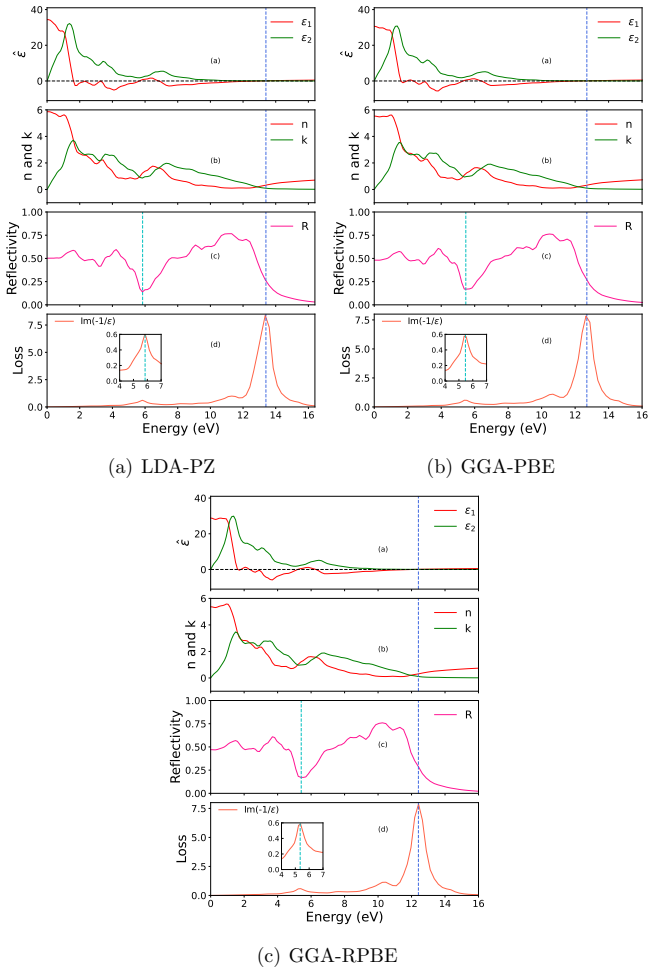
On the paper's own terms, the central discovery is that the zincblende phase of TiSn is a genuine narrow-gap semiconductor rather than a merely hypothetical structure. The evidence is a phonon dispersion calculation with no imaginary frequencies across the Brillouin zone, a direct band gap at the X point that survives across four exchange-correlation functionals, and an electronic structure in which Ti-3d and Sn-5p states hybridize to form the valence and conduction bands. The paper also reports that the conduction-band minimum is very flat, giving a heavy electron effective mass (2.88 m0 with GGA-PBE), while the valence band is lighter; the resulting charge transfer of roughly 1.1 electrons and pronounced LO-TO splitting place the bonding between covalent and ionic. The optical response computed from these bands shows absorption from 100 to 1500 nm and a high refractive index, which the paper connects to infrared applications.
Load-bearing premise
The load-bearing premise is that the absence of imaginary vibrational frequencies, computed at zero temperature on a coarse 2x2x2 grid, is enough to say the 1:1 zincblende phase can exist, even though no formation energy against the known Sn-Ti intermetallics is computed.
Editorial extensions
If this is right
- A direct 0.30 eV gap at X means optical transitions do not require phonon assistance, which favours use in infrared detectors and emitters in the 3-5 µm range.
- The predicted absorption span of 100-1500 nm and static refractive index around 5.5 place zb-TiSn among high-refractive-index narrow-gap materials, relevant for photovoltaics and thermophotovoltaics.
- The flat conduction band and heavy electron effective mass (2.88 m0) imply electrons remain localized once excited; this would shape any transport or device modelling.
- The consistency of the gap across LDA, PBE, RPBE, and GLLB-sc (0.26-0.38 eV) supports the qualitative classification as narrow-gap, although the exact gap value depends on the functional.
- The strong LO-TO splitting and large Born effective charges indicate a polar lattice, with implications for electron-phonon scattering and thermal conductivity.
Reading between the lines
- A testable next step the paper leaves open is a convex-hull calculation of formation enthalpies against the five known Sn-Ti intermetallics; without it, 'stable' means dynamically stable, not thermodynamically preferred.
- Epitaxial growth on a lattice-matched substrate could be the fastest experimental route to realize zb-TiSn; the paper mentions this possibility only in passing, but the predicted lattice constant near 6.3 Å gives a concrete target for substrate matching.
- Because GGA gaps systematically underestimate, the true gap is likely closer to the 0.38 eV GLLB-sc value or larger; a film absorption measurement would settle the value.
- If the heavy-electron picture survives synthesis, the flat conduction band could make doped zb-TiSn a playground for correlation physics; that is an extrapolation, not a claim of the paper.
Editorial analysis
A structured set of objections, weighed in public.
Referee Report
Summary. The manuscript uses DFT (GPAW) and DFPT (Quantum ESPRESSO) to study a hypothetical zincblende (zb) TiSn structure. It reports structural optimization with LDA, PBE, and RPBE functionals, band structures showing a direct gap at X of 0.26–0.38 eV depending on functional, effective masses from fourth-order polynomial fits, charge density and Bader analysis, phonon dispersion showing no imaginary frequencies on a 2×2×2 q-grid, and optical properties. The central claim is that zb-TiSn 'can exist' in zincblende form and is a narrow-gap semiconductor promising for infrared applications.
Significance. If the existence claim were properly supported, zb-TiSn would be a new candidate for mid-infrared optoelectronics. The electronic structure part is standard and consistent across functionals, and the paper provides a useful set of predictions. However, the stability claim rests on incomplete evidence, and several secondary analyses contain errors or overinterpretations. The paper is a conventional computational study with no new methodology, but the specific compound prediction is of interest if thermodynamic stability is established.
major comments (4)
- [Abstract; Introduction; Section 4] The central claim that zb-TiSn 'can exist in zincblende form' is supported only by the absence of imaginary phonon frequencies at 0 K on a 2×2×2 q-grid. Dynamical stability is necessary but not sufficient for thermodynamic stability; the paper never computes the formation enthalpy of zb-TiSn or its distance to the Sn–Ti convex hull, despite citing OQMD's classification as metastable (ref. [20]) and listing the five known intermetallics. Please compute formation energies for all relevant phases at the same level of theory, or explicitly restrict the claim to dynamical stability and soften the language in the Abstract and Introduction accordingly.
- [Section 4] The phonon calculation uses a single 2×2×2 q-grid with no convergence tests against q-mesh density or supercell size. This grid is coarse for a two-atom cell and does not rule out imaginary modes in the full Brillouin zone. Please report convergence tests (e.g., 3×3×3 and 4×4×4 q-grids) and the maximum imaginary frequency anywhere in the BZ, not just along the high-symmetry path.
- [Section 3.5] The Bader charge signs in Table 4 are inconsistent with the physical direction of charge transfer. Since Sn is more electronegative than Ti (Pauling 1.91 vs 1.54), Ti should have a positive Bader charge and Sn a negative one; the table and text give the opposite assignment, and the concluding sentence ('partial negative charge on Sn and partial positive charge on Ti') contradicts the table. Please correct the sign convention and verify the magnitudes, which appear unusually large for a polar covalent bond.
- [Section 3.3] The effective-mass analysis is under-specified and the results are overinterpreted. The fitting direction and k-range are not given, the location of the extremum used in Eq. (6) is not stated, and the fitted coefficients α, β, γ, δ are not reported. The very large electron masses (2.88–3.60 m0) are then used to invoke fractional quantum Hall effect, Wigner crystallization, and high-temperature superconductivity in a bulk 3D semiconductor, which is unsupported speculation. Please provide the fit details and remove or substantially temper these claims.
minor comments (7)
- [Throughout] There are numerous typos: 'Khôn-Sham' and 'Khon-Sham' for Kohn-Sham in the Abstract, 'Brillioun' for Brillouin in several places, 'valance' for valence in Section 3.3, 'preuso-parabolic' for quasi-parabolic in Section 3.3, and 'fuctional' for functional in Section 3.2.
- [Introduction] Reference [18] (van Vucht et al.) is about the vanadium-gallium system, not Sn–Ti; the proper reference for orthorhombic Sn5Ti6 should be used.
- [Section 5] The optical spectra are computed with LDA/PBE/RPBE band structures without a scissor correction, so the absorption edge is expected to be redshifted relative to the true gap; the authors note that GLLB-sc optical data are in the supplementary, but a brief discussion in the main text or a subset of those data would make the optical claims more robust.
- [Abstract and Conclusion] The sentence 'No imaginary frequencies are observed indicating the stable bonding nature of Ti-Sn' is categorical; it should be qualified as referring to dynamical stability at 0 K on the q-grid used.
- [Section 3.2] The GGA-PBE+U results are mentioned but not shown; either include a figure or table with the U-dependence of the gap, or remove the mention to avoid an unsupported statement.
- [Section 3.4] The interpretation of the charge density plots relies on a color code (green, red/purple, blue/cyan) but Figure 2 has no color scale bar; please add a scale or describe the density ranges in the caption.
- [Section 5] The absorption coefficient is given as two different expressions (Eqs. 16 and 17); please clarify that they are equivalent under the relation between n, ε1, and ε2, or present only one.
Circularity Check
No significant circularity: central results are direct DFT outputs; self-references are methodological and non-load-bearing.
full rationale
The central claims—that zb-TiSn is dynamically stable (no imaginary phonon frequencies), that it is a direct narrow-gap semiconductor with a GGA-PBE gap of 0.30 eV, that its bonding is polar covalent, and that it has the reported optical response—are direct outputs of DFT calculations performed with stated codes and functionals. No parameter is fitted to the target result: the band gap, phonon dispersions, Bader charges, and dielectric functions are self-consistently computed, and the effective-mass polynomial is fitted to the band structure itself, which is the definition of that property rather than a forced prediction. The only self-references are to the authors' prior TiGe study (ref. 27), used as a methodological precedent, and to a prior dielectric-function paper (ref. 59) for the standard Kramers-Kronig formalism; neither carries the argument, and the present calculations do not assume the conclusions. The absence of formation-energy or convex-hull analysis against the five known Sn–Ti intermetallics is a real gap in the thermodynamic support for the stability claim, but it is a correctness risk, not circularity, because the phonon calculation is independent of that conclusion and does not reduce to it. Accordingly, no circular step is established.
Assumptions & free parameters
free parameters (2)
- Hubbard U on Ti-3d states =
not reported
- 4th-order E(k) polynomial coefficients (alpha, beta, gamma, delta) =
not reported
assumptions (4)
- domain assumption DFT ground-state and band-structure calculations with LDA/GGA functionals adequately describe the electronic properties of zb-TiSn.
- ad hoc to paper Absence of imaginary phonon frequencies at 0 K on a 2x2x2 q-grid implies the phase 'can exist' in zincblende form.
- domain assumption The RPA dielectric function computed from Kohn-Sham eigenvalues describes the linear optical response.
- standard math The Murnaghan equation of state describes the energy-volume data used for structural optimization.
invented entities (1)
-
zb-TiSn (1:1 zincblende TiSn phase)
Cite this review
Pith. "Pith review of First principles investigation of zb-TiSn: A promising narrow bandgap semiconductor." pith.science (2026). https://pith.science/paper/HVN24V2P
@misc{pith2026250518940,
  author       = {Pith},
  title        = {Pith review of: First principles investigation of zb-TiSn: A promising narrow bandgap semiconductor},
  year         = {2026},
  howpublished = {\url{https://pith.science/paper/HVN24V2P}},
  note         = {Machine review of arXiv:2505.18940}
}
read the original abstract
We have investigated the structural stability of a binary compound TiSn in the zincblende symmetry. The phonon dispersion studies confirms that, TiSn with a nominal composition of 1:1 can exist in zincblende form. No imaginary frequencies are observed indicating the stable bonding nature of Ti-Sn. From the First principles calculations based on density functional theory, the resulting electronic band structure had revealed that zb-TiSn, is a narrow band gap semiconductor with an energy gap of 0.3 eV with GGA- PBE. The bonding nature is identified as polar covalent, determined from charge density difference plots and Bader charge analysis. Further more, the linear optical properties of zb-TiSn are derived from the Khon-Sham eigenvalues.
Figures


Figures from the paper (2 more)

Reference graph
Works this paper leans on
-
[20]
S. Kirklin, J. E. Saal, B. Meredig, A. Thompson, J. W. Doak, M. Aykol, S. R¨ uhl, C. Wolverton, The open quantum materials database (oqmd): assessing the accuracy of dft formation energies, npj Computational Materials 1 (1) (2015) 15010. doi:10.1038/npjcompumats.2015.10. URL https://doi.org/10.1038/npjcompumats.2015.10
-
[1]
A. Castellanos-Gomez, Black phosphorus: narrow gap, wide applica- tions, The journal of physical chemistry letters 6 (21) (2015) 4280–4291. doi:https://doi.org/10.1021/acs.jpclett.5b01686
-
[2]
I. T. Witting, T. C. Chasapis, F. Ricci, M. Peters, N. A. Heinz, G. Hautier, G. J. Snyder, The thermoelectric properties of bis- muth telluride, Advanced Electronic Materials 5 (6) (2019) 1800904. doi:https://doi.org/10.1002/aelm.201800904
-
[3]
J. P. Heremans, V. Jovovic, E. S. Toberer, A. Saramat, K. Kurosaki, A. Charoenphakdee, S. Yamanaka, G. J. Snyder, Enhancement of ther- moelectric efficiency in pbte by distortion of the electronic density of states, Science 321 (5888) (2008) 554–557. doi:10.1126/science.1159725
-
[4]
A. Boyer, E. Cisse, Y. Azzouz, J. Cheron, Narrow-bandgap semiconductor-based thermal sensors, Sensors and Actuators A: Phys- ical 27 (1-3) (1991) 637–640. doi:https://doi.org/10.1016/0924- 4247(91)87063-9. 24
- [5]
-
[6]
N. Dai, Optoelectronic properties of narrow band gap semicon- ductors, De Gruyter, Berlin, M¨ unchen, Boston, 2015, pp. 1–50. doi:doi:10.1515/9783110307023.1
-
[7]
J. Chu, A. Sher, Physics and properties of narrow gap semi- conductors, Springer New York, NY, Berlin, Heidelberg, 2008. doi:https://doi.org/10.1007/978-0-387-74801-6
Show all 61 references
-
[8]
Rogalski, P
A. Rogalski, P. Martyniuk, M. Kopytko, P. Madejczyk, S. Krishna, Inassb-based infrared photodetectors: Thirty years later on, Sensors 20 (24) (2020) 7047. doi:https://doi.org/10.3390/s20247047
2020 doi
-
[9]
Berding, S
M. Berding, S. Krishnamurthy, A. Sher, A.-B. Chen, Electronic and transport properties of hgcdte and hgznte, Journal of Vacuum Science & Technology A: Vacuum, Surfaces, and Films 5 (5) (1987) 3014–3018. doi:https://doi.org/10.1116/1.574249
1987 doi
-
[10]
Rogalski, Hgcdte infrared detector material: history, status and outlook, Reports on Progress in Physics 68 (10) (2005) 2267
A. Rogalski, Hgcdte infrared detector material: history, status and outlook, Reports on Progress in Physics 68 (10) (2005) 2267. doi:10.1088/0034-4885/68/10/R01
2005 doi
-
[11]
M. B. Reine, Hgcdte photodiodes for ir detection: a review, Photodetectors: Materials and Devices VI 4288 (2001) 266–277. doi:https://doi.org/10.1117/12.429413
2001 doi
-
[12]
Li, Y.-X
X.-H. Li, Y.-X. Guo, Y. Ren, J.-J. Peng, J.-S. Liu, C. Wang, H. Zhang, Narrow-bandgap materials for optoelectronics applications, Frontiers of Physics 17 (2022) 1–33. doi:https://doi.org/10.1007/s11467-021-1055-z
2022 doi
-
[13]
T. B. MASSALSKI, Binary alloy phase diagrams, ASM International 3 (1990) 2271–2273. 25
1990
-
[14]
J. L. MURRAY, Phase diagram of titanium alloys, ASM International 182 (1987). URL https://cir.nii.ac.jp/crid/1570854174084521472
1987
-
[15]
F. H. Hayes, P. J. Horrocks, Thermodynamic database for light metal alloys, in: I. Ansara, A. T. Dinsdale, M. H. Rand (Eds.), COST 507, Vol. 2, Office for Official Publications of the European Communities, Luxembourg, 1998, pp. 284–287. doi:https://doi.org/10.1007/b76778
1998 doi
-
[16]
F. H. Hayes, Binary systems from Mn–Mo to Y–Zr, in: Landolt- B¨ ornstein - Group IV Physical Chemistry, Vol. 19B4, Springer, Berlin, Heidelberg, 2006, pp. 1–4
2006
-
[17]
Kuper, W
C. Kuper, W. Peng, A. Pisch, F. Goesmann, R. Schmid-Fetzer, Phase formation and reaction kinetics in the system ti-sn, Z. Metallkd. 89 (12) (1998) 855–862. doi:https;//doi.org/10.3139/ijmr-1998-0165
1998 doi
-
[18]
J. H. N. van Vucht, H. A. C. M. Bruning, H. C. Donkersloot, A. H. G. de Mesquita, The system vanadium-gallium, Philips Res. Rep. 19 (5) (1964) 407–421
1964
-
[19]
Colinet, J.-C
C. Colinet, J.-C. Tedenac, S. G. Fries, Structural stability of inter- metallic phases in the sn–ti system, Calphad 33 (1) (2009) 250–259. doi:https://doi.org/10.1016/j.calphad.2008.08.001
2009 doi
-
[21]
Mizuguchi, H
M. Mizuguchi, H. Akinaga, T. Manago, K. Ono, M. Oshima, M. Shi- rai, M. Yuri, H. J. Lin, H. H. Hsieh, C. T. Chen, Epitaxial growth of zinc-blende cras/gaas multilayer, Journal of Applied Physics 26 91 (10) (2002) 7917–7919. arXiv:https://pubs.aip.org/aip/jap/article- pdf/91/10...
2002 doi
-
[22]
Chichvarina, T
O. Chichvarina, T. S. Herng, K. C. Phuah, et al., Stable zinc-blende zno thin films: formation and physical properties, Journal of Materials Science 50 (2015) 28–33. doi:https://doi.org/10.1007/s10853-014-8561- 0
2015 doi
-
[23]
Li, et al., Growth and stress-induced transformation of zinc blende aln layers in al-aln-tin multilayers, Scientific Reports 5 (2015) 18554
N. Li, et al., Growth and stress-induced transformation of zinc blende aln layers in al-aln-tin multilayers, Scientific Reports 5 (2015) 18554. doi:https://doi.org/10.1038/srep18554
2015 doi
-
[24]
A. KrAl, P. Pomastowski, K. RafiAska, V. Railean-Plugaru, B. Buszewski, Zinc oxide nanoparticles: Synthesis, antiseptic activity and toxicity mechanism, Advances in colloid and interface science 249 (2017) 37–52. doi:https://doi.org/10.1016/j.cis.2017.07.033
2017 doi
-
[25]
Y. Ding, X. D. Wang, Z. L. Wang, Phase controlled synthesis of zns nanobelts: zinc blende vs wurtzite, Chemical physics letters 398 (1-3) (2004) 32–36. doi:https://doi.org/10.1016/j.cplett.2004.09.031
2004 doi
-
[26]
Alrefaee, U
M. Alrefaee, U. P. Singh, S. K. Das, Growth of aluminum doped zinc oxide nanostructure thin films by nonconventional sol-gel method 402 (1) (2022) 2100350. doi:https://doi.org/10.1002/masy.202100350
2022 doi
-
[27]
Manickavasagam, U
S. Manickavasagam, U. M. K. Koppolu, First-principle in- vestigation of zb-tige: A promising narrow bandgap semi- conductor, physica status solidi (b) 262 (2) (2025) 2400475. doi:https://doi.org/10.1002/pssb.202400475. URL https://onlinelibrary.wiley.com/doi/abs/10.1002/pssb.202400475
2025 doi
-
[28]
J. J. Mortensen, A. H. Larsen, M. Kuisma, A. V. Ivanov, A. Taghizadeh, A. Peterson, A. Haldar, A. O. Dohn, C. Sch¨ afer, E. ¨O. J´ onsson, et al., Gpaw: An open python package for electronic structure 27 calculations, The Journal of Chemical Physics 160 (9) (2024). doi:https:/...
2024 doi
-
[29]
D. M. Ceperley, B. J. Alder, Ground state of the electron gas by a stochastic method, Physical review letters 45 (7) (1980) 566. doi:https://doi.org/10.1103/PhysRevLett.45.566
1980 doi
-
[30]
J. P. Perdew, K. Burke, M. Ernzerhof, Generalized gradient approx- imation made simple, Physical review letters 77 (18) (1996) 3865. doi:https://doi.org/10.1103/PhysRevLett.77.3865
1996 doi
-
[31]
Hammer, L
B. Hammer, L. B. Hansen, J. K. Nørskov, Improved adsorption energetics within density-functional theory using revised perdew- burke-ernzerhof functionals, Physical review B 59 (11) (1999) 7413. doi:https://doi.org/10.1103/PhysRevB.59.7413
1999 doi
-
[32]
A. H. Larsen, J. J. Mortensen, J. Blomqvist, I. E. Castelli, R. Chris- tensen, M. Du lak, J. Friis, M. N. Groves, B. Hammer, C. Hargus, et al., The atomic simulation environment—a python library for working with atoms, Journal of Physics: Condensed Matter 29 (27) (2017) 273002...
2017 doi
-
[33]
Graˇ zulis, D
S. Graˇ zulis, D. Chateigner, R. T. Downs, A. Yokochi, M. Quir´ os, L. Lutterotti, E. Manakova, J. Butkus, P. Moeck, A. Le Bail, Crystallography open database–an open-access collection of crys- tal structures, Applied Crystallography 42 (4) (2009) 726–729. doi:https://doi.org/...
2009 doi
-
[34]
F. D. Murnaghan, The compressibility of media under extreme pres- sures, Proceedings of the National Academy of Sciences 30 (9) (1944) 244–247. doi:https://doi.org/10.1073/pnas.30.9.244
1944 doi
-
[35]
D. Fan, M. Yin, K. Wang, Z. Wang, H. Li, H. Hu, F. Guo, Z. Feng, J. Li, D. Zhang, et al., The transition from indirect band gap to direct band gap and effectively separating of electron-hole 28 pairs in h-bc2n/mosi2n4 heterojunction for photocatalytic water split- ting, Intern...
2025 doi
-
[36]
M. Yin, D. Fan, Z. Wang, H. Li, H. Hu, F. Guo, Z. Feng, J. Li, D. Zhang, M. Zhu, et al., The absorption of transition metal atoms in g-c6n6 nanoribbon induces narrow band gap semiconductor with magnetism, Physica B: Condensed Matter 667 (2023) 415158. doi:https://doi.org/10.10...
2023
-
[37]
Dyksik, H
M. Dyksik, H. Duim, X. Zhu, Z. Yang, M. Gen, Y. Kohama, S. Adjokatse, D. K. Maude, M. A. Loi, D. A. Egger, et al., Broad tunability of carrier effective masses in two-dimensional halide perovskites, ACS Energy Letters 5 (11) (2020) 3609–3616. doi:https://doi.org/10.1021/acsene...
2020 doi
-
[38]
Kittel, P
C. Kittel, P. McEuen, Introduction to solid state physics, John Wiley & Sons, Newyork, 2018
2018
-
[39]
Tang, J.-W
E. Tang, J.-W. Mei, X.-G. Wen, High-temperature fractional quan- tum hall states, Physical review letters 106 (23) (2011) 236802. doi:https://doi.org/10.1103/PhysRevLett.106.236802
2011 doi
-
[40]
K. Sun, Z. Gu, H. Katsura, S. Das Sarma, Nearly flatbands with nontrivial topology, Physical review letters 106 (23) (2011) 236803. doi:https://doi.org/10.1103/PhysRevLett.106.236803
2011 doi
-
[41]
C. Wu, D. Bergman, L. Balents, S. Das Sarma, Flat bands and wigner crystallization in the honeycomb opti- cal lattice, Physical review letters 99 (7) (2007) 070401. doi:https://doi.org/10.1103/PhysRevLett.99.070401
2007 doi
-
[42]
S. D. Huber, E. Altman, Bose condensation in flat bands, Physical Review B—Condensed Matter and Materials Physics 82 (18) (2010) 184502. doi:https://doi.org/10.1103/PhysRevB.82.184502. 29
2010 doi
-
[43]
Imada, M
M. Imada, M. Kohno, Superconductivity from flat dispersion designed in doped mott insulators, Physical Review Letters 84 (1) (2000) 143. doi:https://doi.org/10.1103/PhysRevLett.84.143
2000 doi
-
[44]
Peotta, P
S. Peotta, P. T¨ orm¨ a, Superfluidity in topologically nontriv- ial flat bands, Nature communications 6 (1) (2015) 8944. doi:https://doi.org/10.1038/ncomms9944
2015 doi
-
[45]
W. Kohn, L. J. Sham, Self-consistent equations including exchange and correlation effects, Physical review 140 (4A) (1965) A1133. doi:https://doi.org/10.1103/PhysRev.140.A1133
1965 doi
-
[46]
M. Ito, D. Setoyama, J. Matsunaga, H. Muta, K. Kurosaki, M. Uno, S. Yamanaka, Effect of electronegativity on the me- chanical properties of metal hydrides with a fluorite struc- ture, Journal of alloys and compounds 426 (1-2) (2006) 67–71. doi:https://doi.org/10.1016/j.jallcom...
2006 doi
-
[47]
K. T. Giju, F. De Proft, P. Geerlings, Comprehensive study of density functional theory based properties for group 14 atoms and functional groups,- xy3 (x= c, si, ge, sn, pb, element 114; y= ch3, h, f, cl, br, i, at), The Journal of Physical Chemistry A 109 (12) (2005) 2925–29...
2005 doi
-
[48]
Sproul, Electronegativity and bond type: Predicting bond type, Journal of Chemical Education 78 (3) (2001) 387
G. Sproul, Electronegativity and bond type: Predicting bond type, Journal of Chemical Education 78 (3) (2001) 387. doi:https://doi.org/10.1021/ed078p387
2001 doi
-
[49]
Henkelman, A
G. Henkelman, A. Arnaldsson, H. J´ onsson, A fast and ro- bust algorithm for bader decomposition of charge density, Computational Materials Science 36 (3) (2006) 354–360. doi:https://doi.org/10.1016/j.commatsci.2005.04.010
2006 doi
-
[50]
Sanville, S
E. Sanville, S. D. Kenny, R. Smith, G. Henkelman, Improved grid-based algorithm for bader charge allocation, Journal of computational chem- istry 28 (5) (2007) 899–908. doi:https://doi.org/10.1002/jcc.20575. 30
2007 doi
-
[51]
W. Tang, E. Sanville, G. Henkelman, A grid-based bader analysis algo- rithm without lattice bias, Journal of Physics: Condensed Matter 21 (8) (2009) 084204. doi:https://10.1088/0953-8984/21/8/084204
2009 doi
-
[52]
N. W. Ashcroft, N. D. Mermin, Solid state physics, Holt, Rinehart and Winston, New York, NY, 1976. URL https://cds.cern.ch/record/102652
1976
-
[53]
R. H. Lyddane, R. Sachs, E. Teller, On the polar vibra- tions of alkali halides, Physical Review 59 (8) (1941) 673. doi:https://doi.org/10.1103/PhysRev.59.673
1941 doi
-
[54]
Gonze, C
X. Gonze, C. Lee, Dynamical matrices, born effective charges, dielec- tric permittivity tensors, and interatomic force constants from density- functional perturbation theory, Physical Review B 55 (16) (1997) 10355. doi:https://doi.org/10.1103/PhysRevB.55.10355
1997 doi
-
[55]
Y. Yu, J. Zhou, H. Han, C. Zhang, T. Cai, C. Song, T. Gao, Ab initio study of structural, dielectric, and dynamical properties of zinc-blende znx (x= o, s, se, te), Journal of alloys and compounds 471 (1-2) (2009) 492–497. doi:https://doi.org/10.1016/j.jallcom.2008.04.039
2009 doi
-
[56]
Srivastava, H
G. Srivastava, H. T¨ ut¨ unc¨ u, N. G¨ unhan, First-principles studies of struc- tural, electronic, and dynamical properties of be chalcogenides, Physi- cal Review B—Condensed Matter and Materials Physics 70 (8) (2004) 085206. doi:https://doi.org/10.1103/PhysRevB.70.085206
2004 doi
-
[57]
N. V. Smith, Photoelectron energy spectra and the band struc- tures of the noble metals, Physical Review B 3 (6) (1971) 1862. doi:https://doi.org/10.1103/PhysRevB.3.1862
1971 doi
-
[58]
Wooten, Optical properties of solids, Academic Press: New York, NY, USA; London, UK, 1972
F. Wooten, Optical properties of solids, Academic Press: New York, NY, USA; London, UK, 1972. doi:https://doi.org/10.1016/C2013-0-07656-6
1972 doi
-
[59]
U. M. K. Koppolu, Electronic band structure and complex dielectric function of zb-alp: a first principles study, Acta Phys Polonica A 136 (3) (2019) 486–489. doi:https://doi.org/10.12693/APhysPolA.136.486. 31
2019 doi
-
[60]
X. Hu, H. Li, H. Hu, C. Bai, C. Liu, F. Guo, Z. Feng, J. Li, D. Fan, Z. Wang, A potential application of a crystal triazine organic framework in energy: Photocatalytic decomposi- tion of water, Physica B: Condensed Matter 623 (2021) 413342. doi:https://doi.org/10.1016/j.physb....
2021
-
[61]
S. Guan, Y. Cheng, C. Liu, J. Han, Y. Lu, S. A. Yang, Y. Yao, Effects of strain on electronic and optic properties of holey two- dimensional c2n crystals, Applied Physics Letters 107 (23) (2015). doi:https://doi.org/10.1063/1.4937269. 32
2015 doi
Reviewed August 7, 2026 · model on record in the stance chip above.
Discussion (0). Continue with ORCID to comment.