P3MaZe: a Mass-Zero constrained-dynamics formulation of particle-mesh electrostatics
Reviewed by Pith T0 review T1 audit T2 compute T3 formal T4 reserved 2026-07-01 03:00 UTCgrok-4.3pith:HVPMZRUKrecord.jsonopen to challenge →
The pith
P3MaZe replaces the multigrid Poisson solver in particle-mesh electrostatics with a mass-zero constrained dynamics formulation that enforces the discretized Poisson equation as a holonomic constraint.
A machine-rendered reading of the paper's core claim, the machinery that carries it, and where it could break.
Core claim
P3MaZe combines the short-range/long-range decomposition of P3M electrostatics with the MaZe framework by representing the smooth long-range electrostatic potential on a mesh as a zero-inertia auxiliary field and enforcing the discretized Poisson equation as a holonomic constraint. This replaces the conventional multigrid Poisson solver by a constrained correction problem. The formulation retains the systematic accuracy controls associated with the real-space cutoff, the Ewald splitting, the mesh spacing, and the charge-assignment procedure, produces observables in quantitative agreement with established methods, and requires fewer multigrid iterations while retaining linear scaling with sys
What carries the argument
Mass-zero constrained dynamics (MaZe) applied to the long-range electrostatic potential, with the discretized Poisson equation enforced as a holonomic constraint.
If this is right
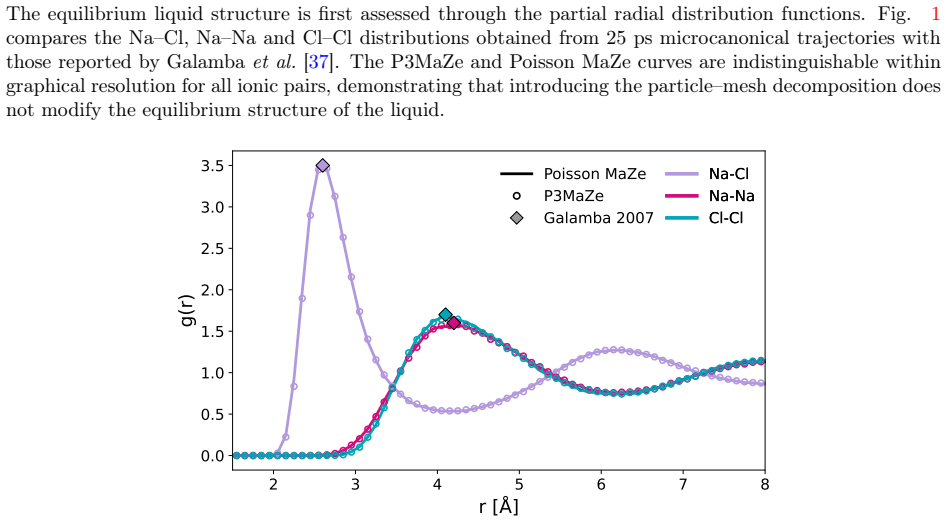
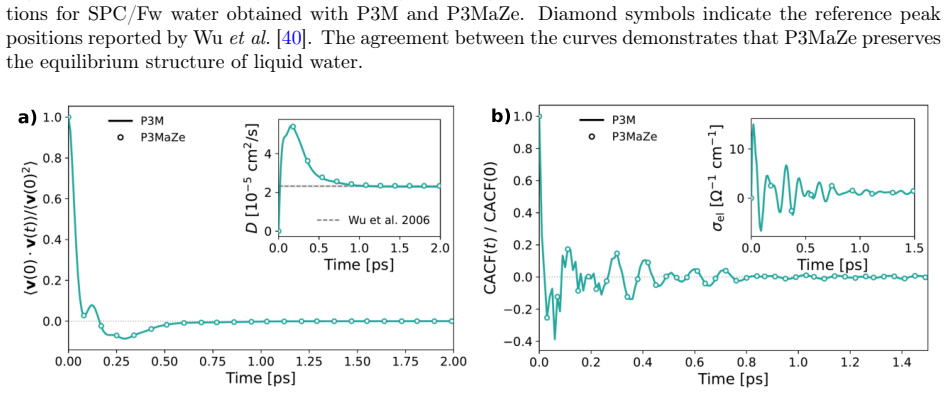
- Structural, translational, collective, and rotational dynamical observables remain in quantitative agreement with those from real-space P3M and Ewald summation.
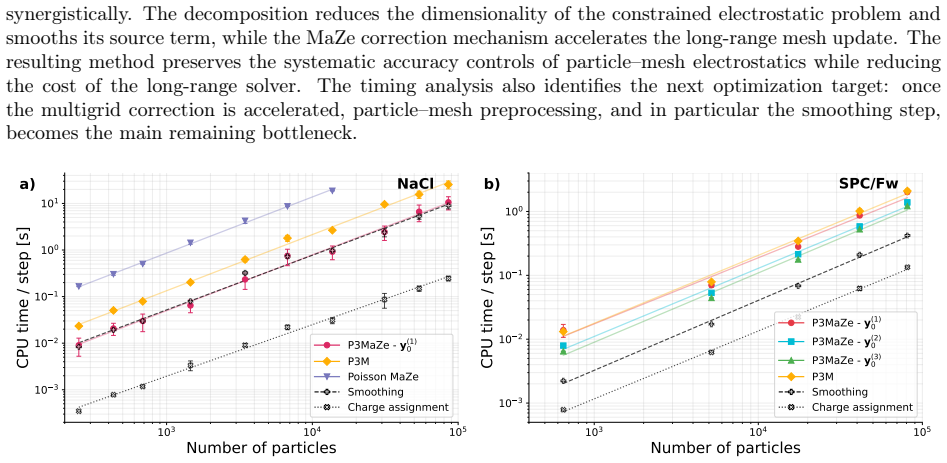
- The method requires fewer multigrid iterations than the corresponding real-space P3M solver.
- Linear scaling with system size is retained.
- All standard accuracy controls from the P3M decomposition remain available for systematic convergence checks.
Where Pith is reading between the lines
- The constrained formulation could be combined with other auxiliary-field constraints already present in a simulation without changing the integrator structure.
- Because the Poisson equation becomes part of the constraint manifold, the method may allow direct control over electrostatic energy contributions during sampling.
- The reduction in multigrid iterations suggests the approach could be particularly advantageous when electrostatics dominate the cost in very large periodic systems.
Load-bearing premise
Enforcing the discretized Poisson equation as a holonomic constraint in the MaZe framework produces dynamics equivalent to the unconstrained P3M solution without introducing numerical artifacts or altering physical observables.
What would settle it
A direct side-by-side simulation of molten NaCl showing a measurable difference in radial distribution functions or diffusion coefficients between P3MaZe and standard real-space P3M at identical cutoff, splitting, and mesh parameters would falsify the claimed equivalence.
Figures




read the original abstract
We introduce P3MaZe, a real-space particle-mesh electrostatic method that combines the standard short-range/long-range decomposition of Particle-Particle Particle-Mesh (P3M) electrostatics with the Mass-Zero constrained dynamics (MaZe) framework. In this formulation, the smooth long-range electrostatic potential is represented on a mesh as a zero-inertia auxiliary field, while the discretized Poisson equation is enforced as a holonomic constraint during molecular dynamics. By retaining the standard P3M decomposition, P3MaZe preserves the systematic accuracy controls associated with the real-space cutoff, the Ewald splitting, the mesh spacing, and the charge-assignment procedure, while replacing the conventional multigrid Poisson solver by a constrained correction problem. The method is validated for molten NaCl and simple point-charge flexible water (SPC/Fw). Structural, translational, collective, and rotational dynamical observables are in quantitative agreement with those obtained with established electrostatic methods, including real-space P3M, and Ewald summation. The constrained formulation consistently requires fewer multigrid iterations than the corresponding real-space P3M solver while retaining the expected linear scaling with system size. These results establish P3MaZe as a promising new direction for scalable real-space electrostatics in large-scale molecular simulations.
Editorial analysis
A structured set of objections, weighed in public.
Referee Report
Summary. The manuscript introduces P3MaZe, which augments the standard short-range/long-range decomposition of real-space P3M electrostatics with the Mass-Zero (MaZe) constrained-dynamics framework. The long-range potential is represented as a zero-inertia auxiliary field on the mesh, and the discretized Poisson equation is imposed as a holonomic constraint. The approach retains the usual P3M accuracy controls (real-space cutoff, Ewald parameter, mesh spacing, charge assignment) while replacing the conventional multigrid Poisson solve with a constrained correction step. Validation on molten NaCl and SPC/Fw reports quantitative agreement with reference real-space P3M and Ewald results for structural, translational, collective, and rotational observables, together with a reduction in multigrid iterations and retention of linear scaling with system size.
Significance. If the dynamical equivalence to unconstrained P3M is confirmed without introducing artifacts, the formulation offers a conceptually distinct route to real-space electrostatics that may reduce solver cost while preserving established accuracy parameters. The explicit retention of P3M controls and the reported linear scaling are positive features; the iteration reduction, if reproducible, would be of practical interest for large-scale MD. The work is grounded in an existing constrained-dynamics framework rather than introducing ad-hoc parameters.
major comments (2)
- [Abstract] Abstract: the central performance claim that the constrained formulation 'consistently requires fewer multigrid iterations' is stated without supporting data (iteration counts, tolerances, or scaling plots). Because this is the primary advertised advantage over standard real-space P3M, the absence of quantitative comparison undermines assessment of the claim.
- [Validation] Validation (abstract and results): quantitative agreement is asserted for structural, translational, collective, and rotational observables, yet no error bars, statistical uncertainties, RMSD values, or convergence diagnostics are supplied. This information is required to evaluate whether the holonomic constraint introduces measurable deviations from the unconstrained P3M reference.
minor comments (2)
- [Introduction] The phrase 'zero-inertia auxiliary field' is used without an immediate definition or reference to its MaZe origin; a one-sentence clarification in the introduction would improve accessibility.
- [Method] Notation for the charge-assignment procedure and the Ewald splitting parameter should be aligned explicitly with standard P3M literature to facilitate direct comparison.
Simulated Author's Rebuttal
We thank the referee for the positive assessment and recommendation for minor revision. We address the two major comments below and will revise the manuscript accordingly to strengthen the presentation of quantitative evidence.
read point-by-point responses
-
Referee: [Abstract] Abstract: the central performance claim that the constrained formulation 'consistently requires fewer multigrid iterations' is stated without supporting data (iteration counts, tolerances, or scaling plots). Because this is the primary advertised advantage over standard real-space P3M, the absence of quantitative comparison undermines assessment of the claim.
Authors: We agree that the abstract would benefit from explicit reference to the supporting data. The results section already contains direct comparisons of multigrid iteration counts (with fixed tolerances) between P3MaZe and standard real-space P3M for both NaCl and SPC/Fw systems, together with a demonstration of linear scaling. In the revised manuscript we will add a short clause in the abstract pointing to these quantitative results and include a compact table of average iteration counts in the main text or as a new figure panel. revision: yes
-
Referee: [Validation] Validation (abstract and results): quantitative agreement is asserted for structural, translational, collective, and rotational observables, yet no error bars, statistical uncertainties, RMSD values, or convergence diagnostics are supplied. This information is required to evaluate whether the holonomic constraint introduces measurable deviations from the unconstrained P3M reference.
Authors: We acknowledge that the current validation would be strengthened by explicit uncertainty estimates. The manuscript already reports that observables match reference P3M and Ewald results to within visual agreement on the plotted scales, but we will add statistical error bars (obtained via block averaging over independent trajectories) to all key figures and report RMSD or mean absolute deviations between P3MaZe and reference P3M runs in a new table. This will allow readers to confirm that any differences lie within statistical uncertainty. revision: yes
Circularity Check
No significant circularity; derivation self-contained
full rationale
The paper introduces P3MaZe by combining the standard P3M short/long-range decomposition with the MaZe constrained-dynamics framework, enforcing the discretized Poisson equation as a holonomic constraint. All accuracy controls (cutoff, Ewald splitting, mesh spacing, charge assignment) are retained from the established P3M method. Validation against independent external references (real-space P3M and Ewald summation) shows quantitative agreement on structural, dynamical, and collective observables for molten NaCl and SPC/Fw, with the reported reduction in multigrid iterations presented as an empirical outcome of the simulations rather than a quantity forced by definition or by a self-citation chain. No load-bearing step reduces to a fitted input renamed as prediction or to an ansatz smuggled via prior self-work; the central claims remain falsifiable against the cited benchmarks.
Axiom & Free-Parameter Ledger
axioms (1)
- domain assumption The discretized Poisson equation can be enforced as a holonomic constraint without changing the underlying electrostatic physics.
invented entities (1)
-
zero-inertia auxiliary field
no independent evidence
Reference graph
Works this paper leans on
-
[1]
J-P. Ryckaert and A. Bellemans and G. Ciccotti and , title =. Molecular Physics , volume =. 1981 , publisher =
work page 1981
-
[2]
Performance Analysis of Parallel FFT on Large Multi-GPU Systems , year=
Ayala, Alan and Tomov, Stan and Stoyanov, Miroslav and Haidar, Azzam and Dongarra, Jack , booktitle=. Performance Analysis of Parallel FFT on Large Multi-GPU Systems , year=
-
[3]
Accelerating MPI All-to-All Communication with Online Compression on Modern GPU Clusters
Zhou, Qinghua and Kousha, Pouya and Anthony, Quentin and Shafie Khorassani, Kawthar and Shafi, Aamir and Subramoni, Hari and Panda, Dhabaleswar K. Accelerating MPI All-to-All Communication with Online Compression on Modern GPU Clusters. High Performance Computing. 2022
work page 2022
-
[4]
The Journal of Chemical Physics , volume =
Sagui, Celeste and Darden, Thomas , title =. The Journal of Chemical Physics , volume =. 2001 , month =
work page 2001
- [5]
-
[6]
Physical Review Letters , volume =
Local Molecular Dynamics with Coulombic Interactions , author =. Physical Review Letters , volume =. 2004 , month =
work page 2004
-
[7]
Phillips, James C. and Hardy, David J. and Maia, Julio D. C. and Stone, John E. and Ribeiro, João V. and Bernardi, Rafael C. and Buch, Ronak and Fiorin, Giacomo and Hénin, Jérôme and Jiang, Wei and McGreevy, Ryan and Melo, Marcelo C. R. and Radak, Brian K. and Skeel, Robert D. and Singharoy, Abhishek and Wang, Yi and Roux, Benoît and Aksimentiev, Aleksei ...
-
[8]
Abraham, Mark J. and Murtola, Teemu and Schulz, Roland and Páll, Szilárd and Smith, Jeremy C. and Hess, Berk and Lindahl, Erik , title =. SoftwareX , year =. doi:10.1016/j.softx.2015.06.001 , issn =
-
[9]
and Lundborg, Magnus and Gray, Alan and Hess, Berk and Lindahl, Erik , title =
Páll, Szilárd and Zhmurov, Artem and Bauer, Paul and Abraham, Mark J. and Lundborg, Magnus and Gray, Alan and Hess, Berk and Lindahl, Erik , title =. Journal of Chemical Physics , year =
-
[10]
The Journal of Physical Chemistry
Time Step Rescaling Recovers Continuous-Time Dynamical Properties for Discrete-Time Langevin Integration of Nonequilibrium Systems , author=. The Journal of Physical Chemistry. B , year=
- [11]
-
[12]
Galamba, N. and Costa Cabral, B. J. , title = ". The Journal of Chemical Physics , volume =. 2007 , month =
work page 2007
-
[13]
Numerical integration of the cartesian equations of motion of a system with constraints: molecular dynamics of n-alkanes , journal =. 1977 , issn =
work page 1977
-
[14]
The Journal of Chemical Physics , volume =
Coretti, Alessandro and Bonella, Sara and Ciccotti, Giovanni , title = ". The Journal of Chemical Physics , volume =. 2018 , month =
work page 2018
- [15]
-
[16]
Fennell, Christopher J. and Gezelter, J. Daniel , title =. The Journal of Chemical Physics , volume =. 2006 , month =
work page 2006
-
[17]
Fast Multipole Methods for the Helmholtz Equation in Three Dimensions , author=. 2004 , publisher=
work page 2004
-
[18]
Journal of Computational Physics , volume=
A hierarchical O(N) force calculation algorithm , author=. Journal of Computational Physics , volume=. 2002 , publisher=
work page 2002
-
[19]
and Darden, Tom and Lee, Hsing and Pedersen, Lee G
Essmann, Ulrich and Perera, Lalith and Berkowitz, Max L. and Darden, Tom and Lee, Hsing and Pedersen, Lee G. , title =. The Journal of Chemical Physics , volume =. 1995 , month =
work page 1995
-
[20]
and Tezcan, Ismail and Hardy, David J
Skeel, Robert D. and Tezcan, Ismail and Hardy, David J. , title =. Journal of Computational Chemistry , volume =
-
[21]
and Wu, Zhe and Phillips, James C
Hardy, David J. and Wu, Zhe and Phillips, James C. and Stone, John E. and Skeel, Robert D. and Schulten, Klaus , title =. Journal of Chemical Theory and Computation , volume =
-
[22]
J. V. L. Beckers and C. P. Lowe and S. W. De Leeuw , title =. Molecular Simulation , volume =. 1998 , publisher =
work page 1998
-
[23]
Journal of Parallel and Distributed Computing , volume=
FFT, FMM, and multigrid on the road to exascale: Performance challenges and opportunities , author=. Journal of Parallel and Distributed Computing , volume=. 2020 , publisher=
work page 2020
-
[24]
George, Anu and Mondal, Sandip and Purnaprajna, Madhura and Athri, Prashanth , title =. ACS Omega , volume =. 2022 , doi =
work page 2022
-
[25]
Adiabatic motion and statistical mechanics via mass-zero constrained dynamics
Bonella, Sara and Coretti, Alessandro and Vuilleumier, Rodolphe and Ciccotti, Giovanni. Adiabatic motion and statistical mechanics via mass-zero constrained dynamics. Physical Chemistry Chemical Physics. 2020
work page 2020
-
[26]
Coretti,A. and Scalfi,L. and Bacon,C. and Rotenberg,B. and Vuilleumier,R. and Ciccotti,G. and Salanne,M. and Bonella,S. , title =. The Journal of Chemical Physics , volume =
-
[27]
Mass-Zero constrained dynamics and statistics for the shell model in magnetic field , volume =
Girardier, David and Coretti, Alessandro and Ciccotti, Giovanni and Bonella, Sara , year =. Mass-Zero constrained dynamics and statistics for the shell model in magnetic field , volume =
-
[28]
The Journal of Chemical Physics
Coretti, Alessandro and Baird, Taylor and Vuilleumier, Rodolphe and Bonella, Sara , year =. The Journal of Chemical Physics
-
[29]
The Journal of Chemical Physics , author =
Mass-zero constrained molecular dynamics for electrostatic interactions , volume =. The Journal of Chemical Physics , author =. 2025 , pages =. doi:10.1063/5.0283356 , number =
-
[30]
Die Berechnung optischer und elektrostatischer Gitterpotentiale , author=. Annalen der physik , volume=. 1921 , publisher=
work page 1921
-
[31]
The Journal of Chemical Physics , volume=
Flexible simple point-charge water model with improved liquid-state properties , author=. The Journal of Chemical Physics , volume=. 2006 , publisher=
work page 2006
-
[32]
Understanding molecular simulation: from algorithms to applications , author=. 2023 , publisher=
work page 2023
-
[33]
Computer Physics Communications , volume=
Comments on P3M, FMM, and the Ewald method for large periodic Coulombic systems , author=. Computer Physics Communications , volume=. 1996 , publisher=
work page 1996
-
[34]
Proceedings of the National Academy of Sciences , volume=
Electrically driven first-order phase transition of a 2D ionic crystal at the electrode/electrolyte interface , author=. Proceedings of the National Academy of Sciences , volume=. 2025 , publisher=
work page 2025
-
[35]
Computer Physics Communications , author =
A particle–particle particle-multigrid method for long-range interactions in molecular simulations , volume =. Computer Physics Communications , author =. 2005 , pages =. doi:10.1016/j.cpc.2005.03.077 , language =
-
[36]
Comparison of scalable fast methods for long-range interactions , volume =. Physical Review E , author =. 2013 , pages =. doi:10.1103/PhysRevE.88.063308 , language =
-
[37]
Computer Simulation Using Particles
-
[38]
The Journal of Chemical Physics , volume =
Darden, Tom and York, Darrin and Pedersen, Lee , title = ". The Journal of Chemical Physics , volume =. 1993 , month =
work page 1993
-
[39]
The Journal of Chemical Physics , volume=
A compression strategy for particle mesh Ewald theory , author=. The Journal of Chemical Physics , volume=. 2021 , publisher=
work page 2021
-
[40]
Journal of Chemical Theory and Computation , volume=
Periodic coulomb tree method: an alternative to parallel particle Mesh Ewald , author=. Journal of Chemical Theory and Computation , volume=. 2019 , publisher=
work page 2019
discussion (0)
Sign in with ORCID, Apple, or X to comment. Anyone can read and Pith papers without signing in.