REVIEW 3 major objections 5 minor 5 cited by
Fast and efficient Bayesian method to search for strongly lensed gravitational waves
T0 review · 3 major / 5 minor · reviewed 2026-08-12 · deepseek-v4-flash
Pith's one-line read PO2.0, a posterior-overlap statistic for strongly lensed gravitational waves, is mathematically equivalent to joint Bayesian parameter estimation yet fast enough for deep background studies, and identifies 65% of simulated galaxy-lensed…
desk verdict PO2.0 is a genuine advance in lensed-GW search methodology with a clean derivation, but the headline numbers are in-sample with respect to one fiducial population model, so they are a model-dependent forecast rather than a verified real-catalog performance. read the letter →
The pith
A machine-rendered reading of the paper's core claim, the machinery that carries it, and where it could break.
The reading
What carries the argument
The central object is the PO2.0 Bayes factor $B^L_U$, a ratio of lensed to unlensed evidences built from individual-event posteriors: posteriors $P(\theta_{\rm eq},\theta_b|d_j)$ are divided by their parameter-estimation priors, multiplied by the population priors under the two hypotheses, and integrated over equal, biased, and bias parameters. Factorization into a sky-overlap factor $S^L_U$, a phase-overlap factor $P^L_{U,n}$, the time-delay ratio $R^L_U$, and a remaining overlap $B'$ reduces 14- and 16-dimensional integrals to manageable low-dimensional pieces. The numerical implementation uses kernel-density estimates of posteriors and importance sampling, with fast single-event parameter estimation to generate the hundreds of thousands of unlensed pairs needed for a deep false-alarm background.
What would settle it
A concrete check is to compute PO2.0 Bayes factors and full joint-parameter-estimation Bayes factors on the same set of simulated lensed and unlensed pairs and compare their rankings and ROC curves: if the two statistics disagree substantially, the claimed equivalence is broken by the kernel-density and importance-sampling reconstruction. A complementary check is to run PO2.0 on a real O4 catalog and see whether the predicted $>2.25\sigma$ candidate or the predicted detection rate actually appears.
Extended reading notes
Core claim
The paper's central claim is that the Bayes factor between the lensed and unlensed hypotheses, written as an integral over reweighted products of the two signals' individual posterior distributions, is mathematically equivalent to the joint-parameter-estimation Bayes factor. The key expression is Eq. (5): each individual posterior is divided by the prior used in that signal's parameter estimation, the product is weighted by the lensed population prior, and the integral runs over equal parameters ($\theta_{\rm eq}$) as well as the lensing-biased parameters ($\theta_{b}$) and the biases themselves ($\Delta\theta_b$). This equivalence follows from splitting the joint likelihood into individual likelihoods, which is justified when the two signals do not overlap in time and their noise realizations are uncorrelated. With population priors that include selection effects and all these parameters, PO2.0 detects 65% of simulated galaxy-lensed binary-black-hole pairs at a pairwise false-alarm probability near $2\times10^{-6}$. For an 18-month catalog at current detector sensitivity, the paper forecasts a 13% probability of detecting at least one lensed event above $2.25\sigma$ significance, roughly double the chance offered by the earlier posterior-overlap method.
Load-bearing premise
The load-bearing premise is that the simulated populations used to build the informative priors, namely the high-redshift merger rate, mass and spin distributions, galaxy lens population, and detector selection effects, faithfully represent the real detectable unlensed and lensed signals; PO2.0's reported efficiencies and the 13% forecast rest on those priors.
Editorial extensions
If this is right
- A pair of detected signals can be ranked for lensing in minutes, so false-alarm backgrounds of hundreds of thousands of pairs become feasible; with about $5\times10^5$ background pairs the paper probes pairwise false-alarm probabilities down to about $2\times10^{-6}$.
- If PO2.0's claimed equivalence to joint parameter estimation holds in practice, lensing searches no longer need to run hourly joint samplings over every candidate pair.
- The forecast is a 13% probability of detecting at least one lensed pair above $2.25\sigma$ catalog significance during 18 months of O4-like observation, compared with 7.5% for the earlier $B_{\rm eq}\times R^L_U$ statistic.
- PO2.0 also produces joint posteriors for source and lens parameters by reweighting individual posteriors, yielding tighter intrinsic-parameter constraints and Morse-phase identification better than 80% efficiency at a false-alarm probability of 0.05.
- All earlier fast statistics, including posterior overlap, the time-delay ratio, and the magnification-ratio statistic, are recovered as approximations of PO2.0; approximating distance and phase posteriors as delta functions degrades efficiency, which PO2.0 avoids by marginalizing over their uncertainties.
Reading between the lines
- Our inference: the 13% detection forecast inherits the assumed lensing fraction $u=1.5\times10^{-3}$, a detection rate of 100 events per year, and the O4 sensitivity curve; a different lensing fraction or high-redshift merger rate would directly change that number.
- Our inference: because the Bayes factor is sensitive to the lens population model, the same machinery could be turned around to rank competing lens models on observed candidate pairs, an extension the paper flags as future work.
- Our inference: a direct comparison of PO2.0 rankings with joint-parameter-estimation rankings on identical simulated pairs, which the paper says is underway, would quantify how much efficiency is lost to kernel-density reconstruction noise.
- Our inference: extending the reweighted-overlap product to triplets and quadruplets of images, mentioned as future work, would directly attack the catalog false-alarm problem that grows quadratically with the number of detected signals.
Signed reviews
Editorial analysis
A structured set of objections, weighed in public.
Referee Report
Summary. The paper introduces PO2.0, a posterior-overlap statistic for identifying strongly lensed gravitational-wave events. The authors derive a Bayes factor that reweights individual-event posteriors with an informative lensed/unlensed population prior, claim that this statistic is mathematically equivalent to joint parameter estimation, and show that under various simplifications it reduces to existing statistics such as Beq, R_L/U, Mgal, and phazap-like measures. They implement PO2.0 using Gaussian KDEs and importance sampling on posterior samples produced by the cogwheel PE code, and benchmark it on simulated galaxy-lensed BBH pairs against an unlensed background. They report 65% detection efficiency at a pairwise false-alarm probability of ~2e-6, and a 13% probability of detecting a lensed event above 2.25σ in an 18-month O4-like catalog. They also present a reweighting method for estimating joint source/lens parameters (e.g., relative magnification, Morse phase) from individual posteriors, with caveats about numerical biases.
Significance. If the central claims hold, PO2.0 would be a substantial practical advance: it offers joint-PE-like sensitivity at a fraction of the computational cost, making deep background studies feasible for lensing searches. The derivation of the reweighting identity (Eq. 5, Appendix A) is correct and is a genuine contribution, and the paper gives a useful taxonomy showing how existing statistics arise as limiting cases. The authors also perform a careful validation of their PE pipeline with p-p plots, and they openly acknowledge numerical limitations in the parameter-estimation extension. The main risk is not internal inconsistency but that the headline efficiency and detection-probability numbers are in-sample with respect to the population models used to build the informative priors, and that the implemented statistic is an approximation to the exact Bayes factor despite the paper's 'equivalent to joint PE' claim. These issues are fixable but require a revised presentation and additional robustness analysis.
major comments (3)
- [§2.2, Appendix B, Eq. (5) vs. Eq. (B11)] The exact Bayes factor in Eq. (5) is derived correctly, but the statistic actually evaluated is not Eq. (5). Appendix B drops the PE priors (Section B.1), approximates arrival-time posteriors as delta functions (Section B.4), and factorizes sky and phase terms, leading to Eq. (B11). The abstract and Section 2 claim that PO2.0 is 'mathematically equivalent to joint parameter estimation'; that equivalence is only true for the unsimplified Eq. (5) under exact marginalization. As written, the claim overstates what is tested. The paper should explicitly distinguish the exact reweighting identity from the implemented approximation, and ideally quantify the bias introduced by these approximations, e.g., by comparing PO2.0 with joint PE on a small subset of pairs, which the authors note is underway.
- [§3.1, Fig. 2, Appendix D] The 65% efficiency at FAP ~2e-6 is an in-sample benchmark: the foreground and background injections are drawn from the same population models used to construct the informative priors (Madau-Dickinson merger rate, power-law+peak masses/spins from Abbott et al. 2023, SIE lenses from Collett 2015, O4 selection cuts). The authors' own Fig. 2 shows that replacing the lensed prior with the unlensed detectable prior H_D^U substantially degrades the ROC, confirming that efficiency is prior-sensitive. Consequently, the abstract's 65% number is conditional on one fiducial population model and does not carry an uncertainty budget for model misspecification. The manuscript should include out-of-sample or stress-test variations (e.g., different mass distributions, lens velocity-dispersion functions, or optical depths) or at least a quantitative sensitivity analysis, to support claims about expected real-catalog performance.
- [§4, Eq. (15)] The forecast detection probability of 13% is directly proportional to the assumed lensing fraction u = 1.5e-3 and the detection rate R = 100/yr, as shown in Eq. (15). Neither parameter has an uncertainty budget in the main text, nor is the dependence stated in the abstract, where the 13% appears as a headline number. Since the lensing fraction is especially uncertain, the paper should state the parametric dependence explicitly and provide a plausible range for the detection probability, e.g., varying u by a factor of 2, to avoid overstating the certainty of the forecast.
minor comments (5)
- [§6, Conclusion] The sentence 'The probability of confidently identifying that lensed event using our method is 65% lower' appears to be a wording error; the intended meaning is that the identification probability is 65%, not 65% lower, since 0.13/0.20 = 0.65. Please rephrase.
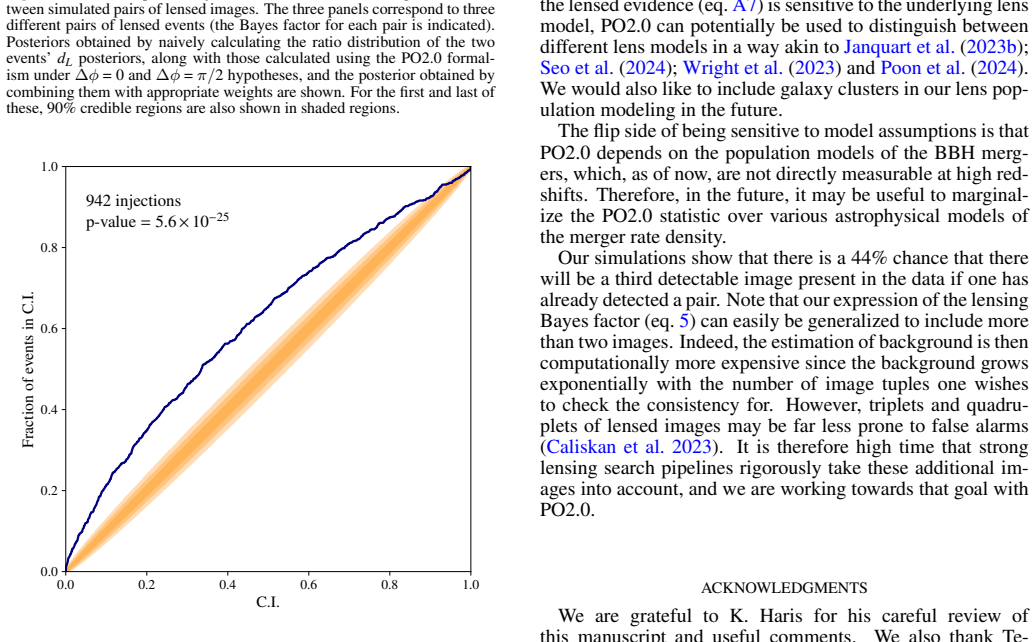
- [§5.2, Fig. 12] The p-p plot in Fig. 12 shows a KS p-value of 5.6e-25, indicating that the relative-magnification posteriors are systematically overestimated. The authors acknowledge this bias, but the conclusion still lists 'measure the relative magnification better than naive' as an achievement. Consider moving the magnification-measurement claim to future work or adding a caveat in the conclusion.
- [§3.4] The comparison with phazap (Ezquiaga et al. 2023) is not entirely apples-to-apples, since phazap is described by its authors as a veto pipeline rather than a detection pipeline. The text notes this, but the ROC comparison may still be misinterpreted; a brief statement of the intended roles would help.
- [Appendix B, Eq. (B4)] The factorization that makes the Bayes factor independent of the Morse phase (by writing B_n as independent of Δφ) is described as 'empirically motivated.' Since this is a modeling assumption that could affect the reported efficiency, it would be helpful to state how sensitive the ROC curves are to this choice.
- [Throughout] The manuscript does not state whether the code and simulation datasets are publicly available. Providing a code repository would improve reproducibility, given that the method depends on several numerical choices (KDE bandwidths, importance sampling proposals, etc.).
Circularity Check
No significant circularity: PO2.0 is an explicit Bayes-theorem reweighting; the reported efficiencies are conditional simulation benchmarks, not reductions to fitted inputs, and the paper acknowledges model sensitivity.
full rationale
The central claim of the paper is that the Bayes factor in Eq. 5, computed by reweighting individual posterior samples, is mathematically equivalent to joint parameter estimation. This is an algebraic result: Appendix A derives Eq. 5 from the likelihood ratio Eq. A1 using Bayes theorem (Eqs. A2-A9), with no fitted parameter entering the derivation. The informative priors P(theta | HU) and P(theta_eq, theta_b1, Delta_theta_b | HL) are constructed from stated external inputs, namely the Madau-Dickinson merger rate, the Abbott et al. (2023) power-law+peak mass and spin model, Collett (2015) SIE galaxy lenses, and O4 noise/selection cuts (Appendix D), not from the foreground/background test pairs. The 65% efficiency and 13% detection probability are Monte Carlo outputs conditional on those assumptions; they are not equal to any input by construction, nor is any parameter fitted to the benchmark pairs. The benchmark is in-sample in that the simulated test pairs and the priors share the same generative model; this is a model-validity caveat for real-catalog extrapolation, not a circular reduction, because the priors are specified before and independently of the test pairs. The paper explicitly acknowledges this sensitivity: 'The flip side of being sensitive to model assumptions is that PO2.0 depends on the population models of the BBH mergers, which, as of now, are not directly measurable at high redshifts' (Section 6), and it also states that numerical parity with joint PE 'needs to be demonstrated' (Section 6). Self-citations (Barsode et al. 2024, Haris et al. 2018) serve as simulation-methodology references whose physical ingredients are external; they are not invoked as uniqueness theorems or to forbid alternatives. Therefore, no circular step is present.
Assumptions & free parameters
free parameters (3)
- detection rate R =
100 yr^-1
- lensing fraction u =
1.5e-3
- observing duration T =
18 months
assumptions (6)
- domain assumption BBH population follows the power-law + peak mass model and spin distributions from Abbott et al. (2023), with merger rate evolving as Madau-Dickinson.
- domain assumption Lens population consists of SIE galaxies with velocity dispersions and axis ratios from Collett (2015), with strong-lensing optical depth tau(zs).
- domain assumption The two signals are non-overlapping in time and their noise realizations are uncorrelated.
- ad hoc to paper Arrival-time posterior is a delta function at the measured value.
- ad hoc to paper PE priors can be dropped from the reweighting integrals.
- domain assumption Sky localization and phase/polarization-angle posteriors are approximately uncorrelated with other parameters and with each other.
Cite this review
Pith. "Pith review of Fast and efficient Bayesian method to search for strongly lensed gravitational waves." pith.science (2026). https://pith.science/paper/HVR5Z5LO
@misc{pith2026241201278,
  author       = {Pith},
  title        = {Pith review of: Fast and efficient Bayesian method to search for strongly lensed gravitational waves},
  year         = {2026},
  howpublished = {\url{https://pith.science/paper/HVR5Z5LO}},
  note         = {Machine review of arXiv:2412.01278}
}
abstract
A small fraction of the gravitational-wave (GW) signals from binary black holes observable by ground-based detectors will be strongly lensed by intervening objects such as galaxies and clusters. Strong lensing will produce nearly identical copies of the GW signals separated in time. These lensed signals must be identified against a background of unlensed pairs GW events, some of which may appear similar by accident. This is usually done using fast, but approximate methods that, for example, check for the overlap between the posterior distributions of a subset of binary parameters, or using slow, but accurate joint Bayesian parameter estimation. In this work, we present a modified version of the posterior overlap method dubbed "PO2.0" that is mathematically equivalent to joint parameter estimation while still remaining fast. We achieve a significant gain in efficiency by incorporating informative priors about the binary and lensing populations, selection effects, and all the inferred parameters of the binary. For binary black hole signals lensed by galaxies, our improved method can detect 65% lensed events at a pair-wise false alarm probability of $\sim 2\times 10^{-6}$. Consequently, we have a 13% probability of detecting a strongly lensed event above $2.25\sigma$ significance during 18 months of observation by the LIGO-Virgo detectors at their current sensitivity. We also show how we can compute the joint posteriors of the lens and source parameters from a pair of lensed events by reweighting the posteriors of individual events in a computationally inexpensive way.
Figures


Figures from the paper (9 more)




Forward citations
Cited by 5 Pith papers
-
Identifying lensed gravitational waves with physics-informed posterior learning
Fusing a simulation-trained common-source mass posterior with waveform features raises lensed-event detection efficiency from 20.8% to 35.2% at 1% false-positive rate and lowers the SNR for 50% efficiency from 45.3 to 33.5.
-
Can Eccentric Binary Black Hole Signals Mimic Gravitational-Wave Microlensing?
Eccentric BBH signals can masquerade as wave-optics microlensing in quasicircular analyses, but eccentric recovery templates break the degeneracy.
-
Spin Precession Signatures as an Indicator of Microlensing in Strongly Lensed Gravitational Waves
Microlensing wave-optics effects in strongly lensed gravitational waves can produce false evidence of spin precession, with the effect growing at higher signal-to-noise ratios.
-
A $\chi^2$ statistic for the identification of strongly lensed gravitational waves from compact binary coalescences
A chi-squared test built from gravitational wave search templates can separate lensed event pairs from unlensed pairs with accuracy comparable to slower Bayesian methods.
-
Machine Learning Assisted Parameter-Space Searches for Lensed Gravitational Waves
Normalizing flow based non-Gaussian consistency tests in a compressed detector basis select GW170104-GW170814 as the only promising lensed pair in GWTC-3.
Reference graph
Works this paper leans on
-
[1]
, " * write output.state after.block = add.period write newline
ENTRY address archivePrefix author booktitle chapter doi edition editor eprint howpublished institution journal key month note number organization pages publisher school series title type volume year label extra.label sort.label short.list INTEGERS output.state before.all mid.sentence after.sentence after.block FUNCTION init.state.consts #0 'before.all :=...
-
[2]
write newline
" write newline "" before.all 'output.state := FUNCTION format.doi doi empty "" "doi:" doi * if FUNCTION format.eprint eprint empty "" archivePrefix empty "" archivePrefix ":" * if eprint field.or.null * if FUNCTION format.pid eprint empty format.doi format.eprint if FUNCTION n.dashify 't := "" t empty not t #1 #1 substring "-" = t #1 #2 substring "--" = ...
-
[3]
2015, Classical and quantum gravity, 32, 074001
Aasi, J., Abbott, B., Abbott, R., et al. 2015, Classical and quantum gravity, 32, 074001
2015
-
[4]
P., Abbott, R., Abbott, T., et al
Abbott, B. P., Abbott, R., Abbott, T., et al. 2020, Living reviews in relativity, 23, 1
2020
-
[5]
2024, The Astrophysical Journal, 970, 191, 10.3847/1538-4357/ad3e83
Abbott, R., Abe, H., Acernese, F., Ackley, K., et al. 2024, The Astrophysical Journal, 970, 191, 10.3847/1538-4357/ad3e83
-
[6]
Abbott, R., et al. 2021, Astrophys. J., 923, 14, 10.3847/1538-4357/ac23db
-
[7]
2023, Physical Review X, 13, 011048
Abbott, R., Abbott, T., Acernese, F., et al. 2023, Physical Review X, 13, 011048
2023
-
[8]
2014, Classical and Quantum Gravity, 32, 024001
Acernese, F., Agathos, M., Agatsuma, K., et al. 2014, Classical and Quantum Gravity, 32, 024001
2014
Show all 58 references
-
[9]
J., & Ajith, P
Barsode, A., Kapadia, S. J., & Ajith, P. 2024, The Astrophysical Journal, 975, 48, 10.3847/1538-4357/ad77c4
2024 doi
-
[10]
1946, Sankhy \=a : the indian journal of statistics, 401
Bhattacharyya, A. 1946, Sankhy \=a : the indian journal of statistics, 401
1946
-
[11]
M., Hannuksela, O
Caliskan, M., Ezquiaga, J. M., Hannuksela, O. A., & Holz, D. E. 2023, Phys. Rev. D, 107, 063023, 10.1103/PhysRevD.107.063023
2023 doi
-
[12]
2024, Monthly Notices of the Royal Astronomical Society, 532, 4842
Chakraborty, A., & Mukherjee, S. 2024, Monthly Notices of the Royal Astronomical Society, 532, 4842
2024
-
[13]
H., Rinaldi, S., Toscani, M., & Hannuksela, O
Cheung, D. H., Rinaldi, S., Toscani, M., & Hannuksela, O. A. 2023, arXiv preprint arXiv:2308.12182
2023
-
[14]
Collett, T. E. 2015, The Astrophysical Journal, 811, 20
2015
-
[15]
2017, arXiv preprint arXiv:1702.04724
Dai, L., & Venumadhav, T. 2017, arXiv preprint arXiv:1702.04724
2017 arXiv
-
[16]
2017, Physical Review D, 95, 044011
Dai, L., Venumadhav, T., & Sigurdson, K. 2017, Physical Review D, 95, 044011
2017
-
[17]
2020, arXiv preprint arXiv:2007.12709
Dai, L., Zackay, B., Venumadhav, T., Roulet, J., & Zaldarriaga, M. 2020, arXiv preprint arXiv:2007.12709. 2007.12709
2020 arXiv
-
[18]
M., Hu, W., & Lo, R
Ezquiaga, J. M., Hu, W., & Lo, R. K. 2023, Physical Review D, 108, 103520
2023
-
[19]
Fukugita, M., & Turner, E. L. 1991, Monthly Notices of the Royal Astronomical Society (ISSN 0035-8711), vol. 253, Nov. 1, 1991, p. 99-106., 253, 99
1991
-
[20]
2023, Classical and Quantum Gravity, 41, 015005
Garr \'o n, \'A ., & Keitel, D. 2023, Classical and Quantum Gravity, 41, 015005
2023
-
[21]
K., & Ajith, P
Goyal, S., Haris, K., Mehta, A. K., & Ajith, P. 2021 a , Phys. Rev. D, 103, 024038, 10.1103/PhysRevD.103.024038
2021 doi
-
[22]
J., & Ajith, P
Goyal, S., Kapadia, S. J., & Ajith, P. 2021 b , Physical Review D, 104, 124057
2021
-
[23]
J., Cudell, J.-R., Li, A
Goyal, S., Kapadia, S. J., Cudell, J.-R., Li, A. K., & Chan, J. C. 2024, Physical Review D, 109, 023028
2024
-
[24]
2019, Astrophys
Hannuksela, O., Haris, K., Ng, K., et al. 2019, Astrophys. J. Lett., 874, L2, 10.3847/2041-8213/ab0c0f
2019 doi
-
[25]
A., Collett, T
Hannuksela, O. A., Collett, T. E., C al s kan, M., & Li, T. G. 2020, Monthly Notices of the Royal Astronomical Society, 498, 3395
2020
-
[26]
K., Kumar, S., Venumadhav, T., & Ajith, P
Haris, K., Mehta, A. K., Kumar, S., Venumadhav, T., & Ajith, P. 2018, arXiv preprint arXiv:1807.07062
2018 arXiv
-
[27]
2022, arXiv preprint arXiv:2210.16278
Islam, T., Roulet, J., & Venumadhav, T. 2022, arXiv preprint arXiv:2210.16278
2022 arXiv
-
[28]
J., Venumadhav, T., More, S., & Ajith, P
Jana, S., Kapadia, S. J., Venumadhav, T., More, S., & Ajith, P. 2024 a , arXiv preprint arXiv:2408.05290
2024 arXiv
-
[29]
2024 b , Classical and Quantum Gravity, 10.1088/1361-6382/ad8d2e
---. 2024 b , Classical and Quantum Gravity, 10.1088/1361-6382/ad8d2e
2024 doi
-
[30]
A., Haris, K., & Van Den Broeck, C
Janquart, J., Hannuksela, O. A., Haris, K., & Van Den Broeck, C. 2021 a , Monthly Notices of the Royal Astronomical Society, 506, 5430
2021
-
[31]
A., & Van Den Broeck, C
Janquart, J., Haris, K., Hannuksela, O. A., & Van Den Broeck, C. 2023 a , Monthly Notices of the Royal Astronomical Society, 526, 3088
2023
-
[32]
2023 b , Monthly Notices of the Royal Astronomical Society, 519, 2046
Janquart, J., More, A., & Van Den Broeck, C. 2023 b , Monthly Notices of the Royal Astronomical Society, 519, 2046
2023
-
[33]
A., Li, T
Janquart, J., Seo, E., Hannuksela, O. A., Li, T. G., & Van Den Broeck, C. 2021 b , The Astrophysical Journal Letters, 923, L1
2021
-
[34]
2023 c , Monthly Notices of the Royal Astronomical Society, 526, 3832–3860, 10.1093/mnras/stad2909
Janquart, J., Wright, M., Goyal, S., et al. 2023 c , Monthly Notices of the Royal Astronomical Society, 526, 3832–3860, 10.1093/mnras/stad2909
2023 doi
-
[35]
1994, Astronomy and Astrophysics (ISSN 0004-6361), vol
Kormann, R., Schneider, P., & Bartelmann, M. 1994, Astronomy and Astrophysics (ISSN 0004-6361), vol. 284, no. 1, p. 285-299, 284, 285
1994
-
[36]
H., Janquart, J., Sharma, A
Leong, S. H., Janquart, J., Sharma, A. K., et al. 2024, arXiv preprint arXiv:2408.13144
2024
-
[37]
K., Chan, J
Li, A. K., Chan, J. C., Fong, H., et al. 2023 a , arXiv preprint arXiv:2311.06416
2023
-
[38]
Li, A. K. Y., Lo, R. K. L., Sachdev, S., et al. 2023 b , Phys. Rev. D, 107, 123014, 10.1103/PhysRevD.107.123014
2023 doi
-
[39]
2020, Noise curves used for Simulations in the update of the Observing Scenarios Paper
LIGO-Virgo Collaboration . 2020, Noise curves used for Simulations in the update of the Observing Scenarios Paper. https://dcc.ligo.org/LIGO-T2000012/public
2020
-
[40]
2024, Gravitational-Wave Candidate Event Database (GraceDB)
---. 2024, Gravitational-Wave Candidate Event Database (GraceDB). https://gracedb.ligo.org/superevents/public/O4/
2024
-
[41]
M., & Creighton, J
Liu, X., Hernandez, I. M., & Creighton, J. 2021 a , The Astrophysical Journal, 908, 97
2021
-
[42]
2021 b , The Astrophysical Journal, 908, 97
---. 2021 b , The Astrophysical Journal, 908, 97
2021
-
[43]
K., & Maga \ n a Hernandez, I
Lo, R. K., & Maga \ n a Hernandez, I. 2023, Physical Review D, 107, 123015
2023
-
[44]
2014, Annual Review of Astronomy and Astrophysics, 52, 415
Madau, P., & Dickinson, M. 2014, Annual Review of Astronomy and Astrophysics, 52, 415
2014
-
[45]
2024, Monthly Notices of the Royal Astronomical Society, 535, 990
Magare, S., More, A., & Choudhary, S. 2024, Monthly Notices of the Royal Astronomical Society, 535, 990
2024
-
[46]
2020, Phys
McIsaac, C., Keitel, D., Collett, T., et al. 2020, Phys. Rev. D, 102, 084031, 10.1103/PhysRevD.102.084031
2020 doi
-
[47]
2022, Monthly Notices of the Royal Astronomical Society, 515, 1044
More, A., & More, S. 2022, Monthly Notices of the Royal Astronomical Society, 515, 1044
2022
-
[48]
C., Janquart, J., Phurailatpam, H., et al
Ng, L. C., Janquart, J., Phurailatpam, H., et al. 2024, arXiv preprint arXiv:2403.16532
2024 arXiv
-
[49]
2024, Bulletin of the American Physical Society
Poon, J., Hannuksela, O., Rinaldi, S., Janquart, J., & Narola, H. 2024, Bulletin of the American Physical Society
2024
-
[50]
2020, Physical Review D, 102, 064001
Pratten, G., Husa, S., Garcia-Quiros, C., et al. 2020, Physical Review D, 102, 064001
2020
-
[51]
2022, Physical Review D, 106, 123015
Roulet, J., Olsen, S., Mushkin, J., et al. 2022, Physical Review D, 106, 123015
2022
-
[52]
A., & Li, T
Seo, E., Hannuksela, O. A., & Li, T. G. 2022, The Astrophysical Journal, 932, 50
2022
-
[53]
G., & Hendry, M
Seo, E., Li, T. G., & Hendry, M. A. 2024, The Astrophysical Journal, 966, 107
2024
-
[54]
K., & Ganguly, A
Vijaykumar, A., Mehta, A. K., & Ganguly, A. 2023, Physical Review D, 108, 043036
2023
-
[55]
V., Wierda, A
Wempe, E., Koopmans, L. V., Wierda, A. R. A., Hannuksela, O. A., & Van Den Broeck, C. 2024, Monthly Notices of the Royal Astronomical Society, 530, 3368
2024
-
[56]
Wierda, A. R. A. C., Wempe, E., Hannuksela, O. A., Koopmans, L. V. E., & Broeck, C. V. D. 2021, The Astrophysical Journal, 921, 154, 10.3847/1538-4357/ac1bb4
2021 doi
-
[57]
2023, The Astrophysical Journal, 959, 70
Wright, M., Janquart, J., & Hendry, M. 2023, The Astrophysical Journal, 959, 70
2023
-
[58]
M., & Holz, D
Xu, F., Ezquiaga, J. M., & Holz, D. E. 2022, The Astrophysical Journal, 929, 9. 2105.14390
2022 arXiv
Reviewed August 12, 2026 · model on record in the stance chip above.
Discussion (0). Continue with ORCID to comment.