REVIEW 3 major objections 4 minor 40 references
A single machine-learning model predicts the sputtering parameters needed to deposit a target alloy composition, and recovers composition from process settings.
Reviewed by Pith at T0; open to challenge. T0 means a machine referee read the full paper against a public rubric. the ladder, T0–T4 →
T0 review · deepseek-v4-flash
2026-08-04 18:31 UTC pith:HX7LIKVA
load-bearing objection A plausible in-sample proof of concept for ML-guided composition control in multicathode PVD; the element-independence claim outruns the evidence. the 3 major comments →
Machine Learning Assisted Design of Complex and High Entropy Alloys by Hybrid HiPIMS/Pulsed-DC PVD Process for Low Carbon Energy Applications in Extreme Environments
The pith
A machine-rendered reading of the paper's core claim, the machinery that carries it, and where it could break.
Core claim
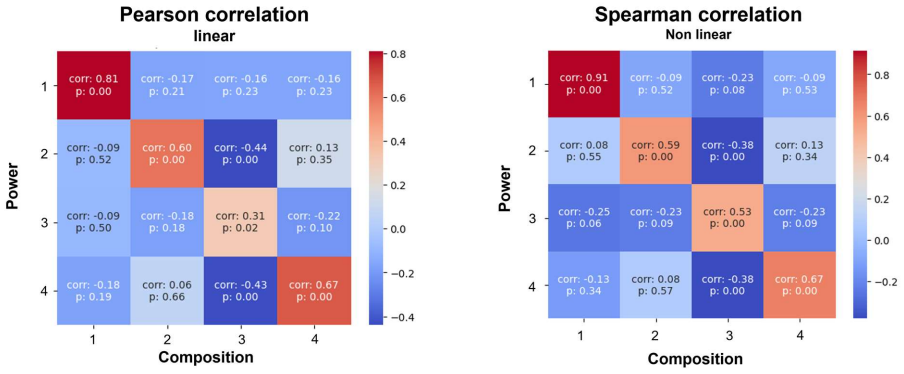
The central claim is the feasibility of a first prototype generic machine learning framework for inverse design in hybrid HiPIMS/pulsed-DC PVD. Rather than training one model per alloy system, the authors encode each cathode by its operating mode and each element by normalized physical parameters, notably sputtering yield. On this basis, Random Forest and XGBoost models learn both the forward map (power -> composition) and the backward map (composition -> power), the latter regularized by bounding the predicted power windows to handle its non-injective nature. The model is validated on a dataset of 82 depositions spanning seven elements (Cr, Al, Mo, Ni, V, W, Nb), with correlations between p
What carries the argument
The element-independent descriptor encoding: each deposition event is described by the cathode operating mode (HiPIMS or pulsed-DC) and normalized physical parameters of the sputtered element, chiefly the sputtering yield, instead of chemical identity. This is what lets a single Random Forest/XGBoost model serve any alloy system; the inverse problem is made tractable by predicting power within user-specified windows, which bounds the otherwise infinite set of power combinations giving the same composition.
Load-bearing premise
The model's transferability rests on the assumption that cathode operating mode plus normalized sputtering yield capture enough of the deposition physics to predict any element combination, yet no element is held out from the training set to verify this.
What would settle it
Train the element-independent model on any six of the seven elements, then use it to predict the cathode powers for a target composition containing only the held-out seventh element, deposit that coating, and measure the actual composition; if the error is comparable to or larger than the reported ~0.1 RMSE rather than the in-distribution error, the element-independence claim fails.
If this is right
- New alloy systems can be explored by swapping target elements and reusing the same model, requiring only a handful of calibration depositions rather than a full retraining campaign.
- The inverse map gives experimentalists a concrete starting recipe for a target composition, reducing the number of deposition runs needed to land on a specified high-entropy alloy.
- The correlation matrices show the model captures cross-cathode plasma interactions, so it can be used to anticipate how changing one cathode's power perturbs the whole film composition.
- The same descriptor logic can be extended to predict microstructural and functional properties once grain size, texture, stress, and deposition rate are added as targets.
- The approach supports the long-term goal of closed-loop autonomous deposition, where in-situ diagnostics feed corrections back into the model in real time.
Where Pith is reading between the lines
- The strongest test of element-independence would be a leave-one-element-out experiment: train on six elements and ask the model to predict the power for a seventh held-out element; the paper does not report this, so transferability to truly unseen elements remains an open claim.
- Sputtering yield alone may not separate elements whose yields are similar but whose plasma chemistry differs (e.g., target poisoning, secondary electron emission, gas rarefaction); adding plasma diagnostics as descriptors could make the model robust to such cases.
- The same descriptor-based inverse-design approach could be carried over to reactive sputtering of oxides or nitrides, where composition targets become stoichiometry targets and the descriptor set would need to include reactive gas flow and target state.
- Because the backward map is surjective, the model as presented gives one recipe among many; a human or optimisation loop must impose additional constraints (cost, rate, stress) to select the best recipe.
Editorial analysis
A structured set of objections, weighed in public.
Referee Report
Summary. The paper presents a combination of a programmatic overview of the French DIADEM materials-data-science initiative and a machine-learning study on the DIADEM-2D combinatorial magnetron sputtering platform. The authors describe the selection of candidate alloy systems for molten-salt corrosion (Ni-Cr-Mo-Al) and nuclear cladding diffusion barriers (V-Nb-Mo-W), then train Random Forest, XGBoost, Bayesian Ridge, and a fuzzy inference system on a dataset of seven elements (Ni, Cr, Mo, Al, W, Nb, V; 82 points). The forward task predicts coating composition from cathode powers; the inverse task predicts powers from a target composition. The authors report RMSE ≈ 0.1 (forward) and RMSE ≈ 70 W (backward) and claim that, because the model uses physical descriptors such as sputtering yield rather than element identity, it is element-independent and transferable to new elements without retraining. The central conclusion is that this is a first prototype of a generic machine-learning framework for inverse design of PVD process parameters.
Significance. If the element-transferability claim were established, this would be a valuable contribution to high-throughput combinatorial sputtering, substantially reducing experimental effort when exploring new alloy systems. The paper has clear strengths: it describes a concrete closed-loop platform concept, checks model behavior through correlation matrices, and explores interpretable fuzzy systems in addition to black-box ensembles. However, the evidence presented is an in-sample proof of concept only. The evaluation uses random splits in which every element appears in training, no element is held out, there is no comparison against a simple physical scaling baseline, and no uncertainty quantification or per-element errors are reported. The central 'generic, element-independent' claim is therefore not yet supported by the data. The work could become a meaningful demonstration if the authors add leave-one-element-out cross-validation, per-element and test-only metrics, a descriptor-based baseline, and public data/code.
major comments (3)
- [§4.2, §4.3, §4.4] The load-bearing claim is element independence and transferability, but it is never tested. Section 4.3 describes a random 80/20 split repeated five times; in such a split every element appears in the training set, so the test set only measures interpolation among already seen elements. Section 4.4 then states that 'This methodology can be applied to dataset with elements which are not present in the dataset', a claim not supported by any experiment. With only seven elements, descriptors such as sputtering yield are nearly unique per element and may serve as an implicit element label. Please add leave-one-element-out cross-validation, report per-element errors, and compare against a simple sputtering-yield normalization baseline (e.g., composition approximately proportional to yield × power normalized over cathodes). Without such a test, the Conclusion's transferability statement is unsu
- [§4.3, §4.4, Figures 10, 11] The reported accuracy lacks the quantitative detail needed to assess the claims. The parity plots appear to show train and test points together, and the RMSE values (≈0.1 and ≈70 W) are given without normalization or scale context: what is the composition unit (mole fraction?) and what is the range of powers in the dataset? The repeated 5-fold split provides only an average; no error bars, confidence intervals, or per-element residuals are shown. Please report separate train/test RMSE with standard deviations, describe the composition and power ranges, and plot test points separately from training points. This is necessary for the 'accuracy' claim in the abstract and conclusion.
- [§4.2] The element-independent descriptor set is under-specified. The text names 'cathode operating mode' and 'sputtering yield' but does not give the full feature vector, the energy at which sputtering yield is evaluated, or an explicit statement that categorical element identity variables are excluded. Without this information the model is not reproducible, and the claim of element independence cannot be checked. Please provide a complete descriptor table, the normalization procedure, and a code/data release. A helpful additional check would be to train on a subset of elements and show that the learned mapping remains physically sensible for a held-out element, even if the eventual target is one of the seven studied elements.
minor comments (4)
- [§II] Typo: 'Thises ways' should be 'These ways'. Also 'reliance' in §4.3 should be 'reliability'.
- [§4.4, Figures 10, 11] The phrase 'test/train graph' or 'test/train batch' is misleading. Please distinguish training and test points clearly, for example with different markers and a separate test-only panel, and state the number of points in each set.
- [Figure 14] Axes of the learning-curve figure are unlabeled. Define CV RMSE in the caption and indicate which line corresponds to which model.
- [Data availability] 'Data are available from the corresponding author upon reasonable request' is not sufficient for reproducibility of the ML results. Please deposit the dataset and analysis code in a public repository, or specify any legal/ethical restrictions preventing release.
Circularity Check
No significant circularity: the ML predictions are empirical fits with random-split test-set evaluation; the transferability claim is an untested extrapolation, not a construction-equivalent reduction.
full rationale
The paper's central results are regression models trained on 82 experimental points and evaluated on random 80/20 splits with 5-fold repetition (Section 4.3). A random-split test set is a standard internal generalization check, so the reported RMSE values are not fitted parameters renamed as predictions. The 'element-independent' claim in Section 4.2 rests on the use of physical descriptors such as sputtering yield instead of element names; this is a representational choice, not an equation that makes the output equal to the input. The statement in Section 4.4 that the methodology 'can be applied to dataset with elements which are not present in the dataset' is an extrapolation that is never tested with a leave-one-element-out experiment; that is a validity/robustness gap, not circular reasoning. Self-citations [4], [23], [38], [39] are background or auxiliary and do not carry the central predictive claim. Therefore the derivation chain is not circular, though the transferability claim is weaker than demonstrated.
Axiom & Free-Parameter Ledger
free parameters (2)
- Machine-learning model parameters and hyperparameters (Random Forest, XGBoost, Bayesian ridge) =
not reported in article
- Inverse-model power windows =
not specified
axioms (3)
- domain assumption Cathode power and tabulated sputtering yield, plus cathode operating mode, are sufficient descriptors to predict composition across elements.
- domain assumption All deposition conditions other than cathode powers are fixed and can be neglected in the mapping.
- domain assumption Random 80/20 splits of the 82 datapoints are representative and the five-fold CV estimates generalization.
Cite this review
Pith. "Pith review of Machine Learning Assisted Design of Complex and High Entropy Alloys by Hybrid HiPIMS/Pulsed-DC PVD Process for Low Carbon Energy Applications in Extreme Environments." pith.science (2026). https://pith.science/paper/HX7LIKVA
@misc{pith2026260801903,
  author       = {Pith},
  title        = {Pith review of: Machine Learning Assisted Design of Complex and High Entropy Alloys by Hybrid HiPIMS/Pulsed-DC PVD Process for Low Carbon Energy Applications in Extreme Environments},
  year         = {2026},
  howpublished = {\url{https://pith.science/paper/HX7LIKVA}},
  note         = {Machine review of arXiv:2608.01903}
}
read the original abstract
Complex and high entropy alloys are attracting much attention currently thanks to their mechanical and corrosion resistance properties in harsh environments, in particular needed for carbon-free energy applications. However, their elaboration in bulk and in thin film form in a trial-and-error approach is impractical due to their complexity and the cocktail effect. The recent development of artificial intelligence brings a new possibility for their elaboration and adjustment of their properties. Firstly, we present an overview of Materials and data science research. Then we describe how DIADEM - French initiative for Materials and Data science convergence - tackles the development of innovative coatings for carbon-free energy applications (nuclear, high temperature electrolysis, ...) thanks to the development of a nationwide network of synthesis and characterization platforms - the DIADEM discovery hub. We describe in particular DIADEM-2D, an AI-driven Hybrid HiPIMS/Pulsed-DC PVD process using 4 cathodes in confocal combinatorial configuration. We present the high entropy alloy determination using data from the literature for corrosion resistance in molten salt media and nuclear accidental conditions. An element-independent model gathering deposition parameters and coating properties has been implemented allowing the design of protective coatings with a particular composition. We demonstrate the feasibility of this process and its accuracy.
Figures




Reference graph
Works this paper leans on
-
[1]
B. De Goes Foschiani, S. Bongiorno, O. Robach, O. Ulrich, J. Micha, et J. Eymery, « Multimodal Imaging of Strain and Light Emission of Core–Shell InGaN/GaN Wires under a Sub-Micrometer Polychromatic X-Ray Probe », Adv. Mater. Interfaces, vol. 13, no 4, p. e01025, févr. 2026, doi: 10.1002/admi.202501025
-
[2]
J. J. De Pablo, B. Jones, C. L. Kovacs, V. Ozolins, et A. P. Ramirez, « The Materials Genome Initiative, the interplay of experiment, theory and computation », Curr. Opin. Solid State Mater. Sci., vol. 18, no 2, p. 99‑117, avr. 2014, doi: 10.1016/j.cossms.2014.02.003
-
[3]
B. Bayerlein et al., « Concepts for a Semantically Accessible Materials Data Space: Overview over Specific Implementations in Materials Science », Adv. Eng. Mater., vol. 27, no 8, p. 2401092, avr. 2025, doi: 10.1002/adem.202401092
-
[4]
F. Lomello, L. Bard, M. Maglione, et F. Schuster, « PEPR DIADEM: Priority equipment and research program on the development of innovative materials using artificial intelligence », Comput. Struct. Biotechnol. J., vol. 25, p. 186‑193, déc. 2024, doi: 10.1016/j.csbj.2024.09.019
-
[5]
B. Cantor, I. T. H. Chang, P. Knight, et A. J. B. Vincent, « Microstructural development in equiatomic multicomponent alloys », Mater. Sci. Eng. A, vol. 375‑377, p. 213‑218, juill. 2004, doi: 10.1016/j.msea.2003.10.257
-
[6]
Yeh, « Alloy Design Strategies and Future Trends in High-Entropy Alloys », JOM, vol
J.-W. Yeh, « Alloy Design Strategies and Future Trends in High-Entropy Alloys », JOM, vol. 65, no 12, p. 1759‑1771, déc. 2013, doi: 10.1007/s11837-013-0761-6
-
[7]
Y. Y. Chen, T. Duval, U. D. Hung, J. W. Yeh, et H. C. Shih, « Microstructure and electrochemical properties of high entropy alloys—a comparison with type-304 stainless steel », Corros. Sci., vol. 47, no 9, p. 2257‑2279, sept. 2005, doi: 10.1016/j.corsci.2004.11.008
-
[8]
Y. Y. Chen, U. T. Hong, H. C. Shih, J. W. Yeh, et T. Duval, « Electrochemical kinetics of the high entropy alloys in aqueous environments—a comparison with type 304 stainless steel », Corros. Sci., vol. 47, no 11, p. 2679‑2699, nov. 2005, doi: 10.1016/j.corsci.2004.09.026
-
[9]
J. -W. Yeh et al., « Nanostructured High-Entropy Alloys with Multiple Principal Elements: Novel Alloy Design Concepts and Outcomes », Adv. Eng. Mater., vol. 6, no 5, p. 299‑303, mai 2004, doi: 10.1002/adem.200300567
-
[10]
C. M. Rost et al., « Entropy-stabilized oxides », Nat. Commun., vol. 6, no 1, p. 8485, sept. 2015, doi: 10.1038/ncomms9485
-
[11]
S. S. I. Almishal et al., « Untangling individual cation roles in rock salt high-entropy oxides », Acta Mater., vol. 279, p. 120289, oct. 2024, doi: 10.1016/j.actamat.2024.120289
arXiv 2024
-
[12]
L. Su et al., « Visualizing the Formation of High-Entropy Fluorite Oxides from an Amorphous Precursor at Atomic Resolution », ACS Nano, vol. 16, no 12, p. 21397‑21406, déc. 2022, doi: 10.1021/acsnano.2c09760
-
[13]
G. H. J. Johnstone et al., « Entropy Engineering and Tunable Magnetic Order in the Spinel High- Entropy Oxide », J. Am. Chem. Soc., vol. 144, no 45, p. 20590‑20600, nov. 2022, doi: 10.1021/jacs.2c06768
-
[14]
Teng et al., « Synthesis and structures of high-entropy pyrochlore oxides », J
Z. Teng et al., « Synthesis and structures of high-entropy pyrochlore oxides », J. Eur. Ceram. Soc., vol. 40, no 4, p. 1639‑1643, avr. 2020, doi: 10.1016/j.jeurceramsoc.2019.12.008
-
[15]
D. A. Vinnik et al., « High-entropy oxide phases with magnetoplumbite structure », Ceram. Int., vol. 45, no 10, p. 12942‑12948, juill. 2019, doi: 10.1016/j.ceramint.2019.03.221
-
[16]
J. Ma, T. Liu, W. Ye, Q. He, et K. Chen, « High-entropy perovskite oxides for energy materials: A review », J. Energy Storage, vol. 90, p. 111890, juin 2024, doi: 10.1016/j.est.2024.111890
arXiv 2024
-
[17]
Y. Feng et al., « Discovery of high entropy garnet solid-state electrolytes via ultrafast synthesis », Energy Storage Mater., vol. 63, p. 103053, nov. 2023, doi: 10.1016/j.ensm.2023.103053
arXiv 2023
-
[18]
forward” direction (power composition) has a bijective character, the “backward
with a wide variety of properties which make them interesting for different applications like thermoelectricity, magnetism, catalysis or batteries [19]. High entropy materials are subject to cocktail effect [20] stating that the material structure and properties are determined by the combination of the properties of the elements and the interactions betwe...
-
[19]
X. Miao, Z. Peng, L. Shi, et S. Zhou, « Insulating High-Entropy Ruthenium Oxide as a Highly Efficient Oxygen-Evolving Electrocatalyst in Acid », ACS Catal., vol. 13, no 6, p. 3983‑3989, mars 2023, doi: 10.1021/acscatal.2c06276. 17
-
[20]
S. Sen, M. Palabathuni, K. M. Ryan, et S. Singh, « High Entropy Oxides: Mapping the Landscape from Fundamentals to Future Vistas: Focus Review », ACS Energy Lett., vol. 9, no 8, p. 3694‑3718, août 2024, doi: 10.1021/acsenergylett.4c01129
-
[21]
Yeh, « Recent progress in high-entropy alloys », Ann
J.-W. Yeh, « Recent progress in high-entropy alloys », Ann. Chim. Sci. Matér., vol. 31, no 6, p. 633‑648, déc. 2006, doi: 10.3166/acsm.31.633-648
-
[22]
Ranganathan, « Alloyed pleasures: Multimetallic cocktails », Curr
S. Ranganathan, « Alloyed pleasures: Multimetallic cocktails », Curr. Sci., vol. 85, no 10, 2003
2003
-
[23]
V. Kouznetsov, K. Macák, J. M. Schneider, U. Helmersson, et I. Petrov, « A novel pulsed magnetron sputter technique utilizing very high target power densities », Surf. Coat. Technol., vol. 122, no 2‑3, p. 290‑293, déc. 1999, doi: 10.1016/S0257-8972(99)00292-3
-
[24]
R. Herschberg et al., « From Pairwise Comparisons of Complex Behavior to an Overall Performance Rank: A Novel Alloy Design Strategy », Metals, vol. 14, no 12, p. 1412, déc. 2024, doi: 10.3390/met14121412
-
[25]
Brachet et al., « Gaines de combustible nucléaire, procédé de fabrication et utilisations contre l’oxydation/hydruration », EP3195322B1, 26 juillet 2017
J.-C. Brachet et al., « Gaines de combustible nucléaire, procédé de fabrication et utilisations contre l’oxydation/hydruration », EP3195322B1, 26 juillet 2017
2017
-
[26]
J. Krejčí et al., « Development and testing of multicomponent fuel cladding with enhanced accidental performance », Nucl. Eng. Technol., vol. 52, no 3, p. 597‑609, mars 2020, doi: 10.1016/j.net.2019.08.015
-
[27]
H. Okamoto, « Supplemental Literature Review of Binary Phase Diagrams: B-Fe, Cr-Zr, Fe-Np, Fe- W, Fe-Zn, Ge-Ni, La-Sn, La-Ti, La-Zr, Li-Sn, Mn-S, and Nb-Re », J. Phase Equilibria Diffus., vol. 37, no 5, p. 621‑634, oct. 2016, doi: 10.1007/s11669-016-0465-z
-
[28]
B. Wang, Q. Wang, N. Lu, X. Liang, et B. Shen, « Enhanced high-temperature strength of HfNbTaTiZrV refractory high-entropy alloy via Al2O3 reinforcement », J. Mater. Sci. Technol., vol. 123, p. 191‑200, oct. 2022, doi: 10.1016/j.jmst.2022.01.025
-
[29]
D. B. Miracle, M.-H. Tsai, O. N. Senkov, V. Soni, et R. Banerjee, « Refractory high entropy superalloys (RSAs) », Scr. Mater., vol. 187, p. 445‑452, oct. 2020, doi: 10.1016/j.scriptamat.2020.06.048
-
[30]
R. Isayev et P. Dzhumaev, « Interaction of a diffusion barrier from the refractory metals with a zirconium alloy and a chrome coating of an accident tolerant fuel », Nucl. Eng. Des., vol. 407, p. 112307, juin 2023, doi: 10.1016/j.nucengdes.2023.112307
arXiv 2023
-
[31]
C. Lee et al., « An experimentally driven high-throughput approach to design refractory high- entropy alloys », Mater. Des., vol. 223, p. 111259, nov. 2022, doi: 10.1016/j.matdes.2022.111259
arXiv 2022
-
[32]
Pedregosa et al., « Scikit-learn: Machine Learning in Python », 2012, doi: 10.48550/ARXIV.1201.0490
F. Pedregosa et al., « Scikit-learn: Machine Learning in Python », 2012, doi: 10.48550/ARXIV.1201.0490
-
[33]
Breiman, « Random Forests », Mach
L. Breiman, « Random Forests », Mach. Learn., vol. 45, no 1, p. 5‑32, oct. 2001, doi: 10.1023/A:1010933404324
- [34]
-
[35]
T. Akiba, S. Sano, T. Yanase, T. Ohta, et M. Koyama, « Optuna: A Next-generation Hyperparameter Optimization Framework », 2019, arXiv. doi: 10.48550/ARXIV.1907.10902
- [36]
-
[37]
D. J. C. MacKay, « Bayesian Interpolation », Neural Comput., vol. 4, no 3, p. 415‑447, mai 1992, doi: 10.1162/neco.1992.4.3.415
-
[38]
Tipping, « Sparse Bayesian Learning and the Relevance Vector Machine », J
M. Tipping, « Sparse Bayesian Learning and the Relevance Vector Machine », J. Mach. Learn. Res., no 1, p. 211‑244, 2001
2001
-
[39]
H. Hajri, J.-P. Poli, et L. Boudet, « Towards Monotonous Functions Approximation from Few Data With Gradual Generalized Modus Ponens: Application to Materials Science », in 2021 IEEE 33rd International Conference on Tools with Artificial Intelligence (ICTAI), Washington, DC, USA: IEEE, nov. 2021, p. 796‑800. doi: 10.1109/ICTAI52525.2021.00127. 18
arXiv 2021
-
[40]
O. Rousselle, J.-P. Poli, et N. B. Abdallah, « Towards an Interpretable Fuzzy Approach to Experimental Design », in Information Processing and Management of Uncertainty in Knowledge- Based Systems, vol. 1174, M.-J. Lesot, S. Vieira, M. Z. Reformat, J. P. Carvalho, F. Batista, B. Bouchon-Meunier, et R. R. Yager, Éd., in Lecture Notes in Networks and System...
discussion (0)
Sign in with ORCID, Apple, or X to comment. Anyone can read and Pith papers without signing in.