Physical and Chemical Conditions of Molecular Gas in NGC 1068: The nuclear feedback in the circumnuclear disk and starburst ring
Pith reviewed 2026-07-01 04:38 UTC · model grok-4.3
The pith
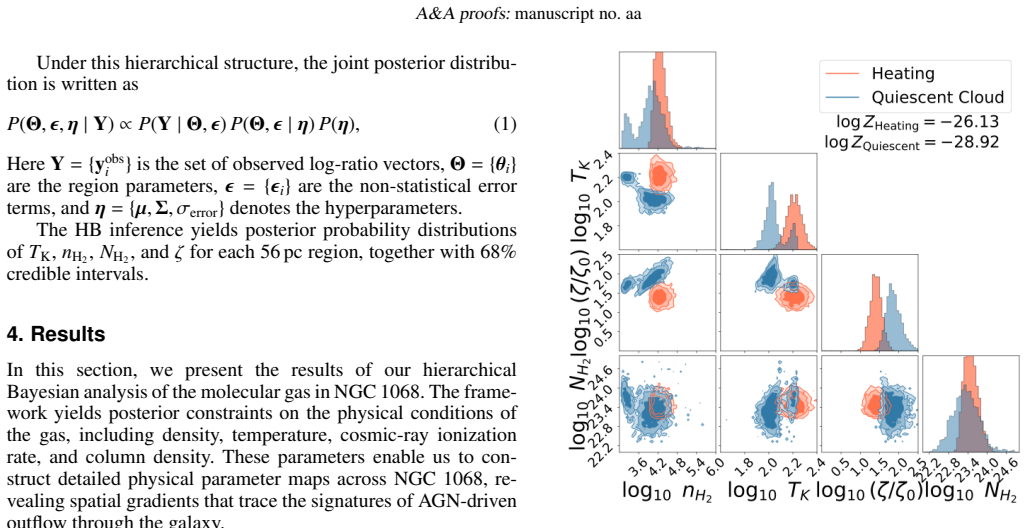
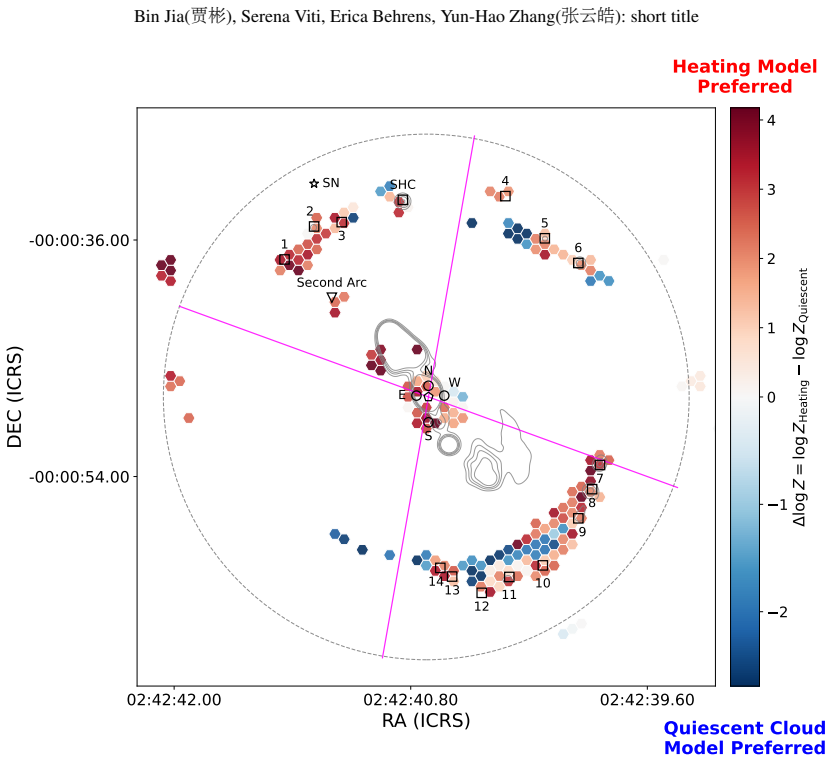
ALMA observations of NGC 1068 reveal radial and azimuthal variations in molecular gas density, temperature, column density, and cosmic-ray ionization rate across the circumnuclear disk and starburst ring.
A machine-rendered reading of the paper's core claim, the machinery that carries it, and where it could break.
Core claim
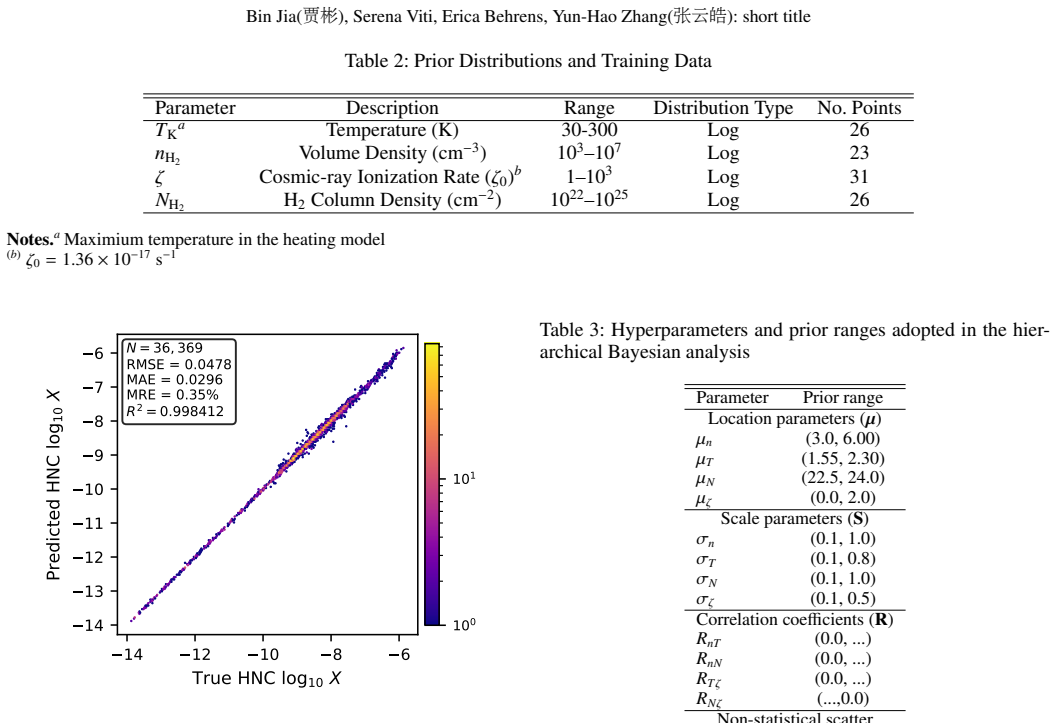
The analysis of convolved ALMA Bands 3, 4, and 5 data cubes for HCN, HCO+, HNC, CS, CN and C2H shows clear radial and azimuthal variations in gas density, temperature, column density, and cosmic-ray ionization rate throughout the circumnuclear disk and starburst ring. These parameters are obtained by linking non-LTE radiative transfer with chemical abundances, where the abundances are supplied by a neural network emulator trained on a large UCLCHEM grid rather than by running the full chemical code at each step. The emulator reproduces UCLCHEM results with low error, enabling the sampling with Nautilus to be performed at modest cost. The derived maps differ from previous RADEX and UCLCHEM st
What carries the argument
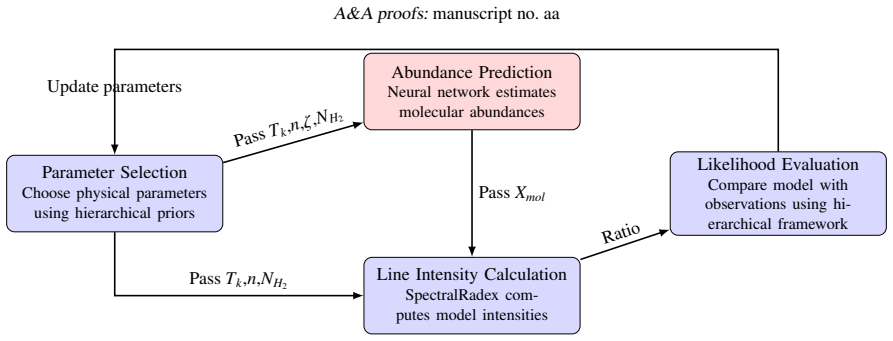
Hierarchical Bayesian inference that couples a non-LTE radiative transfer module to chemical modelling through a neural network emulator of UCLCHEM grids.
If this is right
- The nuclear outflow from the active nucleus affects the physical and chemical state of molecular gas in the starburst ring.
- The heating scenario and the quiescent cloud scenario produce distinguishable predictions for the observed line ratios once the parameter maps are examined.
- The same combination of radiative transfer and emulated chemistry can be applied to additional ALMA datasets of NGC 1068 or other galaxies to extend the spatial coverage.
- Differences between the new maps and earlier single-position studies using RADEX and UCLCHEM arise from the full spatial sampling and the updated chemical treatment.
Where Pith is reading between the lines
- The same emulator-based approach could be used on larger samples of nearby AGN hosts to search for common patterns in how outflows alter star-forming rings.
- Azimuthal variations in cosmic-ray ionization rate may trace the geometry of the outflow or the distribution of supernova remnants, offering a testable link between dynamics and chemistry.
- Higher-resolution observations that resolve structures inside the current 56 pc hexagons would reveal whether the reported variations persist at smaller scales or average out.
Load-bearing premise
The neural network emulator trained on a large model grid accurately reproduces the UCLCHEM abundances with low error.
What would settle it
A direct side-by-side comparison of emulator-predicted abundances against full UCLCHEM runs for a new set of positions with extreme cosmic-ray ionization rates would show whether the low-error assumption holds and whether the inferred parameter maps remain reliable.
Figures
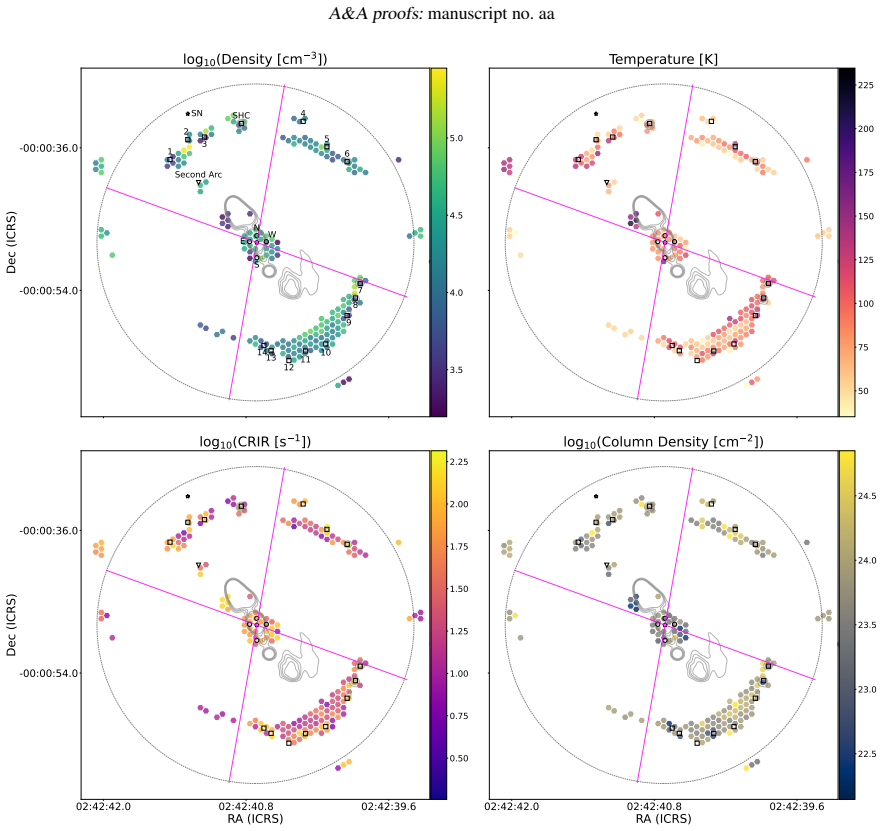
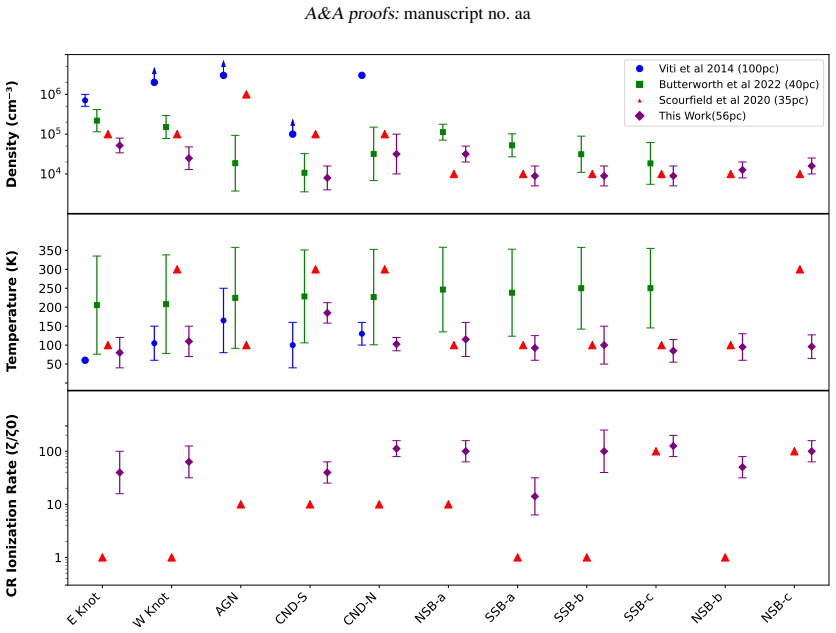
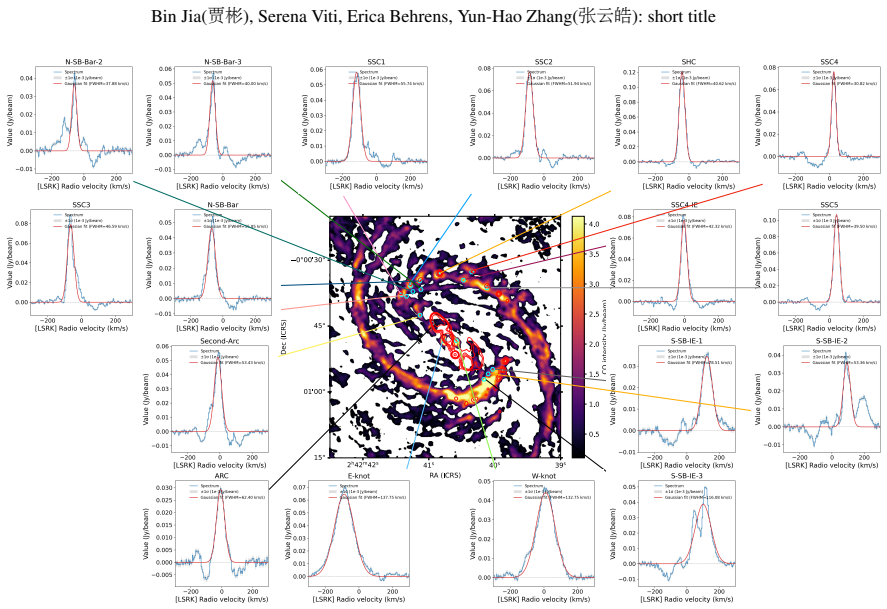
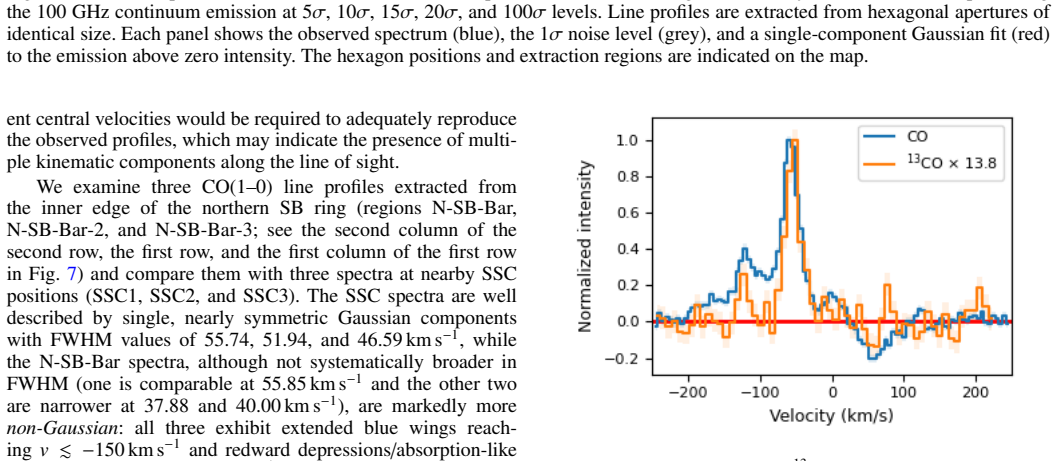
read the original abstract
Molecular gas in galaxies is shaped by both star formation and active galactic nuclei. In NGC 1068, the circumnuclear disk and the starburst ring offer a nearby case to study these effects with many molecular tracers. Earlier work has shown strong outflow activity and complex chemistry, which motivates the use of methods that combine radiative transfer with time-dependent chemistry. Our aim is to map the physical conditions across the circumnuclear disk and the starburst ring of NGC 1068 and to test whether the nuclear outflow influences the molecular gas in the ring. We also examine whether the heating or the quiescent cloud scenario better matches the observations. We use archival ALMA observations obtained in Bands 3, 4, and 5, covering molecular species including HCN, HCO+, HNC, CS, CN and C2H. All data cubes are convolved to a common resolution of 0.8" and are sampled into 56 pc hexagons with a signal-to-noise threshold of three. We perform hierarchical Bayesian inference that links a non-LTE radiative transfer module SpectralRadex with chemical modelling. To make the analysis efficient, we replace direct UCLCHEM calculations with a neural network emulator trained on a large model grid. Sampling is done with Nautilus. We also compare our results with previous studies that used RADEX and UCLCHEM for selected regions. The emulator reproduces the UCLCHEM abundances with low error and allows inference at modest computational cost. We find clear radial and azimuthal variations in gas density, temperature, column density, and cosmic-ray ionization rate.
Editorial analysis
A structured set of objections, weighed in public.
Referee Report
Summary. The paper analyzes archival ALMA Band 3/4/5 observations of HCN, HCO+, HNC, CS, CN and C2H in NGC 1068, convolved to 0.8 arcsec and sampled in 56-pc hexagons. It performs hierarchical Bayesian inference that couples SpectralRadex non-LTE radiative transfer to time-dependent chemistry, replacing direct UCLCHEM runs with a neural-network emulator trained on a large grid; sampling uses Nautilus. The central result is the detection of clear radial and azimuthal variations in n(H2), T, N(H2) and ζ_CR across the circumnuclear disk and starburst ring, together with a comparison to earlier RADEX/UCLCHEM point analyses.
Significance. If the emulator validation and posterior sampling are robust, the work supplies the first spatially resolved, multi-tracer maps of density, temperature, column density and cosmic-ray ionization rate in an AGN host, directly testing the influence of nuclear outflow on the starburst ring and discriminating between heating and quiescent-cloud scenarios. The combination of time-dependent chemistry with non-LTE transfer at modest computational cost is a methodological advance with clear applicability to other nearby AGN.
major comments (2)
- [Abstract / Methods] Abstract and methods section: the statement that “the emulator reproduces the UCLCHEM abundances with low error” is not accompanied by quantitative metrics (MAE, RMSE, or coverage statistics per species) evaluated at the posterior densities (10^3–10^6 cm^{-3}), temperatures (10–100 K) and elevated ζ_CR values that dominate the maps. Because the headline radial/azimuthal variations rest entirely on this substitution inside the SpectralRadex module, the absence of these diagnostics is load-bearing for the central claim.
- [Results] Results section: no test is shown for possible emulator bias correlated with radius or azimuth (e.g., in high-ζ_CR or shock-dominated regimes). If such systematics exist, the reported spatial gradients could be artifacts rather than physical; a residual map or cross-validation against direct UCLCHEM runs at a subset of posterior samples is required.
minor comments (2)
- [Observations] The 56-pc hexagonal sampling and S/N > 3 threshold are reasonable but the paper should state the exact number of independent beams and any covariance introduced by the common-resolution convolution.
- [Methods] Notation for the cosmic-ray ionization rate (ζ_CR) should be defined explicitly on first use and kept consistent with the UCLCHEM input parameter.
Simulated Author's Rebuttal
We thank the referee for the constructive and detailed comments. We agree that quantitative validation of the neural-network emulator is necessary to support the robustness of the reported spatial variations, and we will revise the manuscript to include the requested diagnostics.
read point-by-point responses
-
Referee: [Abstract / Methods] Abstract and methods section: the statement that “the emulator reproduces the UCLCHEM abundances with low error” is not accompanied by quantitative metrics (MAE, RMSE, or coverage statistics per species) evaluated at the posterior densities (10^3–10^6 cm^{-3}), temperatures (10–100 K) and elevated ζ_CR values that dominate the maps. Because the headline radial/azimuthal variations rest entirely on this substitution inside the SpectralRadex module, the absence of these diagnostics is load-bearing for the central claim.
Authors: We acknowledge that the manuscript currently offers only a qualitative description of emulator performance. In the revised version we will add explicit quantitative metrics (MAE, RMSE, and coverage statistics per species) evaluated on a test set drawn from the exact posterior ranges of n(H2), T, and ζ_CR that dominate the maps. These diagnostics will be presented in the Methods section and referenced from the Abstract. revision: yes
-
Referee: [Results] Results section: no test is shown for possible emulator bias correlated with radius or azimuth (e.g., in high-ζ_CR or shock-dominated regimes). If such systematics exist, the reported spatial gradients could be artifacts rather than physical; a residual map or cross-validation against direct UCLCHEM runs at a subset of posterior samples is required.
Authors: We agree that position-dependent bias must be explicitly ruled out. We will add a cross-validation test that selects a representative subset of posterior samples spanning the full range of radii, azimuths, and ζ_CR values (including the highest-ζ_CR and potential shock-influenced locations), recomputes abundances with direct UCLCHEM, and presents residual maps together with a quantitative assessment of any spatially correlated residuals. This material will be included in the Results section. revision: yes
Circularity Check
No significant circularity; emulator is independent approximation
full rationale
The derivation chain relies on archival ALMA observations processed through SpectralRadex non-LTE radiative transfer linked to a neural-network emulator of UCLCHEM time-dependent chemistry. The emulator is trained on an independent large model grid and asserted to reproduce UCLCHEM abundances with low error; this is a standard computational surrogate, not a self-definition or fitted-input prediction. No load-bearing self-citations, uniqueness theorems, or ansatzes imported from the authors' prior work appear in the abstract or described method. The reported radial/azimuthal variations are outputs of the hierarchical Bayesian sampling applied to external data, not reductions of the inputs by construction. The approach is self-contained against external benchmarks.
Axiom & Free-Parameter Ledger
Reference graph
Works this paper leans on
-
[1]
Neural Network Constraints on the Cosmic-Ray Ionization Rate and Other Physical Conditions in NGC 253 with ALCHEMI Measurements of HCN and HNC. , keywords =. doi:10.3847/1538-4357/ad85db , archivePrefix =. 2409.13821 , primaryClass =
-
[2]
Journal of Molecular Spectroscopy , keywords =
The Cologne Database for Molecular Spectroscopy, CDMS, in the Virtual Atomic and Molecular Data Centre, VAMDC. Journal of Molecular Spectroscopy , keywords =. doi:10.1016/j.jms.2016.03.005 , adsurl =
-
[3]
ALMA images the many faces of the <ASTROBJ>NGC 1068</ASTROBJ> torus and its surroundings. , keywords =. doi:10.1051/0004-6361/201936606 , archivePrefix =. 1909.00675 , primaryClass =
-
[4]
The Two Micron All Sky Survey (2MASS). , keywords =. doi:10.1086/498708 , adsurl =
-
[5]
CASA, the Common Astronomy Software Applications for Radio Astronomy
CASA, the Common Astronomy Software Applications for Radio Astronomy. , keywords =. doi:10.1088/1538-3873/ac9642 , archivePrefix =. 2210.02276 , primaryClass =
work page internal anchor Pith review Pith/arXiv arXiv doi:10.1088/1538-3873/ac9642
-
[6]
Understanding molecular abundances in star-forming regions using interpretable machine learning. , keywords =. doi:10.1093/mnras/stad2814 , archivePrefix =. 2309.06784 , primaryClass =
-
[7]
Molecular line emission in NGC 1068 imaged with ALMA. II. The chemistry of the dense molecular gas. , keywords =. doi:10.1051/0004-6361/201424116 , archivePrefix =. 1407.4940 , primaryClass =
work page internal anchor Pith review Pith/arXiv arXiv doi:10.1051/0004-6361/201424116
-
[8]
Understanding if molecular ratios can be used as diagnostics of AGN and starburst activity: The case of NGC 1068. , keywords =. doi:10.1051/0004-6361/202244563 , archivePrefix =. 2209.05928 , primaryClass =
-
[9]
ALMA observations of CS in NGC 1068: chemistry and excitation. , keywords =. doi:10.1093/mnras/staa1891 , archivePrefix =. 2006.15041 , primaryClass =
-
[10]
The chemical footprint of AGN feedback in the outflowing circumnuclear disk of NGC 1068. , keywords =. doi:10.1051/0004-6361/202142831 , archivePrefix =. 2202.05005 , primaryClass =
-
[11]
Dust SEDs in the era of Herschel and Planck: a Hierarchical Bayesian fitting technique
Dust Spectral Energy Distributions in the Era of Herschel and Planck: A Hierarchical Bayesian-fitting Technique. , keywords =. doi:10.1088/0004-637X/752/1/55 , archivePrefix =. 1203.0025 , primaryClass =
work page internal anchor Pith review Pith/arXiv arXiv doi:10.1088/0004-637x/752/1/55
-
[12]
Volume Density Structure of the Central Molecular Zone NGC 253 through ALCHEMI Excitation Analysis. , keywords =. doi:10.3847/1538-4357/ad0e64 , archivePrefix =. 2311.12106 , primaryClass =
-
[13]
Molecular line emission in NGC 1068 imaged with ALMA. I. An AGN-driven outflow in the dense molecular gas. , keywords =. doi:10.1051/0004-6361/201423843 , archivePrefix =. 1405.7706 , primaryClass =
work page internal anchor Pith review Pith/arXiv arXiv doi:10.1051/0004-6361/201423843
-
[14]
ALMA Reveals the Molecular Medium Fueling the Nearest Nuclear Starburst
ALMA Reveals the Molecular Medium Fueling the Nearest Nuclear Starburst. , keywords =. doi:10.1088/0004-637X/801/1/25 , archivePrefix =. 1411.2836 , primaryClass =
work page internal anchor Pith review Pith/arXiv arXiv doi:10.1088/0004-637x/801/1/25
-
[15]
ebehrens97/HERA: ApJ Release , url =
Erica Behrens , doi =. ebehrens97/HERA: ApJ Release , url =
-
[16]
Molecular shock tracers in NGC 1068: SiO and HNCO
Molecular shock tracers in NGC 1068: SiO and HNCO. , keywords =. doi:10.1051/0004-6361/201628946 , archivePrefix =. 1609.02023 , primaryClass =
work page internal anchor Pith review Pith/arXiv arXiv doi:10.1051/0004-6361/201628946
-
[17]
The Dense Molecular Gas in the Circumnuclear Disk of NGC 1068
The Dense Molecular Gas in the Circumnuclear Disk of NGC 1068. , keywords =. doi:10.1088/0004-637X/731/2/83 , archivePrefix =. 1102.3915 , primaryClass =
work page internal anchor Pith review Pith/arXiv arXiv doi:10.1088/0004-637x/731/2/83
-
[18]
A computer program for fast non-LTE analysis of interstellar line spectra
A computer program for fast non-LTE analysis of interstellar line spectra. With diagnostic plots to interpret observed line intensity ratios. , keywords =. doi:10.1051/0004-6361:20066820 , archivePrefix =. 0704.0155 , primaryClass =
work page internal anchor Pith review Pith/arXiv arXiv doi:10.1051/0004-6361:20066820
-
[19]
NAUTILUS: boosting Bayesian importance nested sampling with deep learning. , keywords =. doi:10.1093/mnras/stad2441 , archivePrefix =. 2306.16923 , primaryClass =
-
[20]
Dynamics of the Narrow-Line Region in the Seyfert 2 Galaxy NGC 1068
Dynamics of the Narrow-Line Region in the Seyfert 2 Galaxy NGC 1068. , keywords =. doi:10.1086/510580 , archivePrefix =. astro-ph/0611183 , primaryClass =
work page internal anchor Pith review Pith/arXiv arXiv doi:10.1086/510580
-
[21]
Modelling the [Fe II] 1.644 m outflow and comparison with H _ 2 and H ^ + kinematics in the inner 200 pc of NGC 1068. , keywords =. doi:10.1093/mnras/stu1637 , archivePrefix =. 1408.4750 , primaryClass =
work page internal anchor Pith review Pith/arXiv arXiv doi:10.1093/mnras/stu1637
-
[22]
Theory of Probability , year =
Harold Jeffreys , editor =. Theory of Probability , year =
-
[23]
Vibrationally excited HC _ 3 N emission in NGC 1068: tracing the recent star formation in the starburst ring. , keywords =. doi:10.1093/mnras/stab197 , archivePrefix =. 2008.03693 , primaryClass =
-
[24]
Discovery and Rapid Follow-up Observations of the Unusual Type II SN 2018ivc in NGC 1068. , keywords =. doi:10.3847/1538-4357/ab8945 , archivePrefix =. 1909.07304 , primaryClass =
-
[25]
Radio jets in NGC 1068 with e-MERLIN and VLA: structure and morphology. , keywords =. doi:10.1093/mnras/stad3864 , archivePrefix =. 2312.09722 , primaryClass =
-
[26]
Active Galactic Nuclei Jets as the Origin of Ultrahigh-Energy Cosmic Rays and Perspectives for the Detection of Astrophysical Source Neutrinos at EeV Energies. , keywords =. doi:10.1103/PhysRevLett.126.191101 , archivePrefix =. 2003.08392 , primaryClass =
-
[27]
High Energy Phenomena in Relativistic Outflows VII , year = 2019, month = jul, eid =
UHE Cosmic Rays And Agn Jets. High Energy Phenomena in Relativistic Outflows VII , year = 2019, month = jul, eid =. doi:10.22323/1.354.0019 , archivePrefix =. 1911.04171 , primaryClass =
-
[28]
Active Galactic Nuclei as Potential Sources of Ultra-High Energy Cosmic Rays. Universe , keywords =. doi:10.3390/universe8110607 , archivePrefix =. 2211.12202 , primaryClass =
-
[29]
Resolving acceleration to very high energies along the jet of Centaurus A. , keywords =. doi:10.1038/s41586-020-2354-1 , archivePrefix =. 2007.04823 , primaryClass =
-
[30]
Energizing Star Formation: The Cosmic-Ray Ionization Rate in NGC 253 Derived from ALCHEMI Measurements of H _ 3 O ^ + and SO. , keywords =. doi:10.3847/1538-4357/ac6753 , archivePrefix =. 2204.03668 , primaryClass =
-
[31]
The Astronomical Journal ,year=
Tracers of Dense Gas in the Outer Galaxy ,author=. The Astronomical Journal ,year=
-
[32]
Gao and Shu Liu and Zhi-Yu Zhang and Shanghuo Li and Y
Fei Li and Junzhi Wang and F. Gao and Shu Liu and Zhi-Yu Zhang and Shanghuo Li and Y. Gong and Juan Li and Yong Shi ,year=. Dense gas in local galaxies revealed by multiple tracers ,journal =
-
[33]
Shirley, Yancy L. , year=. The Critical Density and the Effective Excitation Density of Commonly Observed Molecular Dense Gas Tracers , volume=. Publications of the Astronomical Society of the Pacific , publisher=. doi:10.1086/680342 , number=
-
[34]
Astronomy & Astrophysics ,year=
Enhanced UV radiation and dense clumps in the molecular outflow of Mrk 231 ,author=. Astronomy & Astrophysics ,year=
-
[35]
Astronomy and Astrophysics ,year=
Probing X-ray irradiation in the nucleus of NGC 1068 with observations of high-J lines of dense gas tracers ,author=. Astronomy and Astrophysics ,year=
-
[36]
Astronomy and Astrophysics ,year=
Molecular absorption lines toward star-forming regions: a comparative study of HCO+, HNC, HCN, and CN ,author=. Astronomy and Astrophysics ,year=
-
[37]
ALMA imaging of C2H emission in the disk of NGC1068
ALMA imaging of C _ 2 H emission in the disk of <ASTROBJ>NGC 1068</ASTROBJ>. , keywords =. doi:10.1051/0004-6361/201731862 , archivePrefix =. 1709.05895 , primaryClass =
work page internal anchor Pith review Pith/arXiv arXiv doi:10.1051/0004-6361/201731862
-
[38]
Reconstructing the shock history in the CMZ of NGC 253 with ALCHEMI. , keywords =. doi:10.1051/0004-6361/202245659 , archivePrefix =. 2303.12685 , primaryClass =
-
[39]
Incorporating astrochemistry into molecular line modelling via emulation. , keywords =. doi:10.1051/0004-6361/201935973 , archivePrefix =. 1907.07472 , primaryClass =
-
[40]
Modeling the molecular emission of a parsec-scale torus as found in NGC 1068
From the Circumnuclear Disk in the Galactic Center to thick, obscuring tori of AGNs. Modeling the molecular emission of a parsec-scale torus as found in NGC 1068. , keywords =. doi:10.1051/0004-6361/202141684 , archivePrefix =. 2206.14513 , primaryClass =
-
[41]
Tracing Interstellar Heating: An ALCHEMI Measurement of the HCN Isomers in NGC 253. , keywords =. doi:10.3847/1538-4357/ac91ce , archivePrefix =. 2209.06244 , primaryClass =
-
[42]
HD molecules at high redshift: cosmic ray ionization rate in the diffuse interstellar medium. , keywords =. doi:10.1093/mnras/stab1535 , archivePrefix =. 2103.10676 , primaryClass =
-
[43]
Abundance Ratios of OH/CO and HCO ^ + /CO as Probes of the Cosmic-Ray Ionization Rate in Diffuse Clouds. , keywords =. doi:10.3847/1538-4357/acbf34 , archivePrefix =. 2302.12970 , primaryClass =
-
[44]
Investigating the Cosmic-Ray Ionization Rate in the Galactic Diffuse Interstellar Medium through Observations of H ^ + _ 3. , keywords =. doi:10.1088/0004-637X/745/1/91 , archivePrefix =. 1111.6936 , primaryClass =
work page internal anchor Pith review Pith/arXiv arXiv doi:10.1088/0004-637x/745/1/91
-
[45]
Proceedings of the National Academy of Science , keywords =
Interstellar Chemistry Special Feature: The galactic cosmic ray ionization rate. Proceedings of the National Academy of Science , keywords =. doi:10.1073/pnas.0602117103 , adsurl =
-
[46]
Cosmic Ray Ionization of Low-Excitation Lines in Active Galactic Nuclei and Starburst Galaxies
Cosmic-ray ionization of low-excitation lines in active galactic nuclei and starburst galaxies. , keywords =. doi:10.1051/0004-6361/202452232 , archivePrefix =. 2411.17811 , primaryClass =
work page internal anchor Pith review Pith/arXiv arXiv doi:10.1051/0004-6361/202452232
-
[47]
Cosmic-ray ionisation in circumstellar discs
Cosmic-ray ionisation in circumstellar discs. , keywords =. doi:10.1051/0004-6361/201732202 , archivePrefix =. 1803.09348 , primaryClass =
work page internal anchor Pith review Pith/arXiv arXiv doi:10.1051/0004-6361/201732202
-
[48]
Evaporation of ices near massive stars: models based on laboratory temperature programmed desorption data. , keywords =. doi:10.1111/j.1365-2966.2004.08273.x , archivePrefix =. astro-ph/0406054 , primaryClass =
-
[49]
Warm cores around regions of low-mass star formation. , keywords =. doi:10.1111/j.1365-2966.2010.17077.x , archivePrefix =. 1005.5265 , primaryClass =
-
[50]
Two can play at that game: constraining the role of supernova and AGN feedback in dwarf galaxies with cosmological zoom-in simulations. , keywords =. doi:10.1093/mnras/stac2252 , archivePrefix =. 2206.11274 , primaryClass =
-
[51]
Fast and energetic AGN-driven outflows in simulated dwarf galaxies
Fast and energetic AGN-driven outflows in simulated dwarf galaxies. , keywords =. doi:10.1093/mnras/stz097 , archivePrefix =. 1812.04629 , primaryClass =
work page internal anchor Pith review Pith/arXiv arXiv doi:10.1093/mnras/stz097
-
[52]
The MOSDEF Survey: A Census of AGN-driven Ionized Outflows at z = 1.4-3.8. , keywords =. doi:10.3847/1538-4357/ab4a7c , archivePrefix =. 1905.13338 , primaryClass =
-
[53]
Cold gas removal from the centre of a galaxy by a low-luminosity jet. Nature Astronomy , keywords =. doi:10.1038/s41550-021-01596-6 , archivePrefix =. 2202.05222 , primaryClass =
-
[54]
Monthly Notices of the Royal Astronomical Society ,year=
How the central black hole may shape its host galaxy through AGN feedback ,author=. Monthly Notices of the Royal Astronomical Society ,year=
-
[55]
Monthly Notices of the Royal Astronomical Society ,year=
Can AGN feedback-driven star formation explain the size evolution of massive galaxies? ,author=. Monthly Notices of the Royal Astronomical Society ,year=
-
[56]
The Kiloparsec-scale Neutral Atomic Carbon Outflow in the Nearby Type 2 Seyfert Galaxy NGC 1068: Evidence for Negative AGN Feedback. , keywords =. doi:10.3847/2041-8213/ac59ae , archivePrefix =. 2203.01355 , primaryClass =
-
[57]
AGN-driven Cold Gas Outflow of NGC 1068 Characterized by Dissociation-sensitive Molecules. , keywords =. doi:10.3847/1538-4357/ac80ff , archivePrefix =. 2207.06448 , primaryClass =
-
[58]
Widespread HCO emission in the M82's nuclear starburst
Widespread HCO Emission in the Nuclear Starburst of M82. , keywords =. doi:10.1086/342743 , archivePrefix =. astro-ph/0207313 , primaryClass =
work page internal anchor Pith review Pith/arXiv arXiv doi:10.1086/342743
-
[59]
Photodissociation chemistry footprints in the Starburst galaxy NGC 253
Photodissociation Chemistry Footprints in the Starburst Galaxy NGC 253. , keywords =. doi:10.1088/0004-637X/706/2/1323 , archivePrefix =. 0911.2673 , primaryClass =
work page internal anchor Pith review Pith/arXiv arXiv doi:10.1088/0004-637x/706/2/1323
-
[60]
HCO mapping of the Horsehead : Tracing the illuminated dense molecular cloud surfaces
HCO mapping of the Horsehead: tracing the illuminated dense molecular cloud surfaces. , keywords =. doi:10.1051/0004-6361:200810933 , archivePrefix =. 0811.1470 , primaryClass =
work page internal anchor Pith review Pith/arXiv arXiv doi:10.1051/0004-6361:200810933
-
[61]
The Star Formation Rate and Dense Molecular Gas in Galaxies
The Star Formation Rate and Dense Molecular Gas in Galaxies. , keywords =. doi:10.1086/382999 , archivePrefix =. astro-ph/0310339 , primaryClass =
work page internal anchor Pith review Pith/arXiv arXiv doi:10.1086/382999
-
[62]
CS, HC _ 3 N, and CH _ 3 CCH multi-line analyses toward starburst galaxies. The evolution of cloud structures in the central regions of galaxies. , keywords =. doi:10.1051/0004-6361/201014090 , archivePrefix =. 1009.1831 , primaryClass =
work page internal anchor Pith review Pith/arXiv arXiv doi:10.1051/0004-6361/201014090
-
[63]
The distribution and origin of C _ 2 H in NGC 253 from ALCHEMI. , keywords =. doi:10.1051/0004-6361/202141233 , archivePrefix =. 2107.04580 , primaryClass =
-
[64]
The Ringberg Standards for NGC 1068. , keywords =. doi:10.1023/A:1000567831370 , adsurl =
-
[65]
Counter-rotation and High-velocity Outflow in the Parsec-scale Molecular Torus of NGC 1068. , keywords =. doi:10.3847/2041-8213/ab3c64 , archivePrefix =. 1908.07981 , primaryClass =
-
[66]
ALMA 0''02 Resolution Observations Reveal HCN-abundance-enhanced Counter-rotating and Outflowing Dense Molecular Gas at the NGC 1068 Nucleus. , keywords =. doi:10.3847/1538-4357/abaf50 , archivePrefix =. 2008.08101 , primaryClass =
-
[67]
Bars and Warps traced by the Molecular Gas in the Seyfert 2 Galaxy NGC 1068
Bars and Warps Traced by the Molecular Gas in the Seyfert 2 Galaxy NGC 1068. , keywords =. doi:10.1086/308702 , archivePrefix =. astro-ph/9911488 , primaryClass =
work page internal anchor Pith review Pith/arXiv arXiv doi:10.1086/308702
-
[68]
Spatially resolved star-formation relations of dense molecular gas in NGC 1068. , keywords =. doi:10.1051/0004-6361/202142396 , archivePrefix =. 2201.06552 , primaryClass =
-
[69]
The Stellar Bar in NGC 1068. , keywords =. doi:10.1086/185140 , adsurl =
-
[70]
ALMA uncovers optically thin and multi-component CO gas in the outflowing circumnuclear disk of NGC 1068. , keywords =. doi:10.1051/0004-6361/202553704 , archivePrefix =. 2504.02758 , primaryClass =
-
[71]
Observational Evidence of AGN Feedback
Observational Evidence of Active Galactic Nuclei Feedback. , keywords =. doi:10.1146/annurev-astro-081811-125521 , archivePrefix =. 1204.4114 , primaryClass =
work page internal anchor Pith review Pith/arXiv arXiv doi:10.1146/annurev-astro-081811-125521
-
[72]
Impact of supermassive black hole growth on star formation
Impact of supermassive black hole growth on star formation. Nature Astronomy , keywords =. doi:10.1038/s41550-017-0165 , archivePrefix =. 1703.06889 , primaryClass =
work page internal anchor Pith review Pith/arXiv arXiv doi:10.1038/s41550-017-0165
-
[73]
AGN outflows trigger starbursts in gas-rich galaxies
AGN outflows trigger starbursts in gas-rich galaxies. , keywords =. doi:10.1093/mnras/stt952 , archivePrefix =. 1306.0684 , primaryClass =
work page internal anchor Pith review Pith/arXiv arXiv doi:10.1093/mnras/stt952
-
[74]
Unleashing Positive Feedback: Linking the Rates of Star Formation, Supermassive Black Hole Accretion, and Outflows in Distant Galaxies. , keywords =. doi:10.1088/0004-637X/772/2/112 , archivePrefix =. 1305.5840 , primaryClass =
work page internal anchor Pith review Pith/arXiv arXiv doi:10.1088/0004-637x/772/2/112
-
[75]
UCLCHEM: A Gas-Grain Chemical Code
UCLCHEM: A Gas-grain Chemical Code for Clouds, Cores, and C-Shocks. , keywords =. doi:10.3847/1538-3881/aa773f , archivePrefix =. 1705.10677 , primaryClass =
work page internal anchor Pith review Pith/arXiv arXiv doi:10.3847/1538-3881/aa773f
-
[76]
The Ionization Fraction in Dense Molecular Gas. I. Low-Mass Cores. , keywords =. doi:10.1086/306034 , adsurl =
-
[77]
Slow and steady does the trick: Slow outflows enhance the fragmentation of molecular clouds. , keywords =. doi:10.1051/0004-6361/202450286 , archivePrefix =. 2409.13234 , primaryClass =
-
[78]
Turbulence driven by outflow-blown cavities in the molecular cloud of NGC 1333
Turbulence Driven by Outflow-blown Cavities in the Molecular Cloud of NGC 1333. , keywords =. doi:10.1086/444410 , archivePrefix =. astro-ph/0503167 , primaryClass =
work page internal anchor Pith review Pith/arXiv arXiv doi:10.1086/444410
-
[79]
The COMPLETE Survey of Outflows in Perseus
The COMPLETE Survey of Outflows in Perseus. , keywords =. doi:10.1088/0004-637X/715/2/1170 , archivePrefix =. 1005.1714 , primaryClass =
work page internal anchor Pith review Pith/arXiv arXiv doi:10.1088/0004-637x/715/2/1170
-
[80]
Disruption of the Orion molecular core 1 by wind from the massive star ^ 1 Orionis C. , keywords =. doi:10.1038/s41586-018-0844-1 , archivePrefix =. 1901.04221 , primaryClass =
discussion (0)
Sign in with ORCID, Apple, or X to comment. Anyone can read and Pith papers without signing in.