REVIEW 4 major objections 5 minor 47 references
AdaSemSeg: An Adaptive Few-shot Semantic Segmentation of Seismic Facies
T0 review · 4 major / 5 minor · reviewed 2026-08-10 · deepseek-v4-flash
Pith's one-line read A few-shot segmentation model labels seismic facies on unseen volumes using 1 to 5 annotated slices, without fine-tuning on the target volume.
desk verdict A clean but incremental extension of DGPNet to variable class counts makes this a worthwhile application paper; the 'unseen dataset' claim needs to be reconciled with SimCLR pretraining on the target's unlabeled images. read the letter →
The pith
A machine-rendered reading of the paper's core claim, the machinery that carries it, and where it could break.
The reading
What carries the argument
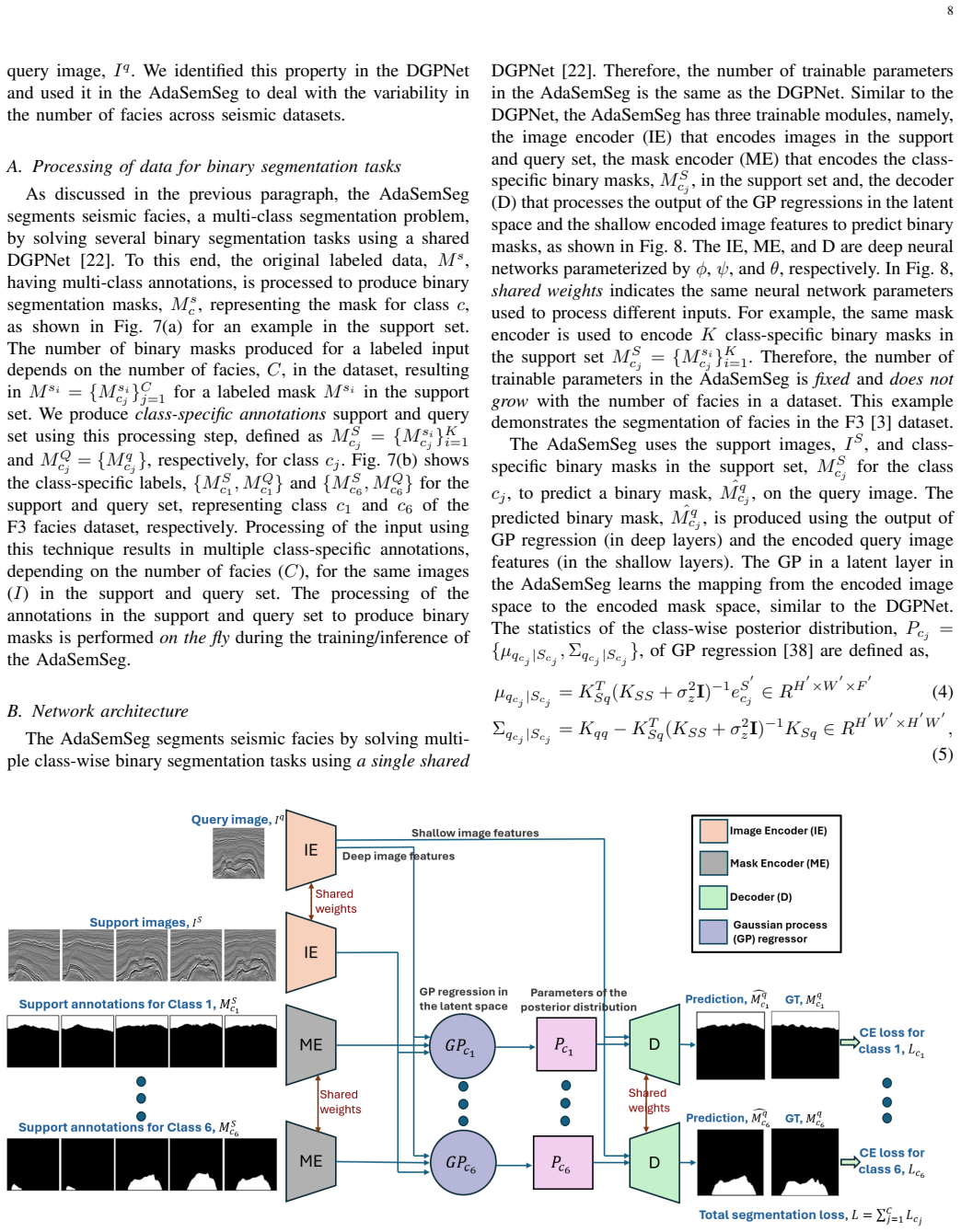
The central mechanism is the dense Gaussian process (GP) regression in a latent layer of the DGPNet-style architecture. The GP learns a mapping from encoded query image features to encoded mask features, conditioned on K support image-mask pairs; its posterior mean (equation 4) depends on the class-specific support mask encodings, which is what lets the same network produce different binary predictions for different facies. AdaSemSeg exploits this by decomposing multi-class segmentation into C binary tasks over a shared network and aggregating with argmax. A second load-bearing mechanism is SimCLR contrastive pretraining of the image encoder on unlabeled patches from the seismic datasets, replacing ImageNet initialization.
What would settle it
Retrain ProtoSemSeg and the transfer-learning baseline using the same SimCLR-pretrained ResNet encoder that AdaSemSeg uses, with all other training choices matched, and evaluate on Parihaka in the 5-shot setting; if the reported margins over ProtoSemSeg (0.30 pixel accuracy inline) and transfer learning (0.27 pixel accuracy inline) collapse to near zero, the claimed advantage is an artifact of initialization rather than the adaptive GP mechanism. Additionally, run AdaSemSeg on a volume whose true facies count is not supplied and check whether accuracy degrades when C is over- or under-estimated.
Extended reading notes
Core claim
AdaSemSeg is a Gaussian-process few-shot semantic segmentation method whose class count is not baked into the architecture. For each facies class in the target dataset, it forms a binary segmentation task: the support set's class-specific binary masks are encoded and fed through a shared dense Gaussian process regression in the latent space, which predicts a per-class mask on the query image; per-class masks are stacked and argmax gives the multi-class prediction. Because the same image encoder, mask encoder, and decoder are shared across all classes, the trainable parameter count stays fixed as the number of facies varies (six in F3 and Parihaka, seven in Penobscot). The image encoder is initialized with SimCLR self-supervised pretraining on unlabeled seismic patches rather than ImageNet. Under leave-one-out evaluation on three public datasets, the paper reports the model outperforms the prototype-based ProtoSemSeg and transfer-learning baselines on unseen target volumes and performs comparably to baselines trained on target samples, especially on F3 and Penobscot.
Load-bearing premise
The evaluations assume that pretraining the image encoder on the unlabeled images of the target volume does not violate the claim that the target is "unseen," and that the comparison methods received comparable initialization; the method also assumes the number of facies in the new volume is known before inference.
Editorial extensions
If this is right
- A model trained on two seismic volumes can label a third volume's facies from 1 to 5 annotated slices without updating its parameters on that volume, according to the reported results.
- Fixed class-count few-shot segmentation can be replaced by a class-agnostic binary-decomposition scheme with no extra parameters per class.
- Self-supervised contrastive initialization on unlabeled seismic data provides large gains, outperforming random initialization by roughly 0.2 in pixel accuracy on Parihaka.
- Using the single support slice nearest to the query instead of K spread-out slices improves performance on structurally varying Parihaka, while for more uniform volumes K=5 spread support is better.
- The approach extends the binary DGPNet to multi-class segmentation, enabling joint training across datasets with different facies counts.
Reading between the lines
- The headline result likely depends on the SimCLR encoder consuming all three volumes' unlabeled images; if that is treated as leakage, the "unseen" claim would weaken substantially.
- The method still needs the target facies count C as an input, so a field deployment would require estimating C from geological knowledge; an extension that predicts C or uses a rejection threshold could close that gap.
- The GP's predictive variance per class could be used as an uncertainty map to flag low-confidence regions for a human interpreter, a use the paper does not explore.
- The same class-agnostic binary decomposition might transfer to other semantic segmentation domains with variable label sets, such as medical images where the set of visible organs differs from scan to scan.
Editorial analysis
A structured set of objections, weighed in public.
Referee Report
Summary. The paper proposes AdaSemSeg, a few-shot semantic segmentation method for seismic facies that handles datasets with different numbers of facies. The method decomposes multi-class segmentation into class-wise binary tasks solved by a shared DGPNet, so the parameter count does not grow with the number of classes. The model is meta-trained on two source volumes and evaluated on the remaining target volume using 1 or 5 annotated support examples from the target volume, with encoder initialization provided by SimCLR pretraining on unlabeled seismic image patches. The paper reports comparisons against target-trained baselines, a prototype-based few-shot method (ProtoSemSeg), and transfer learning, together with an ablation of the encoder initialization strategy.
Significance. If the reported results hold under a clean evaluation protocol, the core idea is a useful extension of DGPNet: sharing one DGPNet across class-wise binary tasks gives a simple way to accommodate datasets with different numbers of facies, and the fixed parameter count is a genuine practical advantage. The paper also includes a useful ablation in Table IV showing that encoder initialization has a large effect. However, the current evaluation does not support the abstract's 'unseen datasets (not used in training)' claim because the SimCLR encoder is trained on all three volumes, and the baselines' initialization is not controlled. The method is therefore not yet validated as stated, but the underlying approach is defensible and the needed experiments are well defined.
major comments (4)
- [Section V-A2, Table IV, abstract] The abstract's claim that AdaSemSeg is evaluated on 'unseen datasets (not used in training)' is not supported by the protocol. Section V-A2 states that the SimCLR image encoder is trained on all three seismic datasets, including the target dataset, and that the encoder 'capture[s] the statistics of the unknown target dataset.' Because the encoder is a trainable component of the full model, unlabeled target images are used in training, contradicting the unseen-data premise. Table IV quantifies the effect: on Parihaka, replacing SimCLR initialization with random initialization changes 1-shot pixel accuracy from 0.84 to 0.61 (inline) and 5-shot pixel accuracy from 0.86 to 0.72 (inline). The headline margins in Table III therefore cannot be attributed to few-shot adaptation alone. Please repeat the comparison with the SimCLR encoder pretrained only on the two source volumes, or explicitly reframe the contribution as a transductive or semi-supervised setting.
- [Table III, Appendices B-C] The comparison against ProtoSemSeg and transfer learning does not control encoder initialization. Appendix B-C defers ProtoSemSeg's training details to reference [26] and reports that all methods use the same optimizer and scheduler, but it does not state whether ProtoSemSeg or the transfer-learning baseline received a SimCLR-pretrained encoder, ImageNet pretraining, or random initialization. Since Table IV shows that initialization alone is worth roughly 0.2 pixel accuracy on Parihaka, the margins in Table III could shrink or disappear under matched initialization. Please specify the initialization of every baseline, and add an ablation in which all methods use identical backbone initialization, ideally source-only SimCLR.
- [Section IV-C, Eq. (6)] Equation (6) is introduced as pixel-wise binary cross-entropy, but the expression L = -1/(CHW) * sum over classes, height, width of M^q_cj(h,w) log(Mhat^q_cj(h,w)) contains only the positive-class term; the background term (1 - M) log(1 - Mhat) is missing. If the implementation matches Eq. (6), the loss is not the advertised binary cross-entropy; if the implementation is true binary cross-entropy, Eq. (6) must be corrected. Since the training objective is load-bearing for all reported results, this needs clarification and correction.
- [Section V-B1, Table I] The support-set construction is selected per dataset based on the test-set scores reported in Table I: the paper concludes from that table that all K examples should be used for F3 and Penobscot but the nearest slice should be used for Parihaka. This makes the evaluation protocol partly data-dependent. In particular, the nearest-slice selection for Parihaka uses a support slice spatially adjacent to the test slices, which may be easier than the volume-spanning support used for the other datasets. For a claim about unseen datasets, the support-selection rule should be fixed before inspecting test results, and the same rule should be applied to all baselines.
minor comments (5)
- [Introduction] The word 'paintstacking' should be 'painstaking'.
- [References] References [16], [17], and [18] duplicate references [13], [14], and [15] (Ravi & Larochelle; Snell et al.; Finn et al.).
- [Appendix C] 'Fog. Fig. 19' should read 'Fig. 19'.
- [Algorithm 2] Algorithm 2 takes the facies count C as an input. The text should state explicitly that AdaSemSeg adapts to a known number of facies in the target dataset, not to an unknown number.
- [Section V-A2 and Section IV-B] The notation for the encoder/decoder parameters is inconsistent: Section IV-B defines IE, ME, and D as parameterized by phi, psi, and theta respectively, but Section V-A2 refers to the image encoder parameters as theta. Please use separate symbols or define the reuse clearly.
Circularity Check
No derivation-level circularity: the GP equations are an acknowledged adaptation of DGPNet, and the variable-class property is a design tautology. The only circularity-adjacent issue is that the abstract's 'unseen dataset' claim is weakened because SimCLR pretraining uses unlabeled target images (Section V-A2, Table IV).
-
fitted input called prediction
[Abstract; Section V-A2 'Initialization of the image encoder'; Table IV]
"The performance of the AdaSemSeg on unseen datasets (not used in training) is better than the prototype-based few-shot method and baselines. ... We use all three seismic datasets studied in this work without the annotations for the facies to train the image encoder parameters (θ) of the AdaSemSeg using the SimCLR method. Under this setting, the image encoder parameters capture the statistics of the unknown target dataset."
The abstract defines the headline target as 'unseen datasets (not used in training),' while Section V-A2 trains the image encoder on all three datasets, including the target's unlabeled images. The image encoder is a fitted component of AdaSemSeg, so the target distribution is an input to training before the few-shot prediction is made. Table IV quantifies the reduction: on Parihaka inline, SimCLR initialization gives PA 0.84 versus 0.61 with random initialization (1-shot) and 0.86 versus 0.72 (5-shot). Thus part of the reported 'unseen' performance is attributable to target-image statistics already seen by the model, so the central claim is weakened by a fitted input being renamed as an unseen prediction rather than by the GP equations themselves being circular.
full rationale
Most of the derivation chain is transparently inherited, not circular. Equations (4)-(5) are index-wise copies of DGPNet's Equations (1)-(2), and the paper explicitly states it is adapting DGPNet, so there is no hidden first-principles derivation. The 'adaptive to varying classes' property is a design tautology: Algorithm 2 takes C as input and runs C binary tasks with a shared network, so any C is accepted by construction; this is not a derived capability. No parameter is fitted to target labels, and the meta-testing stage does not fine-tune on target annotations. The only issue bearing on the paper's claims is that the SimCLR encoder is trained on unlabeled images from all three datasets, including the target, which contradicts the abstract's 'not used in training' wording and may inflate the comparison against baselines lacking matched pretraining. This is an evaluation-setup mismatch rather than a mathematical equivalence in the derivation, so it does not make the core method circular.
Assumptions & free parameters
free parameters (5)
- SimCLR encoder pretraining corpus and configuration =
All three volumes (including target); temperature 0.07, batch size 32, Adam lr 3e-4, weight decay 1e-4, 10 epochs
- Support-set selection per dataset =
K=5 slices spanning the volume for F3 and Penobscot; nearest slice for Parihaka
- GP kernel hyperparameters (scale, length, noise) =
Inherited from DGPNet [22] without re-tuning
- Intensity preprocessing =
5 to 95 percentile clipping, rescaled to 0 to 255
- Patch size and augmentation ranges =
256x256 patches; rotations +/-20 degrees, flips, Gaussian blur, noise, brightness, contrast
assumptions (5)
- standard math GP regression posterior formulas (Equations 1-2 and 4-5) as in Rasmussen and Williams [38]
- domain assumption The number of facies C in the target dataset is known in advance
- domain assumption The three public datasets and their label sets are representative of seismic facies interpretation
- ad hoc to paper One-vs-rest binary decomposition with shared features and argmax fusion yields comparable per-class scores
- ad hoc to paper Unlabeled target images may be used for encoder pretraining without breaking the few-shot evaluation
Cite this review
Pith. "Pith review of AdaSemSeg: An Adaptive Few-shot Semantic Segmentation of Seismic Facies." pith.science (2026). https://pith.science/paper/HY6VOTJQ
@misc{pith2026250116760,
  author       = {Pith},
  title        = {Pith review of: AdaSemSeg: An Adaptive Few-shot Semantic Segmentation of Seismic Facies},
  year         = {2026},
  howpublished = {\url{https://pith.science/paper/HY6VOTJQ}},
  note         = {Machine review of arXiv:2501.16760}
}
read the original abstract
Automated interpretation of seismic images using deep learning methods is challenging because of the limited availability of training data. Few-shot learning is a suitable learning paradigm in such scenarios due to its ability to adapt to a new task with limited supervision (small training budget). Existing few-shot semantic segmentation (FSSS) methods fix the number of target classes. Therefore, they do not support joint training on multiple datasets varying in the number of classes. In the context of the interpretation of seismic facies, fixing the number of target classes inhibits the generalization capability of a model trained on one facies dataset to another, which is likely to have a different number of facies. To address this shortcoming, we propose a few-shot semantic segmentation method for interpreting seismic facies that can adapt to the varying number of facies across the dataset, dubbed the AdaSemSeg. In general, the backbone network of FSSS methods is initialized with the statistics learned from the ImageNet dataset for better performance. The lack of such a huge annotated dataset for seismic images motivates using a self-supervised algorithm on seismic datasets to initialize the backbone network. We have trained the AdaSemSeg on three public seismic facies datasets with different numbers of facies and evaluated the proposed method on multiple metrics. The performance of the AdaSemSeg on unseen datasets (not used in training) is better than the prototype-based few-shot method and baselines.
Figures


Figures from the paper (16 more)




Reference graph
Works this paper leans on
-
[26]
Few- shot learning for seismic facies segmentation via prototype learning,
Y . Zhao, B. Chai, L. Shuo, Z. Li, H. Wu, and T. Wang, “Few- shot learning for seismic facies segmentation via prototype learning,” GEOPHYSICS, vol. 88, no. 3, p. 41–49, 2023
work page 2023
-
[1]
Seismic layer segmentation models with channel attention block in carbon storage study,
I. Farady, C.-C. Kuo, S. Le, C.-W. Wang, H.-F. Ng, C.-Y . Lin, and M.-J. Wang, “Seismic layer segmentation models with channel attention block in carbon storage study,” in Proceedings of the 2nd Workshop on Advances in Environmental Sensing Systems for Smart Cities , ser. EnvSys ’24. New York, NY , USA: Association for Computing Machinery, 2024, p. 1–6. [...
-
[2]
M. V . DeAngelo, R. Fifariz, T. Meckel, and R. H. Trevi ˜no, “A seismic- based co2-sequestration regional assessment of the miocene section, northern gulf of mexico, texas and louisiana,” International Journal of Greenhouse Gas Control, vol. 81, pp. 29–37, 2019
work page 2019
-
[3]
A machine learning benchmark for facies classification,
Y . Alaudah, P. Michałowicz, M. Alfarraj, and G. AlRegib, “A machine learning benchmark for facies classification,”Interpretation, vol. 7, no. 3, pp. 1A–T725, 2019
work page 2019
-
[4]
Deep learning for automated seismic facies classification,
E. Tolstaya and A. Egorov, “Deep learning for automated seismic facies classification,” Interpretation, vol. 10, no. 2, pp. B13–T392, 2022
work page 2022
-
[5]
Few-shot learning for semantic segmentation of seismic data,
T. Papadopoulos, L. Mosser, D. Oikonomou, E. Naeini, and K. Karantza- los, “Few-shot learning for semantic segmentation of seismic data,” in 82nd EAGE Annual Conference & Exhibition . European Association of Geoscientists & Engineers, 2021, pp. 1–5
work page 2021
-
[6]
Riding the wave: One-touch automatic salt segmentation by coupling sam and seggpt,
A. Koeshidayatullah, “Riding the wave: One-touch automatic salt segmentation by coupling sam and seggpt,” in Society of Petroleum Engineers - ADIPEC, ADIP 2023 . Society of Petroleum Engineers, 2023
work page 2023
-
[7]
Improving seismic interpretation accuracy and efficiency with human- machine collaboration,
M. Alotaibi, M. Prabhushankar, K. Kokilepersaud, and G. AlRegib, “Improving seismic interpretation accuracy and efficiency with human- machine collaboration,” in IMAGE, 2024
work page 2024
Show all 47 references
-
[8]
Self-supervised learning for efficient seismic facies classification,
K. Chikhaoui and M. Alfarraj, “Self-supervised learning for efficient seismic facies classification,” Geophysics, vol. 89, no. 5, pp. IM61– IM76, Sep. 2024, publisher Copyright: © 2024 Society of Exploration Geophysicists. All rights reserved
2024
-
[9]
Visualizing and understanding convolu- tional networks,
M. D. Zeiler and R. Fergus, “Visualizing and understanding convolu- tional networks,” in European Conference on Computer Vision , 2014, pp. 818–833
2014
-
[10]
Cnn features off-the-shelf: an astounding baseline for recognition,
A. S. Razavian, H. Azizpour, J. Sullivan, and S. Carlsson, “Cnn features off-the-shelf: an astounding baseline for recognition,” in IEEE Computer Vision and Pattern Recognition Workshop , 2014, pp. 806–813
2014
-
[11]
Seg advanced modeling corporation ai project,
https://www.aicrowd.com/challenges/seismic-facies-identification chal- lenge, “Seg advanced modeling corporation ai project,” March 17, 2024
2024
-
[12]
Penobscot dataset: Fostering machine learning devel- opment for seismic interpretation,
L. Baroni, R. M. Silva, R. S. Ferreira, D. Civitarese, D. Szwarcman, and E. V . Brazil, “Penobscot dataset: Fostering machine learning devel- opment for seismic interpretation,” 2021
2021
-
[16]
Optimization as a model for few-shot learning,
S. Ravi and H. Larochelle, “Optimization as a model for few-shot learning,” in International Conference on Learning Representations , 2017
2017
-
[17]
Prototypical networks for few- shot learning,
J. Snell, K. Swersky, and R. Zemel, “Prototypical networks for few- shot learning,” in Advances in Neural Information Processing Systems , vol. 30, 2017
2017
-
[18]
Model-agnostic meta-learning for fast adaptation of deep networks,
C. Finn, P. Abbeel, and S. Levine, “Model-agnostic meta-learning for fast adaptation of deep networks,” in International Conference on Machine Learning, vol. 70, 2017, pp. 1126–1135
2017
-
[19]
Prototype queue learning for multi- class few-shot semantic segmentation,
Z. Wang, Z. Jiang, and Y . Yuan, “Prototype queue learning for multi- class few-shot semantic segmentation,” in IEEE International Confer- ence on Image Processing (ICIP) , 2022, pp. 1721–1725
2022
-
[20]
Incrementer: Transformer for class-incremental semantic segmentation with knowl- edge distillation focusing on old class,
C. Shang, H. Li, F. Meng, Q. Wu, H. Qiu, and L. Wang, “Incrementer: Transformer for class-incremental semantic segmentation with knowl- edge distillation focusing on old class,” in IEEE/CVF Conference on Computer Vision and Pattern Recognition (CVPR) , 2023, pp. 7214– 7224
2023
-
[21]
One-shot learning for semantic segmentation,
A. Shaban, Shray, B. Z. Liu, I. Essa, and B. Boots, “One-shot learning for semantic segmentation,” in British Machine Vision Conference . BMV A Press, 2017
2017
-
[22]
Dense gaussian processes for few-shot segmentation,
J. Johnander, J. Edstedt, M. Felsberg, F. S. Khan, and M. Danelljan, “Dense gaussian processes for few-shot segmentation,” in European Conference on Computer Vision , 2022
2022
-
[23]
Mseg: A composite dataset for multi-domain semantic segmentation,
J. Lambert, Z. Liu, O. Sener, J. Hays, and V . Koltun, “Mseg: A composite dataset for multi-domain semantic segmentation,” in IEEE Conference on Computer Vision and Pattern Recognition , 2020
2020
-
[24]
Lmseg: Language- guided multi-dataset segmentation,
Q. Zhou, Y . Liu, C. Yu, J. Li, Z. Wang, and F. Wang, “Lmseg: Language- guided multi-dataset segmentation,” in International Conference on Learning Representations, 2023
2023
-
[25]
Dataseg: Taming a universal multi-dataset multi-task segmentation model,
X. Gu, Y . Cui, J. Huang, A. Rashwan, X. Yang, X. Zhou, G. Ghiasi, W. Kuo, H. Chen, L.-C. Chenz, and D. Ross, “Dataseg: Taming a universal multi-dataset multi-task segmentation model,” in Advances in Neural Information Processing Systems , 2023
2023
-
[27]
Seismic fault detection in real data using transfer learning from a convolutional neural network pre-trained with synthetic seismic data,
A. Cunha, A. Pochet, H. Lopes, and M. Gattass, “Seismic fault detection in real data using transfer learning from a convolutional neural network pre-trained with synthetic seismic data,” Computers and Geosciences , vol. 135, p. 104344, 2020
2020
-
[28]
Multitask training as regularization strategy for seismic image segmentation,
S. Saha, W. Gazi, R. Mohammed, T. Rapstine, H. Powers, and R. Whitaker, “Multitask training as regularization strategy for seismic image segmentation,” IEEE Geoscience and Remote Sensing Letters , vol. 20, pp. 1–5, 2023
2023
-
[29]
An open-source package for deep-learning-based seismic facies classifica- tion: Benchmarking experiments on the seg 2020 open data,
X. Chai, W. Nie, K. Lin, G. Tang, T. Yang, J. Yu, and W. Cao, “An open-source package for deep-learning-based seismic facies classifica- tion: Benchmarking experiments on the seg 2020 open data,” IEEE Transactions On Geoscience And Remote Sensing, vol. 60, no. 4507719, pp. 1–19, 2022
2020
-
[30]
A deep learning framework for seismic facies classification,
H. Kaur, N. Pham, S. Fomel, Z. Geng, L. Decker, B. Gremillion, M. Jervis, R. Abma, and S. Gao, “A deep learning framework for seismic facies classification,” Interpretation, vol. 11, no. 1, pp. 1F–Z4, 2023
2023
-
[31]
Semantic segmentation of seismic images,
D. Chevitarese, D. Szwarcman, E. V . Brazil, and B. Zadrozny, “Semantic segmentation of seismic images,” in International Joint Conference on Neural Networks (IJCNN) , 2018
2018
-
[32]
Self-supervised learning for seismic image segmentation from few-labeled samples,
B. A. A. Monteiro, H. Oliveira, and J. A. d. Santos, “Self-supervised learning for seismic image segmentation from few-labeled samples,” IEEE Geoscience and Remote Sensing Letters , vol. 19, pp. 1–5, 2022
2022
-
[33]
Segment anything,
A. Kirillov, E. Mintun, N. Ravi, H. Mao, C. Rolland, L. Gustafson, T. Xiao, S. Whitehead, A. C. Berg, W.-Y . Lo, P. Dollar, and R. Girshick, “Segment anything,” in Proceedings of the IEEE/CVF International Conference on Computer Vision (ICCV) , October 2023, pp. 4015–4026
2023
-
[34]
On the texture bias for few-shot cnn segmentation,
R. Azad, A. R. Fayjie, C. Kauffmann, I. B. Ayed, M. Pedersoli, and J. Dolz, “On the texture bias for few-shot cnn segmentation,” in 2021 IEEE Winter Conference on Applications of Computer Vision (WACV) , 2021, pp. 2673–2682
2021
-
[35]
ImageNet: A Large-Scale Hierarchical Image Database,
J. Deng, W. Dong, R. Socher, L.-J. Li, K. Li, and L. Fei-Fei, “ImageNet: A Large-Scale Hierarchical Image Database,” in IEEE Conference on Computer Vision and Pattern Recognition , 2009
2009
-
[36]
What makes imagenet good for transfer learning?
M. Huh, P. Agrawal, and A. A. Efros, “What makes imagenet good for transfer learning?” 2016, preprint at https://arxiv.org/abs/1608.08614
2016 arXiv
-
[37]
A simple framework for contrastive learning of visual representations,
T. Chen, S. Kornblith, M. Norouzi, and G. Hinton, “A simple framework for contrastive learning of visual representations,” in International Conference on Machine Learning , 2020
2020
-
[38]
C. E. Rasmussen and C. K. I. Williams, Gaussian Processes for Machine Learning. The MIT Press, 2006
2006
-
[39]
Deep residual learning for image recognition,
K. He, X. Zhang, S. Ren, and J. Sun, “Deep residual learning for image recognition,” in IEEE Conference on Computer Vision and Pattern Recognition, 2016, pp. 770–778
2016
-
[40]
Learning a discriminative feature network for semantic segmentation,
C. Yu, J. Wang, C. Peng, C. Gao, G. Yu, and N. Sang, “Learning a discriminative feature network for semantic segmentation,” in 2018 IEEE/CVF Conference on Computer Vision and Pattern Recognition , 2018, pp. 1857–1866
2018
-
[41]
Improving seismic fault recognition with self-supervised pre-training: A study of 3d transformer-based with multi-scale decoding and fusion,
Z. Zhang, R. Chen, and J. Ma, “Improving seismic fault recognition with self-supervised pre-training: A study of 3d transformer-based with multi-scale decoding and fusion,” Remote Sensing, vol. 16, no. 5, 2024
2024
-
[42]
Salt3dnet: A self-supervised learning framework for 3-d salt segmen- tation,
L. Yang, S. Fomel, S. Wang, X. Chen, O. M. Saad, and Y . Chen, “Salt3dnet: A self-supervised learning framework for 3-d salt segmen- tation,” IEEE Transactions on Geoscience and Remote Sensing , vol. 62, pp. 1–15, 2024
2024
-
[43]
Barlow twins: Self- supervised learning via redundancy reduction,
J. Zbontar, L. Jing, I. Misra, Y . LeCun, and S. Deny, “Barlow twins: Self- supervised learning via redundancy reduction,” in Proceedings of the 38th International Conference on Machine Learning , 2021, pp. 12 310– 12 320
2021
-
[44]
Auto-encoding variational bayes,
D. P. Kingma and M. Welling, “Auto-encoding variational bayes,” International Conference on Learning Representations , 2014
2014
-
[45]
Gens: generative encoding networks,
S. Saha, S. Elhabian, and R. Whitaker, “Gens: generative encoding networks,” Machine Learning, vol. 111, p. 4003–4038, 2022. 22
2022
-
[46]
Matching aggregate posteriors in the variational autoencoder,
S. Saha, S. Joshi, and R. Whitaker, “Matching aggregate posteriors in the variational autoencoder,” in International Conference on Pattern Recognition, 2024
2024
-
[47]
Ard-vae: A statistical formulation to find the relevant latent dimensions of variational autoencoders,
S. Saha, S. Joshi, and R. T. Whitaker, “Ard-vae: A statistical formulation to find the relevant latent dimensions of variational autoencoders,” 2025, preprint at https://arxiv.org/abs/2501.10901. To appear in W ACV-2025
2025 arXiv
-
[48]
Disentanglement analysis in deep latent variable models matching aggregate posterior distributions,
S. Saha, S. Joshi, and R. Whitaker, “Disentanglement analysis in deep latent variable models matching aggregate posterior distributions,” 2025, preprint at https://arxiv.org/abs/2501.15705. To appear in ICASSP-2025
2025 arXiv
-
[49]
U-net: Convolutional networks for biomedical image segmentation,
O. Ronneberger, P. Fischer, and T. Brox, “U-net: Convolutional networks for biomedical image segmentation,” in Medical Image Computing and Computer-Assisted Intervention, 2015, pp. 234–241
2015
-
[50]
Transfer learning applied to seismic images classification,
D. Salles Civitarese, D. Szwarcman, R. Silva, and E. Vital Brazil, “Transfer learning applied to seismic images classification,” in AAPG ACE, 05 2018
2018
Reviewed August 10, 2026 · model on record in the stance chip above.
Discussion (0). Continue with ORCID to comment.