REVIEW 2 major objections 4 minor 59 references
Are regular black holes from pure gravity classified within the same thermodynamical topology?
T0 review · 2 major / 4 minor · reviewed 2026-08-11 · deepseek-v4-flash
Pith's one-line read The paper argues that regular black holes generated by pure higher-curvature gravity, in every dimension D≥5 and for all admissible couplings, belong to a single thermodynamic topology class, W0+, with total charge W=0.
desk verdict Solid conditional result on thermodynamic topology of pure-gravity regular black holes, but the universal W0+ claim outruns the proof; needs scoping and a typo fix. read the letter →
The pith
A machine-rendered reading of the paper's core claim, the machinery that carries it, and where it could break.
The reading
What carries the argument
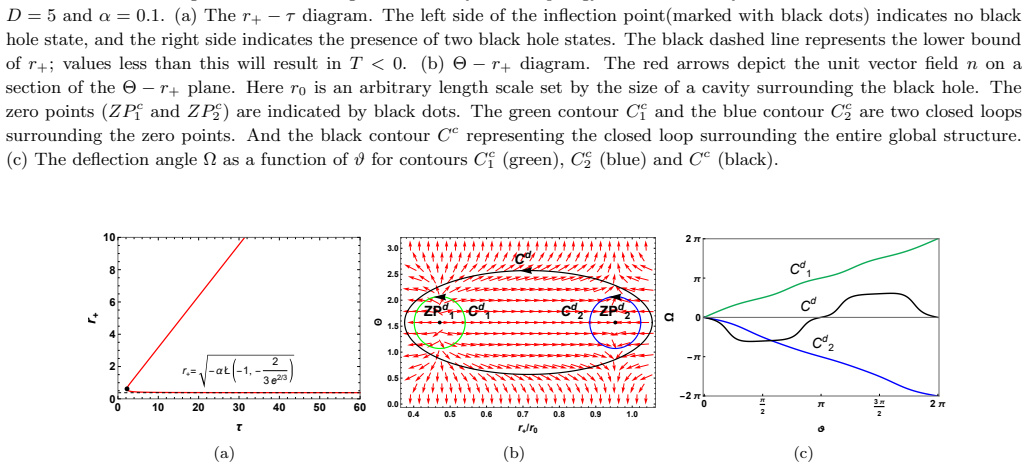
The working object is the generalized free energy $F=M-S/\tau$, where $\tau$ is the inverse temperature of a surrounding cavity, and the vector $\phi=(\partial F/\partial r_+,\ -\cot\Theta\csc\Theta)$ on the half-plane $(r_+,\Theta)$. Zero points of $\phi$ correspond to black hole thermodynamic states; each zero carries a winding number $w_i=\pm 1$, and the global topological number $W=\sum_i w_i$ classifies the solution. The argument's engine is an asymptotic comparison: since $\partial S/\partial r_+>0$ for all $r_+$ and $T-1/\tau<0$ at both ends of the allowed horizon interval, $\partial F/\partial r_+<0$ on both boundaries. Those fixed boundary directions force total winding $W=0$ and, combined with the sign conventions of Ref. [53], select the class $\mathrm{W0}_+$, in which the innermost and outermost states are respectively stable and unstable. The single-zero-temperature assumption keeps the number of zero points finite and odd, so the two-boundary argument captures all of them.
What would settle it
Choose an admissible sequence $\alpha_n$ with $\alpha_n\ge 0$ and $\lim_n(\alpha_n)^{1/n}=C>0$ for which the Hawking temperature $T(r_+)$ has three zeros, compute the winding numbers of the resulting zero points of $\partial F/\partial r_+$ in the $\Theta$-$r_+$ plane, and check whether the global topological number is still $W=0$ with the outermost state unstable; if not, the claimed $\mathrm{W0}_+$ universality fails.
Extended reading notes
Core claim
Within the family of regular black holes constructed by an infinite tower of quasi-topological higher-curvature terms, the paper shows that the vector field built from the generalized free energy, $\phi=(\partial F/\partial r_+,\ -\cot\Theta\csc\Theta)$, points the same way on all boundaries of the $\Theta$-$r_+$ parameter space. Because $T\to 0^-$ near the lower horizon-radius bound $r_{+\min}$ and $T\to 0^+$ as $r_+\to\infty$, while $\partial S/\partial r_+>0$, one obtains $\partial F/\partial r_+<0$ on both ends. A loop enclosing all zero points therefore has total winding number $W=0$, and the boundary directions put the family in the $\mathrm{W0}_+$ class of Ref. [53]: small black holes at low temperature are stable and large ones unstable. The paper verifies this on two explicit examples, the $\alpha_n=n\alpha^{n-1}$ solution and the Dymnikova-type pure-gravity solution, for $D=5$ and $D=7$, and argues that the same asymptotic reasoning covers all admissible $\alpha_n$ and all $D\ge 5$.
Load-bearing premise
The whole classification rests on assuming the Hawking temperature crosses zero only once; if an allowed choice of couplings produced several crossings, the proof would not show that the topology is the same.
Editorial extensions
If this is right
- Every regular black hole constructed by the infinite pure-gravity tower in any $D\ge 5$ has total topological charge $W=0$, so stable and unstable states always come in balanced pairs.
- For large cavity inverse temperature $\tau$, exactly two states appear: a small, thermodynamically stable black hole and a large, unstable one; for small $\tau$ no black hole states exist.
- The topological class $\mathrm{W0}_+$ is preserved under changes of dimension $D$ and coupling constants $\alpha_n$, making the classification a property of the construction method rather than of any specific solution.
- The boundary-vector method gives a stable/unstable ordering of the innermost and outermost states without fully solving the equations of motion.
Reading between the lines
- The paper leaves open the multi-zero case; if some admissible $\alpha_n$ yields a temperature with three zeros, the boundary argument alone would not fix the class, and the full classification could split into subfamilies.
- The same two-sided $T\to 0$ argument may apply to other regular-black-hole constructions that share the de Sitter interior and asymptotic flatness, suggesting $\mathrm{W0}_+$ might be a generic signature of singularity regularization rather than of the specific gravity theory.
- A practical test is to scan the admissible parameter space ($\alpha_n\ge 0$ with $\lim_n (\alpha_n)^{1/n}=C>0$) numerically for temperature curves with more than one zero; the first such curve would either confirm the single-zero conjecture or break the universality claim.
- The result also suggests that topological charge could serve as a coarse-grained equivalence marker for effective field theories: theories whose regular black holes share $\mathrm{W0}_+$ may be thermodynamically indistinguishable even when their Lagrangians differ.
Editorial analysis
A structured set of objections, weighed in public.
Referee Report
Summary. This paper studies the thermodynamic topology of regular black holes obtained from the quasi-topological pure-gravity construction of Bueno, Cano, and Hennigar in D≥5. Using the generalized free energy and Duan's φ-mapping, the authors show that T(r+) tends to zero at large r+ and becomes negative near the lower bound r+=√C, so it has at least one zero. Under the explicit assumption that T(r+) has exactly one zero, they argue from boundary behaviors that the global topological number is W=0 and that the solutions belong to the W0+ class of Ref. [53], implying a stable small black hole and an unstable large black hole at low temperature. Two examples (αn=nα^{n−1} and a Dymnikova-type solution) are worked out in D=5 and D=7, with explicit winding numbers W1=+1 and W2=−1 and total W=0.
Significance. If the universality claim holds, it gives a dimension-independent and coupling-independent thermodynamic-topological signature of the pure-gravity regular black hole construction, which would be a valuable addition to the thermodynamic topology literature. The paper has real strengths: the boundary analysis in Sec. III is general for any admissible h(ψ), the Appendix supplies a proof that T becomes negative near the convergence radius, and the two examples provide explicit, reproducible winding-number calculations rather than parameter fitting. The authors also state the single-zero-temperature limitation in Sec. V. However, the significance is conditional on resolving the gap between the single-zero proof and the unqualified universal statement in the abstract and title.
major comments (2)
- [Sec. III and Sec. V (also Abstract)] The universal classification claim is proved only for the single-zero case of the Hawking temperature. Sec. III states 'we mainly focus on the simplest case where T(r+) has a single zero', and Sec. V concedes that for appropriate αn multi-zero cases 'may arise, requiring more detailed study'. Nevertheless the Abstract asserts without this qualification that regular black holes from pure gravity 'exhibit universal thermodynamical behaviors, strongly suggesting they belong to the same topological class', and the title poses the general question. Since the low-temperature 'one stable small plus one unstable large' pair statement is derived from the single-zero analysis, the headline claim is stronger than the demonstrated result. Please either extend the proof to multi-zero T(r+) (for example by showing that the boundary directions in Table II, together with the alternating signs of successive zeros, still force W0+) or explicitly restrict the Abstract, title, and Conclusion to the single-zero case.
- [Sec. III.B, after Eq. (29)] The identification of the topological class as W0+ (rather than merely W=0) is not derived in the general boundary argument. Table II fixes ∂F/∂r+<0 at both r+min and r+→∞, which yields the total winding number W=0, but the sign of the winding number of the outermost zero (which distinguishes W0+ from W0−) is not determined by these boundary directions alone. The examples in Sec. IV compute the signs explicitly (W1=+1 for the inner zero, W2=−1 for the outer zero), but the general proof should state that, for single-zero T(r+), the innermost intersection of T=1/τ lies on the rising branch of T and has winding +1 while the outermost lies on the falling branch and has winding −1. Without such a step, the W0+ label is imported from Ref. [53] rather than derived from the analysis in this paper.
minor comments (4)
- [Eq. (33)] The formula for T in the αn=nα^{n−1} example appears to have a sign error as typeset: it reads as T=[−(D+3)r+^2+(D+1)α]/[4πr+(r+^2+α)], which is negative for large r+ when D≥5 and vanishes at r+^2=(D+1)/(D+3)α, contradicting Eq. (16) and the extremal radius r+=√((D+1)/(D−3))α quoted in the text. The correct expression following from Eqs. (12) and (30) is T=[(D−3)r+^2−(D+1)α]/[4πr+(r+^2+α)]; please correct the typo and check the subsequent displayed formulas for consistency.
- [Abstract] The phrase 'We presents a comprehensive analysis' should be 'We present a comprehensive analysis'.
- [Fig. 2 caption] The caption refers to the 'Φ − r+ diagram' where the radial coordinate in the diagram is Θ; this appears to be a typo for 'Θ − r+'.
- [Sec. V] The conclusion says 'with at most two horizons' while the body of the paper assumes a single zero of T(r+); please reconcile these statements so that the scope of the claim is unambiguous (for example, 'at most two horizons' requires explicitly allowing two zeros of T, which is not the case analyzed).
Circularity Check
No circular reduction: W=0 is derived from boundary limits; the W0+ label is applied, not fitted, and the single-zero caveat is an acknowledged scope limit.
full rationale
The derivation of the global topological number W=0 is not circular. It follows from the boundary signs of ∂F/∂r+ in Table II, which are obtained directly from the explicit thermodynamic quantities (11)-(13): ∂S/∂r+>0 by (27), and T−1/τ<0 both at r+→r+min and r+→∞. No parameter is fitted to force these signs; the examples in Sec. IV are independent checks with explicit winding numbers W1=+1 and W2=−1. The W0+ label is imported from Ref. [53], a same-group paper, but the present paper independently verifies the defining boundary vector directions and explicitly computes the winding numbers, so the self-citation is a classification label rather than load-bearing evidence. The single-zero assumption is explicitly acknowledged in Sec. V, where the authors concede that multi-zero cases 'may arise' for appropriate αn; this is a scope limitation on the claimed universality, not a circular step. The apparent typo in Eq. (33) (D+3 vs D−3 in the zero location) is a technical error and does not affect the circularity assessment. Overall, the central claim has independent grounding, so no circular step is identified; score 2 reflects the presence of same-group citations without load-bearing circularity.
Assumptions & free parameters
assumptions (5)
- domain assumption The quasi-topological gravity action (1) and conditions (8), with α_n>=0 and lim α_n^(1/n)=C>0, define the regular black hole family.
- domain assumption Thermodynamic quantities M, T, S are given by Eqs. (11)-(13), using the Wald entropy formula and the first law.
- ad hoc to paper The Hawking temperature T(r+) has a single zero point; multi-zero cases are excluded.
- standard math Duan's topological current and winding number formalism is valid for the vector field (18).
- standard math Appendix A lemma: if a smooth f on (a,b) diverges at b, there exists a sequence with 1/f'(ξ_n) -> 0.
Cite this review
Pith. "Pith review of Are regular black holes from pure gravity classified within the same thermodynamical topology?." pith.science (2026). https://pith.science/paper/HZ44KYJV
@misc{pith2026241205811,
  author       = {Pith},
  title        = {Pith review of: Are regular black holes from pure gravity classified within the same thermodynamical topology?},
  year         = {2026},
  howpublished = {\url{https://pith.science/paper/HZ44KYJV}},
  note         = {Machine review of arXiv:2412.05811}
}
abstract
Regular black holes, which avoid the essential center singularities, can be constructed through various methods, including nonlinear electrodynamics and quantum corrections. Recently, it was shown that via an infinite tower of higher-curvature corrections, one can obtain different regular black hole solutions in any spacetime dimension $D\geq 5$. Utilizing the concept of thermodynamical topology, we examine these black holes as topological thermodynamic defects, classifying them into distinct topological categories based on their generalized free energy. We find that the Hawking temperature of the black hole has at least one zero point at the small horizon radius limit. Under this fact, the regular black holes generated through the purely gravitational theories exhibit universal thermodynamical behaviors, strongly suggesting they belong to the same topological class. We presents a comprehensive analysis of these properties, providing a clearer understanding of the fundamental nature of regular black holes and their classification within the framework of thermodynamical topology.
Figures


Figures from the paper (3 more)


Reference graph
Works this paper leans on
- [53]
-
[1]
S. W. Hawking, Particle creation by black holes , Commun. Math. Phys. 43, 199 (1975), Erratum: Commun. Math. Phys. 46, 206 (1976)
work page 1975
-
[2]
S. W. Hawking, Black holes and thermodynamics , Phys. Rev. D 13, 191 (1976)
work page 1976
-
[3]
J. M. Bardeen, B. Carter, S. W. Hawking, The Four laws of black hole mechanics , Commun. Math. Phys. 31, 161 (1973)
work page 1973
-
[4]
G. W. Gibbons and S. W. Hawking, Action integrals and partition functions in quantum gravity , Phys. Rev. D 15, 2752 (1977)
1977
-
[5]
S. W. Wei, Y. X. Liu and R. B. Mann, Black Hole Solutions as Topological Thermodynamic Defects , Phys. Rev. Lett. 129, 191101 (2022), [arXiv:2208.01932 [gr-qc]]
arXiv 2022
- [6]
-
[7]
Wu, Topological classes of rotating black holes , Phys
D. Wu, Topological classes of rotating black holes , Phys. Rev. D 107, 024024 (2023), [arXiv:2211.15151 [gr-qc]]
arXiv 2023
Show all 59 references
-
[8]
N. C. Bai, L. Li and J. Tao, Topology of black hole thermodynamics in Lovelock gravity , Phys. Rev. D 107, 064015 (2023), [arXiv:2208.10177 [gr-qc]]
2023 arXiv
-
[9]
Liu and J
C. Liu and J. Wang, Topological natures of the Gauss-Bonnet black hole in AdS space , Phys. Rev. D 107, 064023 (2023), [arXiv:2211.05524 [gr-qc]]
2023 arXiv
-
[10]
S. P. Wu and S. W. Wei, Thermodynamical topology of quantum BTZ black hole , Phys. Rev. D 110, 024054 (2024), [arXiv:2403.14167 [gr-qc]]
2024 arXiv
-
[11]
Z. Q. Chen and S. W. Wei, Thermodynamics, Ruppeiner geometry, and topology of Born-Infeld black hole in asymptotic flat spacetime, Nucl. Phys. B 996, 116369 (2023)
2023
-
[12]
Z. Q. Chen and S. W. Wei, Thermodynamical topology with multiple defect curves for dyonic AdS black holes , [arXiv:2405.07525 [hep-th]]
-
[13]
C. Fang, J. Jiang and M. Zhang, Revisiting thermodynamic topologies of black holes , JHEP 01, 102 (2023), [arXiv:2211.15534 [gr-qc]]
2023 arXiv
-
[14]
Chatzifotis, P
N. Chatzifotis, P. Dorlis, N. E. Mavromatos and E. Papantonopoulos, Thermal stability of hairy black holes , Phys. Rev. D 107, 084053 (2023), [arXiv:2302.03980 [gr-qc]]
2023 arXiv
-
[15]
S. W. Wei, Y. P. Zhang, Y. X. Liu and R. B. Mann, Static spheres around spherically symmetric black hole spacetime , Phys. Rev. Res. 5, 043050 (2023), [arXiv:2303.06814 [gr-qc]]
2023 arXiv
-
[16]
Du and X
Y. Du and X. Zhang, Topological classes of black holes in de-Sitter spacetime , Eur. Phys. J. C 83, 927 (2023), [arXiv:2303.13105 [gr-qc]]
2023 arXiv
-
[17]
D. Chen, Y. He and J. Tao, Topological classes of higher-dimensional black holes in massive gravity , Eur. Phys. J. C 83, 872 (2023), [arXiv:2306.13286 [gr-qc]]
2023 arXiv
-
[18]
Rizwan and K
M. Rizwan and K. Jusufi, Topological classes of thermodynamics of black holes in perfect fluid dark matter background , Eur. Phys. J. C 83, 944 (2023), [arXiv:2310.15182 [gr-qc]]
2023 arXiv
-
[19]
Hazarika and P
B. Hazarika and P. Phukon, Topology of restricted phase space thermodynamics in Kerr-Sen-Ads black holes , [arXiv:2405.02328 [hep-th]]
-
[20]
S. W. Hawking, G. F. R. Ellis, The Large Scale Structure of Space-Time, Cambridge Monographson Mathematical Physics. Cambridge UniversityPress, 2, 2023
2023
-
[21]
J. M. M. Senovilla, Singularity Theorems and Their Consequences , Gen. Rel. Grav. 30, 701 (1998), [arXiv:1801.04912 [gr-qc]]
1998 arXiv
-
[22]
Penrose, Gravitational collapse and space-time singularities , Phys
R. Penrose, Gravitational collapse and space-time singularities , Phys. Rev. Lett. 14, 57 (1965)
1965
-
[23]
C. Lan, H. Yang, Y. Guo, and Y. G. Miao, Regular Black Holes: A Short Topic Review , Int. J. Theor. Phys. 62, 202 (2023), [arXiv:2303.11696 [gr-qc]]
2023 arXiv
-
[24]
A. D. Sakharov, Nachal’naia stadija rasshirenija Vselennoj i vozniknovenije neodnorodnosti raspredelenija veshchestva , Sov. Phys. JETP 22, 241 (1966)
1966
-
[25]
E. B. Gliner, Algebraic properties of the energy-momentum tensor and vacuum-like states of matter , Sov. Phys. JETP 22, 378 (1966)
1966
-
[26]
J. M. Bardeen. Non-singular general-relativistic gravitational collapse, In Proceedings of the International Conference GR5, Tbilisi, USSR, 1968. 15
1968
-
[27]
Ayon-Beato and A
E. Ayon-Beato and A. Garcia, The Bardeen model as a nonlinear magnetic monopole , Phys. Lett. B 493, 149 (2000), [arXiv:gr-qc/0009077 [gr-qc]]
2000 arXiv
-
[28]
Ayon-Beato and A
E. Ayon-Beato and A. Garcia, Regular black hole in general relativity coupled to nonlinear electrodynamics , Phys. Rev. Lett. 80, 5056 (1998), [arXiv:gr-qc/9911046 [gr-qc]]
1998 arXiv
-
[29]
K. A. Bronnikov, Regular magnetic black holes and monopoles from nonlinear electrodynamics , Phys. Rev. D 63, 044005 (2001), [arXiv:gr-qc/0006014 [gr-qc]]
2001 arXiv
-
[30]
K. A. Bronnikov, Comment on ‘Regular black hole in general relativity coupled to nonlinear electrodynamics’ , Phys. Rev. Lett. 85, 4641 (2000)
2000
-
[31]
Ayon-Beato and A
E. Ayon-Beato and A. Garcia, Four parametric regular black hole solution , Gen. Rel. Grav. 37, 635 (2005), [arXiv:hep- th/0403229 [hep-th]]
2005
-
[32]
Dymnikova, Regular electrically charged structures in nonlinear electrodynamics coupled to general relativity , Class
I. Dymnikova, Regular electrically charged structures in nonlinear electrodynamics coupled to general relativity , Class. Quant. Grav. 21, 4417 (2004), [arXiv:gr-qc/0407072 [gr-qc]]
2004 arXiv
-
[33]
Berej, J
W. Berej, J. Matyjasek, D. Tryniecki, and M. Woronowicz, Regular black holes in quadratic gravity , Gen. Rel. Grav. 38, 885 (2006), [arXiv:hep-th/0606185 [hep-th]]
2006 arXiv
-
[34]
Balart and E
L. Balart and E. C. Vagenas, Regular black hole metrics and the weak energy condition , Phys. Lett. B 730, 14 (2014), [arXiv:1401.2136 [gr-qc]]
2014 arXiv
-
[35]
Z. Y. Fan, Critical phenomena of regular black holes in anti-de Sitter space-time , Eur. Phys. J. C 77, 266 (2017), [arXiv:1609.04489 [hep-th]]
2017 arXiv
-
[36]
K. A. Bronnikov, Nonlinear electrodynamics, regular black holes and wormholes , Int. J. Mod. Phys. D 27, 1841005 (2018), [arXiv:1711.00087 [gr-qc]]
2018 arXiv
-
[37]
J. T. S. S. Junior, F. S. N. Lobo and M. E. Rodrigues, (Regular) Black holes in conformal Killing gravity coupled to nonlinear electrodynamics and scalar fields , Class. Quant. Grav. 41, 055012 (2024), [arXiv:2310.19508 [gr-qc]]
2024 arXiv
-
[38]
Bueno, P
P. Bueno, P. A. Cano, and R. A. Hennigar, Regular Black Holes From Pure Gravity , [arXiv:2403.04827 [gr-qc]]
-
[39]
Oliva and S
J. Oliva and S. Ray, A new cubic theory of gravity in five dimensions: Black hole, Birkhoff ’s theorem and C-function , Class. Quant. Grav. 27, 225002 (2010), [arXiv:1003.4773 [gr-qc]]
2010 arXiv
-
[40]
R. C. Myers and B. Robinson, Black Holes in Quasi-topological Gravity , JHEP 08, 067 (2010), [arXiv:1003.5357 [gr-qc]]
2010 arXiv
-
[41]
M. H. Dehghani, A. Bazrafshan, R. B. Mann, M. R. Mehdizadeh, M. Ghanaatian and M. H. Vahidinia, Black Holes in Quartic Quasitopological Gravity, Phys. Rev. D 85, 104009 (2012), [arXiv:1109.4708 [hep-th]]
2012 arXiv
-
[42]
Ahmed, R
J. Ahmed, R. A. Hennigar, R. B. Mann and M. Mir, Quintessential Quartic Quasi-topological Quartet , JHEP 05, 134 (2017), [arXiv:1703.11007 [hep-th]]
2017 arXiv
-
[43]
Cisterna, L
A. Cisterna, L. Guajardo, M. Hassaine and J. Oliva, Quintic quasi-topological gravity , JHEP 04, 066 (2017), [arXiv:1702.04676 [hep-th]]
2017 arXiv
-
[44]
R. A. Konoplya and A. Zhidenko, Infinite tower of higher-curvature corrections: Quasinormal modes and late-time behavior of D-dimensional regular black holes , Phys. Rev. D 109, 104005 (2024), [arXiv:2403.07848 [gr-qc]]
2024 arXiv
-
[45]
Di Filippo, I
F. Di Filippo, I. Kol´ aˇ r and D. Kubiznak,Inner-extremal regular black holes from pure gravity , [arXiv:2404.07058 [gr-qc]]
-
[46]
R. A. Konoplya and A. Zhidenko, Dymnikova black hole from an infinite tower of higher-curvature corrections , [arXiv:2404.09063 [gr-qc]]
-
[47]
T. X. Ma and Y. Q. Wang, Frozen boson stars in an infinite tower of higher-derivative gravity , [arXiv:2406.08813 [gr-qc]]
-
[48]
Bueno, P
P. Bueno, P. A. Cano, R. A. Hennigar and M. D. Li, Kasner eons in Lovelock black holes , [arXiv:2409.00648 [hep-th]]
-
[49]
X. Y. Zhang, L. Zhao and Y. Q. Wang, Bardeen-Dirac Stars in AdS Spacetime , [arXiv:2409.14402 [gr-qc]]
-
[50]
Estrada, A new representation of vacuum Lovelock solutions in d = 2N + 1 dimensions: Black holes with an integrable singularity and regular black holes , [arXiv:2411.01253 [gr-qc]]
M. Estrada, A new representation of vacuum Lovelock solutions in d = 2N + 1 dimensions: Black holes with an integrable singularity and regular black holes , [arXiv:2411.01253 [gr-qc]]
-
[51]
Bueno, P
P. Bueno, P. A. Cano, R. A. Hennigar and ´A. J. Murcia, Dynamical Formation of Regular Black Holes , [arXiv:2412.02742 [gr-qc]]
-
[52]
Bueno, P
P. Bueno, P. A. Cano, R. A. Hennigar and ´A. J. Murcia, Regular black holes from thin-shell collapse , [arXiv:2412.02740 [gr-qc]]
-
[54]
R. M. Wald, Black hole entropy is the Noether charge, Phys. Rev. D 48, R3427-R3431 (1993), [arXiv:gr-qc/9307038 [gr-qc]]
1993 arXiv
-
[55]
Duan and M.-L
Y.-S. Duan and M.-L. Ge, TSU (2) gauge theory and electrodynamics with N magnetic monopoles , Sci. Sin 9, 1072 (1979)
1979
-
[56]
Duan, The structure of the topological current , SLAC-PUB-3301/84 (1984)
Y.-S. Duan, The structure of the topological current , SLAC-PUB-3301/84 (1984)
1984
-
[57]
Wei, Topological Charge and Black Hole Photon Spheres , Phys
S.-W. Wei, Topological Charge and Black Hole Photon Spheres , Phys. Rev. D 102, 064039 (2020), [arXiv:2006.02112 [gr-qc]]
2020 arXiv
-
[58]
Dymnikova, Vacuum nonsingular black hole , Gen
I. Dymnikova, Vacuum nonsingular black hole , Gen. Rel. Grav. 24, 235 (1992)
1992
-
[59]
B. C. Paul, Dymnikova black hole in higher dimensions , Eur. Phys. J. Plus 138, 633 (2023)
2023
Reviewed August 11, 2026 · model on record in the stance chip above.
Discussion (0). Continue with ORCID to comment.