Aggregation with Exponential Weights is Optimal in Expectation
Pith reviewed 2026-07-03 03:50 UTC · model grok-4.3
The pith
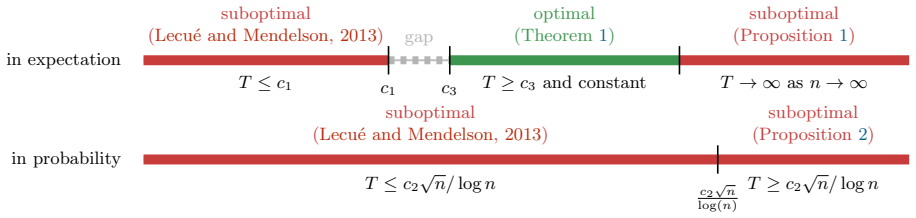
The aggregation with exponential weights estimator achieves the excess risk bound T log(M)/(n+1) in expectation for sufficiently large constant temperatures, without a Bernstein-type assumption.
A machine-rendered reading of the paper's core claim, the machinery that carries it, and where it could break.
Core claim
Without requiring a Bernstein-type assumption, the AEW estimator achieves the excess risk T log(M)/(n+1) in expectation whenever the temperature T satisfies (L^2/T)exp(B/T) ≤ mu/2. Here the loss is bounded by B, L-Lipschitz continuous and mu-strongly convex, M is the number of dictionary elements, and n i.i.d. samples are observed from any distribution. For squared loss, T ≥ 4b^2 suffices when predictions and labels are [0,b]-valued.
What carries the argument
The aggregation with exponential weights (AEW) estimator, which assigns weights to each of the M models proportional to exp(-T times its empirical risk) and forms their convex combination.
Load-bearing premise
The loss must be bounded by B, L-Lipschitz continuous, and mu-strongly convex, and the temperature T must satisfy the inequality (L squared over T) times exp(B over T) at most mu over 2.
What would settle it
An explicit loss that is bounded, L-Lipschitz and mu-strongly convex together with a temperature T meeting the inequality, yet for which the expected excess risk of AEW exceeds T log(M)/(n+1) on some distribution with n samples and M models, would falsify the claim.
Figures
read the original abstract
The aggregation with exponential weights (AEW) estimator is not fully understood in the basic setting of model selection aggregation with squared loss. In particular, whether it is minimax-rate optimal in expectation for large enough fixed temperatures and under random design has been an open problem since its introduction, which was explicitly posed by Lecu\'{e} and Mendelson (2013). In this paper, we settle this problem by showing that \emph{without} requiring a Bernstein-type assumption, the AEW indeed achieves the excess risk $T \log (M) / (n+1)$ in expectation, whenever the temperature $T$ satisfies $(L^2/T)\exp(B/T)\leq \mu /2$. Here, the number of dictionary elements is $M$, the estimator has observed $n$ i.i.d. samples from any distribution, and the loss is assumed to be bounded by $B$, $L$-Lipschitz continuous and $\mu$-strongly convex. For squared loss, we show that $T\geq 4 b^2$ suffices when the predictions and labels are $[0,b]$-valued. Because AEW is known to be suboptimal in expectation for temperatures below some constant, this shows that AEW has a sharp phase transition when the temperature is large enough but constant, as conjectured by Lecu\'{e} and Mendelson.
Editorial analysis
A structured set of objections, weighed in public.
Referee Report
Summary. The manuscript claims to resolve the open problem of Lecué and Mendelson (2013) by proving that aggregation with exponential weights (AEW) achieves the excess risk bound T log(M)/(n+1) in expectation (without Bernstein-type assumptions) whenever the temperature satisfies (L²/T)exp(B/T) ≤ μ/2, for losses that are B-bounded, L-Lipschitz and μ-strongly convex; it further states that T ≥ 4b² suffices for squared loss on [0,b]-valued data.
Significance. If correct, the result establishes minimax-rate optimality in expectation for AEW at large enough constant temperatures under random design, confirming the conjectured sharp phase transition and providing a parameter-free derivation of the bound under the stated loss and temperature conditions.
major comments (1)
- [Abstract] Abstract (paragraph 2): the general sufficient condition (L²/T)exp(B/T)≤μ/2 is violated by the squared-loss parameters at the claimed T=4b². Substituting μ=2, L=2b, B=b² yields (4b²/T)exp(B/T)=exp(0.25)≈1.284 >1=μ/2. This is load-bearing for the central claim, as the phase-transition result for the motivating example therefore rests on either an unstated adjustment to the general theorem or a separate argument whose details must be supplied and verified.
Simulated Author's Rebuttal
We thank the referee for the careful reading and for identifying the inconsistency between the general sufficient condition and the claimed temperature for squared loss. We address the point below and will revise the manuscript to improve clarity.
read point-by-point responses
-
Referee: [Abstract] Abstract (paragraph 2): the general sufficient condition (L²/T)exp(B/T)≤μ/2 is violated by the squared-loss parameters at the claimed T=4b². Substituting μ=2, L=2b, B=b² yields (4b²/T)exp(B/T)=exp(0.25)≈1.284 >1=μ/2. This is load-bearing for the central claim, as the phase-transition result for the motivating example therefore rests on either an unstated adjustment to the general theorem or a separate argument whose details must be supplied and verified.
Authors: We agree that the general condition (L²/T)exp(B/T) ≤ μ/2 is not met at T=4b² under the squared-loss parameters (μ=2, L=2b, B=b²). The manuscript treats the squared-loss case via a separate, direct argument (detailed in Section 4) that establishes the excess-risk bound for T ≥ 4b² without relying on the general sufficient condition derived for arbitrary losses. This separate argument exploits the specific structure of the squared loss to obtain the stated temperature. We acknowledge that the abstract does not make this separation explicit, which can create the impression that the general theorem applies directly. We will revise the abstract to state clearly that the squared-loss result is obtained by a tailored analysis, and we will add a brief pointer in the abstract to the relevant section so that the details are readily verifiable. revision: yes
Circularity Check
No significant circularity; bound derived from explicit assumptions
full rationale
The paper states a theorem giving the excess-risk bound T log(M)/(n+1) under the explicit loss assumptions (bounded by B, L-Lipschitz, μ-strongly convex) and the temperature condition (L²/T)exp(B/T)≤μ/2. This is presented as a direct consequence of those inputs rather than a self-referential or fitted construction. The squared-loss case is handled by a separate sufficient condition T≥4b². No load-bearing self-citation, self-definitional step, or reduction of a prediction to a fitted input appears in the abstract or skeptic analysis. The noted numerical mismatch between the general condition and the squared-loss parameters is a potential correctness issue, not a circularity reduction.
Axiom & Free-Parameter Ledger
axioms (2)
- domain assumption Loss is bounded by B, L-Lipschitz, and μ-strongly convex
- domain assumption Data are i.i.d. from an arbitrary distribution (random design)
Reference graph
Works this paper leans on
- [1]
-
[2]
Audibert, J.-Y. (2007). Progressive mixture rules are deviation suboptimal.Advances in Neural Information Processing Systems (NeurIPS)
work page 2007
-
[3]
Audibert, J.-Y. (2009). Fast learning rates in statistical inference through aggregation.Annals of Statistics
work page 2009
-
[4]
Catoni, O. (2004).Statistical learning theory and stochastic optimization: Ecole d’Et´ e de Probabilit´ es de Saint-Flour XXXI-2001. Springer
work page 2004
-
[5]
(2007).PAC-Bayesian supervised classification: The thermodynamics of statistical learning
Catoni, O. (2007).PAC-Bayesian supervised classification: The thermodynamics of statistical learning. Institute of Mathematical Statistics
work page 2007
-
[6]
Dai, D., Rigollet, P., and Zhang, T. (2012). Deviation optimal learning using greedy Q-aggregation.Annals of Statistics
work page 2012
-
[7]
Dalalyan, A. and Tsybakov, A. B. (2008). Aggregation by exponential weighting, sharp PAC-Bayesian bounds and sparsity.Machine Learning
work page 2008
-
[8]
Forster, J. and Warmuth, M. K. (2002). Relative expected instantaneous loss bounds.Journal of Computer and System Sciences
work page 2002
-
[9]
Hoeven, D., Erven, T., and Kot lowski, W. (2018). The many faces of exponential weights in online learning. Proceedings of the Conference on Learning Theory (COLT)
work page 2018
-
[10]
Juditsky, A., Rigollet, P., and Tsybakov, A. B. (2008). Learning by mirror averaging.Annals of Statistics
work page 2008
-
[11]
Koren, T. and Levy, K. (2015). Fast rates for exp-concave empirical risk minimization.Advances in Neural Information Processing Systems (NeurIPS). Lecu´ e, G. and Mendelson, S. (2009). Aggregation via empirical risk minimization.Probability theory and related fields. Lecu´ e, G. and Mendelson, S. (2013). On the optimality of the aggregate with exponential...
work page 2015
-
[12]
Leung, G. and Barron, A. R. (2006). Information theory and mixing least-squares regressions.IEEE Transactions on Information Theory
work page 2006
-
[13]
Littlestone, N. and Warmuth, M. K. (1994). The weighted majority algorithm.Information and computation
work page 1994
-
[14]
Mourtada, J., Vaˇ skeviˇ cius, T., and Zhivotovskiy, N. (2023). Local risk bounds for statistical aggregation.Proceedings of the Conference on Learning Theory (COLT)
work page 2023
-
[15]
Rigollet, P. and Tsybakov, A. B. (2012). Sparse estimation by exponential weighting.Statistical Science
work page 2012
-
[16]
Tsybakov, A. B. (2003). Optimal rates of aggregation.Proceedings of the Conference on Learning Theory (COLT)
work page 2003
-
[17]
Vovk, V. G. (1990). Aggregating strategies.Proceedings of the Conference on Learning Theory (COLT)
work page 1990
-
[18]
Yang, Y. (2000). Mixing strategies for density estimation.Annals of Statistics. 12
work page 2000
discussion (0)
Sign in with ORCID, Apple, or X to comment. Anyone can read and Pith papers without signing in.