REVIEW 4 major objections 6 minor 64 references
Implicit Delta Learning of High Fidelity Neural Network Potentials
T0 review · 4 major / 6 minor · reviewed 2026-08-11 · deepseek-v4-flash
Pith's one-line read Implicit delta learning (IDLe) claims neural network potentials can reach the same accuracy as single high-fidelity quantum baselines while using up to 50 times less high-fidelity data, by training fidelity-specific heads on a shared…
desk verdict Good method, useful dataset, but the 50x data-efficiency claim is inflated by an accounting error in the OOD setup. read the letter →
The pith
A machine-rendered reading of the paper's core claim, the machinery that carries it, and where it could break.
The reading
What carries the argument
The central object is the shared latent representation with fidelity-specific heads, trained by minimizing a multi-fidelity multi-task mean-squared-error loss over all available labels. The mechanism: LF heads force the backbone to build a representation good enough to reproduce cheap energies across a large chemical space; the HF head then decodes the expensive energy from that same representation, so geometries that never saw an HF label still benefit from the representation shaped by LF labels. Because only the HF head is used at inference, IDLe avoids the extra LF computation that explicit delta learning pays at simulation time.
What would settle it
A direct test: take a dataset with LF labels and a small set of HF labels, train IDLe, and then remove the correlation between LF and HF energies on a held-out test set (e.g., by permuting LF energies among geometries). If the HF head still performs as well as a model trained with correlated labels, the shared-latent mechanism is not the source of the gains; if it degrades to direct-learning level, the mutual-information premise is confirmed.
Extended reading notes
Core claim
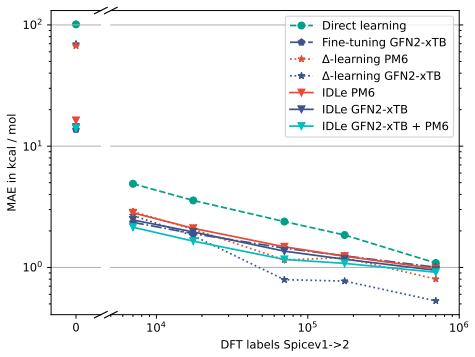
IDLe is a multi-task learning strategy that replaces the explicit energy-difference target of classical delta learning with an implicit one: instead of predicting the gap between a low-fidelity (LF) and a high-fidelity (HF) energy, the network predicts both energies from the same latent representation, with the LF head trained on abundant cheap labels and the HF head trained on fewer expensive ones. The authors show that this shared-latent decoding transfers information from LF to HF: on the SpiceV1 to SpiceV2 transfer, IDLe trained with 2.5% of the DFT labels plus GFN2-xTB and PM6 labels reaches the same accuracy as a direct-learning model trained on 100% of the DFT labels; on ANI1-ccx, IDLe with only 2.5% of the CCSD(T) labels plus GFN2-xTB, PM6, and DFT labels nearly matches the 100%-CCSD(T) baseline. The paper also provides ~11 million new semi-empirical single-point energies on existing datasets, and a scaling study showing power-law gains when high-fidelity data are increased and a saturation regime when only low-fidelity data are added.
Load-bearing premise
The whole method rests on the assumption that a cheap low-fidelity calculation and an expensive high-fidelity calculation on the same molecule share enough mutual information that a model trained mostly on cheap labels can predict the expensive energy on molecules it has never seen with expensive labels.
Editorial extensions
If this is right
- Training NNPs for DFT or CCSD(T) level accuracy can require 4-50x less high-fidelity data when cheap semi-empirical labels are available, reducing the cost of building new datasets.
- IDLe works out-of-distribution: with no additional high-fidelity labels it matches a 100%-HF direct-learning baseline on small and medium chemical shifts, and it is the most efficient user of the few HF labels added under larger shifts.
- IDLe is less sensitive than explicit delta learning to the quality of the LF method, and can combine several LF methods (e.g., GFN2-xTB plus PM6) to improve the HF head.
- The scaling results imply that for a fixed LF dataset, adding HF labels follows a power law whose exponent grows with LF data size, while adding LF labels beyond the HF set shows diminishing returns.
Reading between the lines
- If IDLe's data efficiency transfers to force training (energies plus forces), the practical cost reduction for MD-grade potentials may be larger than the energy-only numbers here, because force labels are the most expensive part of many NNP datasets.
- The mutual-information explanation suggests a cheap diagnostic before launching a new LF/HF campaign: compute the LF-HF correlation on a small probe set; low correlation would predict that IDLe gives little advantage over direct learning for that pair.
- The saturation regime when adding LF-only conformers indicates a specific resource-allocation rule: spend the next budget on HF labels for existing conformers rather than on more LF labels, until the shared representation improves.
- The 11M semi-empirical labels released here could make IDLe a drop-in pre-training scheme for other architectures (equivariant GNNs, MACE-style models), not just the TorchMDNet backbone used in the paper.
Editorial analysis
A structured set of objections, weighed in public.
Referee Report
Summary. This paper introduces IDLe (Implicit Delta Learning), an end-to-end multi-task training strategy for neural network potentials in which a shared backbone is augmented with fidelity-specific prediction heads for high- and low-fidelity QM energies. Training minimizes a masked multi-fidelity MSE loss (Eq. 2) over all available labels, so LF labels from methods such as GFN2-xTB, DFTB3, and PM6 can substitute for expensive HF labels without increasing inference cost. Experiments on QMugs, QM7-X, ANI1-ccx, and Spice compare IDLe with direct learning, explicit delta learning, and fine-tuning across DFT and CCSD(T) target levels, and the authors report up to 50x HF data efficiency and release a large set of newly computed LF single-point energies.
Significance. If the reported results hold, IDLe is a practically valuable contribution: it is a simple, end-to-end way to exploit cheap semi-empirical labels while avoiding the inference-time LF calculation required by explicit delta learning. The breadth of the benchmark suite, spanning four datasets with multiple HF/LF method pairs, is a strength, and the release of millions of new semi-empirical energies is a useful community resource. However, the headline data-efficiency number is computed with an accounting that undercounts the HF labels actually used by IDLe, and the experimental section does not report seed variance or goodness-of-fit statistics for the scaling-law claims. These issues mean the central claim, as stated in the abstract, is not yet established at the reported magnitude, although the underlying method remains plausible and the problems appear addressable.
major comments (4)
- [Section 4.5, Table 3; Section 4.4; Abstract] The 50x data-efficiency ratio is not computed under a consistent accounting of high-fidelity labels. In the SpiceV1->2 OOD experiment, the setup is explicitly that IDLe trains on all LF labels of A and B, all HF labels of A, and a varying fraction of HF labels of B (Section 4.4). Yet Section 4.5 defines N_IDLe as 1% of the total available HF labels of the combined dataset and N_direct as the HF-label count at which direct learning matches IDLe. This definition omits the source-set HF labels of A. If A and B are comparable in size, the true total-HF-label ratio is approximately (A + 0.5B)/(A + 0.01B), which is close to 1.4 rather than 50. The abstract's 'up to 50x less high-fidelity data' is therefore only valid under the much narrower reading '50x fewer newly computed HF labels for an already labeled source dataset.' Please redefine N_IDLe to include all HF labels actually used by IDLe, or explicitly state and prominently caveat the narrower interpretation, and recompute the ratios in Table 3 accordingly.
- [Section 4.1, Figures 1-4] No seed variance or repeated runs are reported; all curves appear to be single training runs without error bars, confidence intervals, or significance tests. Statements such as 'IDLe and fine-tuning approaches reach chemical accuracy with 4-6x fewer DFT labels' and the relative ordering of IDLe versus fine-tuning and delta-learning are therefore not statistically supported. Please provide multiple seeds (at least 3-5) for the key comparisons and report mean plus/minus standard deviation, or an equivalent uncertainty quantification, for the MAE curves that underlie the efficiency ratios in Table 3.
- [Section 4.5, Figure 5 and Appendix A.6] The statement that the model 'perfectly follows power-law scaling' is unsupported by the reported evidence. No goodness-of-fit statistic, confidence interval, or residual analysis is given for the fitted exponents, and the curves contain at most five evaluation points; the segment-wise slopes in Table 5 are computed from two-point segments. Please report fit quality (e.g., R^2 and standard error of beta) and either add more evaluation points or soften the claim to 'approximately follows' power-law scaling.
- [Equation (3), Section 4.1] Please state explicitly whether the normalization constants mu_{j,k} and sigma_j are estimated on the training split only. If they are estimated on the full dataset, including the test set, then test-set statistics leak into training, which would make all reported MAEs optimistic and would require rerunning the experiments with train-only statistics. If they are train-only, this should be stated in the text so that readers do not have to infer it.
minor comments (6)
- [Section 4.3] The sentence 'as discussed in Section 4.3' at the start of Section 4.3 appears to reference the preceding IID results and should presumably refer to Section 4.2.
- [Figure 3 caption] The caption says 'OOD performance on SpiceV2->1' but the text and experimental setup refer to SpiceV1->2; the direction of the transfer should be corrected.
- [Abstract and Table 2] The claimed '~11 million single point energy computations' does not obviously match Table 2: summing the conformer counts times the number of added LF labels per dataset gives roughly 17.9 million computations, or 8.7 million conformers. Please reconcile the stated number in the abstract and contributions with the dataset table.
- [Table 3] The heading 'CPU Time [d]' is ambiguous because the columns contain dimensionless ratios, not CPU days; rename to something like 'Data ratio' and 'Compute-time ratio'.
- [Table 3 and Section 4.5] The data-efficiency ratios are said to be 'inferred from Figures 1, 2, and 3'; please provide the corresponding MAE values in a table so that the ratios are reproducible without reading values off log-scale plots.
- [Throughout] Capitalization of the method name is inconsistent (IDLe versus IDLE); please unify.
Circularity Check
No load-bearing circularity: the central data-efficiency claims are empirical benchmark comparisons, not derivations from fitted inputs.
full rationale
The paper's central claim—that IDLe achieves the same accuracy as high-fidelity baselines using fewer high-fidelity labels—is an empirical benchmark result. The IDLe loss in Eq. 2 is a multi-task MSE over fidelity-specific heads sharing a backbone; no predicted quantity is defined in terms of the claim or of the fitted model. The normalization in Eq. 3 is a standard per-atom mean and per-atom energy-scale computed from training labels and applied identically to all methods; it does not encode the delta or implicitly enforce the reported data-efficiency ratios. The 50x and related ratios in Table 3 are read off empirical MAE-versus-HF-label curves, i.e., N_direct is the label count at which direct learning matches IDLe's 1%-HF performance; this is a descriptive comparison, not a quantity forced by construction. The power-law exponents in Figure 5 and Table 5 are fitted to the model's own test curves and are presented as descriptive scaling analysis; they are not used to establish the headline data-efficiency result. Self-citations ([9], [12], [13]) appear only as contextual references in the introduction and related work and are not load-bearing for the IDLe claim. The main caveat—that the '50x less high-fidelity data' headline in the Spice OOD experiment counts only newly added target-set HF labels and omits the source-set HF labels that IDLe also trains on—is a metric-accounting concern about how N_IDLe is defined, not a circularity in the derivation. Even if that headline ratio needs restating, the underlying method comparison on held-out test sets remains an external empirical result independent of the paper's own fitted parameters.
Assumptions & free parameters
free parameters (2)
- Per-atom-type mean energy mu_j,k and residual scale sigma_j (Eq. 3) =
dataset-specific
- Power-law exponent beta (Fig. 5, Table 5) =
0.081 to 0.286
assumptions (4)
- domain assumption LF and HF energies for the same geometry share enough mutual information for a shared-latent multi-task backbone to yield an accurate HF head.
- domain assumption Energy-matching alone is a valid proxy for NNP accuracy.
- domain assumption A random 80/10/10 split of conformers reflects IID generalization.
- domain assumption CPU-time extrapolation from 17 benchmark molecules to dataset scale is representative.
Cite this review
Pith. "Pith review of Implicit Delta Learning of High Fidelity Neural Network Potentials." pith.science (2026). https://pith.science/paper/I2HOECXL
@misc{pith2026241206064,
  author       = {Pith},
  title        = {Pith review of: Implicit Delta Learning of High Fidelity Neural Network Potentials},
  year         = {2026},
  howpublished = {\url{https://pith.science/paper/I2HOECXL}},
  note         = {Machine review of arXiv:2412.06064}
}
read the original abstract
Neural network potentials (NNPs) offer a fast and accurate alternative to ab-initio methods for molecular dynamics (MD) simulations but are hindered by the high cost of training data from high-fidelity Quantum Mechanics (QM) methods. Our work introduces the Implicit Delta Learning (IDLe) method, which reduces the need for high-fidelity QM data by leveraging cheaper semi-empirical QM computations without compromising NNP accuracy or inference cost. IDLe employs an end-to-end multi-task architecture with fidelity-specific heads that decode energies based on a shared latent representation of the input atomistic system. In various settings, IDLe achieves the same accuracy as single high-fidelity baselines while using up to 50x less high-fidelity data. This result could significantly reduce data generation cost and consequently enhance accuracy and generalization, and expand chemical coverage for NNPs, advancing MD simulations for material science and drug discovery. Additionally, we provide a novel set of 11 million semi-empirical QM calculations to support future multi-fidelity NNP modeling.
Figures


Figures from the paper (6 more)



Reference graph
Works this paper leans on
-
[1]
Generalized Neural-Network Representation of High- Dimensional Potential-Energy Surfaces
Jörg Behler and Michele Parrinello. Generalized Neural-Network Representation of High- Dimensional Potential-Energy Surfaces. Physical Review Letters, 98(14):146401, apr 2007. ISSN 00319007. doi:10.1103/PhysRevLett.98.146401
-
[2]
Justin Gilmer, Samuel S. Schoenholz, Patrick F. Riley, Oriol Vinyals, and George E. Dahl. Neural Message Passing for Quantum Chemistry. In Proceedings of the 34th International Conference on Machine Learning, pages 1263–1272, Sydney, Australia, Aug. 6–11, 2017. ISBN 9781510855144
work page 2017
-
[3]
Finkler, Stefan Goedecker, and Jörg Behler
Tsz Wai Ko, Jonas A. Finkler, Stefan Goedecker, and Jörg Behler. A fourth-generation high- dimensional neural network potential with accurate electrostatics including non-local charge transfer. Nature Communications, 12:398, dec 2021. ISSN 20411723. doi:10.1038/s41467- 020-20427-2
doi:10.1038/s41467- 2021
-
[4]
E(3)-equivariant graph neural networks for data-efficient and accurate interatomic potentials
Simon Batzner, Albert Musaelian, Lixin Sun, Mario Geiger, Jonathan P Mailoa, Mordechai Kornbluth, Nicola Molinari, Tess E Smidt, and Boris Kozinsky. E(3)-equivariant graph neural networks for data-efficient and accurate interatomic potentials. Nature Communications, 13(1): 2453, 2022
work page 2022
-
[5]
TorchMD-Net 2.0: Fast Neural Network Potentials for Molecular Simulations
Raul P Pelaez, Guillem Simeon, Raimondas Galvelis, Antonio Mirarchi, Peter Eastman, Stefan Doerr, Philipp Thölke, Thomas E Markland, and Gianni De Fabritiis. Torchmd-net 2.0: Fast neural network potentials for molecular simulations. arXiv preprint arXiv:2402.17660, 2024
work page Pith review arXiv 2024
-
[6]
Albert Musaelian, Simon Batzner, Anders Johansson, and Boris Kozinsky. Scaling the leading accuracy of deep equivariant models to biomolecular simulations of realistic size. In SC23: International Conference for High Performance Computing, Networking, Storage and Analysis, pages 1–12. IEEE, 2023
work page 2023
-
[7]
Mace-off23: Transfer- able machine learning force fields for organic molecules
Dávid Péter Kovács, J Harry Moore, Nicholas J Browning, Ilyes Batatia, Joshua T Horton, Venkat Kapil, Ioan-Bogdan Magd˘au, Daniel J Cole, and Gábor Csányi. Mace-off23: Transfer- able machine learning force fields for organic molecules. arXiv preprint arXiv:2312.15211, 2023
arXiv 2023
-
[8]
Xiang Fu, Zhenghao Wu, Wujie Wang, Tian Xie, Sinan Keten, Rafael Gomez-Bombarelli, and Tommi Jaakkola. Forces are not enough: Benchmark and critical evaluation for machine learning force fields with molecular simulations. In AI for Science: Progress and Promises Workshop at NeurIPS, New Orleans, LA, USA, Dec. 2, 2022
work page 2022
Show all 64 references
-
[9]
Scalable bayesian uncertainty quantifi- cation for neural network potentials: Promise and pitfalls
Stephan Thaler, Gregor Doehner, and Julija Zavadlav. Scalable bayesian uncertainty quantifi- cation for neural network potentials: Promise and pitfalls. Journal of Chemical Theory and Computation, 19(14):4520–4532, 2023
2023
-
[10]
Molecular dynamics simulations with quantum mechanics/molecular mechanics and adaptive neural networks
Lin Shen and Weitao Yang. Molecular dynamics simulations with quantum mechanics/molecular mechanics and adaptive neural networks. Journal of Chemical Theory and Computation, 14(3): 1442–1455, 2018
2018
-
[11]
Charron, Gianni De Fabritiis, Frank Noé, and Cecilia Clementi
Jiang Wang, Simon Olsson, Christoph Wehmeyer, Adrià Pérez, Nicholas E. Charron, Gianni De Fabritiis, Frank Noé, and Cecilia Clementi. Machine Learning of Coarse-Grained Molec- ular Dynamics Force Fields. ACS Central Science, 5(5):755–767, 2019. ISSN 23747951. doi:10.1021/acsce...
2019 doi
-
[12]
Deep coarse-grained potentials via relative entropy minimization
Stephan Thaler, Maximilian Stupp, and Julija Zavadlav. Deep coarse-grained potentials via relative entropy minimization. The Journal of Chemical Physics, 157:244103, 2022
2022
-
[13]
Learning neural network potentials from experimental data via differentiable trajectory reweighting
Stephan Thaler and Julija Zavadlav. Learning neural network potentials from experimental data via differentiable trajectory reweighting. Nature Communications, 12(1):6884, 2021. doi:10.1038/s41467-021-27241-4
2021 doi
-
[14]
Stability-aware training of neural network interatomic potentials with differentiable boltzmann estimators
Sanjeev Raja, Ishan Amin, Fabian Pedregosa, and Aditi S Krishnapriyan. Stability-aware training of neural network interatomic potentials with differentiable boltzmann estimators. arXiv preprint arXiv:2402.13984, 2024
2024 arXiv
-
[15]
Less is more: Sampling chemical space with active learning
Justin S Smith, Ben Nebgen, Nicholas Lubbers, Olexandr Isayev, and Adrian E Roitberg. Less is more: Sampling chemical space with active learning. The Journal of Chemical Physics, 148 (24):241733, 2018
2018
-
[16]
Hyperactive learning for data-driven interatomic potentials
Cas van der Oord, Matthias Sachs, Dávid Péter Kovács, Christoph Ortner, and Gábor Csányi. Hyperactive learning for data-driven interatomic potentials. npj Computational Materials, 9(1): 168, 2023
2023
-
[17]
Gfn2-xtb—an accurate and broadly parametrized self-consistent tight-binding quantum chemical method with multipole electrostatics and density-dependent dispersion contributions
Christoph Bannwarth, Sebastian Ehlert, and Stefan Grimme. Gfn2-xtb—an accurate and broadly parametrized self-consistent tight-binding quantum chemical method with multipole electrostatics and density-dependent dispersion contributions. Journal of Chemical Theory and Computatio...
2019
-
[18]
Dftb3: Extension of the self-consistent-charge density-functional tight-binding method (scc-dftb)
Michael Gaus, Qiang Cui, and Marcus Elstner. Dftb3: Extension of the self-consistent-charge density-functional tight-binding method (scc-dftb). Journal of Chemical Theory and Computa- tion, 7(4):931–948, 2011
2011
-
[19]
Optimization of parameters for semiempirical methods v: Modification of nddo approximations and application to 70 elements
James JP Stewart. Optimization of parameters for semiempirical methods v: Modification of nddo approximations and application to 70 elements. Journal of Molecular Modeling, 13: 1173–1213, 2007
2007
-
[20]
Big data meets quantum chemistry approximations: the δ-machine learning approach
Raghunathan Ramakrishnan, Pavlo O Dral, Matthias Rupp, and O Anatole V on Lilienfeld. Big data meets quantum chemistry approximations: the δ-machine learning approach. Journal of Chemical Theory and Computation, 11(5):2087–2096, 2015
2015
-
[21]
Multiscale quantum mechanics/molecular mechanics simulations with neural networks
Lin Shen, Jingheng Wu, and Weitao Yang. Multiscale quantum mechanics/molecular mechanics simulations with neural networks. Journal of Chemical Theory and Computation , 12(10): 4934–4946, 2016
2016
-
[22]
Orbnet: Deep learning for quantum chemistry using symmetry-adapted atomic-orbital features
Zhuoran Qiao, Matthew Welborn, Animashree Anandkumar, Frederick R Manby, and Thomas F Miller. Orbnet: Deep learning for quantum chemistry using symmetry-adapted atomic-orbital features. The Journal of Chemical Physics, 153(12), 2020
2020
-
[23]
Qmugs, quan- tum mechanical properties of drug-like molecules
Isert Clemens, Kenneth Atz, José Jiménez-Luna, and Gisbert Schneider. Qmugs, quan- tum mechanical properties of drug-like molecules. Scientific Data 9(1) , June 7, 2022. doi:https://doi.org/10.1038/s41597-022-01390-7
2022 doi
-
[24]
Dotson, Raimondas Galvelis, John E
Peter Eastman, Pavan Kumar Behara, David L. Dotson, Raimondas Galvelis, John E. Herr, Josh T. Horton, Yuezhi Mao, John D. Chodera, Benjamin P. Pritchard, Yuanqing Wang, Gi- anni De Fabritiis, and Thomas E. Markland. Spice, a dataset of drug-like molecules and peptides for trai...
2022 arXiv
-
[25]
Spice 2.0.1, April 2024
Peter Eastman, Pavan Kumar Behara, David Dotson, Raimondas Galvelis, John Herr, Josh Horton, Yuezhi Mao, John Chodera, Benjamin Pritchard, Yuanqing Wang, Gianni De Fabritiis, and Thomas Markland. Spice 2.0.1, April 2024. URL https://doi.org/10.5281/zenodo. 10975225
2024 doi
-
[26]
Robert A., and Tkatchenko Alexandre
Hoja Johannes, Medrano Sandonas Leonardo, Ernst Brian G., Vazquez-Mayagoitia Alvaro, DiStasio Jr. Robert A., and Tkatchenko Alexandre. Qm7-x, a comprehensive dataset of quantum- mechanical properties spanning the chemical space of small organic molecules. Scientific Data 43, V...
2021
-
[27]
J. S. Smith, R. Zubatyuk, B. Nebgen, N. Lubbers, Barros, A. E. K., Roitberg, O. Isayev, and S. Tretiak. The ani-1ccx and ani-1x data sets, coupled-cluster and density functional theory properties for molecules. Scientific Data, 7(1), 134, 2020. doi:https://doi.org/10.1038/s415...
2020 doi
-
[28]
Machine learning in qm/mm molec- ular dynamics simulations of condensed-phase systems
Lennard Boselt, Moritz Thurlemann, and Sereina Riniker. Machine learning in qm/mm molec- ular dynamics simulations of condensed-phase systems. Journal of Chemical Theory and Computation, 17(5):2641–2658, 2021
2021
-
[29]
Graph-convolutional neural networks for (qm) ml/mm molecular dynamics simulations
Albert Hofstetter, Lennard Böselt, and Sereina Riniker. Graph-convolutional neural networks for (qm) ml/mm molecular dynamics simulations. Physical Chemistry Chemical Physics, 24 (37):22497–22512, 2022
2022
-
[30]
Active learning of uniformly accurate interatomic potentials for materials simulation
Linfeng Zhang, De-Ye Lin, Han Wang, Roberto Car, and E Weinan. Active learning of uniformly accurate interatomic potentials for materials simulation. Physical Review Materials, 3(2):023804, 2019
2019
-
[31]
On-the-fly active learning of interatomic potentials for large-scale atomistic simulations
Ryosuke Jinnouchi, Kazutoshi Miwa, Ferenc Karsai, Georg Kresse, and Ryoji Asahi. On-the-fly active learning of interatomic potentials for large-scale atomistic simulations. The Journal of Physical Chemistry Letters, 11(17):6946–6955, 2020
2020
-
[32]
Smith, Benjamin T
Justin S. Smith, Benjamin T. Nebgen, Roman Zubatyuk, Nicholas Lubbers, Christian Devereux, Kipton Barros, Sergei Tretiak, Olexandr Isayev, and Adrian E. Roitberg. Approaching coupled cluster accuracy with a general-purpose neural network potential through transfer learning. Na...
2019 doi
-
[33]
Learning together: Towards foundational models for machine learning interatomic potentials with meta-learning
Alice EA Allen, Nicholas Lubbers, Sakib Matin, Justin Smith, Richard Messerly, Sergei Tretiak, and Kipton Barros. Learning together: Towards foundational models for machine learning interatomic potentials with meta-learning. arXiv preprint arXiv:2307.04012, 2023
2023 arXiv
-
[34]
From molecules to materials: Pre-training large generalizable models for atomic property prediction
Nima Shoghi, Adeesh Kolluru, John R Kitchin, Zachary W Ulissi, C Lawrence Zitnick, and Brandon M Wood. From molecules to materials: Pre-training large generalizable models for atomic property prediction. arXiv preprint arXiv:2310.16802, 2023
-
[35]
Less is more: Sampling chemical space with active learning
Justin S Smith, Ben Nebgen, Nicholas Lubbers, Olexandr Isayev, and Adrian E Roitberg. Less is more: Sampling chemical space with active learning. The Journal of Chemical Physics, 148 (24), 2018
2018
-
[36]
The ani-1ccx and ani-1x data sets, coupled-cluster and density functional theory properties for molecules
Justin S Smith, Roman Zubatyuk, Benjamin Nebgen, Nicholas Lubbers, Kipton Barros, Adrian E Roitberg, Olexandr Isayev, and Sergei Tretiak. The ani-1ccx and ani-1x data sets, coupled-cluster and density functional theory properties for molecules. Scientific Data, 7(1):134, 2020
2020
-
[37]
Ani-1: an extensible neural network potential with dft accuracy at force field computational cost.Chemical Science, 8(4):3192–3203, 2017
Justin S Smith, Olexandr Isayev, and Adrian E Roitberg. Ani-1: an extensible neural network potential with dft accuracy at force field computational cost.Chemical Science, 8(4):3192–3203, 2017
2017
-
[38]
Quantum deep descriptor: Physically informed trans- fer learning from small molecules to polymers
Masashi Tsubaki and Teruyasu Mizoguchi. Quantum deep descriptor: Physically informed trans- fer learning from small molecules to polymers. Journal of Chemical Theory and Computation, 17(12):7814–7821, 2021
2021
-
[39]
Transfer learning using attentions across atomic systems with graph neural networks (taag)
Adeesh Kolluru, Nima Shoghi, Muhammed Shuaibi, Siddharth Goyal, Abhishek Das, C Lawrence Zitnick, and Zachary Ulissi. Transfer learning using attentions across atomic systems with graph neural networks (taag). The Journal of Chemical Physics, 156(18), 2022
2022
-
[40]
Transfer learning for chemically accurate interatomic neural network potentials
Viktor Zaverkin, David Holzmüller, Luca Bonfirraro, and Johannes Kästner. Transfer learning for chemically accurate interatomic neural network potentials. Physical Chemistry Chemical Physics, 25(7):5383–5396, 2023
2023
-
[41]
Machine learning potentials from transfer learning of periodic correlated electronic structure methods: Application to liquid water with afqmc, ccsd, and ccsd (t)
Michael S Chen, Joonho Lee, Hong-Zhou Ye, Timothy C Berkelbach, David R Reichman, and Thomas E Markland. Machine learning potentials from transfer learning of periodic correlated electronic structure methods: Application to liquid water with afqmc, ccsd, and ccsd (t). arXiv pr...
2022 arXiv
-
[42]
Transfer-learned potential energy surfaces: Toward microsecond-scale molecular dynamics simulations in the gas phase at ccsd (t) quality
Silvan Käser and Markus Meuwly. Transfer-learned potential energy surfaces: Toward microsecond-scale molecular dynamics simulations in the gas phase at ccsd (t) quality. The Journal of Chemical Physics, 158(21), 2023
2023
-
[43]
Transfer learning with graph neural networks for improved molecular property prediction in the multi-fidelity setting
David Buterez, Jon Paul Janet, Steven J Kiddle, Dino Oglic, and Pietro Lió. Transfer learning with graph neural networks for improved molecular property prediction in the multi-fidelity setting. Nature Communications, 15(1):1517, 2024
2024
-
[44]
Transfer learning for molecular property predictions from small data sets
Thorren Kirschbaum and Annika Bande. Transfer learning for molecular property predictions from small data sets. arXiv preprint arXiv:2404.13393, 2024
2024 arXiv
-
[45]
Synthetic pre-training for neural- network interatomic potentials
John LA Gardner, Kathryn T Baker, and V olker L Deringer. Synthetic pre-training for neural- network interatomic potentials. Machine Learning: Science and Technology , 5(1):015003, 2024
2024
-
[46]
Pubchemqc b3lyp/6-31g*//pm6 data set: The electronic structures of 86 million molecules using b3lyp/6-31g* calculations
Maho Nakata and Toshiyuki Maeda. Pubchemqc b3lyp/6-31g*//pm6 data set: The electronic structures of 86 million molecules using b3lyp/6-31g* calculations. Journal of Chemical Information and Modeling, 63(18):5734–5754, 2023
2023
-
[47]
Multixc-qm9: Large dataset of molecular and reaction energies from multi-level quantum chemical methods
Surajit Nandi, Tejs Vegge, and Arghya Bhowmik. Multixc-qm9: Large dataset of molecular and reaction energies from multi-level quantum chemical methods. Scientific Data, 10(1):783, 2023
2023
-
[48]
Open force field bespokefit: Automating bespoke torsion parametrization at scale., 2022
Horton J, Boothroyd S, Wagner J, Mitchell J, Gokey T, and Dotson D. Open force field bespokefit: Automating bespoke torsion parametrization at scale., 2022
2022
-
[49]
Daniel G. A. Smith, Annabelle T. Lolinco, Zachary L. Glick, Jiyoung Lee, Asem Alenaizan, Taylor A. Barnes, Carlos H. Borca, Roberto Di Remigio, David L. Dotson, Sebastian Ehlert, Alexander G. Heide, Michael F. Herbst, Jan Hermann, Colton B. Hicks, Joshua T. Horton, Adrian G. H...
2021
-
[50]
Moussa Jonathan E
Stewart James J.P. Moussa Jonathan E. Mopac, 2024-01-29
2024
-
[51]
Extended tight-binding quan- tum chemistry methods
Christoph Bannwarth, Eike Caldeweyher, Sebastian Ehlert, Andreas Hansen, Philipp Pracht, Jakob Seibert, Sebastian Spicher, and Stefan Grimme. Extended tight-binding quan- tum chemistry methods. WIREs Computational Molecular Science , 11(2):e1493, 2021. doi:https://doi.org/10.1...
2021 doi
-
[52]
Neural scaling of deep chemical models
Nathan C Frey, Ryan Soklaski, Simon Axelrod, Siddharth Samsi, Rafael Gomez-Bombarelli, Connor W Coley, and Vijay Gadepally. Neural scaling of deep chemical models. Nature Machine Intelligence, 5(11):1297–1305, 2023
2023
-
[53]
Deep learning scaling is predictable, empirically
Joel Hestness, Sharan Narang, Newsha Ardalani, Gregory Diamos, Heewoo Jun, Hassan Kianinejad, Md Mostofa Ali Patwary, Yang Yang, and Yanqi Zhou. Deep learning scaling is predictable, empirically. arXiv preprint arXiv:1712.00409, 2017
2017 arXiv
-
[54]
Scaling laws for neural language models
Jared Kaplan, Sam McCandlish, Tom Henighan, Tom B Brown, Benjamin Chess, Rewon Child, Scott Gray, Alec Radford, Jeffrey Wu, and Dario Amodei. Scaling laws for neural language models. arXiv preprint arXiv:2001.08361, 2020
2001 arXiv
-
[55]
Scaling vision transform- ers
Xiaohua Zhai, Alexander Kolesnikov, Neil Houlsby, and Lucas Beyer. Scaling vision transform- ers. In Proceedings of the IEEE/CVF conference on computer vision and pattern recognition, pages 12104–12113, 2022. 13
2022
-
[56]
Explaining neural scaling laws
Yasaman Bahri, Ethan Dyer, Jared Kaplan, Jaehoon Lee, and Utkarsh Sharma. Explaining neural scaling laws. arXiv preprint arXiv:2102.06701, 2021
2021 arXiv
-
[57]
Scaling laws for transfer
Danny Hernandez, Jared Kaplan, Tom Henighan, and Sam McCandlish. Scaling laws for transfer. arXiv preprint arXiv:2102.01293, 2021
2021 arXiv
-
[58]
Kingma and Jimmy Lei Ba
Diederik P. Kingma and Jimmy Lei Ba. Adam: A Method for Stochastic Optimization. In 3rd International Conference on Learning Representations, San Diego, CA, USA, May 7-9, 2015
2015
-
[59]
Searching for activation functions
Prajit Ramachandran, Barret Zoph, and Quoc V Le. Searching for activation functions. arXiv preprint arXiv:1710.05941, 2017
2017 arXiv
-
[60]
Lauri Himanen, Marc O. J. Jäger, Eiaki V . Morooka, Filippo Federici Canova, Yashasvi S. Ranawat, David Z. Gao, Patrick Rinke, and Adam S. Foster. DScribe: Library of descriptors for machine learning in materials science. Computer Physics Communications, 247:106949,
-
[61]
On representing chemical environments
Albert P Bartók, Risi Kondor, and Gábor Csányi. On representing chemical environments. Physical Review B, 87(18):184115, 2013
2013
-
[62]
Umap: Uniform manifold approximation and projection for dimension reduction
Leland McInnes, John Healy, and James Melville. Umap: Uniform manifold approximation and projection for dimension reduction. arXiv preprint arXiv:1802.03426, 2018
2018 arXiv
-
[63]
D. G. A. Smith, L. A. Burns, A. C. Simmonett, R. M. Parrish, M. C. Schieber, R. Galvelis, P. Kraus, H. Kruse, R. Di Remigio, A. Alenaizan, A. M. James, S. Lehtola, J. P. Misiewicz, M. Scheurer, R. A. Shaw, J. B. Schriber, Y . Xie, Z. L. Glick, D. A. Sirianni, J. S. O’Brien, J....
2020
-
[2020]
doi:10.1016/j.cpc.2019.106949
ISSN 0010-4655. doi:10.1016/j.cpc.2019.106949. URL https://doi.org/10.1016/ j.cpc.2019.106949
2019
Reviewed August 11, 2026 · model on record in the stance chip above.
Discussion (0). Continue with ORCID to comment.