REVIEW 4 major objections 4 minor 27 references
Smarr Mass formulas for BPS multicenter Black Holes
T0 review · 4 major / 4 minor · reviewed 2026-08-14 · deepseek-v4-flash
Pith's one-line read A new mass formula for two-center BPS black holes relates their ADM mass to the intercenter distance and angular momentum, and yields an always-attractive effective force between the centers.
desk verdict Plausible repackaging of the two-center BPS mass relation, but the abstract's continuous-family prediction is not proven and the derivation skips key steps. read the letter →
The pith
A machine-rendered reading of the paper's core claim, the machinery that carries it, and where it could break.
The reading
What carries the argument
The load-bearing object is the symplectic vector $I_\infty$, the asymptotic value of the harmonic symplectic vector whose inner products with the charge vectors fix the scalar moduli at infinity. Expanding $I_\infty$ in a basis built from the charge vectors $q_1,q_2$ and eigenvectors of the stabilization matrix $S$, the contravariant components are identified with the partial masses $M_1,M_2$ and NUT charges $N_1,N_2$. The asymptotic flatness condition $\langle S I_\infty|I_\infty\rangle=1$ then becomes a quadratic equation in the ADM mass. The integrability condition for the rotation 1-form $\omega$ fixes the NUT charge difference as $N_1=-N_2=J/r$, and this is what puts the intercenter distance $r$ and the angular momentum $J$ into the mass relation.
What would settle it
Solve the implicit scalar equation of Eq. (11) together with Eq. (14) for the paper's toy-model charge pairs across $r\in(0,\infty)$; any interval of $r$ with no physically admissible scalar value would falsify the claimed continuum.
Extended reading notes
Core claim
The paper's central claim is that the asymptotic flatness condition of a two-center BPS solution, expressed as $\langle S I_\infty | I_\infty\rangle = 1$ in the symplectic formalism, reduces to a quadratic mass formula once the vector $I_\infty$ is expanded in a basis adapted to the two charge vectors. For the mass configuration that minimizes $M_\infty$, the formula takes the form $M^2 = A(1+\alpha J^2(1+2M/r + A/r^2))$, where $A = \langle S Q | Q\rangle$ and $\alpha = 1/|\det S|$, with $Q=q_1+q_2$. Under the conditions $A>0$ and $\det S<0$, this equation has a unique positive root $M(r)$ for every $r>0$, interpolating from $M\to\infty$ as $r\to 0$ to $M\to M_\infty$ as $r\to\infty$. The paper further derives the Smarr-like differential $dM = \Omega\,dJ + \Phi_i\,dq_i + F\,dr$, in which $F=\partial M/\partial r$ is always negative and behaves as $-1/r^2$ at large separation.
Load-bearing premise
The prediction of a continuous family of two-center BPS black holes assumes that the scalar-moduli equations can be solved together with the mass formula at every separation; the paper solves the mass formula but does not show that physically admissible scalar values exist across the entire range.
Editorial extensions
If this is right
- For fixed charges with $A>0$ and $\det S<0$, the mass formula has a unique positive solution for every $r>0$, so two-center BPS configurations form a continuous one-parameter family rather than isolated solution points.
- The effective force $F=\partial M/\partial r$ is negative at all distances, recovering the Newtonian $F\sim -1/r^2$ falloff at infinity and a $f_0+f_1/r^2$ form at short distances.
- The Smarr-like differential $dM=\Omega\,dJ+\Phi_i\,dq_i+F\,dr$ provides an effective angular velocity and electromagnetic potentials alongside a force term depending on the separation.
- The same expansion method extends to models with more scalars and more centers, giving analogous mass relations with additional symplectic-invariant coefficients.
- At the minimal-mass relative configuration, the mass at infinite separation has an explicit value, giving a finite lower bound $M_\infty$ for the continuous family.
Reading between the lines
- A direct test of the paper's claim would be to solve Eq. (11) numerically for the toy-model charge pairs and check monotonic variation of $z_\infty$ with $r$; the paper's figures suggest such variation but do not establish it over the full interval.
- If the continuous family exists, it would mean two-center BPS states have a continuous mass spectrum bounded below by $M_\infty$, akin to marginal bound states in which the intercenter force never vanishes at finite separation.
- The structural similarity between this formula and the extremal Kerr-Newman relation $M^2=Q^2+J^2/M^2$ suggests looking for an analogous $r$-dependent Smarr law for non-BPS or near-extremal multi-center systems.
Signed reviews
Editorial analysis
A structured set of objections, weighed in public.
Referee Report
Summary. The paper proposes new ``Smarr-like'' mass formulas for multicenter BPS black holes in N=2, d=4 supergravity. Starting from the standard IWP form and the symplectic vector ansatz I = I_∞ + Σ_i q_i/|x-x_i|, the author derives from the asymptotic flatness condition ⟨S I_∞| I_∞⟩ = 1 a quadratic mass relation, Eq. (8). For the two-center case with one vector multiplet, this is specialized to Eq. (14), and for the minimal-mass configuration m_i = m_i,min to Eq. (18), which relates the ADM mass M to the intercenter distance r, the angular momentum J, and the symplectic invariants A and α. The paper then defines an effective intercenter force F = dM/dr and claims the formula predicts a continuous family of BPS black holes with r ∈ (0,∞) and M ∈ (∞, M_∞). A supplementary numerical example for two charge configurations is presented.
Significance. If the derivation were fully valid and the existence claim properly established, the result would be a useful local constraint on multicenter BPS black holes, complementing the known non-local Denef-Moore integrability conditions. The use of symplectically invariant quantities (A, α, det(S)) is attractive and could provide a compact diagnostic for when a two-center solution exists for a given set of charges, masses, and intercenter distance. The paper also introduces a suggestive effective-force language. However, the manuscript currently leaves the central derivation partly implicit, overstates the generality of Eq. (18), and does not prove the claimed continuous family of solutions; these gaps currently limit the paper's significance. The supplementary numerical work is a positive step but covers only two toy configurations.
major comments (4)
- [Section 2, Eq. (8)] The step from the asymptotic flatness condition ⟨S I_∞|I_∞⟩ = 1 to the mass relation Eq. (8) is not shown. The text merely states that writing the condition in terms of contravariant components and using −2 Im(α_i) = M_i, 2 Re(α_i) = N_i gives 1 = a M_ADM^2 + b M_ADM + c + λ_a λ̄_a. The definitions of a, b, c and the decomposition of the metric g_{i\bar k} = (A + iS)/2 do not by themselves make the algebra transparent. Since Eqs. (14) and (18) are the paper's central claims, this intermediate derivation must be written out explicitly so that the coefficients and the λ_a term can be checked.
- [Section 3, Eq. (18)] Eq. (18) is presented in the abstract and conclusion as the two-center mass relation, but within the body it is derived only for the minimal-mass configuration m_i = m_i,min, where (M_0^2)_min = A. For generic relative masses the correct formula is Eq. (14), which contains M_0^2 = 1/(S^{-1}_{ij} m_i m_j) and therefore depends on m_i in a nontrivial way. The abstract's formula M^2 = A(1 + α J^2(1 + 2M/r + A/r^2)) is not the general two-center relation; presenting it as such overstates the result. The paper should either state explicitly that Eq. (18) holds only for the minimal-mass configuration, or extend the derivation to generic m_i.
- [Section 3 and Eq. (11)] The claimed prediction of a continuous family of BPS black holes for all r ∈ (0,∞) is an existence statement, but the paper establishes only a necessary algebraic condition. The mass relation (14) or (18) is complemented, as the author notes, by the implicit scalar-moduli equations Eq. (11). The paper does not prove that for every r a physically admissible solution z_∞ exists satisfying Eq. (11) together with the mass relation, positive metric factor e^{2U}, and positive horizon entropies. The supplementary figure shows numerical branches for two specific charge configurations but does not establish the generic charge regime or provide a continuity argument over all r. Without this, the continuous-family prediction is not secured by the derivation as written.
- [Section 3, transition from Eq. (8) to Eq. (14)] The passage from the general mass relation Eq. (8) to the two-center formula Eq. (14) drops the λ_a λ̄_a term without justification. In the two-center one-scalar model (n̄ = 2) the symplectic space has dimension 4 and q_1, q_2 may span it, but in models with more vector multiplets the charge vectors do not span the full symplectic space, and the λ_a terms cannot be assumed to vanish. The paper claims the mass relations are valid 'in any N=2 SUGRA,' but no argument is given that Eq. (14) (and hence Eq. (18)) survives the presence of the extra basis vectors s_a. This is a load-bearing gap in the generality claim.
minor comments (4)
- [Throughout] There are numerous typos and grammatical issues: 'intercencenter' in the abstract, 'continuos' for 'continuous', 'cuadratic' for 'quadratic', 'fullfilment' for 'fulfillment', 'neccesary' for 'necessary', 'desiderable' for 'desirable', and 'simmetric' for 'symmetric'. These should be corrected.
- [Section 2, Eq. (8)] The sentence 'Eq.(8) possibly admits solutions with r_ij → ∞' is unclear: the dependence on r_ij enters through N_i via Eq. (3), but the limit is not discussed carefully, and the later statement 'at infinity we recover the familiar Newton law F ∼ 1/r^2' would benefit from a sign convention and a clearer definition of F in terms of M(r).
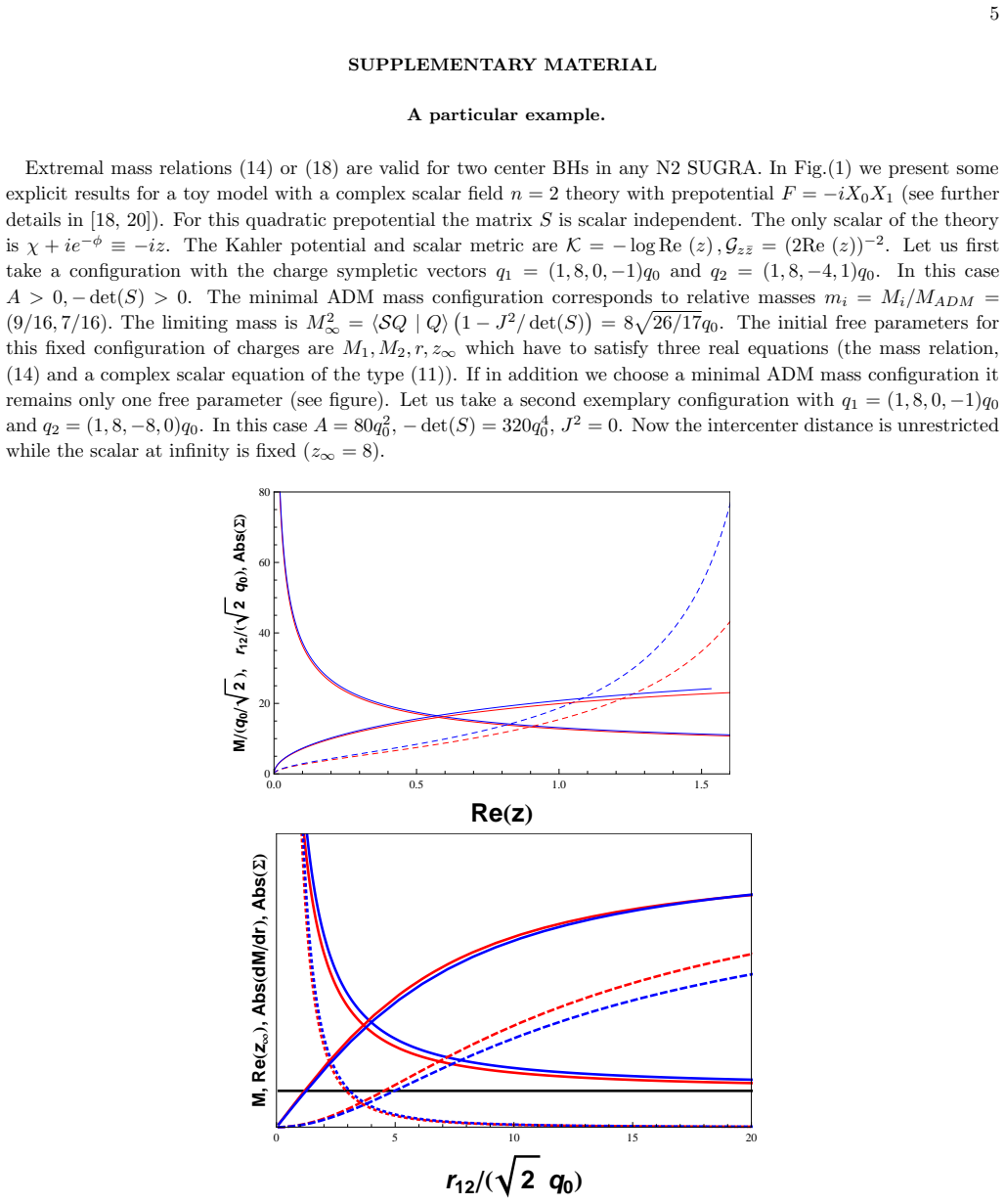
- [Supplementary material, Fig. 1] The figure axes and legends are difficult to read, particularly the mixing of M, r_12, Re(z_∞), |dM/dr|, and |S| in the same plot with different scales. A caption clarifying which curve corresponds to which quantity and the parameter values would substantially improve reproducibility.
- [Section 3, Eq. (16)] The notation m_i,min = ⟨S q_i|Q⟩/⟨S Q|Q⟩ is introduced without derivation; it would be helpful to show that this extremizes M_∞^2 under the constraint Σ_i m_i = 1, since this is used to obtain Eq. (18).
Circularity Check
No circularity: the mass identities are re-derived algebraically from standard constraints; the continuous-family existence claim is a correctness gap, not a circular reduction.
full rationale
The derivation starts from the standard multicenter BPS ansatz and reduces the asymptotic-flatness condition to Eq. (8); specializing to two centers, imposing the no-NUT condition (13) and minimal relative masses (16), gives Eq. (18). This is a direct algebraic re-arrangement of symplectic constraints: A = <S Q|Q> and alpha = 1/|det S| are computed from charges and the prepotential, not defined in terms of M or fitted to the predicted masses. The citations to the author's prior work [20] supply only the basis expansion and the implicit moduli relation (11); the mass formulas themselves are derived in this paper from the quoted asymptotic-flatness condition, so the self-citation is not load-bearing. The paper explicitly states that the mass relations "have to be complemented by the implicit equations for the moduli at infinity" (Sec. 3, after Eq. (18)); the abstract's existence prediction therefore goes beyond what is proved. That is a correctness/existence gap (the converse of the necessary condition is not established), not circularity: Eq. (18) is a necessary mass constraint, and the claimed existence of a full BPS solution for every r is not shown to follow by construction from the derivation. Accordingly, no circular step in the sense of the review criteria is present.
Assumptions & free parameters
free parameters (2)
- Relative masses m_i = M_i/M_ADM
- Coefficients λ_a of extra basis vectors s_a =
0 (implicit)
assumptions (5)
- domain assumption The stabilization equation R = S I, with S determined by a quadratic prepotential, describes BPS solutions.
- domain assumption Asymptotic flatness requires ⟨S I∞|I∞⟩ = 1.
- domain assumption The Denef integrability condition (3) fixes the center positions through the NUT charges.
- domain assumption The vector I∞ can be expanded in a basis of charge vectors plus additional vectors s_a with the metric properties stated.
- ad hoc to paper The extra-vector components λ_a can be set to zero in the two-center one-scalar model.
invented entities (1)
-
Effective intercenter force F = dM/dr
Cite this review
Pith. "Pith review of Smarr Mass formulas for BPS multicenter Black Holes." pith.science (2026). https://pith.science/paper/I2KE6ZDK
@misc{pith2026190811259,
  author       = {Pith},
  title        = {Pith review of: Smarr Mass formulas for BPS multicenter Black Holes},
  year         = {2026},
  howpublished = {\url{https://pith.science/paper/I2KE6ZDK}},
  note         = {Machine review of arXiv:1908.11259}
}
abstract
Mass formulas for multicenter BPS 4D black holes are presented. For example, ADM mass for a two center BPS solution can be related to the intercencenter distance $r$, the angular momentum $J^2$, the dyonic charge vectors $q_i$ and the value of the scalar moduli at infinity ($z_\infty$)by $M_{ADM}^2 =A\left (1+ \alpha J^2\left(1+\frac{2M_{ADM}}{r}+\frac{A}{r^2}\right)\right)$ where $A(Q),\alpha(q_i)$ are symplectic invariant quantities ($Q$, the total charge vector) depending on the special geometry prepotential defining the theory. The formula predicts the existence of a continuos class, for fixed value of the charges, of BH's with interdistances $r\in (0,\infty)$ and $M_{ADM}\in (\infty,M_\infty)$. Smarr-like expressions incorporating the intercenter distance are obtained from it: $$ dM\equiv\Omega d J+\Phi_i d q_i+ F dr,$$ in addition to an effective angular velocity $\Omega$ and electromagnetic potentials $\Phi_i$, the equation allows to define an effective "force", $F$, acting between the centers. This effective force is always negative: at infinity we recover the familiar Newton law $F\sim 1/r^2$ while at short distances $F\sim f_0+f_1/r^2$. Similar results can be easily obtained for more general models and number of centers.
Figures
Reference graph
Works this paper leans on
- [20]
-
[1]
Smarr Mass formulas for BPS multicenter Black Holes
Introduction. Extended theories of gravity as Su- pergravity, and in particular supersymmetric extremal black hole solutions, continues to be central for M- theory, string theory phenomenology, quantum proper- ties of black holes, and the AdS/CFT correspondence. Applications can be found from extensions of the par- ticle physics SM to supersymmetric black...
work page Pith review arXiv 1908
-
[2]
General Mass formulas. Any real symplectic vector X of dim 2 nv + 2 can be expanded in a basis of charge vectors (or lineal combinations of them), and some additional na (possibly zero) vectors, sa [20]. In particular we can write, in terms of eigenvectors of S 3, X = αkP+wk +α ¯kP−wk (5) Associated to the basis we define the “metric” g with components gk¯...
-
[3]
Two center mass relations. For the sake of concreteness, let us consider now a particular, non- trivial case: a model with one scalar (¯ n = 2) and two centers (with charge vectors q1,2). The dimensional- ity of the sympletic space is 2¯ n = 4, and the degrees of freedom dof = 2. The hermitian matrix (2 igi¯) is of signature (1, 1), therefore with negati...
-
[4]
J. Macher and R. Parentani, Phys. Rev. A 80 (2009) 043601 [arXiv:0905.3634 [cond-mat.quant-gas]]
arXiv 2009
-
[5]
S. -S. Lee, Phys. Rev. D 79 (2009) 086006 [arXiv:0809.3402 [hep-th]]
arXiv 2009
-
[6]
(13) We define in addition Q = q1 +q2, A =⟨SQ|Q⟩ and M2 0 = 1/S−1 ij mimj
The ω−form compatibility equations or absence of NUT charge condition for this case read: −N2 =N1 =⟨q1|q2⟩ r ≡ J r. (13) We define in addition Q = q1 +q2, A =⟨SQ|Q⟩ and M2 0 = 1/S−1 ij mimj. The equation Eq.(8) becomes for this two center case M2 = M2 0 ( 1 + J2 − det(S) ( 1 + 2M r + A r2 )) . (14) The solution to this quadratic equation for M has a real a...
-
[7]
Constructing the AdS dual of a Fermi liquid: AdS Black holes with Dirac hair
M. Cubrovic, J. Zaanen and K. Schalm, JHEP 1110 (2011) 017 [arXiv:1012.5681 [hep-th]]
work page Pith review arXiv 2011
Show all 27 references
-
[8]
S. A. Hartnoll, P. K. Kovtun, M. Muller and S. Sachdev, Phys. Rev. B 76 (2007) 144502 [arXiv:0706.3215 [cond- mat.str-el]]
2007 arXiv
-
[9]
Lahav, A
O. Lahav, A. Itah, A. Blumkin, C. Gordon and J. Steinhauer, Phys. Rev. Lett. 105 (2010) 240401 [arXiv:0906.1337 [cond-mat.quant-gas]]
2010 arXiv
-
[10]
Holography, black holes and condensed matter physics,
S. A. Gentle, “Holography, black holes and condensed matter physics,” CITATION = INSPIRE-1243699
-
[11]
Dvali and C
G. Dvali and C. Gomez, Phys. Lett. B 719 (2013) 419 [arXiv:1203.6575 [hep-th]]
2013 arXiv
-
[12]
Ferrara, R
S. Ferrara, R. Kallosh, and A. Marrani, JHEP 1206 (2012) 074
2012
-
[13]
Kallosh and T
R. Kallosh and T. Ortin, Phys. Rev. D 48 (1993) 742 doi:10.1103/PhysRevD.48.742 [hep-th/9302109]
1993 arXiv
-
[14]
Garfinkle, G
D. Garfinkle, G. T. Horowitz and A. Strominger, Phys. Rev. D 43 (1991) 3140 [Erratum-ibid. D 45 (1992) 3888]
1991
-
[15]
Ferrara, G
S. Ferrara, G. W. Gibbons and R. Kallosh, Nucl. Phys. B 500 (1997) 75 [hep-th/9702103]
1997 arXiv
-
[16]
Israel and G
W. Israel and G. A. Wilson, J. Math. Phys. 13 (1972) 865
1972
-
[17]
Perjes, Phys
Z. Perjes, Phys. Rev. Lett. 27 (1971) 1668
1971
-
[18]
W. A. Sabra, Mod. Phys. Lett. A 13 (1998) 239 [hep- th/9708103]
1998
-
[19]
Denef and G
F. Denef and G. W. Moore, JHEP 1111 (2011) 129 [hep- th/0702146 [HEP-TH]]
2011
- [21]
-
[22]
Bellorin, P
J. Bellorin, P. Meessen and T. Ortin, Nucl. Phys. B 762 (2007) 229 [hep-th/0606201]
2007 arXiv
-
[23]
Ortin, Gravity and Strings,2nd Edition, Cambridge 2015
T. Ortin, Gravity and Strings,2nd Edition, Cambridge 2015
2015
-
[24]
J. J. Fernandez-Melgarejo and E. Torrente-Lujan, JHEP 1405 (2014) 081 doi:10.1007/JHEP05(2014)081 [arXiv:1310.4182 [hep-th]]
2014 arXiv
-
[25]
Ceresole, R
A. Ceresole, R. D’Auria, and S. Ferrara, Nucl.Phys.Proc.Suppl. 46 (1996) 67–74,
1996
-
[26]
Ferrara, E
S. Ferrara, E. G. Gimon and R. Kallosh, Phys. Rev. D 74 (2006) 125018 doi:10.1103/PhysRevD.74.125018 [hep- th/0606211]
2006
-
[27]
Pioline, Class
B. Pioline, Class. Quant. Grav. 23 (2006) S981 doi:10.1088/0264-9381/23/21/S05 [hep-th/0607227]. 5 SUPPLEMENT AR Y MA TERIAL A particular example. Extremal mass relations (14) or (18) are valid for two center BHs in any N2 SUGRA. In Fig.(1) we present some explicit results for...
2006 arXiv
Reviewed August 14, 2026 · model on record in the stance chip above.
Discussion (0). Continue with ORCID to comment.