REVIEW 3 major objections 5 minor 49 references
Skyrmion manipulation and logic gate functionality in transition metal multilayers
T0 review · 3 major / 5 minor · reviewed 2026-08-05 · deepseek-v4-flash
Pith's one-line read Voltage-controlled anisotropy barriers can guide skyrmions to perform OR and AND logic operations in PdFe/Ir(111) multilayers.
desk verdict The logic gate claim in the abstract is not supported by the simulations; the OR/AND gates are reconfigurable barriers, not Boolean gates. read the letter →
The pith
A machine-rendered reading of the paper's core claim, the machinery that carries it, and where it could break.
The reading
What carries the argument
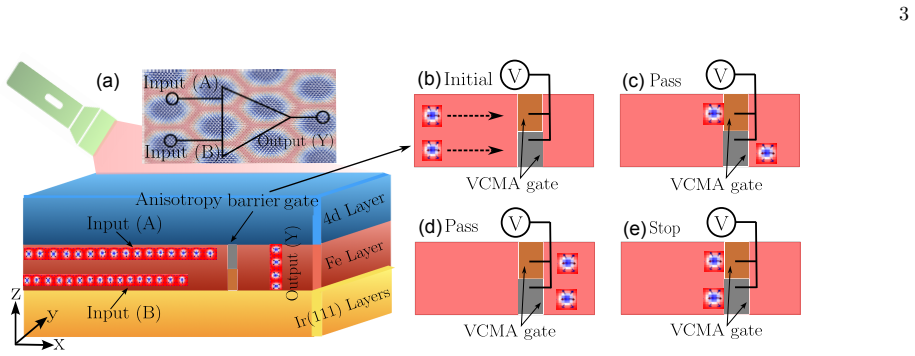
The load-bearing machinery is the Thiele-equation description of skyrmion motion combined with voltage-controlled anisotropy barriers. The skyrmion's topological charge Q = (1/4π)∫ m·(∂_x m × ∂_y m) dxdy enters the Magnus force; together with the dissipative tensor D and damping α it fixes the skyrmion Hall angle through θ_SkH^SL = tan^{-1}(G/(αD)) for Slonczewski torque and θ_SkH^ZL = tan^{-1}(D G(α−β)/(G^2 + D^2 αβ)) for Zhang-Li torque. In the simulations, an anisotropy barrier with uniaxial anisotropy K_u^(2) tunable by VCMA acts as a filter whose pass/stop behavior depends on the ratio K_u^(2)/K_u^(1) and the barrier width; this filtering is what the proposed OR and AND gates are built
What would settle it
Run the reported OR and AND sequences with the barrier anisotropy values frozen and only skyrmion occupancy varied among the four input cases; if the output does not follow the truth table, the logic-gate claim fails. Separately, measuring the deflection angle of a skyrmion in PdFe/Ir(111) under a known Zhang-Li current would directly test the 3.26° value.
Extended reading notes
Core claim
On the paper's own terms, the central discovery is that one material platform—PdFe/Ir(111)—can host stable skyrmions, move them predictably under nanosecond current pulses, and filter them with engineered anisotropy barriers, yielding Boolean logic. The Hall-angle calculation from the Thiele equation gives θ_SkH^SL = 89.53° for Slonczewski torque, which explains the observed accumulation of skyrmions at the structure's edge; for Zhang-Li torque it gives θ_SkH^ZL = 3.26°, which explains why skyrmions travel almost straight along the current direction. In the logic-gate simulations, two vertical chains of skyrmions act as inputs, and barriers whose anisotropy constants are set to 2.0 or 2.5 ti
Load-bearing premise
The load-bearing premise is that a bit can be encoded as the presence or absence of a skyrmion while the gate's barrier configuration stays fixed; the paper's demonstrations instead reprogram the barriers for each input pattern.
Editorial extensions
If this is right
- If the 3.26° Zhang-Li Hall angle is representative, skyrmion racetracks and gate channels can be made without severe transverse drift, so narrow tracks will not lose bits at edges.
- VCMA barriers can replace high current densities for trajectory control: voltage sets the barrier strength while the current only supplies forward motion.
- The edge-accumulation behavior under Slonczewski torque gives a way to collect and pattern skyrmions into shapes, demonstrated here for 'T', 'π', 'L', 'C', and '7' configurations.
- The same nucleation and dynamics protocol should extend to other 4d Fe/Ir(111) multilayers such as Rh and Ru, whose behavior is reported to resemble PdFe/Ir(111).
Reading between the lines
- A stricter test of the logic claim would fix all barrier anisotropies and positions and vary only which skyrmion chains are populated; the simulations as reported reprogram the gate for each input row, so they demonstrate controller-selected outputs rather than a fixed gate.
- The barrier transmission map could be used to design richer gates, e.g., NAND or XOR, by chaining barriers, provided the fixed-gate encoding is resolved.
- Direct measurement of the Zhang-Li Hall angle in a PdFe/Ir(111) film would be a clean experimental check; a value much larger than 3.26° would change track-width requirements for logic channels.
- The small Hall angle and gate operation rely on specific parameters (β = 0.2, damping 0.023, and the stated anisotropy values); a parameter sweep would show how sensitive the logic channel is to variations in these quantities.
Editorial analysis
A structured set of objections, weighed in public.
Referee Report
Summary. The paper reports micromagnetic simulations (Mumax3) of skyrmion nucleation, current-driven dynamics, and proposed logic functionality in a 200×200×1 nm^3 PdFe/Ir(111) multilayer. The main claims are: (i) controlled skyrmion edge accumulation and shape engineering ('π', 'T', 'L', 'C', '7') under Slonczewski-type and Zhang-Li-type spin torques; (ii) quantitative skyrmion Hall angles, θ_SkH^SL = 89.53° and θ_SkH^ZL = 3.26°, obtained from Thiele equations; and (iii) voltage-controlled magnetic anisotropy (VCMA) barriers that implement OR and AND logic gates, with skyrmions representing binary states. The logic gates are realized by placing two vertical skyrmion chains and three anisotropy barriers whose anisotropy constants K_u^(2), K_u^(3), K_u^(4) and positions are changed for each truth-table row.
Significance. If the logic-gate demonstration were valid, it would be an interesting step toward reconfigurable, low-power skyrmion logic. The nucleation and edge-accumulation parts of the paper are consistent with standard skyrmion physics, and the explicit Mumax3 parameters and pulse protocols give those sections a concrete, reproducible core. However, the central advertised claim—OR/AND computation with skyrmions as bits—is not supported. The truth tables are generated by reprogramming the barrier anisotropies and barrier positions for each input combination, rather than by a fixed gate acting on skyrmion-encoded inputs. This is a load-bearing circularity, and the other content (shape engineering, Racetrack-like ordering) does not compensate for it.
major comments (3)
- [Section IV.E, Figs. 8-9] The central logic-gate claim is not supported. Each row of the OR and AND truth tables is produced by changing the gate itself: K_u^(2) and K_u^(3) are set to either 2.0K_u^(1) or 2.5K_u^(1), and the third barrier K_u^(4) is placed at (50,-50) or (-50,-50) as needed. For example, OR 0+0 uses 2.5K for both barriers; OR 0+1 and 1+0 reduce one barrier to 2.0K; OR 1+1 sets both to 2.0K and adds a blocking barrier. The same is true for AND. Thus the output is forced by the operator's choice of barrier configuration, and the skyrmion dynamics only display that choice. A Boolean gate must have a fixed physical structure and compute the output from its inputs; this implementation is a programmable switch, not a logic gate.
- [Section IV.E, first paragraph; Figs. 8(a), 9(a)-(c)] The stated binary encoding—'0' as absence and '1' as presence of a skyrmion—is internally inconsistent with the simulations. In Fig. 8(a), the 0+0=0 row is shown with both input chains populated and blocked by barriers set to 2.5K_u^(1). In Fig. 9(a)-(c), all AND low-output rows start with skyrmions present and rely on their annihilation at barriers. The inputs are therefore effectively the barrier settings, not the presence or absence of skyrmions. This contradicts the abstract's claim that the barriers implement logic 'with skyrmions representing binary states.'
- [Section IV.E, Figs. 8(d) and 9(d)] The high-output rows for OR and AND are identical: K_u^(2)=K_u^(3)=2.0K_u^(1), with a third barrier blocking one of the two chains. A genuine OR gate and a genuine AND gate should differ by their fixed structure and by how they respond to the four input combinations. Here the assigned gate type is determined only by the accompanying discussion of which inputs are 'supposed' to be low, further confirming that the operation is not computed by a fixed circuit.
minor comments (5)
- [Section IV.E] The manuscript refers twice to 'Table ??' (truth-table summary and crossing-time data), but no tables are present in the submitted text. These tables are needed to evaluate the speed and reproducibility claims.
- [Eq. (8), Section IV.E] With α=0.023 and β=0.2, the numerator D G (α−β) in Eq. (8) is negative, so the reported θ_SkH^ZL = 3.26° should be stated as an absolute value or with a sign convention. The text does not address this.
- [Caption of Fig. 14] The OR-gate snapshot (d) is labeled '1 + 0 = 0', which is inconsistent with OR logic; this is presumably a typo.
- [Section II] The DMI parameter is written as 'D_int = 3.64×10^{-3} A/m^2'; the correct unit for DMI is J/m^2. Please correct.
- [Section IV.E] The claim of average skyrmion velocity ≈60.24 m/s is not substantiated; provide the simulation data or the method used to extract this value.
Circularity Check
OR/AND 'gates' hold by construction: each truth-table row is programmed by changing barrier anisotropies and moving an extra barrier, so outputs are forced by the gate settings rather than computed from fixed skyrmion inputs.
-
self definitional
[Section IV.E, Figs. 8-9 (logic gate execution)]
"Binary information is encoded by the presence (‘1’) or absence (‘0’) of a skyrmion. ... In Fig.8(a), both anisotropy constants,K(2)u andK(3)u, are set to 2.5K(1)u, preventing skyrmion transmission from either input, thereby realizing 0 + 0 = 0. In Fig.8(b),K(3)u is reduced to 2.0K(1)u, allowing skyrmions from inputBto pass while blocking those fromA, corresponding to 0 + 1 = 1."
For a real logic gate, the anisotropy constants and barrier positions are part of the fixed gate structure, not part of the input data. Here, each row of the OR/AND truth table is obtained by reprogramming K_u^(2), K_u^(3), and by adding or moving the downstream K_u^(4) barrier (at (50,−50) or (−50,−50) nm). Thus the output is directly determined by the operator's choice of barrier settings, and the skyrmion dynamics merely display that preset choice. The Boolean relation is satisfied by construction rather than computed by a fixed device, so the claimed logic-gate functionality reduces to the simulation parameters chosen for each entry.
full rationale
The paper's central claim — that VCMA anisotropy barriers implement OR and AND gates with skyrmions as bits — is circular in the sense that the gate is reconfigured for every input combination. The quoted text shows that the barrier anisotropies K_u^(2) and K_u^(3) are switched between 2.0K_u^(1) and 2.5K_u^(1), and an extra barrier is placed on either side, precisely to force the desired output for each row. If the skyrmions are the true inputs, the gate structure is not fixed, so no Boolean computation occurs; if the barrier settings are the true inputs, the output is trivially determined by those settings. Either reading makes the truth table an artifact of the simulation setup. The Hall angles θ_SkH^SL and θ_SkH^ZL are evaluations of standard Thiele-equation formulas with the simulation parameters, so they are not circular in themselves. The self-citation to the authors' previous work [46] for skyrmion-nucleation field ranges is also not load-bearing for the logic claim. The central logic demonstration, however, is forced by construction, warranting a high circularity score.
Assumptions & free parameters
free parameters (6)
- Barrier anisotropy ratio K_u^(2)/K_u^(1) and K_u^(3)/K_u^(1) =
2.0 (pass) and 2.5 (block)
- Third-barrier placement and strength =
at (50,-50) or (-50,-50) nm, K_u^(4) = 2.5 K_u^(1)
- Zhang-Li non-adiabatic factor beta =
0.2
- Slonczewski/SOT parameters =
P = 0.5, Lambda = 1.0, epsilon' = 0, alpha_H = 0.5
- Shape-engineering pulse protocols =
e.g., 6e11 A/m2 for 5.5 ns in +z, 4.5e11 A/m2 for 2.5 ns, 6e11 A/m2 for 1.5 ns in +y, etc.
- Gate barrier geometry =
length 100 nm, width 6 nm, positioned at (+/-50, -30) nm; third barrier at (+/-50, -50) nm
assumptions (6)
- standard math LLG micromagnetics as implemented in Mumax3 (Eq. 1) faithfully models the skyrmion dynamics
- domain assumption Thiele rigid-particle approximation (Eqs. 3-15) with topological charge G and dissipative tensor D gives the skyrmion velocity and Hall angle
- domain assumption PdFe/Ir(111) material parameters (Ms = 6.3e5 A/m, alpha = 0.023, Aex = 2.269e-12 J/m, Dint = 3.64e-3 J/m2, Ku1 = 1.4e6 J/m3)
- domain assumption The system starts from a spin-spiral ground state whose preparation protocol is not given
- domain assumption Zero-temperature dynamics is sufficient for the claimed device functionality ('No thermal fluctuations are taken into account')
- domain assumption VCMA can modulate the anisotropy by the assumed amount (K_u^(VCMA) in (1.4-4.2)e6 J/m3 at 2 T, (0-2.8)e6 J/m3 at 3 T)
Cite this review
Pith. "Pith review of Skyrmion manipulation and logic gate functionality in transition metal multilayers." pith.science (2026). https://pith.science/paper/I2RSSZWN
@misc{pith2026250905951,
  author       = {Pith},
  title        = {Pith review of: Skyrmion manipulation and logic gate functionality in transition metal multilayers},
  year         = {2026},
  howpublished = {\url{https://pith.science/paper/I2RSSZWN}},
  note         = {Machine review of arXiv:2509.05951}
}
abstract
Magnetic skyrmions, due to their topological stability and high mobility, are strong candidates for information carriers in spintronic devices. To advance their practical applications, a detailed understanding of their nucleation and current-driven dynamics is essential. We investigate the formation and manipulation of skyrmions in a square nano structure (200 $\times$ 200 nm$^{2}$, 1 nm thick) of PdFe/Ir(111) multilayers subjected to nano second current pulses with magnitude ranging from (1-5)$\times$10$^{11}$ A/m$^2$. Using micromagnetic simulations, we demonstrate controlled motion of skyrmion under different types of spin-transfer torque (STT). The calculated skyrmion Hall angle (SkH) for Slonczewski type STT is ${\theta_{SkH}^{SL}} = 89.53^{\circ}$ for PdFe/Ir(111) multilayers which ensures the edge accululation of skyrmion like a track within the nano structure and we extend this idea further for different shape engineering of skyrmion in 4d tranisition metal multilayers by manipulating the magnitude and direction of current pulses. Next, we investigate the influence of voltage-controlled magnetic anisotropy ranging from (1.4 - 4.2) $\times$ 10$^6$ J/m$^3$ with external magnetic field B$_{ext}$ = 2 T, and (0 - 2.8) $\times$ 10$^6$ J/m$^3$ with B$_{ext}$ = 3 T respectively, on skyrmion dynamics for designing anisotropy-engineered barriers to guide their trajectories in PdFe/Ir(111) multilayers. We use further these barriers to implement basic logic operations, including OR and AND gates, with skyrmions representing binary states. The calculatd skyrmion Hall angle for Zhang-Li type STT in PdFe/Ir(111) multilayers is ${\theta_{SkH}^{ZL}} = 3.26^{\circ}$. Consequently, the skyrmions propagate predominantly along the direction of the applied current with minimal deflection, a feature that renders them highly suitable for logic operations.
Figures


Figures from the paper (12 more)


Reference graph
Works this paper leans on
-
[46]
Direct observation of the skyrmion hall effect,
Wanjun Jiang, Xichao Zhang, Guoqiang Yu, Wei Zhang, Xiao Wang, M Benjamin Jungfleisch, John E Pearson, Xuemei Cheng, Olle Heinonen, Kang L Wang,et al., “Direct observation of the skyrmion hall effect,” Nature Physics13, 162–169 (2017)
work page 2017
-
[1]
Gate-controlled skyrmion and domain wall chirality,
Charles-Elie Fillion, Johanna Fischer, Raj Kumar, Aymen Fassatoui, Stefania Pizzini, Laurent Ranno, Djoudi Ourdani, Mohamed Belmeguenai, Yves Rous- sign´ e, Salim-Mourad Ch´ erif,et al., “Gate-controlled skyrmion and domain wall chirality,” Nature Commu- nications13, 5257 (2022)
work page 2022
-
[2]
Magnetic skyrmion: from fundamental physics to pioneering applications,
Kishan K Mishra, Aijaz H Lone, Srikant Srinivasan, Hos- sein Fariborzi, and Gianluca Setti, “Magnetic skyrmion: from fundamental physics to pioneering applications,” Applied Physics Reviews12(2025). 12 FIG. 12: Manipulating the skyrmions in the square nano-structure to form (A)‘T’Shape: (a) current pulse along +z –direction; (i) - (iv) intermediate states...
work page 2025
-
[3]
Voltage-controlled skyrmion manipulation chambers for neuromorphic computing,
Zulfidin Khodzhaev and Jean Anne C. Incorvia, “Voltage-controlled skyrmion manipulation chambers for neuromorphic computing,” Current Opinion in Solid State and Materials Science35, 101220 (2025)
work page 2025
-
[4]
Davi Rodrigues, Alejandro Riveros, Andrea Meo, Emily Darwin, Vito Puliafito, Anna Giordano, Mario Car- pentieri, Riccardo Tomasello, and Giovanni Finocchio, “Skyrmions in nanotechnology: Fundamental proper- ties, experimental advances, and emerging applications,” arXiv preprint arXiv:2503.06159 (2025)
work page Pith review arXiv 2025
-
[5]
Takaaki Dohi, Robert M Reeve, and Mathias Kl¨ aui, “Thin film skyrmionics,” Annual Review of Condensed Matter Physics13, 73–95 (2022)
work page 2022
-
[6]
Engineering skyrmion from spin spiral in transition metal multilayers,
Banasree Sadhukhan, “Engineering skyrmion from spin spiral in transition metal multilayers,” Journal of Physics: Condensed Matter37, 095801 (2024)
work page 2024
-
[7]
Sateesh Kandukuri, V Satya Narayana Murthy, and PK Thiruvikraman, “Isolated skyrmion, skyrmion lattice and antiskyrmion lattice creation through magnetization reversal in co/pd nanostructure,” Scientific Reports11, 18945 (2021)
work page 2021
Show all 49 references
-
[8]
Role of magnetic anisotropy constant orders and thermal noise on skyrmion formation in the co/pt square nanostruc- ture,
Tamali Mukherjee and V Satya Narayana Murthy, “Role of magnetic anisotropy constant orders and thermal noise on skyrmion formation in the co/pt square nanostruc- ture,” Pramana99, 21 (2025)
2025
-
[9]
Tailoring optical excitation to control magnetic skyrmion nucleation,
L-M Kern, Bastian Pfau, Michael Schneider, Kathinka Gerlinger, Victor Deinhart, Steffen Wittrock, Themis- toklis Sidiropoulos, Dieter Engel, Ingo Will, Christian M G¨ unther,et al., “Tailoring optical excitation to control magnetic skyrmion nucleation,” Physical Review B106, 0...
2022
-
[10]
Application concepts for ultrafast laser- induced skyrmion creation and annihilation,
Kathinka Gerlinger, Bastian Pfau, Felix B¨ uttner, Michael Schneider, Lisa-Marie Kern, Josefin Fuchs, Di- eter Engel, Christian M G¨ unther, Mantao Huang, Ivan Lemesh,et al., “Application concepts for ultrafast laser- induced skyrmion creation and annihilation,” Applied Physic...
2021
-
[11]
Spin-lattice cou- plings and effect of displacements on magnetic interac- tions of a skyrmion system PdFe/Ir(111),
Banasree Sadhukhan, Anders Bergman, Johan Hellsvik, Patrik Thunstr¨ om, and Anna Delin, “Spin-lattice cou- plings and effect of displacements on magnetic interac- tions of a skyrmion system PdFe/Ir(111),” SciPost Phys. 18, 064 (2025)
2025
-
[12]
In the new era of technology, skyrmionic devices offer miniaturized, energy-efficient, non-volatile data storage as a better alternative to the conventional electronic approach
Since then, thin films with strong interfacial Dzyaloshinskii–Moriya interaction (iDMI) capable of sta- bilizing high-density, nano scale skyrmions have been extensively investigated.[13–15]. In the new era of technology, skyrmionic devices offer miniaturized, energy-efficient...
2025 arXiv
-
[13]
Skyrmions on the track,
Albert Fert, Vincent Cros, and Joao Sampaio, “Skyrmions on the track,” Nature nanotechnology8, 152–156 (2013). 13 FIG. 13: Manipulating the skyrmions in the circular nano-structure to form (A)‘C’Shape: (a) current pulse along +z –direction; (i) - (iii) intermediate states duri...
2013
-
[14]
Spontaneous atomic-scale magnetic skyrmion lattice in two dimen- sions,
Stefan Heinze, Kirsten Von Bergmann, Matthias Menzel, Jens Brede, Andr´ e Kubetzka, Roland Wiesendanger, Gustav Bihlmayer, and Stefan Bl¨ ugel, “Spontaneous atomic-scale magnetic skyrmion lattice in two dimen- sions,” nature physics7, 713–718 (2011)
2011
-
[15]
Skyrmion-electronics: An overview and outlook,
Wang Kang, Yangqi Huang, Xichao Zhang, Yan Zhou, and Weisheng Zhao, “Skyrmion-electronics: An overview and outlook,” Proceedings of the IEEE104, 2040–2061 (2016)
-
[16]
The 2020 skyrmionics roadmap,
Christian Back, Vincent Cros, Hubert Ebert, Karin Everschor-Sitte, Albert Fert, Markus Garst, Tian- ping Ma, Sergiy Mankovsky, TL Monchesky, Maxim Mostovoy,et al., “The 2020 skyrmionics roadmap,” Journal of Physics D: Applied Physics53, 363001 (2020)
2020
-
[17]
Skyrmion racetrack memory with random information update/deletion/insertion,
Daoqian Zhu, Wang Kang, Sai Li, Yangqi Huang, Xichao Zhang, Yan Zhou, and Weisheng Zhao, “Skyrmion racetrack memory with random information update/deletion/insertion,” IEEE Transactions on Elec- tron Devices65, 87–95 (2017)
2017
-
[18]
A strategy for the design of skyrmion racetrack memories,
Riccardo Tomasello, E Martinez, Roberto Zivieri, Luis Torres, Mario Carpentieri, and Giovanni Finocchio, “A strategy for the design of skyrmion racetrack memories,” Scientific reports4, 1–7 (2014)
2014
-
[19]
Programmable skyrmion logic gates based on skyrmion tunneling,
Naveen Sisodia, Johan Pelloux-Prayer, Liliana D Buda- Prejbeanu, Lorena Anghel, Gilles Gaudin, and Olivier Boulle, “Programmable skyrmion logic gates based on skyrmion tunneling,” Physical Review Applied17, 064035 (2022)
2022
-
[20]
(b) At t = 2ns, 16 isolated skyrmions are nucleated
nm2 rectangular track from (a) spin-spiral ground state. (b) At t = 2ns, 16 isolated skyrmions are nucleated. A current density pulse of 1×10 12 A/m2 is applied in +x - direction for 4.5 ns. (c) and (d) are snapshots taken when the current pulse is on. In absence of any curren...
2024
-
[21]
Mag- netic skyrmion logic gates: conversion, duplication and merging of skyrmions,
Xichao Zhang, Motohiko Ezawa, and Yan Zhou, “Mag- netic skyrmion logic gates: conversion, duplication and merging of skyrmions,” Scientific reports5, 1–8 (2015)
2015
-
[22]
Current-induced skyrmion dynamics in con- stricted geometries,
Junichi Iwasaki, Masahito Mochizuki, and Naoto Na- gaosa, “Current-induced skyrmion dynamics in con- stricted geometries,” Nature nanotechnology8, 742–747 (2013)
2013
-
[23]
Universal current-velocity relation of skyrmion motion in chiral magnets,
Junichi Iwasaki, Masahito Mochizuki, and Naoto Na- gaosa, “Universal current-velocity relation of skyrmion motion in chiral magnets,” Nature communications4, 1463 (2013)
2013
-
[24]
Fundamental the- ory of current-induced motion of magnetic skyrmions,
Yuto Ohki and Masahito Mochizuki, “Fundamental the- ory of current-induced motion of magnetic skyrmions,” Journal of Physics: Condensed Matter37, 023003 (2024)
2024
-
[25]
Current-driven motion of magnetic domain wall skyrmions,
Haoyang Nie, Zhixiong Li, Xiansi Wang, and Zhenyu Wang, “Current-driven motion of magnetic domain wall skyrmions,” Applied Physics Letters126(2025)
2025
-
[26]
Spin- orbit torque-driven skyrmion dynamics revealed by time- resolved x-ray microscopy,
Seonghoon Woo, Kyung Mee Song, Hee-Sung Han, Min- Seung Jung, Mi-Young Im, Ki-Suk Lee, Kun Soo Song, Peter Fischer, Jung-Il Hong, Jun Woo Choi,et al., “Spin- orbit torque-driven skyrmion dynamics revealed by time- resolved x-ray microscopy,” Nature communications8, 15573 (2017)
2017
-
[27]
Current-induced spin–orbit torques for spin- tronic applications,
Jeongchun Ryu, Soogil Lee, Kyung-Jin Lee, and Byong- Guk Park, “Current-induced spin–orbit torques for spin- tronic applications,” Advanced Materials32, 1907148 (2020)
2020
-
[28]
Roadmap of spin–orbit torques,
Qiming Shao, Peng Li, Luqiao Liu, Hyunsoo Yang, Shunsuke Fukami, Armin Razavi, Hao Wu, Kang Wang, Frank Freimuth, Yuriy Mokrousov,et al., “Roadmap of spin–orbit torques,” IEEE transactions on magnetics57, 1–39 (2021)
2021
-
[29]
Spin transfer torques,
Daniel C Ralph and Mark D Stiles, “Spin transfer torques,” Journal of Magnetism and Magnetic Materials 320, 1190–1216 (2008)
2008
-
[30]
Skyrmion dynamics in chiral ferromagnets under spin-transfer torque,
Stavros Komineas and Nikos Papanicolaou, “Skyrmion dynamics in chiral ferromagnets under spin-transfer torque,” Physical Review B92, 174405 (2015)
2015
-
[31]
Spin-transfer torque driven motion, deformation, and instabilities of magnetic skyrmions at high currents,
Jan Masell, Davi R Rodrigues, Ben F McKeever, and Karin Everschor-Sitte, “Spin-transfer torque driven motion, deformation, and instabilities of magnetic skyrmions at high currents,” Physical Review B101, 214428 (2020)
2020
-
[32]
A comparative cross-layer study on racetrack memories: Domain wall vs skyrmion,
Wang Kang, Bi Wu, Xing Chen, Daoqian Zhu, Zhaohao Wang, Xichao Zhang, Yan Zhou, Youguang Zhang, and Weisheng Zhao, “A comparative cross-layer study on racetrack memories: Domain wall vs skyrmion,” ACM Journal on Emerging Technologies in Computing Systems (JETC)16, 1–17 (2019)
2019
-
[33]
Magnetic skyrmion-based artificial neuron device,
Sai Li, Wang Kang, Yangqi Huang, Xichao Zhang, Yan Zhou, and Weisheng Zhao, “Magnetic skyrmion-based artificial neuron device,” Nanotechnology28, 31LT01 (2017)
2017
-
[34]
Magnetic skyrmions for unconventional computing,
Sai Li, Wang Kang, Xichao Zhang, Tianxiao Nie, Yan Zhou, Kang L Wang, and Weisheng Zhao, “Magnetic skyrmions for unconventional computing,” Materials Horizons8, 854–868 (2021)
2021
-
[35]
Pattern recognition with neuromorphic computing using magnetic field–induced dynamics of skyrmions,
Tomoyuki Yokouchi, Satoshi Sugimoto, Bivas Rana, Shinichiro Seki, Naoki Ogawa, Yuki Shiomi, Shinya Kasai, and Yoshichika Otani, “Pattern recognition with neuromorphic computing using magnetic field–induced dynamics of skyrmions,” Science Advances8, eabq5652 (2022)
2022
-
[36]
Reconfigurable skyrmion logic gates,
Shijiang Luo, Min Song, Xin Li, Yue Zhang, Jeongmin Hong, Xiaofei Yang, Xuecheng Zou, Nuo Xu, and Long You, “Reconfigurable skyrmion logic gates,” Nano letters 18, 1180–1184 (2018)
2018
-
[37]
Skyrmion devices for memory and logic applications,
Shijiang Luo and Long You, “Skyrmion devices for memory and logic applications,” APL Materials9(2021). 15
2021
-
[38]
Skyrmion based uni- versal logic gates and computation operation,
Satwik Wats and Susmita Saha, “Skyrmion based uni- versal logic gates and computation operation,” Journal of Physics D: Applied Physics57, 245001 (2024)
2024
-
[39]
Skyrmion based majority logic gate by voltage controlled magnetic anisotropy in a nanomagnetic device,
Bibekananda Paikaray, Mahathi Kuchibhotla, Arabinda Haldar, and Chandrasekhar Murapaka, “Skyrmion based majority logic gate by voltage controlled magnetic anisotropy in a nanomagnetic device,” Nanotechnology 34, 225202 (2023)
2023
-
[40]
Skyrmion motion driven by the gradient of voltage-controlled mag- netic anisotropy,
Haiyan Xia, Chengkun Song, Chendong Jin, Jinshuai Wang, Jianbo Wang, and Qingfang Liu, “Skyrmion motion driven by the gradient of voltage-controlled mag- netic anisotropy,” Journal of Magnetism and Magnetic Materials458, 57–61 (2018)
2018
-
[41]
The design and verification of mu- max3,
Arne Vansteenkiste, Jonathan Leliaert, Mykola Dvornik, Mathias Helsen, Felipe Garcia-Sanchez, and Bartel Van Waeyenberge, “The design and verification of mu- max3,” AIP advances4(2014)
2014
-
[42]
Tomorrow’s micromagnetic simulations,
Jonathan Leliaert and Jeroen Mulkers, “Tomorrow’s micromagnetic simulations,” Journal of Applied Physics 125(2019)
2019
-
[43]
Deflection of ferromagnetic and antiferromagnetic skyrmions at heterochiral inter- faces,
Ra ´ ı M Menezes, Jeroen Mulkers, Cl´ ecio C de Souza Silva, and Milorad V Miloˇ sevi´ c, “Deflection of ferromagnetic and antiferromagnetic skyrmions at heterochiral inter- faces,” Physical Review B99, 104409 (2019)
2019
-
[44]
Mag- netic bilayer-skyrmions without skyrmion hall effect,
Xichao Zhang, Yan Zhou, and Motohiko Ezawa, “Mag- netic bilayer-skyrmions without skyrmion hall effect,” Nature communications7, 10293 (2016)
2016
-
[45]
Tutorial: Simulating modern mag- netic material systems in mumax3,
Jonas J Joos, Pedram Bassirian, Pieter Gypens, Jeroen Mulkers, Kai Litzius, Bartel Van Waeyenberge, and Jonathan Leliaert, “Tutorial: Simulating modern mag- netic material systems in mumax3,” Journal of Applied Physics134(2023)
2023
-
[47]
Writing and deleting single magnetic skyrmions,
Niklas Romming, Christian Hanneken, Matthias Menzel, Jessica E Bickel, Boris Wolter, Kirsten von Bergmann, Andr´ e Kubetzka, and Roland Wiesendanger, “Writing and deleting single magnetic skyrmions,” Science341, 636–639 (2013)
2013
-
[48]
Interplay between interfacial dzyaloshinskii moriya interaction and magnetic anisotropy in 4d transition metal multilayers for skyrmion nucleation,
Tamali Mukherjee, Banasree Sadhukhan, and V Satya Narayana Murthy, “Interplay between interfacial dzyaloshinskii moriya interaction and magnetic anisotropy in 4d transition metal multilayers for skyrmion nucleation,” Journal of Magnetism and Magnetic Materials , 173036 (2025)
2025
-
[49]
Formation of magnetic skyrmions with tunable properties in pdfe bilayer deposited on ir (111),
E Simon, K Palot´ as, L R´ ozsa, L Udvardi, and L Szun- yogh, “Formation of magnetic skyrmions with tunable properties in pdfe bilayer deposited on ir (111),” Physical Review B90, 094410 (2014)
2014
Reviewed August 5, 2026 · model on record in the stance chip above.
Discussion (0). Sign in to comment.