REVIEW 3 major objections 3 minor 38 references
Critical habitat size of organisms diffusing with stochastic resetting
T0 review · 3 major / 3 minor · reviewed 2026-08-15 · deepseek-v4-flash
Pith's one-line read Stochastic resetting can shrink or enlarge the minimum habitat a population needs to survive, and the paper gives a closed formula that says which.
desk verdict Worth a major revision, not a desk reject: the closed-form results for resetting inside the patch are real, but a missing factor of r in Eq. (18) invalidates the partial-relocation phase diagrams, and the validity domain of Eq. (7) is not tracked. read the letter →
The pith
A machine-rendered reading of the paper's core claim, the machinery that carries it, and where it could break.
The reading
What carries the argument
The engine of the derivation is the backward master equation for the total population, $\partial_t N(x_0)=\partial_{x_0}^2 N(x_0)+(1-r)N(x_0)+rN(x_r)$, where $x_0$ is the initial position. Setting the dominant long-time growth rate $s_M$ to zero turns this into a stationary boundary-value problem whose self-consistency at $x_r$ produces Eq. (7); the same pole condition appears through Laplace inversion of the full time-dependent solution. For finite outside hostility, the equivalent machinery is a piecewise exponential and sinusoidal stationary solution together with continuity, flux, and delta-jump conditions, whose determinant condition yields the closed formulas and transcendental equations.
What would settle it
Take parameters where the predicted critical patch cannot contain the reset site, for instance $x_r=1.0$ and $r$ large enough that Eq. (7) gives $\ell_c<1$; simulate the agent-based process there and compare survival to the outside-reset prediction. Agreement with Eq. (7) would validate its unstated domain of validity; either outcome settles whether the phase diagrams hold beyond $|x_r|<\ell_c$.
Extended reading notes
Core claim
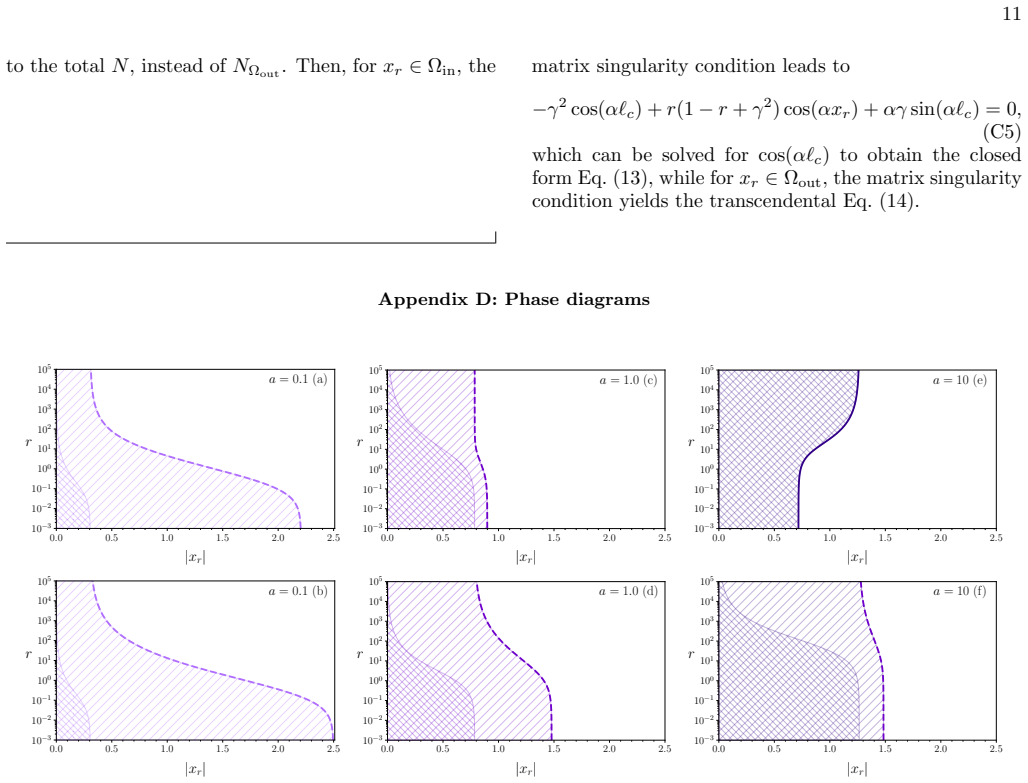
For a perfectly hostile exterior, the paper's main claim is that the critical patch half-width is $\ell_c(r,x_r)=\arccos(r\cos(x_r/\sqrt{1-r}))/\sqrt{1-r}$, recovering $\pi/2$ when $r=0$ and $\sqrt{2+x_r^2}$ at $r=1$. The slope at $r=0$ is $\pi/4-\cos x_r$, which yields three regimes: resetting helps at any rate when $|x_r|<\arccos(\pi/4)\approx0.667$; it helps only above a threshold rate when $0.667<|x_r|<\pi/2$; and it never helps when the reset site lies beyond $\pi/2$. The paper extends this to finite outside mortality $a$, giving closed-form critical sizes when resets return organisms to the patch and transcendental equations when the reset site lies outside, for both total and outside-only relocation. Agent-based simulations reproduce the predicted population growth, stationary profiles, and critical sizes.
Load-bearing premise
The derivation assumes the reset location $x_r$ lies inside the viable patch, so every reset returns an organism to the habitat; if the formula predicts a patch too small to contain $x_r$, the reset source term disappears and Eq. (7) no longer applies.
Editorial extensions
If this is right
- When organisms reset to the patch center, the critical habitat size decreases monotonically with reset rate, so frequent homing can let a population persist in fragments far smaller than the reset-free threshold.
- For reset sites between $x_r^*\approx0.667$ and $\pi/2$, weak resetting is harmful and only rates above a threshold $r^*$ reduce the required habitat, so a little homing can be worse than none.
- With a perfectly hostile exterior and a reset site outside the patch, resetting cannot reduce the critical size; it only drains population unless $r<1$, in which case survival needs a larger patch.
- In weakly hostile environments, resetting to a point just outside the patch can lower the critical size at a finite optimal rate, so the value of a refuge depends on the mortality contrast across the boundary.
- The critical size does not depend on the initial spatial distribution, because the evolution equation is linear and arbitrary initial conditions are superpositions of point sources.
Reading between the lines
- Editor's inference: the three-regime picture should carry over to two-dimensional patches, with the reset point replaced by a central refuge and the threshold condition set by the patch radius; the same eigenvalue argument applies to the radial Laplacian.
- Editor's inference: under logistic growth, the linearized critical condition near extinction is unchanged, so the formulas should still mark the extinction boundary even with carrying capacity, a testable prediction.
- Editor's inference: a distribution of reset positions would smooth the sharp regime boundaries but should preserve the central qualitative result that near-center refuges shrink habitat requirements while far refuges enlarge them.
Signed reviews
Editorial analysis
A structured set of objections, weighed in public.
Referee Report
Summary. The paper studies the critical patch size for a one-dimensional population that grows inside a finite habitat, dies in the exterior, and is subject to stochastic resetting to a fixed position x_r. The authors derive analytical expressions for the critical half-width \ell_c for two exterior scenarios (totally hostile and finitely hostile) and for two reset protocols (total relocation from anywhere, and partial relocation from the exterior only). They report three qualitative regimes in the (x_r, r) plane: resetting reduces the critical size for any rate, reduces it only above a threshold rate, or never reduces it. Agent-based simulations are used to validate the transient dynamics, stationary profiles, and in some cases the critical sizes. The paper claims that resetting can either increase or decrease the required habitat size depending on the reset position, the reset rate, and the external mortality rate.
Significance. If correct, the paper provides a useful and parameter-free extension of the classical critical-patch-size problem to a class of movement behavior (stochastic resetting) that is relevant for homing, refuge-seeking, and central-place foraging. The analytical derivations are explicit, and the agent-based simulations serve as a consistency check of the same stochastic rules used in the derivation. However, two load-bearing issues prevent the results from being relied upon in their current form: the outside-patch partial-relocation equation does not reduce to the reset-free limit, and the displayed Eq. (7) is inconsistent with its own derivation and with the limits quoted immediately after it. Because these errors affect parts of the phase diagrams and the corresponding figures, the manuscript requires substantial correction before its central quantitative claims can be accepted.
major comments (3)
- [Section IV B, Eq. (18)] Eq. (18) fails the r -> 0 limit, which is the central consistency test for the partial-relocation model. Setting r = 0 in Eq. (18) with gamma = sqrt(a) gives e^{sqrt(a) x_r} a (sqrt(a) cos ell_c - sin ell_c) = e^{sqrt(a) ell_c} sin ell_c. This is not solved by the reset-free critical condition tan ell_c = sqrt(a); for a = 1, x_r = 2, ell_c = pi/4 the left side vanishes while the right side does not. The derivation in Appendix C must therefore contain an algebraic error in the determinant for x_r in Omega_out; the term e^{gamma ell_c} sin ell_c should carry an additional factor of r (or, equivalently, the displayed equation is missing a reset-rate factor). Consequently the dashed curves for x_r outside the patch in Figs. 7(b,c), the outside-patch boundaries in Fig. 8, and the corresponding lower-row panels of Fig. 9 are based on an incorrect equation and need to be recomputed from the correctly derived transcendental condition.
- [Section III A, Eq. (7)] The formula displayed as Eq. (7), with x_r / sqrt(1-r) inside the cosine, is inconsistent with the derivation in Appendix B. The stationary solution in Appendix B yields cos(ell_c sqrt(1-r)) = r cos(x_r sqrt(1-r)), so the argument of the cosine should be x_r sqrt(1-r), not x_r / sqrt(1-r). With the printed form, the claimed resonant limit ell_c(1, x_r) = sqrt(2 + x_r^2) does not follow, because the argument of the cosine oscillates as r -> 1, and the claimed asymptotic value ell_c(infinity, x_r) = |x_r| is not obtained either (the printed expression tends to 0 for fixed x_r). The authors should correct Eq. (7) and re-examine every subsequent limit and figure that relies on it, including the curves in Fig. 3(a).
- [Section III A, domain of validity] Even after correcting the algebraic form of Eq. (7), the solution is only valid when the reset position lies inside the patch, |x_r| < ell_c(r, x_r). The paper acknowledges this condition and introduces Eq. (9) for the outside-patch case, but Fig. 3(a) plots solid curves from Eq. (7) over parameter ranges where the resulting ell_c is smaller than |x_r| (for example, the |x_r| = 1.9 and 2.5 curves at small r). The text and figures should make explicit whether Eq. (7), Eq. (9), or no survival (for r >= 1 with x_r outside) applies in each part of the parameter plane; as printed, the solid branches in those ranges are not physical critical sizes.
minor comments (3)
- [Section IV B, Eqs. (16)] The delta-source term r N_Omega_out delta(x - x_r) is displayed in both the interior and exterior equations, but it should appear only in the equation for the region that contains x_r. This typo should be corrected because it affects the readability of the subsequent derivation.
- [Fig. 3(a)] The single dashed curve labeled Eq. (9) is easily misread as applying globally; actually the switch from Eq. (7) to Eq. (9) occurs at an r value that depends on x_r. Marking the crossover point on each solid curve would remove the ambiguity.
- [Section IV B, paragraph after Eq. (17)] The statement that in the limit a -> infinity ell_c becomes independent of r is correct for Eq. (17) with x_r inside the patch, but it should be stated with that restriction, since the dashed outside-patch branches in the same figure are the ones affected by the Eq. (18) error.
Circularity Check
No significant circularity: the critical-size formulas are derived from the model equations without fitted parameters, and the self-citations are not load-bearing.
full rationale
The analysis is self-contained. The model is specified by Eqs. (1)-(3), with standard stochastic-resetting terms; the authors then solve the backward equation (5) and its stationary form (B1) to obtain the dominant-rate condition s_M = 0. The critical-size formulas, including Eq. (7), follow algebraically from that eigenvalue condition. The self-consistency condition N(xr) = ... is the model's fixed-point structure (resets deposit individuals at xr), not an input disguised as an output. No parameter is fitted to data or to simulations. The r -> 0 and a -> infinity limits recover known reset-free results, which are external consistency checks. The agent-based simulations implement exactly Eqs. (1)-(2), so they are numerical consistency checks rather than independent empirical tests; this does not make the analytic derivation circular. Self-citations (e.g., Refs. [12], [17], [18], [29], [30]) are contextual, analogical, or relate to prior heterogeneity work; none supplies a load-bearing uniqueness theorem or ansatz. Possible correctness concerns about the domain of validity of Eq. (7) or the r -> 0 limit of Eq. (18) are mathematical-consistency issues, not circular reductions.
Assumptions & free parameters
assumptions (4)
- domain assumption Near the critical condition, population density is low enough that carrying capacity can be neglected, making the reaction-diffusion equation linear.
- domain assumption Resets occur as a Poisson process with rate r and a fixed position xr.
- domain assumption In the totally hostile exterior, aout → ∞ is modeled by absorbing boundary conditions at x = ±ℓ.
- ad hoc to paper The reset position xr lies inside the habitat when Eq. (7) is used, so the delta-source term rNδ(x−xr) appears in the interior equation and N(xr) is nonzero.
Cite this review
Pith. "Pith review of Critical habitat size of organisms diffusing with stochastic resetting." pith.science (2026). https://pith.science/paper/I34V64BM
@misc{pith2026250503727,
  author       = {Pith},
  title        = {Pith review of: Critical habitat size of organisms diffusing with stochastic resetting},
  year         = {2026},
  howpublished = {\url{https://pith.science/paper/I34V64BM}},
  note         = {Machine review of arXiv:2505.03727}
}
read the original abstract
The persistence of populations depends on the minimum habitat area required for survival, known as the critical patch size. While most studies assume purely diffusive movement, additional movement components can significantly alter habitat requirements. Here, we investigate how critical patch sizes are affected by stochastic resetting, where each organism intermittently returns to a common fixed location, modeling behaviors such as homing, refuge-seeking, or movement toward essential resources. We analytically derive the total population growth over time and the critical patch size. Our results are validated by agent-based simulations, showing excellent agreement. Our findings demonstrate that stochastic resetting can either increase or decrease the critical patch size, depending on the reset rate, reset position, and external environmental hostility. These results highlight how intermittent relocation shapes ecological thresholds and may provide insights for ecological modeling and conservation planning, particularly in fragmented landscapes such as in deforested regions.
Figures


Figures from the paper (5 more)


Reference graph
Works this paper leans on
-
[1]
if Ω contains Ω (or not). In addition, we rescaled the variables and parameters as follows: ta in → t, x p ain/D→ x, aout/ain→ a (ain→ 1), and r/ain→ r. Note that in Eq. (3), the term with the Dirac delta van- ishes in one of the equations since xr belongs to one of the two regions only. In the equation for x∈ Ωin, the first term represents diffusion, the...
-
[2]
C.A. also acknowledges the partial financial sup- port (311435/ 2020-3) of Conselho Nacional de De- senvolvimento Cient´ ıfico e Tecnol´ ogico (CNPq), Brazil, and (CNE E-26/204.130/2024) Funda¸ c˜ ao de Amparo ` a Pesquisa do Estado do Rio de Janeiro (FAPERJ), Brazil. P.d.C. was supported by Scholarships No. 2021/10139- 2 and No. 2022/13872-5 and ICTP-SAI...
work page 2020
-
[3]
R. H. MacArthur and E. O. Wilson, The theory of island biogeography, Vol. 1 (Princeton university press, 2001)
work page 2001
-
[4]
Tilman, Competition and biodiversity in spatially structured habitats, Ecology 75, 2 (1994)
D. Tilman, Competition and biodiversity in spatially structured habitats, Ecology 75, 2 (1994)
work page 1994
-
[5]
Hanski, Metapopulation ecology (Oxford University Press, 1999)
I. Hanski, Metapopulation ecology (Oxford University Press, 1999)
1999
-
[6]
L. Fahrig, Effects of habitat fragmentation on biodiver- sity, Annual review of ecology, evolution, and systematics 34, 487 (2003)
work page 2003
-
[7]
A. B. Franklin, B. R. Noon, and T. L. George, What is habitat fragmentation?, Studies in avian biology 25, 20 (2002)
work page 2002
-
[8]
S. L. Pimm and C. N. Jenkins, Connecting habitats to prevent species extinctions, American Scientist 107, 162 (2019)
work page 2019
Show all 38 references
-
[9]
Ibagon, A
I. Ibagon, A. Furlan, and R. Dickman, Reducing species extinction by connecting fragmented habitats: Insights from the contact process, Physica A: Statistical Mechan- ics and its Applications 603, 127614 (2022)
2022
-
[10]
Cantrell and C
R. Cantrell and C. Cosner, Diffusion models for pop- ulation dynamics incorporating individual behavior at boundaries: applications to refuge design, Theoretical population biology 55, 189 (1999)
1999
-
[11]
Cantrell and C
R. Cantrell and C. Cosner, Spatial heterogeneity and crit- ical patch size: area effects via diffusion in closed environ- ments, Journal of Theoretical Biology 209, 161 (2001)
2001
-
[12]
Kierstead and L
H. Kierstead and L. Slobodkin, The size of water masses containing plankton blooms, Journal of Marine Research (1953)
1953
-
[13]
Colombo and C
E. Colombo and C. Anteneodo, Nonlinear population dy- namics in a bounded habitat, Journal of Theoretical Bi- ology 446, 11 (2018)
2018
-
[14]
M. A. F. dos Santos, V. Dornelas, E. H. Colombo, and C. Anteneodo, Critical patch size reduction by heteroge- neous diffusion, Phys. Rev. E 102, 042139 (2020). 9
2020
-
[15]
A. L. Lin, B. A. Mann, G. Torres-Oviedo, B. Lincoln, J. K¨ as, and H. L. Swinney, Localization and extinction of bacterial populations under inhomogeneous growth con- ditions, Biophysical Journal 87, 75 (2004)
2004
-
[16]
M´ endez, I
V. M´ endez, I. Llopis, D. Campos, and W. Horsthemke, Extinction conditions for isolated populations affected by environmental stochasticity, Theoretical Population Biol- ogy 77, 250 (2010)
2010
-
[17]
Berti, M
S. Berti, M. Cencini, D. Vergni, and A. Vulpiani, Extinc- tion dynamics of a discrete population in an oasis, Phys. Rev. E 92, 012722 (2015)
2015
-
[18]
Ballard, V
M. Ballard, V. M. Kenkre, and M. N. Kuperman, Peri- odically varying externally imposed environmental effects on population dynamics, Phys. Rev. E70, 031912 (2004)
2004
-
[19]
E. H. Colombo and C. Anteneodo, Population dynam- ics in an intermittent refuge, Phys. Rev. E 94, 042413 (2016)
2016
-
[20]
Dornelas, P
V. Dornelas, P. de Castro, J. M. Calabrese, W. F. Fagan, and R. Martinez-Garcia, Movement bias in asymmetric landscapes and its impact on population distribution and critical habitat size, Proceedings of the Royal Society A 480, 10.1098/rspa.2024.0185 (2024)
2024
-
[21]
Neicu, A
T. Neicu, A. Pradhan, D. A. Larochelle, and A. Kudrolli, Extinction transition in bacterial colonies under forced convection, Phys. Rev. E 62, 1059 (2000)
2000
-
[22]
Mercado-V´ asquez and D
G. Mercado-V´ asquez and D. Boyer, Lotka–volterra sys- tems with stochastic resetting, Journal of Physics A: Mathematical and Theoretical 51, 405601 (2018)
2018
-
[23]
M. R. Evans and S. N. Majumdar, Diffusion with stochas- tic resetting, Phys. Rev. Lett. 106, 160601 (2011)
2011
-
[24]
M. R. Evans, S. N. Majumdar, and G. Schehr, Stochastic resetting and applications, Journal of Physics A: Mathe- matical and Theoretical 53, 193001 (2020)
2020
-
[25]
W. J. Bell, Central place foraging, in Searching Be- haviour: The behavioural ecology of finding resources (Springer Netherlands, Dordrecht, 1990) pp. 171–187
1990
-
[26]
Van Moorter, C
B. Van Moorter, C. M. Rolandsen, M. Basille, and J.-M. Gaillard, Movement is the glue connecting home ranges and habitat selection, Journal of Animal Ecology 85, 21 (2016)
2016
-
[27]
M. R. Evans and S. N. Majumdar, Diffusion with opti- mal resetting, Journal of Physics A: Mathematical and Theoretical 44, 435001 (2011)
2011
-
[28]
C. W. Gardiner et al. , Handbook of stochastic methods , Vol. 3 (springer Berlin, 1985)
1985
-
[29]
Obtained numerically by de Hoog method [34]
-
[30]
Skellam, Random dispersal in theoretical populations, Bulletin of Mathematical Biology 53, 135 (1991)
J. Skellam, Random dispersal in theoretical populations, Bulletin of Mathematical Biology 53, 135 (1991)
1991
-
[31]
Menon and C
L. Menon and C. Anteneodo, Random search with reset- ting in heterogeneous environments, Phys. Rev. E 110, 054111 (2024)
2024
-
[32]
Piva and C
G. Piva and C. Anteneodo, Influence of density- dependent diffusion on pattern formation in a refuge, Physica A: Statistical Mechanics and its Applications 658, 130305 (2025)
2025
-
[33]
A. S. Bodrova and I. M. Sokolov, Resetting processes with noninstantaneous return, Physical Review E 101, 052130 (2020)
2020
-
[34]
Mercado-V´ asquez, D
G. Mercado-V´ asquez, D. Boyer, S. N. Majumdar, and G. Schehr, Intermittent resetting potentials, Journal of Statistical Mechanics: Theory and Experiment 2020, 113203 (2020)
2020
-
[35]
Gupta, A
D. Gupta, A. Pal, and A. Kundu, Resetting with stochas- tic return through linear confining potential, Journal of Statistical Mechanics: Theory and Experiment 2021, 043202 (2021)
2021
-
[36]
F. R. De Hoog, J. H. Knight, and A. Stokes, An im- proved method for numerical inversion of laplace trans- forms, SIAM Journal on scientific and Statistical Com- puting 3, 357 (1982)
1982
-
[37]
Butkov, Mathematical physics (Addison-Wesley Publ., Reading, Mass, 1973)
E. Butkov, Mathematical physics (Addison-Wesley Publ., Reading, Mass, 1973)
1973
-
[38]
Ludwig, D
D. Ludwig, D. Aronson, and H. Weinberger, Spatial pat- terning of the spruce budworm, Journal of Mathematical Biology 8, 217 (1979). Appendix A: Solving Eq. (5) We proceed to solve Eq. (5) by Laplace transforming in time, which yields ∂2 x0N(x0,s ) + (1−r−s)N(x0,s ) +rN(xr,s )...
1979
Reviewed August 15, 2026 · model on record in the stance chip above.
Discussion (0). Continue with ORCID to comment.