REVIEW 5 major objections 6 minor 39 references
Region-Aware CAM: High-Resolution Weakly-Supervised Defect Segmentation via Salient Region Perception
T0 review · 5 major / 6 minor · reviewed 2026-08-06 · deepseek-v4-flash
Pith's one-line read The paper claims that filtering out low-magnitude gradients during backpropagation produces higher-resolution class activation maps for defects, and that training a segmentation network on the resulting pseudo-labels approaches fully…
desk verdict A modest CAM variant plus pseudo-label training; the idea is plausible and the plug-in ablation is the best part, but the headline gains rest on single runs with no variance and a threshold tuned on the benchmarks. read the letter →
The pith
A machine-rendered reading of the paper's core claim, the machinery that carries it, and where it could break.
The reading
What carries the argument
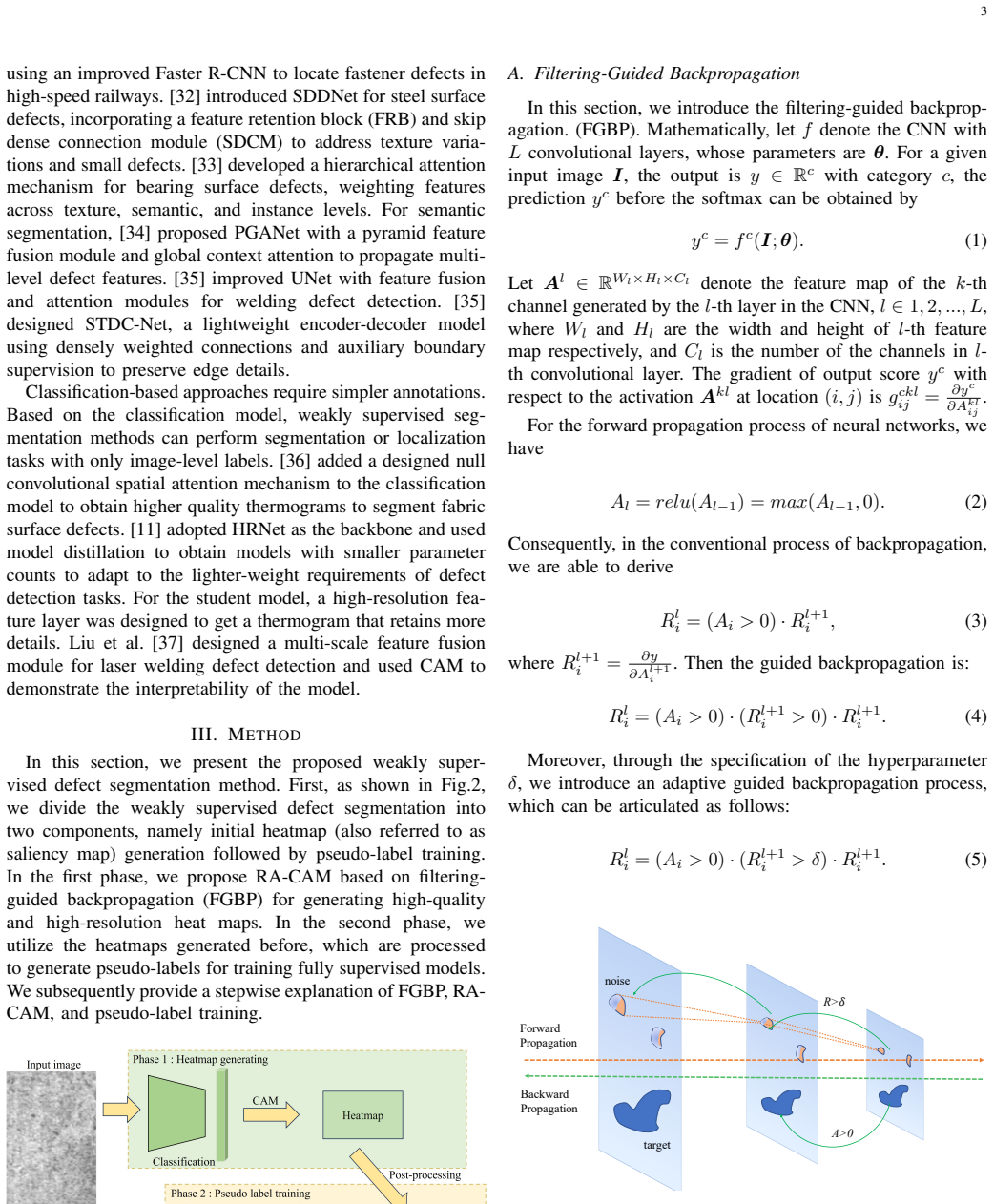
The central mechanism is filtering-guided backpropagation (FGBP), which replaces the standard ReLU gate in the backward pass with an adaptive magnitude filter: gradients are multiplied by an indicator $R^{l+1}_i > \delta$, where $\delta$ is the $\delta$-th percentile of positive gradient values in each feature map. RA-CAM then applies this filtered gradient to weight the feature maps $A^l_k$ and sums across channels as $M^c_{RA-CAM} = \mathrm{ReLU}(\sum_k R^c_{kl} \cdot A^l_k)$. The load-bearing idea is that high-gradient locations correspond to defect regions, so thresholding at a percentile like 50% progressively strips background while retaining the target.
What would settle it
Measure, on a defect dataset with pixel-level ground truth, how often low-gradient pixels inside ground-truth defect masks are truncated by the 50th-percentile cutoff and how often high-gradient background-texture pixels survive it; if the two distributions overlap heavily for some layers or defect categories, the FGBP filter will remove genuine defect regions or retain background, and RA-CAM's IoU gain over LayerCAM or FullGrad should disappear or reverse.
Extended reading notes
Core claim
The central claim is that gradient magnitude itself carries reliable spatial information about defect location, and that truncating small gradients during backpropagation removes background noise while preserving defect detail. Building on this, RA-CAM weights feature maps with the filtered gradients and aggregates them across layers to produce high-resolution heatmaps. The paper further claims that converting these heatmaps into pseudo-labels and training a standard segmentation network yields substantial gains, approaching fully supervised performance on both KSDD and KSDD2. The proposed FGBP also works as a plug-in, improving both FullGrad and LayerCAM on both datasets.
Load-bearing premise
The method presumes that gradient magnitude is monotonically related to defect relevance—higher gradients mean higher probability of being part of the defect—and that a single percentile threshold $\delta$ can separate defect from background in every feature map and every defect type.
Editorial extensions
If this is right
- RA-CAM exceeds the previous best weakly supervised CAM method on KSDD by 7.24 IoU points and on KSDD2 by 3.53 points over LayerCAM, indicating that gradient-magnitude filtering extracts target semantics more cleanly than existing weighting schemes.
- Pseudo-label training lifts defect IoU to 37.86% on KSDD and 57.56% on KSDD2, reaching 88.6% of DeepLabV3+'s mIoU on KSDD, so image-level labels plus pseudo-labels can substitute for most dense annotation.
- FGBP is a drop-in replacement for gradient backpropagation in other methods: adding it to FullGrad raises KSDD IoU from 13.19% to 16.73%, and to LayerCAM from 16.25% to 18.65%.
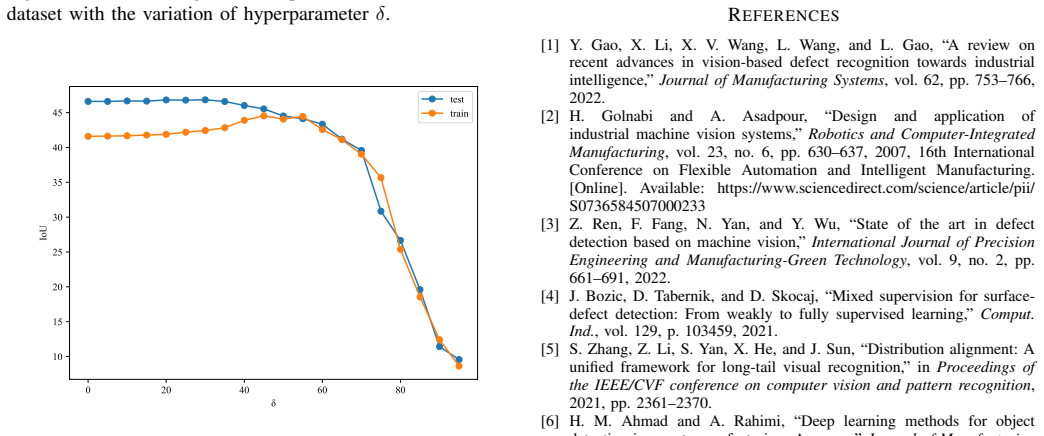
- The optimal $\delta$ is around the 50th percentile on both datasets; training-set IoU curves track test-set curves, so the threshold can be chosen without validation annotations.
Reading between the lines
- Because FGBP operates purely on gradients, it should transfer to other gradient-based explainability methods beyond the two tested, such as Grad-CAM++ or XGrad-CAM, and to other backbones such as ResNet or HRNet—an untested extension implied by the plug-in claim.
- The method's success on commutator and similar structured surfaces may not carry to defects on highly textured or stochastic backgrounds, where high-frequency texture could masquerade as high-gradient signal; a stress test on a texture-rich dataset would clarify the boundary of the claim.
- If gradient magnitude is indeed a reliable defect prior, the same filter could be applied inside fully supervised segmentation losses as a hard attention mask, potentially improving boundary precision where the paper observes fully supervised models under-segment.
- The paper's comparison with full supervision suggests the biggest remaining gap is boundary fidelity, so combining RA-CAM pseudo-labels with boundary-aware post-processing could push weakly supervised IoU closer to the fully supervised numbers.
Editorial analysis
A structured set of objections, weighed in public.
Referee Report
Summary. The manuscript proposes a weakly supervised defect segmentation framework consisting of two stages: generating high-resolution class activation maps via a region-aware CAM (RA-CAM) built on filtering-guided backpropagation (FGBP), and then using these maps as pseudo-labels to train a segmentation network. The method is evaluated on KSDD and KSDD2, reporting IoU improvements over existing CAM methods and pseudo-label segmentation performances that approach fully supervised baselines. The authors also demonstrate FGBP as a plug-in module for LayerCAM and FullGrad.
Significance. If the reported gains are robust, the method would be a practically useful contribution to industrial defect inspection with image-level labels only. The paper's main strengths are the simplicity of the proposed filtering idea, the plug-and-play demonstration with two existing CAM methods (Table IV), and the explicit analysis of the δ sensitivity on both training and test splits (Figs. 8–9). The pseudo-label training results (Table III) suggest that the generated heatmaps are informative enough to train a segmentation model to near-full-supervision performance on KSDD2. However, the empirical claims currently rest on single-run evaluations, a benchmark-tuned hyperparameter, and under-specified baselines, which limits the strength of the conclusions.
major comments (5)
- [Section IV.C, Tables I and II] The headline gains (7.24% IoU over Ablation-CAM on KSDD and 3.53% over LayerCAM on KSDD2) are single-run point estimates. The KSDD defect set contains only 52 images, and the classification model is trained with stochastic SGD and random horizontal/vertical flips, so the reported differences may be within run-to-run variation. Please report mean and standard deviation (or at least multiple seeds) for all compared methods, and confirm that the ranking holds under resampling.
- [Section III.B, Eq. (6)] The definition of RA-CAM is not reproducible as written. The left-hand side R^c_l_CAM appears on both sides, the arguments (x, I(∂y^c/∂A^l ≥ δ) ⊗ ∂y^c/∂A^l) are undefined (what is x? what is ⊗?), and the connection between R^c_l_CAM in Eq. (6) and R^c_kl in Eq. (7) is unclear. Please rewrite Eq. (6) to specify exactly how the indicator-filtered gradients are used to weight the feature maps in Eq. (7).
- [Section IV.E.1, Figs. 8 and 9] The hyperparameter δ is selected based on the IoU-versus-δ curves on the training sets of the same two datasets, and the default δ=50% is then used for the reported test results. This makes part of the reported superiority dependent on benchmark-specific tuning. Please report test performance for a range of δ values (e.g., 30% to 70%) to show the sensitivity of the claimed gains, and ideally validate δ on a third dataset or via cross-validation.
- [Section IV.D, Table III] The fully supervised baselines (UNet, DeepLabV3, DeepLabV3+) are not described or cited; the reader cannot tell what training protocol, backbone, data split, or loss function produced the numbers. Since the claim of '88.6% of DeepLabV3+'s mIoU' depends entirely on these baseline numbers, please specify their training setup or provide a reference with the exact protocol.
- [Section III.A and Fig. 3] The central premise that 'the higher the value of the gradient, the higher the likelihood that the defect will be localized' is asserted but never tested. Because FGBP discards all gradient entries below the δ-th percentile, this assumption could remove genuine low-gradient defect boundaries. Please provide a per-layer analysis (e.g., correlation between gradient magnitudes and ground-truth defect masks) to support the mechanism, or at least report how the segmentation changes when the filtering is replaced by random filtering of the same fraction of gradients.
minor comments (6)
- [Section I, Contributions] 'Develope' should be 'develop'; also use 'filtering-guided backpropagation' consistently instead of 'filtering-guide backpropagation'.
- [Fig. 3 caption] The caption 'The workflow of weakly-supervised defect segmentation' duplicates the caption of Fig. 2; it should describe the FGBP computational workflow.
- [Table III] The table is missing a caption line; add a caption such as 'Comparison of fully supervised models and pseudo-label training'.
- [Section IV.E.2, Table IV] It is unclear whether FGBP is applied to all layers or only the last layer when used as a plug-in; specify the layer range and the chosen δ for each method.
- [Section IV.D, text and Table III] The text states that IoU scores reach 37.86% and 57.56%, but Table III reports both Defect IoU and mIoU; clarify which metric is being referenced in the prose.
- [Section II.B, reference [35]] The sentence '[35] designed STDC-Net' appears to misattribute the STDC-Net work; reference [35] is a welding defect segmentation paper, so please check the citation or rephrase.
Circularity Check
No significant circularity: RA-CAM's filtering step is an architectural modification, and the default threshold is selected from training-set trends rather than from the reported test labels.
full rationale
The paper's derivation chain is self-contained: RA-CAM is built from Eqs. (5)-(7) by thresholding backpropagated gradients with a percentile filter and combining the result with feature maps; this does not use segmentation labels or any quantity derived from the final test IoU. The only potentially circular-looking element is the choice of the threshold δ. The paper states: "allowing us to select an appropriate threshold based on the training set" and "RA-CAM performs better around the δ value of 50%, so this value can be taken as the default threshold." This is ordinary hyperparameter selection on training/validation information, not a fitted parameter that is then renamed as a prediction. The reported KSDD and KSDD2 IoU values are evaluated on held-out test sets, so the numerical claims are not forced by construction. The paper contains no load-bearing self-citations, no imported uniqueness theorem, and no equation-level identity between an input and a claimed output. The observation that train and test IoU curves are consistent is a possible robustness concern, but it does not constitute circularity because the stated selection rule is training-based. Therefore no circular step is present.
Assumptions & free parameters
free parameters (1)
- δ (gradient threshold percentile) =
50th percentile of positive gradients (default)
assumptions (3)
- standard math Backpropagation through ReLU layers follows Rl_i = (Ai>0)*Rl+1_i
- domain assumption Larger gradient magnitude implies higher probability of belonging to the defect region
- ad hoc to paper The threshold δ can be tuned on the training set and generalize to test data
Cite this review
Pith. "Pith review of Region-Aware CAM: High-Resolution Weakly-Supervised Defect Segmentation via Salient Region Perception." pith.science (2026). https://pith.science/paper/I3B57NJ6
@misc{pith2026250622866,
  author       = {Pith},
  title        = {Pith review of: Region-Aware CAM: High-Resolution Weakly-Supervised Defect Segmentation via Salient Region Perception},
  year         = {2026},
  howpublished = {\url{https://pith.science/paper/I3B57NJ6}},
  note         = {Machine review of arXiv:2506.22866}
}
read the original abstract
Surface defect detection plays a critical role in industrial quality inspection. Recent advances in artificial intelligence have significantly enhanced the automation level of detection processes. However, conventional semantic segmentation and object detection models heavily rely on large-scale annotated datasets, which conflicts with the practical requirements of defect detection tasks. This paper proposes a novel weakly supervised semantic segmentation framework comprising two key components: a region-aware class activation map (CAM) and pseudo-label training. To address the limitations of existing CAM methods, especially low-resolution thermal maps, and insufficient detail preservation, we introduce filtering-guided backpropagation (FGBP), which refines target regions by filtering gradient magnitudes to identify areas with higher relevance to defects. Building upon this, we further develop a region-aware weighted module to enhance spatial precision. Finally, pseudo-label segmentation is implemented to refine the model's performance iteratively. Comprehensive experiments on industrial defect datasets demonstrate the superiority of our method. The proposed framework effectively bridges the gap between weakly supervised learning and high-precision defect segmentation, offering a practical solution for resource-constrained industrial scenarios.
Figures


Figures from the paper (4 more)


Reference graph
Works this paper leans on
-
[1]
A review on recent advances in vision-based defect recognition towards industrial intelligence,
Y . Gao, X. Li, X. V . Wang, L. Wang, and L. Gao, “A review on recent advances in vision-based defect recognition towards industrial intelligence,” Journal of Manufacturing Systems , vol. 62, pp. 753–766, 2022
work page 2022
-
[2]
Design and application of industrial machine vision systems,
H. Golnabi and A. Asadpour, “Design and application of industrial machine vision systems,” Robotics and Computer-Integrated Manufacturing, vol. 23, no. 6, pp. 630–637, 2007, 16th International Conference on Flexible Automation and Intelligent Manufacturing. [Online]. Available: https://www.sciencedirect.com/science/article/pii/ S0736584507000233
work page 2007
-
[3]
State of the art in defect detection based on machine vision,
Z. Ren, F. Fang, N. Yan, and Y . Wu, “State of the art in defect detection based on machine vision,” International Journal of Precision Engineering and Manufacturing-Green Technology , vol. 9, no. 2, pp. 661–691, 2022
work page 2022
-
[4]
Mixed supervision for surface- defect detection: From weakly to fully supervised learning,
J. Bozic, D. Tabernik, and D. Skocaj, “Mixed supervision for surface- defect detection: From weakly to fully supervised learning,” Comput. Ind., vol. 129, p. 103459, 2021
work page 2021
-
[5]
Distribution alignment: A unified framework for long-tail visual recognition,
S. Zhang, Z. Li, S. Yan, X. He, and J. Sun, “Distribution alignment: A unified framework for long-tail visual recognition,” in Proceedings of the IEEE/CVF conference on computer vision and pattern recognition , 2021, pp. 2361–2370
work page 2021
-
[6]
Deep learning methods for object detection in smart manufacturing: A survey,
H. M. Ahmad and A. Rahimi, “Deep learning methods for object detection in smart manufacturing: A survey,” Journal of Manufacturing Systems, vol. 64, pp. 181–196, 2022
work page 2022
-
[7]
Evolution of image segmentation using deep convolutional neural network: A survey,
F. Sultana, A. Sufian, and P. Dutta, “Evolution of image segmentation using deep convolutional neural network: A survey,” Knowledge-Based Systems, vol. 201, p. 106062, 2020
work page 2020
-
[8]
A survey of real-time surface defect inspection methods based on deep learning,
Y . Liu, C. Zhang, and X. Dong, “A survey of real-time surface defect inspection methods based on deep learning,” Artificial Intelligence Review, vol. 56, no. 10, pp. 12 131–12 170, 2023
work page 2023
Show all 39 references
-
[9]
Deep learning for unsupervised anomaly localization in industrial images: A survey,
X. Tao, X. Gong, X. Zhang, S. Yan, and C. Adak, “Deep learning for unsupervised anomaly localization in industrial images: A survey,” IEEE Transactions on Instrumentation and Measurement , vol. 71, pp. 1–21, 2022
2022
-
[10]
Learning deep features for discriminative localization,
B. Zhou, A. Khosla, `A. Lapedriza, A. Oliva, and A. Torralba, “Learning deep features for discriminative localization,” in 2016 IEEE Conference on Computer Vision and Pattern Recognition, CVPR 2016, Las Vegas, NV , USA, June 27-30, 2016, pp. 2921–2929
2016
-
[11]
Cadn: A weakly supervised learning-based category-aware object detection network for surface defect detection,
J. Zhang, H. Su, W. Zou, X. Gong, Z. Zhang, and F. Shen, “Cadn: A weakly supervised learning-based category-aware object detection network for surface defect detection,” Pattern Recognition , vol. 109, p. 107571, 2021. 8
2021
-
[12]
Grad-cam: Visual explanations from deep networks via gradient-based localization,
R. R. Selvaraju, M. Cogswell, A. Das, R. Vedantam, D. Parikh, and D. Batra, “Grad-cam: Visual explanations from deep networks via gradient-based localization,” in IEEE International Conference on Computer Vision, ICCV 2017, Venice, Italy, October 22-29 , 2017, pp. 618–626
2017
-
[13]
Layercam: Exploring hierarchical class activation maps for localization,
P. Jiang, C. Zhang, Q. Hou, M. Cheng, and Y . Wei, “Layercam: Exploring hierarchical class activation maps for localization,” IEEE Trans. Image Process., vol. 30, pp. 5875–5888, 2021
2021
-
[14]
On interpretability of artificial neural networks: A survey,
F.-L. Fan, J. Xiong, M. Li, and G. Wang, “On interpretability of artificial neural networks: A survey,”IEEE Transactions on Radiation and Plasma Medical Sciences, vol. 5, no. 6, pp. 741–760, 2021
2021
-
[15]
Grad-cam++: Generalized gradient-based visual explanations for deep convolutional networks,
A. Chattopadhay, A. Sarkar, P. Howlader, and V . N. Balasubramanian, “Grad-cam++: Generalized gradient-based visual explanations for deep convolutional networks,” in 2018 IEEE winter conference on applica- tions of computer vision (WACV) . IEEE, 2018, pp. 839–847
2018
-
[16]
Axiom-based grad- cam: Towards accurate visualization and explanation of cnns,
R. Fu, Q. Hu, X. Dong, Y . Guo, Y . Gao, and B. Li, “Axiom-based grad- cam: Towards accurate visualization and explanation of cnns,” in 31st British Machine Vision Conference 2020, BMVC 2020, Virtual Event, UK, September 7-10 , 2020
2020
-
[17]
Towards better explanations of class activation mapping,
H. Jung and Y . Oh, “Towards better explanations of class activation mapping,” in Proceedings of the IEEE/CVF International Conference on Computer Vision , 2021, pp. 1336–1344
2021
-
[18]
Relevance-cam: Your model already knows where to look,
J. R. Lee, S. Kim, I. Park, T. Eo, and D. Hwang, “Relevance-cam: Your model already knows where to look,” in Proceedings of the IEEE/CVF Conference on Computer Vision and Pattern Recognition , 2021, pp. 14 944–14 953
2021
-
[19]
On pixel-wise explanations for non-linear classifier deci- sions by layer-wise relevance propagation,
S. Bach, A. Binder, G. Montavon, F. Klauschen, K.-R. M ¨uller, and W. Samek, “On pixel-wise explanations for non-linear classifier deci- sions by layer-wise relevance propagation,” PloS one, vol. 10, no. 7, p. e0130140, 2015
2015
-
[20]
Score-cam: Score-weighted visual explanations for convo- lutional neural networks,
H. Wang, Z. Wang, M. Du, F. Yang, Z. Zhang, S. Ding, P. Mardziel, and X. Hu, “Score-cam: Score-weighted visual explanations for convo- lutional neural networks,” in 2020 IEEE/CVF Conference on Computer Vision and Pattern Recognition, CVPR Workshops 2020, Seattle, WA, USA, June...
2020
-
[21]
Ablation-cam: Visual explanations for deep convolutional network via gradient-free localization,
H. G. Ramaswamy et al., “Ablation-cam: Visual explanations for deep convolutional network via gradient-free localization,” in Proceedings of the IEEE/CVF Winter Conference on Applications of Computer Vision , 2020, pp. 983–991
2020
-
[22]
Group-cam: Group score-weighted visual explanations for deep convolutional networks,
Q. Zhang, L. Rao, and Y . Yang, “Group-cam: Group score-weighted visual explanations for deep convolutional networks,” arXiv preprint arXiv:2103.13859, 2021
2021 arXiv
-
[23]
Feature similarity group-class activation mapping (fsg-cam): Clarity in deep learning models and enhancement of visual explanations,
D. Wang, Y . Xia, W. Pedrycz, Z. Li, and Z. Yu, “Feature similarity group-class activation mapping (fsg-cam): Clarity in deep learning models and enhancement of visual explanations,” Expert Systems with Applications , p. 127553, 2025. [Online]. Available: https://www.sciencedi...
2025
-
[24]
Full-gradient representation for neural network visualization,
S. Srinivas and F. Fleuret, “Full-gradient representation for neural network visualization,” in Advances in Neural Information Processing Systems 32: Annual Conference on Neural Information Processing Systems 2019, NeurIPS 2019, December 8-14, 2019, Vancouver, BC, Canada, H. M...
2019
-
[25]
Non-target feature filtering for weakly supervised semantic segmentation,
X. Zhou, Y . Li, G. Cao, and W. Cao, “Non-target feature filtering for weakly supervised semantic segmentation,” Complex & Intelligent Systems, vol. 11, no. 1, pp. 1–15, 2025
2025
-
[26]
Sess: Saliency en- hancing with scaling and sliding,
O. Tursun, S. Denman, S. Sridharan, and C. Fookes, “Sess: Saliency en- hancing with scaling and sliding,” in European Conference on Computer Vision. Springer, 2022, pp. 318–333
2022
-
[27]
Yolov11: An overview of the key architectural enhancements,
R. Khanam and M. Hussain, “Yolov11: An overview of the key architectural enhancements,” arXiv preprint arXiv:2410.17725 , 2024
2024 arXiv
-
[28]
Faster r-cnn: Towards real-time object detection with region proposal networks,
S. Ren, K. He, R. Girshick, and J. Sun, “Faster r-cnn: Towards real-time object detection with region proposal networks,” IEEE transactions on pattern analysis and machine intelligence, vol. 39, no. 6, pp. 1137–1149, 2016
2016
-
[29]
U-net: Convolutional networks for biomedical image segmentation,
O. Ronneberger, P. Fischer, and T. Brox, “U-net: Convolutional networks for biomedical image segmentation,” in International Conference on Medical Image Computing and Computer-Assisted Intervention , 2015
2015
-
[30]
Encoder- decoder with atrous separable convolution for semantic image segmen- tation,
L. C. Chen, Y . Zhu, G. Papandreou, F. Schroff, and H. Adam, “Encoder- decoder with atrous separable convolution for semantic image segmen- tation,” in European Conference on Computer Vision , 2018
2018
-
[31]
A cnn-based defect inspection method for catenary split pins in high-speed railway,
J. Zhong, Z. Liu, Z. Han, Y . Han, and W. Zhang, “A cnn-based defect inspection method for catenary split pins in high-speed railway,” IEEE Transactions on Instrumentation and Measurement , vol. 68, no. 8, pp. 2849–2860, 2018
2018
-
[32]
Sddnet: A fast and accurate network for surface defect detection,
L. Cui, X. Jiang, M. Xu, W. Li, P. Lv, and B. Zhou, “Sddnet: A fast and accurate network for surface defect detection,” IEEE Transactions on Instrumentation and Measurement , vol. 70, pp. 1–13, 2021
2021
-
[33]
A hierarchical attention detector for bearing surface defect detection,
J. Ma, S. Hu, J. Fu, and G. Chen, “A hierarchical attention detector for bearing surface defect detection,” Expert Systems with Applications, vol. 239, p. 122365, 2024
2024
-
[34]
Pga-net: Pyramid feature fusion and global context attention network for automated surface defect detection,
H. Dong, K. Song, Y . He, J. Xu, Y . Yan, and Q. Meng, “Pga-net: Pyramid feature fusion and global context attention network for automated surface defect detection,” IEEE Transactions on Industrial Informatics , vol. 16, no. 12, pp. 7448–7458, 2019
2019
-
[35]
An automatic deep segmentation network for pixel-level welding defect detection,
L. Yang, S. Song, J. Fan, B. Huo, E. Li, and Y . Liu, “An automatic deep segmentation network for pixel-level welding defect detection,” IEEE Transactions on Instrumentation and Measurement , vol. 71, pp. 1–10, 2021
2021
-
[36]
Dlse-net: A robust weakly supervised network for fabric defect detection,
Z. Liu, Z. Huo, C. Li, Y . Dong, and B. Li, “Dlse-net: A robust weakly supervised network for fabric defect detection,” Displays, vol. 68, p. 102008, 2021. [Online]. Available: https: //www.sciencedirect.com/science/article/pii/S0141938221000226
2021
-
[37]
An explainable laser welding defect recognition method based on multi- scale class activation mapping,
T. Liu, H. Zheng, J. Bao, P. Zheng, J. Wang, C. Yang, and J. Gu, “An explainable laser welding defect recognition method based on multi- scale class activation mapping,” IEEE Transactions on Instrumentation and Measurement, vol. 71, pp. 1–12, 2022
2022
-
[38]
Grad-cam: visual explanations from deep networks via gradient-based localization,
R. R. Selvaraju, M. Cogswell, A. Das, R. Vedantam, D. Parikh, and D. Batra, “Grad-cam: visual explanations from deep networks via gradient-based localization,” International journal of computer vision , vol. 128, pp. 336–359, 2020
2020
-
[39]
Segmentation-based deep-learning approach for surface-defect detection,
D. Tabernik, S. Sela, J. Skvarc, and D. Skocaj, “Segmentation-based deep-learning approach for surface-defect detection,” Journal of Intelli- gent Manufacturing, vol. 31, no. 3, pp. 759–776, 2020
2020
Reviewed August 6, 2026 · model on record in the stance chip above.
Discussion (0). Continue with ORCID to comment.