REVIEW 3 major objections 5 minor 59 references
Building-MLLM turns indoor point clouds into natural-language recognition, captions, and engineering answers instead of just class labels.
Reviewed by Pith at T0; open to challenge. T0 means a machine referee read the full paper against a public rubric. the ladder, T0–T4 →
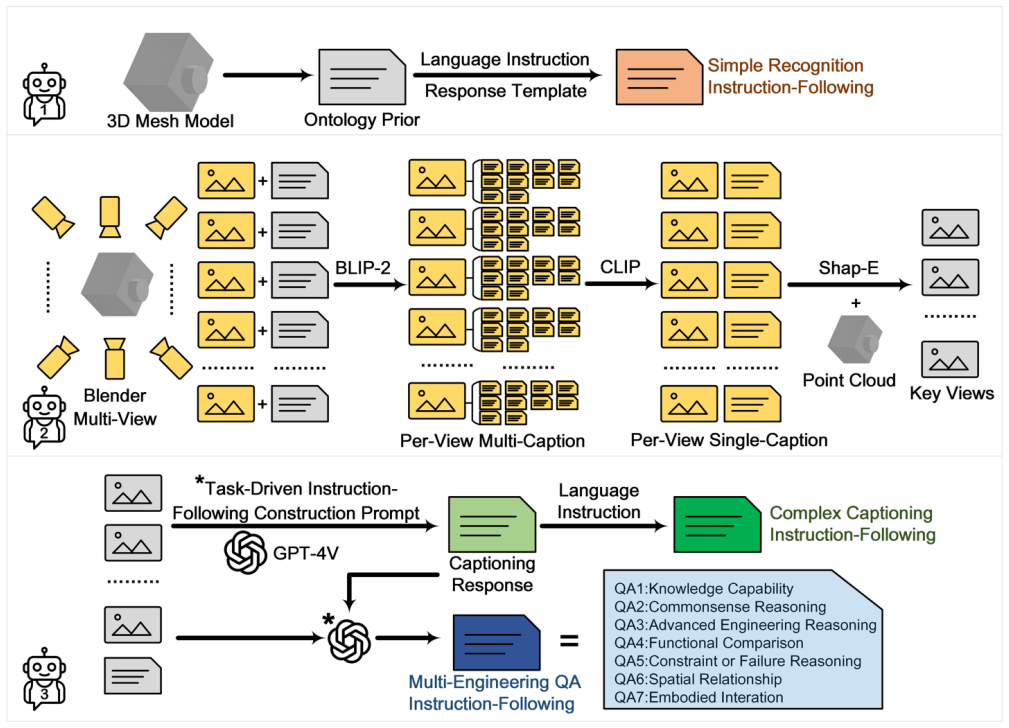
Building-MLLM, with PIE, GPR, fixed prefix and multi-dimensional LoRA plus a 37k-pair synthetic dataset, reaches 88/65/68 % on recognition, captioning and multi-engineering QA for 47 indoor component categories.
T0 review reviewed 2026-07-12 challenge →
load-bearing objection Solid domain adaptation of PointLLM for indoor components with a real new dataset and clean ablations; headline scores rest on GPT-family self-evaluation and a 30-sample real transfer, so treat them as synthetic-distribution gains rather than external engineering truth. the 3 major comments →
From Geometric Labels to Semantic Understanding of Indoor Building Components Using Multimodal Large Language Models
The pith
A machine-rendered reading of the paper's core claim, the machinery that carries it, and where it could break.
The reading
Core claim
A point-cloud-centered multimodal LLM specialized for indoor building components can generate coherent natural-language responses across simple recognition, complex captioning and multi-engineering question answering, provided it is trained on ontology-constrained synthetic instruction data and equipped with geometry-preserving alignment plus multi-dimensional LoRA; under GPT-4 evaluation the resulting Building-MLLM reaches 88.00 %, 65.10 % and 68.14 % on the three tasks and transfers with large gains to small real-world samples.
What carries the argument
The triple-constraint geometry-language alignment (Point Information Enhancer that recursively fuses local and spatial cues, Geometry-Preserving Regularization that reconstructs shallow-layer point features, plus a fixed domain prefix) together with multi-dimensional LoRA that jointly tunes layer range, target modules, rank and progressive scaling; these keep fine geometric distinctions alive while still allowing long-range engineering reasoning.
Load-bearing premise
The progressive synthetic engine that uses ontology templates, multi-view filtering and GPT-4V produces instruction text whose engineering semantics are faithful enough that GPT-4 evaluation of the same model family can serve as a reliable external measure of correctness.
What would settle it
A larger, independently annotated real-world point-cloud–text benchmark for indoor MEP and architectural components on which Building-MLLM’s GPT-4 scores fall back to or below the general PointLLM baseline, or human expert raters systematically disagree with the GPT-4 scores on engineering logic.
If this is right
- Facility O&M systems can move from discrete class labels to interactive natural-language queries about function, installation constraints and maintenance steps directly from component point clouds.
- The same progressive engine can be reused to generate instruction data for other concentrated engineering domains that currently lack multimodal corpora.
- Geometry-preserving regularizers of the kind introduced here become a standard tool when frozen point encoders must be adapted to fine-grained professional categories.
- Multi-dimensional LoRA schedules that trade short-range geometric grounding against long-range reasoning can be ported to other mixed point–text multimodal models.
- Component-level language understanding becomes a modular entry point for future scene-level digital-twin agents that reason over connectivity and global constraints.
Where Pith is reading between the lines
- If the synthetic-to-real gap can be closed with modest real annotation, the same architecture could serve as a lightweight semantic front-end for existing BIM-CMMS platforms without requiring full scene-level 3D LLMs.
- The large performance drop on severely incomplete or atypical real scans suggests that active sensing or multi-sensor fusion will be necessary before the method can be trusted in live construction or renovation sites.
- The seven engineering QA subtypes (especially constraint and embodied interaction) form a natural curriculum that could be used to stress-test other multimodal models claiming domain expertise.
- Because the authors already freeze most of the 7 B backbone, further distillation to smaller edge-deployable models looks feasible for on-site mobile capture devices.
Editorial analysis
A structured set of objections, weighed in public.
Referee Report
Summary. The paper proposes Building-MLLM, a point-cloud-centered multimodal LLM for indoor building components that unifies Simple Recognition, Complex Captioning, and Multi-Engineering QA. It introduces four domain mechanisms (Point Information Enhancer, Geometry-Preserving Regularization on shallow LLM layers, a fixed textual prefix, and multi-dimensional LoRA) to address semantic concentration and multi-task balance, together with a progressive multi-constraint instruction-generation engine that produces a synthetic dataset of 4,198 objects, 47 categories and 37,782 instruction pairs. On a held-out synthetic test set the model reports GPT-4 semantic scores of 88.00 %, 65.10 % and 68.14 % (outperforming a fine-tuned PointLLM baseline), with limited-sample transfer gains on 30 real-world point clouds from Pipework, ScanObjectNN and S3DIS.
Significance. If the reported gains hold under independent evaluation, the work supplies a concrete bridge from discrete geometric labels to language-grounded engineering understanding for facility O&M and digital twins—an underexplored niche relative to general 3D MLLMs. Strengths include a carefully ablated architecture (PIE +5.25 %, GPR +2.12 %, fixed prefix, systematic LoRA layer/module/rank/scaling tables), an open progressive data engine with ontology and cross-modal (BLIP-2/CLIP/Shap-E) filters, public code, and explicit multi-task coverage spanning knowledge, constraint and embodied interaction. These elements make the manuscript a useful methodological foundation even if absolute numbers require stronger external validation.
major comments (3)
- §3.1 Step 3 / Table 2 and §5.2: The headline scores (88.00 / 65.10 / 68.14) are GPT-4 judgments of model outputs against reference text generated by GPT-4V under the same ontology and task prompts. Manual review of 800 samples (κ=0.874) only flags binary “need correction” and does not supply independent human-authored ground truth. This creates a distributional loop that can inflate agreement on style and omitted constraints; the paper itself notes residual bias risk. An independent human or code-based engineering-logic audit on a non-trivial subset is required before the superiority claim can be treated as reliable.
- §5.3 / Table 12: Real-world transfer is demonstrated on only 30 hand-selected samples (10 per dataset) that remain GPT-4-scored. While the absolute gains over PointLLM are large, the sample size and selection procedure are insufficient to support the claim of “initial generalisability.” Either enlarge the real-world test set with stratified sampling and report confidence intervals, or clearly reframe the transfer results as qualitative feasibility only.
- §5.4.1–5.4.2 and Eq. (9)–(10): Ablations convincingly isolate PIE, GPR and LoRA dimensions on the synthetic validation set, yet all Stage-1/Stage-2 metrics ultimately feed into the same GPT-4 evaluator. Without a secondary metric suite (e.g., human preference rankings or external ontology consistency checks) it remains unclear how much of the multi-task balance improvement is genuine geometric-semantic gain versus better imitation of the generator’s distribution.
minor comments (5)
- Figure 2 and §3.2: Token-length statistics are given, but category-wise sample counts and class-balance statistics for the 47 categories would help readers assess long-tail effects.
- §4.2.2 / Eq. (5)–(7): The recursive-block count and Fourier parameters (α, β) are ablated, yet the precise definition of the gating function G(·) and the residual bottleneck dimensions are only sketched; a short algorithmic box or appendix would improve reproducibility.
- Table 9–11: Asterisked rows (independent test set) are helpful, but the distinction between validation-inference and test-inference splits should be stated once in the experimental-setup paragraph for clarity.
- Appendix A: Prompt-robustness numbers are reassuring; moving a one-sentence summary into the main evaluation section would strengthen the claim that results are not prompt-specific.
- Minor typographical inconsistencies appear (e.g., “generalisability” vs “generalizability”, occasional missing spaces around citations); a final proof-reading pass is recommended.
Circularity Check
Headline GPT-4 scores partly measure agreement with GPT-4V-generated references under shared ontology/task prompts; architecture and gains over PointLLM remain independently trained.
specific steps
-
other
[Section 3.1 Step 3 + Table 2; Section 5.2 + Tables 6–8]
"Step 3: Complex Captioning and Multi-Engineering QA Text Instruction-Following Generation. ... we design a Task-Driven Instruction-Following Construction Prompt (Table 2) using API ... GPT-4V ... To address these limitations, we introduce GPT-4 as a high-level semantic evaluator ... we design task-specific standardized GPT-4 evaluation prompts ... Nevertheless, we conservatively acknowledge that some bias may still remain"
Reference texts for the two complex tasks are generated by GPT-4V under ontology-constrained, task-driven prompts; the same model family (GPT-4) later scores model outputs against those references using prompts that check semantic equivalence to the generated ground truth. Agreement therefore partly reflects shared GPT-family style and prompt distribution rather than fully independent engineering correctness. Manual review and the paper’s caveat reduce but do not break the loop; the Simple Recognition task (template-based) and architectural ablations remain outside it.
full rationale
This is an empirical MLLM paper, not a first-principles derivation. No equations reduce by construction, no fitted parameters are renamed as predictions, and no uniqueness theorems or ansätze are imported via self-citation. The only load-bearing circularity risk is the closed GPT-family loop: Complex Captioning and Multi-Engineering QA references are produced by GPT-4V (Section 3.1 Step 3, Table 2) under the same ontology priors and task-driven prompts later used by the GPT-4 evaluator (Section 5.2, Tables 6–8). Manual review of 800 samples (κ=0.874, ~5 % corrected) and the paper’s own residual-bias caveat mitigate but do not eliminate distributional self-consistency. Real-world transfer (30 samples) and the architectural ablations (PIE/GPR/LoRA) supply independent content, so the central claim is not forced. Score 4 reflects partial circularity confined to the evaluation hinge, not the model itself.
Axiom & Free-Parameter Ledger
free parameters (4)
- PIE recursive blocks =
3
- GPR unfrozen shallow layers =
2
- LoRA rank and progressive scaling =
r=16, λ=16/32/64
- Fourier frequency parameters α,β =
α=2.5, β=0.8
axioms (3)
- domain assumption Ontology-constrained GPT-4V generation under BLIP-2/CLIP/Shap-E view filtering produces instruction text whose engineering semantics are sufficiently accurate for both training and GPT-4 evaluation.
- domain assumption Frozen Point-BERT encoder plus a lightweight PIE is sufficient to capture the fine-grained geometric distinctions among 47 indoor component categories.
- standard math Standard Transformer/LoRA mathematics and MSE reconstruction loss behave as expected under mixed point-text sequences.
invented entities (2)
-
Point Information Enhancer (PIE)
no independent evidence
-
Geometry-Preserving Regularization (GPR)
no independent evidence
Cite this review
Pith. "Pith review of From Geometric Labels to Semantic Understanding of Indoor Building Components Using Multimodal Large Language Models." pith.science (2026). https://pith.science/paper/I3R2ULPG
@misc{pith2026260703661,
  author       = {Pith},
  title        = {Pith review of: From Geometric Labels to Semantic Understanding of Indoor Building Components Using Multimodal Large Language Models},
  year         = {2026},
  howpublished = {\url{https://pith.science/paper/I3R2ULPG}},
  note         = {Machine review of arXiv:2607.03661}
}
read the original abstract
Point cloud-based understanding has become an important enabler for facility operation and maintenance involving indoor building components. However, existing methods output only discrete labels without explaining component functions or natural language interactions. This paper proposes Building-MLLM, a point cloud-centered multimodal large language model (MLLM) for indoor components, which models point clouds and instructions to generate responses across Simple Recognition, Complex Captioning, and Multi-Engineering Question Answering tasks. Building-MLLM addresses semantic concentration through four domain-specific mechanisms: Point Information Enhancer for task-relevant semantics, Geometry-Preserving Regularization preventing geometric erosion, fixed textual prefix for domain stabilization, and multi-dimensional LoRA balancing recognition with reasoning. A multi-constraint progressive instruction-generation engine is developed to compile a synthetic point cloud-text dataset with 4198 objects, 37,782 instruction-following pairs, and 47 categories. Experiments show that Building-MLLM achieves 88.00%, 65.10%, and 68.14% on the three task types, respectively, demonstrating superior indoor component language understanding and providing initial generalizability in transfer inference on other real-world datasets.
Figures


Reference graph
Works this paper leans on
-
[1]
M. Li, V. J. Gan, B. Wang, Integrating hierarchical segmentation and vision-language reason- ing for spatially complex and occluded MEP point clouds, Automation in Construction 179 (2025) 106455.doi:10.1016/j.autcon.2025.106455
-
[3]
C. Yin, B. Yang, J. C. Cheng, V. J. Gan, B. Wang, J. Yang, Label-efficient semantic segmen- tation of large-scale industrial point clouds using weakly supervised learning, Automation in Construction 148 (2023) 104757.doi:10.1016/j.autcon.2023.104757
-
[4]
Y. Zhang, L. Chen, Q. Lu, Y. Zou, X. Xiahou, S. Sølvsten, C. Hancock, Semi-automated localised updating for as-built BIM of piping systems using point cloud data, Automation in Construction 181 (2026) 106609.doi:10.1016/j.autcon.2025.106609
-
[5]
A. B. Ersöz, F. Bosché, Evaluating confidence in geometric matching between 3D point clouds and BIM models by integrating coverage, distance, and distribution metrics, Automation in Construction 181 (2026) 106636.doi:10.1016/j.autcon.2025.106636. 41
-
[6]
Z. Liu, Y. Mo, B. Hou, M. Li, W. Li, C. Xu, Digital twin modelling approaches and applica- tions in urban infrastructure operations and maintenance, Automation in Construction 179 (2025) 106445.doi:10.1016/j.autcon.2025.106445
-
[7]
H. Yue, Q. Wang, M. Zhao, Z. Yang, L. Lu, Advancements in digital twin applications for intelligent construction quality management, Journal of Construction Engineering and Man- agement 152 (1) (2026) 03125011.doi:10.1061/JCEMD4.COENG-17126
-
[8]
C. Yin, J. C. Cheng, B. Wang, V. J. Gan, Automated classification of piping components from 3D LiDAR point clouds using SE-PseudoGrid, Automation in Construction 139 (2022) 104300.doi:10.1016/j.autcon.2022.104300
-
[9]
W. Teclaw, A. Tomczak, M. Kasznia, M. Luczkowski, N. Labonnote, E. Hjelseth, ContextNET-Contextual classification of building components using deep neural networks, Advanced Engineering Informatics 67 (2025) 103484.doi:10.1016/j.aei.2025.103484
-
[10]
H. Liu, C. Li, Q. Wu, Y. J. Lee, Visual instruction tuning, Advances in neural information processing systems 36 (2023) 34892–34916.doi:10.48550/arXiv.2304.08485
-
[11]
J. Achiam, S. Adler, S. Agarwal, L. Ahmad, I. Akkaya, F. L. Aleman, D. Almeida, J. Altenschmidt, S. Altman, S. Anadkat, et al., Gpt-4 technical report, arXiv preprint arXiv:2303.08774 (2023).doi:10.48550/arXiv.2303.08774
-
[12]
K. Areerob, V.-Q. Nguyen, X. Li, S. Inadomi, T. Shimada, H. Kanasaki, Z. Wang, M. Sug- anuma, K. Nagatani, P.-j. Chun, et al., Multimodal artificial intelligence approaches using large language models for expert-level landslide image analysis, Computer-Aided Civil and Infrastructure Engineering (2025).doi:10.1111/mice.13482
-
[13]
X. Wang, Q. Yue, X. Liu, Crack image classification and information extraction in steel bridges using multimodal large language models, Automation in Construction 171 (2025) 105995.doi:10.1016/j.autcon.2025.105995
-
[14]
P. K.-Y. Wong, J. C. Cheng, C.-F. Chan, P.-H. Leung, X. Tao, et al., Enhancing visual- LLM for construction site safety compliance via prompt engineering and Bi-stage retrieval- augmented generation, Automation in Construction 179 (2025) 106490.doi:10.1016/j. autcon.2025.106490
doi:10.1016/j 2025
-
[15]
I. Armeni, O. Sener, A. R. Zamir, H. Jiang, I. Brilakis, M. Fischer, S. Savarese, 3d semantic parsing of large-scale indoor spaces, in: Proceedings of the IEEE conference on computer vision and pattern recognition, 2016, pp. 1534–1543.doi:10.1109/cvpr.2016.170
-
[16]
C. Yin, B. Wang, V. J. Gan, M. Wang, J. C. Cheng, Automated semantic segmentation of industrial point clouds using ResPointNet++, Automation in Construction 130 (2021) 103874. doi:10.1016/j.autcon.2021.103874
-
[17]
T. Luo, C. Rockwell, H. Lee, J. Johnson, Scalable 3d captioning with pretrained models, Advances in Neural Information Processing Systems 36 (2023) 75307–75337.doi:10.48550/ arXiv.2306.07279
Pith/arXiv arXiv 2023
-
[18]
R. Xu, X. Wang, T. Wang, Y. Chen, J. Pang, D. Lin, Pointllm: Empowering large language models to understand point clouds, in: European Conference on Computer Vision, Springer, 2024, pp. 131–147.doi:10.1007/978-3-031-72698-9_8. 42
-
[19]
Y. Tang, X. Han, X. Li, Q. Yu, Y. Hao, L. Hu, M. Chen, Minigpt-3d: Efficiently aligning 3d point clouds with large language models using 2d priors, in: Proceedings of the 32nd ACM International Conference on Multimedia, 2024, pp. 6617–6626.doi:10.1145/3664647. 3681257
doi:10.1145/3664647 2024
-
[20]
Z. Qi, Y. Fang, Z. Sun, X. Wu, T. Wu, J. Wang, D. Lin, H. Zhao, Gpt4point: A unified framework for point-language understanding and generation, in: Proceedings of the ieee/cvf conference on computer vision and pattern recognition, 2024, pp. 26417–26427.doi:10.1109/ cvpr52733.2024.02495
arXiv 2024
-
[21]
Z. Qi, R. Dong, S. Zhang, H. Geng, C. Han, Z. Ge, L. Yi, K. Ma, Shapellm: Universal 3d object understanding for embodied interaction, in: European Conference on Computer Vision, Springer, 2024, pp. 214–238.doi:10.1007/978-3-031-72775-7_13
-
[22]
E. J. Hu, Y. Shen, P. Wallis, Z. Allen-Zhu, Y. Li, S. Wang, L. Wang, W. Chen, et al., Lora: Low-rank adaptation of large language models., ICLR 1 (2) (2022) 3.doi:10.48550/arXiv. 2106.09685
-
[23]
A. Radford, J. W. Kim, C. Hallacy, A. Ramesh, G. Goh, S. Agarwal, G. Sastry, A. Askell, P. Mishkin, J. Clark, et al., Learning transferable visual models from natural language su- pervision, in: International conference on machine learning, PmLR, 2021, pp. 8748–8763. doi:10.48550/arXiv.2103.00020
-
[24]
J. Li, D. Li, S. Savarese, S. Hoi, Blip-2: Bootstrapping language-image pre-training with frozen image encoders and large language models, in: International conference on machine learning, PMLR, 2023, pp. 19730–19742.doi:10.48550/arXiv.2301.12597
-
[25]
H. Jun, A. Nichol, Shap-e: Generating conditional 3d implicit functions, arXiv preprint arXiv:2305.02463 (2023).doi:10.48550/arXiv.2305.02463
-
[26]
K. Mirzaei, M. Arashpour, E. Asadi, H. Masoumi, Y. Bai, A. Behnood, 3D point cloud data processing with machine learning for construction and infrastructure applications: A comprehensive review, Advanced Engineering Informatics 51 (2022) 101501.doi:10.1016/ j.aei.2021.101501
arXiv 2022
-
[27]
H. Yue, Q. Wang, X. Nie, H. Fang, J. C. Cheng, S. Jing, B. Wang, Point cloud instance segmentation for building indoor scenes using deep learning and BIM-Generated synthetic point clouds, Advanced Engineering Informatics 72 (2026) 104453.doi:https://doi.org/ 10.1016/j.aei.2026.104453
-
[28]
M. Li, V. J. Gan, K. Li, Vision foundation model with connectivity-based inferencing for zero- shot bridge element segmentation and geometric reconstruction, Automation in Construction 188 (2026) 106995.doi:10.1016/j.autcon.2026.106995
-
[29]
H. Yue, Q. Wang, Y. Huang, H. Fang, J. C. Cheng, L. Li, Enhancing 3D Object Detection for Building Indoor Scenes Using BIM-Generated Synthetic Point Clouds, Journal of Comput- ing in Civil Engineering 40 (4) (2026) 05026003.doi:https://doi.org/10.1061/JCCEE5. CPENG-7008. 43
doi:10.1061/jccee5 2026
-
[30]
H. Yue, Q. Wang, L. Cui, C. Li, H. Fang, J. C. Cheng, Transfer Learning for Deep Learning-Based Point Cloud Tasks in Construction Scenes, Journal of Construction Engi- neering and Management 152 (6) (2026) 04026058.doi:https://doi.org/10.1061/JCEMD4. COENG-18262
-
[31]
C. R. Qi, H. Su, K. Mo, L. J. Guibas, Pointnet: Deep learning on point sets for 3d classification and segmentation, in: Proceedings of the IEEE conference on computer vision and pattern recognition, 2017, pp. 652–660.doi:10.1109/cvpr.2017.16
-
[32]
C. R. Qi, L. Yi, H. Su, L. J. Guibas, Pointnet++: Deep hierarchical feature learning on point sets in a metric space, Advances in neural information processing systems 30 (2017). doi:10.48550/arXiv.1706.02413
-
[33]
H. Zhao, L. Jiang, J. Jia, P. H. Torr, V. Koltun, Point transformer, in: Proceedings of the IEEE/CVF international conference on computer vision, 2021, pp. 16259–16268.doi: 10.1109/iccv48922.2021.01595
-
[34]
B. Koo, R. Jung, Y. Yu, Automatic classification of wall and door BIM element subtypes using 3D geometric deep neural networks, Advanced Engineering Informatics 47 (2021) 101200. doi:10.1016/j.aei.2020.101200
-
[35]
C. Emunds, N. Pauen, V. Richter, J. Frisch, C. van Treeck, SpaRSE-BIM: Classification of IFC-based geometry via sparse convolutional neural networks, Advanced Engineering Infor- matics 53 (2022) 101641.doi:10.1016/j.aei.2022.101641
-
[36]
M. A. Uy, Q.-H. Pham, B.-S. Hua, T. Nguyen, S.-K. Yeung, Revisiting point cloud classifi- cation: A new benchmark dataset and classification model on real-world data, in: Proceed- ings of the IEEE/CVF international conference on computer vision, 2019, pp. 1588–1597. doi:10.1109/iccv.2019.00167
-
[37]
X. Wu, L. Jiang, P.-S. Wang, Z. Liu, X. Liu, Y. Qiao, W. Ouyang, T. He, H. Zhao, Point transformer v3: Simpler faster stronger, in: Proceedings of the IEEE/CVF conference on computer vision and pattern recognition, 2024, pp. 4840–4851.doi:10.48550/arXiv.2312. 10035
-
[38]
R. Zhai, J. Zou, Y. He, L. Meng, BIM-driven data augmentation method for semantic seg- mentation in superpoint-based deep learning network, Automation in construction 140 (2022) 104373.doi:10.1016/j.autcon.2022.104373
-
[39]
H. Yue, S. Jing, G. Huang, P. Peng, L. Li, Q. Wang, Weakly supervised framework for semantic segmentation of MEP point clouds, Automation in Construction 187 (2026) 106960. doi:10.1016/j.autcon.2026.106960
-
[40]
Y. Hong, H. Zhen, P. Chen, S. Zheng, Y. Du, Z. Chen, C. Gan, 3D-LLM: Injecting 3D world into large language models, Advances in Neural Information Processing Systems 36 (2023) 20482–20494.doi:10.48550/arXiv.2307.12981
-
[41]
X. Yu, L. Tang, Y. Rao, T. Huang, J. Zhou, J. Lu, Point-bert: Pre-training 3d point cloud transformers with masked point modeling, in: Proceedings of the IEEE/CVF conference on computer vision and pattern recognition, 2022, pp. 19313–19322.doi:10.1109/cvpr52688. 2022.01871. 44
-
[42]
W. Dai, J. Li, D. Li, A. Tiong, J. Zhao, W. Wang, B. Li, P. N. Fung, S. Hoi, Instructblip: Towards general-purpose vision-language models with instruction tuning, Advances in neural information processing systems 36 (2023) 49250–49267.doi:10.48550/arXiv.2305.06500
-
[43]
M. Deitke, D. Schwenk, J. Salvador, L. Weihs, O. Michel, E. VanderBilt, L. Schmidt, K. Ehsani, A. Kembhavi, A. Farhadi, Objaverse: A universe of annotated 3d objects, in: Proceedings of the IEEE/CVF conference on computer vision and pattern recognition, 2023, pp. 13142–13153.doi:10.1109/cvpr52729.2023.01263
-
[44]
D. Utkucu, H. Ying, Z. Wang, R. Sacks, Classification of architectural and MEP BIM objects for building performance evaluation, Advanced Engineering Informatics 61 (2024) 102503. doi:10.1016/j.aei.2024.102503
-
[45]
1179–1189.doi:10.1109/cvpr52729.2023.00120
L.Xue, M.Gao, C.Xing, R.Martín-Martín, J.Wu, C.Xiong, R.Xu, J.C.Niebles, S.Savarese, Ulip: Learning a unified representation of language, images, and point clouds for 3d un- derstanding, in: Proceedings of the IEEE/CVF conference on computer vision and pattern recognition, 2023, pp. 1179–1189.doi:10.1109/cvpr52729.2023.00120
-
[46]
S. Yin, C. Fu, S. Zhao, K. Li, X. Sun, T. Xu, E. Chen, A survey on multimodal large language models, National Science Review 11 (12) (2024) nwae403.doi:10.1093/nsr/nwae403
-
[47]
A. B. Sai, A. K. Mohankumar, M. M. Khapra, A survey of evaluation metrics used for nlg systems, ACM Computing Surveys (CSUR) 55 (2) (2022) 1–39.doi:10.1145/3485766
doi:10.1145/3485766 2022
-
[48]
K. Papineni, S. Roukos, T. Ward, W.-J. Zhu, Bleu: a method for automatic evaluation of machine translation, in: Proceedings of the 40th annual meeting of the Association for Computational Linguistics, 2002, pp. 311–318.doi:10.3115/1073083.1073135
-
[49]
C.-Y. Lin, Rouge: A package for automatic evaluation of summaries, in: Text Summarization Branches Out: Proceedings of the ACL Workshop, 2004, pp. 74–81.doi:10.3115/1220355. 1220369
-
[50]
S. Banerjee, A. Lavie, METEOR: An automatic metric for MT evaluation with improved correlation with human judgments, in: Proceedings of the acl workshop on intrinsic and extrinsic evaluation measures for machine translation and/or summarization, 2005, pp. 65– 72.doi:10.3115/1220575.1220599
-
[51]
N. Reimers, I. Gurevych, Sentence-bert: Sentence embeddings using siamese bert-networks, arXiv preprint arXiv:1908.10084 (2019).doi:10.18653/v1/d19-1410
-
[52]
T. Gao, X. Yao, D. Chen, Simcse: Simple contrastive learning of sentence embeddings, arXiv preprint arXiv:2104.08821 (2021).doi:10.18653/v1/2021.emnlp-main.552
-
[53]
IFCNet: A Benchmark Dataset for IFC Entity Classification
C. Emunds, N. Pauen, V. Richter, J. Frisch, C. Van Treeck, IFCNet: A benchmark dataset for IFC entity classification, in: Proceedings of the 28th International Workshop on Intelligent Computing in Engineering, EG-ICE, Vol. 166, 2021.doi:10.48550/arXiv.2106.09712
work page internal anchor Pith review Pith/arXiv arXiv doi:10.48550/arxiv.2106.09712 2021
-
[54]
BIMobject,https://www.bimobject.com/en, accessed: 2025-11-13 (2023)
2025
-
[55]
BIMstore,https://www.bimstore.co/, accessed: 2025-11-13 (2023). 45
2025
-
[56]
NBS Enterprises Ltd., NBS Source,https://source.thenbs.com/, accessed: 2025-11-13 (2023)
2025
-
[57]
Construction Industry Council, CIC BIM Object Library,https://www.bim.cic.hk/en/ resources/bim_objects_list, accessed: 2025-11-13 (2023)
2025
-
[58]
Collins, BIMGEOM (2021).doi:10.7910/DVN/YK86XK
F. Collins, BIMGEOM (2021).doi:10.7910/DVN/YK86XK
-
[59]
C. Yeo, S. Kim, H. Kim, S. Kim, D. Mun, Deep learning applications in an industrial process plant: repository of segmented point clouds for pipework components, JMST Advances 2 (1) (2020) 15–24.doi:10.1007/s42791-019-00027-y
-
[60]
R. Zhang, Z. Guo, W. Zhang, K. Li, X. Miao, B. Cui, Y. Qiao, P. Gao, H. Li, Pointclip: Point cloud understanding by clip, in: Proceedings of the IEEE/CVF conference on computer vision and pattern recognition, 2022, pp. 8552–8562.doi:10.48550/arXiv.2112.02413. Appendix A. Prompt Robustness Analysis During the training stage, we introduced a diverse set of ...
This paper was first reviewed by grok-4.5 on July 12, 2026.
discussion (0)
Sign in with ORCID, Apple, or X to comment. Anyone can read and Pith papers without signing in.