REVIEW 3 major objections 4 minor 66 references
Diffusive noise controls early stages of genetic demixing
T0 review · 3 major / 4 minor · reviewed 2026-08-07 · deepseek-v4-flash
Pith's one-line read The early-time separation of two alleles in the stepping-stone model is set by a diffusive-noise term that the standard stochastic Fisher–Kolmogorov continuum theory omits.
desk verdict Careful derivation of a missing diffusive-noise term in the stepping-stone model, with simulation backing; the 'exact' language overreaches and the singular term needs more rigorous handling, but the core correction is real. read the letter →
The pith
A machine-rendered reading of the paper's core claim, the machinery that carries it, and where it could break.
The reading
What carries the argument
The load-bearing object is the path-integral representation of the microscopic allele-frequency current: for each site and time step the current $J_i(\tau_j)$ is enforced by a delta function, and auxiliary fields linearize the action, which separates into a diffusive part $T_d$ for neighbor exchanges and a reaction part $T_r$ for birth-death events. Taylor-expanding the lattice fields to order $a^2$ and $d\tau$, then applying a Hubbard–Stratonovich transformation, converts the action's quadratic terms into two Gaussian white noises. Itô's lemma closes the second moment to produce the heterozygosity equation Eq. (14). For current fluctuations, the same action biased by $\lambda$ times the integrated current is evaluated at a saddle point, and a perturbative expansion in $\lambda$ yields Eq. (21) with explicit $\sigma_d$ and $\sigma_r$ contributions.
What would settle it
Run the stepping-stone model with $R_r \ll R_d$ from a quenched uniform initial condition and measure $H(x,t)$: if Eq. (14) with the third term does not match the simulated profile while the sFKPP version does, or if the integrated-current variance does not show the predicted $\sqrt{T}$ scaling with prefactor $\sigma_d/\sqrt{2\pi D_d}$ for $T < T^*$, the central claim fails.
Extended reading notes
Core claim
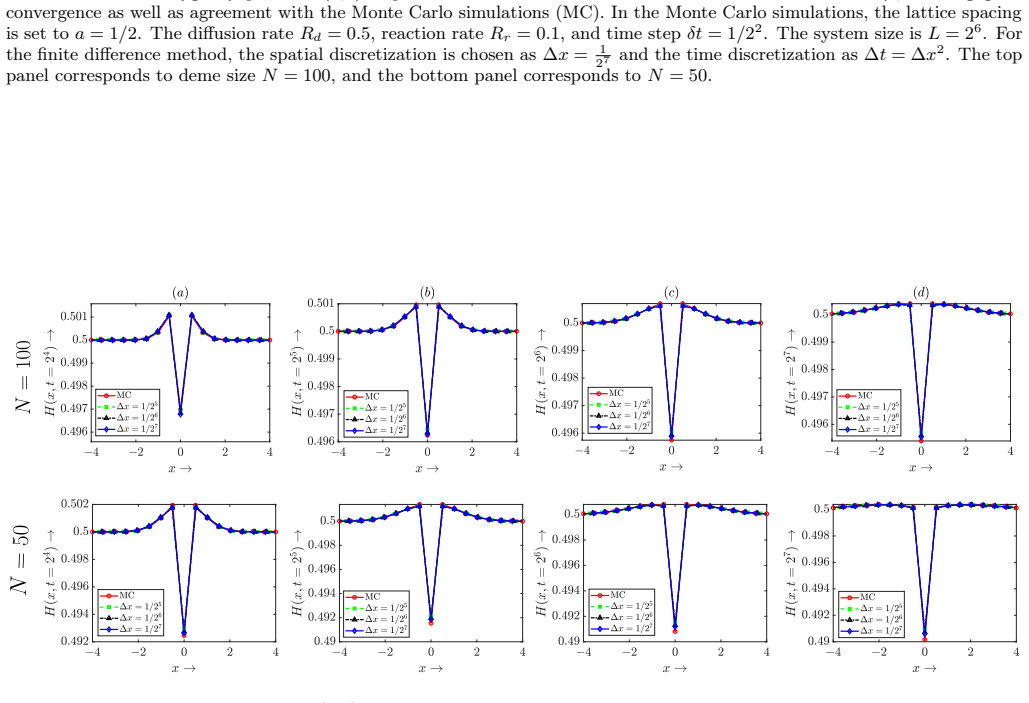
Starting from the discrete update rules of the stepping-stone model, the authors construct a path-integral action for the microscopic current and coarse-grain it to order $a^2$ and $d\tau$. The resulting stochastic partial differential equation, Eq. (11), contains a conservative diffusive-noise term $\partial_x(\sqrt{\sigma_d a}\,\eta_d)$ alongside the usual reaction-noise term $\sqrt{\sigma_r a}\,\eta_r$. Applied to the two-point function $H(x_1,x_2,t)$, this yields Eq. (14), with the new term $(2D_d a/N)\partial_x^2[H\,\delta(x_1-x_2)]$ coming purely from migration noise. Direct Monte Carlo simulations of the discrete model match solutions of Eq. (14) at early times, whereas solutions without the diffusive-noise term do not; the disagreement is largest when $R_r \ll R_d$. The paper therefore claims that early-time genetic demixing, characterized by heterozygosity at the origin, is described by the modified hydrodynamic equation and not by the ubiquitously used sFKPP framework, while the long-time decay of heterozygosity is unchanged.
Load-bearing premise
The derivation assumes that after coarse-graining to order $a^2$ and $d\tau$, all fluctuations of the discrete exchange and reproduction processes are captured by two independent Gaussian white noises, and that in the Itô average the noise-induced terms close as $\langle f(1-f)\rangle \approx H/2$; if higher-order correlations or temporal memory of the discrete updates matter, the third term in Eq. (14) changes.
Editorial extensions
If this is right
- Early-time heterozygosity profiles from Monte Carlo simulations are reproduced by Eq. (14) but not by sFKPP-type equations, so simulations or experiments probing short times must include the third term.
- Spatial heterozygosity is suppressed exactly at the origin and enhanced at nearby separations at short times, a structure that reaction noise alone cannot generate.
- The integrated current across a domain scales as $\sqrt{T}$ at short times with prefactor $\sigma_d/\sqrt{2\pi D_d}$, then crosses over to $\sigma_r T/8$ at long times, with all curves collapsing when time is scaled by $L^2$ and variance by $L$.
- The crossover time $T^* \sim 32\sigma_d^2/(\pi\sigma_r^2 D_d)$ separates diffusive-noise-dominated from reaction-noise-dominated fluctuations, giving an observable timescale for when migration noise matters.
- In the absence of reactions, the short-time current-fluctuation scaling matches the symmetric simple exclusion process, reduced by a factor $1/N$ relative to that model.
Reading between the lines
- Inference: The same coarse-graining should carry to two-dimensional and spatially heterogeneous demes, where the new term may leave an observable early-time signature in allele-correlation lengths; the authors list this as a direction but do not compute it.
- Inference: Because the noise amplitudes carry a factor $1/N$, a direct test could vary deme size $N$; the predicted early-time heterozygosity dip should sharpen as $N$ decreases even when the ratio $R_r/R_d$ is fixed.
- Inference: The paper leaves open whether diffusive noise changes Fisher front speeds; the macroscopic-fluctuation-theory action described here could be used to compute front-speed corrections beyond demographic noise, a consequence implied by the authors' final discussion.
Editorial analysis
A structured set of objections, weighed in public.
Referee Report
Summary. The paper studies the one-dimensional stepping-stone model and derives a fluctuating hydrodynamic description that includes, in addition to the usual demographic (reaction) noise, a conservative noise arising from migration. Starting from a path-integral representation of the microscopic update rules, the authors obtain an SPDE (Eq. 11) whose diffusive-noise term is absent from the standard sFKPP equation. They then derive a closed equation for the two-point heterozygosity H(x,t) (Eq. 14) containing a new singular term (2D_d a/N)∂_x^2[Hδ(x)], and an MFT expression for the variance of the integrated current (Eq. 21). The results are compared with kinetic Monte Carlo simulations of the same microscopic model, with apparent agreement and scaling collapses shown in the main text and the Supplemental Material.
Significance. The paper identifies a physically important effect: migration noise can dominate early-time genetic demixing when migration rates exceed reaction rates. The analytic formulas for heterozygosity and current fluctuations are useful, and the MFT calculation in Eq. (21) gives a concrete prediction for the crossover from sqrt(T) to linear T scaling. The authors provide explicit numerical schemes and convergence tests, and the derivations are presented transparently. However, because the simulations implement the same microscopic rules used to derive the theory, the agreement is a consistency check rather than an independent prediction; the value of the paper lies in the derivation itself. The significance therefore depends on whether Eq. (14) is a correctly derived and well-defined hydrodynamic equation, which is the point that needs attention.
major comments (3)
- [Eq. (13) and the Ito step to Eq. (14)] The sign in Eq. (13) is inconsistent with the stated Ito procedure. For a conservative noise term of the form ∂_x(√σ_d a η), the increment covariance is proportional to -∂_x∂_{x'}[f(1-f)δ(x-x')], not +∂_x∂_{x'}[...]. Applying Ito's lemma to H = f_1(1-f_2)+f_2(1-f_1), the second-order correction from the noise is -2⟨δf_1δf_2⟩, so with the plus sign in Eq. (13) the diffusive-noise contribution to ∂_t H is -2D_d a/N ∂_{x1}∂_{x2}[Hδ], opposite in sign to the third term in Eq. (14). The manuscript's statement that the noise contributions produce +2D_d a/N ∂_{x1}∂_{x2}[Hδ] is consistent only if Eq. (13) has a minus sign on the diffusive term. Since the third term in Eq. (14) is the central new result, this sign error must be corrected or the sign convention must be explained explicitly.
- [Eqs. (7), (10), (11), (14) and Supplemental Secs. I.A, III] The label 'exact' is not supported. The action in Eq. (7) is obtained by Taylor expansion retaining terms to O(a^2,dτ), and Eq. (10) itself uses an approximation. Moreover, Eq. (14) is not a conventional PDE: the new term contains the lattice spacing a multiplying a distribution ∂^2[Hδ(x)], and its numerical solution requires a Gaussian regulator δ_μ (Supplement Eqs. (23)-(24)). The convergence tests in Supplemental Figs. 7-9 are reassuring for the specific parameters and regulator shape used, but they do not establish that the solution is independent of the regulator or that a well-defined continuum limit exists as a, Δx, and μ^{-1/2} tend to zero jointly. The authors should either prove regulator-shape independence and specify the limiting procedure, or consistently describe Eq. (14) as an effective lattice-scale equation. Relatedly, the factors of a in Eqs. (10)-(13) should be checked: from the 1/a prefactor in Eq. (9), the conservative-noise amplitude in Eq. (10) is naturally √(σ_d/a) unless the noise correlations in Eq. (12) are redefined.
- [Abstract and Conclusions] The statements 'derive an exact fluctuating hydrodynamic description' and 'Our exact results' overstate the content of the paper, given the O(a^2,dτ) truncation and the regularization-dependent singular term in Eq. (14). I recommend replacing 'exact' with a more cautious phrase such as 'a systematic fluctuating hydrodynamic description to leading nontrivial order' or 'an exact lattice-scale description followed by a controlled truncation,' so that the claims match the derivation.
minor comments (4)
- [Supplement Fig. 7 caption] The values of μ used in the convergence test are not listed in the caption; please add them so that the reader can verify the range of regulators tested.
- [Eq. (20)] The Fourier coefficient in Eq. (20) is written as i(1-e^{ikπ})/(2kπ), which is indeterminate at k=0; please specify the limiting value used in the sum.
- [Just above Eq. (15)] The quantity Q_T is described as the 'total flux of particles across the origin,' but Eq. (15) defines it as an integral of the density change over half the domain; this is an integrated density change rather than a literal flux, so please adjust the terminology.
- [Supplement Sec. I.B] The scaling statement 'D'_d → D_r/D_d L^2' is confusing because D'_d is not the quantity that appears in Eq. (26); please clarify whether the intended rescaling is for D'_r and how it relates to the dimensionless constant A.
Circularity Check
No significant circularity: the fluctuating-hydrodynamic equations and their heterozygosity/current predictions are derived from the stated microscopic rules with no fitted parameters.
full rationale
The central derivation chain is self-contained. The path-integral action (Eqs. 4-6) is constructed directly from the microscopic exchange and reaction rules; the SPDE (Eq. 11) follows by Taylor expansion, Hubbard-Stratonovich transformation, and integration over the auxiliary field. The heterozygosity equation (Eq. 14) is obtained from Eq. (11) by an explicit Ito-Lemma calculation, with the noise correlations in Eq. (13) written in terms of the model parameters D_d, D_r, N, and a. The current-fluctuation prediction (Eq. 21) is obtained by solving the linearized MFT equations (Eqs. 19-20) derived in the paper from the same action. No step imports the new diffusive-noise term from a prior publication; the citations to the authors' earlier work (e.g., Ref. [22]) are methodological, for a standard perturbative expansion, and are not load-bearing for the new term. The Monte Carlo simulations are of the same stepping-stone model used in the derivation, so the agreement is a consistency check of the coarse-graining rather than a statistically forced prediction from fitted parameters; there are no fitted amplitudes. The Gaussian regulator μ used in the supplemental solution of Eq. (22) is a numerical regularization device, and the paper reports convergence tests (Supplement Figs. 7-9); any concern about regulator dependence is a correctness or regularization issue, not a circular reduction of the result to its inputs.
Assumptions & free parameters
free parameters (1)
- Gaussian delta-function regularization width μ =
Not fitted to data; chosen for numerical convergence (e.g., μ = 24, 6, 48 in main text figures)
assumptions (5)
- standard math Path integral representation of stochastic trajectories (Eq. 2-4)
- domain assumption Quadratic truncation in the auxiliary field and Hubbard-Stratonovich transformation to Gaussian noises (Eq. 7-11)
- domain assumption Hydrodynamic scaling R_d → R_tilde_d/a^2 as a, dτ → 0 so diffusive and reaction noise enter at equal order
- domain assumption Itô's lemma with multiplicative Gaussian white noise, and the closure ⟨f(1-f)⟩ ≈ H/2 when forming Eq. (14) from Eq. (13)
- domain assumption Delta-correlated (white) noise in time and space for both noise fields (Eq. 12)
Cite this review
Pith. "Pith review of Diffusive noise controls early stages of genetic demixing." pith.science (2026). https://pith.science/paper/I43JMS7Y
@misc{pith2026250523698,
  author       = {Pith},
  title        = {Pith review of: Diffusive noise controls early stages of genetic demixing},
  year         = {2026},
  howpublished = {\url{https://pith.science/paper/I43JMS7Y}},
  note         = {Machine review of arXiv:2505.23698}
}
read the original abstract
Theoretical descriptions of the stepping-stone model, a cornerstone of spatial population genetics, have long overlooked diffusive noise arising from migration dynamics. We derive an exact fluctuating hydrodynamic description of this model from microscopic rules, which we then use to demonstrate that diffusive noise significantly alters early-time genetic demixing, which we characterize through heterozygosity, a key measure of diversity. Combining macroscopic fluctuation theory and microscopic simulations, we demonstrate that the scaling of density fluctuations in a spatial domain displays an early-time behaviour dominated by diffusive noise. Our exact results underscore the need for additional terms in existing continuum theories and highlight the necessity of including diffusive noise in models of spatially structured populations.
Figures


Figures from the paper (6 more)


Reference graph
Works this paper leans on
-
[1]
W. J. Ewens and W. Ewens,Mathematical Population Genetics: Theoretical Introduction, vol. 27 (Springer, 2004)
work page 2004
-
[2]
O. Hallatschek, P. Hersen, S. Ramanathan, and D. R. Nelson, Proceedings of the National Academy of Sciences 104, 19926 (2007)
work page 2007
-
[3]
N. Rana, P. Ghosh, and P. Perlekar, Physical Review E 96, 052403 (2017)
work page 2017
-
[4]
S. Pigolotti, R. Benzi, P. Perlekar, M. H. Jensen, F. Toschi, and D. R. Nelson, Theoretical Population Bi- ology 84, 72 (2013)
work page 2013
-
[5]
U. C. Täuber, in Order, Disorder and Criticality: Ad- vanced Problems of Phase Transitions and Complex Sys- tems (World Scientific, 2025), pp. 67–115
work page 2025
-
[6]
Murray, Mathematical Biology: An Introduction (Springer, 2002)
J. Murray, Mathematical Biology: An Introduction (Springer, 2002)
work page 2002
-
[7]
Kimura and G
M. Kimura and G. H. Weiss, Genetics49, 561 (1964)
1964
-
[8]
K. S. Korolev, M. Avlund, O. Hallatschek, and D. R. Nelson, Reviews of Modern Physics82, 1691 (2010)
work page 2010
Show all 66 references
-
[9]
Singha, P
T. Singha, P. Perlekar, and M. Barma, Physical Review 6 Research 2, 023412 (2020)
2020
-
[10]
R. A. Fisher, Annals of Eugenics7, 355 (1937)
1937
-
[11]
C. R. Doering, C. Mueller, and P. Smereka, Physica A: Statistical Mechanics and its Applications325, 243 (2003)
2003
-
[12]
A. N. Kolmogorov and N. Piskunov, inDifferential Equa- tions (CRC Press, 2019), pp. 106–132
2019
-
[13]
T. L. Duty, Ph.D. thesis, University of British Columbia (2000)
2000
-
[14]
U. C. Täuber, M. Howard, and B. P. Vollmayr-Lee, Jour- nal of Physics A: Mathematical and General 38, R79 (2005)
2005
-
[15]
Raymond and M
M. Raymond and M. Marquine, Journal of Evolutionary Biology 7, 315 (1994)
1994
-
[16]
R. M. May, J. A. Endler, and R. E. McMurtrie, The American Naturalist109, 659 (1975)
1975
-
[17]
Lenormand, Trends in Ecology & Evolution17, 183 (2002)
T. Lenormand, Trends in Ecology & Evolution17, 183 (2002)
2002
-
[18]
Jain and A
S. Jain and A. D. Bradshaw, Heredity (1966)
1966
- [19]
-
[20]
Agranov, S
T. Agranov, S. Ro, Y. Kafri, and V. Lecomte, Journal of Statistical Mechanics: Theory and Experiment2021, 083208 (2021)
2021
-
[21]
Bodineau and B
T. Bodineau and B. Derrida, Journal of Statistical Physics 145, 745 (2011)
2011
-
[22]
S. Jose, R. Dandekar, and K. Ramola, Journal of Statis- tical Mechanics: Theory and Experiment2023, 083208 (2023)
2023
-
[23]
Mukherjee, S
R. Mukherjee, S. Saha, T. Sadhu, A. Dhar, and S. Sab- hapandit, Physical Review E111, 024128 (2025)
2025
-
[25]
Bertini, A
L. Bertini, A. De Sole, D. Gabrielli, G. Jona-Lasinio, and C. Landim, Reviews of Modern Physics87, 593 (2015)
2015
-
[26]
A. G. Thompson, J. Tailleur, M. E. Cates, and R. A. Blythe, Journal of Statistical Mechanics: Theory and Ex- periment 2011, P02029 (2011)
2011
-
[27]
Korolev and D
K. Korolev and D. R. Nelson, Physical Review Letters 107, 088103 (2011)
2011
-
[28]
P. A. P. Moran,Random Processes in Genetics (Pro- ceedings of the Cambridge Philosophical Society, vol. 54, issue 01, p. 60, 1958)
1958
-
[29]
See Supplemental Material for details
-
[30]
Lefevre and G
A. Lefevre and G. Biroli, Journal of Statistical Mechan- ics: Theory and Experiment2007, P07024 (2007)
2007
-
[31]
Doi, Journal of Physics A: Mathematical and General 9, 1465 (1976)
M. Doi, Journal of Physics A: Mathematical and General 9, 1465 (1976)
1976
-
[32]
Peliti, Journal de Physique46, 1469 (1985)
L. Peliti, Journal de Physique46, 1469 (1985)
1985
-
[33]
Martin, Ph.D
D. Martin, Ph.D. thesis, Université Paris Cité (2021)
2021
-
[34]
Derrida, Physics Reports301, 65 (1998)
B. Derrida, Physics Reports301, 65 (1998)
1998
-
[35]
Spohn,Large Scale Dynamics of Interacting Particles (Springer Science & Business Media, 2012)
H. Spohn,Large Scale Dynamics of Interacting Particles (Springer Science & Business Media, 2012)
2012
-
[36]
Pechenik and H
L. Pechenik and H. Levine, Physical Review E59, 3893 (1999)
1999
-
[37]
P. C. Martin, E. Siggia, and H. Rose, Physical Review A 8, 423 (1973)
1973
-
[38]
Derrida, C
B. Derrida, C. Enaud, C. Landim, and S. Olla, Journal of Statistical Physics118, 795 (2005)
2005
-
[39]
D.S.Dean, JournalofPhysicsA:MathematicalandGen- eral 29, L613 (1996)
1996
-
[40]
Brunet and B
E. Brunet and B. Derrida, Physical Review E56, 2597 (1997)
1997
-
[41]
Derrida and A
B. Derrida and A. Gerschenfeld, Journal of Statistical Physics 137, 978 (2009)
2009
-
[42]
Krapivsky and B
P. Krapivsky and B. Meerson, Physical Review E86, 031106 (2012)
2012
-
[43]
Banerjee, R
T. Banerjee, R. L. Jack, and M. E. Cates, Physical Re- view E106, L062101 (2022)
2022
-
[44]
P. L. Krapivsky, K. Mallick, and T. Sadhu, Journal of Statistical Physics160, 885 (2015)
2015
-
[45]
Krapivsky, K
P. Krapivsky, K. Mallick, and T. Sadhu, Physical Review Letters 113, 078101 (2014)
2014
-
[46]
K.Mallick, H.Moriya, andT.Sasamoto, PhysicalReview Letters 129, 040601 (2022)
2022
-
[47]
Dandekar, P
R. Dandekar, P. Krapivsky, and K. Mallick, Physical Re- view E107, 044129 (2023)
2023
-
[48]
S. Jose, A. Rosso, and K. Ramola, Physical Review E 108, L052601 (2023)
2023
-
[49]
Bertini, A
L. Bertini, A. De Sole, D. Gabrielli, G. Jona-Lasinio, and C. Landim, Physical Review Letters94, 030601 (2005)
2005
-
[50]
Bertini, A
L. Bertini, A. D. Sole, D. Gabrielli, G. Jona-Lasinio, and C. Landim, Journal of Statistical Physics123, 237 (2006)
2006
-
[51]
Bertini, A
L. Bertini, A. De Sole, D. Gabrielli, G. Jona-Lasinio, and C. Landim, Journal of Statistical Mechanics: Theory and Experiment 2007, P07014 (2007)
2007
-
[52]
Bertini, A
L. Bertini, A. De Sole, D. Gabrielli, G. Jona-Lasinio, and C. Landim, Journal of Statistical Physics135, 857 (2009)
2009
-
[53]
Dandekar, P
R. Dandekar, P. Krapivsky, and K. Mallick, Physical Re- view E110, 064153 (2024)
2024
-
[54]
Banerjee, S
T. Banerjee, S. N. Majumdar, A. Rosso, and G. Schehr, Physical Review E101, 052101 (2020)
2020
-
[55]
D. G. Levitt, Physical Review A8, 3050 (1973)
1973
-
[56]
Arratia, The Annals of Probability11, 362 (1983)
R. Arratia, The Annals of Probability11, 362 (1983)
1983
-
[57]
J. V. Noble, Nature250, 726 (1974)
1974
-
[58]
Campos, V
D. Campos, V. Méndez, and V. Ortega-Cejas, Bulletin of mathematical biology70, 1937 (2008)
2008
-
[59]
Schimansky-Geier and C
L. Schimansky-Geier and C. Zülicke, Zeitschrift für Physik B Condensed Matter82, 157 (1991)
1991
-
[60]
Hallatschek and K
O. Hallatschek and K. S. Korolev, Physical Review Let- ters 103, 108103 (2009)
2009
-
[61]
Cividini and A
J. Cividini and A. Kundu, Journal of Statistical Mechan- ics: Theory and Experiment2017, 083203 (2017)
2017
-
[62]
Van Saarloos, Physical Review A37, 211 (1988)
W. Van Saarloos, Physical Review A37, 211 (1988)
1988
-
[63]
Hallatschek and D
O. Hallatschek and D. R. Nelson, Evolution 64, 193 (2010)
2010
-
[64]
Lemarchand, I
A. Lemarchand, I. Nainville, and M. Mareschal, Euro- physics Letters36, 227 (1996)
1996
-
[65]
Prados, J
A. Prados, J. Brey, and B. Sánchez-Rey, Journal of Sta- tistical Physics89, 709 (1997)
1997
-
[66]
A. B. Bortz, M. H. Kalos, and J. L. Lebowitz, Journal of Computational Physics17, 10 (1975)
1975
-
[67]
Diffusive noise controls early stages of genetic demixing
A. F. Voter, in Radiation Effects in Solids (Springer, 2007), pp. 1–23. 7 Supplemental Material for “Diffusive noise controls early stages of genetic demixing” This document provides supplemental figures and details related to the results presented in the main text. I. DETAILS...
2007
Reviewed August 7, 2026 · model on record in the stance chip above.
Discussion (0). Sign in to comment.