REVIEW 5 major objections 5 minor 37 references
ICAS: IP Adapter and ControlNet-based Attention Structure for Multi-Subject Style Transfer Optimization
T0 review · 5 major / 5 minor · reviewed 2026-08-16 · deepseek-v4-flash
Pith's one-line read ICAS claims that combining a frozen IP-Adapter style path, ControlNet structure control, and cyclically injected content embeddings preserves multiple subjects' identities during style transfer without large stylized datasets or inversion.
desk verdict The paper's headline contribution—partial fine-tuning of the content branch—is never actually tested in its own experiments, which fall back to a pre-trained IP-Adapter plus ControlNet; the remaining evidence is qualitative figures and a 20-person user study without statistics. read the letter →
The pith
A machine-rendered reading of the paper's core claim, the machinery that carries it, and where it could break.
The reading
What carries the argument
The central mechanism is the two-branch injection into U-Net attention: the Style Injection Module reuses IP-Adapter's pre-trained cross-attention with a gating term to blend style keys and values into the content query, and the Structure Preservation Module adds a ControlNet-derived residual map $R_S = \phi(F_S)$ scaled by $\gamma$ to U-Net features. A third piece, the cyclic multi-subject content embedding list, repeatedly injects several encodings of the content image so each subject receives its own attention signal. Together these carry the argument: style comes from the frozen adapter, layout from the ControlNet residual, and subject identity from multiple content embeddings.
What would settle it
Run ICAS twice on the same held-out multi-subject set, once with the content cross-attention branch updated and once with it frozen, and compare per-subject identity preservation. If the two outputs are indistinguishable, partial fine-tuning is not load-bearing; if the frozen version loses or merges subjects, then the paper's claim that all reported experiments used the pre-trained adapter without fine-tuning is inconsistent with the method it proposes.
Extended reading notes
Core claim
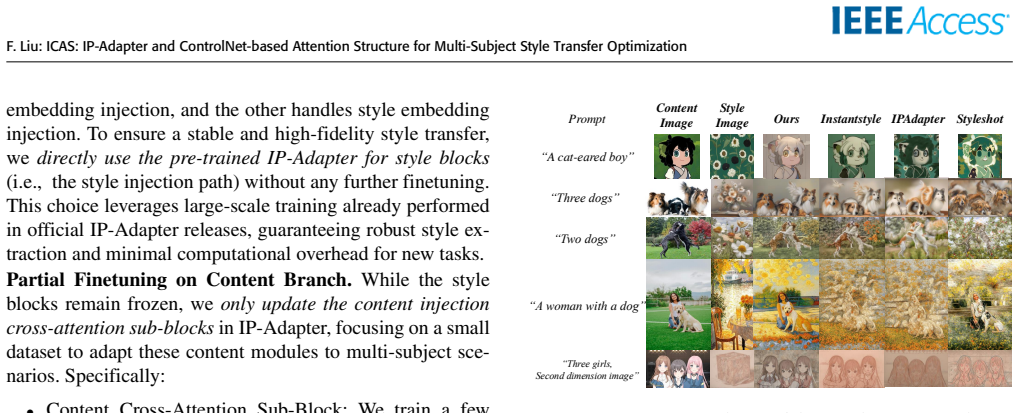
The central claim is that decoupling style and structure and injecting them through separate adapter branches lets a pre-trained diffusion model perform multi-subject style transfer with only minimal, selective parameter updates. The style injection output is $F_{sim} = \alpha A_R + (1-\alpha)Q + g$, where a sigmoid gate $g$ modulates style contribution based on content-style similarity, and the structure branch adds $\gamma R_S$ to U-Net features at selected blocks. The paper reports that with $\gamma=0.7$, ICAS preserves multiple subjects better than InstantStyle, StyleShot, and the original IP-Adapter, and that a 20-participant user study gives ICAS the highest mean scores on style fidelity, subject clarity, and overall aesthetic. It further states that freezing the style path and updating only content-related parameters achieves the best balance of quality and computational overhead.
Load-bearing premise
The central claim assumes that a pre-trained IP-Adapter's style-only path, combined with ControlNet at scale 0.7 and cyclically injected content embeddings, generalizes to arbitrary multi-subject inputs; if the partial fine-tuning of the content branch is genuinely required, then the reported experiments, which say they used no fine-tuning, do not test the proposed method.
Editorial extensions
If this is right
- Multi-subject style transfer can be performed without inversion or large stylized datasets, using a frozen pre-trained style adapter plus a structure control branch.
- Freezing the style path while lightly updating only the content cross-attention preserves pre-trained style knowledge and adapts to multi-subject content at minimal parameter cost.
- Cyclically injecting multiple content embeddings into the content path keeps individual subjects from being merged, occluded, or lost in the background.
- A ControlNet conditioning scale around $\gamma=0.7$ balances geometry preservation and style richness across the tested multi-subject scenes.
- In the reported small user study, ICAS scores higher than original IP-Adapter and InstantStyle on style fidelity, subject clarity, and overall aesthetics.
Reading between the lines
- If the statement that all experiments used the pre-trained IP-Adapter without further fine-tuning is taken literally, then the partial content-branch fine-tuning module is not actually tested by the reported results, and the observed gains would come entirely from the frozen style path, ControlNet at $\gamma=0.7$, and cyclic content embeddings.
- Because the ablation describes the gating term as possibly 'solely a scale parameter in the code,' the gating mechanism may be functionally equivalent to IP-Adapter's existing strength adjustment; a direct test would compare ICAS against IP-Adapter with matched per-subject scales on the same content set.
- The cyclic multi-content embedding recipe could generalize to other adapter-based multi-subject generation tasks, such as multi-person personalization or story illustration, where encoding each subject multiple times through augmentation or segmentation and alternating injections may improve identity preservation.
- The $\gamma=0.7$ sweet spot suggests that structure scale and style strength interact, so a natural extension would be a joint calibration or a learned schedule for $\gamma$ conditioned on the number of subjects and the complexity of the scene.
Signed reviews
Editorial analysis
A structured set of objections, weighed in public.
Referee Report
Summary. The paper proposes ICAS, a framework for multi-subject style transfer that combines a pre-trained IP-Adapter (for style injection) with a ControlNet branch (for structural conditioning), and introduces a gating mechanism plus a cyclic multi-content embedding strategy. The stated contribution is a lightweight partial fine-tuning scheme that updates only the content injection branch while freezing the style path. The authors claim superior performance over baselines such as InstantStyle, StyleShot, and IP-Adapter, supported by qualitative comparisons and a 20-participant user study.
Significance. If the method worked as described and were properly evaluated, the direction of combining IP-Adapter and ControlNet for multi-subject style transfer with minimal fine-tuning could be of interest to the community. The paper also addresses a practical need: efficient style transfer without inversion or large stylized datasets. However, the current manuscript does not validate these claims: the experiments do not implement the proposed partial fine-tuning, the reported quantitative evidence is a user study without statistical support, and the method description contains internal contradictions and an ill-defined gating equation. The potential significance is therefore not realized in the present form.
major comments (5)
- [Section IV-A] Section IV-A states that 'all subsequent experiments (Section IV) are conducted with the pre-trained IP-Adapter without further fine-tuning.' This directly contradicts the central contribution described in Section III-A and Section IV-C, which is partial fine-tuning of the content injection branch. Consequently, Figures 2, 4, 6 and Table 1 evaluate a system that omits the proposed fine-tuning. The 'Content-Only (Ours)' condition in the ablation study of Section IV-C is therefore never actually realized in the reported results; the 'No-Finetune' condition is the de facto evaluated system. This means the central claim that ICAS outperforms baselines is not supported by the experiments.
- [Table 1] The user study in Section IV-D reports only mean scores from 20 participants, with no standard deviations, confidence intervals, or significance tests. The differences between ICAS and InstantStyle on Style Fidelity are 4.32 versus 4.22, which is likely within inter-rater variability. Without per-participant or per-task variance, and without any statistical test (e.g., paired t-test or Wilcoxon), the conclusion that 'ICAS consistently outperforms' is not justified.
- [Section III-B, Eq. (4)] Equation (4) defines F_sim = α·A_R + (1−α)·Q + g, where A_R and Q are N×d matrices and g is defined in Eq. (3) as a d-dimensional vector via g = σ(Wg(e_C·e_R) + bg). The addition of a d-vector to an N×d matrix is undefined without specifying broadcasting; if broadcast over the N dimension, every spatial token receives the identical bias, which is not an 'adaptive' per-token gate. If g is intended to be per-token, Eq. (3) cannot produce an N-dimensional vector because e_C·e_R is a global similarity. This makes the core gating mechanism ill-defined, and the claim that it provides 'fine-grained modulation of style strength' is not supported.
- [Section III-A and Section IV-C] The paper is internally inconsistent about whether fine-tuning is required. Section III-A calls ICAS a 'lightweight and tuning-free method' but then immediately states that 'we only update a small content injection sub-block.' Section IV-C claims that the Content-Only partial fine-tuning strategy is superior to No-Finetune, yet Section IV-A says all experiments used the pre-trained adapter without fine-tuning. The reader cannot determine whether the proposed method requires training or not, and the experimental results are consistent only with the no-fine-tuning interpretation. This ambiguity undermines the reproducibility of the method.
- [Section IV-C] The ablation studies in Section IV-C repeatedly refer to quantitative measures such as 'subject-level matching score' and 'FID / style match / subject fidelity,' but no numerical values are reported anywhere in the paper. The conclusions of the ablations are based solely on qualitative figures (Figures 3 and 4) with no error bars or quantitative backing. Consequently, the claim of 'comprehensive ablation experiments' is overstated; the evidence is anecdotal.
minor comments (5)
- [Throughout] The paper contains numerous typos and inconsistent terminology: 'criss-cross attention' should be 'cross-attention,' 'iPadAdapter' in the Figure 2 caption should be 'IP-Adapter,' 'Evol ving' in Section II-C should be 'Evolving,' 'Instantstyle' should be 'InstantStyle,' and 'Styleshot' should be 'StyleShot.'
- [Section IV-A] The phrase 'The Base Model Setup. The Base Model Setup.' is duplicated in the 'Base Model Setup' paragraph. This appears to be an editing error.
- [Section III-B] Equation (4) introduces a scalar α that is described as 'user-controllable,' but the paper does not specify how α is set in the experiments or whether it is learned. The relationship between the gating parameters (Wg, bg) and α is not clarified.
- [Section III-C] The structure preservation module is described as a 'residual map' added to U-Net features with a scaling parameter γ. The paper does not define the spatial dimensions of R_S or how the projection ϕ is parameterized, making it difficult to reproduce the implementation.
- [Section IV-B] In the comparison with state-of-the-art methods, the paper states that baselines' weights are 'manually adjusted to maintain consistent intensity sensitivity.' No details are given about how this adjustment was performed, which weakens the fairness of the comparison.
Circularity Check
No circular derivation found; the method is a modular composition of external components, and the evaluation gap around omitted fine-tuning is a missing-support issue, not circularity.
full rationale
The paper contains no derivation chain in which a claimed result is equivalent to its inputs by construction. The method is a modular composition of external components: IP-Adapter (ref. [26]) for style injection, ControlNet ([24]) for structure, a sigmoid gating term (Eqs. 3-4), and cyclic injection of multiple content embeddings. None of these components is defined in terms of the evaluation metrics, and no parameter is fitted to the reported success criteria and then renamed as a prediction. The gating equation and the choice of gamma=0.7 are ad hoc design choices validated by qualitative ablations, not circular reductions. The only self-referential aspect is an evaluation gap: Section IV-A states 'all subsequent experiments (Section IV) are conducted with the pre-trained IP-Adapter without further fine-tuning,' even though the proposed contribution is partial fine-tuning of the content branch (Section III-A and Section IV-A, 'Partial Finetuning on Content Branch'). Consequently Figures 2, 4, 6 and Table 1 appear to evaluate the no-fine-tune variant rather than the proposed fine-tuned ICAS, so the claim that ICAS 'achieves superior performance' is not directly supported by tests of the proposed training strategy. This is a missing-support / internal-consistency problem, not a circularity, so the circularity score is 0.
Assumptions & free parameters
free parameters (5)
- gating parameters Wg, bg =
not reported
- content cross-attention weights (num_control_attn) =
not reported
- structure scale γ =
0.7
- style strength α =
not specified
- λgate regularizer =
not specified ('small')
assumptions (3)
- domain assumption Pre-trained IP-Adapter style path and ControlNet remain effective when combined in the ICAS configuration
- domain assumption The 20-participant user study is a reliable measure of style fidelity, subject clarity, and overall aesthetics
- standard math Standard cross-attention (Eq. 2) and sigmoid operation (Eq. 3) behave as expected in the diffusion U-Net
Cite this review
Pith. "Pith review of ICAS: IP Adapter and ControlNet-based Attention Structure for Multi-Subject Style Transfer Optimization." pith.science (2026). https://pith.science/paper/I4A6ING5
@misc{pith2026250413224,
  author       = {Pith},
  title        = {Pith review of: ICAS: IP Adapter and ControlNet-based Attention Structure for Multi-Subject Style Transfer Optimization},
  year         = {2026},
  howpublished = {\url{https://pith.science/paper/I4A6ING5}},
  note         = {Machine review of arXiv:2504.13224}
}
read the original abstract
Generating multi-subject stylized images remains a significant challenge due to the ambiguity in defining style attributes (e.g., color, texture, atmosphere, and structure) and the difficulty in consistently applying them across multiple subjects. Although recent diffusion-based text-to-image models have achieved remarkable progress, existing methods typically rely on computationally expensive inversion procedures or large-scale stylized datasets. Moreover, these methods often struggle with maintaining multi-subject semantic fidelity and are limited by high inference costs. To address these limitations, we propose ICAS (IP-Adapter and ControlNet-based Attention Structure), a novel framework for efficient and controllable multi-subject style transfer. Instead of full-model tuning, ICAS adaptively fine-tunes only the content injection branch of a pre-trained diffusion model, thereby preserving identity-specific semantics while enhancing style controllability. By combining IP-Adapter for adaptive style injection with ControlNet for structural conditioning, our framework ensures faithful global layout preservation alongside accurate local style synthesis. Furthermore, ICAS introduces a cyclic multi-subject content embedding mechanism, which enables effective style transfer under limited-data settings without the need for extensive stylized corpora. Extensive experiments show that ICAS achieves superior performance in structure preservation, style consistency, and inference efficiency, establishing a new paradigm for multi-subject style transfer in real-world applications.
Figures


Figures from the paper (3 more)



Reference graph
Works this paper leans on
-
[1]
Y . Jing, Y . Y ang, Z. Feng, J. Y e, Y . Y u, and M. Song, ‘‘Neural style transfer: A review,’’ IEEE transactions on visualization and computer graphics , vol. 26, no. 11, pp. 3365–3385, 2019
work page 2019
-
[2]
Y . Deng, F. Tang, W. Dong, W. Sun, F. Huang, and C. Xu, ‘‘Arbitrary style transfer via multi-adaptation network,’’ in Proceedings of the 28th ACM international conference on multimedia , 2020, pp. 2719–2727
work page 2020
-
[3]
F. Shen and J. Tang, ‘‘Imagpose: A unified conditional framework for pose- guided person generation,’’ in The Thirty-eighth Annual Conference on Neural Information Processing Systems, 2024
work page 2024
-
[4]
F. Shen, X. Jiang, X. He, H. Y e, C. Wang, X. Du, Z. Li, and J. Tang, ‘‘Imagdressing-v1: Customizable virtual dressing,’’arXiv preprint arXiv:2407.12705, 2024
arXiv 2024
-
[5]
F. Shen, C. Wang, J. Gao, Q. Guo, J. Dang, J. Tang, and T.-S. Chua, ‘‘Long- term talkingface generation via motion-prior conditional diffusion model,’’ arXiv preprint arXiv:2502.09533, 2025
arXiv 2025
-
[6]
J. Song, C. Meng, and S. Ermon, ‘‘Denoising diffusion implicit models,’’ arXiv preprint arXiv:2010.02502, 2020
arXiv 2010
-
[7]
N. Tumanyan, M. Geyer, S. Bagon, and T. Dekel, ‘‘Plug-and-play diffusion features for text-driven image-to-image translation,’’ in Proceedings of the IEEE/CVF Conference on Computer Vision and Pattern Recognition, 2023, pp. 1921–1930
work page 2023
- [8]
Show all 37 references
-
[9]
Mokady, A
R. Mokady, A. Hertz, K. Aberman, Y . Pritch, and D. Cohen-Or, ‘‘Null- text inversion for editing real images using guided diffusion models,’’ in Proceedings of the IEEE/CVF conference on computer vision and pattern recognition, 2023, pp. 6038–6047
2023
-
[10]
H. Wang, M. Spinelli, Q. Wang, X. Bai, Z. Qin, and A. Chen, ‘‘Instantstyle: Free lunch towards style-preserving in text-to-image generation,’’ arXiv preprint arXiv:2404.02733, 2024
2024 arXiv
-
[11]
V . Shah, N. Ruiz, F. Cole, E. Lu, S. Lazebnik, Y . Li, and V . Jampani, ‘‘Zi- plora: Any subject in any style by effectively merging loras,’’ in European Conference on Computer Vision. Springer, 2024, pp. 422–438
2024
-
[12]
Frenkel, Y
Y . Frenkel, Y . Vinker, A. Shamir, and D. Cohen-Or, ‘‘Implicit style-content separation using b-lora,’’ in European Conference on Computer Vision . Springer, 2024, pp. 181–198
2024
-
[13]
J. Gao, Y . Liu, Y . Sun, Y . Tang, Y . Zeng, K. Chen, and C. Zhao, ‘‘Styleshot: A snapshot on any style,’’ arXiv preprint arXiv:2407.01414, 2024
2024 arXiv
-
[14]
F. Shen, H. Y e, S. Liu, J. Zhang, C. Wang, X. Han, and W. Y ang, ‘‘Boosting consistency in story visualization with rich-contextual conditional diffu- sion models,’’ arXiv preprint arXiv:2407.02482, 2024
2024 arXiv
-
[15]
F. Shen, H. Y e, J. Zhang, C. Wang, X. Han, and W. Y ang, ‘‘Advancing pose- guided image synthesis with progressive conditional diffusion models,’’ arXiv preprint arXiv:2310.06313, 2023
2023 arXiv
-
[16]
Dhariwal and A
P . Dhariwal and A. Nichol, ‘‘Diffusion models beat gans on image syn- thesis,’’ Advances in neural information processing systems , vol. 34, pp. 8780–8794, 2021
2021
-
[17]
Ramesh, P
A. Ramesh, P . Dhariwal, A. Nichol, C. Chu, and M. Chen, ‘‘Hierarchi- cal text-conditional image generation with clip latents,’’ arXiv preprint arXiv:2204.06125, vol. 1, no. 2, p. 3, 2022
2022 arXiv
-
[18]
Nichol, P
A. Nichol, P . Dhariwal, A. Ramesh, P . Shyam, P . Mishkin, B. McGrew, I. Sutskever, and M. Chen, ‘‘Glide: Towards photorealistic image gen- eration and editing with text-guided diffusion models,’’ arXiv preprint arXiv:2112.10741, 2021
2021 arXiv
-
[19]
Raffel, N
C. Raffel, N. Shazeer, A. Roberts, K. Lee, S. Narang, M. Matena, Y . Zhou, W. Li, and P . J. Liu, ‘‘Exploring the limits of transfer learning with a unified text-to-text transformer,’’ Journal of machine learning research , vol. 21, no. 140, pp. 1–67, 2020
2020
-
[20]
W. Chen, H. Hu, C. Saharia, and W. W. Cohen, ‘‘Re-imagen: Retrieval- augmented text-to-image generator,’’ arXiv preprint arXiv:2209.14491 , 2022
2022 arXiv
-
[21]
Rombach, A
R. Rombach, A. Blattmann, D. Lorenz, P . Esser, and B. Ommer, ‘‘High- resolution image synthesis with latent diffusion models,’’ in Proceedings of the IEEE/CVF conference on computer vision and pattern recognition , 2022, pp. 10 684–10 695
2022
-
[22]
Podell, Z
D. Podell, Z. English, K. Lacey, A. Blattmann, T. Dockhorn, J. Müller, J. Penna, and R. Rombach, ‘‘Sdxl: Improving latent diffusion models for high-resolution image synthesis,’’ arXiv preprint arXiv:2307.01952, 2023
2023 arXiv
-
[23]
Huang, D
L. Huang, D. Chen, Y . Liu, Y . Shen, D. Zhao, and J. Zhou, ‘‘Composer: Creative and controllable image synthesis with composable conditions,’’ arXiv preprint arXiv:2302.09778, 2023
2023 arXiv
-
[24]
Zhang, N
Y . Zhang, N. Huang, F. Tang, H. Huang, C. Ma, W. Dong, and C. Xu, ‘‘Inversion-based style transfer with diffusion models,’’ in Proceedings of the IEEE/CVF conference on computer vision and pattern recognition , 2023, pp. 10 146–10 156
2023
-
[25]
C. Mou, X. Wang, L. Xie, Y . Wu, J. Zhang, Z. Qi, and Y . Shan, ‘‘T2i- adapter: Learning adapters to dig out more controllable ability for text- to-image diffusion models,’’ in Proceedings of the AAAI conference on artificial intelligence, vol. 38, no. 5, 2024, pp. 4296–4304
2024
-
[26]
H. Y e, J. Zhang, S. Liu, X. Han, and W. Y ang, ‘‘Ip-adapter: Text compatible image prompt adapter for text-to-image diffusion models,’’ arXiv preprint arXiv:2308.06721, 2023
2023 arXiv
-
[27]
L. A. Gatys, A. S. Ecker, and M. Bethge, ‘‘Image style transfer using convolutional neural networks,’’ in Proceedings of the IEEE conference on computer vision and pattern recognition , 2016, pp. 2414–2423
2016
-
[28]
D. Chen, L. Y uan, J. Liao, N. Y u, and G. Hua, ‘‘Stylebank: An explicit representation for neural image style transfer,’’ in Proceedings of the IEEE conference on computer vision and pattern recognition , 2017, pp. 1897– 1906
2017
-
[29]
Dumoulin, J
V . Dumoulin, J. Shlens, and M. Kudlur, ‘‘A learned representation for artistic style,’’ arXiv preprint arXiv:1610.07629, 2016
2016 arXiv
-
[30]
Huang and S
X. Huang and S. Belongie, ‘‘Arbitrary style transfer in real-time with adaptive instance normalization,’’ inProceedings of the IEEE international conference on computer vision , 2017, pp. 1501–1510
2017
-
[31]
H. Chen, Z. Wang, H. Zhang, Z. Zuo, A. Li, W. Xing, D. Lu et al., ‘‘Artistic style transfer with internal-external learning and contrastive learning,’’ Advances in Neural Information Processing Systems , vol. 34, pp. 26 561– 26 573, 2021
2021
-
[32]
Hertz, A
A. Hertz, A. V oynov, S. Fruchter, and D. Cohen-Or, ‘‘Style aligned image generation via shared attention,’’ in Proceedings of the IEEE/CVF Confer- ence on Computer Vision and Pattern Recognition , 2024, pp. 4775–4785. VOLUME 4, 2025 9 F. Liu: ICAS: IP-Adapter and ControlNet-b...
2024
-
[33]
X. Wu, Z. Hu, L. Sheng, and D. Xu, ‘‘Styleformer: Real-time arbitrary style transfer via parametric style composition,’’ in Proceedings of the IEEE/CVF international conference on computer vision, 2021, pp. 14 618– 14 627
2021
-
[34]
Y . Deng, F. Tang, W. Dong, C. Ma, X. Pan, L. Wang, and C. Xu, ‘‘Stytr2: Image style transfer with transformers,’’ in Proceedings of the IEEE/CVF conference on computer vision and pattern recognition , 2022, pp. 11 326– 11 336
2022
-
[35]
T. Qi, S. Fang, Y . Wu, H. Xie, J. Liu, L. Chen, Q. He, and Y . Zhang, ‘‘Deadiff: An efficient stylization diffusion model with disentangled rep- resentations,’’ in Proceedings of the IEEE/CVF Conference on Computer Vision and Pattern Recognition, 2024, pp. 8693–8702
2024
-
[36]
Z. Wang, X. Wang, L. Xie, Z. Qi, Y . Shan, W. Wang, and P . Luo, ‘‘Styleadapter: A unified stylized image generation model,’’arXiv preprint arXiv:2309.01770, 2023
2023 arXiv
-
[37]
Jeong, J
J. Jeong, J. Kim, Y . Choi, G. Lee, and Y . Uh, ‘‘Visual style prompting with swapping self-attention,’’ arXiv preprint arXiv:2402.12974, 2024. 10 VOLUME 4, 2025
2024 arXiv
Reviewed August 16, 2026 · model on record in the stance chip above.
Discussion (0). Continue with ORCID to comment.