Fibonacci Steady-States and Persistent Oscillations in an Ordered Multimode Dicke Model
Pith reviewed 2026-06-27 06:37 UTC · model grok-4.3
The pith
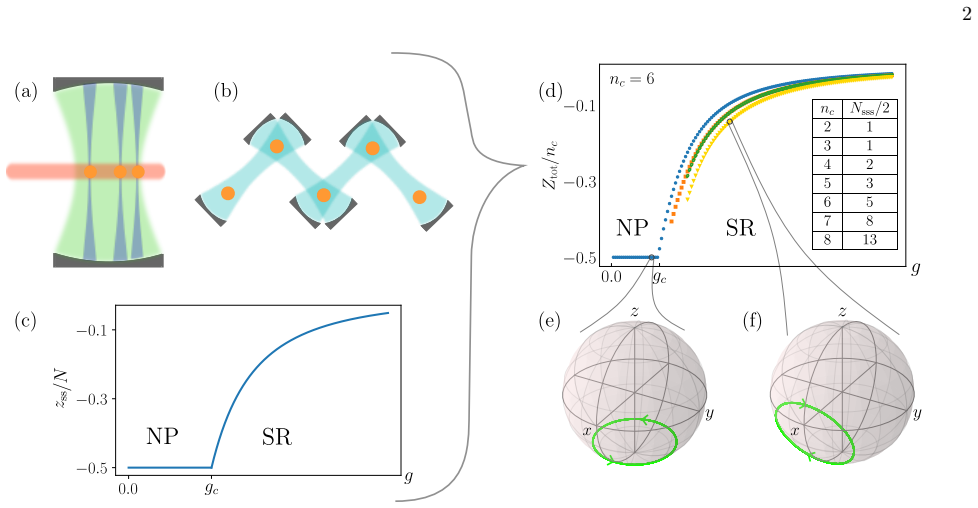
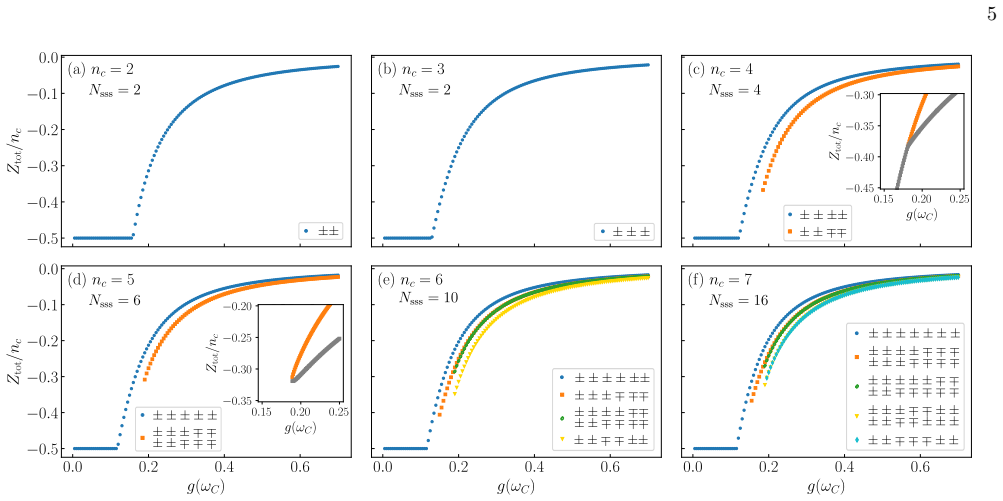
In the ordered multimode Dicke model with nearest-neighbor couplings, the number of mean-field stable steady-states in the superradiant phase scales according to the Fibonacci sequence with the number of atomic clusters.
A machine-rendered reading of the paper's core claim, the machinery that carries it, and where it could break.
Core claim
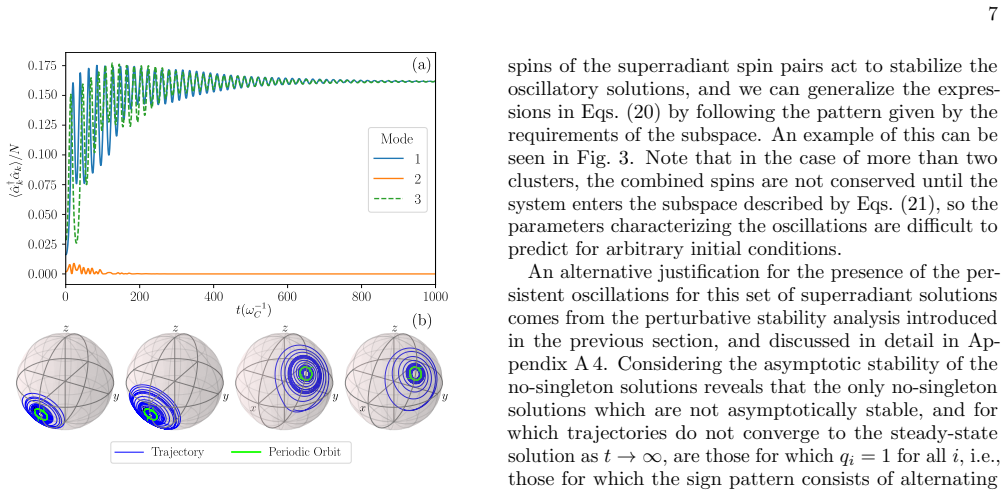
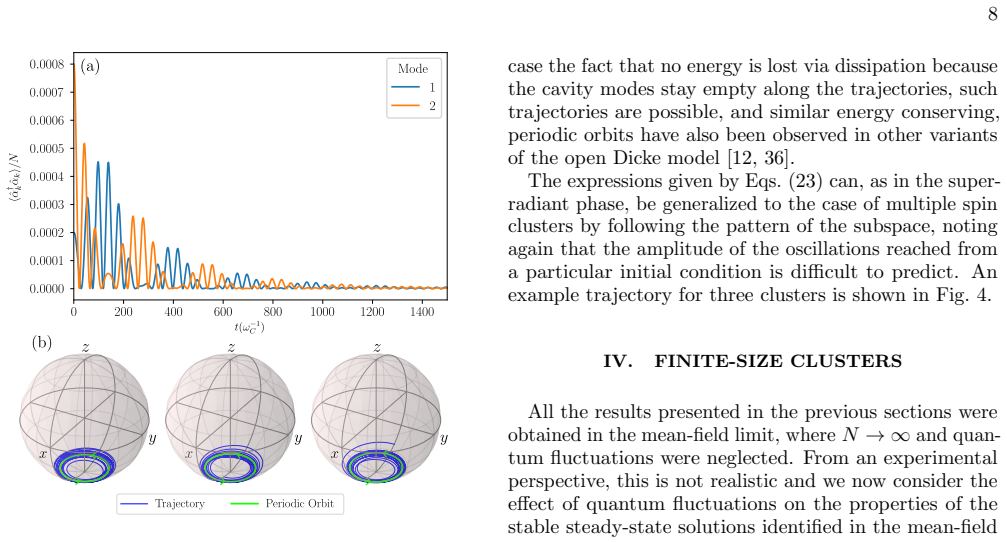
For an ordered multimode Dicke model in which n_c atomic clusters are coupled by n_c-1 modes in nearest-neighbor geometry, the number of mean-field stable steady-states in the superradiant phase obeys Fibonacci scaling with n_c; a subset of these states exhibits persistent oscillations; both features remain present when the clusters are taken to finite size.
What carries the argument
The nearest-neighbor ordered coupling geometry with n_c clusters linked by n_c-1 modes, whose recursive structure produces the Fibonacci recurrence in the count of stable mean-field solutions.
If this is right
- The Fibonacci scaling is a direct consequence of the linear chain topology of the couplings, allowing each additional cluster to extend the set of stable configurations recursively.
- Persistent oscillations arise only for specific phase patterns permitted by the ordered geometry and are absent in fully disordered multimode Dicke models.
- The same scaling and oscillatory states survive finite-size corrections, indicating they are not artifacts of the infinite-cluster mean-field limit.
- The model can be realized with existing multimode cavity QED platforms, opening a route to observe the predicted states experimentally.
Where Pith is reading between the lines
- Similar Fibonacci or other integer-sequence scaling may appear in other one-dimensional dissipative spin models whose couplings admit a recursive counting of fixed points.
- The persistent oscillations could serve as a diagnostic for the underlying ordered geometry in future cavity experiments that vary the coupling range.
- Extending the chain to include next-nearest-neighbor modes might replace the Fibonacci sequence with a different linear recurrence whose characteristic equation reflects the longer-range interactions.
Load-bearing premise
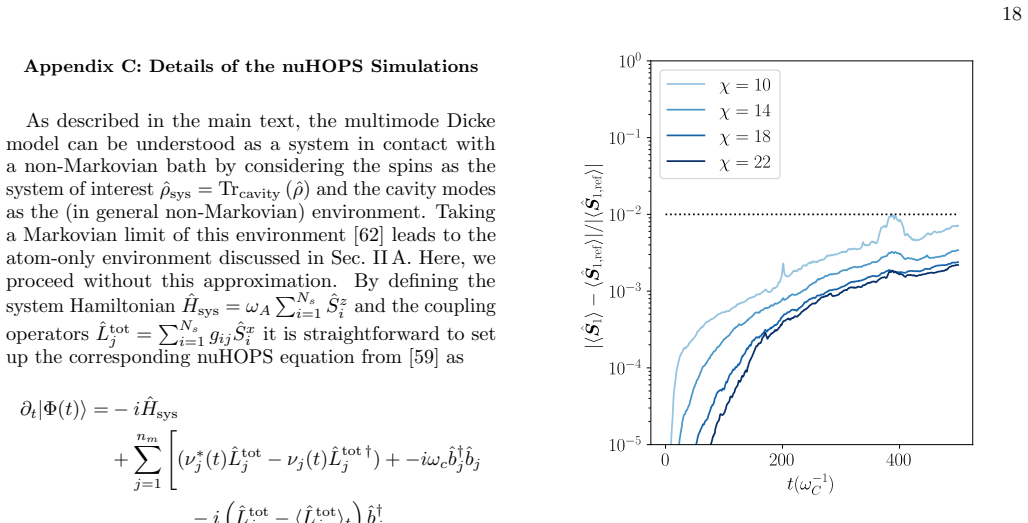
The mean-field equations together with the truncated Wigner and hierarchy-of-pure-states methods correctly identify and count all stable steady-states without missing additional instabilities from correlations beyond those approximations.
What would settle it
An exact numerical solution for n_c = 4 or 5 clusters that yields a number of stable steady-states different from the corresponding Fibonacci number or that shows no persistent oscillations in the predicted subset.
Figures
read the original abstract
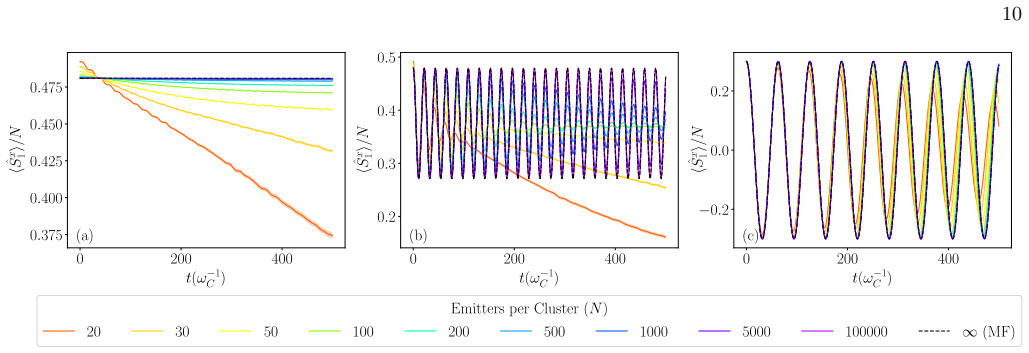
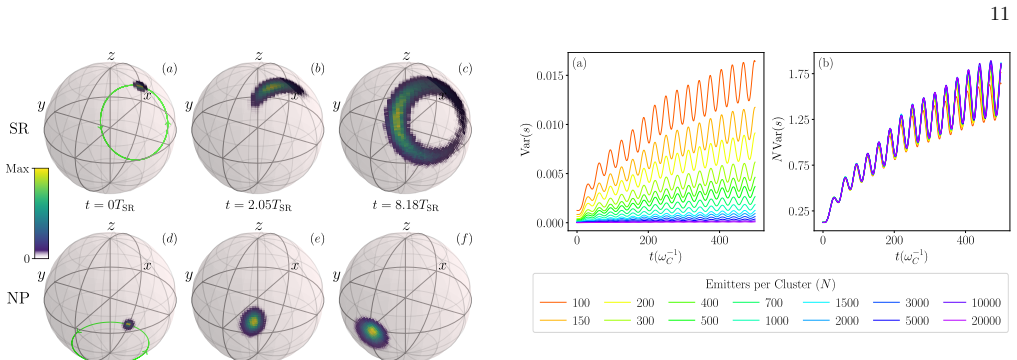
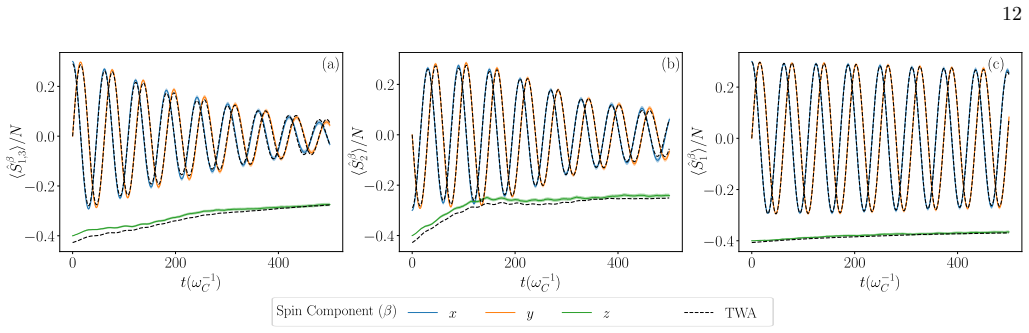
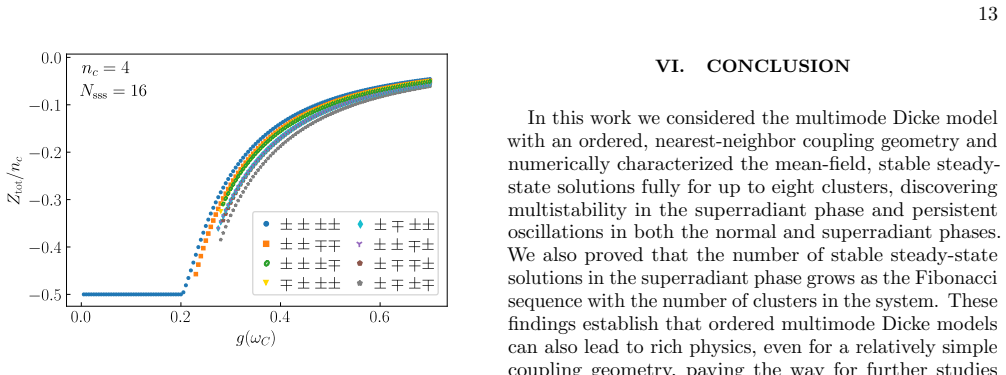
Ultracold atoms in multimode optical cavities provide a rich testbed for many-body phenomena enabled by light-mediated interactions. Recent experiments include realizations of spin glasses and associative memories, as described by multimode Dicke models with disordered couplings. However, the properties of multimode Dicke models with ordered coupling geometries remain largely unexplored. In this work, we investigate the stable steady-states of the multimode Dicke model with an ordered nearest-neighbor coupling geometry, where $n_c$ atomic clusters are coupled via $n_c-1$ cavity modes. We show that the number of mean-field stable steady-states in the superradiant phase exhibits Fibonacci scaling with the number of atomic clusters, and that a subset of these steady-states exhibit persistent oscillations. Using both the truncated Wigner approximation and the numerically-exact hierarchy of pure states, we further demonstrate that these features of the stable steady-state solutions persist for finite cluster sizes. Ordered multimode Dicke models, such as the nearest-neighbor coupling geometry considered here, are accessible with current experimental technologies and point toward a broader class of strongly interacting dissipative systems with similarly rich behavior.
Editorial analysis
A structured set of objections, weighed in public.
Referee Report
Summary. The manuscript analyzes the multimode Dicke model with ordered nearest-neighbor couplings, where n_c atomic clusters interact via n_c-1 cavity modes. It reports that the number of mean-field stable steady-states in the superradiant phase follows Fibonacci scaling with n_c, that a subset of these states exhibits persistent oscillations, and that both the scaling and the oscillations persist for finite cluster sizes according to truncated Wigner approximation (TWA) and hierarchy-of-pure-states (HOPS) calculations.
Significance. If the central claims hold, the work identifies an analytically tractable ordered geometry in multimode cavity QED that produces Fibonacci-structured steady-state landscapes and oscillatory attractors, providing a counterpoint to disordered multimode Dicke models and indicating experimental relevance with existing ultracold-atom platforms. The combination of mean-field analysis with both approximate and numerically exact methods is a methodological strength.
major comments (2)
- [§4 (Mean-field analysis)] §4 (Mean-field analysis): the recurrence that maps the nearest-neighbor coupling geometry onto Fibonacci numbers must be derived explicitly from the steady-state equations; without the closed-form relation or the explicit counting procedure, it is impossible to verify that the reported scaling is a structural consequence of the n_c-1 modes rather than a numerical coincidence.
- [§5 (TWA and HOPS results)] §5 (TWA and HOPS results): the manuscript must demonstrate convergence of the number of stable states with hierarchy depth in HOPS and quantify the effect of cumulant truncation in TWA on the superradiant fixed-point count; if either truncation systematically merges or eliminates states, the claim that Fibonacci scaling and persistent oscillations survive for finite n_c is not yet supported.
minor comments (2)
- [Abstract] Abstract: the range of n_c for which Fibonacci scaling is observed and the precise sequence (e.g., F_{n_c+2}) should be stated explicitly.
- [Figure captions] Figure captions: every panel showing steady-state counts or trajectories should label both the value of n_c and the method (mean-field, TWA, or HOPS) used.
Simulated Author's Rebuttal
We thank the referee for their careful reading of the manuscript and for the constructive major comments. We address each point below and will revise the manuscript accordingly to strengthen the presentation of the mean-field analysis and the finite-size results.
read point-by-point responses
-
Referee: §4 (Mean-field analysis): the recurrence that maps the nearest-neighbor coupling geometry onto Fibonacci numbers must be derived explicitly from the steady-state equations; without the closed-form relation or the explicit counting procedure, it is impossible to verify that the reported scaling is a structural consequence of the n_c-1 modes rather than a numerical coincidence.
Authors: We agree that an explicit derivation from the steady-state equations is required. In the revised manuscript we will expand §4 to derive the recurrence directly: the steady-state conditions on the mean-field amplitudes for the n_c-1 modes impose a chain of algebraic constraints whose number of stable solutions satisfies the Fibonacci recurrence S(n_c) = S(n_c-1) + S(n_c-2) with S(1)=1, S(2)=2. The derivation follows from partitioning the possible sign patterns of the superradiant amplitudes according to whether the additional cluster-mode pair is aligned with the preceding solution or introduces an independent stable branch. We will also include the closed-form counting procedure based on these recurrence relations. revision: yes
-
Referee: §5 (TWA and HOPS results): the manuscript must demonstrate convergence of the number of stable states with hierarchy depth in HOPS and quantify the effect of cumulant truncation in TWA on the superradiant fixed-point count; if either truncation systematically merges or eliminates states, the claim that Fibonacci scaling and persistent oscillations survive for finite n_c is not yet supported.
Authors: We accept that explicit convergence checks are necessary. In the revised §5 we will add data showing that the number of stable states identified by HOPS remains constant once the hierarchy depth exceeds a modest threshold for the system sizes examined, together with a quantitative comparison of TWA results at successive cumulant orders. These additions will confirm that neither truncation systematically alters the Fibonacci count or eliminates the oscillatory attractors for the finite n_c values considered. revision: yes
Circularity Check
No significant circularity; claims follow from model equations and numerical methods
full rationale
The paper derives the Fibonacci count of mean-field steady states directly from the recurrence structure of the nearest-neighbor ordered multimode Dicke model and verifies persistence under TWA and HOPS numerics. No self-definitional steps, no fitted inputs renamed as predictions, and no load-bearing self-citations appear in the provided text or abstract. The derivation chain is independent of its target results.
Axiom & Free-Parameter Ledger
Reference graph
Works this paper leans on
-
[1]
To that end, for a given sign pattern σ= (σ 1,
Singletons We have found that it is useful to classify steady-state solutions by the sign pattern of their x spin components. To that end, for a given sign pattern σ= (σ 1, . . . , σnc), σ i ∈ {±1},(A4) we look for a solution with sgn(xi) = σi. For given σ, we define the counting variable qi =1 {i>1 andσ i−1=σi} +1 {i<nc andσ i+1=σi}.(A5) For a given site...
-
[2]
III B of the main text we found that the stable steady-state solutions corresponded to the sign patterns with no singletons
Perturbation theory of no-singleton solutions In Section. III B of the main text we found that the stable steady-state solutions corresponded to the sign patterns with no singletons. The number of such patterns is given by the Fibonacci numbers, as per Eq. (14). Let us now argue for the perturbative continuity of these solutions in the strong coupling lim...
-
[3]
We begin by recording the fixed-point Hessian ofF(x), which will determine the stiffness matrix in the linearized dynamics
Linearized stability of no-singleton solutions To evaluate the stability of the no-singleton solutions, we must linearize the full mean-field dynamics. We begin by recording the fixed-point Hessian ofF(x), which will determine the stiffness matrix in the linearized dynamics. We have HF(x) = diag −ωA 4z3 i −4g 2V0T,(A13) where we have computed ∂2F/∂x i∂xj ...
-
[4]
The kernel of T is one-dimensional and spanned by the alternating vector a = (1 ,− 1, 1,− 1,
Persistent oscillations in the Superradiant phase To determine when the stability is asymptotic (meaning the system converges to the equilibrium point as t→ ∞ ), we use LaSalle’s invariance principle [ 67]. The kernel of T is one-dimensional and spanned by the alternating vector a = (1 ,− 1, 1,− 1, . . .)T , so the only potentially undamped direction is k...
-
[5]
Scaling of the perturbation parameter Let us now examine the physical conditions under which we have ϵ = ωA/g2V0 ≪ 1. An explicit computation shows thatV 0 = Re(α+) is given by V0 = 2ωC(ω2 c +κ 2 −ω 2 A) (ω2 C +κ 2 −ω 2 A)2 + 4ω2 Aκ2 .(A29) Assuming ωC ∼κ , and writing g = rgκ and ωA = rAκ, we then have ϵ=O rA r2g ,(A30) so for ϵ≪ 1 we need r2 g ≫r A, whi...
-
[6]
Existence of all no-singleton stable steady-states for smallϵ Finally, we find an upper bound on the value of ϵ needed to guarantee that the Hessian, HF(x∗), is positive definite, and thus to guarantee that all the no-singleton stable steady-state solutions exist. The exact Hessian is given by HF(x∗) =ω A diag 1 4|z∗,i|3 − 4 ϵ T .(A32) To ensure HF(x∗) is...
-
[7]
Below we will prove that we can get a suitable upper bound provided we take ϵ≤ 3 4
So we need to derive an upper bound on ∥z∗(ϵ)∥∞ from the mean-field equations. Below we will prove that we can get a suitable upper bound provided we take ϵ≤ 3 4 . (A34) Note that, while this is explicit, it is unlikely to be tight since there are various numerical factors in the proof that we have not attempted to optimize. Steady state solution as a fix...
-
[8]
= (1.868504,1.106345), (rx 2 , ry
-
[9]
= (−0.328201,0.562800), (rx 3 , ry
-
[10]
= (0.353471,0.112478), (rx 4 , ry
-
[11]
(D2) Note that this matrix has been scaled from the form given in Eq
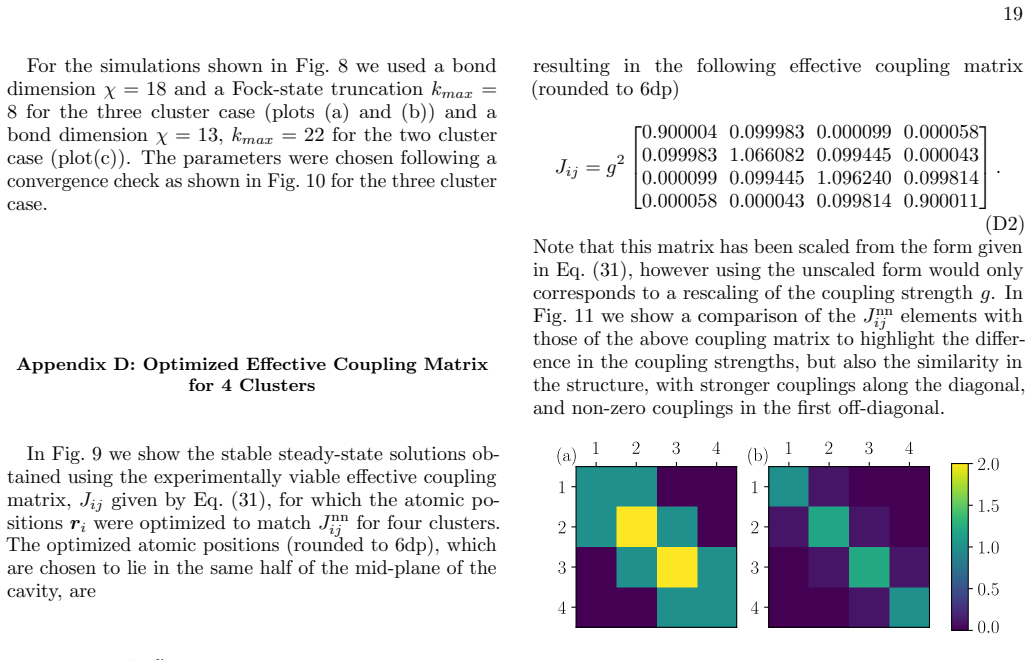
= (−0.301707,1.21919), (D1) resulting in the following effective coupling matrix (rounded to 6dp) Jij =g 2 0.900004 0.099983 0.000099 0.000058 0.099983 1.066082 0.099445 0.000043 0.000099 0.099445 1.096240 0.099814 0.000058 0.000043 0.099814 0.900011 . (D2) Note that this matrix has been scaled from the form given in Eq. (31), however using the ...
-
[12]
Hepp and E
K. Hepp and E. H. Lieb, Equilibrium Statistical Mechanics of Matter Interacting with the Quantized Radiation Field, Physical Review A8, 2517 (1973)
1973
-
[13]
Hepp and E
K. Hepp and E. H. Lieb, On the superradiant phase transition for molecules in a quantized radiation field: the dicke maser model, Annals of Physics76, 360 (1973)
1973
-
[14]
Y. K. Wang and F. T. Hioe, Phase Transition in the Dicke Model of Superradiance, Physical Review A7, 831 (1973)
1973
-
[15]
Kirton, M
P. Kirton, M. M. Roses, J. Keeling, and E. G. Dalla Torre, Introduction to the Dicke Model: From Equilibrium to Nonequilibrium, and Vice Versa, Advanced Quantum Technologies2, 1800043 (2019)
2019
-
[16]
Dimer, B
F. Dimer, B. Estienne, A. S. Parkins, and H. J. Carmichael, Proposed realization of the Dicke-model quan- tum phase transition in an optical cavity QED system, Physical Review A75, 013804 (2007)
2007
-
[17]
Emary and T
C. Emary and T. Brandes, Chaos and the quantum phase transition in the Dicke model, Physical Review E67, 066203 (2003)
2003
-
[18]
Baumann, C
K. Baumann, C. Guerlin, F. Brennecke, and T. Esslinger, Dicke quantum phase transition with a superfluid gas in an optical cavity, Nature464, 1301 (2010)
2010
-
[19]
Klinder, H
J. Klinder, H. Keßler, M. Wolke, L. Mathey, and A. Hem- merich, Dynamical phase transition in the open Dicke model, Proc. Natl. Acad. Sci. U.S.A.112, 3290 (2015)
2015
-
[20]
R. M. Kroeze, Y. Guo, V. D. Vaidya, J. Keeling, and B. L. Lev, Spinor self-ordering of a quantum gas in a cavity, Phys. Rev. Lett.121, 163601 (2018)
2018
-
[21]
B¨ uhler, A
T. B¨ uhler, A. Fabre, G. Bolognini, Z. Xue, T. Zwettler, G. Del Pace, and J.-P. Brantut, Microscopy of cavity- induced density-wave ordering in ultracold gases, Phys. Rev. Lett.136, 143401 (2026)
2026
-
[22]
M. J. Bhaseen, J. Mayoh, B. D. Simons, and J. Keel- ing, Dynamics of nonequilibrium Dicke models, Physical Review A85, 013817 (2012)
2012
-
[23]
K. C. Stitely, A. Giraldo, B. Krauskopf, and S. Parkins, Nonlinear semiclassical dynamics of the unbalanced, open Dicke model, Physical Review Research2, 033131 (2020)
2020
-
[24]
M¨ uller and W
K. M¨ uller and W. T. Strunz, Genuine Quantum Effects in Dicke-Type Models at Large Atom Numbers, Physical Review Letters135, 123602 (2025)
2025
-
[25]
Kirton and J
P. Kirton and J. Keeling, Superradiant and lasing states in driven-dissipative Dicke models, New Journal of Physics 20, 015009 (2018)
2018
-
[26]
Zhiqiang, C
Z. Zhiqiang, C. H. Lee, R. Kumar, K. J. Arnold, S. J. Masson, A. S. Parkins, and M. D. Barrett, Nonequilibrium phase transition in a spin-1 Dicke model, Optica4, 424 (2017)
2017
-
[27]
J. Jachinowski and P. B. Littlewood, Spin-only dynamics of the multi-species nonreciprocal Dicke model (2026), 20 arXiv:2507.07960 [cond-mat]
arXiv 2026
-
[28]
A. B. Bhattacherjee, Non-equilibrium dynamical phases of the two-atom Dicke model, Physics Letters A378, 3244 (2014)
2014
-
[29]
Mivehvar, Conventional and Unconventional Dicke Models: Multistabilities and Nonequilibrium Dynamics, Physical Review Letters132, 073602 (2024)
F. Mivehvar, Conventional and Unconventional Dicke Models: Multistabilities and Nonequilibrium Dynamics, Physical Review Letters132, 073602 (2024)
2024
-
[30]
Iemini, D
F. Iemini, D. Chang, and J. Marino, Dynamics of in- homogeneous spin ensembles with all-to-all interactions: Breaking permutational invariance, Physical Review A 109, 032204 (2024)
2024
-
[31]
X. Zhao, N. Liu, and J.-Q. Liang, Collective atomic- population-inversion and stimulated radiation for two- component Bose-Einstein condensate in an optical cavity, Optics Express25, 8123 (2017)
2017
-
[32]
B. P. Marsh, R. M. Kroeze, S. Ganguli, S. Gopalakrishnan, J. Keeling, and B. L. Lev, Entanglement and Replica Symmetry Breaking in a Driven-Dissipative Quantum Spin Glass, Physical Review X14, 011026 (2024)
2024
-
[33]
Gopalakrishnan, B
S. Gopalakrishnan, B. L. Lev, and P. M. Goldbart, Frustra- tion and Glassiness in Spin Models with Cavity-Mediated Interactions, Physical Review Letters107, 277201 (2011)
2011
-
[34]
Buchhold, P
M. Buchhold, P. Strack, S. Sachdev, and S. Diehl, Dicke- model quantum spin and photon glass in optical cavities: Nonequilibrium theory and experimental signatures, Phys- ical Review A87, 063622 (2013)
2013
-
[35]
Hosseinabadi, D
H. Hosseinabadi, D. E. Chang, and J. Marino, Quantum- to-classical crossover in the spin glass dynamics of cavity QED simulators, Physical Review Research6, 043313 (2024)
2024
-
[36]
B. P. Marsh, D. A. Schuller, Y. Ji, H. S. Hunt, G. Z. Socolof, D. P. Bowman, J. Keeling, and B. L. Lev, Mul- timode Cavity QED Ising Spin Glass, Physical Review Letters135, 160403 (2025)
2025
-
[37]
Tolkunov and D
D. Tolkunov and D. Solenov, Quantum phase transition in the multimode Dicke model, Physical Review B75, 024402 (2007)
2007
-
[38]
E. I. R. Chiacchio and A. Nunnenkamp, Emergence of continuous rotational symmetries in ultracold atoms cou- pled to optical cavities, Physical Review A98, 023617 (2018)
2018
-
[39]
R. I. Moodie, K. E. Ballantine, and J. Keeling, General- ized classes of continuous symmetries in two-mode Dicke models, Physical Review A97, 033802 (2018)
2018
-
[40]
Y. Guo, R. M. Kroeze, V. D. Vaidya, J. Keeling, and B. L. Lev, Sign-Changing Photon-Mediated Atom Interactions in Multimode Cavity Quantum Electrodynamics, Physical Review Letters122, 193601 (2019)
2019
-
[41]
Y. Guo, V. D. Vaidya, R. M. Kroeze, R. A. Lunney, B. L. Lev, and J. Keeling, Emergent and broken symmetries of atomic self-organization arising from Gouy phase shifts in multimode cavity QED, Physical Review A99, 053818 (2019)
2019
-
[42]
B. P. Marsh, Y. Guo, R. M. Kroeze, S. Gopalakrishnan, S. Ganguli, J. Keeling, and B. L. Lev, Enhancing Associa- tive Memory Recall and Storage Capacity Using Confocal Cavity QED, Physical Review X11, 021048 (2021)
2021
-
[43]
V. Link, K. M¨ uller, R. G. Lena, K. Luoma, F. Damanet, W. T. Strunz, and A. J. Daley, Non-Markovian Quantum Dynamics in Strongly Coupled Multimode Cavities Con- ditioned on Continuous Measurement, PRX Quantum3, 020348 (2022)
2022
-
[44]
Hosseinabadi, D
H. Hosseinabadi, D. E. Chang, and J. Marino, Far from equilibrium field theory for strongly coupled light and matter: Dynamics of frustrated multimode cavity QED, Physical Review Research6, 043314 (2024)
2024
-
[45]
Fiorelli, M
E. Fiorelli, M. Marcuzzi, P. Rotondo, F. Carollo, and I. Lesanovsky, Signatures of Associative Memory Behavior in a Multimode Dicke Model, Physical Review Letters 125, 070604 (2020)
2020
-
[46]
Mivehvar, F
F. Mivehvar, F. Piazza, T. Donner, and H. Ritsch, Cavity QED with quantum gases: new paradigms in many-body physics, Adv. Phys.70, 1 (2021)
2021
-
[47]
O. Adiv, B. Krauskopf, and S. Parkins, Nonlinear dynam- ics of a Dicke model for V-type atoms, Physical Review A113, 023723 (2026)
2026
-
[48]
R. M. Kroeze, B. P. Marsh, D. Atri Schuller, H. S. Hunt, A. N. Bourzutschky, M. Winer, S. Gopalakrish- nan, J. Keeling, and B. L. Lev, Directly observing replica symmetry breaking in a vector quantum-optical spin glass, Science0, eadu7710 (2025)
2025
-
[49]
B. P. Marsh, D. A. Schuller, Y. Ji, H. S. Hunt, S. Gan- guli, S. Gopalakrishnan, J. Keeling, and B. L. Lev, High- capacity associative memory in a quantum-optical spin glass (2025), arXiv:2509.12202 [quant-ph]
arXiv 2025
-
[50]
R. M. Kroeze, B. P. Marsh, K.-Y. Lin, J. Keeling, and B. L. Lev, High Cooperativity Using a Confocal-Cavity–QED Microscope, PRX Quantum4, 020326 (2023)
2023
-
[51]
V. D. Vaidya, Y. Guo, R. M. Kroeze, K. E. Ballantine, A. J. Koll´ ar, J. Keeling, and B. L. Lev, Tunable-Range, Photon-Mediated Atomic Interactions in Multimode Cav- ity QED, Physical Review X8, 011002 (2018)
2018
-
[52]
Y. Guo, R. M. Kroeze, B. P. Marsh, S. Gopalakrishnan, J. Keeling, and B. L. Lev, An optical lattice with sound, Nature599, 211 (2021)
2021
-
[53]
A. J. Koll´ ar, A. T. Papageorge, K. Baumann, M. A. Armen, and B. L. Lev, An adjustable-length cavity and Bose–Einstein condensate apparatus for multimode cavity QED, New Journal of Physics17, 043012 (2015)
2015
-
[54]
A. J. Koll´ ar, A. T. Papageorge, V. D. Vaidya, Y. Guo, J. Keeling, and B. L. Lev, Supermode-density-wave- polariton condensation with a Bose–Einstein condensate in a multimode cavity, Nature Communications8, 14386 (2017)
2017
-
[55]
Strack and S
P. Strack and S. Sachdev, Dicke Quantum Spin Glass of Atoms and Photons, Physical Review Letters107, 277202 (2011)
2011
-
[56]
Gopalakrishnan, B
S. Gopalakrishnan, B. L. Lev, and P. M. Goldbart, Emer- gent crystallinity and frustration with Bose–Einstein con- densates in multimode cavities, Nature Physics5, 845 (2009)
2009
-
[57]
B. P. Marsh,Quantum-Optical Neural Networks and Spin Glasses Made of Ultracold Atoms and Photons, Ph.D. thesis, Stanford University (2024)
2024
-
[58]
Gopalakrishnan, B
S. Gopalakrishnan, B. L. Lev, and P. M. Goldbart, Ex- ploring models of associative memory via cavity quantum electrodynamics, Philosophical Magazine92, 353 (2012)
2012
-
[59]
V. Erba, M. Pastore, and P. Rotondo, Self-Induced Glassy Phase in Multimodal Cavity Quantum Electrodynamics, Physical Review Letters126, 183601 (2021)
2021
-
[60]
J. Lang, F. Piazza, and W. Zwerger, Collective excita- tions and supersolid behavior of bosonic atoms inside two crossed optical cavities, New Journal of Physics19, 123027 (2017)
2017
-
[61]
J. Fan, Z. Yang, Y. Zhang, J. Ma, G. Chen, and S. Jia, Hid- den continuous symmetry and Nambu-Goldstone mode in a two-mode Dicke model, Physical Review A89, 023812 (2014). 21
2014
-
[62]
Wickenbrock, M
A. Wickenbrock, M. Hemmerling, G. R. M. Robb, C. Emary, and F. Renzoni, Collective strong coupling in multimode cavity QED, Physical Review A87, 043817 (2013)
2013
-
[63]
L´ eonard, A
J. L´ eonard, A. Morales, P. Zupancic, T. Esslinger, and T. Donner, Supersolid formation in a quantum gas break- ing a continuous translational symmetry, Nature543, 87 (2017)
2017
-
[64]
Baumg¨ artner, S
A. Baumg¨ artner, S. Hertlein, T. Schmit, D. Dreon, C. M´ aximo, X. Li, G. Morigi, and T. Donner, Stabil- ity and decay of subradiant patterns in a quantum gas with photon-mediated interactions, Science Advances11, eadw0299 (2025)
2025
-
[65]
L´ eonard, A
J. L´ eonard, A. Morales, P. Zupancic, T. Donner, and T. Esslinger, Monitoring and manipulating Higgs and Goldstone modes in a supersolid quantum gas, Science 358, 1415 (2017)
2017
-
[66]
Morales, P
A. Morales, P. Zupancic, J. L´ eonard, T. Esslinger, and T. Donner, Coupling two order parameters in a quantum gas, Nature Materials17, 686 (2018)
2018
-
[67]
Polkovnikov, Phase space representation of quantum dynamics, Annals of Physics325, 1790 (2010)
A. Polkovnikov, Phase space representation of quantum dynamics, Annals of Physics325, 1790 (2010)
2010
-
[68]
Suess, A
D. Suess, A. Eisfeld, and W. T. Strunz, Hierarchy of Stochastic Pure States for Open Quantum System Dy- namics, Physical Review Letters113, 150403 (2014)
2014
-
[69]
Hartmann and W
R. Hartmann and W. T. Strunz, Exact Open Quantum System Dynamics Using the Hierarchy of Pure States (HOPS), Journal of Chemical Theory and Computation 13, 5834 (2017)
2017
-
[70]
M¨ uller and W
K. M¨ uller and W. T. Strunz, Quantum trajectory method for highly excited environments in non-Markovian open quantum dynamics, Physical Review A112, 033719 (2025)
2025
-
[71]
Lindblad, On the generators of quantum dynamical semigroups, Communications in Mathematical Physics 48, 119 (1976)
G. Lindblad, On the generators of quantum dynamical semigroups, Communications in Mathematical Physics 48, 119 (1976)
1976
-
[72]
Gorini, A
V. Gorini, A. Kossakowski, and E. C. G. Sudarshan, Com- pletely positive dynamical semigroups of N-level systems, Journal of Mathematical Physics17, 821 (1976)
1976
-
[73]
S. B. J¨ ager, T. Schmit, G. Morigi, M. J. Holland, and R. Betzholz, Lindblad Master Equations for Quantum Systems Coupled to Dissipative Bosonic Modes, Physical Review Letters129, 063601 (2022)
2022
-
[74]
S. H. Strogatz,Nonlinear Dynamics and Chaos: With Applications to Physics, Biology, Chemistry, and Engi- neering, 2nd ed. (CRC Press, Boca Raton, 2018)
2018
-
[75]
This labeling only uniquely identifiesstablesteady-state solutions, as there can be multiple additional unstable steady-state solutions with the same sign pattern but different magnitudes of thex-spin components
-
[76]
R. P. Stanley,Enumerative Combinatorics: Volume 1 (Cambridge University Press, 1997)
1997
-
[77]
V. E. Hoggatt Jr. and D. A. Lind, Compositions and Fi- bonacci Numbers, The Fibonacci Quarterly7, 253 (1969)
1969
-
[78]
H. K. Khalil,Nonlinear Systems(Prentice Hall, 2002)
2002
-
[79]
We note that this analysis does not rule out the possibility of additional stable steady-state solutions, which do not follow this pattern
-
[80]
Hosseinabadi, O
H. Hosseinabadi, O. Chelpanova, and J. Marino, User- Friendly Truncated Wigner Approximation for Dissipative Spin Dynamics, PRX Quantum6, 030344 (2025)
2025
discussion (0)
Sign in with ORCID, Apple, or X to comment. Anyone can read and Pith papers without signing in.