Hierarchical Semantic-Constrained Heterogeneous Graph for Audio-Visual Event Localization
Pith reviewed 2026-06-27 22:19 UTC · model grok-4.3
The pith
A heterogeneous graph with bidirectional semantic constraints and hyperbolic mapping maintains consistency for audio-visual events unseen in training.
A machine-rendered reading of the paper's core claim, the machinery that carries it, and where it could break.
Core claim
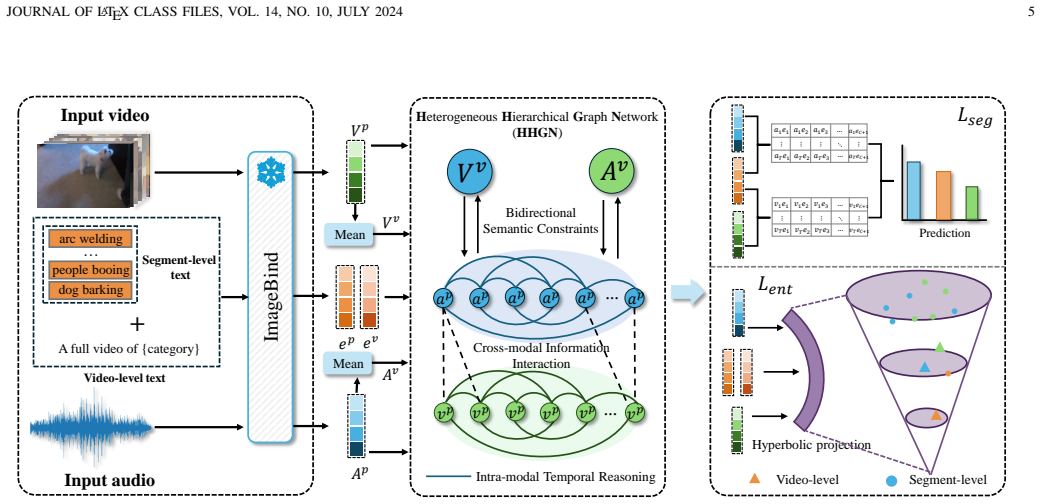
The authors claim that a hierarchical semantic-constrained heterogeneous graph constructed in Euclidean space, equipped with bidirectional constraints between segment- and video-level nodes and a subsequent mapping to hyperbolic space regularized by a hierarchical entailment loss, produces the semantic consistency across levels and modalities required for open-vocabulary audio-visual event localization, yielding higher performance than prior methods on the OV-AVEL benchmark.
What carries the argument
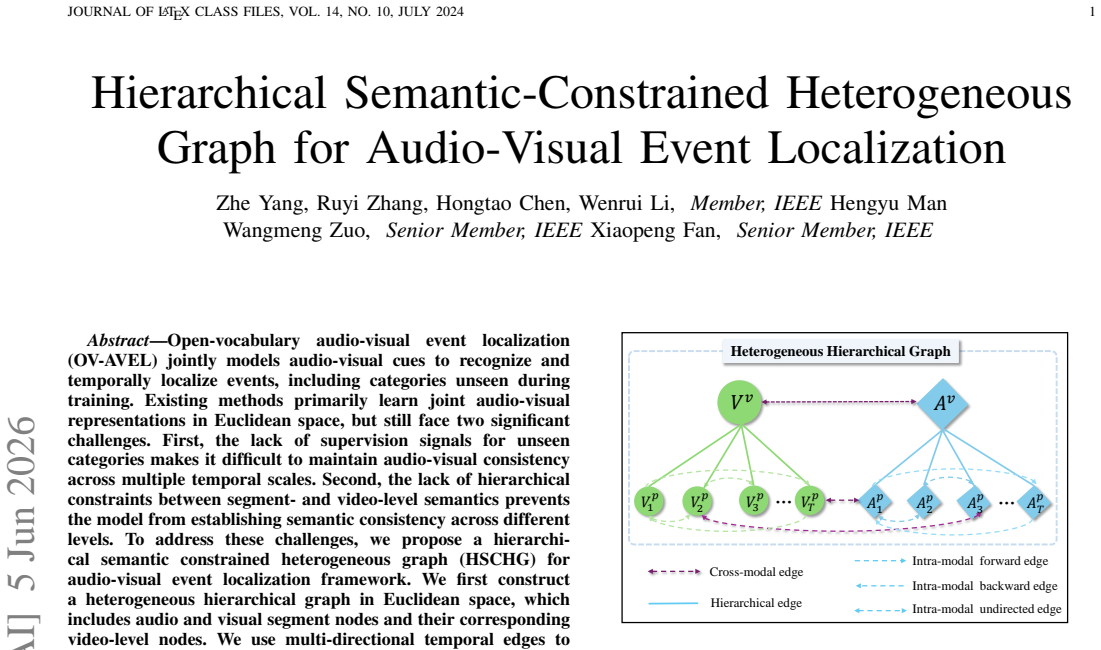
The hierarchical semantic-constrained heterogeneous graph (HSCHG), which links audio-visual segment nodes to video-level nodes through temporal and cross-modal edges while enforcing bidirectional semantic constraints and hyperbolic hierarchical relationships via an entailment loss.
If this is right
- The model integrates cross-modal cues selectively via dual-threshold gated fusion rather than unconditionally.
- Semantic consistency is enforced both within each modality across time and between segment and video levels.
- Hierarchical relationships between video and segment representations are captured explicitly in hyperbolic space.
- The resulting representations support localization of events from categories absent from the training set.
Where Pith is reading between the lines
- The same combination of Euclidean graph construction and hyperbolic hierarchical regularization could be tested on other multi-modal temporal tasks such as audio-visual captioning or action segmentation with novel classes.
- The dual-threshold filtering step may require domain-specific retuning of the thresholds when moving from the OV-AVEL benchmark to new data distributions.
- If the entailment loss proves robust, it could serve as a drop-in regularizer for other open-vocabulary multi-modal problems that already use hyperbolic embeddings.
Load-bearing premise
That bidirectional semantic constraints together with the hierarchical entailment loss in hyperbolic space will enforce consistency even when the test events belong to categories that supplied no training examples.
What would settle it
An ablation on the OV-AVEL benchmark in which removing the bidirectional constraints or the hyperbolic entailment loss causes localization accuracy on unseen categories to fall to the level of existing Euclidean baselines.
Figures
read the original abstract
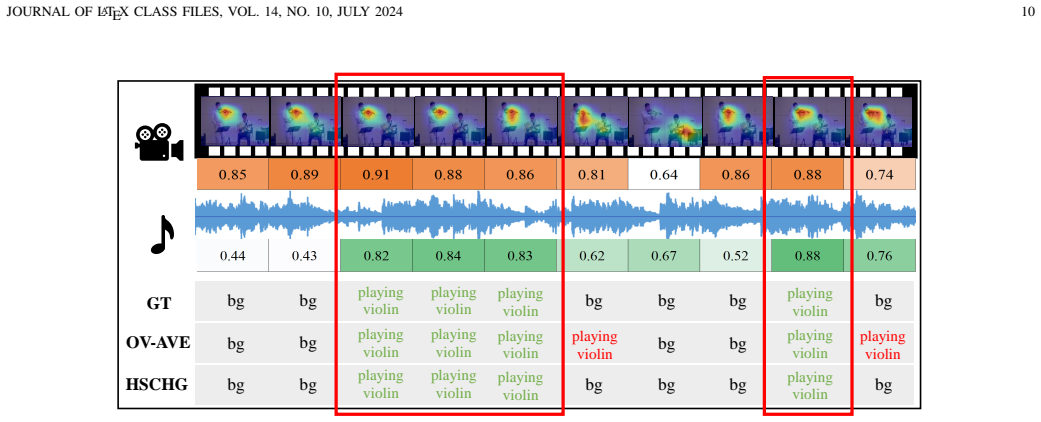
Open-vocabulary audio-visual event localization (OV-AVEL) jointly models audio-visual cues to recognize and temporally localize events, including categories unseen during training. Existing methods primarily learn joint audio-visual representations in Euclidean space, but still face two significant challenges. First, the lack of supervision signals for unseen categories makes it difficult to maintain audio-visual consistency across multiple temporal scales. Second, the lack of hierarchical constraints between segment- and video-level semantics prevents the model from establishing semantic consistency across different levels. To address these challenges, we propose a hierarchical semantic constrained heterogeneous graph (HSCHG) for audio-visual event localization framework. We first construct a heterogeneous hierarchical graph in Euclidean space, which includes audio and visual segment nodes and their corresponding video-level nodes. We use multi-directional temporal edges to capture complete temporal information within each modality. Simultaneously, we employ a dual-threshold filtering gated fusion strategy, introducing cross-modal information only when the alignment confidence is high. Furthermore, we introduce bidirectional semantic constraints between segment- and video-level representations to achieve semantic consistency across different levels. Based on this, we map the multi-level audio-visual representations and text prototypes uniformly into hyperbolic space. We use a hierarchical entailment regularization loss to characterize the hierarchical relationships between videos and segments. Extensive experimental results show that our method outperforms existing methods on the OV-AVEL benchmark. Ablation studies further validate the effectiveness of our method.
Editorial analysis
A structured set of objections, weighed in public.
Referee Report
Summary. The manuscript proposes the Hierarchical Semantic-Constrained Heterogeneous Graph (HSCHG) framework for open-vocabulary audio-visual event localization (OV-AVEL). It constructs a heterogeneous hierarchical graph in Euclidean space with audio/visual segment and video-level nodes, multi-directional temporal edges, dual-threshold gated fusion for cross-modal information, bidirectional semantic constraints between levels, then maps representations and text prototypes to hyperbolic space with a hierarchical entailment regularization loss. The central claim is outperformance over existing methods on the OV-AVEL benchmark, with ablations validating component effectiveness.
Significance. If the results hold, the combination of heterogeneous graph structure with hyperbolic-space hierarchical entailment offers a structured way to enforce cross-level and cross-modal semantic consistency for unseen categories. The explicit treatment of both temporal multi-directionality and level-wise constraints is a positive step beyond standard Euclidean joint embeddings.
major comments (2)
- [Experiments] Experiments section: the outperformance claim on OV-AVEL for unseen categories rests on the full model but provides no ablation isolating the hierarchical entailment regularization loss (and hyperbolic mapping) from the Euclidean heterogeneous graph plus bidirectional constraints alone. This is load-bearing for the open-vocabulary result, as the graph structure may suffice without the hyperbolic component.
- [Method] Method section (proposed framework): the mechanism for generating text prototypes for unseen categories is not specified in sufficient detail to rule out supervision leakage, which directly affects the validity of the open-vocabulary consistency claim.
minor comments (1)
- Abstract: no quantitative results, error bars, dataset statistics, or baseline numbers are supplied, which weakens the reader's ability to gauge the practical magnitude of the reported gains.
Simulated Author's Rebuttal
We thank the referee for the constructive comments and positive assessment of the framework's potential significance. We address each major comment below.
read point-by-point responses
-
Referee: [Experiments] Experiments section: the outperformance claim on OV-AVEL for unseen categories rests on the full model but provides no ablation isolating the hierarchical entailment regularization loss (and hyperbolic mapping) from the Euclidean heterogeneous graph plus bidirectional constraints alone. This is load-bearing for the open-vocabulary result, as the graph structure may suffice without the hyperbolic component.
Authors: We agree that an explicit ablation isolating the hierarchical entailment regularization loss and hyperbolic mapping is necessary to substantiate the contribution to open-vocabulary performance. Our current ablations evaluate the heterogeneous graph construction, multi-directional edges, dual-threshold fusion, and bidirectional semantic constraints, but do not include a direct Euclidean-only variant without the hyperbolic component. We will add this ablation study to the revised Experiments section, reporting performance on the OV-AVEL unseen categories for the full model versus the Euclidean graph plus bidirectional constraints alone. revision: yes
-
Referee: [Method] Method section (proposed framework): the mechanism for generating text prototypes for unseen categories is not specified in sufficient detail to rule out supervision leakage, which directly affects the validity of the open-vocabulary consistency claim.
Authors: We acknowledge that additional detail is required. Text prototypes for unseen categories are obtained by passing the raw category name strings through a frozen pre-trained CLIP text encoder with no fine-tuning or exposure to the OV-AVEL training data or labels. This design precludes supervision leakage. We will expand the Method section with a new subsection explicitly describing the text prototype generation pipeline, the encoder choice, its frozen status, and the absence of any target-dataset supervision. revision: yes
Circularity Check
No circularity: method description and experimental claims are self-contained without reductions to fitted inputs or self-referential definitions.
full rationale
The paper proposes a heterogeneous graph construction in Euclidean space followed by hyperbolic mapping and a hierarchical entailment loss, then reports outperformance on the OV-AVEL benchmark via experiments and ablations. No equations, parameter-fitting steps, or derivations are exhibited that reduce a claimed prediction or result to an input quantity by construction. The bidirectional constraints and entailment regularization are presented as architectural choices whose contribution is assessed externally via ablation, not defined in terms of the target consistency metric. Self-citations are absent from the provided text, and the open-vocabulary claim rests on benchmark evaluation rather than any self-definitional loop. This is the normal case of an empirical ML architecture paper whose central claims remain falsifiable outside its own fitted values.
Axiom & Free-Parameter Ledger
Reference graph
Works this paper leans on
-
[1]
Multi-layer probabilistic association reasoning network for image-text retrieval.IEEE Transac- tions on Circuits and Systems for Video Technology, 34(10):9706–9717, 2024
Wenrui Li, Ruiqin Xiong, and Xiaopeng Fan. Multi-layer probabilistic association reasoning network for image-text retrieval.IEEE Transac- tions on Circuits and Systems for Video Technology, 34(10):9706–9717, 2024
2024
-
[2]
Fedpam: Federated personalized augmentation model for text- to-image retrieval
Yueying Feng, Fan Ma, Wang Lin, Chang Yao, Jingyuan Chen, and Yi Yang. Fedpam: Federated personalized augmentation model for text- to-image retrieval. InProceedings of the 2024 International Conference on Multimedia Retrieval, pages 1185–1189, 2024
2024
-
[3]
Neuron-based spiking transmission and reasoning network for robust image-text retrieval.IEEE Transactions on Circuits and Systems for Video Technology, 33(7):3516–3528, 2023
Wenrui Li, Zhengyu Ma, Liang-Jian Deng, Xiaopeng Fan, and Yonghong Tian. Neuron-based spiking transmission and reasoning network for robust image-text retrieval.IEEE Transactions on Circuits and Systems for Video Technology, 33(7):3516–3528, 2023
2023
-
[4]
Reservoir computing transformer for image- text retrieval
Wenrui Li, Zhengyu Ma, Liang-Jian Deng, Penghong Wang, Jinqiao Shi, and Xiaopeng Fan. Reservoir computing transformer for image- text retrieval. InProceedings of the 31st ACM International Conference on Multimedia, pages 5605–5613, 2023. JOURNAL OF LATEX CLASS FILES, VOL. 14, NO. 10, JULY 2024 12
2023
-
[5]
Text-video retrieval with global-local semantic consistent learning.IEEE Transactions on Image Processing, 34:3463–3474, 2025
Haonan Zhang, Pengpeng Zeng, Lianli Gao, Jingkuan Song, Yihang Duan, Xinyu Lyu, and Heng Tao Shen. Text-video retrieval with global-local semantic consistent learning.IEEE Transactions on Image Processing, 34:3463–3474, 2025
2025
-
[6]
Ump: Unified modality-aware prompt tuning for text- video retrieval.IEEE Transactions on Circuits and Systems for Video Technology, 34(11):11954–11964, 2024
Haonan Zhang, Pengpeng Zeng, Lianli Gao, Jingkuan Song, and Heng Tao Shen. Ump: Unified modality-aware prompt tuning for text- video retrieval.IEEE Transactions on Circuits and Systems for Video Technology, 34(11):11954–11964, 2024
2024
-
[7]
Exploiting unlabeled videos for video-text retrieval via pseudo-supervised learning.IEEE Transactions on Image Processing, 33:6748–6760, 2024
Yu Lu, Ruijie Quan, Linchao Zhu, and Yi Yang. Exploiting unlabeled videos for video-text retrieval via pseudo-supervised learning.IEEE Transactions on Image Processing, 33:6748–6760, 2024
2024
-
[8]
Zero-shot video ground- ing with pseudo query lookup and verification.IEEE Transactions on Image Processing, 33:1643–1654, 2024
Yu Lu, Ruijie Quan, Linchao Zhu, and Yi Yang. Zero-shot video ground- ing with pseudo query lookup and verification.IEEE Transactions on Image Processing, 33:1643–1654, 2024
2024
-
[9]
Aicl: Action in-context learning for text-to-video generation
Jianzhi Liu, Junchen Zhu, Pengpeng Zeng, Lianli Gao, Heng Tao Shen, and Jingkuan Song. Aicl: Action in-context learning for text-to-video generation. InProceedings of the 33rd ACM International Conference on Multimedia, pages 9414–9423, 2025
2025
-
[10]
Spiking tucker fusion transformer for audio-visual zero-shot learning.IEEE Transactions on Image Processing, 33:4840–4852, 2024
Wenrui Li, Penghong Wang, Ruiqin Xiong, and Xiaopeng Fan. Spiking tucker fusion transformer for audio-visual zero-shot learning.IEEE Transactions on Image Processing, 33:4840–4852, 2024
2024
-
[11]
Multi-timescale motion-decoupled spiking transformer for audio-visual zero-shot learning.IEEE Transactions on Circuits and Systems for Video Technology, pages 1–1, 2025
Wenrui Li, Penghong Wang, Xingtao Wang, Wangmeng Zuo, Xiaopeng Fan, and Yonghong Tian. Multi-timescale motion-decoupled spiking transformer for audio-visual zero-shot learning.IEEE Transactions on Circuits and Systems for Video Technology, pages 1–1, 2025
2025
-
[12]
Motion-decoupled spiking transformer for audio- visual zero-shot learning
Wenrui Li, Xi-Le Zhao, Zhengyu Ma, Xingtao Wang, Xiaopeng Fan, and Yonghong Tian. Motion-decoupled spiking transformer for audio- visual zero-shot learning. InProceedings of the 31st ACM International Conference on Multimedia, pages 3994–4002, 2023
2023
-
[13]
Multi-modal spiking tensor regression network for audio-visual zero-shot learning
Zhe Yang, Wenrui Li, Jinxiu Hou, and Guanghui Cheng. Multi-modal spiking tensor regression network for audio-visual zero-shot learning. Neurocomputing, 629:129636, 2025
2025
-
[14]
Spiking variational graph representation inference for video summarization.IEEE Transactions on Image Processing, 34:5697–5709, 2025
Wenrui Li, Wei Han, Liang-Jian Deng, Ruiqin Xiong, and Xiaopeng Fan. Spiking variational graph representation inference for video summarization.IEEE Transactions on Image Processing, 34:5697–5709, 2025
2025
-
[16]
Dis- criminative cross-modality attention network for temporal inconsistent audio-visual event localization.IEEE Transactions on Image Processing, 30:7878–7888, 2021
Hanyu Xuan, Lei Luo, Zhenyu Zhang, Jian Yang, and Yan Yan. Dis- criminative cross-modality attention network for temporal inconsistent audio-visual event localization.IEEE Transactions on Image Processing, 30:7878–7888, 2021
2021
-
[17]
Cross-modal background suppression for audio-visual event localization
Yan Xia and Zhou Zhao. Cross-modal background suppression for audio-visual event localization. InProceedings of the IEEE/CVF Conference on Computer Vision and Pattern Recognition, pages 19989– 19998, June 2022
2022
-
[18]
Dense modality interaction network for audio-visual event localization.IEEE Transactions on Multimedia, 25:2734–2748, 2023
Shuo Liu, Weize Quan, Chaoqun Wang, Yuan Liu, Bin Liu, and Dong- Ming Yan. Dense modality interaction network for audio-visual event localization.IEEE Transactions on Multimedia, 25:2734–2748, 2023
2023
-
[19]
Learning event-specific localization preferences for audio- visual event localization
Shiping Ge, Zhiwei Jiang, Yafeng Yin, Cong Wang, Zifeng Cheng, and Qing Gu. Learning event-specific localization preferences for audio- visual event localization. InProceedings of the 31st ACM International Conference on Multimedia, pages 3446–3454, 2023
2023
-
[20]
Towards open-vocabulary audio-visual event localization
Jinxing Zhou, Dan Guo, Ruohao Guo, Yuxin Mao, Jingjing Hu, Yiran Zhong, Xiaojun Chang, and Meng Wang. Towards open-vocabulary audio-visual event localization. InProceedings of the IEEE/CVF Conference on Computer Vision and Pattern Recognition, pages 8362– 8371, June 2025
2025
-
[21]
Ov-davel: Towards open-vocabulary dense audio-visual event localization in untrimmed videos
Jiale Yu, Baopeng Zhang, Zhu Teng, and Jianping Fan. Ov-davel: Towards open-vocabulary dense audio-visual event localization in untrimmed videos. InProceedings of the 33rd ACM International Conference on Multimedia, pages 553–562, 2025
2025
-
[22]
Poincar ´e embeddings for learn- ing hierarchical representations
Maximillian Nickel and Douwe Kiela. Poincar ´e embeddings for learn- ing hierarchical representations. InAdvances in Neural Information Processing Systems, volume 30, 2017
2017
-
[23]
Hyperbolic audio-visual zero-shot learning
Jie Hong, Zeeshan Hayder, Junlin Han, Pengfei Fang, Mehrtash Harandi, and Lars Petersson. Hyperbolic audio-visual zero-shot learning. In Proceedings of the IEEE/CVF International Conference on Computer Vision, pages 7873–7883, October 2023
2023
-
[24]
Shmamba: Structured hyperbolic state space model for audio-visual question answering.IEEE Transactions on Audio, Speech and Language Processing, 33:3582– 3593, 2025
Zhe Yang, Wenrui Li, and Guanghui Cheng. Shmamba: Structured hyperbolic state space model for audio-visual question answering.IEEE Transactions on Audio, Speech and Language Processing, 33:3582– 3593, 2025
2025
-
[25]
Css-net: A consistent segment selection network for audio-visual event localization
Fan Feng, Yue Ming, Nannan Hu, Hui Yu, and Yuanan Liu. Css-net: A consistent segment selection network for audio-visual event localization. IEEE Transactions on Multimedia, 26:701–713, 2024
2024
-
[26]
Listen with seeing: Cross-modal contrastive learning for audio- visual event localization.IEEE Transactions on Multimedia, 27:2650– 2665, 2025
Chao Sun, Min Chen, Chuanbo Zhu, Sheng Zhang, Ping Lu, and Jincai Chen. Listen with seeing: Cross-modal contrastive learning for audio- visual event localization.IEEE Transactions on Multimedia, 27:2650– 2665, 2025
2025
-
[27]
Dense audio-visual event localization under cross-modal consistency and multi-temporal granularity collaboration
Ziheng Zhou, Jinxing Zhou, Wei Qian, Shengeng Tang, Xiaojun Chang, and Dan Guo. Dense audio-visual event localization under cross-modal consistency and multi-temporal granularity collaboration. InProceed- ings of the AAAI Conference on Artificial Intelligence, volume 39, pages 10905–10913, April 2025
2025
-
[28]
Fine-grained audio–visual event localization.IEEE Transactions on Neural Networks and Learning Systems, pages 1–15, 2025
Baoyu Fan, Lu Liu, Xiaochuan Li, Runze Zhang, Liang Jin, and Jin Zhang. Fine-grained audio–visual event localization.IEEE Transactions on Neural Networks and Learning Systems, pages 1–15, 2025
2025
-
[29]
Hierarchical attention networks for document classification
Zichao Yang, Diyi Yang, Chris Dyer, Xiaodong He, Alex Smola, and Ed- uard Hovy. Hierarchical attention networks for document classification. InProceedings of the 2016 Conference of the North American Chapter of the Association for Computational Linguistics: Human Language Technologies, pages 1480–1489, 2016
2016
-
[30]
Hierarchical self-attention network for action localization in videos
Rizard Renanda Adhi Pramono, Yie-Tarng Chen, and Wen-Hsien Fang. Hierarchical self-attention network for action localization in videos. In Proceedings of the IEEE/CVF International Conference on Computer Vision, October 2019
2019
-
[31]
Learning from untrimmed videos: Self-supervised video representation learning with hierarchical consistency
Zhiwu Qing, Shiwei Zhang, Ziyuan Huang, Yi Xu, Xiang Wang, Mingqian Tang, Changxin Gao, Rong Jin, and Nong Sang. Learning from untrimmed videos: Self-supervised video representation learning with hierarchical consistency. InProceedings of the IEEE/CVF Confer- ence on Computer Vision and Pattern Recognition, pages 13821–13831, June 2022
2022
-
[32]
Hyperbolic entailment cones for learning hierarchical embeddings
Octavian Ganea, Gary Becigneul, and Thomas Hofmann. Hyperbolic entailment cones for learning hierarchical embeddings. InProceedings of the 35th International Conference on Machine Learning, pages 1646– 1655, July 2018
2018
-
[33]
Compositional entailment learning for hyperbolic vision-language models
Avik Pal, Max van Spengler, Guido Maria D’Amely di Melendugno, Alessandro Flaborea, Fabio Galasso, and Pascal Mettes. Compositional entailment learning for hyperbolic vision-language models. InThe Thirteenth International Conference on Learning Representations, 2025
2025
-
[34]
Language-guided graph representation learning for video summarization.IEEE Transactions on Pattern Analysis and Machine Intelligence, pages 1–17, 2025
Wenrui Li, Wei Han, Hengyu Man, Wangmeng Zuo, Xiaopeng Fan, and Yonghong Tian. Language-guided graph representation learning for video summarization.IEEE Transactions on Pattern Analysis and Machine Intelligence, pages 1–17, 2025
2025
-
[35]
Hyperbolic geometry.Flavors of Geometry, 31:59–115, 1997
James W Cannon, William J Floyd, Richard Kenyon, Walter R Parry, et al. Hyperbolic geometry.Flavors of Geometry, 31:59–115, 1997
1997
-
[36]
Inferring concept hierarchies from text corpora via hyperbolic embeddings
Matthew Le, Stephen Roller, Laetitia Papaxanthos, Douwe Kiela, and Maximilian Nickel. Inferring concept hierarchies from text corpora via hyperbolic embeddings. InProceedings of the 57th Annual Meeting of the Association for Computational Linguistics, pages 3231–3241, July 2019
2019
-
[37]
Cross-modal relation-aware networks for audio-visual event localization
Haoming Xu, Runhao Zeng, Qingyao Wu, Mingkui Tan, and Chuang Gan. Cross-modal relation-aware networks for audio-visual event localization. InProceedings of the 28th ACM International Conference on Multimedia, pages 3893–3901, 2020
2020
-
[38]
Audio-visual event localization in unconstrained videos
Yapeng Tian, Jing Shi, Bochen Li, Zhiyao Duan, and Chenliang Xu. Audio-visual event localization in unconstrained videos. InProceedings of the European Conference on Computer Vision, September 2018
2018
-
[39]
Positive sample propagation along the audio-visual event line
Jinxing Zhou, Liang Zheng, Yiran Zhong, Shijie Hao, and Meng Wang. Positive sample propagation along the audio-visual event line. In Proceedings of the IEEE/CVF Conference on Computer Vision and Pattern Recognition, pages 8436–8444, June 2021
2021
-
[40]
Mm-pyramid: Multimodal pyramid attentional network for audio-visual event localization and video parsing
Jiashuo Yu, Ying Cheng, Rui-Wei Zhao, Rui Feng, and Yuejie Zhang. Mm-pyramid: Multimodal pyramid attentional network for audio-visual event localization and video parsing. InProceedings of the 30th ACM International Conference on Multimedia, pages 6241–6249, 2022
2022
-
[41]
Imagebind: One embedding space to bind them all
Rohit Girdhar, Alaaeldin El-Nouby, Zhuang Liu, Mannat Singh, Kalyan Vasudev Alwala, Armand Joulin, and Ishan Misra. Imagebind: One embedding space to bind them all. InProceedings of the IEEE/CVF Conference on Computer Vision and Pattern Recognition (CVPR), pages 15180–15190, June 2023
2023
-
[42]
Visualizing data using t-sne.Journal of Machine Learning Research, 9(Nov):2579–2605, 2008
Laurens van der Maaten and Geoffrey Hinton. Visualizing data using t-sne.Journal of Machine Learning Research, 9(Nov):2579–2605, 2008
2008
-
[43]
Hyperbolic-constraint point cloud reconstruction from single rgb-d images
Wenrui Li, Zhe Yang, Wei Han, Hengyu Man, Xingtao Wang, and Xiaopeng Fan. Hyperbolic-constraint point cloud reconstruction from single rgb-d images. InProceedings of the AAAI Conference on Artificial Intelligence, volume 39, pages 4959–4967, April 2025
2025
-
[44]
Leland McInnes, John Healy, and James Melville. Umap: Uniform manifold approximation and projection for dimension reduction.arXiv preprint arXiv:1802.03426, 2020
Pith/arXiv arXiv 2020
discussion (0)
Sign in with ORCID, Apple, or X to comment. Anyone can read and Pith papers without signing in.