REVIEW 3 major objections 5 minor 39 references
Multi-resolution Enhancement for Full Spectrum Neural Representations
T0 review · 3 major / 5 minor · reviewed 2026-08-04 · deepseek-v4-flash
Pith's one-line read By splitting signals into wavelet scales and adding a kernel-prediction network at the finest band, WIEN-INR lets compact neural representations keep fine speckle detail that standard INRs blur, with higher PSNR at matched compression.
desk verdict A genuinely useful multi-scale INR architecture for scientific data, with a real external-validity caveat: the enhancement module assumes cross-scale wavelet correlation, so 'data-agnostic' overclaims. read the letter →
The pith
A machine-rendered reading of the paper's core claim, the machinery that carries it, and where it could break.
The reading
What carries the argument
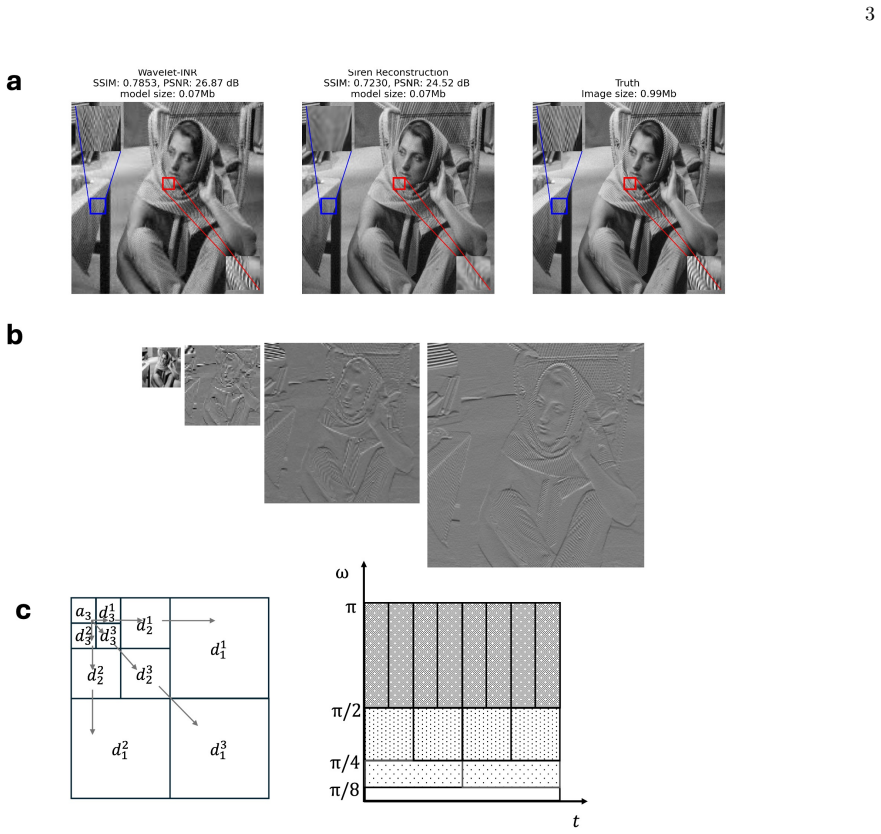
Enhancement module (learned local deconvolution). For each orientation and scale transition, a lightweight SIREN takes a coordinate x and emits an r^p kernel; the kernel is applied as an inner product to an r×r patch extracted from the upsampled prediction of the next-coarser INR, and the result is trained to match the true wavelet coefficient at x. This is the mechanism that carries the claim of recovering subtle detail without inflating model size; it exploits the geometric regularity of wavelet coefficients—large amplitudes cluster along contours and textures, so fine detail is locally predictable from coarse structure. The multi-resolution preprocess (DWT plus one shared INR per scale fo
What would settle it
Take a real dataset, apply the wavelet transform, and randomly permute the spatial positions of the finest detail coefficients while keeping their marginal statistics intact; train WIEN-INR and the same framework without enhancement. If the enhancement no longer improves PSNR (or worsens it), the local coarse-to-fine correlation assumption is exposed as the source of the gain. A cleaner version: generate a volume whose finest-scale wavelet coefficients are independent random noise—there, the module has nothing predictable to learn and should show no rate-distortion benefit.
Extended reading notes
Core claim
WIEN-INR claims that the low-frequency bias of compact INRs can be overcome not by enlarging the network, but by reorganizing the representation: a discrete wavelet transform separates the signal into a coarse approximation and orientation-specific detail bands; each band is assigned its own small SIREN, with frequency parameters matched to the band; and the finest band is synthesized by an enhancement network rather than learned directly. The enhancement up-samples the next-coarser scale's prediction and applies a per-location r×r kernel—outputs of a separate lightweight network—to the local patch, matching the true finest coefficients. Across three raw experimental datasets, this yields hi
Load-bearing premise
The load-bearing premise is that fine-scale wavelet detail is locally predictable from the next-coarser scale through a small learned kernel; if a dataset's finest structures are spatially independent of coarser structure, the enhancement module cannot recover them and the central fidelity gain disappears.
Editorial extensions
If this is right
- Raw experimental volumes can be replaced by a set of small network weights, with decoding as a forward pass, and at a fixed weight budget the reconstructed data retains more fine-scale structure than with a single large INR.
- Because the objective separates by scale, subnetworks can be trained in parallel; only the enhancement step depends on the previous scale, so encoding time can drop relative to monolithic INR training.
- Each scale is a continuous coordinate function, so users can decode arbitrary regions of interest or resolutions without retraining, and the finest band is enhanced rather than emulated from scratch.
- The enhancement module is modular, so existing coordinate-based INR pipelines can adopt it without changing their core architecture.
- Preserving the wavelet-coefficient distribution, not just pixel error, means compression preserves multi-scale statistics that downstream physical analyses rely on.
Reading between the lines
- If the local coarse-to-fine correlation the enhancement assumes holds broadly, WIEN-INR effectively learns a data-driven zerotree-style prior for INR compression; combining it with entropy-coded weight quantization could push scientific INR codecs close to wavelet transform-codec rate-distortion limits.
- The same coarse-to-fine predictor suggests a super-resolution mode the paper does not test: train only coarse scales, then let the enhancement module synthesize finer detail at inference, yielding resolution-scalable scientific data.
- On data whose finest band is dominated by detector noise rather than geometric regularity, the enhancement could fabricate texture rather than recover signal; a synthetic white-noise-detail experiment would delineate the regime in which WIEN-INR should be used.
- The reported robustness across wavelet bases masks a tunable resource-allocation question: how to split the parameter budget across scales. An adaptive rule based on per-band energy could extend the method to datasets with very different spectra.
Editorial analysis
A structured set of objections, weighed in public.
Referee Report
Summary. The paper proposes WIEN-INR, a hierarchical implicit neural representation for scientific data compression. A discrete wavelet transform partitions the data into approximation and detail sub-bands; each band is modeled by a compact SIREN, with the finest detail band predicted by an enhancement module that applies a coordinate-dependent kernel to the upsampled output of the next-coarser scale. Experiments on three scattering datasets (X-ray diffraction, neutron scattering, ultrafast X-ray scattering) report higher PSNR at matched compression ratios than FE, SIREN, WIRE, and TCNN, together with robustness to wavelet basis and decomposition depth.
Significance. If the reported results are reproducible, WIEN-INR offers a practical improvement to INR-based compression for scientific data. The modular design (wavelet decomposition as preprocessing, optional enhancement module) is clean and the ablation against Wavelet-INR in Fig. 6 is valuable evidence that the enhancement module adds representational capacity beyond the multi-scale decomposition itself. The paper also includes a useful robustness analysis (Fig. 7) for wavelet type, number of scales, and window size. No code is provided and no theoretical guarantees are claimed, so the contribution is empirical.
major comments (3)
- [Sec. III.a, Eqs. (2) and (3)] The sums run over j=1..J−1. With the indexing used in the paper (j=1 finest, j=J coarsest; see Sec. III.c where the enhancement module predicts d1 from d2), a J-level DWT has J detail sub-bands d1..dJ. As written, the coarsest detail band d_J is omitted from the training objective. This is load-bearing: it changes which coefficients the networks are trained to represent. Please correct to j=1..J, or precisely define a different indexing convention and apply it consistently.
- [Sec. IV.b, Fig. 4] The central rate-distortion claim rests on single-run curves. No number of seeds, error bars, or statistical significance tests are reported. Since the differences between methods at a given compression ratio appear modest and the baseline precision is not specified, please provide multiple independent runs and report mean ± std, or at least state the seed variability.
- [Sec. VI vs Sec. IV.a] The conclusion claims 'data-agnostic applicability,' but the enhancement module (Sec. III.c, Eq. 5) assumes fine-scale wavelet coefficients are locally predictable from coarser-scale coefficients (a zerotree-like prior). The paper itself states in Sec. IV.a that applying the enhancement to the finest band is a data-dependent choice. All three evaluation datasets are scattering measurements with speckle/texture, which plausibly share this cross-scale structure. To support the 'data-agnostic' claim, either test on data without such parent-child correlation (e.g., i.i.d. noise, natural images) or temper the conclusion to specify the applicable data regime.
minor comments (5)
- [Sec. III.c, Eq. (5)] The notation 'N∇(x)' should be 'N_r(x)' for the r×r neighborhood. Also clarify whether the patch is extracted from φ^i_j or its upsampled version φ^i_{j−1}; the current text and equation are inconsistent.
- [Fig. 4a caption] The caption says 'coarse levels (a and d1)', but elsewhere d1 is the finest detail band (e.g., Sec. III.c describes enhancing 'd2 to d1'). Please clarify which scale is meant, or correct the indexing.
- [Table I] The enhancement window size is given as '(2^1+1)^p to (2^3+1)^p'; this is a roundabout way to say 3^p to 9^p. Please simplify for readability.
- [Sec. V] The description 'post-training quantization of network weights (division by two)' is unclear. Division by two is a scaling operation, not quantization to half precision. Please specify the actual quantization/rounding scheme used.
- [References] Reference [30] appears to duplicate reference [7] (both cite the same paper by Lu et al. on compressive neural representations of volumetric scalar fields). Please consolidate.
Circularity Check
No significant circularity: WIEN-INR's enhancement prediction is a learned conditional model (Eq. 5) benchmarked against external baselines, so no claimed result reduces to its inputs by construction; one non-load-bearing self-citation and a data-dependent architecture choice are the only mild residues.
full rationale
Walking the derivation chain: the wavelet decomposition (Eqs. 2-3) maps the data into coefficient sub-bands; the per-scale SIREN subnetworks regress those coefficients; and the enhancement module (Eqs. 4-5) predicts the finest detail band d^i_{j-1}(x) as an inner product of an upsampled coarser-scale prediction patch with a learned kernel output by P^i_{j->j-1,xi}(x), trained by minimizing the squared error against the true coefficients. Nothing here is defined in terms of its output: the kernel network is genuinely fit, and the reported fidelity (PSNR/SSIM at matched compression ratio, Fig. 4b) is measured against external baselines (FE, SIREN, WIRE, TCNN) in a domain-neutral pixel space, so the central claim is not a fitted input renamed as a prediction. The zerotree/geometric-regularity prior motivating the module is imported from standard external references (Mallat [16]; Shapiro [17]; JPEG-2000 [23]), not from the authors' prior work, so no ansatz is smuggled in via self-citation. The only self-citation is [25], used analogically ('reminiscent of a progressive refinement') in Sec. III.c; it is not load-bearing, so per the rubric it only nudges the score to 2. Two non-circular qualifications are flagged per the reviewing rule: (i) Sec. IV.a concedes the key design choice is data-dependent ('We choose to apply the enhancement structure to the finest detail band... This choice is data-dependent... but we found it sufficient for all evaluated scientific datasets'), which undercuts the Sec. VI claim of 'data-agnostic applicability' and is an external-validity risk for data lacking cross-scale wavelet correlation; (ii) Fig. 4a's wavelet-coefficient-fidelity plot measures WIEN-INR in the same domain in which it was trained, so it partly restates the training objective, though the headline rate-distortion claims are made in a domain-neutral pixel space. No equation or uniqueness theorem in the paper reduces a claimed prediction to a fitted parameter, and no self-citation chain forces the architecture choice. Verdict: no significant circularity.
Assumptions & free parameters
free parameters (5)
- Number of wavelet scales J =
4
- Enhancement window size n_r =
3
- Wavelet basis =
Haar
- Per-scale hidden layer widths =
24 to 1024
- SIREN frequency parameters =
omega0=30 for enhancement net; per-scale frequencies varied
assumptions (5)
- standard math DWT with a chosen basis is invertible and provides a hierarchical time-frequency decomposition.
- standard math Coordinate MLPs with sufficient width can approximate any measurable function (universal approximation).
- standard math Optimization of coordinate networks exhibits spectral bias, fitting low frequencies first.
- domain assumption Signals of interest (scientific images) obey geometric regularity: significant wavelet coefficients cluster along contours and are locally correlated across scales.
- domain assumption The fine detail band [pi/2, pi] is the most difficult to represent, and the difficulty is representational capacity rather than frequency bias.
Cite this review
Pith. "Pith review of Multi-resolution Enhancement for Full Spectrum Neural Representations." pith.science (2026). https://pith.science/paper/I6JI7FR5
@misc{pith2026250915494,
  author       = {Pith},
  title        = {Pith review of: Multi-resolution Enhancement for Full Spectrum Neural Representations},
  year         = {2026},
  howpublished = {\url{https://pith.science/paper/I6JI7FR5}},
  note         = {Machine review of arXiv:2509.15494}
}
read the original abstract
Scientific data acquisition continues to outpace storage and analysis capabilities, making voxel-based representations increasingly intractable. Implicit neural representations (INRs) offer a promising solution by encoding signals through coordinate-based neural networks, serving as surrogates of data, with computational and storage requirements scaling with network complexity rather than data dimensionality. However, smaller INRs struggle to faithfully represent the multi-scale structures, high-frequency information, and fine textures that constitute a large proportion of scientific measurements. We propose WIEN-INR, a theoretically-guided hierarchical INR framework that distributes modeling across resolution scales and enables improved representation capacity through a novel enhancement network to recover subtle details. This multi-scale architecture allows smaller networks to retain the full spectrum of information while preserving training efficiency and lowering storage cost. Evaluated on distinct raw experimental measurements across scales and complexities, WIEN-INR represents a practical step toward broader adoption of neural representations in scientific workflows, delivering compact, robust, and high-fidelity representations.
Figures


Figures from the paper (4 more)


Reference graph
Works this paper leans on
-
[1]
Fourier features let networks learn high frequency func- tions in low dimensional domains
Matthew Tancik, Pratul P Srinivasan, Ben Mildenhall, Sara Fridovich-Keil, Nithin Raghavan, Utkarsh Singhal, Ravi Ramamoorthi, Jonathan T Barron, and Ren Ng. Fourier features let networks learn high frequency func- tions in low dimensional domains. Advances in Neural Information Processing Systems, 2020
2020
-
[2]
Baraniuk
Vishwanath Saragadam, Daniel LeJeune, Jasper Tan, Guha Balakrishnan, Ashok Veeraraghavan, and Richard G. Baraniuk. WIRE: Wavelet implicit neural representations. In 2023 IEEE/CVF Conference on Computer Vision and Pattern Recognition (CVPR) ,
2023
-
[3]
Implicit neural representations with periodic activation functions
Vincent Sitzmann, Julien Martel, Alexander Bergman, David Lindell, and Gordon Wetzstein. Implicit neural representations with periodic activation functions. In Advances in Neural Information Processing Systems, vol- ume 33, pages 7462–7473. Curran Associates, Inc., 2020
2020
-
[4]
Dami- ani, Christopher Ford, M
Jana Thayer, Zhantao Chen, Richard Claus, D. Dami- ani, Christopher Ford, M. Dubrovin, Victor Elmir, W. Kroeger, Xiang Li, S. Marchesini, Valerio Mariani, Riccardo Melcchiori, Silke Nelson, Ariana Peck, A. Per- azzo, F. Poitevin, Christopher P. O’Grady, Julieth Otero, Omar Quijano, Murali Shankar, M. Uervirojnangkoorn, Riccardo Veraldi, Matthew Weaver, C....
arXiv 2024
-
[5]
Data reduction activities at European XFEL: Early results
Egor Sobolev, Philipp Schmidt, Janusz Malka, David Hammer, Djelloul Boukhelef, Johannes M¨ oller, Karim Ahmed, Richard Bean, Ivette Jazm ´ ın Berm´ udez Mac ´ ıas, Johan Bielecki, and et al. Data reduction activities at European XFEL: Early results. Frontiers in Physics, 12, Feb 2024. doi:10.3389/fphy.2024.1331329
arXiv 2024
-
[6]
Where do we stand with implicit neural representations? a technical and performance survey, 2025
Amer Essakine, Yanqi Cheng, Chun-Wun Cheng, Lipei Zhang, Zhongying Deng, Lei Zhu, Carola-Bibiane Sch¨ onlieb, and Angelica I Aviles-Rivero. Where do we stand with implicit neural representations? a technical and performance survey, 2025. URL https://arxiv. org/abs/2411.03688
arXiv 2025
-
[8]
Implicit neural representa- tions for image compression
Yannick Str¨ umpler, Janis Postels, Ren Yang, Luc Van Gool, and Federico Tombari. Implicit neural representa- tions for image compression. In Shai Avidan, Gabriel Brostow, Moustapha Ciss´ e, Giovanni Maria Farinella, and Tal Hassner, editors, Computer Vision – ECCV 2022, pages 74–91, Cham, 2022. Springer Nature Switzer- land. ISBN 978-3-031-19809-0
2022
-
[9]
Instant neural graphics primitives with a multiresolution hash encoding
Thomas M¨ uller, Alex Evans, Christoph Schied, and Alexander Keller. Instant neural graphics primitives with a multiresolution hash encoding. ACM Transac- tions on Graphics (TOG), 41:1 – 15, 2022. URL https: //api.semanticscholar.org/CorpusID:246016186
2022
Show all 39 references
-
[10]
Srinivasan, Matthew Tan- cik, Jonathan T
Ben Mildenhall, Pratul P. Srinivasan, Matthew Tan- cik, Jonathan T. Barron, Ravi Ramamoorthi, and Ren Ng. NeRF: Representing scenes as neural radiance fields for view synthesis. In Andrea Vedaldi, Horst Bischof, Thomas Brox, and Jan-Michael Frahm, editors, Com- puter Vision – ...
2020
-
[11]
anomalies,
: the minimum number of bits (rate) required to represent data depends on how much information can be altered or discarded without exceeding a specified error threshold. Such rates are in turn determined by network size, weight quantization, and entropy coding [8, 12]. In the ...
2025 arXiv
-
[12]
Entropy-constrained implicit neural representations for deep image compression
Soonbin Lee, Jong-Beom Jeong, and Eun-Seok Ryu. Entropy-constrained implicit neural representations for deep image compression. IEEE Signal Processing Let- ters, 30:663–667, 2023. doi:10.1109/LSP.2023.3279780
2023
-
[13]
George V. Cybenko. Approximation by superpositions of a sigmoidal function. Mathematics of Control, Sig- 11 nals and Systems, 2:303–314, 1989. URL https://api. semanticscholar.org/CorpusID:3958369
1989
-
[14]
Cover and Joy A
Thomas M. Cover and Joy A. Thomas. Elements of In- formation Theory. Wiley-Interscience, 2 edition, 2006. doi:https://doi.org/10.1002/047174882X.ch10
2006 doi
-
[15]
Lossy compression of scientific data: Applications constrains and requirements, 2025
Franck Cappello, Allison Baker, Ebru Bozda, Martin Burtscher, Kyle Chard, Sheng Di, Paul Christopher O Grady, Peng Jiang, Shaomeng Li, Erik Lindahl, Peter Lindstrom, Magnus Lundborg, Kai Zhao, Xin Liang, Masaru Nagaso, Kento Sato, Amarjit Singh, Seung Woo Son, Dingwen Tao, Jia...
2025 arXiv
-
[16]
A Wavelet Tour of Signal Processing, Third Edition: The Sparse Way
Stphane Mallat. A Wavelet Tour of Signal Processing, Third Edition: The Sparse Way. Academic Press, Inc., USA, 3rd edition, 2008. ISBN 0123743702
2008
-
[17]
HOSC: A periodic activation function for pre- serving sharp features in implicit neural representations,
Danzel Serrano, Jakub Szymkowiak, and Przemyslaw Musialski. HOSC: A periodic activation function for pre- serving sharp features in implicit neural representations,
-
[18]
FINER: Flexible spectral-bias tuning in implicit neural representation by variable-periodic activation functions
Zhen Liu, Hao Zhu, Qi Zhang, Jingde Fu, Weibing Deng, Zhan Ma, Yanwen Guo, and Xun Cao. FINER: Flexible spectral-bias tuning in implicit neural representation by variable-periodic activation functions. In Proceedings of the IEEE/CVF Computer Vision and Pattern Recogni- tion Co...
2024
-
[19]
InCode: Implicit neural conditioning with prior knowledge embeddings
Amirhossein Kazerouni, Reza Azad, Alireza Hosseini, Dorit Merhof, and Ulas Bagci. InCode: Implicit neural conditioning with prior knowledge embeddings. In Pro- ceedings of the IEEE/CVF Winter Conference on Appli- cations of Computer Vision (WACV), pages 1298–1307, 2024
2024
-
[20]
Improved implicit neural representation with fourier reparameter- ized training
Kexuan Shi, Xingyu Zhou, and Shuhang Gu. Improved implicit neural representation with fourier reparameter- ized training. In Proceedings of the IEEE/CVF Confer- ence on Computer Vision and Pattern Recognition, pages 25985–25994, 2024
2024
-
[21]
J.M. Shapiro. Embedded image coding using zerotrees of wavelet coefficients. IEEE Transactions on Signal Pro- cessing, 41(12):3445–3462, 1993. doi:10.1109/78.258085
1993 doi
-
[22]
Cross-frequency implicit neural representation with self- evolving parameters, 2025
Chang Yu, Yisi Luo, Kai Ye, Xile Zhao, and Deyu Meng. Cross-frequency implicit neural representation with self- evolving parameters, 2025. URL https://arxiv.org/ abs/2504.10929
2025 arXiv
-
[23]
Taubman and Michael W
David S. Taubman and Michael W. Marcellin. JPEG2000: Image Compression Fundamentals, stan- dards, and Practice. Springer Science + Business Media, LLC, 2013
2013
-
[24]
Coifman and M.V
R.R. Coifman and M.V. Wickerhauser. Entropy-based algorithms for best basis selection. IEEE Transac- tions on Information Theory, 38(2):713–718, 1992. doi: 10.1109/18.119732
1992 doi
-
[25]
Multiplicative filter networks
Rizal Fathony, Anit Kumar Sahu, Devin Willmott, and J Zico Kolter. Multiplicative filter networks. In Inter- national Conference on Learning Representations, 2021. URL https://openreview.net/forum?id=OmtmcPkkhT
2021
-
[26]
Testing the data framework for an AI algorithm in preparation for high data rate X- ray facilities
Hongwei Chen et al. Testing the data framework for an AI algorithm in preparation for high data rate X- ray facilities. In 4th Annual Workshop on Extreme- scale Experiment-in-the-Loop Computing, 10 2022. doi: 10.1109/XLOOP56614.2022.00006
2022
-
[27]
High-energy Spin Waves in the Spin-1 Square- lattice Antiferromagnet La 2NiO4
AN Petsch, NS Headings, D Prabhakaran, AI Kolesnikov, CD Frost, AT Boothroyd, R Coldea, and SM Hay- den. High-energy Spin Waves in the Spin-1 Square- lattice Antiferromagnet La 2NiO4. Physical Review Re- search, 5(3):033113, 2023. URL https://doi.org/10. 1103/PhysRevResearch.5.033113
2023
-
[28]
Song Han, Huizi Mao, and William J. Dally. Deep compression: Compressing deep neural network with pruning, trained quantization and huffman coding. International Conference on Learning Representations (ICLR), 2016. URL https://api.semanticscholar. org/CorpusID:2134321
2016
-
[29]
Petsch, Ed- mund Xu, Cheng Peng, Alexander I
Yuan Ni, Zhantao Chen, Alexander N. Petsch, Ed- mund Xu, Cheng Peng, Alexander I. Kolesnikov, Sugata Chowdhury, Arun Bansil, Jana B. Thayer, and Joshua J. Turner. Physics-guided dual implicit neural representa- tions for source separation, 2025. URL https://arxiv. org/abs/2507.05249
2025 arXiv
-
[30]
Y. Lu, K. Jiang, J. A. Levine, and M. Berger. Com- pressive neural representations of volumetric scalar fields. Computer Graphics Forum, 40(3), 06 2021. ISSN ISSN 0167-7055. doi:10.1111/cgf.14295
2021 doi
-
[31]
Sparsity in deep learning: pruning and growth for efficient inference and training in neural networks
Torsten Hoefler, Dan Alistarh, Tal Ben-Nun, Nikoli Dry- den, and Alexandra Peste. Sparsity in deep learning: pruning and growth for efficient inference and training in neural networks. Journal of Machine Learning Research, 2021
2021
-
[32]
DCINR: a divide-and-conquer implicit neural representation for compressing time- varying volumetric data in hours
Jun Han and Fan Yang. DCINR: a divide-and-conquer implicit neural representation for compressing time- varying volumetric data in hours. IEEE transactions on visualization and computer graphics, PP, 2025. doi: 10.1109/TVCG.2025.3564255
2025
-
[33]
Deep im- age compression in the wavelet transform domain based on high frequency sub-band prediction
Chuxi Yang, Yan Zhao, and Shigang Wang. Deep im- age compression in the wavelet transform domain based on high frequency sub-band prediction. IEEE Access, 7: 52484–52497, 2019. doi:10.1109/ACCESS.2019.2911403
2019
-
[34]
WINNet: Wavelet-inspired invertible network for image denoising
Jun-Jie Huang and Pier Luigi Dragotti. WINNet: Wavelet-inspired invertible network for image denoising. Trans. Img. Proc., 31, 2022. ISSN 1057-7149. doi: 10.1109/TIP.2022.3184845. URL https://doi.org/10. 1109/TIP.2022.3184845
2022
-
[35]
Hou, and Max Tegmark
Ziming Liu, Yixuan Wang, Sachin Vaidya, Fabian Ruehle, James Halverson, Marin Soljaˇ ci´ c, Thomas Y. Hou, and Max Tegmark. KAN: Kolmogorov–arnold net- works. In International Conference on Learning Rep- resentations (ICLR), 2025. URL https://openreview. net/forum?id=Ozo7qJ5vZi. Oral
2025
-
[36]
Neural wavelet-domain diffusion for 3D shape generation
Ka-Hei Hui, Ruihui Li, Jingyu Hu, and Chi-Wing Fu. Neural wavelet-domain diffusion for 3D shape generation. December 2022
2022
-
[37]
Suo, and Qionghai Dai
Runzhao Yang, Tingxiong Xiao, Yuxiao Cheng, J. Suo, and Qionghai Dai. TINC: Tree-structured implicit neural compression. 2023 IEEE/CVF Conference on Computer Vision and Pattern Recognition (CVPR), pages 18517– 18526, 2022. doi:10.1109/CVPR52729.2023.01776
2023
-
[41]
Generative neural fields by mixtures of neu- ral implicit functions, 2023
Tackgeun You, Mijeong Kim, Jungtaek Kim, and Bo- hyung Han. Generative neural fields by mixtures of neu- ral implicit functions, 2023. URL https://arxiv.org/ abs/2310.19464
2023 arXiv
-
[2020]
ISBN 978-3-030- 58452-8
Springer International Publishing. ISBN 978-3-030- 58452-8
-
[2024]
URL https://arxiv.org/abs/2401.10967
Reviewed August 4, 2026 · model on record in the stance chip above.
Discussion (0). Sign in to comment.