Gaussian mean width strong converse bound on the classical identification capacity of quantum channels
Pith reviewed 2026-06-28 05:41 UTC · model grok-4.3
The pith
A product state-weighted Euclidean geometry on outputs yields a single-letter strong converse bound for classical identification capacity of quantum channels.
A machine-rendered reading of the paper's core claim, the machinery that carries it, and where it could break.
Core claim
Equipping the n-fold output space with a product state-weighted σ-Euclidean geometry allows trace-distance separation constraints to be controlled by Euclidean covering estimates. Sudakov's inequality bounds the covering numbers via their Gaussian mean widths in the weighted geometry, whose exponential growth is governed by the operator norm of a single-letter positive operator. Optimizing over σ yields a strong converse bound on the identification capacity that admits a semidefinite representation.
What carries the argument
The product state-weighted σ-Euclidean geometry on the n-fold output space, which converts identification-code separation conditions into Euclidean covering problems controlled by Gaussian mean widths.
If this is right
- The resulting bound is single-letter and admits a semidefinite-program representation.
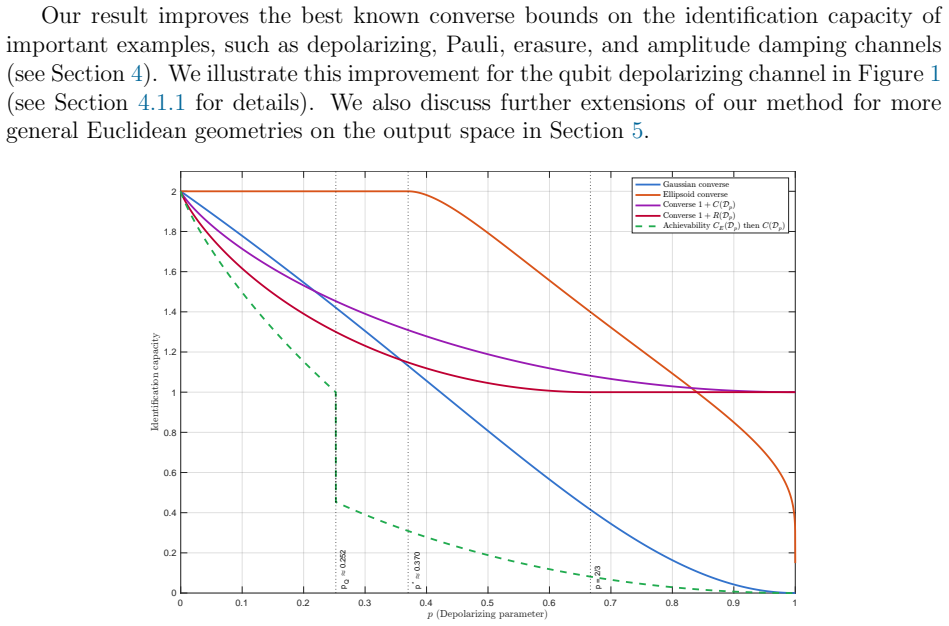
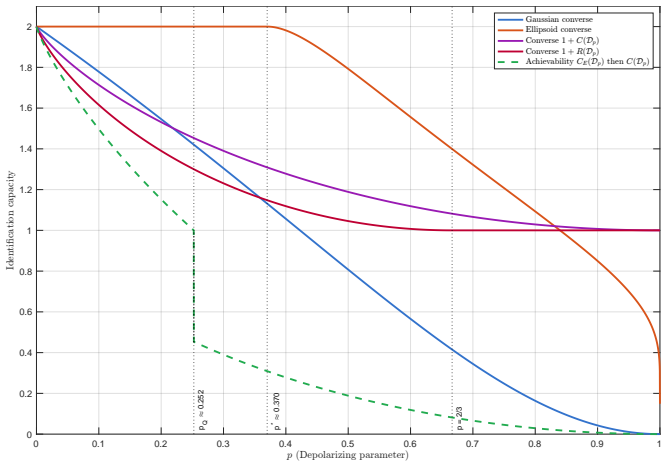
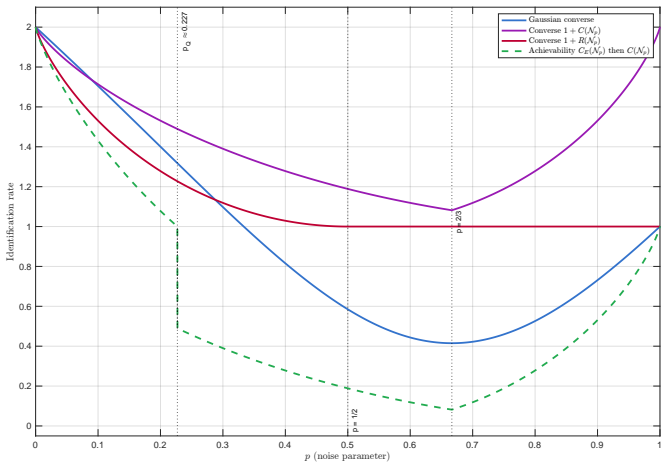
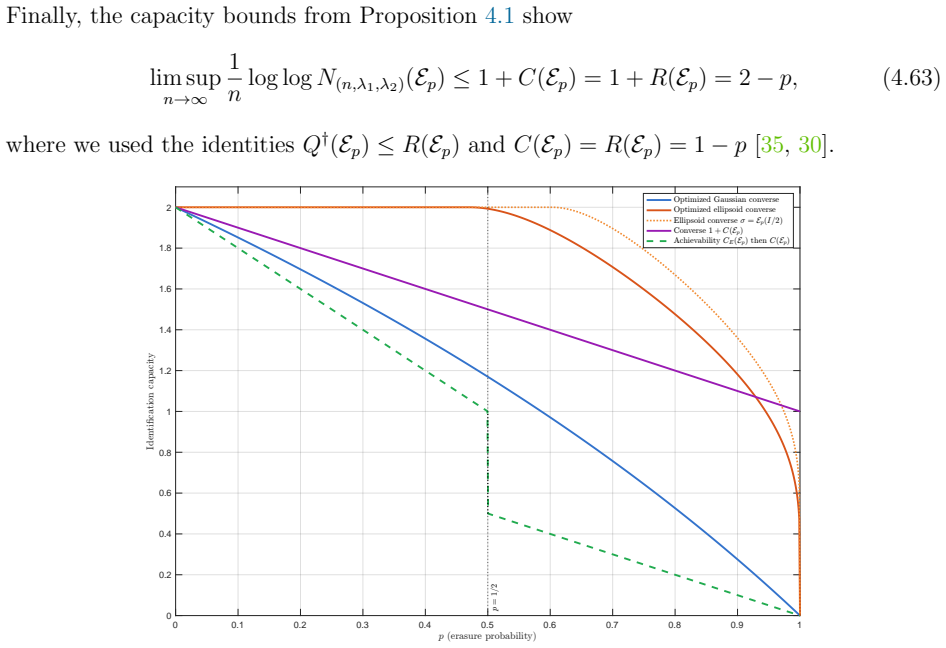
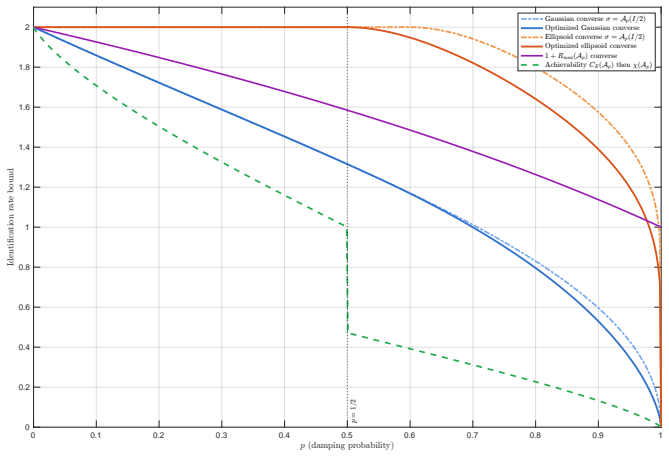
- The bound improves the best previously known converses for depolarizing, Pauli, erasure and amplitude-damping channels.
- The same covering-number technique extends directly to more general Euclidean geometries on the output space.
Where Pith is reading between the lines
- If matching achievability results are found, the identification capacity would be exactly determined for the channels where the new bound is tight.
- The weighted-geometry approach may apply to other quantum tasks whose performance is governed by output-state distinguishability.
- The optimal weighting state σ could serve as a natural figure of merit for how well a channel supports identification tasks.
Load-bearing premise
Trace-distance separation constraints for identification codes can be controlled by Euclidean covering estimates once the n-fold output space is equipped with the product state-weighted σ-Euclidean geometry.
What would settle it
An explicit identification code whose rate exceeds the bound obtained by optimizing the operator norm over all weighting states σ.
Figures
read the original abstract
We establish a single-letter and efficiently computable strong converse bound on the classical identification capacity of quantum channels. By equipping the $n$-fold channel output space with a product state-weighted $\sigma$-Euclidean geometry, we allow trace-distance separation constraints for identification codes to be controlled by Euclidean covering estimates. Using Sudakov's inequality, we bound the covering numbers of the $n$-fold channel outputs via their Gaussian mean widths in the weighted geometry, whose exponential growth in $n$ is governed by the operator norm of a single-letter positive operator. Upon optimizing over all weighing states $\sigma$, this yields a strong converse bound on the identification capacity of the channel, which also admits a semidefinite representation. Our method improves the best known converse bounds on the identification capacity of several important examples, such as depolarizing, Pauli, erasure, and amplitude damping channels. We also discuss extensions of this method to more general Euclidean geometries on the output space.
Editorial analysis
A structured set of objections, weighed in public.
Referee Report
Summary. The manuscript claims to establish a single-letter, efficiently computable strong converse bound on the classical identification capacity of quantum channels. It equips the n-fold output space with a product σ-weighted Euclidean geometry so that trace-distance separation constraints on identification codes can be controlled by Euclidean covering estimates; Sudakov's inequality then bounds the covering numbers via Gaussian mean widths whose exponential growth is governed by the operator norm of a single-letter positive operator. Optimizing over the weighting state σ yields the bound, which admits an SDP representation and improves prior converses for the depolarizing, Pauli, erasure, and amplitude-damping channels. Extensions to general Euclidean geometries are also discussed.
Significance. If the central derivation is free of n-dependent looseness in the distance equivalence, the result supplies a new geometric method for strong converses that is both single-letter and SDP-representable, a concrete strength. The explicit improvements on standard channels and the discussion of broader geometries add practical value for quantum channel capacity questions.
major comments (2)
- [the derivation following the definition of the product σ-Euclidean geometry] The step that converts trace-distance separation of code outputs into Euclidean separation in the product σ-weighted geometry (the paragraph beginning 'By equipping the n-fold channel output space...') is load-bearing for the single-letter claim. The manuscript must explicitly state the multiplicative constant relating ||·||_1 and ||·||_{2,σ^{\otimes n}} and prove that this constant remains independent of n (or is absorbed into the o(n) term) when the geometry is the product of single-copy weighted norms; otherwise the exponential growth rate extracted from the Gaussian mean width may acquire sub-exponential or n-dependent factors.
- [the paragraph containing 'which also admits a semidefinite representation'] Section on the SDP representation: the claim that the optimized bound 'admits a semidefinite representation' requires an explicit SDP formulation (variables, objective, and constraints) rather than an existence statement, because the optimization is over both the weighting state σ and the operator whose norm appears in the mean-width bound.
minor comments (2)
- Notation for the weighted Euclidean norm ||·||_{2,σ} should be defined once at first use with an explicit formula (e.g., Tr(X^* (σ^{-1/2} · σ^{-1/2}) X) or equivalent) to avoid ambiguity when the product geometry is introduced.
- The examples section would benefit from a short table comparing the new bound, the previous best converse, and the Holevo capacity for each channel (depolarizing, Pauli, erasure, amplitude damping) so that the improvement is immediately quantifiable.
Simulated Author's Rebuttal
We thank the referee for the thorough review and insightful comments on our manuscript. The suggestions help clarify the presentation of the geometric argument and the computational aspects of the bound. We address each major comment below and will revise the manuscript accordingly.
read point-by-point responses
-
Referee: [the derivation following the definition of the product σ-Euclidean geometry] The step that converts trace-distance separation of code outputs into Euclidean separation in the product σ-weighted geometry (the paragraph beginning 'By equipping the n-fold channel output space...') is load-bearing for the single-letter claim. The manuscript must explicitly state the multiplicative constant relating ||·||_1 and ||·||_{2,σ^{\otimes n}} and prove that this constant remains independent of n (or is absorbed into the o(n) term) when the geometry is the product of single-copy weighted norms; otherwise the exponential growth rate extracted from the Gaussian mean width may acquire sub-exponential or n-dependent factors.
Authors: We agree that an explicit statement of the norm equivalence is necessary for rigor. In the product σ-weighted Euclidean geometry, the relation ||X||_1 ≤ C ||X||_{2,σ^{\otimes n}} holds with a multiplicative constant C that depends only on the minimal eigenvalue of the single-copy state σ (via the operator norm of σ^{-1/2}) and is therefore independent of n. Because the geometry is defined as a tensor-product structure, the equivalence factors across copies without introducing additional n-dependent growth beyond what is already controlled by the o(n) terms in the rate. We will add a dedicated lemma (with proof) immediately after the geometry definition that states the constant explicitly and verifies its n-independence, ensuring the exponential growth rate extracted from the Gaussian mean width remains single-letter. revision: yes
-
Referee: [the paragraph containing 'which also admits a semidefinite representation'] Section on the SDP representation: the claim that the optimized bound 'admits a semidefinite representation' requires an explicit SDP formulation (variables, objective, and constraints) rather than an existence statement, because the optimization is over both the weighting state σ and the operator whose norm appears in the mean-width bound.
Authors: We accept that an existence claim is insufficient and will replace it with a fully explicit SDP. The revised section will state: variables are the weighting state σ (Hermitian, trace-1, positive semidefinite) and a positive semidefinite operator M; the objective is to minimize the operator norm ||M|| subject to the constraint that the single-letter mean-width expression (involving the channel output and the weighted geometry) is bounded by M, together with the semidefinite constraint that the Gaussian mean-width functional is majorized by Tr(M · positive operator derived from the channel). We will also note that the resulting program is an SDP because the operator-norm objective and the linear constraints in σ and M are semidefinite-representable. revision: yes
Circularity Check
No circularity; bound derived from external inequalities and optimization over external parameter
full rationale
The derivation equips the n-fold output space with a product σ-weighted Euclidean geometry (chosen externally), invokes Sudakov's minoration on Gaussian mean width to control covering numbers, and obtains the single-letter rate from the operator norm of a single-copy positive operator. The final bound is produced by optimizing the free parameter σ via semidefinite programming. None of these steps reduces by construction to a quantity defined inside the paper; Sudakov's inequality and the mean-width estimate are imported from outside the manuscript, and the geometry is not self-referential. No self-citation load-bearing steps, fitted-input predictions, or ansatz smuggling appear in the provided derivation chain.
Axiom & Free-Parameter Ledger
axioms (2)
- standard math Sudakov's inequality bounds covering numbers of sets via their Gaussian mean widths.
- domain assumption The product state-weighted σ-Euclidean geometry converts trace-distance separation into Euclidean covering estimates.
Reference graph
Works this paper leans on
-
[1]
R. Ahlswede and G. Dueck. Identification via channels.IEEE Transactions on In- formation Theory, 35(1):15–29, 1989. URL:http://dx.doi.org/10.1109/18.42172, doi:10.1109/18.42172
-
[2]
R. Ahlswede and A. Winter. Strong converse for identification via quantum channels. IEEE Transactions on Information Theory, 48(3):569–579, March 2002. URL:http: //dx.doi.org/10.1109/18.985947,doi:10.1109/18.985947
-
[3]
T. Ando. Concavity of certain maps on positive definite matrices and applications to hadamard products.Linear Algebra and its Applications, 26:203–241, August
-
[4]
URL:http://dx.doi.org/10.1016/0024-3795(79)90179-4,doi:10.1016/ 0024-3795(79)90179-4
-
[5]
Shiri Artstein-Avidan, Apostolos Giannopoulos, and Vitali Milman.Asymptotic Ge- ometric Analysis, Part I. American Mathematical Society, June 2015. URL:http: //dx.doi.org/10.1090/surv/202,doi:10.1090/surv/202
-
[6]
Sandeep Pradhan, and Andreas Winter
Touheed Anwar Atif, S. Sandeep Pradhan, and Andreas Winter. Quantum soft- covering lemma with applications to rate-distortion coding, resolvability and iden- tification via quantum channels.International Journal of Quantum Information, 22(05), 2024. URL:http://dx.doi.org/10.1142/S0219749924400136,doi:10.1142/ s0219749924400136
-
[7]
Mary Beth Ruskai, Stanislaw Szarek, and Elisabeth Werner. An analysis of completely- positive trace-preserving maps onM 2.Linear Algebra and its Applications, 347(1- 3):159–187, May 2002. URL:http://dx.doi.org/10.1016/S0024-3795(01)00547-X, doi:10.1016/s0024-3795(01)00547-x
-
[8]
Bhatia.Positive Definite Matrices
R. Bhatia.Positive Definite Matrices. Princeton Series in Applied Mathematics. Princeton University Press, 2015. URL:https://books.google.co.in/books?id= Y22YDwAAQBAJ
2015
-
[9]
Springer, 1997.doi:10.1007/978-1-4612-0653-8
Rajendra Bhatia.Matrix Analysis. Springer New York, 1997. URL:http://dx.doi. org/10.1007/978-1-4612-0653-8,doi:10.1007/978-1-4612-0653-8
-
[10]
Cover and Joy A
Thomas M. Cover and Joy A. Thomas.Elements of Information Theory. Wiley, April
-
[11]
URL:http://dx.doi.org/10.1002/047174882X,doi:10.1002/047174882x
-
[12]
The sizes of compact subsets of Hilbert space and continuity of Gaussian processes.Journal of Functional Analysis, 1(3):290–330, October
R.M Dudley. The sizes of compact subsets of Hilbert space and continuity of Gaussian processes.Journal of Functional Analysis, 1(3):290–330, October
-
[13]
URL:http://dx.doi.org/10.1016/0022-1236(67)90017-1,doi:10.1016/ 0022-1236(67)90017-1. 37
-
[14]
Physics Letters A 338(3), 217–224 (May 2005), ISSN 0375-9601, https://doi.org/10.1016/j
Ilya Dumer. Covering an ellipsoid with equal balls.Journal of Combinatorial Theory, Series A, 113(8):1667–1676, November 2006. URL:http://dx.doi.org/10.1016/j. jcta.2006.03.021,doi:10.1016/j.jcta.2006.03.021
work page doi:10.1016/j 2006
-
[15]
M. Fekete. ¨Uber die verteilung der wurzeln bei gewissen algebraischen gleichungen mit ganzzahligen koeffizienten.Mathematische Zeitschrift, 17(1):228–249, December 1923. URL:http://dx.doi.org/10.1007/BF01504345,doi:10.1007/bf01504345
-
[16]
Kalton Fernando Albiac.Topics in Banach Space Theory
Nigel J. Kalton Fernando Albiac.Topics in Banach Space Theory. Springer-Verlag, 2006. URL:http://dx.doi.org/10.1007/0-387-28142-8,doi:10.1007/0-387-28142-8
-
[17]
Information-capacity description of spin-chain correlations.Physical Review A, 71(3), March 2005
Vittorio Giovannetti and Rosario Fazio. Information-capacity description of spin-chain correlations.Physical Review A, 71(3), March 2005. URL:http://dx.doi.org/10. 1103/PhysRevA.71.032314,doi:10.1103/physreva.71.032314
-
[18]
Patrick Hayden and Andreas Winter. Weak decoupling duality and quantum identifi- cation.IEEE Transactions on Information Theory, 58(7):4914–4929, July 2012. URL: http://dx.doi.org/10.1109/TIT.2012.2191695,doi:10.1109/tit.2012.2191695
-
[19]
Tuomas Hyt¨ onen, Jan van Neerven, Mark Veraar, and Lutz Weis.Analysis in Banach Spaces. Springer International Publishing, 2017. URL:http://dx.doi.org/10.1007/ 978-3-319-69808-3,doi:10.1007/978-3-319-69808-3
-
[20]
C. King. The capacity of the quantum depolarizing channel.IEEE Transactions on In- formation Theory, 49(1):221–229, January 2003. URL:http://dx.doi.org/10.1109/ TIT.2002.806153,doi:10.1109/tit.2002.806153
-
[21]
C. King and M.B. Ruskai. Minimal entropy of states emerging from noisy quantum channels.IEEE Transactions on Information Theory, 47(1):192–209, 2001. URL:http: //dx.doi.org/10.1109/18.904522,doi:10.1109/18.904522
-
[22]
Christopher King. Additivity for unital qubit channels.Journal of Mathematical Physics, 43(10):4641–4653, October 2002. URL:http://dx.doi.org/10.1063/1. 1500791,doi:10.1063/1.1500791
work page doi:10.1063/1 2002
-
[23]
Means of positive linear operators.Mathema- tische Annalen, 246(3):205–224, October 1980
Fumio Kubo and Tsuyoshi Ando. Means of positive linear operators.Mathema- tische Annalen, 246(3):205–224, October 1980. URL:http://dx.doi.org/10.1007/ BF01371042,doi:10.1007/bf01371042
-
[24]
Probability in Banach Spaces , subtitle=
Michel Ledoux and Michel Talagrand.Probability in Banach Spaces. Springer Berlin Heidelberg, 1991. URL:http://dx.doi.org/10.1007/978-3-642-20212-4,doi:10. 1007/978-3-642-20212-4
-
[25]
PhD thesis, Bielefeld University., 1999
Peter L¨ ober.Quantum channels and simultaneous ID coding. PhD thesis, Bielefeld University., 1999. URL:https://pub.uni-bielefeld.de/record/2303327. 38
arXiv 1999
-
[26]
Closed formula for the relative entropy of entanglement.Physical Review A, 78(3), 2008
Adam Miranowicz and Satoshi Ishizaka. Closed formula for the relative entropy of entanglement.Physical Review A, 78(3), 2008. URL:http://dx.doi.org/10.1103/ PhysRevA.78.032310,doi:10.1103/physreva.78.032310
-
[27]
E. M. Rains. Bound on distillable entanglement.Physical Review A, 60(1):179–184, 1999. URL:http://dx.doi.org/10.1103/PhysRevA.60.179,doi: 10.1103/physreva.60.179
-
[28]
Luca Rigovacca, Go Kato, Stefan B¨ auml, M S Kim, W J Munro, and Koji Azuma. Versatile relative entropy bounds for quantum networks.New Journal of Physics, 20(1):013033, January 2018. URL:http://dx.doi.org/10.1088/1367-2630/aa9fcf, doi:10.1088/1367-2630/aa9fcf
-
[29]
C. E. Shannon. A mathematical theory of communication.Bell System Technical Journal, 27(3):379–423, July 1948. URL:http://dx.doi.org/10.1002/j.1538-7305. 1948.tb01338.x,doi:10.1002/j.1538-7305.1948.tb01338.x
-
[30]
Detecting positive quantum capacities of quantum channels.npj Quantum Information, 8(1), May 2022
Satvik Singh and Nilanjana Datta. Detecting positive quantum capacities of quantum channels.npj Quantum Information, 8(1), May 2022. URL:http://dx.doi.org/10. 1038/s41534-022-00550-2,doi:10.1038/s41534-022-00550-2
-
[31]
Diagonal unitary and orthogonal symmetries in quan- tum theory.Quantum, 5:519, August 2021
Satvik Singh and Ion Nechita. Diagonal unitary and orthogonal symmetries in quan- tum theory.Quantum, 5:519, August 2021. URL:http://dx.doi.org/10.22331/ q-2021-08-09-519,doi:10.22331/q-2021-08-09-519
-
[32]
V. N. Sudakov. Gaussian random processes and measures of solid angles in hilbert space.Dokl. Akad. Nauk SSSR, 197(1):43–45, 1971. URL:https://mathscinet.ams. org/mathscinet-getitem?mr=0288832
1971
-
[33]
Marco Tomamichel, Mark M. Wilde, and Andreas Winter. Strong converse rates for quantum communication.IEEE Transactions on Information Theory, 63(1):715–727, January 2017. URL:http://dx.doi.org/10.1109/TIT.2016.2615847,doi:10.1109/ tit.2016.2615847
-
[34]
Joel A. Tropp. User-friendly tail bounds for sums of random matrices.Foundations of Computational Mathematics, 12(4):389–434, August 2011. URL:http://dx.doi.org/ 10.1007/s10208-011-9099-z,doi:10.1007/s10208-011-9099-z
-
[35]
Joel A. Tropp. An introduction to matrix concentration inequalities.Foundations and Trends®in Machine Learning, 8(1–2):1–230, May 2015. URL:http://dx.doi.org/ 10.1561/2200000048,doi:10.1561/2200000048
-
[36]
V. Vedral, M. B. Plenio, M. A. Rippin, and P. L. Knight. Quantifying entanglement. Physical Review Letters, 78(12):2275–2279, March 1997. URL:http://dx.doi.org/ 10.1103/PhysRevLett.78.2275,doi:10.1103/physrevlett.78.2275. 39
-
[37]
Roman Vershynin.High-Dimensional Probability: An Introduction with Applications in Data Science. Cambridge University Press, September 2018. URL:http://dx.doi. org/10.1017/9781108231596,doi:10.1017/9781108231596
-
[38]
Wilde.Quantum Information Theory
Mark M. Wilde.Quantum Information Theory. Cambridge University Press, November 2016. URL:http://dx.doi.org/10.1017/9781316809976,doi:10.1017/ 9781316809976
-
[39]
Springer Berlin Heidelberg, 2013
Andreas Winter.Identification via Quantum Channels, page 217–233. Springer Berlin Heidelberg, 2013. URL:http://dx.doi.org/10.1007/978-3-642-36899-8_9,doi: 10.1007/978-3-642-36899-8_9
-
[40]
M. M. Wolf. Quantum channels and operations: Guided tour.(unpublished), 2012. URL:https://mediatum.ub.tum.de/node?id=1701036
2012
-
[41]
Liuhang Ye, Bjarne Bergh, and Nilanjana Datta. Strong converse bounds on the classical identification capacity of the qubit depolarizing channel, 2026. URL:https://arxiv. org/abs/2603.29987,arXiv:2603.29987. 40
arXiv 2026
discussion (0)
Sign in with ORCID, Apple, or X to comment. Anyone can read and Pith papers without signing in.