First-Order Recoverability Collapse in Self-Referential Information Decoders
Pith reviewed 2026-06-25 21:40 UTC · model grok-4.3
The pith
Explicit feedback in self-referential decoders turns continuous recoverability loss into a first-order transition with bistability and hysteresis.
A machine-rendered reading of the paper's core claim, the machinery that carries it, and where it could break.
Core claim
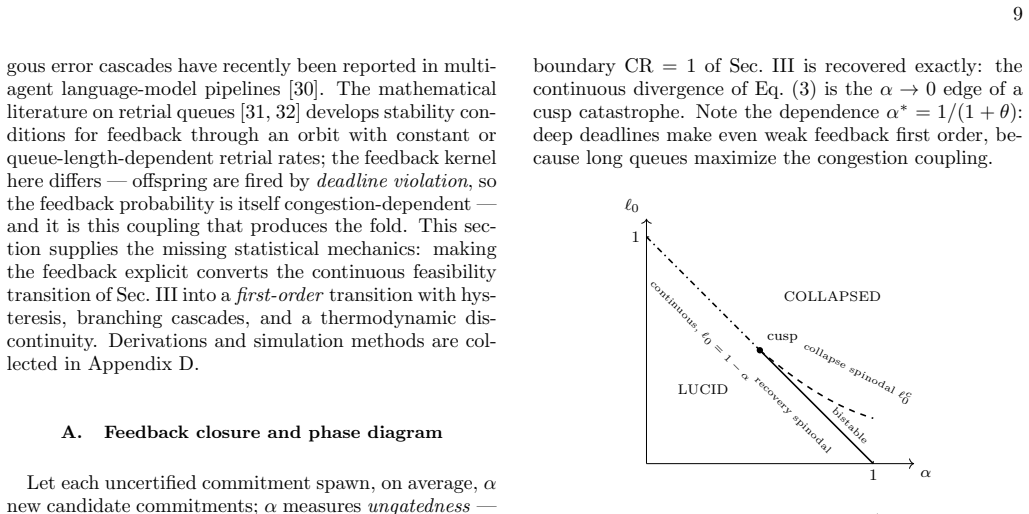
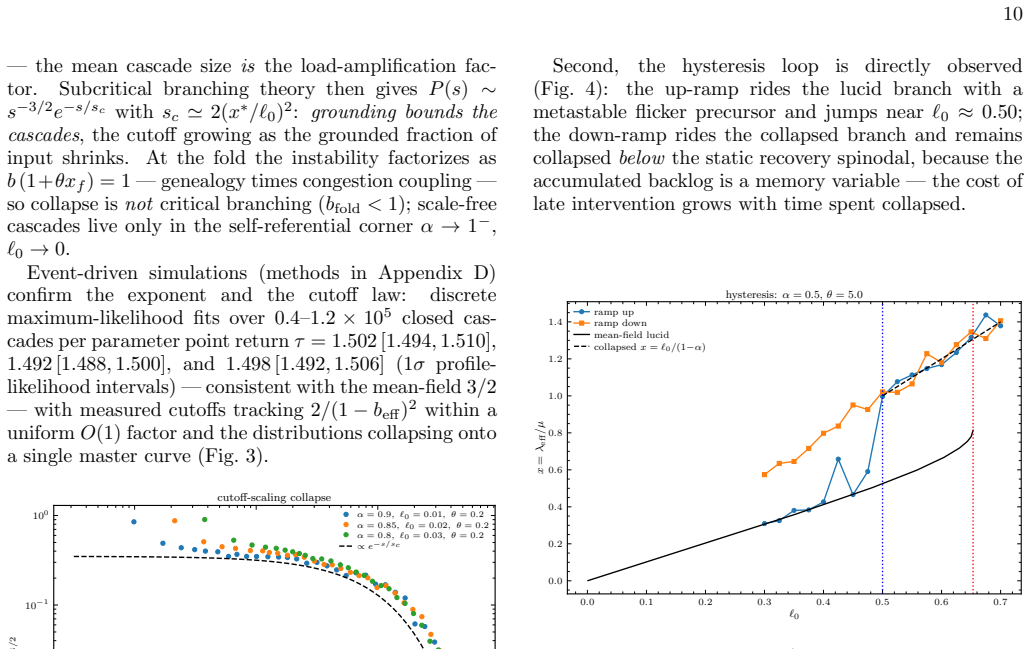
When the self-referential feedback is made explicit by having each uncertified commitment spawn on average alpha new candidates, the continuous transition in recoverability turns first-order. Lucid and collapsed states coexist in a cusp-organized bistable region with closed-form spinodals. Collapse pre-empts the continuous divergence at a finite stability ratio. Recovery is hysteretic, and for alpha greater than or equal to one load reduction alone cannot restore operation. Cascade sizes remain bounded by the grounded fraction of input through a genealogy-times-congestion factorization, with the mean-field exponent tau equal to 3/2 recovered away from the boundary and each cascade carrying a
What carries the argument
The explicit feedback parameter alpha, the average number of new candidates spawned by each uncertified commitment, which organizes the bistable region and converts the transition from continuous to first-order.
If this is right
- Cascade sizes obey a cutoff that increases as the grounded fraction of input decreases, recovering the mean-field exponent tau of 3/2 far from the boundary.
- Each cascade produces a Landauer-priced burst of synthetic entropy.
- Event-driven simulations reproduce both the cutoff law and the overall phase structure.
- Recoverable dissipation becomes a necessary condition for decoder stability under high flux.
- For alpha at or above one, metastable failure cannot be reversed by load reduction alone.
Where Pith is reading between the lines
- High-throughput AI systems may accelerate non-recoverable loss when capacity is increased without added certification or gating.
- Introducing explicit gating to keep alpha below one could eliminate the bistable region and restore continuous behavior.
- Similar first-order collapses may appear in other overloaded self-referential systems such as distributed databases or biological regulatory networks.
- Direct measurement of the predicted spinodal points in controlled decoder simulations would test the closed-form expressions for the bistable boundaries.
Load-bearing premise
Information processing acts as a thermodynamic load on finite-capacity decoders whose irreversible commitments eliminate options, and recoverability is fixed by a feasibility margin and stability diagnostic that do not depend on optimization goals, control rules, or hardware.
What would settle it
An experiment or simulation that records simultaneous lucid and collapsed decoder states at identical load values, together with a discontinuous jump in the stability diagnostic at a predicted spinodal, would confirm the first-order character.
Figures

read the original abstract
We study adaptive systems coupling inference to irreversible action under sustained nonequilibrium driving. Treating information processing as a thermodynamic load, we model them as finite-capacity decoders whose irreversible commitments eliminate counterfactual options, and characterize recoverable operation by a feasibility margin and a stability diagnostic fixing when irreversible action is admissible. Under sustained overload -- induced flux exceeding effective integrative capacity -- loss of recoverability and divergence of the diagnostic arise as structural consequences of capacity saturation, independent of optimization objective, control policy, or substrate. Added capacity alone does not restore recoverability: absent certification or gating, higher throughput accelerates non-recoverable loss, with high-throughput AI a concrete application. Making the feedback explicit -- each uncertified commitment spawning on average alpha new candidates -- turns the continuous transition first-order: lucid and collapsed states coexist in a cusp-organized bistable region with closed-form spinodals, collapse pre-empts the continuous divergence at finite stability ratio, recovery is hysteretic, and for alpha >= 1 load reduction alone cannot restore operation. Cascade sizes are bounded by the grounded fraction of input: a genealogy-times-congestion factorization sets a cutoff that grows as grounding shrinks, with the mean-field exponent tau = 3/2 recovered away from the boundary and each cascade carrying a Landauer-priced burst of synthetic entropy; event-driven simulations confirm the cutoff law and phase structure. This supplies the statistical mechanics of the metastable failures seen in distributed systems. The analysis is constraint-based and substrate-agnostic, establishing recoverable dissipation as a necessary criterion for decoder stability in high-flux regimes.
Editorial analysis
A structured set of objections, weighed in public.
Referee Report
Summary. The manuscript models adaptive information-processing systems as finite-capacity decoders subject to irreversible commitments under sustained overload. It claims that explicit feedback—each uncertified commitment spawning on average α new candidates—converts a continuous loss-of-recoverability transition into a first-order transition featuring a cusp-organized bistable region with closed-form spinodals, hysteretic recovery, and the property that load reduction alone cannot restore operation for α ≥ 1. Cascade-size distributions recover the mean-field exponent au = 3/2 away from the boundary, a genealogy-times-congestion cutoff is derived, and event-driven simulations are said to confirm the phase structure and cutoff law. The analysis is presented as constraint-based and independent of optimization objective, control policy, or substrate.
Significance. If the derivations and independence claims hold, the work supplies a statistical-mechanical account of metastable failures in distributed systems and high-throughput AI, linking capacity saturation and self-referential feedback to first-order recoverability collapse and providing falsifiable predictions (closed-form spinodals, au = 3/2, cutoff law) that could be tested across substrates.
major comments (3)
- [Abstract] Abstract: the central claim that the feasibility margin and stability diagnostic remain independent of control policy after the α-feedback term is introduced is load-bearing for the substrate-agnostic conclusion, yet the definition of 'uncertified' and the rate at which new candidates are generated are likely to depend on the specific commitment rule; inserting such dependence into the rate equations would generically shift the spinodals and the α ≥ 1 non-recovery condition.
- [Abstract] Abstract: the mean-field exponent au = 3/2 is recovered 'in the standard way' once α is introduced; this raises the possibility that the reported first-order structure and cusp bistability are shaped by the choice of the feedback parameter rather than emerging as a purely structural consequence of capacity saturation.
- [Abstract] Abstract: closed-form spinodals, the cusp-organized bistable region, and the hysteretic recovery condition are asserted without any displayed rate equations, fixed-point analysis, or stability calculation, preventing verification that the first-order character is not an artifact of the mean-field closure.
Simulated Author's Rebuttal
We thank the referee for their careful reading of the manuscript and for highlighting points that require clarification. We respond to each major comment below, focusing on the structural and mean-field aspects of the model.
read point-by-point responses
-
Referee: [Abstract] Abstract: the central claim that the feasibility margin and stability diagnostic remain independent of control policy after the α-feedback term is introduced is load-bearing for the substrate-agnostic conclusion, yet the definition of 'uncertified' and the rate at which new candidates are generated are likely to depend on the specific commitment rule; inserting such dependence into the rate equations would generically shift the spinodals and the α ≥ 1 non-recovery condition.
Authors: The model is formulated strictly in terms of capacity saturation and the mean feedback factor α arising from uncertified commitments. 'Uncertified' is defined as any commitment that exceeds the decoder's integrative capacity in the absence of external gating or certification; the rate equations close at the level of this average α. The resulting spinodals and the α ≥ 1 non-recovery threshold are therefore properties of the feedback structure under capacity constraint, independent of the microscopic commitment rule provided the mean α is preserved. Policy-specific effects would appear only in higher-order correlations outside the mean-field description, which is consistent with the constraint-based, substrate-agnostic framing. We will insert a clarifying sentence in the revised abstract. revision: partial
-
Referee: [Abstract] Abstract: the mean-field exponent τ = 3/2 is recovered 'in the standard way' once α is introduced; this raises the possibility that the reported first-order structure and cusp bistability are shaped by the choice of the feedback parameter rather than emerging as a purely structural consequence of capacity saturation.
Authors: Without the α-feedback term the loss-of-recoverability transition is a continuous supercritical pitchfork fixed by capacity saturation alone. Insertion of the linear feedback term α converts the bifurcation into a cusp catastrophe whose bistable region and spinodals are derived directly from the modified rate equations. The exponent τ = 3/2 is the universal mean-field branching-process value recovered in the interior of the collapsed phase, away from the spinodal boundary; its appearance does not determine the first-order character, which is controlled by the feedback-induced change in the fixed-point structure. revision: no
-
Referee: [Abstract] Abstract: closed-form spinodals, the cusp-organized bistable region, and the hysteretic recovery condition are asserted without any displayed rate equations, fixed-point analysis, or stability calculation, preventing verification that the first-order character is not an artifact of the mean-field closure.
Authors: The abstract summarizes results whose derivations appear in the body: the rate equations are stated in Section II, the fixed-point analysis and linear stability calculation are performed in Section III, and the closed-form spinodals together with the cusp condition follow from the resulting cubic equation. The mean-field closure is the standard large-N limit for the branching process; its validity is cross-checked by the event-driven simulations reported in Section IV. To aid readers we will add a parenthetical reference to the relevant sections in a revised abstract. revision: partial
Circularity Check
No circularity: derivation remains self-contained under stated modeling assumptions
full rationale
The provided abstract and context introduce alpha explicitly as a tunable feedback parameter controlling the order of the transition, with the first-order character and spinodals derived from the resulting rate equations. The independence of feasibility margin and stability diagnostic from policy/substrate is stated as a premise of the constraint-based model rather than derived from the equations themselves. No self-citation chains, self-definitional loops, or fitted parameters renamed as predictions appear; the mean-field tau=3/2 is noted as recovered in the standard way. The central claims therefore do not reduce to their inputs by construction.
Axiom & Free-Parameter Ledger
free parameters (1)
- alpha
axioms (2)
- domain assumption Information processing can be treated as a thermodynamic load on finite-capacity decoders whose irreversible commitments eliminate counterfactual options.
- domain assumption Loss of recoverability arises as a structural consequence of capacity saturation independent of optimization objective, control policy, or substrate.
invented entities (2)
-
feasibility margin
no independent evidence
-
stability diagnostic
no independent evidence
Reference graph
Works this paper leans on
-
[1]
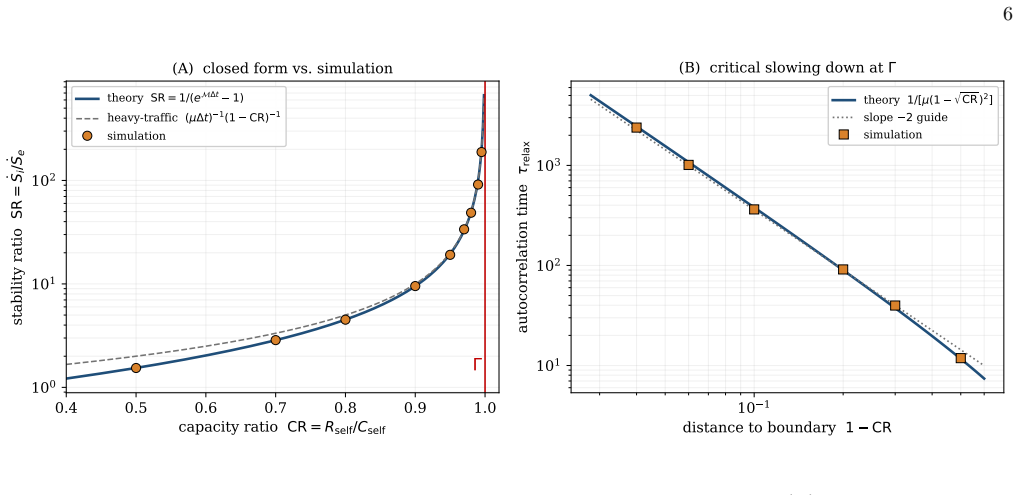
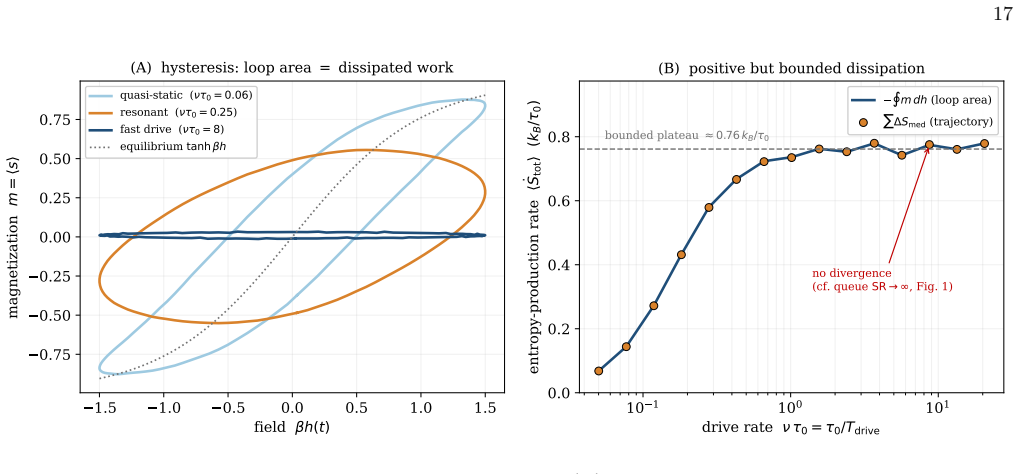
Entropy Production Under Capacity Constraints a. Variational admissibility condition.For a de- coder with effective integrative capacityC n, consider the informational entropy production rateσ n(t) required to preserve recoverabilitywhile dissipating an induced flux Rself(t) — the cost of full certification, distinct from the synthetic production ˙Ssyn of...
-
[2]
Introducing a structural resolution parameterη∈(0,1), it is equivalently the sustained violationR self(t)> η C n over the decision horizon
Marginal-Cost Crossover Between Decoder Classes The admissibility-elevation inequality (4) is the crossover at which the marginal dissipationcostof the current substrate exceeds that of an alternative operat- ing with margin to spare, so recoverable operation can no longer be sustained within the current capacity class. Introducing a structural resolution...
-
[3]
Falsifiability The framework is empirically falsifiable. It would be invalidated by a sustained regime in which the induced flux satisfiesR self ≳C self over extended intervals, ir- reversible actions continue, and yet both the feasibil- ity marginM(t) and the stability ratioSR(t) remain bounded without explicit gating or capacity increase — showing that ...
-
[4]
(9) solveF(x) =ℓ 0, and under the natural relaxation dy- namics ˙x∝ℓ 0 −F(x) a fixed point is stable iffF ′(x)>0, whereF ′(x) = 1−αe −(1−x)θ(1 +θx)
Fixed points, fold, and cusp WithF(x)≜x−αxe −(1−x)θ, steady states of Eq. (9) solveF(x) =ℓ 0, and under the natural relaxation dy- namics ˙x∝ℓ 0 −F(x) a fixed point is stable iffF ′(x)>0, whereF ′(x) = 1−αe −(1−x)θ(1 +θx). Forα(1 +θ)< 1,Fis monotone and a unique lucid state exists for ℓ0 < F(1) = 1−α— the continuous boundary. For α(1 +θ)>1,Fhas an interio...
-
[5]
Branching identities Each commitment is uncertified with probabilityP u and then spawns meanαoffspring, so the genealogical ratio isb=αP u(x∗). From Eq. (9),αx ∗Pu =x ∗ −ℓ 0, henceb= 1−ℓ 0/x∗ and⟨s⟩= 1/(1−b) =x ∗/ℓ0 (cascade size = load amplification; a parameter-free internal check of the simulation, satisfied to∼1%). Subcritical Galton– Watson (Otter) s...
-
[6]
Simulation methods Event-driven, seeded simulation of the closed loop: ex- ogenous Poisson arrivals at rateλ 0 (aggregateN λ 0 for the fleet);NFCFS servers (defaultN= 1) with Exp(µ) service; a job whose sojourn exceeds ∆tfires uncertified at its deadlineand spawns Poisson(α) offspring (routed uniformly across servers in the fleet), with an optional ex- po...
-
[7]
Prigogine and I
I. Prigogine and I. Stengers,Order Out of Chaos: Man ’s New Dialogue with Nature(Bantam Books, New York, 1984)
1984
-
[8]
Nicolis and I
G. Nicolis and I. Prigogine,Self-Organization in Nonequi- librium Systems(Wiley, New York, 1977)
1977
-
[9]
J. L. England, Statistical physics of self-replication, J. Chem. Phys.139, 121923 (2013)
2013
-
[10]
C. E. Shannon, A mathematical theory of communica- tion, The Bell System Technical Journal27, 379 (1948)
1948
-
[11]
T. M. Cover and J. A. Thomas,Elements of Information Theory, 2nd ed. (Wiley, Hoboken, NJ, 2006)
2006
-
[12]
Landauer, Irreversibility and heat generation in the computing process, IBM Journal of Research and Devel- opment5, 183 (1961)
R. Landauer, Irreversibility and heat generation in the computing process, IBM Journal of Research and Devel- opment5, 183 (1961)
1961
-
[13]
C. H. Bennett, The thermodynamics of computation—a review, International Journal of Theoretical Physics21, 905 (1982)
1982
-
[14]
S. R. de Groot and P. Mazur,Non-Equilibrium Thermo- dynamics(Dover Publications, New York, 1984)
1984
-
[15]
H. B. Callen,Thermodynamics and an Introduction to Thermostatistics, 2nd ed. (Wiley, New York, 1985)
1985
-
[16]
S. B. Laughlin, Energy as a constraint on the coding and processing of sensory information, Current Opinion in Neurobiology11, 475 (2001)
2001
-
[17]
H. B. Barlow, Possible principles underlying the trans- formations of sensory messages, Sensory Communication , 217 (1961)
1961
-
[18]
H. A. Simon,Models of Man: Social and Rational(Wiley, New York, 1957)
1957
-
[19]
Tsallis, Introduction to nonextensive statistical me- chanics, Springer (2009), book-length monograph
C. Tsallis, Introduction to nonextensive statistical me- chanics, Springer (2009), book-length monograph
2009
-
[20]
van Rooyen, Entropy, annealing, and the continuity of agency in Human–AI systems, Preprints202601, 0688 (2026)
P. van Rooyen, Entropy, annealing, and the continuity of agency in Human–AI systems, Preprints202601, 0688 (2026)
2026
-
[21]
P. van Rooyen, Entropy, annealing, and the continuity of agency in Human–AI systems, inEntropy 2026: Explor- ing Complexity and Information in Science(Barcelona, Spain, 2026) peer-reviewed abstract accepted; Informa- tion Theory, Data Science and Artificial Intelligence ses- sion
2026
-
[22]
Entropy 2026: Exploring Complexity and Information in Science
P. van Rooyen, Entropy, capacity, and the continuity of agency in Human–AI systems: A recoverable self- coding account,Entropy(MDPI), Special Issue “Entropy 2026: Exploring Complexity and Information in Science” (2026), forthcoming; the open-loop companion to the present work
2026
-
[23]
P. van Rooyen, Entropy, capacity, and the continuity of agency in Human–AI systems: A recoverable self-coding account, inPhysical Sciences Forum (Proceedings of En- tropy 2026)(2026) in press
2026
-
[24]
Wald,Sequential Analysis(Wiley, New York, 1947)
A. Wald,Sequential Analysis(Wiley, New York, 1947)
1947
-
[25]
Bogacz, E
R. Bogacz, E. Brown, J. Moehlis, P. Holmes, and J. D. Cohen, The physics of optimal decision mak- ing: A formal analysis of models of performance in two-alternative forced-choice tasks, Psychological Review 113, 700 (2006)
2006
-
[26]
J. I. Gold and M. N. Shadlen, The neural basis of decision making, Annual Review of Neuroscience30, 535 (2007)
2007
-
[27]
Bronson, A
N. Bronson, A. Aghayev, A. Charapko, and T. Zhu, Metastable failures in distributed systems, inProceed- ings of the Workshop on Hot Topics in Operating Systems (HotOS ’21)(2021) pp. 221–227
2021
-
[28]
Lloyd, Ultimate physical limits to computation, Na- ture406, 1047 (2000)
S. Lloyd, Ultimate physical limits to computation, Na- ture406, 1047 (2000)
2000
-
[29]
Lloyd, Computational capacity of the universe, Phys
S. Lloyd, Computational capacity of the universe, Phys. Rev. Lett.88, 237901 (2002)
2002
-
[30]
E. T. Jaynes, Information theory and statistical mechan- ics, Physical Review106, 620 (1957)
1957
-
[31]
Kleinrock,Queueing Systems, Volume 1: Theory(Wi- ley, New York, 1975)
L. Kleinrock,Queueing Systems, Volume 1: Theory(Wi- ley, New York, 1975)
1975
-
[32]
J. F. C. Kingman, The single server queue in heavy traf- fic, Mathematical Proceedings of the Cambridge Philo- sophical Society57, 902 (1961)
1961
-
[33]
Whitt,Stochastic-Process Limits(Springer, New York, 2002)
W. Whitt,Stochastic-Process Limits(Springer, New York, 2002)
2002
-
[34]
F. P. Kelly,Reversibility and Stochastic Networks(Wiley, Chichester, 1979)
1979
-
[35]
Hu, W.-X
M.-B. Hu, W.-X. Wang, R. Jiang, Q.-S. Wu, and Y.-H. Wu, Phase transition and hysteresis in scale-free network traffic, Physical Review E75, 036102 (2007)
2007
-
[36]
S. Jamshidi, A. Moradi Dakhel, K. W. Nafi, and F. Khomh, Hallucination cascade: Analyzing error prop- agation in multi-agent LLM systems, arXiv preprint arXiv:2606.07937 (2026)
Pith/arXiv arXiv 2026
-
[37]
J. R. Artalejo and A. G´ omez-Corral,Retrial Queueing Systems: A Computational Approach(Springer, Berlin, 2008)
2008
-
[38]
Phung-Duc, Retrial queueing models: A survey on theory and applications, inStochastic Operations Re- search in Business and Industry(World Scientific, 2017)
T. Phung-Duc, Retrial queueing models: A survey on theory and applications, inStochastic Operations Re- search in Business and Industry(World Scientific, 2017)
2017
-
[39]
Touchette, The large deviation approach to statistical mechanics, Physics Reports478, 1 (2009)
H. Touchette, The large deviation approach to statistical mechanics, Physics Reports478, 1 (2009)
2009
-
[40]
Scheffer, J
M. Scheffer, J. Bascompte, W. A. Brock, V. Brovkin, S. R. Carpenter, V. Dakos, H. Held, E. H. van Nes, M. Ri- etkerk, and G. Sugihara, Early-warning signals for critical transitions, Nature461, 53 (2009)
2009
-
[41]
Sagawa and M
T. Sagawa and M. Ueda, Second law of thermodynamics with discrete quantum feedback control, Physical Review Letters100, 080403 (2008)
2008
-
[42]
Shumailov, Z
I. Shumailov, Z. Shumaylov, Y. Zhao, N. Papernot, R. Anderson, and Y. Gal, AI models collapse when trained on recursively generated data, Nature631, 755 (2024)
2024
-
[43]
Alemohammad, J
S. Alemohammad, J. Casco-Rodriguez, L. Luzi, A. I. Hu- mayun, H. Babaei, D. LeJeune, A. Siahkoohi, and R. G. Baraniuk, Self-consuming generative models go MAD, inInternational Conference on Learning Representations (ICLR)(2024)
2024
-
[44]
T. B. Brown, B. Mann, N. Ryder, M. Subbiah, J. Ka- plan,et al., Language models are few-shot learners, Ad- 19 vances in Neural Information Processing Systems33, 1877 (2020)
2020
-
[45]
R. Bommasani, D. A. Hudson, E. Adeli, R. Altman, S. Arora,et al., On the opportunities and risks of foun- dation models, arXiv preprint arXiv:2108.07258 (2021)
Pith/arXiv arXiv 2021
-
[46]
Vaswani, N
A. Vaswani, N. Shazeer, N. Parmar, J. Uszkoreit, L. Jones, A. N. Gomez, L. Kaiser, and I. Polosukhin, At- tention is all you need, Advances in Neural Information Processing Systems30(2017)
2017
-
[47]
N. Tishby, F. C. Pereira, and W. Bialek, The informa- tion bottleneck method, arXiv preprint physics/0004057 (2000)
Pith/arXiv arXiv 2000
-
[48]
R. Shwartz-Ziv and N. Tishby, Opening the black box of deep neural networks via information, arXiv preprint arXiv:1703.00810 (2017)
Pith/arXiv arXiv 2017
-
[49]
Achille and S
A. Achille and S. Soatto, Information dropout: Learn- ing optimal representations through noisy computation, IEEE Transactions on Pattern Analysis and Machine In- telligence40, 2897 (2018)
2018
-
[50]
Behrmann, W
J. Behrmann, W. Grathwohl, R. T. Q. Chen, D. Duve- naud, and J.-H. Jacobsen, Invertible residual networks, Proceedings of the 36th International Conference on Ma- chine Learning (2019)
2019
-
[51]
Geiger, H
A. Geiger, H. Lu, T. Icard, and C. Potts, Causal abstrac- tions of neural networks, Advances in Neural Information Processing Systems34(2021)
2021
-
[52]
E. J. Chaisson,Cosmic Evolution: The Rise of Com- plexity in Nature(Harvard University Press, Cambridge, MA, 2001)
2001
-
[53]
R. J. Glauber, Time-dependent statistics of the ising model, Journal of Mathematical Physics4, 294 (1963)
1963
-
[54]
Seifert, Stochastic thermodynamics, fluctuation the- orems and molecular machines, Reports on Progress in Physics75, 126001 (2012)
U. Seifert, Stochastic thermodynamics, fluctuation the- orems and molecular machines, Reports on Progress in Physics75, 126001 (2012)
2012
-
[55]
Schnakenberg, Network theory of microscopic and macroscopic behavior of master equation systems, Re- views of Modern Physics48, 571 (1976)
J. Schnakenberg, Network theory of microscopic and macroscopic behavior of master equation systems, Re- views of Modern Physics48, 571 (1976)
1976
-
[56]
van Rooyen, cascade-collapse: simulation code,https: //github.com/Pietervr/cascade-collapse(2026)
P. van Rooyen, cascade-collapse: simulation code,https: //github.com/Pietervr/cascade-collapse(2026)
2026
discussion (0)
Sign in with ORCID, Apple, or X to comment. Anyone can read and Pith papers without signing in.