REVIEW 5 major objections 7 minor 24 references
An ACO-MPC Framework for Energy-Efficient and Collision-Free Path Planning in Autonomous Maritime Navigation
T0 review · 5 major / 7 minor · reviewed 2026-08-16 · deepseek-v4-flash
Pith's one-line read A hybrid ACO-MPC planner produces collision-free ship routes that consume less energy than standard MPC and rule-based methods in simulated maritime environments.
desk verdict The paper has a coherent ACO-MPC math core, but the central energy-efficiency claim rests on an unverified cost map and the submission is internally inconsistent, including an abstract about ramp driving. read the letter →
The pith
A machine-rendered reading of the paper's core claim, the machinery that carries it, and where it could break.
The reading
What carries the argument
The load-bearing mechanism is the ACO-MPC loop. At each cycle, a colony of ants builds candidate paths over a horizon $H$ by picking from eight move directions with probability proportional to pheromone $\phi_{h,m}$ times a target-distance heuristic, evaluates each path against the energy map $E$ plus an obstacle penalty, and updates pheromones by reinforcing moves used by low-cost paths. The best candidate's first step is executed, and the process repeats in receding-horizon fashion; an inner MPC layer dispatches battery and backup power subject to state-of-charge constraints. The linear energy model of Eq. (32) supplies the cost map that couples routing decisions to renewable generation, wind, and polar conditions.
What would settle it
Re-run the planner comparison with the energy cost map replaced by a high-fidelity ship power model or by measured fuel consumption from a trial voyage; if the ACO-MPC route no longer has the lowest total energy among the same baseline methods, the central claim is refuted. A simpler check is to compare the linear model's predictions against actual ship power readings over the same wind and polar conditions and look for systematic residuals.
Extended reading notes
Core claim
On its own terms, the paper establishes that a matrix-based ACO-MPC framework, using the fitted energy model $G=\gamma_1 R_{\mathrm{pol}}+\gamma_2 V_{\mathrm{wind}}+\gamma_3 V_{\mathrm{wind}}^3+\gamma_4$ as the cost field, produces collision-free paths with the lowest cumulative energy among the tested planners. In the first scenario the ACO-MPC route consumes 51.775 kWh against 52.084 kWh for standard MPC and higher values for GA-MPC and PSO-MPC; in the second it consumes 49.221 kWh against 50.167 kWh for standard MPC. Rule-based routes (direct, wind-first, 50/50 combined) and two whale-optimization variants collide with obstacles and are assigned infinite cost. The authors interpret this as evidence that combining metaheuristic global search with receding-horizon control avoids the local optima that trap standard MPC while keeping paths feasible.
Load-bearing premise
The results stand or fall on whether the fitted linear energy model, Eq. (32), accurately represents real ship energy consumption; the same map is used to plan paths and to decide which method used least energy, so a wrong map would make the lowest-energy claim true only inside the simulation.
Editorial extensions
If this is right
- If the claim holds, a ship can reach a target with measurably less cumulative energy than standard MPC or rule-based routing while staying collision-free in the simulated environments.
- The framework couples route choice with onboard energy dispatch, so path planning and battery/backup management can be optimized as one problem.
- The linear energy model with a cubic wind term is sufficient, in the authors' simulations, to capture the environmental factors that matter for routing.
- The same matrix formulation is compact enough to be described as real-time implementable, since all operations are expressed as matrix updates.
- In both test scenarios, standard MPC falls into a locally suboptimal route, while the pheromone mechanism finds a cheaper feasible path.
Reading between the lines
- A natural next test is to replace the fitted linear energy map with a high-fidelity hydrodynamics simulator or measured fuel data; if the ACO-MPC route remains cheapest, the energy claim would transfer to real operations.
- Because the planner only needs a grid cost map and an obstacle map, the same ACO-MPC formulation could be applied to other renewable-aware routing problems, such as solar-powered UAVs or electric ground vehicles.
- The comparison results would be stronger if the planning objective and the evaluation metric were not both built from the same linear model; an independent energy measurement would separate planning skill from model fidelity.
- The paper's receding-horizon pheromone update suggests a natural extension to cooperative multi-vessel routing, where shared pheromone maps encode traffic or energy information.
Signed reviews
Editorial analysis
A structured set of objections, weighed in public.
Referee Report
Summary. The manuscript proposes an ACO-MPC path planner for autonomous maritime navigation. The planner uses ant colony optimization inside a receding-horizon framework, with a matrix-based energy cost map as the objective, and the authors claim that it achieves collision-free navigation and the lowest cumulative energy compared with rule-based, GA-MPC, PSO-MPC, WOA-MPC, and standard MPC baselines. The headline simulation results report 51.775 kWh in Fig. 7 and 49.221 kWh in Fig. 8. The paper states that a linear energy consumption model, Eq. (32), is fitted from real-world data and embedded in the MPC cost, and that the proposed method significantly outperforms the baselines.
Significance. The ACO formulation in Section II is internally consistent and the matrix notation is easy to follow, but the significance of the claimed performance advantage depends entirely on the validity of the energy-cost map and the fairness of the comparison. As submitted, the fitted linear equation reported in Section IV.A describes renewable generation, not ship energy consumption; the planner is evaluated on the same cost map it optimizes; the data are HOMER-generated synthetic data rather than measured real-world data; and all comparisons are single runs with no statistics. The MPC battery dispatch layer is formulated but never evaluated. These issues are load-bearing for the central claim, so the paper does not currently support its abstract and conclusion.
major comments (5)
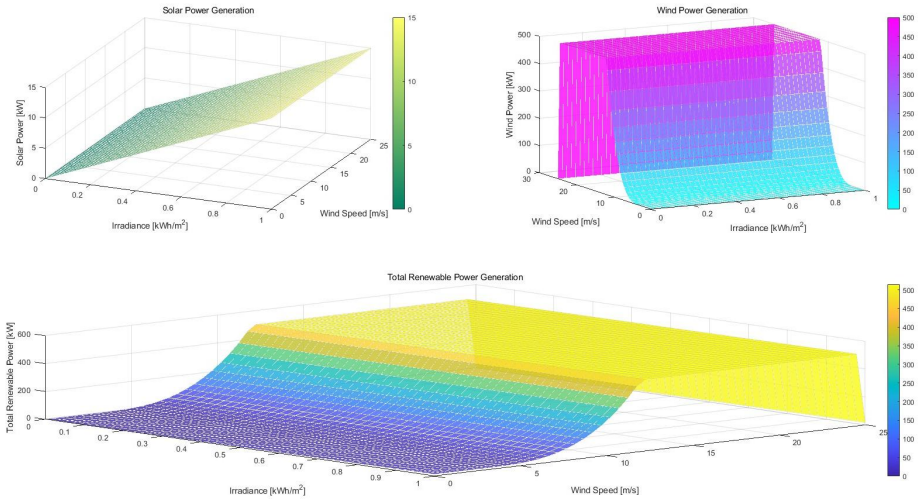
- [Section III, Eq. (32)-(33), and Section IV.A] The fitted linear model reported in Section IV.A is Ptotal = -166.3272 + 15*Irr + 51.7979*v - 0.047*v^3, which the text identifies as 'total renewable power output.' This is a generation model, not the consumption model G of Eq. (32): it has no polar-strength term and it includes irradiance, which Eq. (32) does not. The coefficients gamma1-gamma4 of Eq. (32) are never reported, and the text never states that the bottom-left Energy Cost Map (kWh/km) in Fig. 6 was computed from Gpred in Eq. (33) rather than from -Ptotal, Ptotal, or some other transform. Since every algorithm in Figs. 7-8 is scored on this same undisclosed map, the reported energy totals cannot be independently verified, and the central energy-efficiency claim is unsupported.
- [Section IV.B, Figs. 7-8, Eq. (17) and Eq. (37)] The planner's ACO cost J in Eq. (17) and the MPC cost in Eq. (37) both use the same energy cost map E / Gpred that is later used to compute the reported cumulative energy totals in Figs. 7-8. This makes the evaluation self-referential: the planner is rewarded for reducing the very quantity used as the evaluation metric. A meaningful comparison would require an independent energy evaluation, such as a high-fidelity ship dynamics simulator, measured propulsion data, or at least a holdout map not available to the planner. As it stands, the 'lowest cumulative energy' claim is an artifact of the cost definition.
- [Section IV.A and Fig. 3] The abstract, the Introduction, and Fig. 2 repeatedly state that the model is derived from 'real-world data,' but Section IV.A explicitly says that Fig. 3 is based on 'HOMER-generated synthetic resource datasets.' HOMER-generated data are simulated, not measured. This misrepresentation matters because the external validity of the energy model is the basis of the claimed practical relevance of the results.
- [Section IV.B, Figs. 7-8] All comparisons are single runs without repetitions, standard deviations, confidence intervals, or sensitivity analysis. Since ACO is a stochastic algorithm, a single trajectory cannot support the statement that the proposed approach 'significantly outperforms' the baselines. Furthermore, several baselines (direct path, wind-first, combined path, WOA-ACO, and WOA-MPC) are reported as colliding with the obstacles; these are unconstrained or rule-based methods, so the collision comparison does not demonstrate that ACO-MPC is collision-free in a meaningfully harder or fairer setting.
- [Section III, Eqs. (34)-(38)] The MPC layer for battery dispatch is formulated in Eqs. (34)-(38) but is never evaluated. The results contain no state-of-charge trajectories, charging/discharging commands, backup power usage, or battery cycling data. Therefore the abstract's claim about optimizing 'renewable utilization, battery cycling, and backup power usage' is unsupported by the experiments, and the actual contribution reduces to an ACO path search on a given static cost map.
minor comments (7)
- [Abstract] The abstract supplied with the manuscript (the passage beginning 'Automated driving on ramps...') describes a different problem and should be replaced with the maritime navigation abstract that appears in the body of the paper.
- [Introduction] The Introduction contains two inconsistent 'remainder of this paper' paragraphs; the first announces a related-work Section II that does not exist in the manuscript.
- [Fig. 3 caption] The caption of Fig. 3 says 'hourly velocity of the ship' while the surrounding text discusses wind speed; the caption should be corrected.
- [Table I and Eq. (37)] Table I lists the cost weights cbat and cbackup used in Eq. (37) but their numerical values are never given; the table also lists a fixed wind speed of 8 m/s, which conflicts with the spatially varying wind map in Fig. 6.
- [Section IV.B] The opening sentence of Section IV.B refers to the proposed method as 'EG-MPC,' while the rest of the paper calls it ACO-MPC; the typo should be fixed.
- [Figs. 7-8 legends] The legend entry 'WOCA-ACO MPC' is inconsistent with 'WOA-ACO Hybrid MPC' used in Section IV.B; the acronym should be unified.
- [Eq. (37)] The term trace(Gpred(P(t))) is not clearly defined for a path-indexed matrix; the notation should be clarified so that the summed energy along the path is unambiguous.
Circularity Check
Headline energy totals are sums over the same fitted cost map that the planner minimizes, making the efficiency comparison self-referential.
-
fitted input called prediction
[Section III Eqs. (32)-(33) and (37); Algorithm 1 step 17; Section IV.B Figs. 6-8 (Fig. 7 caption)]
"G_pred = γ1 R_pol + γ2 V_wind + γ3 V_wind^(3) + γ4 1, (33) ... J = Σ_{t=0}^{N−1} [c_bat P_dis(t)+c_backup P_backup(t)+trace(G_pred(P(t)))] (37) ... our proposed approach achieves the lowest feasible cost at 51.775 kWh."
The fitted linear surrogate G_pred is inserted directly into the MPC objective (Eq. 37) via trace(G_pred(P(t))), and Algorithm 1's cost J is the sum of the energy map E along the path (step 17). The 'total energy cost' reported in Figs. 7-8 is the same accumulated map value, so the headline 51.775 kWh / 49.221 kWh is the value of the very function being minimized, not an independent measurement. The energy-efficiency claim therefore reduces to self-evaluation on the fitted cost map; unless the map is externally validated, 'lowest cumulative energy' is true only by construction of the objective.
-
fitted input called prediction
[Section IV.A, Fig. 3 caption and Fig. 5 caption; fitted equation following Fig. 5]
"The linear model Ptotal =−166.3272 + 15× Irr + 51.7979×v− 0.047×v3 provides an accurate approximation ... As illustrated in Fig. 5, the model’s predictions closely track real-world measurements across a range of typical operating conditions. (Fig. 3 caption:) The hourly velocity of the ship over 12 months based on HOMER-generated synthetic resource datasets."
The coefficients are obtained by least-squares regression on the HOMER-generated data, and Fig. 5 compares the fitted model with that same 'original data.' Calling the agreement 'predictions closely track measurements' presents an in-sample fit as predictive validation. The caption also labels the data synthetic, contradicting the 'real-world data' framing. This is a secondary circularity: the fitted model's accuracy is assessed on its own training input rather than on any held-out or physical measurement.
full rationale
The main circular step is evaluation-on-the-objective: Eq. (32)-(33) define a fitted energy map G_pred, Eq. (37) puts trace(G_pred(P(t))) inside the MPC objective, Algorithm 1 optimizes J = Σ E, and Figs. 7-8 report the accumulated map value as the headline 'total energy cost.' Thus the energy comparison is self-referential with respect to the fitted surrogate. It is only partial circularity because the comparison of search algorithms over the shared surrogate is a genuine optimization benchmark, and the ACO/MPC mechanics themselves are not defined in terms of the outcome. A secondary in-sample validation appears in Section IV.A/Fig. 5, where the least-squares model is judged against the same HOMER-generated data used for fitting. The self-citations [1]-[4] are background related-work citations and are not load-bearing, so no self-citation or imported-uniqueness circularity is present. The 'real-world data' claim in the abstract versus 'HOMER-generated synthetic' in Fig. 3 is a provenance/correctness concern, not a derivation-circularity one; it reinforces but does not replace the self-referential evaluation finding. Score 6 reflects partial circularity: the central energy-efficiency prediction reduces to the fitted objective, while algorithmic feasibility/collision-avoidance comparisons retain independent content.
Assumptions & free parameters
free parameters (6)
- gamma1 (coefficient for polar strength in Eq. 32) =
not reported; model in Section IV.A uses 15 for irradiance
- gamma2 (coefficient for wind speed) =
51.7979
- gamma3 (coefficient for wind speed cubed) =
-0.047
- gamma4 (intercept) =
-166.3272
- ACO and MPC hyperparameters =
not reported
- cbat, cbackup (cost weights in Eq. 37) =
not reported
assumptions (6)
- ad hoc to paper Energy consumption per unit distance is a linear function of polar strength, wind speed, and wind speed cubed.
- ad hoc to paper HOMER-generated synthetic resource datasets are representative of real-world maritime renewable conditions.
- domain assumption The ship moves on a grid using only eight discrete directions, with no kinematic constraints.
- domain assumption Obstacles are static and perfectly known through the binary matrix O.
- domain assumption Battery dynamics are linear with constant charging and discharging efficiencies.
- standard math Standard ant colony pheromone update equations hold.
invented entities (1)
-
polar strength map Rpol
Cite this review
Pith. "Pith review of An ACO-MPC Framework for Energy-Efficient and Collision-Free Path Planning in Autonomous Maritime Navigation." pith.science (2026). https://pith.science/paper/I7PVLSSA
@misc{pith2026250415611,
  author       = {Pith},
  title        = {Pith review of: An ACO-MPC Framework for Energy-Efficient and Collision-Free Path Planning in Autonomous Maritime Navigation},
  year         = {2026},
  howpublished = {\url{https://pith.science/paper/I7PVLSSA}},
  note         = {Machine review of arXiv:2504.15611}
}
read the original abstract
Automated driving on ramps presents significant challenges due to the need to balance both safety and efficiency during lane changes. This paper proposes an integrated planner for automated vehicles (AVs) on ramps, utilizing an unsatisfactory level metric for efficiency and arrow-cluster-based sampling for safety. The planner identifies optimal times for the AV to change lanes, taking into account the vehicle's velocity as a key factor in efficiency. Additionally, the integrated planner employs arrow-cluster-based sampling to evaluate collision risks and select an optimal lane-changing curve. Extensive simulations were conducted in a ramp scenario to verify the planner's efficient and safe performance. The results demonstrate that the proposed planner can effectively select an appropriate lane-changing time point and a safe lane-changing curve for AVs, without incurring any collisions during the maneuver.
Figures


Figures from the paper (6 more)



Reference graph
Works this paper leans on
-
[1]
Enhanced visual slam for collision-free driving with lightweight autonomous cars,
Z. Lin, Z. Tian, Q. Zhang, H. Zhuang, and J. Lan, “Enhanced visual slam for collision-free driving with lightweight autonomous cars,” Sensors, vol. 24, no. 19, p. 6258, 2024
2024
-
[2]
Z. Lin, Z. Tian, Q. Zhang, Z. Ye, H. Zhuang, and J. Lan, “A conflicts- free, speed-lossless kan-based reinforcement learning decision system for interactive driving in roundabouts,”arXiv preprint arXiv:2408.08242, 2024
arXiv 2024
-
[3]
Balanced reward-inspired reinforcement learning for autonomous vehicle racing,
Z. Tian, D. Zhao, Z. Lin, D. Flynn, W. Zhao, and D. Tian, “Balanced reward-inspired reinforcement learning for autonomous vehicle racing,” in 6th Annual Learning for Dynamics & Control Conference . PMLR, 2024, pp. 628–640
work page 2024
-
[4]
Z. Tian, D. Zhao, Z. Lin, W. Zhao, D. Flynn, Y . Jiang, D. Tian, Y . Zhang, and Y . Sun, “Efficient and balanced exploration-driven decision making for autonomous racing using local information,” IEEE Transactions on Intelligent Vehicles, pp. 1–17, 2024
work page 2024
-
[5]
Research on autonomous robots navigation based on reinforcement learning,
Z. Wang, H. Yan, Z. Wang, Z. Xu, Z. Wu, and Y . Wang, “Research on autonomous robots navigation based on reinforcement learning,” in 2024 3rd International Conference on Robotics, Artificial Intelligence and Intelligent Control (RAIIC) . IEEE, 2024, pp. 78–81
work page 2024
-
[6]
F. A. Leite, E. Lopes-Silva, J. Diaz-Amado, C. Lima, C. S. Libarino, P. N. Trujillo, and J. E. Marques, “A robocentric paradigm for enhanced social navigation in autonomous robotic: a use case for an autonomous wheelchair,” in 2024 IEEE International Conference on Autonomous Robot Systems and Competitions (ICARSC) . IEEE, 2024, pp. 112–119
work page 2024
-
[7]
Field experiment of autonomous ship navigation in canal and surrounding nearshore environments,
J. Kim, C. Lee, D. Chung, Y . Cho, J. Kim, W. Jang, and S. Park, “Field experiment of autonomous ship navigation in canal and surrounding nearshore environments,” Journal of Field Robotics , vol. 41, no. 2, pp. 470–489, 2024
work page 2024
-
[8]
Au- tonomous ship navigation with an enhanced safety collision avoidance technique,
H. Ali, G. Xiong, Q. Tianci, R. Kumar, X. Dong, and Z. Shen, “Au- tonomous ship navigation with an enhanced safety collision avoidance technique,” ISA transactions, vol. 144, pp. 271–281, 2024
work page 2024
Show all 24 references
-
[9]
Investigating off-grid energy solutions for the salmon farming industry,
H. L. Syse, “Investigating off-grid energy solutions for the salmon farming industry,” University of Strathclyde: Glasgow, UK , 2016
2016
-
[10]
Profit and loss dynamics of aquaculture farming,
P. Saha, M. E. Hossain, M. M. H. Prodhan, M. T. Rahman, M. Nielsen, and M. A. Khan, “Profit and loss dynamics of aquaculture farming,” Aquaculture, vol. 561, p. 738619, 2022
2022
-
[11]
Green urban mobility with autonomous electric ferries: Studies of simulated maritime collisions using adaptive stress testing,
J.-M. Vatle, B.-O. H. Eriksen, and O. J. Mengshoel, “Green urban mobility with autonomous electric ferries: Studies of simulated maritime collisions using adaptive stress testing,” Swedish Artificial Intelligence Society, pp. 47–56, 2024
2024
-
[12]
The pompeii column: The lost monument of istanbul
E. K. Ates ¸ and N. Yılmaz, “The pompeii column: The lost monument of istanbul.” Journal of History, Culture & Art Research/Tarih K ¨ult¨ur ve Sanat Arastirmalari Dergisi , vol. 13, no. 1, 2024
2024
-
[13]
A review on motion prediction for intelligent ship navigation,
D. Zhang, X. Chu, C. Liu, Z. He, P. Zhang, and W. Wu, “A review on motion prediction for intelligent ship navigation,” Journal of Marine Science and Engineering , vol. 12, no. 1, p. 107, 2024
2024
-
[14]
Computational fluid dynamics-based ship energy-saving technologies: A comprehensive review,
K. Wang, Z. Li, R. Zhang, R. Ma, L. Huang, Z. Wang, and X. Jiang, “Computational fluid dynamics-based ship energy-saving technologies: A comprehensive review,” Renewable and Sustainable Energy Reviews , vol. 207, p. 114896, 2025
2025
-
[15]
A review of path planning methods for marine autonomous surface vehicles,
Y . Wu, T. Wang, and S. Liu, “A review of path planning methods for marine autonomous surface vehicles,” Journal of Marine Science and Engineering, vol. 12, no. 5, p. 833, 2024
2024
-
[16]
A review on recent size optimization methodologies for standalone solar and wind hybrid renewable energy system,
M. D. Al-Falahi, S. Jayasinghe, and H. Enshaei, “A review on recent size optimization methodologies for standalone solar and wind hybrid renewable energy system,” Energy conversion and management , vol. 143, pp. 252–274, 2017
2017
-
[17]
Electrical power supply of remote maritime areas: A review of hybrid systems based on marine renewable energies,
A. Roy, F. Auger, F. Dupriez-Robin, S. Bourguet, and Q. T. Tran, “Electrical power supply of remote maritime areas: A review of hybrid systems based on marine renewable energies,” Energies, vol. 11, no. 7, p. 1904, 2018
1904
-
[18]
Model predictive control,
B. Kouvaritakis and M. Cannon, “Model predictive control,” Switzer- land: Springer International Publishing , vol. 38, pp. 13–56, 2016
2016
-
[19]
Review on model predic- tive control: An engineering perspective,
M. Schwenzer, M. Ay, T. Bergs, and D. Abel, “Review on model predic- tive control: An engineering perspective,” The International Journal of Advanced Manufacturing Technology , vol. 117, no. 5, pp. 1327–1349, 2021
2021
-
[20]
Recent meta-heuristics improved by self-adaptation applied to nonlinear model-based predictive control,
E. D. M. Mesquita, R. C. Sampaio, H. V . H. Ayala, and C. H. Llanos, “Recent meta-heuristics improved by self-adaptation applied to nonlinear model-based predictive control,” IEEE Access , vol. 8, pp. 118 841– 118 852, 2020
2020
-
[21]
A survey on new generation metaheuristic algorithms,
T. Dokeroglu, E. Sevinc, T. Kucukyilmaz, and A. Cosar, “A survey on new generation metaheuristic algorithms,” Computers & Industrial Engineering, vol. 137, p. 106040, 2019
2019
-
[22]
Ant colony optimization,
M. Dorigo, M. Birattari, and T. Stutzle, “Ant colony optimization,” IEEE computational intelligence magazine , vol. 1, no. 4, pp. 28–39, 2007
2007
-
[23]
Obstacle avoidance for ship navigation safety combining heuristic search algorithm and improved aco algorithm,
D. Wang and Y . Jing, “Obstacle avoidance for ship navigation safety combining heuristic search algorithm and improved aco algorithm,” Archives of Transport, vol. 72, no. 4, pp. 75–88, 2024
2024
-
[24]
Exploring the application of ant colony optimization in path planning for unmanned surface vehicles,
H. Heng, M. H. M. Ghazali, and W. Rahiman, “Exploring the application of ant colony optimization in path planning for unmanned surface vehicles,” Ocean Engineering, vol. 311, p. 118738, 2024
2024
Reviewed August 16, 2026 · model on record in the stance chip above.
Discussion (0). Continue with ORCID to comment.