REVIEW 3 major objections 5 minor 51 references
EEG models trained to predict latent neural states from structured context transfer better than models trained to reconstruct raw waveforms, raising frozen-task accuracy from 40.5% to 50.4% on the same backbone, corpus, and training budget.
Reviewed by Pith at T0; open to challenge. T0 means a machine referee read the full paper against a public rubric. the ladder, T0–T4 →
T0 review · deepseek-v4-flash
2026-08-04 00:35 UTC pith:IAHRZYYA
load-bearing objection Worth refereeing; the controlled objective comparisons are solid, but the headline frozen gain needs a subject-level de-duplication check before the causal story holds. the 3 major comments →
EEG-JEPA: Structured Latent Prediction for EEG Foundation Models
The pith
A machine-rendered reading of the paper's core claim, the machinery that carries it, and where it could break.
Core claim
The central claim is that latent prediction is a strictly better pretext task than masked waveform reconstruction for EEG transfer. EEG-JEPA masks structured electrode–time regions (N-MET: temporal stripes, channel stripes, local blocks, topo-pair stripes, full-channel and full-topo pairs), feeds the visible context through an encoder, and trains a predictor to recover the target encoder's full-input contextual representation at those masked locations—with the target encoder updated by exponential moving average and supervision applied at layers 3, 6, 9, and 12. Under controlled comparison (same backbone, corpus, and duration), this objective raises the 14-task frozen macro balanced accuracy
What carries the argument
Three coupled design choices carry the argument: (1) target content—an EMA target encoder observing the complete crop produces stop-gradient contextual targets, so prediction is of latent states, not voltage; (2) target support—N-MET, a mixture of six electrode–time masking primitives (temporal stripes at 35%, channel stripes 17.5%, local blocks 17.5%, topo-pair stripes 10%, full channel 15%, full topo-pair 5%) that forces inference across temporal continuity, focal activity, regional fields, bilateral correspondence, and sensor loss; (3) target depth—hierarchical prediction of L3, L6, L9, and final-layer targets from fused multi-depth context, with a shared predictor trunk and separate head
Load-bearing premise
All conclusions rest on the frozen-transfer yardstick: balanced accuracy of mean-pooled token features fed to dataset-specific MLP heads on 14 EEG-FM-Bench tasks; if that protocol rewards dataset-specific statistics or the tasks are not representative, the 10-point gap does not establish general transferability.
What would settle it
Train the exact same CBraMod-style masked-reconstruction objective with N-MET structured masking and multi-depth supervision (predict raw waveform patches at L3, L6, L9, and L12 with the same predictor). If its 14-task frozen balanced accuracy under the matched Stage-1 protocol reaches about 50%, the paper's attribution of the gains to latent content is wrong; if it stays near 40.5%, the latent-target claim is confirmed. A second check: evaluate the released Stage-1 EEG-JEPA checkpoint on a task that demands precise transient timing (e.g., spike detection)—if reconstruction-trained models clea
If this is right
- EEG pretraining objectives can be compared cleanly: the same backbone, corpus, and duration produce a 9.93-point swing in frozen transfer, so future pretraining efforts should treat the objective, not scale alone, as the main lever.
- Intermediate encoder prefixes become usable as smaller models: L3/L6/L9 prefixes, without retraining, give 48.87/49.06/49.70 macro balanced accuracy vs 40.49 for the parameter-matched reconstruction encoder.
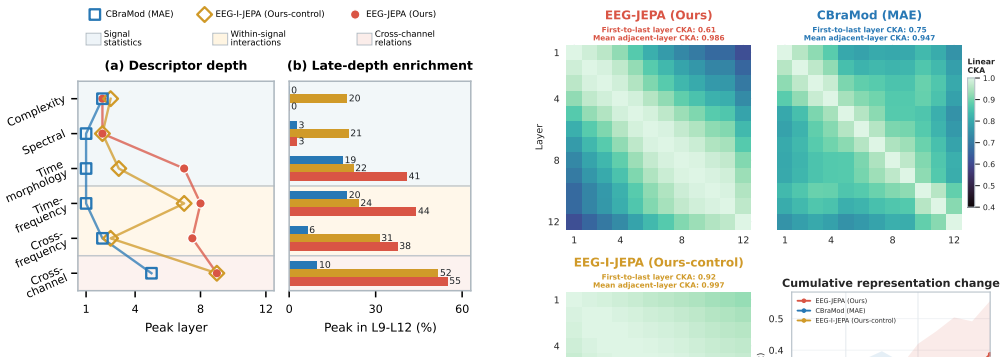
- Representations from latent prediction organize by depth: cross-channel and within-signal interactions peak in deep layers (54.8% and 41.5% of late-layer peaks), a concrete signature that future benchmarks can probe.
- Latent prediction with structured support transfers across clinical, sleep, motor-imagery, affective, workload, seizure, depression, and visual tasks under a frozen encoder, demonstrating that one pretrained model can cover heterogeneous EEG applications.
- Multi-source continuation (TUEG plus TDBRAIN plus HBN) adds a further 2.52 points, suggesting corpus diversity and latent prediction compound.
Where Pith is reading between the lines
- If the claim holds, the structured-masking and depth-supervision components can be tested in isolation on a raw-waveform predictor: if those two changes alone close most of the gap, the attribution to latent content is weaker than the paper's ablation implies.
- The ridge-probe depth signature could be recycled as a cheap screening metric for future EEG pretraining runs: a model whose cross-channel descriptors peak in shallow layers likely transfers worse to multi-channel classifiers.
- A 10-point frozen-transfer gain, if replicated, would make latent prediction the default objective for large EEG corpora and would let downstream applications use a single frozen encoder with task-specific heads rather than per-task fine-tuning.
- The paper does not isolate the EMA stabilizer itself: the 0.33-point gain over an independently optimized target encoder is small, so most of the effect must come from content, support, and depth—but the independent-encoder control still updates on the same data; a fixed random target encoder would further clarify how much of the EMA design matters.
Editorial analysis
A structured set of objections, weighed in public.
Referee Report
Summary. The paper presents EEG-JEPA, a latent-prediction objective for EEG foundation models. The central design is a masked context encoder plus predictor that infers EMA-derived contextual targets at selected electrode–time locations (N-MET), with supervision at four encoder depths. Under a controlled Stage-1 setting (same CBraMod backbone, TUEG corpus, and 100 epochs), it reports raising the 14-task frozen macro balanced accuracy from 40.49±0.32 (masked waveform reconstruction) to 50.42±0.58, and after two-stage continuation to 52.94±0.30, which it claims is the highest among EEG foundation models on EEG-FM-Bench. Protocol-matched full fine-tuning on nine tasks improves the average BA from 68.98 to 70.65. The paper also provides layerwise probe and CKA analyses to support the claim of selective deep organization of interaction and cross-channel information.
Significance. If the controlled improvement is causal, the paper makes a strong contribution: it cleanly isolates objective design from architecture, corpus, and training duration, provides a systematic ablation over target content, support, and depth, and releases code. The progressive ablations and the parameter-efficient depth-prefix results are useful for practitioners. However, two load-bearing gaps—possible subject/record overlap between pretraining and benchmark evaluation, and the undefined context-consistency loss—prevent the central causal claim from being accepted at face value.
major comments (3)
- [Pretraining Setup / Data Preprocessing (Tables 2 and 4)] The manuscript does not state whether subjects or records are disjoint between the TUEG pretraining corpus and the TUAB/TUEV tasks in EEG-FM-Bench, even though all derive from the Temple University Hospital corpus. Stage 1 trains on all 39,758 TUEG records; Stage 2 additionally uses TDBRAIN and HBN, which may overlap with seizure/sleep tasks. If TUAB/TUEV test records or subjects are included in pretraining, the frozen MLP heads can exploit subject- or record-specific signatures rather than transferable neural structure, inflating the 10-point controlled gain and the 52.94% 'highest average' claim. Please report the exact de-duplication procedure (subject-level split, record exclusion, or overlap statistics) for both stages, and rerun on disjoint data if overlaps exist.
- [Training Objective (Eqs. 5–7), Figure 3] Table 6 and Figure 3 attribute a 'context consistency' loss with part of the improvement (50.13 → 50.42), but Eqs. (5)–(7) only define L_latent and L_VCReg. No equation or prose defines the context-consistency term L_ctx, its weighting λ_ctx, or its inputs. Without a precise definition, the ablation component is unreproducible and its contribution cannot be verified. Please add the full expression and clarify how it is combined with L_latent.
- [Main Results, Table 3] Table 3 reports frozen macro BAs without error bars or statistical significance, including the margins over EEGPT (52.94 vs 52.15) and REVE (52.94 vs 51.50) that are smaller than the reported run-to-run variation of the full model (±0.30 in Table 6). It is also not stated whether the external baselines were re-run under the identical frozen protocol or taken from earlier papers. The 'highest average' claim should be supported by per-task uncertainties and a clear statement of which numbers were recomputed in this paper.
minor comments (5)
- [Appendix / Supplementary] The text repeatedly refers to an appendix/supplementary for preprocessing details and task-level results, but no such material is included in the submitted manuscript. Please provide it or indicate where it is available.
- [Table 2 caption] Typo: 'trainnig' should be 'training'.
- [Full fine-tuning comparison] It is ambiguous which baseline numbers in Table 5 were re-run under the same protocol versus taken from the literature. The sentence 'External baseline results are taken from REVE' should be expanded to specify the source for each baseline and confirm protocol matching.
- [Parameter-efficient transfer] The discussion of L3/L6/L9 prefixes compares them against the full CBraMod encoder, which is parameter-matched only to the full EEG-JEPA model. Clarify that the prefixes are not parameter-matched to CBraMod and that the comparison is about efficiency of the same pretrained encoder.
- [Evaluation Protocol] All transfer conclusions rest on the frozen mean-pooled linear-head protocol on 14 selected tasks. The paper could usefully acknowledge that this protocol is one particular yardstick and discuss how the conclusions might change under alternative readouts or task distributions.
Circularity Check
No load-bearing circularity: pretraining targets are EMA latent states from raw EEG, downstream labels never enter the objective, and the central gain is quantified by matched objective comparisons.
full rationale
EEG-JEPA's derivation chain does not reduce to its inputs. The pretraining target (Eq. 1) is a stop-gradient, layer-normalized latent state from an EMA target encoder that sees the complete raw EEG crop; the context encoder sees the N-MET-masked crop (Eq. 2), and the predictor maps visible context plus a positional query to that latent state (Eqs. 3-5). No downstream label or benchmark score is used to construct the target, so the model is not predicting a quantity that was fitted from the evaluation metric. The main claim (40.49 -> 50.42, and 52.94 with two-stage continuation) is supported by matched comparisons in Table 6: all variants share the same backbone, TUEG corpus, and training duration, and the ablation progression changes only the objective (random-block latent target, N-MET support, multi-level prediction, context consistency, VCReg). That is an empirical causal comparison, not a tautology. The self-citations present (e.g., Ma et al. 2026 for multi-scale EEG structure; possibly Xiong et al. 2025 for EEG-FM-Bench) are contextual or evaluative rather than load-bearing arguments; no uniqueness theorem or ansatz is imported from the authors' prior work to force the design. Concerns that remain -- no explicit subject-level split between TUEG pretraining and TUAB/TUEV evaluation, and the possibility that design choices were tuned on the same benchmark -- are data-hygiene and generalization risks, not circular reductions; the matched CBraMod baseline is exposed to the same pretraining corpus and evaluation protocol.
Axiom & Free-Parameter Ledger
free parameters (6)
- N-MET primitive mass weights =
35% temporal stripe; 17.5% channel stripe; 17.5% local block; 10% topo-pair stripe; 15% full channel; 5% full topo-pair
- Masking ratio range =
40–55% of valid tokens
- Supervised depth set D =
{3, 6, 9, 12}
- Loss weights λ_var, λ_cov (and context/depth weights in Fig. 3) =
Not specified numerically
- EMA momentum / target update rate =
Not reported
- Stage-2 corpus mixture weights =
75% TUEG / 15% TDBRAIN / 10% HBN
axioms (6)
- domain assumption Unlabeled EEG contains reusable neural structure that is better captured by predicting latent states than by reconstructing raw samples.
- domain assumption Structured electrode–time masking (N-MET) creates prediction problems that teach temporal, spatial, bilateral, and sensor-robust transferable features.
- domain assumption An EMA target encoder provides stable contextual targets and avoids collapse.
- domain assumption Frozen macro balanced accuracy on EEG-FM-Bench with jointly trained dataset-specific heads measures representation transferability.
- domain assumption CBraMod's 19-channel tokenization and spatio-temporal encoder is a fair common substrate for comparing objectives.
- domain assumption VCReg on predictor outputs prevents collapse without distorting learned representations.
read the original abstract
Electroencephalography (EEG) foundation models aim to learn reusable representations from large-scale unlabeled recordings. A common pretraining strategy is masked waveform reconstruction, but applying supervision directly to noisy EEG may encourage models to recover predictable background activity, acquisition effects, and artifacts rather than neural structure that transfers across tasks. This raises a central question: what should an EEG foundation model predict to learn transferable representations? We introduce EEG-JEPA a structured latent-prediction framework for EEG foundation modeling. Rather than reconstructing masked voltage samples, a masked context encoder and predictor infer contextual latent states produced by an exponential-moving-average target encoder that observes the complete input. EEG-JEPA organizes target design along three complementary dimensions: target content specifies what representation is predicted, target support specifies where prediction occurs over structured electrode--time regions through Neurotopology-Aware Multi-scale Electrode-Temporal Masking (N-MET), and target depth specifies at which encoder layers supervision is applied. Together, these designs shift EEG pretraining from recovering missing measurements to inferring latent states from structured electrode--time context. We evaluate EEG-JEPA through controlled objective comparisons, frozen multitask transfer, and full fine-tuning. Under the same backbone, pretraining corpus, and training duration, EEG-JEPA improves the 14-task frozen macro balanced accuracy from 40.49% to 50.42% over CBraMod-style masked waveform reconstruction. Multi-source continuation further raises this result to 52.94%, the highest average among the EEG foundation models evaluated on EEG-FM-Bench. Under protocol-matched full fine-tuning, EEG-JEPA also improves the nine-task average balanced accuracy from 68.98% to 70.65%.
Figures


Reference graph
Works this paper leans on
-
[1]
Journal of neural engineering , volume=
A review of classification algorithms for EEG-based brain--computer interfaces: a 10 year update , author=. Journal of neural engineering , volume=. 2018 , publisher=
2018
-
[2]
International conference on learning representations , volume=
NeuroLM: A universal multi-task foundation model for bridging the gap between language and EEG signals , author=. International conference on learning representations , volume=
-
[3]
Proceedings of the 30th ACM SIGKDD Conference on Knowledge Discovery and Data Mining , pages=
Eeg2rep: enhancing self-supervised eeg representation through informative masked inputs , author=. Proceedings of the 30th ACM SIGKDD Conference on Knowledge Discovery and Data Mining , pages=
-
[4]
Frontiers in human neuroscience , volume=
Systems, subjects, sessions: to what extent do these factors influence EEG data? , author=. Frontiers in human neuroscience , volume=. 2017 , publisher=
2017
-
[5]
Sensors , volume=
Removal of artifacts from EEG signals: a review , author=. Sensors , volume=. 2019 , publisher=
2019
-
[6]
Clinical neurophysiology , volume=
Event-related EEG/MEG synchronization and desynchronization: basic principles , author=. Clinical neurophysiology , volume=. 1999 , publisher=
1999
-
[7]
Electroencephalography and clinical Neurophysiology , volume=
Talking off the top of your head: toward a mental prosthesis utilizing event-related brain potentials , author=. Electroencephalography and clinical Neurophysiology , volume=. 1988 , publisher=
1988
-
[8]
arXiv preprint arXiv:2604.18095 , year=
Dsainet: An efficient dual-scale attentive interaction network for general eeg decoding , author=. arXiv preprint arXiv:2604.18095 , year=
-
[9]
arXiv preprint arXiv:1807.03748 , year=
Representation learning with contrastive predictive coding , author=. arXiv preprint arXiv:1807.03748 , year=
-
[10]
Proceedings of the International Conference on Machine Learning , year =
A Simple Framework for Contrastive Learning of Visual Representations , author =. Proceedings of the International Conference on Machine Learning , year =
-
[11]
Proceedings of the IEEE/CVF Conference on Computer Vision and Pattern Recognition , year =
Momentum Contrast for Unsupervised Visual Representation Learning , author =. Proceedings of the IEEE/CVF Conference on Computer Vision and Pattern Recognition , year =
-
[12]
Advances in Neural Information Processing Systems , year =
Bootstrap Your Own Latent: A New Approach to Self-Supervised Learning , author =. Advances in Neural Information Processing Systems , year =
-
[13]
Proceedings of the IEEE/CVF International Conference on Computer Vision , year =
Emerging Properties in Self-Supervised Vision Transformers , author =. Proceedings of the IEEE/CVF International Conference on Computer Vision , year =
-
[14]
Proceedings of the International Conference on Machine Learning , year =
Barlow Twins: Self-Supervised Learning via Redundancy Reduction , author =. Proceedings of the International Conference on Machine Learning , year =
-
[15]
Bardes, Adrien and Ponce, Jean and LeCun, Yann , booktitle =
-
[16]
Proceedings of the International Conference on Machine Learning , year =
Extracting and Composing Robust Features with Denoising Autoencoders , author =. Proceedings of the International Conference on Machine Learning , year =
-
[17]
Devlin, Jacob and Chang, Ming-Wei and Lee, Kenton and Toutanova, Kristina , booktitle =
-
[18]
Bao, Hangbo and Dong, Li and Piao, Songhao and Wei, Furu , booktitle =
-
[19]
Proceedings of the IEEE/CVF Conference on Computer Vision and Pattern Recognition , year =
Masked Autoencoders Are Scalable Vision Learners , author =. Proceedings of the IEEE/CVF Conference on Computer Vision and Pattern Recognition , year =
-
[20]
Xie, Zhenda and Zhang, Zheng and Cao, Yue and Lin, Yutong and Bao, Jianmin and Yao, Zhuliang and Dai, Qi and Hu, Han , booktitle =
-
[21]
Proceedings of the IEEE/CVF Conference on Computer Vision and Pattern Recognition , year =
Self-Supervised Learning from Images with a Joint-Embedding Predictive Architecture , author =. Proceedings of the IEEE/CVF Conference on Computer Vision and Pattern Recognition , year =
-
[22]
Advances in Neural Information Processing Systems , year =
Unsupervised Scalable Representation Learning for Multivariate Time Series , author =. Advances in Neural Information Processing Systems , year =
-
[23]
Proceedings of the ACM SIGKDD Conference on Knowledge Discovery and Data Mining , year =
A Transformer-Based Framework for Multivariate Time Series Representation Learning , author =. Proceedings of the ACM SIGKDD Conference on Knowledge Discovery and Data Mining , year =
-
[24]
Proceedings of the International Joint Conference on Artificial Intelligence , year =
Time-Series Representation Learning via Temporal and Contextual Contrasting , author =. Proceedings of the International Joint Conference on Artificial Intelligence , year =
-
[25]
Yue, Zhihan and Wang, Yujing and Duan, Juanyong and Yang, Tian and Huang, Congrui and Tong, Yunhai and Xu, Bixiong , booktitle =
-
[26]
Uncovering the Structure of Clinical
Banville, Hubert and Chehab, Omar and Hyv. Uncovering the Structure of Clinical. Journal of Neural Engineering , volume =
-
[27]
Machine learning for health , pages=
Contrastive representation learning for electroencephalogram classification , author=. Machine learning for health , pages=. 2020 , organization=
2020
-
[28]
Frontiers in Human Neuroscience , volume =
Kostas, Demetres and Aroca-Ouellette, St. Frontiers in Human Neuroscience , volume =
-
[29]
Brandon and Sun, Jimeng , booktitle =
Yang, Chaoqi and Westover, M. Brandon and Sun, Jimeng , booktitle =
-
[30]
Large Brain Model for Learning Generic Representations with Tremendous
Jiang, Wei-Bang and Zhao, Li-Ming and Lu, Bao-Liang , booktitle =. Large Brain Model for Learning Generic Representations with Tremendous
-
[31]
Advances in Neural Information Processing Systems , volume=
Eegpt: Pretrained transformer for universal and reliable representation of eeg signals , author=. Advances in Neural Information Processing Systems , volume=
-
[32]
Wang, Jiquan and Zhao, Sha and Luo, Zhiling and Zhou, Yangxuan and Jiang, Haiteng and Li, Shijian and Li, Tao and Pan, Gang , booktitle =
-
[33]
Zhou, Yuchen and Wu, Jiamin and Ren, Zichen and Yao, Zhouheng and Lu, Weiheng and Peng, Kunyu and Zheng, Qihao and Song, Chunfeng and Ouyang, Wanli and Gou, Chao , journal =
-
[34]
Advances in Neural Information Processing Systems , volume =
El Ouahidi, Yassine and Lys, Jonathan and Th. Advances in Neural Information Processing Systems , volume =
-
[35]
arXiv preprint arXiv:2508.17742 , year=
Eeg-fm-bench: A comprehensive benchmark for the systematic evaluation of eeg foundation models , author=. arXiv preprint arXiv:2508.17742 , year=
-
[36]
Circulation , volume =
PhysioBank, PhysioToolkit, and PhysioNet: Components of a New Research Resource for Complex Physiologic Signals , author =. Circulation , volume =
-
[37]
and Hinterberger, Thilo and Birbaumer, Niels and Wolpaw, Jonathan R
Schalk, Gerwin and McFarland, Dennis J. and Hinterberger, Thilo and Birbaumer, Niels and Wolpaw, Jonathan R. , journal =
-
[38]
The Temple University Hospital
Obeid, Iyad and Picone, Joseph , journal =. The Temple University Hospital
-
[39]
Review of the
Tangermann, Michael and M. Review of the. Frontiers in Neuroscience , volume =
-
[40]
Computer Methods and Programs in Biomedicine , volume =
Khalighi, Sirvan and Sousa, Teresa and Santos, Jos. Computer Methods and Programs in Biomedicine , volume =
-
[41]
PhysioNet , year =
Haaglanden Medisch Centrum Sleep Staging Database , author =. PhysioNet , year =
-
[42]
Investigating Critical Frequency Bands and Channels for
Zheng, Wei-Long and Lu, Bao-Liang , journal =. Investigating Critical Frequency Bands and Channels for
-
[43]
A Large Finer-Grained Affective Computing
Chen, Jingjing and Wang, Xiaobin and Huang, Chen and Hu, Xin and Shen, Xinke and Zhang, Dan and others , journal =. A Large Finer-Grained Affective Computing
-
[44]
Siena Scalp
Detti, Paolo , journal =. Siena Scalp. 2020 , note =
2020
-
[45]
PLOS ONE , volume =
A Wavelet-Based Technique to Predict Treatment Outcome for Major Depressive Disorder , author =. PLOS ONE , volume =
-
[46]
and Hebart, Martin N
Grootswagers, Tijl and Zhou, Ivy and Robinson, Amanda K. and Hebart, Martin N. and Carlson, Thomas A. , journal =. Human
-
[47]
and Solon, Amelia J
Lawhern, Vernon J. and Solon, Amelia J. and Waytowich, Nicholas R. and Gordon, Stephen M. and Hung, Chou P. and Lance, Brent J. , journal =
-
[48]
Song, Yonghao and Zheng, Qingqing and Liu, Bingchuan and Gao, Xiaorong , journal =
-
[49]
Proceedings of the 39th International Conference on Machine Learning , series =
data2vec: A General Framework for Self-Supervised Learning in Speech, Vision and Language , author =. Proceedings of the 39th International Conference on Machine Learning , series =. 2022 , publisher =
2022
-
[50]
Tang, Ling and Chen, Qian and Mei, Jilin and Xu, Houshi and Zhang, Quanshi and Shao, Jing and Zou, Na and Hu, Xia and Liu, Dongrui , journal =. What Do
-
[51]
Proceedings of the 36th International Conference on Machine Learning , series =
Similarity of Neural Network Representations Revisited , author =. Proceedings of the 36th International Conference on Machine Learning , series =. 2019 , publisher =
2019
discussion (0)
Sign in with ORCID, Apple, or X to comment. Anyone can read and Pith papers without signing in.